
A dispensary owner who runs the store can earn anything from nothing to several hundred thousand dollars a year. Three things decide where you land: how much the store sells, what gross margin it keeps on product and whether federal tax rule Section 280E still applies to it. The averages are big. Illinois sold $1.51 billion of adult-use cannabis in 2025 through 277 licensed dispensaries, which works out to about $5.4 million per store (IDFPR, 2025, my calculation). Under 280E, though, a store pays federal income tax on its gross profit, not its net profit. That is why a store can lose money after tax even when it looks profitable on paper.
Short answer: I built a model from public data for an owner who also works as the store’s general manager. Under Section 280E, that owner ends up with about minus $36,000 (a loss) at $1.5 million in annual sales, about $89,000 at $4 million and about $234,000 at $6 million. If the same store is free of 280E, owner pay rises to about $105,000, $391,000 and $655,000. All figures are pre-personal-tax and include a $105,770 manager salary. No government survey reports what dispensary owners earn, so treat any single online “owner salary” figure with caution.
Below are the primary numbers that do exist: state regulator sales data, the audited results in two public cannabis companies’ 2025 10-K filings, BLS wages, the statute text of 280E and the April 2026 federal rescheduling rule. After that comes a labeled P&L you can rerun with your own sales and margin.
How much does a dispensary owner make a year? What the data can and cannot tell you
No federal dataset measures dispensary owner income. BLS wage surveys leave out business owners. The Census Bureau files “marijuana stores, medical or recreational” under NAICS 459991, which it shares with tobacco and vape shops, so no clean federal revenue count exists. The IRS does not publish cannabis returns as a separate group. What you can measure is how much a store sells, what public operators keep and what tax they pay. Each source counts something different, so read the “what it measures” column first.
| Source and year | What it measures | Figure | How it was calculated |
|---|---|---|---|
| Illinois IDFPR, 2025 | Adult-use sales per licensed dispensary (medical sales not included) | $5.44M to $6.18M | $1,506,740,853 ÷ 277 active licenses (Feb. 20, 2026 list) or ÷ 244 stores (Feb. 2025 count), my calculation |
| Massachusetts CCC, 2025 | Adult-use sales per consumer-facing license (retailers, delivery operators, microbusinesses) | $3.97M | $1.65 billion ÷ 416 licenses cleared to operate as of November 2025, my calculation |
| Trulieve 10-K, 2025 | Retail revenue per dispensary at the largest US cannabis retailer | $4.77M | $1,110.4M retail revenue ÷ 233 dispensaries, my calculation |
| Green Thumb 10-K, 2025 | Retail segment revenue per store (RISE and other stores) | $7.34M | $829.5M ÷ 113 retail locations, my calculation |
| Trulieve and Green Thumb 10-Ks, 2025 | Gross margin of vertically integrated operators (they grow what they sell) | 60.2% and 49% | Published |
| BLS OEWS, May 2025 | Median pay for general and operations managers, all industries (what you would pay someone to run your store) | $105,770 | Published |
Three things to take from this table:
- Revenue per store is in the millions, but it is an average. The state figures divide total sales by the number of licenses. A few high-volume stores pull the average up. No state I checked publishes the median store’s sales.
- The public operators’ margins are not a standalone store’s margins. Trulieve and Green Thumb grow and process most of what they sell, so their gross margin includes the cultivation markup. A store that buys all its product wholesale keeps less.
- Owner pay is not in any of these numbers. You have to build it: salary plus whatever profit survives operating costs and tax. That is what the model further down does.
How much revenue does a dispensary make, and how much a day?
Divide each state’s annual sales by its store count, then by 365 days, and you get a rough daily figure. These are my calculations from regulator data. They average strong and weak stores together.
| Measure | Illinois, 2025 | Massachusetts, 2025 |
|---|---|---|
| Adult-use sales | $1,506,740,853 | $1.65 billion |
| Stores or licenses used | 244 to 277 | 416 |
| Average sales per store per year | $5.44M to $6.18M | $3.97M |
| Average sales per store per day | $14,900 to $16,900 | $10,870 |
| Average price per unit | $28.89 per item (52,146,122 items) | $35.64 per transaction (46.3 million transactions) |
Sources: IDFPR monthly sales figures, released January 30, 2026; Massachusetts Cannabis Control Commission, January 8, 2026. Illinois moved to the Metrc tracking system in 2025, and IDFPR notes that earlier months “collected some pre-discount prices,” so 2025 is not directly comparable to 2024. Massachusetts says its figures are gross sales and do not represent tax collections. Per-store and per-unit figures are my calculations.
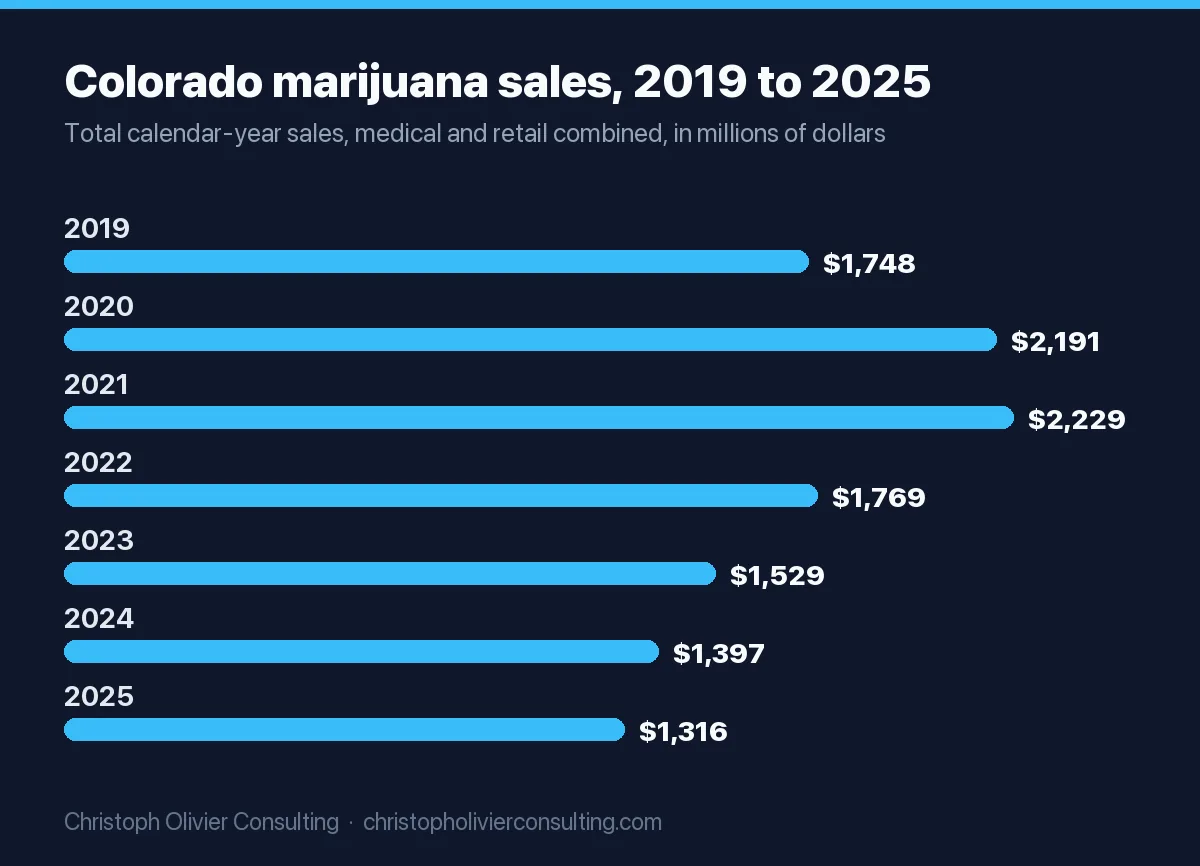
Prices keep falling, and that matters more for owner pay than any other trend. Colorado, the oldest adult-use market, has seen total sales drop four years in a row.
Colorado shows what price compression does to store sales
| Year | Colorado total marijuana sales | Change vs prior year |
|---|---|---|
| 2019 | $1,747,990,628 | |
| 2020 | $2,191,091,679 | +25.3% |
| 2021 | $2,228,994,553 | +1.7% |
| 2022 | $1,768,688,837 | −20.7% |
| 2023 | $1,529,324,553 | −13.5% |
| 2024 | $1,397,131,978 | −8.6% |
| 2025 | $1,315,678,364 | −5.8% |
Source: Colorado Department of Revenue, Marijuana Sales Reports, calendar-year totals, medical and retail combined. Percent changes are my calculations. By 2025, statewide sales were 41% below the 2021 peak.
In Illinois, the data runs the other way on volume. In the first nine months of 2026, stores sold 42.25 million items for $1.05 billion (IDFPR, October 29, 2026). That is about $24.89 per item, down from $28.89 across 2025 (my calculation). More units at lower prices means a store has to sell more just to hold its gross profit flat.
Section 280E: why dispensary profit margins look fine until tax day
The statute is one sentence. 26 U.S.C. 280E says no deduction or credit is allowed for any trade or business that “consists of trafficking in controlled substances (within the meaning of schedule I and II of the Controlled Substances Act)” that federal or state law prohibits. The IRS cannabis industry FAQ spells out what that means for a store: a dispensary “may not deduct, for example, advertising or selling expenses,” but it may reduce gross receipts by cost of goods sold calculated under Section 471.
For a retailer that buys finished product, cost of goods sold is mostly the wholesale price of inventory. Rent, payroll, security, software and marketing all stay on the taxable side. Rules on how you can advertise are covered in my guide to cannabis advertising rules for dispensaries. Under 280E, that ad spend is not deductible either.
You can see the effect in the public companies’ 2025 results:
| 2025, from the 10-K | Trulieve | Green Thumb |
|---|---|---|
| Revenue | $1,181.2M | $1,175.3M |
| Gross margin | 60.2% | 49% |
| Income before income taxes | $91.5M | $263.4M |
| Provision for income taxes | $208.1M | $147.3M |
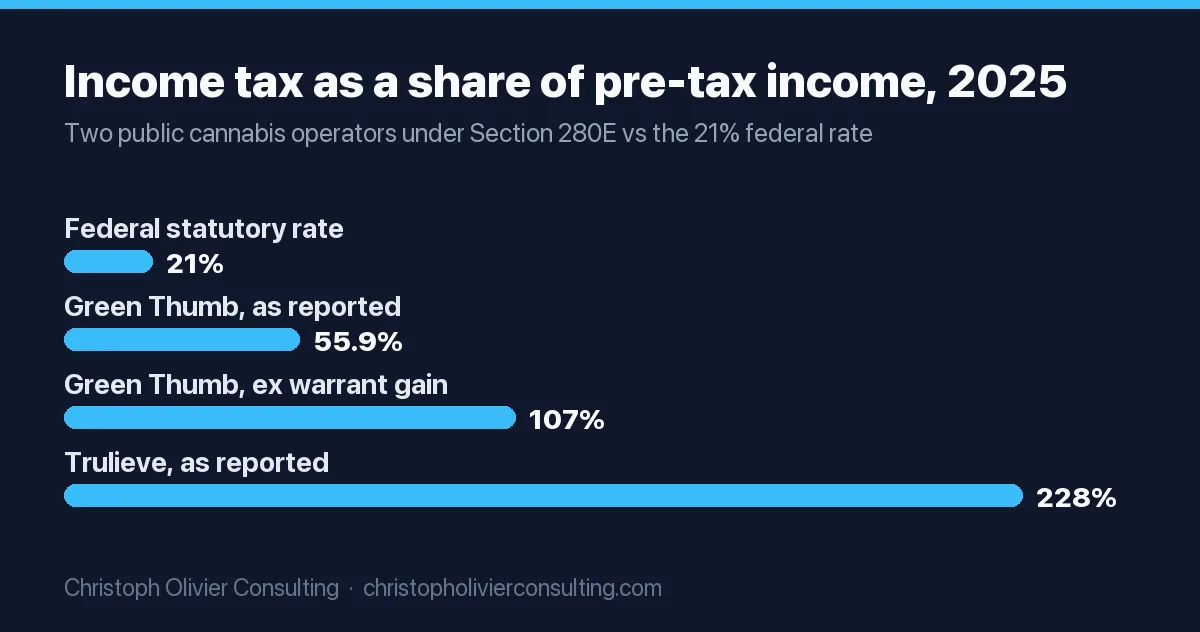
| Tax as a share of pre-tax income | 227.5% | 55.9% (107.2% excluding a $125.9M non-cash warrant gain) |
| Bottom line | Net loss of $122.2M | Net income of $116.1M |
| How the company treats 280E | Takes the position that 280E does not bar ordinary deductions; carries $668.4M of uncertain tax position liabilities | States it is subject to 280E and can deduct only expenses directly related to product sales |
Sources: Trulieve Cannabis Corp. Form 10-K for 2025; Green Thumb Industries Form 10-K for 2025. Tax shares are my calculations. Both companies grow, process and sell, so their figures include cultivation and wholesale, not retail alone.
The federal statutory rate is 21%. Trulieve’s tax bill was more than twice its pre-tax income, and Green Thumb’s 10-K calls its effective rate “well in excess of statutory tax rates.” A single store owner faces the same math on a smaller scale.
Did rescheduling end 280E for dispensaries? The 2026 status
Partly. On April 28, 2026, the Justice Department published a final rule (91 FR 22714), effective that day. It moved FDA-approved drug products containing marijuana, and marijuana covered by a state medical marijuana license, into Schedule III. The rule states that “state licensees will no longer be subject to the deduction disallowance imposed by Section 280E.” It also says nothing in it “constitutes a determination regarding federal tax liability” and tells licensees to consult tax counsel.
Four details decide whether your store benefits:
- Medical only. The rule says any marijuana other than FDA-approved products or marijuana “subject to a state medical marijuana license remains a schedule I controlled substance.” Adult-use sales are not covered.
- DEA registration. Dispensaries that transfer marijuana to patients “must register with DEA as ‘practitioners.'” Applicants who filed within 60 days of publication could keep operating under their state license while DEA reviewed the application.
- Mixed medical and adult-use stores. The rule text I read does not say how 280E applies to a store whose sales are part medical and part adult-use. Get that answer from a tax advisor, not a blog.
- The broader move is still pending. DEA set a new hearing, beginning June 29, 2026, on moving all marijuana to Schedule III. As of November 26, 2026, I found no final rule from that proceeding. Until there is one, adult-use dispensaries remain under 280E.
Dispensary owner salary: owner pay is salary plus what survives 280E
An owner gets paid two ways. First, a salary for running the store, which you would otherwise pay a general manager. BLS puts the median general and operations manager at $105,770 in May 2025 (OEWS). Second, the profit left after every cost and tax. Under 280E, the salary is not deductible either. Every dollar you pay yourself still counts as taxable income to the store.
That is why “owners make 10% of revenue” rules of thumb break down. Two stores with identical sales and identical pre-tax margins can produce very different owner incomes, depending on whether 280E applies.
Worked P&L: what an owner makes at $1.5M, $4M and $6M in sales
This is my own model, not reported data. The $4 million store sits near the Massachusetts average per license, and the $6 million store sits near the Illinois average. The inputs:
- Gross margin 45% (assumption) for a store buying all product wholesale. It sits below the 49% and 60.2% that vertically integrated Green Thumb and Trulieve reported.
- Floor staff at $35,410 per full-time equivalent, the May 2025 median for retail salespersons (BLS OEWS). BLS does not track budtenders separately. Shift leads earn $48,520, the median for first-line retail supervisors (BLS OEWS).
- Owner works as general manager at $105,770.
- Benefits and payroll taxes at 26.6% of wages. Employers in retail trade, sales and related jobs paid $5.02 in benefits per $18.87 in wages in June 2026 (BLS ECEC, Table 4, my calculation).
- Rent $96,000 to $180,000 a year and other operating costs at 10% of sales (assumptions). Other costs cover security, compliance software, insurance, cash handling, marketing and professional fees. Replace these with your own lease and quotes.
- License fee $10,000 a year, the Massachusetts retailer fee (CCC).
- Federal tax at 21%, C-corporation rate. Under 280E it is charged on gross profit; without 280E, on operating profit. State income tax and personal tax on distributions are left out.
| Line (own calculation) | Small store | Mid store | Large store |
|---|---|---|---|
| Annual sales | $1,500,000 | $4,000,000 | $6,000,000 |
| Cost of goods sold (55%) | $825,000 | $2,200,000 | $3,300,000 |
| Gross profit (45%) | $675,000 | $1,800,000 | $2,700,000 |
| Floor staff and shift leads | $225,570 (5 FTE + 1 lead) | $592,780 (14 FTE + 2 leads) | $853,760 (20 FTE + 3 leads) |
| Owner’s salary as GM | $105,770 | $105,770 | $105,770 |
| Benefits and payroll taxes (26.6%) | $88,147 | $185,836 | $255,264 |
| Rent (assumption) | $96,000 | $144,000 | $180,000 |
| Other operating costs (10%) | $150,000 | $400,000 | $600,000 |
| License fee | $10,000 | $10,000 | $10,000 |
| Operating profit | −$487 (0.0%) | $361,614 (9.0%) | $695,206 (11.6%) |
| Federal tax under 280E (21% of gross profit) | $141,750 | $378,000 | $567,000 |
| Profit after tax, under 280E | −$142,237 | −$16,386 | $128,206 |
| Owner pay under 280E (salary + profit) | −$36,467 | $89,384 | $233,976 |
| Federal tax without 280E (21% of operating profit) | $0 | $75,939 | $145,993 |
| Owner pay without 280E | $105,283 | $391,445 | $654,982 |
Own calculation. Wage inputs: BLS OEWS May 2025 and BLS ECEC June 2026. License fee: Massachusetts CCC. Gross margin, staffing, rent and other costs are assumptions. A negative owner pay means the owner draws a salary but puts more than that back in to cover the store’s tax and losses.
What the model shows:
- Under 280E, the mid store’s tax bill is 105% of its operating profit. It makes $361,614 before tax and owes $378,000.
- Break-even moves up by more than a third. With the mid store’s fixed costs, after-tax break-even (owner salary included) is about $4.06 million in sales under 280E and about $2.97 million without it. For the small store, it is about $2.06 million vs $1.50 million (my calculation).
- A medical-only store that completes DEA registration moves from the 280E row to the “without 280E” row, according to the April 2026 rule. Confirm that with your tax counsel.
Sensitivity: owner pay at 40%, 45% and 50% gross margin
| Owner pay (own calculation) | 40% margin | 45% margin | 50% margin |
|---|---|---|---|
| $1.5M store, under 280E | −$95,717 | −$36,467 | $22,783 |
| $1.5M store, without 280E | $30,283 | $105,283 | $164,636 |
| $4M store, under 280E | −$68,616 | $89,384 | $247,384 |
| $4M store, without 280E | $233,445 | $391,445 | $549,445 |
| $6M store, under 280E | −$3,024 | $233,976 | $470,976 |
| $6M store, without 280E | $417,982 | $654,982 | $891,982 |
Under 280E, each 5 points of gross margin is worth $158,000 a year to the $4 million owner. A 10% discount on every sale comes straight out of gross profit, and the tax bill barely moves because it is based on gross profit. That is why I would rather see a store fix its pricing and promotion calendar than add a new location. My guide to good, better, best pricing shows one way to structure tiers so you can stop discounting your best sellers.
Is a 40% profit margin high for a dispensary?
It depends which margin you mean. A 40% gross margin is low for a cannabis retailer. Both public operators reported more than that in 2025, and at 40% every 280E scenario in the model above loses money or barely breaks even. A 40% net margin would be exceptional for any store. In my model, even the $6 million store without 280E keeps 9.2% of sales after tax. For context across other sectors, see my table of profit margins by industry.
How much does it cost to open a dispensary?
No regulator I checked publishes total startup costs, and the public companies do not report a cost per store. What is published is the state fees. Everything else depends on your lease, build-out and the inventory you need on day one.
| Cost line | Published figure | Source or how to get it |
|---|---|---|
| Massachusetts retailer application and license | $1,500 application, $10,000 a year | CCC license fees; background checks, fingerprinting and Metrc fees are extra |
| New York adult-use retail dispensary | $1,000 application, $7,000 license fee; 50% off for social and economic equity applicants | OCM retail fact sheet, February 2026 |
| Location rules | New York: no storefront within 500 feet of a school on the same street or 200 feet of a house of worship | Same OCM fact sheet; check local zoning before signing a lease |
| Opening inventory | Not published | Weeks of cover × daily sales at cost. At $10,870 a day in sales and 55% cost of goods, 4 weeks is about $167,000 (my calculation) |
| Build-out, vault, security cameras, POS | Not published | Get 3 contractor quotes against your state’s security rules |
| Working capital for tax | Not published | Under 280E, set aside about 21% of gross profit for federal tax: $378,000 a year in the mid store model |
The tax line surprises most first-time owners. Under 280E, a store can owe federal tax in a year it loses money. That cash has to come from somewhere, so budget for it before you open.
Owner pay worksheet: will this store pay you? (pass/fail)
Run your own numbers through these six tests before you sign a lease or buy a license. Each one comes from the model above.
| Test | Pass | Fail |
|---|---|---|
| 1. Your projected sales vs your state’s average per store (sales ÷ licenses) | At or above 75% of the average | Below 50% with no clear reason you will beat it |
| 2. Gross margin after discounts, at wholesale prices you can actually get | 45% or higher | Below 40% |
| 3. Federal tax under 280E (21% × gross profit) vs operating profit | Tax is less than 70% of operating profit | Tax is more than 100% of operating profit |
| 4. Owner pay (your salary + after-tax profit) vs the $105,770 BLS median manager salary | Higher | Lower: you would earn more managing someone else’s store |
| 5. Cash set aside for federal tax and opening inventory | 12 months of 280E tax plus 4 weeks of inventory at cost | Less than one quarter of tax |
| 6. 280E status | Medical-only license with a DEA practitioner registration (confirm with tax counsel) | Adult-use sales counted on the assumption that rescheduling will arrive |
If you fail tests 1 or 2, more marketing will not fix the store. If you pass those but fail test 4, the store probably needs a tighter staffing schedule or pricing before it needs more traffic. If you want a second opinion on whether demand in your market can carry a store, you can book a consultation.
Ready to scale your revenue?
Book a free 30-min consultation. We’ll diagnose your growth bottleneck and map out the 3 highest-leverage moves for your business.
Frequently asked questions
How much does a dispensary owner make a year?
No government survey reports it. In a model built from regulator, BLS and 10-K data, an owner who also works as general manager earns about $89,000 a year at $4 million in sales and about $234,000 at $6 million while Section 280E applies. At $1.5 million the owner loses money. Without 280E, the same stores pay about $105,000, $391,000 and $655,000 before personal tax.
What is the average dispensary profit margin?
No regulator publishes one. Public operators report gross margins: Trulieve 60.2% and Green Thumb 49% in 2025, both vertically integrated. A store buying wholesale keeps less. In a model at a 45% gross margin, a $4 million store earns a 9.0% operating margin but loses 0.4% after 280E tax, because federal tax is charged on gross profit rather than net profit.
How much profit do dispensaries make?
It depends mostly on Section 280E. Green Thumb earned $116.1 million in 2025 after paying $147.3 million in income tax. Trulieve reported $91.5 million of pre-tax income but $208.1 million of tax and a $122.2 million net loss. For a single store, the tax can exceed the operating profit unless the store makes enough sales or qualifies for relief.
How much revenue does a dispensary make a day?
On average, about $14,900 to $16,900 a day in Illinois and about $10,870 a day in Massachusetts in 2025. Those figures divide 2025 adult-use sales of $1.51 billion and $1.65 billion by the number of licensed stores, then by 365. They are averages across strong and weak stores and exclude medical sales.
How much does it cost to open a dispensary?
No regulator publishes a total. State fees are the only published part: Massachusetts charges a $1,500 application fee and $10,000 a year, and New York charges $1,000 to apply and a $7,000 license fee. Build-out, security, opening inventory and a cash reserve for 280E tax usually cost far more and need contractor quotes.
Does rescheduling end 280E for dispensaries?
Only for medical marijuana so far. The April 28, 2026 final rule moved state-licensed medical marijuana into Schedule III and says those licensees will no longer face 280E. Dispensaries must register with DEA as practitioners. Adult-use marijuana stays in Schedule I until the separate rescheduling proceeding produces a final rule, which had not happened by November 26, 2026.
Small business owner income