
A medical billing company owner typically makes somewhere between a part-time side income and a few hundred thousand dollars a year. What decides it is how many practices you bill for, what percentage of their collections you charge and how many billers you have to pay. Employed medical records specialists, the BLS category that includes billers and coders, earned a median of $51,140 in May 2025 (BLS). The typical U.S. billing and bookkeeping firm with employees took in between $100,000 and $499,999 in 2022 (Census SUSB, my calculation). Public contracts show billing fees of 6.5% to 8.4% of collections.
Short answer: In my worked model built from public data, an owner who does all the billing for 5 small practices at 6% of collections earns about $112,000 a year before tax. With 20 clients and 3 employed billers, that rises to about $227,000. With 60 clients, 12 billers and a manager, it is about $311,000. Drop the fee to 4% and the 60-client firm loses money. No government survey reports billing company owner income directly, so treat any single “owner salary” figure you see online with caution.
The pages ranking for this question mostly come from companies selling billing training or software. Their owner income claims, such as $150,000 to $250,000 in the first three years, cite no source. Below are the numbers that do exist: Census revenue counts, IRS sole proprietor profits, BLS wages, fee rates from public billing contracts and the audited margins of two public revenue cycle companies. Then I turn them into a labeled P&L you can rerun with your own client count and rate.
Medical billing company owner salary: what each source actually measures
No federal dataset reports income for billing company owners. BLS wage data leaves out the self-employed. Census does not even give medical billing its own industry code. In the 2022 NAICS index, “billing services” and “medical coding services combined with accounting services” sit in NAICS 541219, Other Accounting Services, together with bookkeeping. Coding without accounting goes to NAICS 561499, a catch-all business support code. So every Census and IRS figure below covers billing and bookkeeping firms. That is the closest government proxy, not a clean count. Read the “what it measures” column before comparing numbers.
| Source and year | What it measures | Figure | How it was calculated |
|---|---|---|---|
| Census SUSB 2022, NAICS 541219 | Revenue per firm with employees (billing, bookkeeping and other accounting services) | $638,236 | $28,969,536,000 receipts ÷ 45,390 firms (my calculation) |
| Census SUSB 2022, NAICS 541219 | Revenue band of the median employer firm | $100,000 to $499,999 | 35.6% of firms are below $100,000 and 80.7% below $500,000 (my calculation) |
| Census Nonemployer Statistics 2022, NAICS 541219 | Revenue per business with no paid employees | $28,869 | $7,283,895,000 ÷ 252,312 businesses (my calculation) |
| IRS SOI, sole proprietorships, tax year 2023 | Average net profit per Schedule C return, “other accounting services” | $13,797 | $4,595,590,000 net income less deficit ÷ 333,080 returns (my calculation) |
| BLS Occupational Outlook Handbook, May 2025 | Median wage of employed medical records specialists (billers and coders) | $51,140 | Published |
| CareCloud 10-K, 2025 | Operating margin of a public medical billing and software company | 9.4% | Published; adjusted EBITDA margin 22.9% (my calculation from $27.549M ÷ $120.499M) |
Three things to take from this table:
- The Census code is broader than medical billing. NAICS 541219 also holds bookkeepers, which is why it counts 45,390 employer firms. No source breaks out medical billing alone.
- The $28,869 nonemployer average is not a billing owner’s income. 93.8% of those 252,312 businesses are sole proprietors and 70.3% took in under $25,000 in 2022 (my calculation from the Nonemployer file). That is side work, not a full-time billing service.
- The IRS figure is after every expense, but also includes losses. Only 76.1% of those 333,080 returns showed a profit. The profitable ones averaged $21,679 of net income on $39,525 of receipts (my calculation, IRS SOI tax year 2023). The category also includes tax preparers and payroll services.
How much do medical billing companies make? Revenue by size
The $638,236 average is pulled up by a small group of large firms. Census also publishes firms by annual revenue band. I added the shares and per-firm averages.
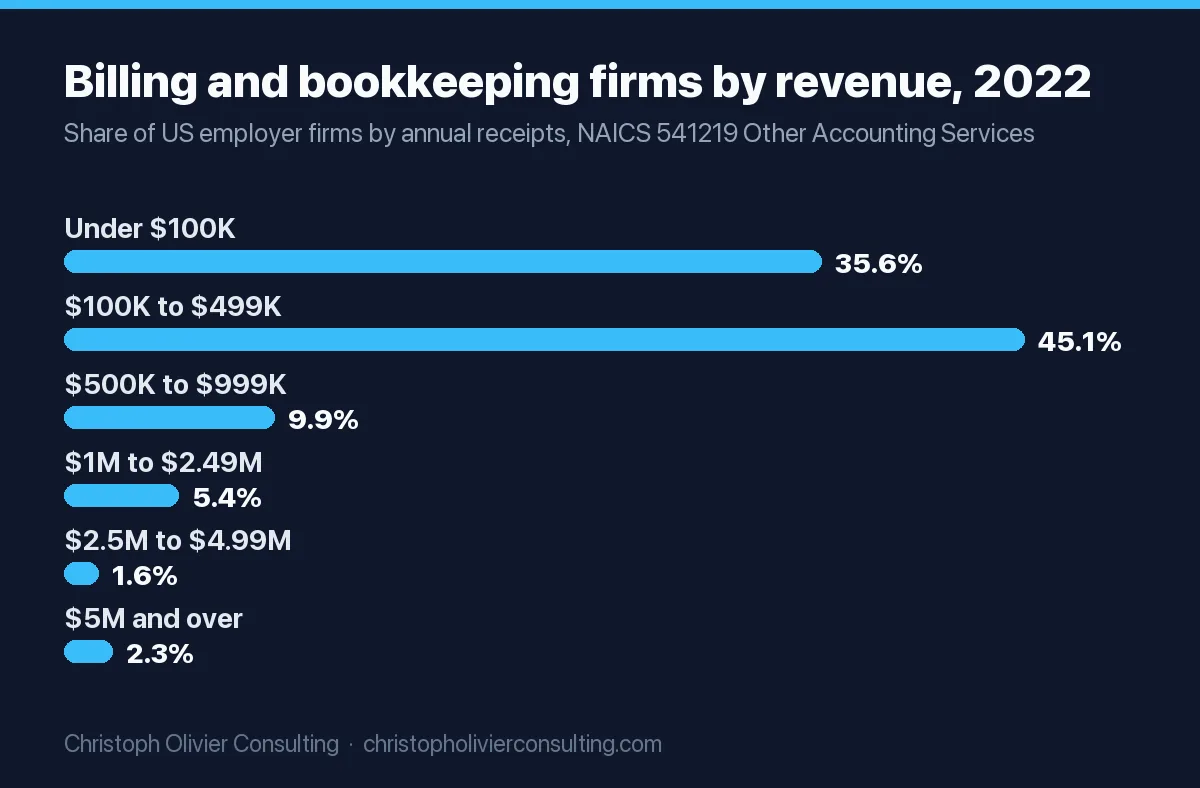
| Annual receipts of the firm | Firms | Share of firms | Cumulative share | Average receipts per firm | Employees per firm | Share of all revenue |
|---|---|---|---|---|---|---|
| Under $100,000 | 16,161 | 35.6% | 35.6% | $46,996 | 1.0 | 2.6% |
| $100,000 to $499,999 | 20,464 | 45.1% | 80.7% | $232,606 | 2.6 | 16.4% |
| $500,000 to $999,999 | 4,502 | 9.9% | 90.6% | $691,090 | 6.1 | 10.7% |
| $1 million to $2.49 million | 2,473 | 5.4% | 96.1% | $1,467,924 | 11.9 | 12.5% |
| $2.5 million to $4.99 million | 734 | 1.6% | 97.7% | $3,265,508 | 24.2 | 8.3% |
| $5 million and over | 1,056 | 2.3% | 100% | $13,552,679 | 97.4 | 49.4% |
Source: U.S. Census Bureau, SUSB 2022, U.S. 6-digit NAICS by enterprise receipts size, NAICS 541219 Other Accounting Services, released April 10, 2025. Employer firms only. The $5 million and over row combines the published bands above $5 million. Averages, shares and cumulative shares are my calculations.
What the table tells you:
- The median firm collects $100,000 to $499,999 a year. The average firm in that band took in $232,606 with 2.6 employees.
- Payroll is the biggest cost. Payroll was 47.2% of receipts across NAICS 541219 in 2022 ($13.67 billion of $28.97 billion, my calculation). That is wages only, before payroll taxes and benefits.
- Revenue is concentrated. The 1,056 firms with $5 million or more are 2.3% of firms but collect 49.4% of the revenue.
- Revenue per employee is modest. 247,793 employees produced $28.97 billion, about $116,910 each (my calculation). A billing firm sells labor, so it grows by adding people or by making each person handle more claims.
How medical billing companies get paid: a percentage of collections
Most billing companies charge a percentage of what the practice actually collects, not of what it bills. CareCloud describes its own model in its 2025 10-K: it “invoices customers on a monthly basis based on the actual collections received by its customers and the agreed-upon rate in the sales contract.” Private billing companies do not publish their rates, but public agencies must. These are rates I found in public documents:
| Public buyer and document | Service | Fee | Context |
|---|---|---|---|
| Clackamas County, Oregon, board packet, December 18, 2025 | Billing and coding for county health centers (vendor: OCHIN) | 6.5% of non-Medicaid insurance collections; 6.5% of patient collections; coding 0.5% extra; $6 per Medicaid or capitated claim | Amendment value $960,000 for 1 year; total agreement $4,340,898 over 5.5 years |
| San Antonio City Auditor, audit AU24-014, May 28, 2025 | EMS ambulance billing and collections | 8.4% of revenues collected, monthly | About $42.5M collected FY2023 through June 2024; about $4.2M paid to the vendor; 55% net collection rate guaranteed |
Both are large public contracts. A small private practice usually has less negotiating power, but also a different claim mix. Treat these as reference points, not a market average; no public survey of physician billing fees exists.
The Medicare rule that shapes percentage pricing
Medicare does not let just anyone take a cut of its payments. Under 42 CFR 424.73(b)(3), Medicare may pay a billing agent only if “the agent’s compensation is not related in any way to the dollar amounts billed or collected” and “is not dependent upon the actual collection of payment.” The Medicare Claims Processing Manual, chapter 1, section 30.2.4 adds the key exception: those conditions “do not apply if the agent merely prepares bills for the provider and does not receive and negotiate the checks payable to the provider/supplier.” In practice, a percentage-fee billing company sets up Medicare payments to land in the practice’s own bank account, then invoices the practice. Get this structure right in your contract before you sign your first client.
What the software and clearinghouse cost
Your two hard tech costs are practice management software and a clearinghouse that sends claims to payers. Published prices, checked November 2026:
| Vendor and plan | Published price | What matters for a billing company |
|---|---|---|
| CollaborateMD Medical Billing Package | Per claim, “typically start at $0.32 per claim” and decrease with volume | Clearinghouse included in every plan; no setup fee; unlimited users |
| Claim.MD Unlimited | $120 per month: unlimited claims and ERA, 1,000 eligibility checks | One billing tax ID included; each additional client tax ID $30 down to $6 per month, tiered |
| Claim.MD Small Volume | $60 per month for 100 claims, ERA and eligibility transactions | Extra claims $0.50 each |
At $0.32 a claim, a practice sending 230 claims a month costs you about $883 a year in software. That is under 4% of the fee you earn from it in the model below. Labor, not software, decides whether you make money.
Owner pay is salary plus profit
When people ask what a billing company owner “makes,” they mix two things. The first is the market wage for the work you do yourself: billing, coding, payer follow-up, client calls. The second is what the firm keeps after paying everyone, including you. A solo owner collects both. An owner who stops billing and only sells and manages must replace their own labor with a hire, and that hire costs real money:
| Role you would hire | BLS median wage, May 2025 | Fully loaded cost to you (my calculation) | Source |
|---|---|---|---|
| Medical records specialist (biller, coder) | $51,140 | $73,057 | Wages ÷ 0.70 (BLS ECEC: wages were 70.0% of private employer compensation costs in June 2026) |
| Medical records specialist, professional and technical services employers | $46,800 | $66,857 | BLS OOH |
| Billing and posting clerk | $48,500 | $69,286 | BLS OOH |
| Medical and health services manager, offices of physicians | $105,770 | $151,100 | BLS OOH |
So a full-time solo owner should earn at least about $51,000 just to match an employed biller. Anything above that is the firm’s profit. For the same split explained for other owner-run service firms, see how it works for a staffing agency owner or a consulting firm owner.
Worked P&L: what a 5, 20 and 60 client billing company owner makes
This is my own calculation, not survey data. Every input is either a published figure above or a labeled assumption you should replace with your own.
| Input | Value used | Basis |
|---|---|---|
| Client size | $35,000 a month collected ($420,000 a year) | Assumption. Physician office firms in the $100,000 to $499,999 band averaged $296,377 and those in the $500,000 to $999,999 band averaged $712,231 in 2022 (SUSB, NAICS 621111, my calculation) |
| Fee | 6% of collections | Assumption, below the 6.5% and 8.4% public contract rates above |
| Claims per client | 230 a month | Assumption (about $152 collected per claim) |
| Clients per full-time biller | 5 | Assumption; the biggest swing factor after the fee |
| Biller cost | $73,057 a year | BLS median $51,140 ÷ 0.70 benefits load |
| Software and clearinghouse | $0.32 per claim | CollaborateMD published starting rate |
| Other overhead (insurance, accounting, marketing, office) | $10,000 / $40,000 / $120,000 | Assumption by size |
| Line (annual) | Solo: 5 clients, owner bills | Team: 20 clients, owner + 3 billers | Agency: 60 clients, 12 billers + manager |
|---|---|---|---|
| Client collections billed | $2,100,000 | $8,400,000 | $25,200,000 |
| Fee revenue at 6% | $126,000 | $504,000 | $1,512,000 |
| Billers (loaded) | $0 | $219,171 | $876,686 |
| Operations manager (loaded) | $0 | $0 | $151,100 |
| Software and clearinghouse | $4,416 | $17,664 | $52,992 |
| Other overhead | $10,000 | $40,000 | $120,000 |
| Owner pay before tax | $111,584 | $227,165 | $311,222 |
| Owner pay as share of revenue | 88.6% | 45.1% | 20.6% |
| Closest Census band (2022) | $100K to $499K: avg $232,606, 2.6 employees | $500K to $999K: avg $691,090, 6.1 employees | $1M to $2.49M: avg $1,467,924, 11.9 employees |
My calculation. Owner pay is pre-tax and before any owner benefits or retirement contributions. In the solo and team columns the owner also bills five clients personally; in the agency column the owner sells and manages only.
Two things stand out. First, the solo owner’s $111,584 is roughly $51,000 of wage plus $60,000 of profit, and it only works if you can keep 5 practices current without help. Second, the share of revenue you keep falls fast as you hire. That is why 60 clients pays only 37% more than 20 clients in this model.
How the fee rate changes owner pay
| Fee (share of collections) | Solo, 5 clients | Team, 20 clients | Agency, 60 clients |
|---|---|---|---|
| 4% | $69,584 | $59,165 | loss of $192,778 |
| 5% | $90,584 | $143,165 | $59,222 |
| 6% (base case) | $111,584 | $227,165 | $311,222 |
| 7% | $132,584 | $311,165 | $563,222 |
| 8.4% (San Antonio EMS rate) | $161,984 | $428,765 | $916,022 |
My calculation, all other inputs unchanged. With clients per biller at 4 instead of 5 (15 billers), the 60-client owner at 6% earns about $92,000; at 6 per biller (10 billers) about $457,000.
A larger firm is far more sensitive to price. Each percentage point of fee on $25.2 million of client collections is $252,000 of revenue, while the payroll stays the same. This is the real risk in this business: CareCloud says in its 2025 10-K that its roughly 3,300 offshore staff cost “approximately 17% the cost of comparable U.S. employees.” A U.S.-staffed firm that competes on price against that cost base loses.
Medical billing company profit margin
Audited margins come only from public companies, and both of the ones below are much larger than a typical owner-run firm:
| Company and year | Revenue | Margin measure | Figure |
|---|---|---|---|
| CareCloud 10-K, 2025 | $120.5 million | Revenue left after direct operating costs (billing staff, claims processing) | 46.5% (100% minus 53.5%) |
| CareCloud 10-K, 2025 | $120.5 million | Operating margin / net margin | 9.4% / 8.9% |
| CareCloud 10-K, 2025 | $120.5 million | Adjusted EBITDA margin (adds back $14.96M depreciation and amortization, among others) | 22.9% (my calculation) |
| R1 RCM 10-K, 2023 | $2,254.2 million | Revenue left after cost of services | 21.5% (my calculation from $1,769.7M cost of services) |
| R1 RCM 10-K, 2023 | $2,254.2 million | Adjusted EBITDA margin / net margin | 27.3% / 0.1% (my calculation from $614.3M and $3.3M) |
| IRS SOI, tax year 2023 | $11.7 billion, all “other accounting services” sole proprietors | Net income less deficit ÷ receipts (includes the owner’s own labor) | 39.3% (my calculation) |
The gap between these numbers is mostly the owner’s own wage. A public company pays every biller and executive before it reports a margin, so 9% to 27% is the range for a fully staffed business. A sole proprietor’s 39% includes the pay for work they did themselves. A healthy owner-run billing firm with staff should land near the low end of my agency model, about 20% of revenue to the owner, which fits inside the public company range. For how these margins compare to other industries, see the profit margin by industry benchmarks. R1 is a hospital revenue cycle company; its 2023 10-K is the last annual report it filed before going private.
Is a medical billing business profitable?
It can be, but the public data shows most are small. 70.3% of nonemployer billing and bookkeeping businesses took in under $25,000 in 2022, and 23.9% of IRS sole proprietor returns in this category showed a loss in 2023 (my calculations from Census and IRS data). Profit depends on three numbers you can check before you start:
- Fee revenue per client per year. At 6% of $35,000 a month, that is $25,200. At 6% of a $10,000-a-month solo provider, it is $7,200, less than half of the $14,611 a biller costs you per client at 5 clients each.
- Clients per biller. At 5 clients each, a biller costs you $14,611 per client against $25,200 of fee revenue. At 3 clients each, $24,352. That is roughly break-even.
- Client acquisition. The FTC warned in its guidance on at-home medical billing businesses that “many doctors’ offices process their own medical claims” and that those who outsource “often use established firms, not individuals working from home.” That guidance is from 2002, but the point still holds: you need a sales plan before you need software. The math of paying to win a client against the fee it brings in is the same one covered in the LTV:CAC ratio guide.
Can I start my own medical billing company?
Yes. The American Medical Billing Association states that no federal or state law requires certification to do medical billing, though certification helps with credibility. What you do need:
- A HIPAA business associate agreement with every client. HHS lists “claims processing or administration, data analysis, billing, and practice management” as business associate activities.
- A payment structure that fits Medicare’s agent rules, described above, if you charge a percentage.
- Care with “business in a box” offers. The FTC found that “few consumers who pay for medical billing opportunities find clients or make any money,” and that the client lists sold with them are often “based on out-of-date databases of doctors” (FTC).
If your edge is a specialty, such as therapy or mental health practices, pick a niche whose payers you know. A practice owner’s own economics, like the visit counts in a physical therapy clinic owner’s P&L, tell you how much collection volume each client brings.
What is the highest salary in medical billing?
Among employees, the top 10% of medical records specialists earned more than $81,150 in May 2025, and the bottom 10% less than $37,000 (BLS). Moving into management pays more: medical and health services managers earned a median of $123,860, with the top 10% above $224,340 (BLS). So six figures as an employed coder or biller is rare; it usually takes a management role or ownership.
Where do medical billers make the most money?
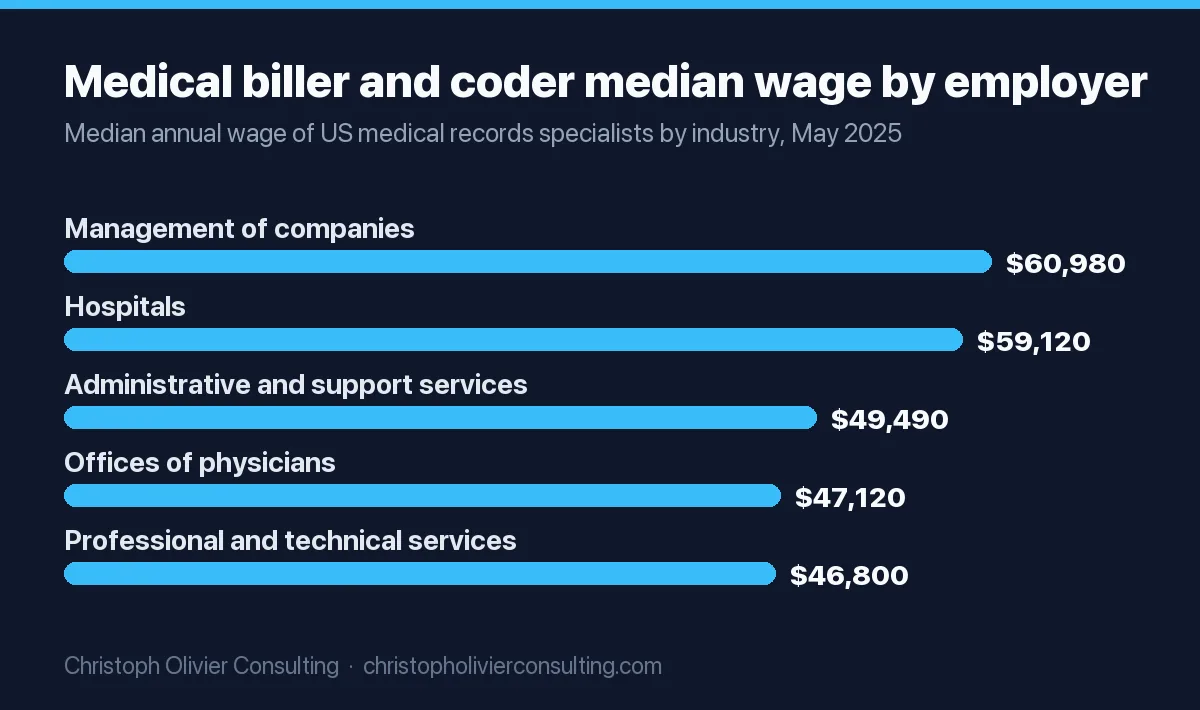
By employer type, billers and coders earn the most at corporate offices and hospitals and the least at billing-style service firms:
Owner pay worksheet: run your own numbers
Fill in your own figures, line by line. Each check has a pass or fail line based on the model above.
| Step | Your formula | Pass if | Fail if |
|---|---|---|---|
| 1. Fee revenue per client | Client monthly collections × 12 × your fee % | $20,000 or more a year | Under $10,000: one client cannot carry its share of a biller |
| 2. Labor cost per client | ($51,140 ÷ 0.70) ÷ clients per biller | Under 60% of step 1 | Over 90% of step 1: you are paying to work |
| 3. Tech cost per client | Monthly claims × 12 × your per-claim rate | Under 5% of step 1 | Over 10% of step 1 |
| 4. Contribution per client | Step 1 minus step 2 minus step 3 | Positive, ideally $8,000 or more | Zero or negative |
| 5. Owner pay | (Step 4 × clients) minus overhead, plus your own wage if you bill | Above $51,140, the BLS biller median | Below $51,140: a billing job pays more |
| 6. Price floor test | Rerun step 5 at a fee 2 points lower | Still positive | Negative: one lost price war ends the business |
| 7. Medicare check | Do Medicare payments go to the client’s own bank account? | Yes | No, and your fee is a percentage: restructure before billing |
| 8. Concentration | Largest client ÷ total fee revenue | Under 25% | Over 40%: losing one practice cuts your pay by that share or more |
Thresholds in steps 1 to 6 and 8 are my rules of thumb derived from the worked model, not industry standards. Step 7 follows 42 CFR 424.73 and the CMS manual, chapter 1, section 30.2.4.
If your worksheet passes steps 1 to 5 but fails step 6, the problem is usually not billing skill, it is a client pipeline too thin to walk away from a bad price. If you want help building a repeatable way to win practices, you can book a consultation to map the numbers for your firm.
Ready to scale your revenue?
Book a free 30-min consultation. We’ll diagnose your growth bottleneck and map out the 3 highest-leverage moves for your business.
Frequently asked questions
How much does a medical billing company owner make?
No government survey reports it. In a model built from Census, BLS and published vendor prices, an owner billing 5 practices alone at 6% of collections earns about $112,000 pre-tax. With 20 clients and 3 billers, about $227,000. With 60 clients, 12 billers and a manager, about $311,000. At a 4% fee the 60-client firm loses money, so price and clients per biller decide the outcome.
How much do medical billing companies make in revenue?
Billing, bookkeeping and other accounting firms with employees (NAICS 541219) averaged $638,236 in receipts in 2022, but the median firm took in $100,000 to $499,999, with that band averaging $232,606 and 2.6 employees (Census SUSB, my calculation). Businesses with no employees averaged just $28,869. Census does not publish medical billing as its own industry.
What is a typical medical billing company profit margin?
Audited figures come only from public companies. CareCloud reported a 9.4% operating margin and a 22.9% adjusted EBITDA margin in 2025. R1 RCM had a 27.3% adjusted EBITDA margin in 2023. IRS data shows sole proprietors in other accounting services kept 39.3% of receipts in 2023, but that includes the owner's own labor.
How much do medical billing companies charge?
Most charge a percentage of collections. Public contracts show 6.5% of insurance and patient collections for Clackamas County health centers (December 2025, plus 0.5% for coding) and 8.4% for San Antonio EMS billing (audit dated May 2025). Private firms rarely publish rates, and no public survey of physician billing fees exists.
Is a medical billing business profitable?
It can be, but most are small. 70.3% of nonemployer billing and bookkeeping businesses took in under $25,000 in 2022, and 23.9% of IRS sole proprietor returns in the category showed a loss in 2023. Profit depends on fee revenue per client, how many clients each biller handles and a steady way to win practices.
Can you make 6 figures in medical billing?
Rarely as an employee. The top 10% of medical records specialists earned more than $81,150 in May 2025, against a $51,140 median. Medical and health services managers earned a $123,860 median. Owners can pass six figures: in the worked model, a solo owner with 5 practices at 6% of collections earns about $112,000 before tax.
Small business owner income