
The typical Airbnb host in the U.S. earned about $15,600 in 2025, according to Airbnb’s own April 2026 release. That is roughly $1,300 a month, and it is earnings, not profit. Listings tracked by AirDNA had median revenue of $2,408 a month in 2025, and the top 10% took in $7,912 a month or more (AirDNA). What you actually keep depends on two numbers most income pages skip: the 15.5% fee Airbnb now takes from most hosts, and whether you carry a mortgage on the property.
Short answer: Most hosts make somewhere between $1,300 a month (Airbnb’s 2025 median) and about $4,000 a month in revenue for a full-time entire home. In my worked model of one entire home at a $250 nightly rate, the host clears about $10,800, $22,700 or $31,900 a year before any mortgage at 40%, 57% and 70% occupancy. Bought today with a 20% down payment at the current 7.21% mortgage rate, the same home loses money below about 63% occupancy.
Below are the numbers that are actually published: Airbnb’s 10-K, its host earnings releases, AirDNA’s market data, Census counts of small lodging businesses, IRS rules and a real local tax table. Then I turn them into a labeled P&L you can rerun with your own rate, occupancy and loan.
How much do Airbnb hosts make? What each number actually measures
Almost every “Airbnb income” figure online is one of the numbers below, and they measure different things. A median earnings figure from Airbnb, a revenue median from a data vendor and a profit figure from a model can differ by a factor of three for the same kind of listing. Read the second column before you compare anything.
| Source and year | What it measures | Figure | Notes |
|---|---|---|---|
| Airbnb newsroom, 2025 (released April 15, 2026) | Earnings of the typical U.S. host, all listing types | $15,600 a year | Airbnb calls it “supplemental income.” Includes spare rooms and part-time listings |
| Airbnb newsroom, 2022 | Median U.S. host earnings; total U.S. host earnings | $14,000; $22 billion | Footnote defines “typical” as the median for U.S. hosts |
| AirDNA, 2025 | Median monthly revenue per U.S. short-term rental listing | $2,408 a month | Top 25%: $4,626 or more. Top 10%: $7,912 or more. Revenue, not profit |
| AirDNA, full year 2025 | U.S. short-term rental occupancy | 56.9% | 2024: 56.7%. December 2025 ADR: $248.57 |
| Airbnb 10-K, 2025 | Gross booking value per night or seat booked, worldwide | $171 | $91.273 billion GBV ÷ 533 million nights and seats (my calculation). Includes cleaning fees, taxes and service fees |
| Census Nonemployer Statistics, 2022, NAICS 7211 | Average receipts of traveler accommodation businesses with no employees | $57,046 | $3.87 billion ÷ 67,811 businesses (my calculation). Sole proprietors alone: $33,132 |
Three things to take from this table:
- Airbnb’s $15,600 is a median across every kind of host. It mixes people renting a spare room a few weekends a year with full-time entire homes. It says nothing about expenses.
- AirDNA’s figures are gross revenue per listing. They are a better guide to what a dedicated listing grosses, but you still pay Airbnb’s fee, cleaning, utilities and the property itself out of them.
- No government source reports Airbnb host profit. Most hosts report on Schedule E, which Census nonemployer counts leave out, and the IRS does not publish short-term rental results as their own line. The Census row only captures lodging operators who file as a business, so treat it as a cross-check, not the answer.
How much does an Airbnb make a month?
For a dedicated listing, the AirDNA median of $2,408 a month in 2025 is the best single public number. It works out to $28,896 a year in revenue (my calculation). Your month-to-month figure will swing hard. AirDNA reports median monthly revenue for U.S. listings of about $1,451 in January 2025 and about $3,970 in July 2025, so a host who budgets on the annual average will be short every winter.
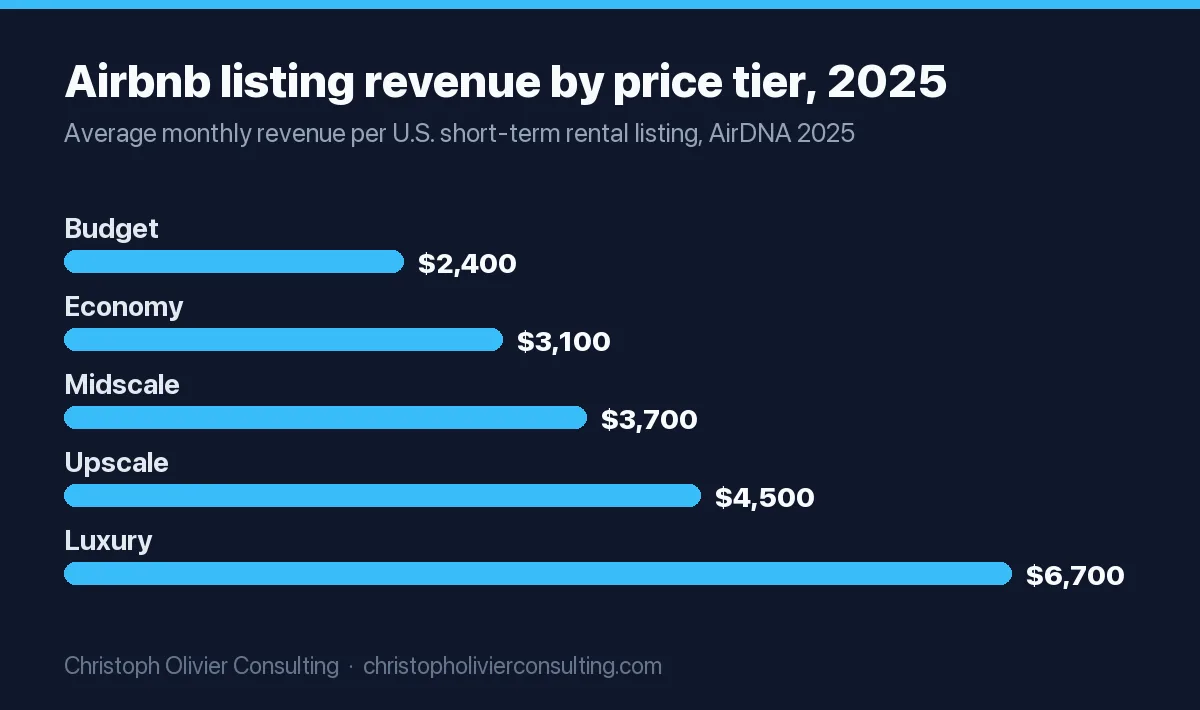
Property type and price tier move the number more than anything you do inside the listing. AirDNA’s 2025 averages (averages run higher than medians):
| Listing segment, 2025 | Average monthly revenue | Annual equivalent (my calculation) |
|---|---|---|
| Entire home | about $4,700 | about $56,400 |
| Entire apartment | about $3,800 | about $45,600 |
| Unique property (cabin, tiny home, treehouse) | about $4,500 | about $54,000 |
| With a hot tub / without | about $6,200 / $3,600 | about $74,400 / $43,200 |
| Available 1 to 90 days a year / 90 days or more | about $3,400 / $4,100 | Monthly figure applies only to the months listed |
Source for every row: AirDNA, 2025 U.S. data. The highest state medians AirDNA lists are Hawaii at $55,541 a year and Alabama at $39,330; the top market is Aspen/Snowmass at $85,952.
What Airbnb takes: the 15.5% host fee and where a booking goes
The fee structure changed, and many pages still quote the old one. According to Airbnb’s help center, the single host-only fee now applies to most hosts, including anyone using property management software: most pay 15.5%, calculated on the nightly price plus any fees the host charges (such as a cleaning fee) and excluding taxes, with others typically between 14% and 16% (16% in Brazil and Mexico). The older split fee, where most hosts paid 3% and guests paid 14.1% to 16.5%, “is being phased out.” Once you switch to the single fee you cannot switch back.
That matters for profit math. On the $59,519 booking subtotal in my middle scenario below, a 3% fee would be $1,786. The 15.5% fee is $9,226. The guest’s total may be similar either way, but under the single fee the whole fee comes out of your payout, and it is charged on host fees such as cleaning too.
At the platform level, Airbnb’s 2025 revenue of $12.241 billion was 13.4% of its $91.273 billion gross booking value (my calculation from the 2025 10-K). GBV includes host earnings, service fees, cleaning fees and taxes. Airbnb pays hosts “generally” on the business day after check-in, and the 10-K reports an average stay of 4.1 nights in North America in 2025, which is the stay length I use below. Occupancy taxes Airbnb collects on your behalf pass through to the government and are not your income; in places where it does not collect them, Airbnb’s tax collection page says hosts “are responsible for assessing all other tax obligations.”
Airbnb itself spent $2.588 billion on sales and marketing in 2025. If you want to see how that compares with other platforms, the Uber, DoorDash and Airbnb marketing spend breakdown uses the same filings.
Host income is two things: pay for your work plus a return on the property
“How much do hosts make” mixes two incomes that are worth separating:
- Pay for labor. Messaging guests, pricing, turnovers, restocking, repairs. If you clean yourself, you keep the cleaning fee. For a benchmark, the median wage of janitors and building cleaners was $17.71 an hour in May 2025 (BLS). A host who does a 4-hour turnover is earning that work, not profit.
- Return on the property. What is left after every cost, including what the property costs you to own. This is the part that disappears fastest when the home was bought recently with a loan.
The test I use: if a co-host or manager ran the listing for you, would anything be left? Airbnb lets hosts pay co-hosts a percentage, a fixed amount, the cleaning fee, or the cleaning fee plus a percentage, set inside the platform (Airbnb help center). Airbnb does not publish a standard co-host rate, so the 20% I test below is my assumption. The same split between owner labor and owner profit runs through the bed and breakfast owner salary and property management company owner models, which use the same method.
Worked P&L: one entire home at 40%, 57% and 70% occupancy
This is my own calculation, not a reported figure. It models one entire home bought at the U.S. median existing-home price of $416,700 (NAR, October 2026) with 20% down and a 30-year loan at 7.21% (Freddie Mac PMMS, week of November 25, 2026). The middle occupancy is AirDNA’s 2025 U.S. average of 56.9%.
| Assumption | Value | Basis |
|---|---|---|
| Nightly rate (ADR) | $250 | Assumption, close to AirDNA’s December 2025 U.S. ADR of $248.57 |
| Average stay | 4.1 nights | Airbnb 10-K, North America, 2025 |
| Cleaning fee charged / cleaner cost per turnover | $150 / $120 | Assumption |
| Airbnb host fee | 15.5% of nightly rate plus cleaning fee | Airbnb help center, single host-only fee |
| Supplies per turnover; maintenance | $25; 5% of bookings | Assumption |
| Fixed costs per year | Utilities, internet and streaming $4,200; STR insurance $3,000; property tax $4,167 (1% of price); software $600; permit $300; furnishing replacement $5,000 ($25,000 over 5 years) | Assumptions; property tax rates vary widely by county |
| Mortgage principal and interest | $27,181 a year ($2,265 a month) | $333,360 loan at 7.21%, 30 years (my calculation) |
| Annual P&L (own calculation) | 40% occupancy | 56.9% occupancy | 70% occupancy |
|---|---|---|---|
| Nights booked / stays | 146 / 36 | 208 / 51 | 255 / 62 |
| Nightly revenue | $36,500 | $51,921 | $63,875 |
| Cleaning fees collected | $5,341 | $7,598 | $9,348 |
| Booking subtotal | $41,841 | $59,519 | $73,223 |
| Airbnb host fee (15.5%) | −$6,485 | −$9,226 | −$11,349 |
| Payout to host | $35,356 | $50,294 | $61,873 |
| Cleaning, supplies, maintenance | −$7,255 | −$10,321 | −$12,697 |
| Fixed costs | −$17,267 | −$17,267 | −$17,267 |
| Profit before mortgage (what an owner without a loan makes) | $10,834 | $22,706 | $31,909 |
| Mortgage principal and interest | −$27,181 | −$27,181 | −$27,181 |
| Cash flow with a new mortgage | −$16,347 | −$4,475 | $4,728 |
| Same, with a co-host at 20% of payout | −$23,418 | −$14,534 | −$7,646 |
How to read it. A host who owns the home outright, or bought years ago at a low rate, makes $10,800 to $31,900 a year on this listing for doing the work. The 57% case grosses $4,960 a month, pays out $4,191 and keeps about $1,892 before any loan. A buyer who finances the same home today needs about 70% occupancy to clear a few thousand dollars, and even then about $3,252 of the year-one mortgage payment is principal you get back as equity, not money spent. The middle scenario’s $59,519 subtotal sits close to AirDNA’s $56,400 average for entire homes, which is a useful sanity check on the inputs.
Break-even occupancy and rate
- Without a mortgage: break-even at about 25% occupancy at $250 a night.
- With the new 7.21% mortgage: break-even at about 63% occupancy, or a nightly rate of about $277 at 56.9% occupancy.
- With a new mortgage and a 20% co-host: about 85% occupancy, a level very few markets sustain.
Airbnb host profit margin
There is no audited figure for host margins. Airbnb’s own 2025 net income of $2.5 billion on $12.2 billion of revenue is the platform’s margin, not yours. In my model, profit before mortgage equals 26%, 38% and 44% of the booking subtotal at the three occupancy levels. After a new mortgage, the margin is −39%, −7.5% and +6.5%. The grid shows how fast both move with rate and occupancy:
| Nightly rate | 40% occupancy | 56.9% occupancy | 70% occupancy |
|---|---|---|---|
| $200, before mortgage / after | $5,030 / −$22,151 | $14,451 / −$12,730 | $21,753 / −$5,428 |
| $250, before mortgage / after | $10,834 / −$16,347 | $22,706 / −$4,475 | $31,909 / $4,728 |
| $300, before mortgage / after | $16,637 / −$10,544 | $30,962 / $3,781 | $42,065 / $14,884 |
Own calculation, same assumptions as the P&L above, annual figures. For context on how these margins compare with other small businesses, see the profit margin by industry tables.
One common error to avoid: some margin guides still list the Airbnb host fee as 3% to 5%. Under the single host-only fee that most hosts now pay, using 3% overstates profit by about $7,400 a year in the middle scenario (my calculation).
Is Airbnb still profitable for hosts in 2026?
For hosts who already own the property, usually yes on these numbers. For new buyers financing at current rates, often not at average occupancy. Three published data points explain why:
- Occupancy is flat, not rising. AirDNA put 2025 U.S. occupancy at 56.9%, versus 56.7% in 2024, with year-over-year declines in every month after May. Full-year ADR growth was 1.8%, below the 2.7% inflation rate AirDNA cites.
- Results split widely. Among full-time hosts active in both years, AirDNA found the average occupancy change was near zero, but “nearly one in five hosts” saw occupancy fall 20% or more. Of the top 50 markets, 25 gained and 25 declined.
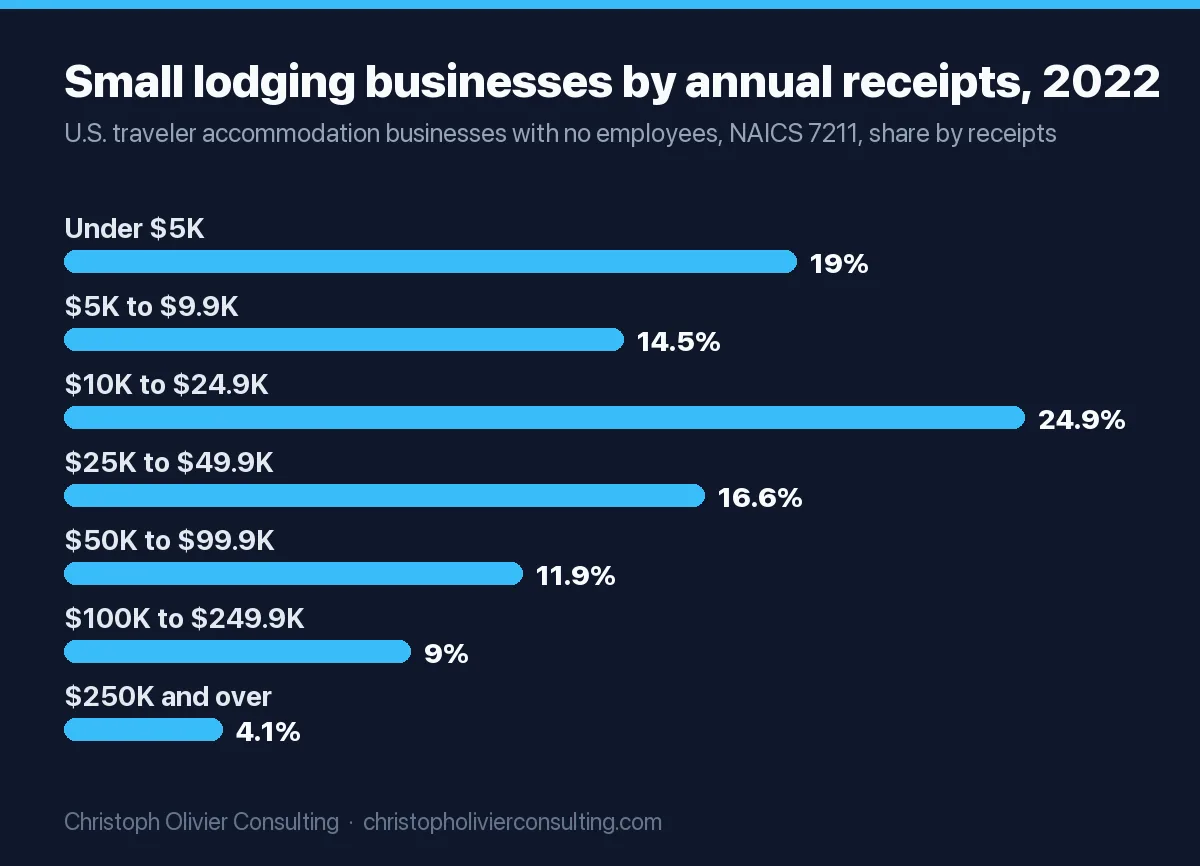
- Most small lodging businesses are small. In Census’s 2022 count of traveler accommodation businesses with no employees, 58.5% took in under $25,000 and only 13.1% took in $100,000 or more (my calculation). That fits a part-time, side-income activity for most operators.
Taxes that change what you keep
Tax treatment can move after-tax income by thousands of dollars. These are the rules from the IRS’s 2025-year publications; confirm your case with a tax professional.
| Rule | What it says | Source |
|---|---|---|
| The 14-day rule | If you use a dwelling as a home and rent it for fewer than 15 days in the year, you do not report the rental income (and do not deduct rental expenses) | IRS Topic 415 |
| Personal use test | A unit is used as a home if your personal use exceeds the greater of 14 days or 10% of days rented at a fair price; then expense deductions are limited | IRS Publication 527 (2025) |
| Schedule E vs Schedule C | Rental income normally goes on Schedule E. If you provide substantial services “such as regular cleaning, changing linen, or maid service,” you report on Schedule C and may owe self-employment tax | IRS Publication 527 |
| The 7-day rule | If the average period of customer use is 7 days or less, the activity is not a “rental activity” under passive activity rules. With a 4.1-night average stay, most Airbnb listings fall here, so material participation tests (such as more than 500 hours) decide how losses are treated | IRS Publication 925 (2025) |
| Depreciation | Residential rental buildings are depreciated over 27.5 years; appliances and furniture have shorter recovery periods | IRS Publication 527, Table 2-1 |
| Form 1099-K | Platforms must report payments that exceed $20,000 in more than 200 transactions, but “whether or not you receive a Form 1099-K, you must still report any income” | IRS |
Lodging taxes are paid by guests but set your all-in price. Florida is a clear example: stays of six months or less owe the 6% state sales tax plus any county surtax plus a local option transient rental tax, which is 6% in Orange, Osceola, Pinellas and Broward counties, 5% in Monroe and 7% in Miami Beach, according to the Florida Department of Revenue’s DR-15TDT rate chart (revised October 2026). A $250 night in Orange County carries at least $30 in state and county lodging tax before any surtax (my calculation). Florida is on Airbnb’s list of areas where it collects and remits taxes, but the rate chart notes counties do not always notify the state when rates change.
Pass/fail worksheet: should you list this property?
Fill in your own numbers. Each line uses figures from this page; any “fail” means the listing needs a better rate, lower costs or a different property before it pays you.
| Check | Pass | Fail | Where the threshold comes from |
|---|---|---|---|
| Comparable listings’ occupancy in your market vs your break-even occupancy | Comps beat break-even by 10 points or more | Within 5 points | Own model: break-even 25% owned outright, 63% with a new loan |
| Fee used in your math | 15.5% of nightly rate plus cleaning fee | 3% split fee assumed | Airbnb help center, single host-only fee |
| Monthly fixed costs covered in your slowest month | January payout covers fixed costs and loan | Needs savings every winter | AirDNA 2025 median: $1,451 January vs $3,970 July |
| Profit before mortgage as % of bookings | 35% or more | Under 25% | Own model: 26% at 40% occupancy, 44% at 70% |
| Profit if a 20% co-host ran it | Still positive | Negative | Shows whether you own a business or a job |
| Your hours vs your profit | Profit per hour above $17.71 | Below $17.71 | BLS median wage, janitors and building cleaners, May 2025 |
| Local permit and lodging tax registration | Confirmed in writing | Unknown | Example: Florida DR-15TDT county rates |
If the listing passes and you want more direct bookings, the commission math in hotel marketing for direct bookings applies to vacation rentals too.
Quick answers to the other questions hosts ask
What is the 80/20 rule for Airbnb?
Airbnb has no official 80/20 rule. Hosts use the phrase in the Pareto sense: a minority of nights, months or listings produce most of the money. The public data supports the idea of a skew: AirDNA’s top 10% of U.S. listings earned at least $7,912 a month in 2025, more than three times the $2,408 median, and July median revenue was more than 2.7 times January’s (my calculation).
What is the 75-55 rule in Airbnb?
It is an informal investor screen, not an Airbnb policy. One lender’s explainer defines it as a property reaching about 75% occupancy at a nightly rate of at least 55% of the local market average, and says it “won’t appear in any official Airbnb documentation.” Other host educators use the same label for pricing rules, so ask which version someone means. My model is a stricter test: run your own break-even.
Do I need an LLC to run an Airbnb?
Airbnb does not require one, and an LLC does not change your federal tax by default. The IRS treats a single-member LLC as “disregarded as separate from its owner” unless it elects corporate treatment on Form 8832, and the owner still reports on Schedule C, E or F (IRS). Whether an LLC protects you is a state-law and insurance question for a local attorney. If you keep books for several listings, the cost ranges in what a bookkeeper costs help you budget for it.
Can you make a lot of money with an Airbnb?
Some hosts do, mostly with properties they already own in strong markets. AirDNA’s top market medians reach $85,952 a year in Aspen/Snowmass and $80,709 in Kauai, but those are revenue, and property prices there are far above the $416,700 national median used in my model. For most hosts, Airbnb’s $15,600 median is the honest expectation. If you are deciding whether to build a hospitality business around one or more listings, you can book a consultation. Outside the U.S., fees, taxes and data differ, so this page does not apply.
How the numbers on this page were built
- Airbnb. 2025 Form 10-K (GBV, nights and seats booked, revenue, average nights per booking, payout timing); newsroom releases for 2025 and 2022 host earnings; help center articles for host fees and tax collection. GBV per night includes experiences and services seats and all taxes and fees.
- AirDNA. 2025 U.S. revenue medians, averages by segment and seasonality from its host earnings guide (updated March 10, 2026); occupancy and ADR from its December 2025 U.S. review. AirDNA is a private data vendor; its figures are estimates from listing data, not host-reported profit.
- Census. Nonemployer Statistics 2022, U.S. file, NAICS 7211 (traveler accommodation), receipts size classes. Shares and averages are my calculations. The code includes small hotels, motels and bed and breakfasts and leaves out hosts who file on Schedule E.
- Government rules. IRS Topic 415, Publications 527 and 925 (2025 returns), the Form 1099-K page and the single-member LLC page; Florida DOR form DR-15TDT (R. 10/26).
- Model inputs. NAR October 2026 median price, Freddie Mac rate for the week of November 25, 2026, Airbnb’s 15.5% fee and 4.1-night stay. Nightly rate, cleaning, supplies, maintenance, insurance, utilities, property tax rate, furnishing cost and the 20% co-host share are my assumptions, labeled in the tables. Replace them with your own.
Ready to scale your revenue?
Book a free 30-min consultation. We’ll diagnose your growth bottleneck and map out the 3 highest-leverage moves for your business.
Frequently asked questions
How much do Airbnb hosts make?
Airbnb says the typical U.S. host earned about $15,600 in 2025, a median across spare rooms, part-time and full-time listings. AirDNA puts median revenue for a U.S. listing at $2,408 a month in 2025. In a worked model of one entire home at $250 a night, profit before any mortgage is about $10,800 to $31,900 a year at 40% to 70% occupancy.
How much does an Airbnb make a month?
AirDNA reports median revenue of $2,408 a month for U.S. listings in 2025, with the top 25% at $4,626 or more and the top 10% at $7,912 or more. Seasonality is large: the median was about $1,451 in January and $3,970 in July. Airbnb's $15,600 typical host figure works out to about $1,300 a month.
What is a typical Airbnb host profit margin?
No audited figure exists for hosts. In a labeled model of one entire home, profit before mortgage is 26%, 38% and 44% of bookings at 40%, 57% and 70% occupancy. With a new 7.21% mortgage on a $416,700 home, the margin falls to minus 39%, minus 7.5% and plus 6.5%. Using the old 3% host fee instead of 15.5% overstates profit.
Is Airbnb profitable for hosts in 2026?
For owners without a large new mortgage, usually yes at average occupancy. AirDNA put 2025 U.S. occupancy at 56.9%, flat versus 2024, and nearly one in five full-time hosts saw occupancy drop 20% or more. In the model on this page, a home financed at current rates breaks even only at about 63% occupancy at $250 a night.
What percent does Airbnb take from hosts?
Most hosts now pay Airbnb's single host-only fee of 15.5%, charged on the nightly price plus host fees such as cleaning, excluding taxes. Some pay 14% to 16%. The older split fee, about 3% for hosts with 14.1% to 16.5% paid by guests, is being phased out. Across the platform, Airbnb's 2025 revenue was 13.4% of gross booking value.
Do Airbnb hosts pay taxes on rental income?
Usually yes. Under IRS rules, renting a home you also use for fewer than 15 days a year is not reported. Otherwise income goes on Schedule E, or on Schedule C with possible self-employment tax if you provide hotel-like services such as regular cleaning or linen changes. Platforms send Form 1099-K above $20,000 and 200 transactions, but all income is reportable.
Small business owner income