

The IAB/PwC Internet Advertising Revenue Report: Full Year 2024 puts U.S. internet ad revenue at $258.6 billion in 2024, up 14.9%, with search at $102.9 billion, digital video at $62.1 billion and retail media at $53.7 billion (IAB/PwC Full Year 2024 PDF). The Full Year 2025 edition, released April 16, 2026, reports $294.6 billion, up 13.9%, with social now the largest category at $117.7 billion (IAB press release). Neither report breaks out contextual advertising as its own line, so the contextual figures further down come from market-research firms and vendors, each labeled by who published it and what it measures.
IAB Internet Advertising Revenue Report: full year 2024 and 2025 figures
Every figure in this table was read from IAB’s own documents: the 2024 column from the full PDF (pages 5 to 22), the 2025 column from IAB’s April 16, 2026 release. The 2025 full report sits behind a free IAB account on the IAB report page; a public summary of the same numbers is on PPC Land.
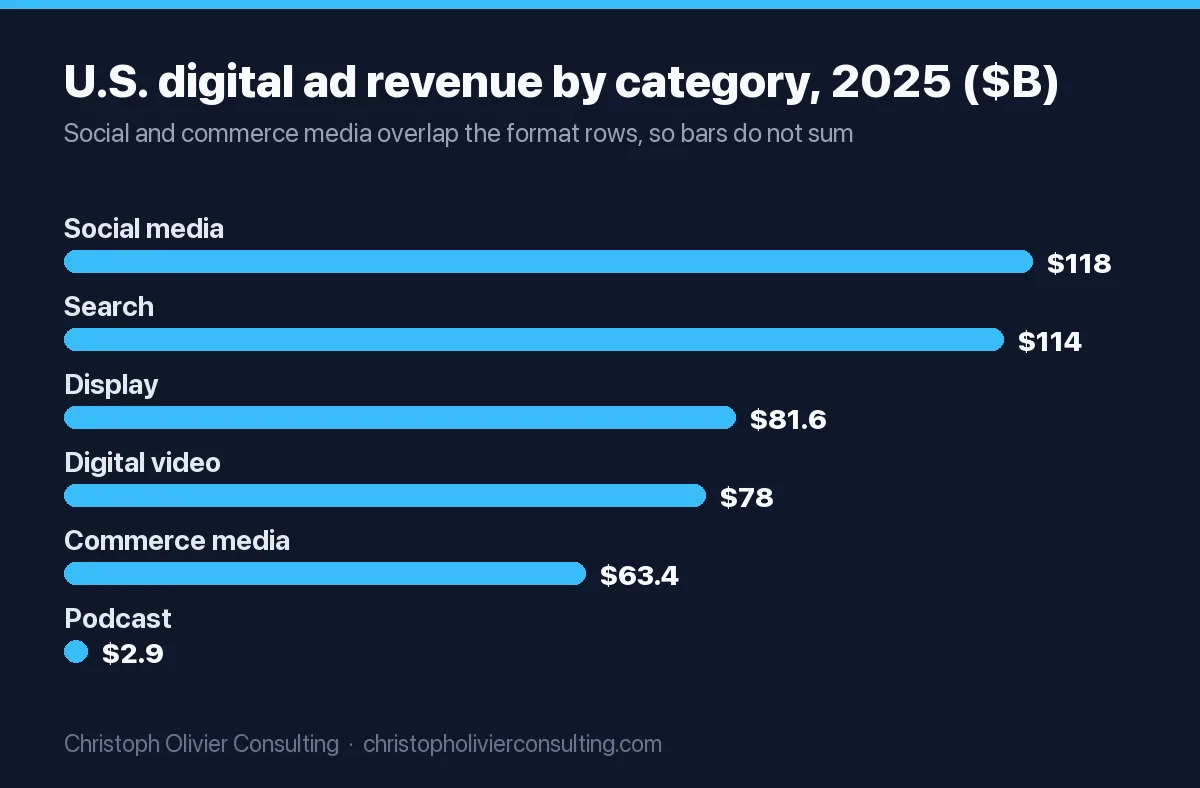
| Category | FY 2024 revenue | 2024 growth | 2024 share of total | FY 2025 revenue | 2025 growth | 2025 share of total |
|---|---|---|---|---|---|---|
| Total U.S. internet advertising | $258.6B | +14.9% | 100% | $294.6B | +13.9% | 100% |
| Search (paid search, incl. contextual search links; AI search in 2025) | $102.9B | +15.9% | 39.8% | $114.2B | +11.0% | 38.8% |
| Display (banner, rich media, sponsorship, native) | $74.3B | +12.4% | 28.7% | $81.6B | +9.8% | 27.7% |
| Digital video (incl. CTV) | $62.1B | +19.2% | 24.0% | $78.0B | +25.4% | 26.5% |
| Digital audio (podcast, streaming music, radio) | $7.6B | +8.5% | 2.9% | Not in public release | n/a | n/a |
| of which podcast | $2.43B | +26.4% | 0.9% | $2.9B | +17.6% | 1% |
| Other (classifieds, directories, lead generation) | $11.7B | n/a | 4.5% | Not in public release | n/a | n/a |
| Overlapping cut: social media | $88.8B | +36.7% | 34.3% | $117.7B | +32.6% | 40.0% |
| Overlapping cut: retail media (2024) / commerce media (2025) | $53.7B | +23.0% | 20.8% | $63.4B | +18.0% | 21.5% |
| Overlapping cut: programmatic (excl. search) | $134.8B | +18.0% | n/a | $162.4B | +20.5% | n/a |
Sources: IAB/PwC Full Year 2024 report and its April 17, 2025 release; IAB Full Year 2025 release, April 16, 2026.
How the IAB numbers fit together (and why the shares add up to more than 100%)
The IAB report has two kinds of rows, and mixing them is the most common citation mistake.
- Format rows add up to the total. In 2024: $102.9B search + $74.3B display + $62.1B video + $7.6B audio + $11.7B other = $258.6B. The share chart on page 17 of the PDF (39.8% + 28.7% + 24.0% + 2.9% + 4.5%) sums to 99.9% because of rounding.
- Social, retail/commerce media and programmatic are cuts across those formats. A video ad on a social platform sits in video and in social at the same time. IAB’s own definitions page says programmatic “is not a separate format” and its revenue “may appear duplicative.” That is why 2025 shares of 40.0% social, 38.8% search and 27.7% display cannot be added.
- 2025 remainder. Search, display and video total $273.8B in 2025, leaving $20.8B (our subtraction, not an IAB figure) for audio and other formats, which the public release does not split.
- Retail vs commerce media. IAB labeled the 2024 line “retail media network” revenue “within commerce media” and the 2025 line “commerce media.” The 18.0% growth IAB reports for 2025 matches $53.7B grown to $63.4B, so IAB is comparing against the 2024 retail media figure.
Two more 2024 data points researchers ask for: programmatic revenue split 61% open real-time bidding and 39% programmatic direct (private marketplace, preferred deals, automated guaranteed), and non-programmatic placements outside search fell 4.9% to $20.9B (FY 2024 PDF, page 20). Social’s 2024 total of $88.8B came in as $40.5B in the first half and $48.2B in the second (page 21).
Where contextual advertising sits inside the IAB report
Contextual is a targeting method, not a format, so IAB does not count it separately. It appears twice in the 2024 PDF. The survey definition of Search (page 27) includes “contextual search: payments made for clicks on text links that appear in an article based on the context of the content, instead of a user-submitted keyword.” And the podcast section names contextual advertising as one reason podcast revenue grew 26.4%. Contextual display, video and CTV buys are spread across the display, video and programmatic rows above. For the same figures read from a budget planning angle, the CMO and marketing budget statistics page sets the IAB totals against Gartner and CMO Survey spend data.
U.S. internet ad revenue by year, 2020 to 2025
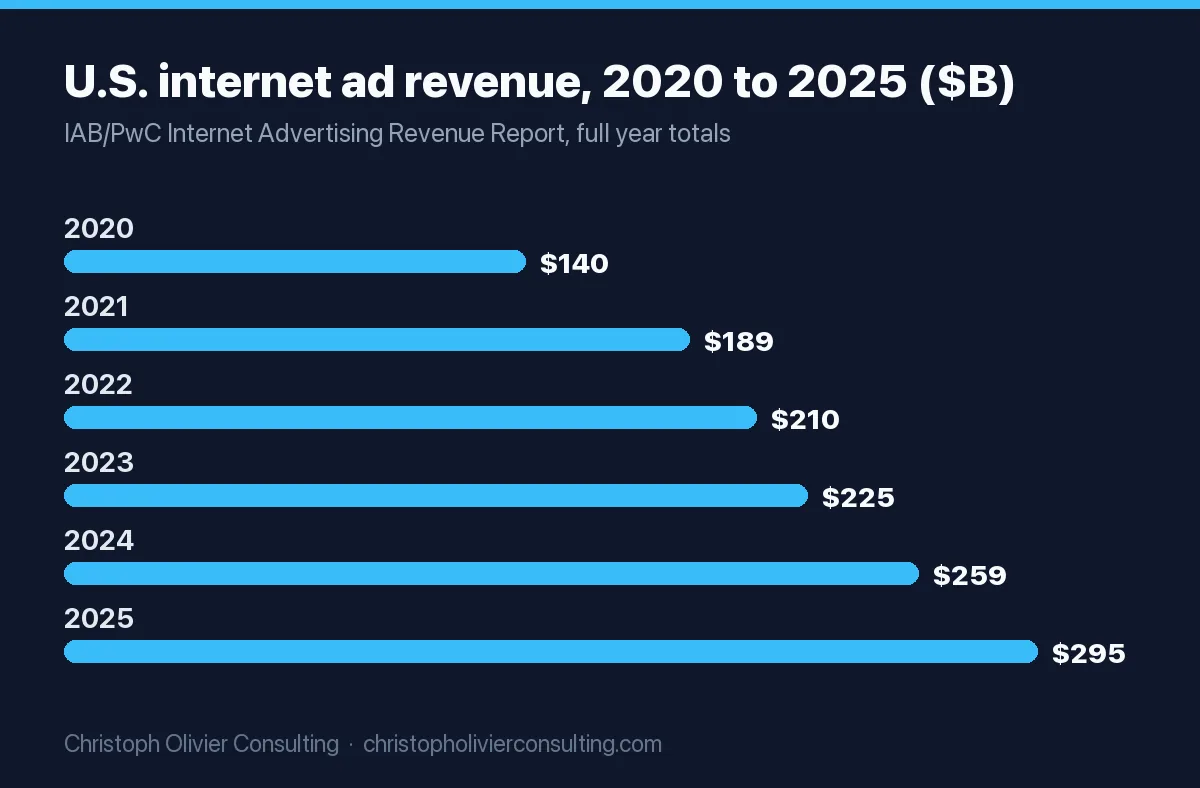
The five-year trend in the 2024 PDF (page 5), plus the 2025 release, gives the series below. 2024 growth was helped by a presidential election and an Olympic year, which IAB calls out on page 5; 2025 grew 13.9% without either.
| Year | U.S. internet ad revenue | YoY growth | Search | Display | Video |
|---|---|---|---|---|---|
| 2020 | $139.8B | n/a | $59.0B | $44.0B | $26.2B |
| 2021 | $189.3B | +35.4% | $78.3B | $56.7B | $39.5B |
| 2022 | $209.7B | +10.8% | $84.4B | $63.5B | $47.1B |
| 2023 | $225.0B | +7.3% | $88.8B | $66.1B | $52.1B |
| 2024 | $258.6B | +14.9% | $102.9B | $74.3B | $62.1B |
| 2025 | $294.6B | +13.9% | $114.2B | $81.6B | $78.0B |
The broader spend picture, including forecasts beyond IAB’s seller-reported census, is on our U.S. digital ad spend statistics page.
Contextual advertising market size: four estimates, four definitions
Syndicated research firms size the global contextual market at roughly $212B to $258B for 2026. Before you quote one, look at what each firm counts.
| Publisher (report date) | 2025 | 2026 | Forecast | What they count as contextual |
|---|---|---|---|---|
| The Business Research Company (2026 edition, Sept 2026) | $233.89B | $258.32B (+10.4%) | $379.84B by 2030 (10.1% CAGR) | Activity based, location based and other types (time based, product recommendations, contextual video); mobile, desktop and digital billboards |
| 360iResearch (July 24, 2026, via GII listing) | $225.78B | $250.64B | $487.10B by 2032 (11.61% CAGR) | Audio, banner, text and video formats, including search engines and social media as “user activity” segments (360iResearch) |
| Business Research Insights (updated Sept 18, 2026) | Base year, not stated | $212.34B | $545.32B by 2035 (10.7% CAGR) | Activity based, location based and others, across nine end-user industries |
The tell: each 2026 estimate is close to the entire $294.6B U.S. internet ad market IAB measured for 2025. Numbers that large only work if “contextual” includes keyword-matched search, which is how 360iResearch segments it and how IAB’s own Search definition treats contextual text links. If your question is “how much is spent on contextual display and video targeting specifically,” none of these reports answers it. Read them as “ads matched to content, keywords or situation,” not as the size of the contextual ad tech vendor market.
One more caution: 360iResearch’s own page phrases its figure as the market will “grow by USD 487.10 billion,” while the GII reseller listing gives $487.10B as the 2032 market size. Quote the reseller wording with the date, or skip it.
Do third-party cookies still work in Chrome in 2026?
Yes. Contextual’s pitch used to be “cookies are going away.” That stopped being true in two steps, both announced on Google’s Privacy Sandbox blog by VP Anthony Chavez.
| Date | What happened | Source |
|---|---|---|
| March 24, 2020 | Safari becomes “the first mainstream browser to fully block third-party cookies by default.” | WebKit blog |
| June 14, 2022 | Firefox makes Total Cookie Protection (separate cookie storage per site) the default for all desktop users worldwide. | Mozilla blog |
| April 22, 2025 | Google will “maintain our current approach to offering users third-party cookie choice in Chrome” and “will not be rolling out a new standalone prompt for third-party cookies.” Incognito already blocks them by default. | Privacy Sandbox: next steps |
| October 17, 2025 | Google retires Topics, Protected Audience, Attribution Reporting, Private Aggregation (incl. Shared Storage), Related Website Sets, SelectURL, IP Protection, On-Device Personalization, Protected App Signals and SDK Runtime, citing low adoption. CHIPS, FedCM and Private State Tokens stay. | Update on plans for Privacy Sandbox technologies |
What that means for a 2026 media plan: in Chrome, third-party cookies remain on unless the user turns them off. In Safari, Firefox and Chrome Incognito they are blocked or partitioned. So contextual is no longer a forced replacement. It is the targeting method that works the same in every browser, in CTV and in podcasts, and it does not depend on consent banners. If you are rebuilding audience targeting around your own data instead, our first-party data strategy playbook covers that side.
IAB Tech Lab Content Taxonomy: the labels contextual vendors use
When a DSP or verification vendor says a page is about “Personal Finance” or “Automotive,” it is usually using the IAB Tech Lab Content Taxonomy, which the official repository describes as “a common language that can be used when describing content or the aboutness of a webpage.”
| Version | Released | What changed |
|---|---|---|
| 1.0 | Legacy | About 400 categories; superseded |
| 2.0 to 2.2 | Legacy | Superseded by 3.0 |
| 3.0 | June 2022 | Expanded from about 400 to 1,500+ categories; better coverage of news, video/CTV, podcasts, radio, games and app stores; some deletions make it not backwards compatible |
| 3.1 | December 2024 (public comment to Jan 24, 2025) | Genre update, adding Thriller; current version |
Source: IAB Tech Lab Content Taxonomy page, last updated February 11, 2026. The 3.1 file is a free TSV in the GitHub repository, and IAB Tech Lab links an open-source mapper for converting 2.x codes to 3.x. Practical check: ask any contextual vendor which taxonomy version its segments map to. A vendor still on 1.0 or 2.x labels is working with roughly a quarter of the categories in 3.x.
Contextual advertising vendors and what they actually sell
The vendor list changed in 2024 when Oracle shut down its whole advertising business, including the Grapeshot contextual product and Moat measurement, at the end of September 2024 (Digiday, June 28, 2024). The table lists vendors named in that coverage or behind the studies below, with claims from their own pages.
| Vendor | What it is | Verified detail |
|---|---|---|
| Peer39 | Pre-bid contextual and suitability data for buyers | Says it categorizes 400B bid requests daily across 4,300+ categories, 300+ semantic categories, 40+ languages; partners shown include The Trade Desk and Amazon DSP (Peer39) |
| GumGum | Contextual intelligence and ad formats | Says it reads “the full page, text, images, video, and audio” before the bid (GumGum); Verity added 300+ advertisers in the weeks after Oracle’s exit (Digiday) |
| DoubleVerify | Verification firm with contextual targeting | Pitched a combined contextual, brand safety, suitability, fraud and viewability package to Oracle customers (Digiday) |
| Integral Ad Science (IAS) | Verification firm with contextual targeting | Named with DoubleVerify as the established verification leaders (Digiday); runs its own context research (below) |
| Seedtag | Contextual advertising company | Publishes Nielsen and neuroscience studies on contextual (below) |
| Oracle (Grapeshot, Moat) | Former contextual and measurement products | Shut down end of September 2024 |
If you buy through Google’s own tools rather than a DSP, our Google Display ads guide covers the content targeting options there, and the programmatic advertising statistics page covers the open-exchange side.
Contextual performance studies (all vendor research)
There is no independent, audited sales-lift study of contextual vs behavioral targeting in the public record that I could find. Every study below was paid for by a company that sells contextual or verification products. They are still useful if you read the metric and the comparison group.
| Study (date) | Headline result | Compared against | Method and sample |
|---|---|---|---|
| GumGum survey (Feb 19, 2025) | 94% prefer contextually relevant ads; 42% call interest-matched ads the most valuable; almost 80% more likely to engage with ads matching the content | Ads based on browsing history | Stated preference survey, 3,000 consumers, U.S., U.K., Canada |
| Seedtag with Prof. Moran Cerf (Nov 19, 2025) | “Neuro-contextual” ads: 3.5x neural engagement; +30% vs standard contextual; +26% positive emotional response | Non-contextual ads (3.5x) and standard contextual (+30%) | EEG and cross-brain correlation; sample size not published in the release |
| IAS with Tobii (June 23, 2022) | In-context ad noticed in 0.4s vs 1.0s; purchase intent +14%; favorability +5%; 4x unaided recall | Same ad in an out-of-context article | Eye tracking, one display ad in two environments; sample not stated |
| Seedtag and Nielsen (May 11, 2022) | 32% more likely to “do something as a result”; 2.5x category interest vs no targeting | Demographic targeting (32%), no targeting (2.5x) | Controlled media environment, 1,800 U.K. consumers, automotive, food and drink, beauty |
| DoubleVerify (Nov 14, 2022) | 67% more likely to pay attention to an ad relevant to the content; 61% less likely to buy a brand seen next to misinformation | None (stated attitudes) | Survey, 16,600+ consumers, 18 countries |
| GumGum, Publicis Groupe, Lumen Research (Oct 20, 2021) | +69% prompted recall, +41% spontaneous recall; 92% viewability vs 55%; 46s vs 18s viewable time | Standard IAB formats (so format and context change together) | Eye tracking by Lumen; sample not stated in release |
| IAS U.K. survey (Dec 7, 2020) | 81% prefer ads that match the content; 65% view such brands more favorably | None (stated attitudes) | U.K. consumer survey; sample not stated on page |
Score a contextual statistic before you put it in a deck
Use this pass/fail rubric on any contextual stat, including the ones above. Four or more passes and it is safe to cite with its label. Two or fewer, leave it out of anything a CFO will read.
| Test | Pass if | Fail if |
|---|---|---|
| 1. Who paid | Independent body or census (IAB/PwC, a browser’s own post) | Commissioned by a contextual or verification seller |
| 2. Metric | Sales, conversions or cost per outcome | Stated preference, recall, attention or EEG only |
| 3. Comparison group | Same creative, behavioral or audience targeting as control | No control, or format changed along with context (GumGum 2021 rich media vs standard units) |
| 4. Sample | Size and market stated | Not published |
| 5. Date | Fielded after April 2025, when Chrome kept cookies | Assumes a cookie phase-out that did not happen |
Worked example: Seedtag and Nielsen 2022 passes sample (1,800, U.K.) and comparison group (demographic control), fails who paid, metric (stated intent) and date. Two passes. The honest wording is “a Seedtag-commissioned Nielsen test found contextual raised stated intent to act 32% over demographic targeting.” The IAB revenue figures pass four of five; the only miss is metric, because they measure what sellers earned, not what advertisers got back.
My read: the vendor evidence consistently shows contextual wins on attention and preference, and it says almost nothing about cost per sale. If you shift performance budget to contextual, run a holdout test on your own conversions first. If you want a second pair of eyes on that test design, you can book a consultation.
Most-cited contextual and IAB statistics, with the exact source
| Statistic | Cite as |
|---|---|
| $258.6B U.S. internet ad revenue in 2024, +14.9% | IAB/PwC Internet Advertising Revenue Report: Full Year 2024, April 2025 |
| $102.9B search, 39.8% share, 2024 | Same report, page 16 |
| $62.1B digital video, +19.2%, 2024 | Same report, page 16 |
| $53.7B retail media, +23.0%, 2024 | Same report, page 22 |
| $294.6B in 2025, +13.9%; social $117.7B, +32.6% | IAB/PwC Full Year 2025, April 16, 2026 |
| $212B to $258B global contextual market, 2026 | Business Research Insights; The Business Research Company (definitions differ) |
| Chrome keeps third-party cookies; Privacy Sandbox APIs retired | Google Privacy Sandbox blog, April 22 and October 17, 2025 |
| 94% prefer contextual over browsing-history ads | GumGum survey (vendor), February 2025 |
Related channel data: retail media statistics and connected TV advertising statistics, where contextual signals such as genre (from the same Content Taxonomy) do most of the targeting.
Frequently asked questions
What does the IAB Internet Advertising Revenue Report: Full Year 2024 say?
The IAB/PwC Full Year 2024 report, released April 17, 2025, puts U.S. internet ad revenue at $258.6 billion, up 14.9%. Search led at $102.9 billion (39.8% share), display reached $74.3 billion, digital video $62.1 billion, audio $7.6 billion and other formats $11.7 billion. Social ($88.8 billion) and retail media ($53.7 billion) are overlapping cuts, not extra revenue.
What was search advertising revenue in 2024 according to IAB?
IAB/PwC reports U.S. search advertising revenue of $102.9 billion in 2024, up 15.9% from $88.8 billion in 2023, a $14.1 billion increase. Search held a 39.8% share of total internet ad revenue. IAB's search definition includes paid listings and contextual search text links placed in articles. In 2025 search grew 11.0% to $114.2 billion, including AI search.
How much was retail media and digital video in the IAB 2024 report?
Retail media network revenue was $53.7 billion in 2024, up 23.0% or $10.1 billion, equal to 20.8% of total digital ad revenue. Digital video was $62.1 billion, up 19.2%, a 24.0% share and the fastest growing format that year. In 2025 IAB reported commerce media at $63.4 billion and digital video at $78.0 billion.
What are the 2025 US social media advertising revenue trends according to IAB and PwC?
The IAB/PwC Full Year 2025 report shows U.S. social media ad revenue of $117.7 billion, up 32.6% and about $29 billion more than 2024. Social reached 40.0% of total digital ad revenue, passing search at 38.8%, though the two overlap because social video also counts as video. IAB credits the creator economy and commerce integration; creator advertising reached $37 billion.
How big is the contextual advertising market?
Syndicated research firms put the global 2026 contextual advertising market between $212.34 billion (Business Research Insights) and $258.32 billion (The Business Research Company), with 360iResearch at $250.64 billion. These estimates count keyword, location and activity based matching, including search, so they are not the size of contextual display and video targeting. IAB does not measure contextual separately.
Which companies are contextual advertising vendors?
Commonly used contextual vendors include Peer39, GumGum, Seedtag, DoubleVerify and Integral Ad Science, the last two being verification firms that also sell contextual targeting. Oracle's Grapeshot was a major contextual product until Oracle shut down its advertising business at the end of September 2024. Ask any vendor which IAB Tech Lab Content Taxonomy version its segments use; 3.1 is current.
Are third-party cookies still in Chrome in 2026?
Yes. On April 22, 2025 Google said Chrome would keep its current third-party cookie choice and would not launch a standalone prompt. On October 17, 2025 it retired most Privacy Sandbox technologies, including Topics, Protected Audience and Attribution Reporting. Safari and Firefox still block or partition third-party cookies by default, and Chrome Incognito blocks them.