

Commercial marketing is the profit-driven discipline of selling products and services to customers. It is defined by its objective, a sale that earns money, not by any channel. The word “commercial” also names a department in many large companies, usually one that sits above or beside marketing and owns sales, pricing and key customers, which is why “marketing vs commercial” confuses so many people. This page gives you the definition, what “commercial” means in pharma, consumer goods, airlines, B2B, government and law, and a one-page commercial marketing plan you can copy.
What is commercial marketing?
Commercial marketing is the practice of promoting products or services to convert prospects into paying customers, so a for-profit business earns revenue and profit. The customer can be a consumer or another company. Success is measured in commercial terms: revenue, margin, market share, customer acquisition cost and payback. Positioning, pricing, the offer and the ad all sit inside that profit objective.
Compare it with the broad definition the American Marketing Association uses for marketing itself: “the activity, set of institutions, and processes for creating, communicating, delivering, and exchanging offerings that have value for customers, clients, partners, and society at large.” That definition covers nonprofits and public agencies too. Adding “commercial” narrows it to one case: the exchange is money for a product or service, and the seller keeps the profit.
A quick test you can apply to any campaign: if the success metric is a sale, a booked deal or revenue, it is commercial marketing. If the success metric is a behavior that benefits the public (quitting smoking, wearing a seatbelt), it is social marketing. If the work is governing the company brand and reputation rather than selling a specific offer, it is the corporate marketing function.
What “commercial” means in different industries
The same word describes very different teams depending on where you work. Before you compare “marketing vs commercial” in a job posting or an org chart, check which of these meanings is in play.
| Context | What “commercial” means there | Public example |
|---|---|---|
| Pharma and biotech | The teams that sell and promote approved products (sales, marketing, market access), kept separate from medical affairs and R&D | Pfizer lists a Chief U.S. Commercial Officer and a Chief International Commercial Officer on its executive team page |
| Consumer goods (CPG) | The customer-facing business that sells to retailers and channels, plus the sales and operations behind it | Hershey hired PepsiCo’s Chief Commercial Officer, U.S. Away From Home Beverages, as President, U.S. (June 24, 2026 release) |
| Airlines and travel | Everything that turns capacity into revenue: pricing, revenue management, network, sales, loyalty and marketing | United’s EVP and Chief Commercial Officer oversees pricing and revenue management, sales, alliances, marketing functions and MileagePlus |
| B2B industrials and services | “Commercial excellence”: disciplined pricing, segmentation and sales coverage to lift margin | Strategy& (originally Booz & Company, 2013) commercial excellence report |
| UK government | The buying side: procurement and contract management | The Government Commercial Function is “a cross-government network procuring or supporting the procurement of goods and services for the government” |
| Public health | Companies as an influence on health, including through their marketing | WHO’s commercial determinants of health fact sheet (21 March 2023) |
| US law | “Commercial speech”: advertising and other speech about a transaction, which gets a lower level of First Amendment protection | Central Hudson Gas & Electric v. Public Service Commission (1980) |
Pharma: commercial vs medical affairs
In pharma, “commercial” is the side of the company allowed to promote approved uses of a product. Medical affairs handles scientific exchange, including questions about uses the FDA has not approved. The wall between them is driven by regulation. FDA’s January 2025 guidance on communications about scientific information on unapproved uses (SIUU) recommends that those communications “be separate from promotional communications about approved uses.” It spells out what separate means in practice:
- At conference exhibit halls, FDA “strongly recommends” dividing booth space so SIUU material has its own dedicated area.
- Online, SIUU communications should sit on a separate web page, with no direct links from the promotional page.
- By email, SIUU communications should go in separate messages from promotional ones.
- In a rep visit, the SIUU communication should not be “attached to or intermingled with” promotional material.
The guidance itself notes it is “not for current implementation” while parts are under OMB review, so treat it as FDA’s stated direction rather than settled rules. If you market in a regulated field, this is the clearest public example of why a commercial team and a medical or scientific team cannot simply share one content calendar.
Consumer goods: commercial means the customer, often the retailer
In consumer goods, the “commercial” organization usually faces the customers who stock the product: grocery chains, distributors, foodservice. Brand marketing faces the shopper. Hershey’s release on its new U.S. president describes the job as “end-to-end accountability for Hershey’s U.S. commercial business” and a “ONE Hershey commercial model” that “delivers greater value to retail partners and consumers alike.” Her previous PepsiCo role, Chief Commercial Officer for U.S. Away From Home Beverages, centered on “partnering closely with the industry’s largest national customers.” Read that and you see the CPG split: brand marketing builds demand, commercial converts it into shelf space, distribution and sales volume.
B2B: commercial excellence and the pricing lever
In B2B, “commercial” often signals a margin focus. The Strategy& report describes commercial excellence as an approach that “imposes discipline on a company’s pricing decisions and aligns its service offerings with its customers’ needs,” and names margin diagnostics, customer segmentation and pricing as the most important disciplines. The reason pricing gets so much attention: a McKinsey analysis by Marn, Roegner and Zawada (February 2003) found that for the average S&P 1500 company, a 1 percent price rise with stable volume would lift operating profit by 8 percent, more than three times the effect of a 1 percent volume increase. That number is old, but the arithmetic still holds for any business with thin operating margins. If you sell to other businesses, our B2B marketing strategy template shows how to pick channels by deal size and sales cycle.
Marketing vs commercial: who owns what
When a company has both a “marketing” team and a “commercial” team, the commercial side usually owns the revenue number and marketing feeds it. United is a clean public example: its Chief Commercial Officer’s remit includes “marketing functions” alongside pricing and revenue management, network and commercial strategy, and sales, so marketing sits inside the commercial remit. Where the two are peers, the split typically looks like this.
| Question | Marketing function | Commercial function |
|---|---|---|
| Core question | Who should want this, and why us? | How do we turn demand into profitable revenue? |
| Owns | Brand, positioning, messaging, campaigns, demand generation, content | Sales, key accounts, channel partners, pricing and discounts, commercial strategy, often revenue management |
| Typical KPIs | Qualified pipeline created, cost per qualified lead, share of search, brand awareness, CAC by channel | Bookings, revenue vs plan, gross margin, price realization, win rate, account retention |
| Who owns pricing | Sometimes list price and packaging (common in consumer brands) | Usually price execution, discount authority and deal approval (airlines and many B2B firms) |
| Time horizon | Quarters to years (brand), weeks to months (campaigns) | This month and this quarter |
| Typical leader titles | Chief Marketing Officer, VP Marketing, Head of Brand | Chief Commercial Officer, Chief Revenue Officer, Commercial Director |
Two practical rules come out of that table. First, if nobody can say who approves a discount, pricing is unowned, and given the McKinsey math above that is usually the most expensive gap in the org chart. Second, if marketing reports leads and commercial reports revenue with no shared definition between them, you have two scoreboards. A pipeline marketing model fixes that by making marketing accountable for opportunities and revenue rather than lead volume, and a revenue operations function gives both teams one data model and one forecast.
“Market & commercial” and “commercial and marketing” in job titles
When you see “Marketing & Commercial” or “Market & Commercial” on a team name or job ad, read it as one leader holding both columns of the table: demand creation and revenue conversion, usually with pricing. In smaller firms that is the norm, because one person runs marketing and sales anyway. In larger firms the combined title is a signal that the company wants marketing judged on revenue, not on activity. In a service business I generally prefer this setup, because it removes the handoff where most leads go cold.
Commercial marketing vs social marketing
Commercial marketing sells a product or service for profit; social marketing sells a behavior to benefit society. Both use the same toolkit (research, segmentation, positioning, campaigns), which public health openly acknowledges. An article in CDC’s journal Preventing Chronic Disease (Bernhardt, July 2006) describes health marketing as using “the science and strategies of commercial marketing,” then draws the line on purpose: the goal of commercial marketing “is to benefit the product ‘sellers’ and shareholders,” while the goal of health marketing “is to benefit the product ‘consumers’ and the public.”
| Dimension | Commercial marketing | Social marketing |
|---|---|---|
| Primary goal | Sell a product or service for profit | Change a behavior for public benefit |
| What is “sold” | Goods and paid services | A behavior (quit smoking, recycle, get screened) |
| Who usually runs it | For-profit businesses | Government agencies, nonprofits, public-health bodies |
| Main beneficiary | The company and its owners | The target population and society |
| Success metric | Revenue, margin, ROI, CAC | Behavior change, reach in the target group, health outcomes |
| Funding | Sales revenue | Taxes, grants, donations |
Public health also uses “commercial” in a third, critical sense. The WHO fact sheet defines commercial determinants of health as “the conditions, actions and omissions by commercial actors that affect health,” notes they “can have beneficial or detrimental impacts on health,” and names company choices in the “targeted marketing of products, such as breast-milk substitutes, ultra-processed foods, tobacco, sugar-sweetened beverages and alcohol” among the harmful ones. It reports that 29 countries covering 832 million people (12% of the world’s population) have a comprehensive ban on tobacco advertising. In that frame, commercial marketing is sometimes the very thing a public-health campaign is built to counter. For real campaigns built on social marketing, see these public health campaign examples with documented results.
The label follows the campaign’s objective, not the organization. A nonprofit selling event tickets is doing commercial marketing. A company that ties a product sale to a cause is doing cause marketing, which is commercial marketing with a social message attached, and it carries its own disclosure rules.
Commercial marketing vs corporate marketing
Commercial marketing is a purpose (sell for profit). Corporate marketing is an organizational function: the team that governs the master brand, corporate communications, PR and consistency across business units. One answers “why does this marketing exist?” The other answers “where does it sit in the org chart?”
| Commercial marketing | Corporate marketing (function) | |
|---|---|---|
| Nature | A purpose: marketing to sell for profit | A department: the company-level marketing function |
| Core job | Generate demand and revenue for specific offers | Govern brand, communications and cross-unit consistency |
| Owns | Campaigns, offers, funnels, sales enablement | Master brand, PR, investor and corporate communications |
| Measured on | Pipeline, revenue, CAC, payback | Reputation, brand health, message consistency |
In a small business one person does both. In an enterprise they are separate teams with separate budgets. The departmental side is covered in our guide to what the corporate marketing function owns.
Commercial speech: what “commercial” means legally
If you work in marketing, “commercial” also has a legal meaning that sets how far government can regulate your ads. In Central Hudson Gas & Electric Corp. v. Public Service Commission of New York, decided June 20, 1980, the US Supreme Court described commercial speech as “expression related solely to the economic interests of the speaker and its audience” and set out a four-part test for regulations that restrict it:
- Is the speech protected at all? To qualify, it “at least must concern lawful activity and not be misleading.” Misleading ads and ads for illegal activity fail here and can be banned.
- Is the government’s asserted interest substantial?
- Does the regulation directly advance that interest?
- Is the regulation “not more extensive than is necessary to serve that interest”?
The case itself is a marketing story. New York’s Public Service Commission had banned all promotional advertising by electric utilities to conserve energy. The Court, in an opinion by Justice Powell, called the energy conservation rationale important but held the total ban went further than necessary, because it also blocked ads for services that would not increase energy use. The ban was struck down. The practical takeaway for commercial marketers: truthful advertising for a lawful product has real constitutional protection, and misleading advertising has none.
Commercial marketing jobs: titles and pay
Commercial roles are usually titled by scope rather than channel. The public examples above show the pattern: Chief Commercial Officer at United, Chief U.S. Commercial Officer and Chief International Commercial Officer at Pfizer, Chief Commercial Officer for a channel at PepsiCo. Below the C-suite you will see Commercial Director, Head of Commercial Excellence, Commercial Marketing Manager and Revenue Management Manager.
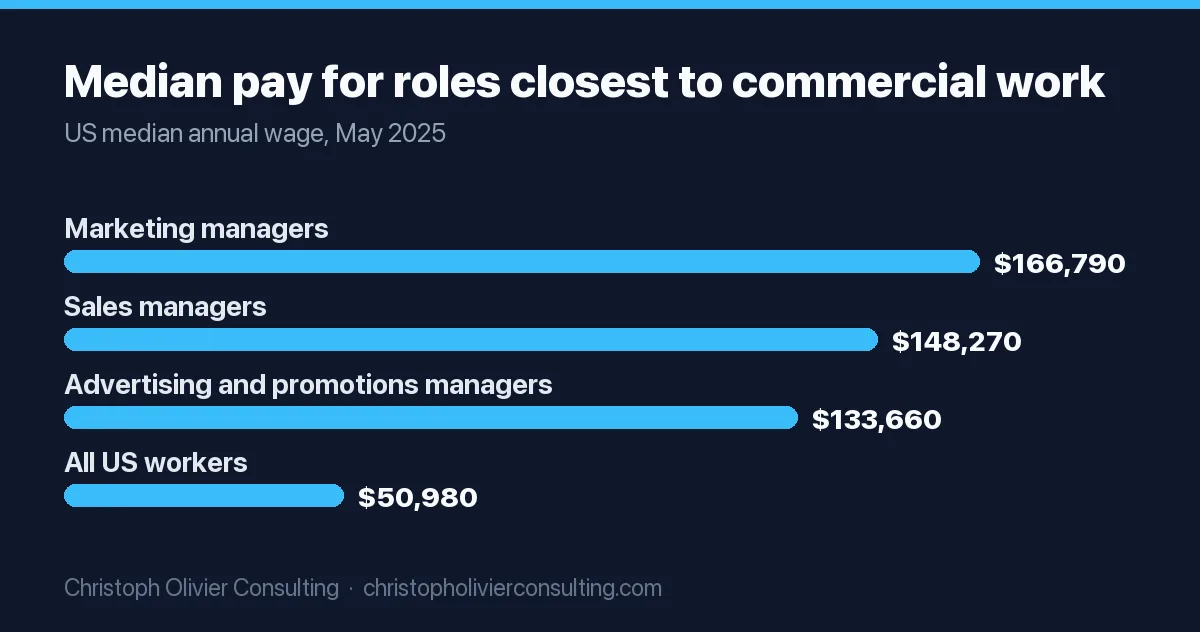
The US Bureau of Labor Statistics does not track “commercial” as an occupation, but its closest categories give you a pay baseline. In May 2025, the median annual wage was $166,790 for marketing managers, $148,270 for sales managers and $133,660 for advertising and promotions managers, against $50,980 for all workers. BLS projects employment of advertising, promotions and marketing managers to grow 6 percent from 2025 to 2035, and sales managers 4 percent. For C-level marketing pay and reporting lines, see our breakdown of the chief marketing officer role and compensation.
Commercial marketing plan template (one page)
A commercial marketing plan differs from a generic marketing plan in one way: every line ties to revenue and margin, and pricing is in it. Copy the template below, fill one row at a time, and do not move on until the row passes its test.
| Section | What you write | Pass/fail test |
|---|---|---|
| 1. Revenue goal | New revenue target for the period, and from which offer | Pass if it is a dollar figure with a date and one named offer |
| 2. Unit economics | Average first-year value per customer, gross margin, allowable acquisition cost | Pass if allowable CAC is a number you would defend to the owner |
| 3. Target buyer | Who buys, who signs, what triggers the purchase | Pass if you can name 20 real companies or people who fit |
| 4. Price and package | List price, tiers, discount rules and who approves a discount | Pass if one named person owns discount approval |
| 5. Funnel math | Customers needed, close rate, meetings needed, inquiries needed | Pass if each stage uses your own historical rates, or is marked as an assumption to test |
| 6. Channels | Two or three channels, each with an expected cost per qualified inquiry | Pass if total channel cost is at or below allowable CAC times customers needed |
| 7. Sales handoff | Definition of a qualified inquiry, response time, who follows up | Pass if marketing and sales signed the same definition |
| 8. Scoreboard | Weekly: inquiries, meetings, proposals, wins, revenue, average price realized | Pass if one dashboard shows marketing and sales numbers together |
Filled example: a 12-person accounting firm
The inputs below are hypothetical, chosen to show the math. Replace every one with your own numbers.
- Revenue goal: $480,000 in new annual fees within 12 months, from the business advisory package.
- Unit economics: average first-year fees of $8,000 per client. The firm decides it will spend up to 25 percent of first-year fees to win a client, so allowable CAC is $2,000.
- Customers needed: $480,000 divided by $8,000 is 60 new clients.
- Funnel math: at an assumed 30 percent close rate on consultations, 60 clients need 200 consultations. If half of qualified inquiries book a consultation, the firm needs 400 qualified inquiries, about 33 a month.
- Budget ceiling: 60 clients times $2,000 allowable CAC is $120,000 for the year, about $10,000 a month across all channels and sales time.
- Channel check: if paid search delivers qualified inquiries at $150 each, 400 inquiries cost $60,000, which fits the ceiling with room for content and referral programs. If it costs $400 per inquiry, it does not fit, and the firm either raises price, improves close rate or picks a different channel.
- Price and package: three tiers, with the managing partner as the only person who can approve a discount over 10 percent.
Notice which lever does the most work. Raising the average first-year fee from $8,000 to $9,000 cuts the clients needed from 60 to about 54 and lifts allowable CAC to $2,250 at the same 25 percent rule. That is the commercial mindset in one line: price and close rate often move the plan more than another channel does. For setting the price itself, use our pricing strategy decision framework. If you want a second pair of eyes on the funnel math before you commit budget, you can book a consultation.
One campaign, three labels: a worked example
A private solar installer runs search ads and a referral offer to sell rooftop panels. That is commercial marketing: the goal is a sale and a margin. A state energy office runs a campaign urging households to cut peak-hour electricity use, with nothing to sell. That is social marketing: the goal is a behavior that benefits the grid and the public.
Inside the installer, a corporate marketing team maintains the company brand, handles press and keeps residential and commercial divisions on one message, while a performance team runs the ads. If the installer is large enough to have a commercial director, that person owns pricing, installer financing offers and the sales team, and holds the revenue number the performance team feeds. Same company, same topic, four different meanings of “marketing” and “commercial.” Naming them correctly is what stops each team from being measured on the wrong thing.
Frequently asked questions
What is commercial marketing?
Commercial marketing is promoting products or services so a for-profit business earns revenue and profit. It is defined by its objective, a sale, not by any channel, so SEO, paid ads, email, events and sales outreach all count when the goal is revenue. Success is measured in money terms such as revenue, margin, customer acquisition cost and payback.
What is the difference between marketing and commercial?
Marketing usually owns brand, positioning, campaigns and demand generation. A commercial function usually owns the revenue number: sales, key accounts, pricing and discount approval, and often revenue management. At United Airlines, for example, the Chief Commercial Officer oversees marketing functions along with pricing, revenue management, network and sales, so marketing sits inside the commercial remit.
What does a commercial team do?
It depends on the industry. In pharma, commercial teams promote approved products and stay separate from medical affairs. In consumer goods, commercial teams sell to retailers and channels. In airlines, commercial covers pricing, revenue management, network, sales and loyalty. In UK government, the Government Commercial Function handles procurement, the buying side rather than selling.
What is the difference between commercial marketing and social marketing?
Commercial marketing sells a product or service for profit; social marketing promotes a behavior for public benefit, such as quitting smoking or getting screened. Both use the same research and campaign methods. A 2006 article in CDC's journal Preventing Chronic Disease put it this way: commercial marketing benefits sellers and shareholders, while health marketing benefits consumers and the public.
Is commercial marketing the same as corporate marketing?
No. Commercial marketing is a purpose: marketing to sell for profit. Corporate marketing is a function: the company-level team that governs the master brand, corporate communications, PR and consistency across business units. In a small business one person often does both. In a large company they are separate teams with separate budgets and different success metrics.
What is commercial speech in marketing law?
In US law, commercial speech is advertising and similar speech about a transaction. In Central Hudson v. Public Service Commission (1980), the Supreme Court described it as expression related solely to the economic interests of the speaker and its audience and set a four-part test for restricting it. Misleading ads get no protection; truthful ads for lawful products do.
What does a Chief Commercial Officer do?
A Chief Commercial Officer owns how a company turns demand into revenue, typically sales, pricing, key customers and often marketing. Public examples include United Airlines, whose CCO oversees pricing and revenue management, sales, alliances, marketing and MileagePlus, and Pfizer, which splits the role into a Chief U.S. Commercial Officer and a Chief International Commercial Officer.
More Growth, Strategy & Sales guides
- Marketing Strategist vs Manager
- Marketing Strategy Consultant: What They Do, Cost, and How to Hire One
- 7 Marketing Strategy Examples & Frameworks
- Marketing Strategy Framework for Service Businesses
- 12 Marketing Strategy Frameworks Compared
- How to Build a Marketing Technology Stack
- All Growth, Strategy & Sales guides →