

Exit planning for an ad agency or a digital marketing agency starts with one number: recast EBITDA times a multiple. Agency M&A advisors quoted by Axial in November 2025 put agencies under $1 million of EBITDA at 2.5x to 3.9x and agencies over $5 million at 8x to 10x, and FE International in October 2026 puts most digital marketing agencies at 4x to 7x. Where you land inside those ranges comes down to three things buyers check first: how much revenue sits with your biggest clients, how much of it is retained, and whether new business still depends on you.
This page has two halves. The first is for agency owners: sourced valuation multiples, a worked example, the buyer diligence scorecard, and how to hire an exit planning firm and an M&A advisor, including credentials, the SEC broker rules and fee models. The second is for exit planning advisors: when to stop doing your own marketing and what each kind of help costs. None of it is legal, tax or investment advice.
Need senior marketing leadership without a full-time hire? See CO Consulting’s fractional CMO services.
Exit planning for an ad agency or digital marketing agency: what it is worth in 2026
No public database of private agency sales exists. Every multiple you will see comes from an advisor’s own deal set or estimate, so read them side by side, note the date and the basis, and never mix an EBITDA multiple with a revenue multiple.
| Source and date | Basis | Sample | Figures |
|---|---|---|---|
| Palmer, via Axial, November 12, 2025 | Times EBITDA, by EBITDA size | Advisor’s estimate, no count given | Under $1M: 2.5x to 3.9x. $1M plus: 3.5x to 5x. $2M plus: 4x to 7x. Over $5M: 8x to 10x |
| TobinLeff, via Axial, November 12, 2025 | Times adjusted EBITDA | The firm’s recent 25 transactions | Average adjusted EBITDA $2.4M: 6.46x average, some up to 12x for strategic buyers. Average adjusted EBITDA about $500K: 3.33x |
| FE International, October 19, 2026 | Times adjusted EBITDA; SDE below about $500K of earnings | Benchmark ranges, no sample size stated | Digital marketing agencies 4x to 7x. Performance and paid media 8x to 10x with 70%+ retainers, documented ROI and EBITDA above $3M. SDE 2x to 4x for owner-operated shops |
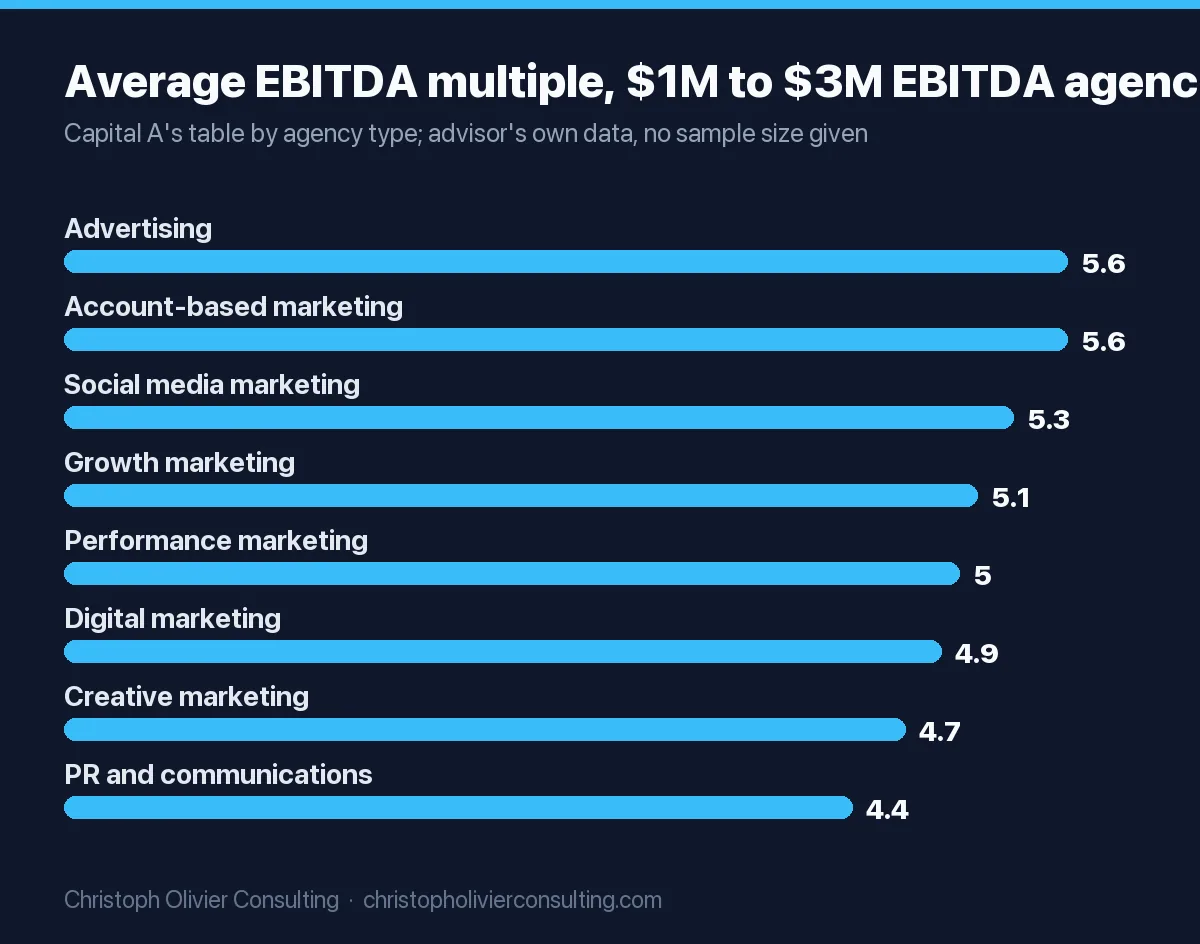
| Capital A, page dated April 19, 2024, table labeled 2025 | Average times EBITDA, by EBITDA band | Not disclosed | Advertising: 5.6x ($1M to $3M), 7.7x ($3M to $5M), 9.5x ($5M to $10M). Digital marketing: 4.9x, 6.1x, 9x |
| FE International, October 19, 2026 | Times trailing net revenue | Benchmark range | 0.4x to 1.0x, top of the range for retainer-heavy books |
Two rules hold across all four sources. Size moves the multiple more than anything else: Palmer’s top band is roughly three times its bottom band. And revenue multiples are a sanity check, not a price. Axial’s advisors describe revenue multiples as a ceiling of about 1x revenue rather than the primary method.
Ad agencies: buyers price net revenue, not billings
If your agency places media, gross billings overstate the business. FE International states that media agencies are valued on net revenue, not gross billings, and that their multiples depend on whether they own data and analytics capability or only execute buys. David Tobin of TobinLeff told Axial that purely service-based digital agencies trade at multiples “not that much different” from well-run PR, integrated, advertising and creative agencies, typically 4.5x to 7x for most midsize and smaller firms, with a lift only when there is a real AdTech or MarTech component. If you run a PR firm, the bands are different; our exit planning guide for PR firm owners has the PR-specific figures and deal structures.
Worked example: a $5M digital marketing agency
Say your agency books $5.0 million of net revenue (after pass-through media) and earns an 18% EBITDA margin once you recast owner perks and pay yourself a market salary. That is $900,000 of adjusted EBITDA.
- FE International, $500K to $1M band (3x to 5x): $900,000 x 3 to 5 = $2.7M to $4.5M.
- Palmer, under $1M band (2.5x to 3.9x): $2.25M to $3.51M.
- FE revenue cross check (0.4x to 1.0x net revenue): $2.0M to $5.0M, which says the top of the EBITDA range is optimistic for this margin.
- Lift the margin to 22% on the same revenue: EBITDA becomes $1.1M and crosses into the next band. FE’s $1M to $2.5M band (4x to 6.5x) gives $4.4M to $7.15M; Palmer’s $1M plus band (3.5x to 5x) gives $3.85M to $5.5M.
Four points of margin move the low end of the range from $2.25M to $3.85M because the agency changes size band. FE reserves the top of its $1M to $2.5M band for agencies with a 60%+ retainer mix, a 20%+ margin and no client above 15%, so margin alone does not get you to $7M. The scorecard below shows what does.
What buyers diligence in an agency: a pass/fail scorecard
Score your agency on each line before you speak to a buyer or a banker. Every threshold comes from the source named in the row.
| Factor | Pass | Fix first | Where the line comes from |
|---|---|---|---|
| Largest client | No client above 10% of revenue | Any client above 20%; above 25% is structural risk | Palmer via Axial (10%); FE International (above 15% bars the top of the $1M to $2.5M band, above 20% diversify first, at 35% a buyer’s model “collapses”) |
| Top three clients | 25% of revenue or less | Above 25% | Palmer via Axial |
| Retained revenue | 60% or more on retainer; 70%+ for a performance agency aiming at 8x to 10x | Mostly project or campaign work | FE International: above 60% earns one to two turns more than an identical project shop |
| EBITDA margin (recast) | Above 20% | Below 20% | TobinLeff study of 60+ agency buyers, via Axial: margin was the number one value driver; FE ties 20%+ to the top of its band |
| Client retention history | Client-by-client churn you can show for three to four years | No churn data, or heavy turnover | TobinLeff via Axial: buyers “go back over the past three to four years” client by client |
| Who sells new business | A managing director or a documented inbound and outbound process | You personally run sales | FE International: a founder-run sales function pushes a digital agency to 3x to 4x |
| Who holds client relationships | Account leads clients call first | Clients call you | Palmer via Axial; buyers expect a founder who holds relationships to stay 6 to 12 months after closing |
| Positioning | A named sector or service line | “Everything for everyone” | Palmer and TobinLeff via Axial: premiums go to sector brand equity and specific capabilities |
My rule of thumb for reading the result: six or more passes and you can run a process now; four or five and you are a year of focused work away; three or fewer and the readiness plan comes before any banker. Treat that as a planning heuristic, not a market standard.
How the price actually gets paid
The headline number is not the cash you take home at closing. FE International’s 2026 ranges for clean lower middle market agency deals are 60% to 70% cash at close with a 10% to 20% earnout over one to two years. With a client above 25% or founder-run sales, cash at close drops to about 50% and the earnout rises to 25% to 40%. On the $4.4M valuation above, that is $2.64M to $3.08M at close in a clean deal, against about $2.2M with structural risk. Earnouts also underpay: FE cites SRS Acquiom data on 2025 private deals showing 59% of earnouts paid something, but only 21% of total potential earnout dollars were paid.
How to hire an exit planning firm (and the M&A advisor who sells the agency)
Most agency owners need two different hires, often at different times. An exit planner works on readiness: your goals, the value gaps in the scorecard above, and the personal side of the transition. An M&A advisor or investment banker runs the sale itself: valuation, buyer outreach, letters of intent and closing. Some firms do both. Ask which one you are buying.
Exit planning credentials compared: CEPA vs CExP
| CEPA | CExP | |
|---|---|---|
| Issued by | Exit Planning Institute | Business Enterprise Institute (BEI) |
| Prerequisite | Age 18 or older (FINRA profile) | A professional designation such as CPA, JD, CFP, CLU, ChFC, CFA or MBA, or relevant business planning experience (FINRA profile) |
| Training | Five-day virtual program; EPI says it is approved for up to 18 CPE and 14 CFP hours | Online, self-paced Exit Planning Boot Camp plus the Advanced Exit Planning program |
| Exam | Online, proctored, closed-book final exam | Open-book module assessments plus two written case study exams |
| Continuing education | 40 hours every three years | 30 hours every two years |
| Published price | Not checked here | Boot Camp $1,495, Advanced course $4,000, exam $1,795 ($7,290 in total) on BEI’s page |
| Complaint process listed by FINRA | None | Complaints by email to BEI |
Both are training credentials. Neither is a license to give investment, tax or legal advice, or to act as a securities broker. Before you sign, run the planner through BrokerCheck, IAPD and the state lookups in our eight-lookup vetting table for exit planners, which also explains the parts of Form ADV worth reading.
Does the advisor selling your agency need to be a registered broker-dealer?
It depends on the deal and the advisor. Under Section 15(a) of the Securities Exchange Act, a broker who effects transactions in securities must register with the SEC, and Section 15(b)(8) requires a registered broker-dealer to belong to a registered securities association, which in practice means FINRA. A stock sale of your agency is a securities transaction.
Since March 29, 2023, Section 15(b)(13) exempts “M&A brokers” from SEC registration. Congress added it in the Consolidated Appropriations Act, 2023 (Pub. L. 117-328, signed December 29, 2022). The exemption only applies when all of these hold, per the statute text:
- Size: in the fiscal year before the broker is engaged, your company had EBITDA under $25 million or gross revenue under $250 million, and no SEC-registered securities. The dollar figures are adjusted for inflation every five years from December 29, 2022.
- Buyer: the buyer will control the company and be active in managing it. A transfer to passive buyers is excluded.
- No money handling or financing: the broker may not hold or transmit the deal funds or securities, or provide financing. Helping arrange third-party financing requires written disclosure of any compensation.
- No binding authority, no shell companies, no broker-assembled buyer groups. Representing both sides needs clear written disclosure and written consent from both.
- Clean record: anyone barred from, or suspended from, association with a broker-dealer cannot use it.
The exemption is federal only. Sidley Austin’s March 2023 analysis notes it “provides no protection from the broker-dealer registration requirements of the individual states,” so ask any unregistered advisor which exemption they rely on in your state, and have your deal attorney confirm it.
Exit planning and M&A advisor fee models
Exit planners and M&A advisors rarely publish prices, so use the survey data and the standard formulas to test a quote.
| Fee model | How it works | Published data point |
|---|---|---|
| Lehman scale | 5% of the first $1M of enterprise value, 4% of the second, 3% of the third, 2% of the fourth, 1% above that | Divestopedia definition |
| Double Lehman | 10%, 8%, 6%, 4%, then 2% | Divestopedia |
| Typical success fee by deal size | Percent of enterprise value | Divestopedia: 8% to 12% under $1M, 6% to 8% at $1M to $5M, 4% to 6% at $5M to $10M |
| Upfront engagement fee | One-time fixed fee or monthly retainer | Axial 2026 M&A Fee Guide (331 advisor responses, Q2 2026): 71% charge some upfront fee; 31% one-time fixed, 29% monthly; nearly a third charge none, up from 19% in the 2024 survey |
| Monthly retainer size | Paid during the engagement | Axial’s earlier guide (250+ advisors, 2022 data): 49% said $5,000 to $10,000 a month; 56% deducted retainers from the success fee |
| Success fee structure mix | Lehman-style vs flat percent | Axial 2026: Lehman-style and flat percentage together are 79% of responses; Lehman-style remains the most common |
Worked example on the $4.4M agency sale above. The Lehman scale gives $50,000 + $40,000 + $30,000 + $20,000 + 1% of $400,000 ($4,000) = $144,000, or 3.3%. The Double Lehman gives $100,000 + $80,000 + $60,000 + $40,000 + $8,000 = $288,000, or 6.5%. Divestopedia’s 6% to 8% band for $1M to $5M deals gives $264,000 to $352,000. If a banker quotes above the band, ask what the extra buys. If they quote far below it with a large retainer, ask whether the retainer is credited against the success fee.
Questions to ask before you sign an engagement letter
Owners in Axial’s Advisor Finder program met an average of 3.3 advisors and took 80.4 days from first outreach to a signed engagement letter in 2026, per Axial’s Q3 2026 report. Use that time to ask every candidate the same questions:
- Which agency deals like mine have you closed in the last three years? Ask for size, buyer type and the multiple range. A firm that sold a $40M holding company platform may not chase a $4M agency.
- How is your fee structured? Get the retainer, the success fee formula, whether the retainer is credited at close, any minimum fee, and the tail period in writing. Axial lists this as the first question to ask.
- Are you registered with FINRA, and if not, which exemption do you rely on? Check the answer on BrokerCheck and with your attorney.
- What should I fix before we go to market? A good answer names items from the scorecard above, such as client concentration or founder-run sales, with a timeline.
- How many buyers will you contact, and how? TobinLeff told Axial it typically contacts 300 to 600 target buyers to bring 3 to 6 qualified offers. Compare every candidate’s answer to that.
- Who works my deal day to day? The partner who pitches is not always the person who builds your data room.
- How do you handle earnouts? Ask what share of their recent deals had one and how much of it sellers actually collected.
For exit planning advisors: when to hire marketing help
Everything above is what your agency-owner prospects need to hear from you. Producing it every month is where many exit planners hit a wall. Most advisors do their own marketing for a long time, and for a long time that is the right call: your referral partners already trust you and a steady LinkedIn habit can fill a calendar. Hire help when specific things break:
- You are the bottleneck. Marketing only happens when you sit down to do it, and stops the week client work gets busy.
- You have demand you cannot capture. People find you, but the site, the follow-up or the intake leaks them before a first meeting.
- You are guessing. You cannot say which activities produced this quarter’s qualified owner conversations.
- You want a second channel beyond referrals. That is a strategy problem, not a posting problem.
- You are spending without a plan. A freelancer, some ads and a tool subscription that do not connect to a number you track.
One signal means get organized. Three or more at once means bring in outside help. Before you hire anyone for production, settle who you serve and why with our exit planning positioning framework, because content made without a position just makes noise faster.
In-house vs agency vs fractional CMO: what each costs in 2026
These are the same published rates we use in our fractional CMO cost guide. They are vendors’ asking prices, not survey data, so always ask for the hours behind a monthly quote.
| Option | Published cost | Hours or scope | Exit terms | Source |
|---|---|---|---|---|
| Fractional CMO, strategy only | $3,000 to $6,000 a month ($36,000 to $72,000 a year) | 5 to 10 hours a week | Month-to-month deals typically 30 days’ notice | MarketerHire, April 2026; SaaS Hero |
| Fractional CMO, strategy plus oversight | $7,000 to $12,000 a month ($84,000 to $144,000 a year) | 15 to 20 hours a week | Longer deals 3 to 12 months, 30 to 60 days’ notice | MarketerHire; SaaS Hero |
| Agency | $5,000 to $25,000+ a month | A team the agency assigns | 6 to 12 month lock-in; often 60 to 90 days’ notice | MarketerHire; SaaS Hero |
| Freelancer | $2,000 to $8,000 a month | A defined task you direct | Per project | MarketerHire |
| Full-time marketing leader | $216,373 a year loaded ($166,790 median salary x 1.297) | Full time | Employment | BLS, May 2025; benefits load from BLS ECEC, June 2026 |
The 1.297 multiplier is the BLS benefits load for private-industry management, business and financial jobs: $20.31 of benefits and supplemental pay on $68.32 of wages plus paid leave. Divide $216,373 by 12 and the break-even is $18,031 a month; a fractional leader billing more than that for a full year costs more than a median full-time hire. MarketerHire puts its own tipping point lower, at fractional fees above $12,000 to $15,000 a month for six months or more.
Then hold any option to a payback bar: year-one cost divided by gross margin is the new revenue it must produce. A $72,000 strategy-only year at a 50% gross margin needs $144,000 of added revenue. As an illustration, if one new planning engagement brings you $24,000 of gross margin, that year has to produce three engagements you would not otherwise have won.
A simple way to choose
Map the broken layer to the structure that fixes it:
| What is broken | Hire first | Why |
|---|---|---|
| Nobody decides who you target, what you say or which channel to fund | Fractional CMO, strategy only | Senior direction for $36,000 to $72,000 a year, well under a loaded full-time hire |
| The plan is clear but nothing gets made | Agency or a specialist freelancer | Production volume; you or a fractional lead directs it |
| One channel works and needs a specialist | Channel specialist | For example, a retargeting setup for the few hundred owners already on your site |
| Steady, predictable work for years | In-house hire | Knowledge stays inside the firm; only once volume fills a full role |
Many advisors run a hybrid: a fractional lead sets direction and manages an agency or two freelancers. Our guide to fractional marketing roles breaks down each role and its rate. If you start with one channel, our retargeting guide for exit planning advisors shows what a specialist should hand you, from audience windows to budget math for small audiences. My view: for exit planners the strategy layer, who you target and how you nurture a two-to-five-year decision, is where most of the value sits, and it is the layer a junior hire or a template agency is least equipped to own.
Compliance follows the work, not the worker
Handing marketing to an agency or a hire does not move the responsibility off your desk. If you are a registered investment adviser, the SEC Marketing Rule (17 CFR 275.206(4)-1) applies to your advertisements whoever writes them. Three requirements trip up outsourced marketing most often:
- Testimonials need disclosures. The ad must clearly and prominently state whether the person is a current client and whether they were paid in cash or otherwise for it.
- You must have oversight. The rule requires a reasonable basis for believing each testimonial or endorsement complies, and a written agreement with promoters, subject to the rule’s exceptions.
- Every material fact must be substantiated. An ad may not include a material statement of fact you cannot substantiate on request. A valuation lift, sale price or timeline you cannot document does not belong in copy.
Ask your compliance counsel whether your LinkedIn posts and webinar decks count as advertisements, rather than assuming they do not. Keep a documented review step before anything goes live, even when the content came from a vendor, and confirm how these rules apply to your registration with your compliance counsel. Then fold the hire into a written marketing plan for your exit planning practice so the channels, content and compliance review run on one calendar. If you want a second opinion on which hire fits your firm right now, you can book a consultation.
Work with CO Consulting
Senior marketing leadership, without the full-time hire
- One senior owner of strategy, budget, vendors and the weekly scorecard
- Audit first, then a prioritized 90-day plan with measurable milestones
- Weekly team leadership, monthly strategic reviews and quarterly planning
- No guarantees we cannot back up; reporting tied to pipeline
Book a free strategy callHow we work with exit planning advisors
Frequently asked questions
How do you do exit planning for an ad agency?
Start by recasting EBITDA: add back owner perks, pay yourself a market salary, and value media on net revenue, not gross billings. Then score the agency on client concentration, retainer share, margin and founder dependence. Axial's advisors put agencies under $1 million of EBITDA at 2.5x to 3.9x and over $5 million at 8x to 10x. Fix the weak lines before you hire a banker to run the sale.
What multiple does a digital marketing agency sell for?
FE International's October 2026 benchmarks put most digital marketing agencies at 4x to 7x adjusted EBITDA, with performance and paid media agencies reaching 8x to 10x when retainers exceed 70%, ROI is documented and EBITDA tops $3 million. Founder-run sales or one client above 25% pushes agencies to 3x to 4x. Revenue multiples run 0.4x to 1.0x of trailing net revenue.
How do I hire an exit planning firm?
Interview at least three firms; owners in Axial's 2026 program met 3.3 advisors on average and took 80.4 days to sign. Check the credential (CEPA from the Exit Planning Institute or CExP from BEI), run BrokerCheck and IAPD, ask for agency deals closed in the last three years, and get the retainer, success fee formula and retainer credit terms in writing.
Does an M&A advisor need to be FINRA registered to sell my agency?
A broker effecting securities transactions, such as a stock sale, must register with the SEC and join FINRA, unless an exemption applies. Since March 29, 2023, Exchange Act Section 15(b)(13) exempts M&A brokers selling private companies with under $25 million EBITDA or $250 million revenue to buyers who will control and run them. States can still require registration, so confirm with your attorney.
What does an M&A advisor charge to sell an agency?
Most charge an upfront fee plus a success fee. Axial's 2026 survey of 331 advisors found 71% charge some upfront fee, and Lehman-style or flat-percentage success fees make up 79% of structures. On a $4.4 million sale, the Lehman scale gives $144,000 and the Double Lehman $288,000. Divestopedia lists 6% to 8% as typical for $1 million to $5 million deals.
When should an exit planning advisor hire marketing help?
When three or more things break at once: marketing only happens when you do it, interested owners leak before a first meeting, you cannot say which activities produced this quarter's conversations, or you want a channel beyond referrals. A strategy-only fractional CMO costs $3,000 to $6,000 a month, against about $216,373 a year for a loaded full-time marketing leader at the BLS median.
Is a fractional CMO cheaper than an agency for an exit planner?
They buy different things. A fractional CMO at $3,000 to $12,000 a month owns strategy, while an agency at $5,000 to $25,000 or more a month produces work, usually on a 6 to 12 month lock-in with 60 to 90 days' notice. Many advisors pair a fractional lead with one agency or freelancer, so the plan and the production come from different people.
More marketing guides for exit planning advisors
- Email Marketing for Exit Planning Advisors
- Google Ads for Exit Planning Advisors: A Practical Playbook
- How Exit Planning Advisors Get Cited by AI Search
- Marketing KPIs and Metrics for Exit Planning Advisors
- Thought Leadership for Exit Planning Advisors: How to Build Authority That Wins Referrals
- CRM and Deal Pipeline for Exit Planning Advisors