

Seasonal marketing for a business coach means running four dated campaigns a year, each tied to a moment when owners already plan: new-year planning (cart open January 11 to 22, 2027), the post-tax spring reset after Thursday, April 15, a mid-year review in June, and a back-to-business plus Q4 planning push from Labor Day to December 10. Between them sit two quiet stretches, July and the Thanksgiving and Christmas weeks, where you build assets instead of selling. Google search data for “business coach” is flatter across the year than most launch advice suggests, so the calendar your buyers live by matters more than a universal “peak month.”
This page is the campaign layer: what to run, when to start it, which offer fits, the subject lines to send, how to weight the budget by month, and what to measure. The month-by-month themes, holiday table and posting cadence already live in our 2027 marketing calendar for business coaches; every date below matches it.
The 2027 seasonal campaign plan at a glance
Four campaigns, two quiet periods. Dates are 2027 unless noted. Federal holidays are from OPM’s 2027 holiday table; tax dates follow the due-date rules in IRS Publication 509, and none of the 2027 dates used here lands on a weekend.
| Campaign | Runs | Dated hook | Main offer | Ask level |
|---|---|---|---|---|
| 1. New-year planning | Mon Dec 7, 2026 to Fri Jan 22 | Fri Jan 1 New Year’s Day; Fri Jan 15 fourth 2026 estimated tax payment | Winter cohort starting Mon Feb 1 | High: workshop Tue Jan 5, cart Jan 11 to 22 |
| Tax season (quiet selling) | Mon Feb 1 to Thu Apr 15 | Mon Mar 15 partnership and S corp returns; Wed Mar 31 Q1 ends; Thu Apr 15 Form 1040 | None. Help content and 1:1 calls only | Low |
| 2. Post-tax spring reset | Mon Mar 22 to Fri Apr 30 | The day after April 15 | Spring cohort starting Mon May 3 | High: cart Apr 19 to 30, workshop Tue Apr 20 |
| 3. Mid-year review | Tue Jun 1 to Wed Jun 30 | Tue Jun 15 Q2 estimate; Wed Jun 30 half-year close | Paid mid-year review session | Medium: one small offer |
| Summer quiet | Mon Jul 5 to Fri Aug 13 | Mon Jul 5 Independence Day (observed) | Waitlist for fall | None |
| 4a. Back to business | Mon Aug 16 to Fri Sep 17 | Mon Sep 6 Labor Day; Wed Sep 15 Q3 estimate and extended business returns | Fall cohort starting Mon Oct 4 | High: workshop Wed Sep 8, cart Sep 7 to 17 |
| 4b. Q4 planning | Mon Oct 18 to Fri Dec 10 | Fri Oct 15 extended Form 1040; Thu Nov 25 Thanksgiving | January 2028 cohort starting Mon Jan 10, 2028 | High: early-bird Nov 8 to 19, final enrollment Nov 29 to Dec 10 |
| Holiday quiet | Mon Dec 13 to Fri Dec 31 | Fri Dec 24 Christmas (observed) | None | None |
The 2027 tax dates are the same ones used in our 2027 tax season email templates for tax firms, which is useful if a CPA is one of your referral partners: you will be quiet in the weeks they are busiest.
When people actually search for a business coach: Google Trends, 2022 to 2026
I pulled US weekly data from Google Trends on November 1, 2026 for “business coach” and “executive coach”: a 2022 to 2025 window and a five-year window to October 2026. Trends numbers are not search volumes. Google says each point is a share of all searches for that time and place, scaled 0 to 100, and drawn from a sample. So read the shape, not the size.
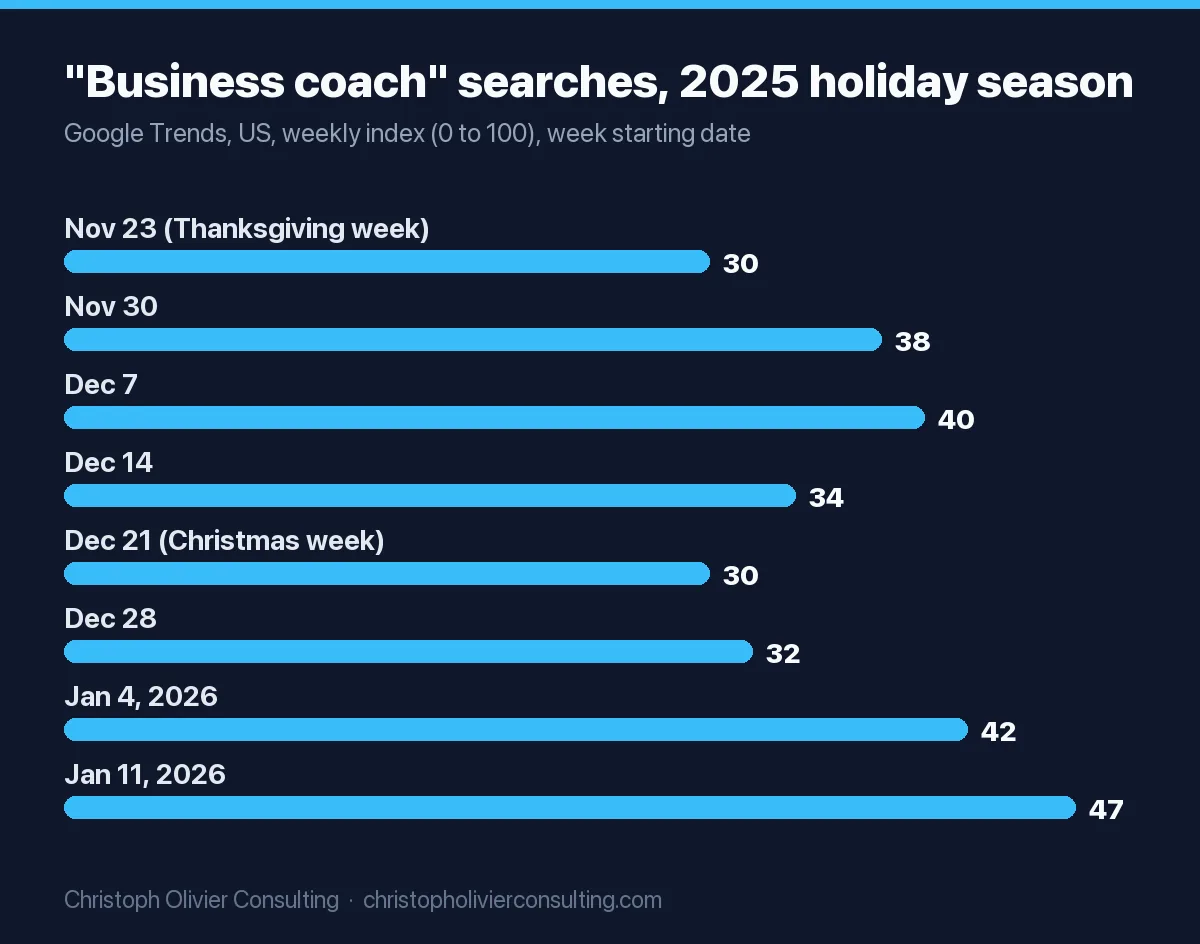
What the curve shows:
- No dependable peak month. From 2022 through 2024, weekly interest in “business coach” stayed inside a band of 24 to 47 (2022 to 2025 window). The year’s high week landed in a different place each year: week of October 2 in 2022, week of December 10 in 2023, week of March 10 in 2024. “January is coaching season” is not visible in search.
- The holiday weeks are the reliable low. For “executive coach,” the Thanksgiving week and the Christmas week were at or near the year’s lowest reading in 2022, 2023 and 2024 (index 10 to 12 against yearly highs of 16 to 19). For “business coach,” the week of November 19, 2023, which contains Thanksgiving, was that year’s low, and the week of December 18, 2022 fell to 26 from 34 the week before.
- Early December and the first full week of January hold up. The first or second week of December was a local high in every year from 2022 to 2025. In 2025 the week of December 7 was the single highest week of the whole 2022 to 2025 window for “business coach” (index 100), and “executive coach” doubled that week (57, against 28 the week after). The first full week of January rebounded each year: in the five-year window, 30 in the week of December 21, 2025, then 42 and 47 in the weeks of January 4 and 11, 2026.
- 2025 rose steadily, and spring 2026 was a one-off. Interest climbed through 2025, then jumped from late March 2026 to a peak in the week of April 12 (index 100 in the five-year window) and stayed high into early July. In the week of July 12 it fell back, and by October 2026 it averaged 15.8, below October 2025’s 19.2 on the same scale. Trends does not show why. Do not plan 2027 around that spring repeating.
What this means for planning: search tells you when not to sell (the two holiday weeks), not when to sell. The selling windows come from your buyers’ calendar and from the “fresh start” effect. Dai, Milkman and Riis found in “The Fresh Start Effect” (Management Science, 2014) that Google searches for “diet,” gym visits and goal commitments all rise after temporal landmarks such as the start of a new week, month, year or semester, or after a holiday. Every campaign below opens a cohort on the first Monday after one of those landmarks.
Campaign 1: New-year planning (December 7, 2026 to January 22, 2027)
This is the campaign most coaches run, and most run it too late. Owners decide in December whether January will be different. The early-December bump in search fits that.
- Runway, Mon Dec 7 to Mon Jan 4. Two emails a week until December 18, then one light email in the holiday week. Content: the planning problem, never the offer.
- Free workshop, Tue Jan 5. 45 minutes: “Set your 2027 numbers.” Registration page goes live December 7.
- Cart, Mon Jan 11 to Fri Jan 22. Load the email order from our group program launch email sequence. That sequence is built on a 7-day cart; across a 10 to 12 day cart, keep its prelaunch emails as written and spread the open-cart emails over the extra days.
- Cohort starts Mon Feb 1. Three weeks after cart close leaves room for onboarding.
Offer: the winter cohort, plus a planning-season bonus only if it is real (for example, one 1:1 planning session for people who enroll by January 15). Copy-ready subject lines, in send order:
- “The 4 numbers to set before February” (runway, Dec 8)
- “What did 2026 actually pay you per hour?” (runway, Dec 15)
- “Tuesday: set your 2027 numbers in 45 minutes” (workshop invite, Dec 29)
- “Your Q4 estimate is due Friday. Your 2027 plan isn’t.” (cart week, Jan 12, three days before the January 15 payment)
- “[Program] closes Friday at 9 pm ET” (Jan 21)
Tax season: why February and March are quiet selling months
If your clients own businesses, March is spent with their accountant. Partnership and S corporation returns are due Monday, March 15, and individual returns Thursday, April 15 (Publication 509: the 15th day of the 3rd and 4th months after year end). A launch email that lands on March 12 competes with a K-1 chase.
Run help content and 1:1 calls only. Three plays that work in this window:
- A “close your Q1” checklist sent Tue Mar 23, the week before Q1 ends on Wednesday, March 31. Subject: “Your Q1 close in 30 minutes: the owner’s checklist.”
- Referral-partner co-content. Ask a CPA partner for the three questions owners always ask in March and answer them in your newsletter. Subject: “3 things your CPA wishes you had ready by March 15.”
- Waitlist capture for the spring cohort, with no price shown yet.
Campaign 2: The post-tax spring reset (March 22 to April 30)
April 15 is a landmark for owners: the return is filed and the year’s numbers are on paper. The runway starts Monday, March 22 in a tax-season tone, and the cart opens Monday, April 19, four days after the 1040 deadline, which is also when the first 2027 estimated payment is due.
- Workshop Tue Apr 20: “Read your 2026 return as a business plan.”
- Cart Mon Apr 19 to Fri Apr 30. Cohort starts Mon May 3.
- Skip this cart if most of your buyers are accountants. April is their deadline, not their reset; run your spring push for them in May instead.
Subject lines:
- “Taxes filed. Now read your return as a business plan” (Apr 16)
- “The 3 lines on your 2026 return that predict 2027” (Apr 19, cart open)
- “Spring cohort: 12 weeks, starts Monday May 3” (Apr 26)
- “Last day: spring cohort closes tonight” (Apr 30)
Campaign 3: The mid-year review (June 1 to June 30)
June is a small campaign, not a launch. Wednesday, June 30 closes the half-year, and Tuesday, June 15 is the second estimated tax date, so cash is on owners’ minds. Sell one low-ticket, fixed-scope offer: a 90-minute mid-year review session, with a written 90-day plan. Those buyers become your best fall cohort leads.
- Open the offer Tue Jun 1. Cap it at the number of sessions you can deliver before July 5.
- Avoid sends on Fri Jun 18 (Juneteenth observed).
- Subject lines: “Half of 2027 is gone: the 3-question mid-year review” (Jun 1), “Ahead or behind on your 2027 number?” (Jun 8), “6 review slots left before July” (Jun 22, only if true).
The quiet periods: July and the holiday weeks
Quiet is not silent. In the Trends data the Thanksgiving and Christmas weeks were the softest weeks for “executive coach,” the July 4 week was a low in 2023 and 2024, and summer weeks (June 30, July 14, August 4) were 2024’s lows for “business coach.” Use them to build what the next campaign needs:
- July (Jul 5 to Aug 13): newsletter every other week, short. Record the fall workshop and three runway videos; our guide to video marketing for business coaches covers the production side. Open a fall waitlist with no price.
- Thanksgiving week (Nov 22 to 26): no cart closes, no launch emails. The calendar’s early-bird closes November 19 and final enrollment opens Monday, November 29, which keeps the whole week clear.
- December 13 to 31: one honest “year in numbers” email, then stop. Owners who are researching coaches in the quiet week will find your content, not your cart.
Campaign 4: Back to business and Q4 planning (August 16 to December 10)
The fall is two campaigns run back to back. Labor Day (Monday, September 6) is the landmark for the first, and Q4 planning season is the reason for the second.
| Step | 4a: Fall cohort | 4b: January 2028 cohort |
|---|---|---|
| Runway (content, no pitch) | Mon Aug 16 to Fri Sep 3 | Mon Oct 18 to Fri Nov 5 |
| Free workshop | Wed Sep 8: “The 90-day Q4 plan” | Tue Nov 9: “Build your 2028 plan in one afternoon” |
| Cart | Tue Sep 7 to Fri Sep 17 | Early-bird Mon Nov 8 to Fri Nov 19; final Mon Nov 29 to Fri Dec 10 |
| Cohort starts | Mon Oct 4 | Mon Jan 10, 2028 |
| Dated hook in copy | Wed Sep 15: Q3 estimate and extended partnership and S corp returns | Fri Oct 15: extended Form 1040 deadline, the last tax task of the year for owners on extension |
Subject lines for 4a: “Why Q4 is won or lost in September” (Aug 17), “Wednesday: your 90-day Q4 plan, live” (Sep 2), “Fall cohort is open: starts Monday, October 4” (Sep 7), “Closes Friday: fall cohort” (Sep 16).
Subject lines for 4b: “Year-end decisions to make before Thanksgiving” (Oct 19), “Early-bird for the January cohort ends Friday” (Nov 17), “Enrollment is open again: January 2028 cohort” (Mon Nov 29), “Last call for the January 10 start” (Dec 9).
One rule from the calendar page applies here: never close a cart on a federal holiday or the Friday after Thanksgiving.
If your buyer’s fiscal year does not start in January
Most owner-run small businesses plan on the calendar year because the tax rules push them there. IRS Publication 538 says individuals generally must adopt the calendar year, personal service corporations must use a calendar year unless an exception applies, and a partnership must conform its tax year to its partners’ years unless an exception applies. That is why the plan above works for most business-coach buyers.
Executive coaching bought by a company is different: the buyer is often an HR or L&D budget on the company’s own fiscal year. Ask one question on every discovery call: “When does your fiscal year end, and when is next year’s budget approved?” Then move the campaigns:
| Buyer’s fiscal year ends | Run the “planning” campaign | Run the “use it or plan it” campaign |
|---|---|---|
| December 31 (most owner-led firms) | Oct 18 to Dec 10 (4b above) | Not needed |
| March 31 | Six to eight weeks before the budget is approved, typically January and February | February to mid-March, for unspent current-year budget |
| June 30 | April and May | May to mid-June |
| September 30 | July and August | August to mid-September |
The timing in this table is my planning rule, not a published benchmark. Replace it with the approval dates your buyers give you.
Budget weighting by month (assumptions, labeled)
Seasonal budgets should follow the carts, not the calendar. The split below assumes a $18,000 annual paid budget (retargeting, a little search, workshop promotion and tools) and four carts. Both the total and the weights are assumptions for illustration. To set your own total, price only the tactics you will run, using the cash-cost column in our 27 marketing ideas for business coaches.
| Month | Weight | At $18,000/year | Why |
|---|---|---|---|
| January | 10% | $1,800 | Workshop promotion, winter cart |
| February | 6% | $1,080 | Retargeting list building, onboarding |
| March | 5% | $900 | Tax season: help content only |
| April | 12% | $2,160 | Spring runway peak and cart |
| May | 6% | $1,080 | Cohort delivery, testimonial capture |
| June | 7% | $1,260 | Mid-year review offer |
| July | 3% | $540 | Quiet: waitlist only |
| August | 8% | $1,440 | Fall runway starts Aug 16 |
| September | 13% | $2,340 | Fall workshop and cart |
| October | 9% | $1,620 | Q4 planning runway |
| November | 14% | $2,520 | Workshop Nov 9, early-bird, final enrollment |
| December | 7% | $1,260 | Final enrollment to Dec 10, then stop |
| Total | 100% | $18,000 |
Two adjustments. If you get clients mainly from referrals and speaking rather than ads, move the money into time instead, using the channels in our guide to getting coaching clients without social media. And do not raise spend because a Trends line jumps, as it did in spring 2026; check your own impressions and booked calls first.
KPIs for each seasonal campaign
Judge a seasonal campaign on the four numbers that tell you which stage broke. Record them for every cart, so the second year’s plan is built on your data, not mine.
| KPI | How to calculate | Check on | If it is low, fix |
|---|---|---|---|
| Workshop show rate | Live attendees / registrants | Workshop day | Reminder emails and the day and time |
| Attendee to call rate | Calls or applications booked / attendees | Cart day 3 | The workshop’s offer section |
| Call close rate | Enrollments / calls held | Cart close | Fit of who you invited, or the price |
| Quiet-period list growth | New subscribers in July and late December | Aug 13 and Dec 31 | The waitlist offer |
Worked example, working back from seats. Say the fall cohort has 8 seats. Using placeholder rates (not benchmarks; swap in yours after one cart): a 25% call close rate means you need 32 calls. If 20% of attendees book a call, you need 160 attendees. If 40% of registrants show up, you need 400 registrants by Wednesday, September 8. If your list cannot produce 400 registrants, the plan needs a partner workshop or a smaller seat count, and you know that by mid-August, not on September 17.
Seasonal urgency that stays inside FTC rules
Seasonal campaigns run on deadlines and proof, which is where coaches get into trouble. Three rules:
- Deadlines must be real. If the January cart closes Friday, January 22, it closes. A deadline you extend teaches your list to wait for the next one.
- Exceptional results need the typical result next to them. The FTC’s Endorsement Guides FAQ says an ad featuring an endorser’s exceptional results must make clear what the generally expected results are, unless you can show the experience is typical, and that a connection consumers would not expect, such as payment or a free seat, should be disclosed clearly and conspicuously. Our page on testimonials and case studies for business coaches shows the wording.
- No invented testimonials. The FTC’s Consumer Reviews and Testimonials Rule, in effect since October 21, 2024, covers creating or selling fake or false consumer testimonials.
This is marketing guidance, not legal advice. If you want a second pair of eyes on your 2027 campaign dates before the December 7 runway starts, you can book a consultation.
Frequently asked questions
What are the best months for a business coach to launch a program?
For coaches who sell to business owners, the strongest 2027 windows sit right after landmarks: a January cart (Jan 11 to 22) after New Year, an April cart (Apr 19 to 30) right after the April 15 tax deadline, a September cart after Labor Day, and a November early-bird for a January 2028 start. Google Trends shows no single peak month, so time launches to your buyers' calendar.
Do people buy coaching during the holidays?
They research, but the holiday weeks are the weakest weeks to sell. In Google Trends, Thanksgiving week and Christmas week were at or near the year's low for "executive coach" in 2022, 2023 and 2024. Early December held up well, though, and the first full week of January rebounded every year. Sell in early December and January, and stay quiet but visible in between.
Is there a slow season for business coaches?
Yes, but it is shorter than most people think. The reliable soft spots are the Thanksgiving and Christmas weeks, plus parts of summer: the weeks of June 30, July 14 and August 4 were the 2024 lows for "business coach" in Google Trends. Use July for recording workshops, writing runway emails and building a fall waitlist rather than selling.
How should a business coach plan marketing around tax season?
Go quiet on selling from February to mid-April if your clients own businesses. In 2027, partnership and S corporation returns are due Monday, March 15 and individual returns Thursday, April 15. Send help content and a Q1 close checklist in March, then open your spring cart on Monday, April 19, four days after the filing deadline.
How far ahead should I start a seasonal coaching campaign?
Start the runway three to four weeks before the cart opens. In the 2027 plan, the new-year runway starts Monday, December 7, 2026 for a January 11 cart, the spring runway starts March 22 for an April 19 cart, and the fall runway starts August 16 for a September 7 cart. Leave about three weeks between cart close and cohort start for onboarding.
How should I split a coaching marketing budget by month?
Weight spend toward cart months and their runways. One illustrative split, assuming $18,000 a year and four carts, puts 14% in November, 13% in September, 12% in April and 10% in January, with only 3% in July and 5% in March. These weights are planning assumptions, so reset them after one year using your own booked calls per dollar.