

Direct marketing for a business coach means mailing a short list of named owners you actually want as clients, not blanketing a neighborhood. The play that fits most coaching practices is 100 hand-picked companies, three touches over about three weeks (a letter, a postcard, a handwritten note), and one tracked call to action on every piece. Using published 2026 vendor prices, that sequence costs about $577 for all 100 companies, list and call tracking included, and every price below is linked to the page it came from.
If you landed here looking for a “direct marketing coach” to teach you this, the playbook below is the core of what one would install: a defined list, a small offer, a sequence, and measurement against cost per booked call. It is written for coaches and consultants who sell to business owners, partners and executives.
The 100-company direct mail plan at a glance
| Decision | What to do | Why |
|---|---|---|
| Who | 100 named owners or CEOs, scored with the rubric below | A coaching practice needs a handful of clients a quarter, not thousands of leads |
| List source | Your CRM first, then Data Axle Reference Solutions (free with many library cards) or ListShack ($50 a month) | Both carry business owner or executive data plus size and industry fields |
| Touch 1, day 0 | One-page letter in a plain envelope, First-Class | Room to show you understand one specific problem |
| Touch 2, about day 10 | 4×6 postcard that refers back to the letter | Cheap reminder, readable without opening |
| Touch 3, about day 21 | Handwritten note card | The most personal touch, saved for last |
| Optional | A “lumpy” package to your top 10 | Parcel postage runs 10 to 17 times a letter stamp, so ration them |
| Tracking | QR code with UTM tags, a short personal URL, one call tracking number per touch | So you can price each booked call |
| Success metric | Cost per booked call, then cost per client | Response rate alone hides whether the calls were any good |
Who to mail: building a list of 100 business owners
The list decides more of your result than the copy does. A coach does not need volume. You need the right 100 people at addresses where they will open their own mail.
Why EDDM rarely fits a business coach
Every Door Direct Mail is the cheapest way to mail in the US, but it is built for neighborhoods. The USPS EDDM page describes pieces addressed to “Postal Customer” that go to “every address on your selected routes”, with filters for “age, income, or household size” drawn from Census data. EDDM Retail is “currently $0.26 per piece”, needs at least 200 pieces, and caps at 5,000 pieces per day per ZIP Code.
For a coach that is the wrong tool on three counts. You cannot put an owner’s name on the piece. You cannot select by industry, headcount or revenue, because the filters describe households. And most pieces land at homes and apartments, while your buyer is a specific person at a specific company. EDDM can work for a coach who sells to local consumers, or to promote a public workshop in one town. For owner-level B2B coaching, use a named list.
Where to get named business owner data, with published prices
| Source | Published price | What you get | Watch out for |
|---|---|---|---|
| Your own CRM, past webinar and event lists, referral partners’ introductions | Free | People who already know your name | Usually too few, so it becomes the first 20 of the 100 |
| Data Axle Reference Solutions through a public library | Free with a participating library card | Fort Bend Libraries lists “more than 94 million US business records” with executive contact name and title, employee size, sales volume, SIC and NAICS codes, and says users can download and print lists and “create lists for marketing, building a business plan, and much more” | Access depends on your library’s subscription; check its terms before you export |
| ListShack | Individual $50 a month (5,000 records per file), Team $99, 50K Rollover $199 | The business database covers “over 14 million businesses” with “owner information (where available), address, sales volume, SIC code” | No contact title field is listed; owner names are not on every record |
| LinkedIn and the company website | Free to check | Confirms the owner still runs the firm and gives you a real detail for the letter | Manual: budget a few minutes per company |
Two rules keep the list clean. First, check every record by hand, because a list of 100 is small enough to verify and one wrong name on a personal letter undoes the effort. Second, if you ever scale to presorted postage, the USPS Move Update standard requires that addresses were updated “within 95 days before the mailing date” for First-Class presorted and Marketing Mail prices.
Score the 100 before you mail: a 10-point fit rubric
This is the rubric I would use to pick the 100 from a few hundred raw records. Mail anyone scoring 6 or more, starting from the top.
| Criterion | Points | How to check |
|---|---|---|
| Size inside your sweet spot (for example 10 to 50 staff, or the revenue band you coach best) | 3 | Employee size or sales volume field in the list, cross-checked on LinkedIn |
| A visible trigger: hiring a first manager, opening a second location, a new partner, a leadership change | 2 | Job posts, press releases, the company news page |
| Named decision maker confirmed at a current mailing address | 2 | Website team page or LinkedIn profile matches the list record |
| Some connection: mutual contact, same association, attended your event | 2 | Your CRM, LinkedIn mutuals, member directories |
| Within a drive of you, so an in-person meeting is possible | 1 | ZIP Code |
Formats and 2026 USPS postage for a coach’s mailing
A 100-piece mailing is too small for bulk prices. The Domestic Mail Manual requires “at least 500 pieces” for presorted First-Class Mail and “at least 200 pieces or 50 pounds” for USPS Marketing Mail. So if you mail it yourself, you pay single-piece prices. Every figure below is from USPS Notice 123, the price list headed “Effective October 04, 2026”.
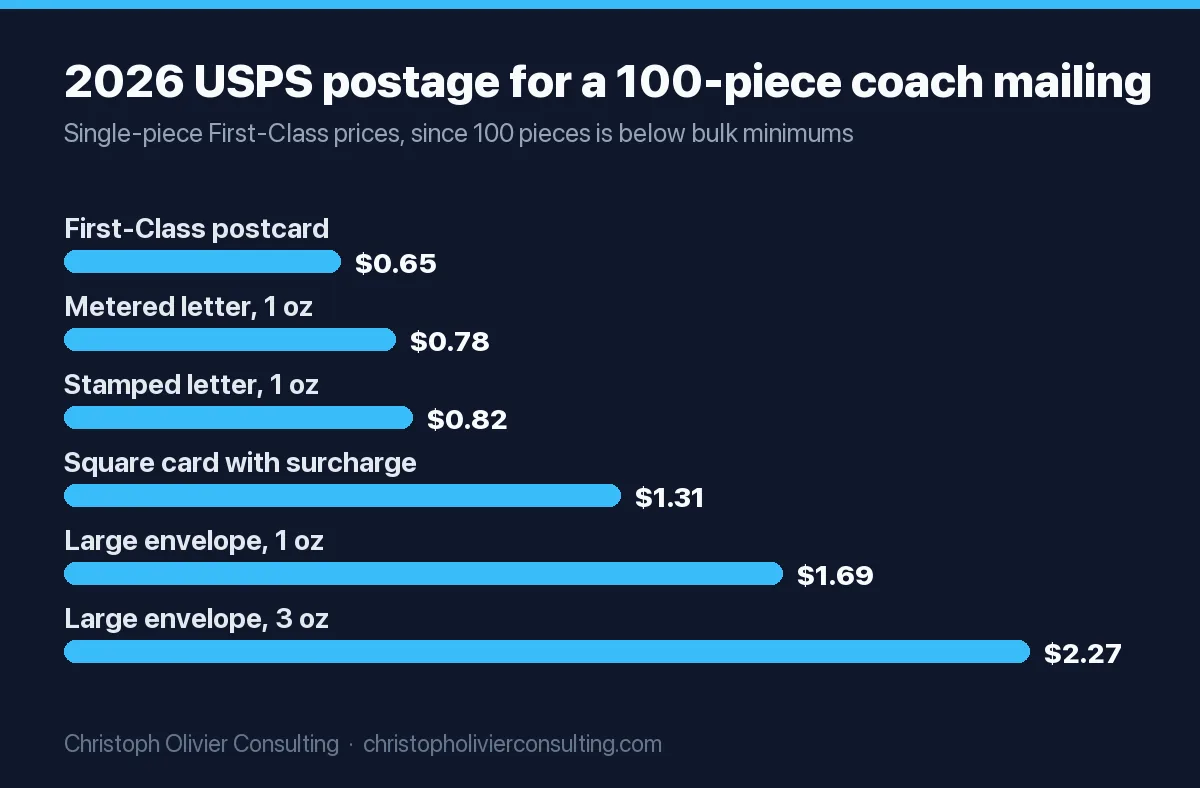
| Piece | 2026 postage per piece | Coaching use |
|---|---|---|
| First-Class postcard (single piece) | $0.65 | Touch 2 reminder; must be 3.5 to 4.25 inches high and 5 to 6 inches long for the card price |
| First-Class letter, metered, 1 oz | $0.78 | Touch 1 letter if you use a postage meter or online postage |
| First-Class letter, stamped, 1 oz (2 oz $1.11, 3 oz $1.40) | $0.82 | Touch 1 letter; touch 3 note in a standard envelope |
| Square note card or other nonmachinable letter | $0.82 plus the $0.49 nonmachinable surcharge, so $1.31 | Touch 3 if you choose a square card |
| Large envelope (flat), 1 oz / 2 oz / 3 oz | $1.69 / $1.98 / $2.27 | A 9×12 envelope with a short report or scorecard |
| USPS Ground Advantage Retail parcel, up to 4 oz / up to 12 oz | $8.40 to $10.20 / $10.05 to $13.65, by zone | Lumpy mail: a book or object in a box |
| For reference at volume: Marketing Mail automation 5-digit letter, First-Class presort automation 5-digit postcard / letter | $0.395, $0.453 / $0.621 | Only once you mail 200 or 500 plus pieces, through a mail house |
The square card trap catches a lot of coaches. The DMM nonmachinable criteria include any letter with an aspect ratio (length divided by height) under 1.3, so a square envelope pays the surcharge. The same list catches “clasps, strings, buttons”, pieces “too rigid” to bend, and items such as “pens, pencils, keys, or coins” that make the thickness uneven. For the full rate card at bulk volumes and the USPS size rules, see the direct mail best practices guide with 2026 postage.
Print-and-mail vendors with published USD prices
You can print letters on your office printer and stamp them, and for 100 pieces that is reasonable. If you would rather upload a file and a CSV, these services publish their per-piece prices. All figures were read from each vendor’s pricing page on November 1, 2026.
| Vendor | Plans and monthly fee | 4×6 postcard | Letter | Handwritten card | Postage |
|---|---|---|---|---|---|
| Lob | Developer $0, Startup from $260, Growth from $550 | From $0.905 (Developer), $0.645 (Startup), $0.615 (Growth) | From $0.828 / $0.658 / $0.628 | Not offered | Included: print, postage and envelope in one rate |
| Postalytics | Free $0, Marketer $199, Pro and Agency $399 | First Class $1.081 (Free), $0.941 (Marketer, under 2,500), $0.821 (Pro) | 8.5×11 simplex, First Class: $1.411 / $1.211 / $1.091 | Not offered | Included; Standard/Marketing Mail and First Class priced separately |
| PostGrid | Starter $0 (up to 500 mailings a month), Enterprise custom | First Class $0.902 | First Class, black and white $1.059, color $1.219; Standard Class B&W $0.827 | Not offered | Included; PostGrid states First Class at 5 to 7 business days and Standard at 10 to 15 |
| Thanks.io | Pay as you go $0, Business $49, Professional $199 | $1.18 / $0.77 / $0.64 | Windowed letter $1.24 / $0.83 / $0.79 | Notecard $3.04 / $1.83 / $1.49 | US postage included; Business and Professional rates are Standard Mail, First Class upgrade adds $0.05 on 4×6 and 6×9 postcards and $0.21 on other products |
| Handwrytten | Pro $449 ($374 billed annually), Enterprise $649, Elite $849, Agency $2,499 | Not its focus | Not its focus | Retail $3.75 a card; $1.99 on Pro, $1.49 Enterprise, $1.29 Elite, $1.19 Agency | “Postage extra”, billed at the current USPS rate |
Two readings matter for a 100-piece campaign. Subscription plans only pay off at volume: Lob’s $260 Startup fee is $2.60 a piece on 100 letters, so the free Developer tier wins. And handwritten cards are where prices diverge most. Thanks.io’s pay-as-you-go notecard at $3.04 includes postage, while a Handwrytten retail card is $3.75 plus postage, which is $0.82 if it goes out at the stamped one-ounce letter price. Click2Mail also sells printed mail and rented lists, but its pricing pages returned an access error when we checked, so it is not in the table.
Lumpy mail and handwritten notes: when the extra cost earns its place
“Lumpy mail” means a package with something inside that makes it bulge: a book, an object, a small box. The case for it comes from ANA’s Response Rate Report 2021, released January 24, 2022: on prospect lists, letter-sized envelopes returned a 112% ROI, “the highest of all formats”, while dimensional and oversized envelopes both “eclipsed 90 percent ROI”. The plain letter won on ROI. Dimensional pieces earn their place when a few accounts are worth far more than the rest, not as the default.
The postage shows why. Once a piece is rigid or uneven it leaves letter prices behind: Notice 123 says large envelopes that are “rigid, nonrectangular, or not uniformly thick pay parcel prices”, and a Ground Advantage Retail parcel up to 12 oz runs $10.05 to $13.65 by zone, against $0.82 for a letter. Keep lumpy mail for your top 10 scorers, and make the object do a job:
- Your book, with one page flagged and a sticky note in your handwriting: “Page 41 is the hiring section I mentioned.”
- A printed one-page scorecard in a rigid folder, with “Score yourself in 4 minutes, then let’s compare notes” on the cover.
- Something tied to the trigger you found: for a firm opening a second office, a desk-sized checklist titled “The first 90 days of a second location”.
Skip novelty props with no link to the offer. They get noticed and then forgotten.
Handwritten notes work differently. They are cheap enough to send to all 100 and slow enough that recipients can tell a person wrote them. Real handwriting is the strongest version. For 100 cards you can write them yourself in an evening; past that, Thanks.io and Handwrytten sell handwritten-style cards at the prices in the table above.
The 3-touch sequence for 100 target companies, ready to copy
Each touch refers to the one before, and each carries the same small offer. The offer below is a 30-minute review with a written one-page result, because a cold owner will book a short, specific diagnostic far more readily than a sales call. Replace everything in brackets.
| Day | Touch | Format and class | Tracking path |
|---|---|---|---|
| 0 | Letter | One page, plain #10 envelope, hand-signed, First-Class | QR code and PURL ending /r/[code]; call tracking number A |
| 4 to 6 (after delivery) | LinkedIn connection request, no pitch | “Sent you a short letter last week about [trigger]. Glad to connect either way.” | Noted in CRM |
| 10 | Postcard | 4×6, First-Class | Same PURL; call tracking number B |
| 21 | Handwritten note | 5×7 card in an A7 envelope (5.25 x 7.25 inches, aspect ratio about 1.4, so no square surcharge) | Short URL written by hand; number C |
| 28 | One phone call to the top 30 scorers who have not replied | “Did my note make it to you?” | Call outcome in CRM |
Touch 1: the letter
[First name],
I saw that [company] is [hiring its first operations manager / opening the [city] office / bringing on a new partner]. Congratulations. In firms around [headcount] people, that step is usually where the owner finds out how many decisions still run through them.
I coach owners of [industry] firms with [10 to 50] staff, and the question I hear most at this stage is: “Which of my decisions can I hand off first, without things breaking?”
So here is an offer. Give me 30 minutes by video. I will ask you eight questions about where your time went last month, and within two working days you get a one-page decision map: what to hand off, to whom, and in what order. You keep the page whether or not we ever work together.
Book a time at [yoursite.com/r/CODE] or scan the code below. If you would rather talk first, call [tracked number A].
[Signature in blue ink]
[Your name], [credential you can document]P.S. I am sending this to a short list of [industry] owners in [region], not a mailing list. If the timing is wrong, the offer stays open through [date].
Touch 2: the postcard
Front: “Which decisions should [industry] owners hand off first?” Under it, a simple three-column sketch: Keep / Delegate / Drop.
Back: [First name], I wrote to you on [date] about the step [company] is taking. The offer still stands: a 30-minute review and a one-page decision map you keep. Scan the code or visit [yoursite.com/r/CODE]. Call [tracked number B]. Open through [date]. [Your name]
Touch 3: the handwritten note
[First name], last note from me on this. I have kept two review slots open in [month] for [industry] owners in [region]. If one is useful, it is at [yoursite.com/r/CODE]. If not, I wish you a smooth [trigger]. [Your first name]
Keep the note under 60 words, so it fits a card in real handwriting. Only say “two slots” if it is true: false urgency is one of the practices the FTC targets, covered below.
If the 100 already know you
For past clients, lapsed leads and event attendees, drop the trigger paragraph and open with the last real contact: “When we spoke after the [event] in [month], you mentioned [problem].” Warm lists respond better, so expect to fill your calendar from fewer pieces.
Tracking every piece: QR with UTM, PURLs and call tracking
Without tracking you cannot price a booked call, and the campaign becomes a guess. Set up three paths before anything prints.
- QR code with UTM tags. Google’s GA4 campaign tagging help says you “should always use utm_source, utm_medium, and utm_campaign”, warns that values are case sensitive, and that missing parameters show as “(not set)”. A working pattern:
yoursite.com/review?utm_source=letter1&utm_medium=direct_mail&utm_campaign=owners100_2027q1&utm_content=trigger_hiring. Change only utm_source per touch (letter1, postcard2, note3). Encode that long URL in the QR code; never print it. - A short personal URL. Print a short path such as
yoursite.com/r/ACME7that redirects to the tagged URL with the company code attached. That way you know which of the 100 responded even if they type it, and the booking page can greet them by company. - Call tracking numbers. Owners often call instead. CallRail Lead Tracking is $50 a month with 5 local numbers and 250 minutes, and $3 for each extra number, so one number per touch fits inside the base plan.
Log every response in one sheet with columns for company, score, touch that triggered it, path (QR, typed URL, phone, reply), date, booked yes or no, and outcome. After the campaign, that sheet is what tells you whether the list, the offer or the format did the work.
What response to expect: the ANA benchmarks, read honestly
The only recurring cross-industry benchmark is the ANA Response Rate Report. Its full tables are for members. The 2024 edition, as summarized by Printing Impressions (a secondary source), puts house list response at “between 5% and 9%” and prospect lists at “4% to 5%, depending on format and targeting”. On ROI, the ANA’s own 2021 release gives the 112% figure for letter-sized envelopes to prospects and 92% for postcards on house lists.
Three cautions before you plan with those numbers. They are averages across consumer and business mailers, so they say little about owners of 20-person firms. A “response” is any reply, which is not the same as a qualified booked call. And on a list of 100, one booking more or less swings the rate by a full point, so judge the first run on cost per booked call, not percentages. For every edition and how to cite it, see the direct mail statistics page.
Cost per booked call: a worked example for 100 companies
Every price below is a published 2026 figure from the sources above. The response outcomes are labelled assumptions, not benchmarks.
| Line | Math | Cost |
|---|---|---|
| List | ListShack Individual, one month | $50.00 |
| Touch 1: letter | 100 x $0.828 (Lob Developer, print and postage included) | $82.80 |
| Touch 2: 4×6 postcard | 100 x $0.902 (PostGrid Starter, First Class) | $90.20 |
| Touch 3: handwritten notecard | 100 x $3.04 (Thanks.io pay as you go, postage included) | $304.00 |
| Call tracking | CallRail Lead Tracking, one month | $50.00 |
| Total, 100 companies, 3 touches | $577.00 | |
| Optional: lumpy package to the top 10 | 10 x ($15 book, an assumption, plus up to $13.65 Ground Advantage Retail for 12 oz) | up to $286.50 |
Doing it yourself instead (office-printed letters at $0.82 postage, $0.65 postcards, your own handwritten notes in rectangular envelopes at $0.82) brings postage to $229 for the three touches, plus paper, card stock and your time. Lob’s prices are “starting at” figures, so confirm the exact spec in its quote.
Now the outcomes. These three scenarios are assumptions for planning, not predictions:
| Scenario (assumption) | Booked calls from 100 | Cost per booked call ($577 / calls) | With top-10 lumpy add-on ($863.50 / calls) |
|---|---|---|---|
| Weak | 1 | $577.00 | $863.50 |
| Middle | 3 | $192.33 | $287.83 |
| Strong | 5 | $115.40 | $172.70 |
To decide whether that is worth it, use your own numbers in one line: break-even booked calls = campaign cost / (first-year gross profit per client x your close rate from booked call to client). With a placeholder of $10,000 gross profit per client and a placeholder close rate of 1 in 4, each booked call is worth $2,500, so even the weak scenario clears the $577 cost. If your offer is a $300 group program, the same math says mail is the wrong channel for it. Your time also counts: if scoring and checking each company takes about 5 minutes (an assumption), the list is roughly 8 hours of work before anything prints.
For a second worked example of mail economics at higher volume, the estate planning attorney direct mail guide runs a 3,500-piece seminar mailing through to cost per signed client.
FTC rules for coaching mailers: earnings claims and testimonials
A mailer is an advertisement, and coaching is squarely in the FTC’s sights. On October 26, 2021 the FTC sent a Notice of Penalty Offenses on money-making opportunities to more than 1,100 companies, with business coaching among the covered offers. It lists claiming participants will make a profit, claiming profits are typical, misleading earnings testimonials, and falsely saying people must act immediately. The notice cited penalties of up to $43,792 per violation at the time. The current maximum is $53,088 per violation, as stated in the FTC’s CAN-SPAM guide, and the FTC said in a September 15, 2026 Federal Register notice that it “will continue to apply the 2025 civil penalty levels” during 2026.
This is not theoretical. In its September 28, 2023 action against Lurn, an online business coaching seller, the FTC cited claims such as “Fail 98% of the Time & Still Be Able to Make $11,453 Per Month”; the order set a $14,077,121 judgment, partially suspended, with $2.5 million for refunds.
Testimonials have their own rules. Under 16 CFR 255.2(b), a client story about a key result is read as “representative of what consumers will generally achieve”. If you cannot back that up, you “should clearly and conspicuously disclose the generally expected performance”, and the disclosure “must alter the net impression”. Under 16 CFR 255.5(a), a material connection such as payment or “free or discounted products” must be disclosed clearly and conspicuously.
| Do not print | Print instead |
|---|---|
| “My clients add $250k in profit in 12 months.” | “You get a one-page decision map from a 30-minute review.” |
| “Sarah doubled revenue in 90 days. (Results may vary.)” | A client story shared with written consent, plus what results generally look like across your clients |
| “Only 2 spots left!” when it is not true | A real limit you keep: “I take [4] new clients a quarter.” |
| A testimonial from a client who got a discount, with no mention of it | The same quote with “[Name] received a reduced fee for an early program” beside it |
The business coach marketing mistakes guide has more before-and-after rewrites. This is marketing guidance, not legal advice; when a claim is close to the line, have an advertising lawyer review it.
Where direct mail fits in a coach’s client pipeline
Mail is an outbound channel: it starts conversations with people who have not heard of you. It works best next to the inbound channels in the list of marketing ideas for business coaches, and the booked calls it creates still need the follow-up and qualification steps in lead generation for business coaches. In my view the 100-company sequence is the right first test because it is small enough to finish in a month and cheap enough that one client covers it many times over. Run it once, read the response sheet, then change one thing: the list, the offer or the format. If you want a second opinion on the list and the offer before you print, you can book a consultation.
Frequently asked questions
What is a direct marketing coach?
A direct marketing coach teaches response-driven marketing: a defined list, a specific offer, a sequence of touches and measurement of every response. For a business coach, the most practical version is a short direct mail campaign to named owners, tracked by QR code, personal URL and call tracking number, and judged on cost per booked call rather than reach or impressions.
Does direct mail work for business coaches?
It fits when you sell a high-value engagement to a narrow, nameable group of owners. ANA's 2021 Response Rate Report found letter-sized envelopes to prospect lists returned a 112% ROI, the highest of all formats. A 100-company, three-touch sequence costs about $577 at published 2026 vendor prices, so one client usually covers the campaign many times.
How much does it cost to mail 100 business owners?
Postage alone is $0.82 for a stamped one-ounce First-Class letter and $0.65 for a postcard under USPS Notice 123, because 100 pieces is below the 200 and 500 piece minimums for bulk prices. All-in vendor prices run from $0.828 for a Lob Developer letter to $3.04 for a Thanks.io handwritten notecard, postage included.
Can a coach use EDDM to reach business owners?
Rarely. Every Door Direct Mail goes to every address on the carrier routes you pick, addressed to Postal Customer, with Census filters for age, income and household size. You cannot name the owner or select by industry, headcount or revenue. EDDM suits coaches selling to local consumers or promoting a public workshop, not owner-level B2B coaching.
What response rate should a coach expect from direct mail?
The ANA Response Rate Report 2024, as summarized by Printing Impressions, puts house lists at 5% to 9% and prospect lists at 4% to 5%. Those are cross-industry averages and count any reply, not booked calls. On a list of 100, one booking changes the rate by a full point, so judge the first run on cost per booked call.
Can I put client results or income figures in a coaching mailer?
Only with care. The FTC's 2021 Notice of Penalty Offenses covers claims that profits are typical and misleading earnings testimonials, with penalties now up to $53,088 per violation. Under 16 CFR 255.2(b), a client result is read as typical unless you disclose generally expected results. Offer a concrete deliverable instead of an income promise.
Is a handwritten note worth the cost?
For a short list, usually yes. Thanks.io lists a handwritten notecard at $3.04 pay as you go, postage included, and Handwrytten lists $3.75 retail plus postage. Writing 100 notes yourself costs $0.82 each in postage if you use a rectangular envelope; a square envelope adds the $0.49 USPS nonmachinable surcharge.