
A fractional CMO for a professional services firm is a part-time senior marketer who owns the firm’s growth plan, the marketing budget and the referral and reputation pipeline, usually for 5 to 20 hours a week, while partners keep doing the selling. Published 2026 rates run from about $3,000 to $6,000 a month for strategy only to $7,000 to $12,000 a month with oversight of a team, and one provider that sells only to professional services firms lists $5,000 to $18,000 a month. For most firms, the fit is between roughly $2.5 million and $25 million in revenue. Below that the fee eats too much of the budget. Above it, a full-time hire starts to make more sense.
Short answer: Expect $36,000 to $144,000 a year for a fractional CMO, against about $220,600 a year for a full-time marketing manager in professional services at the BLS median wage plus benefits, before any search fee. In the CMO Survey, professional services firms spend a mean 6.84% of revenue on marketing. At that rate a fractional CMO is affordable from about $2.5 million in revenue. Below that, a consultant by the hour or a single specialist is usually the better buy.
This page covers what makes professional services marketing different, published rates and their sources, a cost model by revenue band built from Census and CMO Survey data, a fit and no-fit table (including the cases where you should not hire anyone), a 90-day plan and interview questions with pass/fail answers.
Why marketing a professional services firm is different
A fractional CMO who has only marketed products or SaaS will make predictable mistakes in a law, accounting, engineering or consulting firm. Four constraints shape the job.
Referrals carry the pipeline, and they are not automatic
In Hinge Research Institute’s Inside the Buyer’s Brain, Second Edition (2018), a survey of 1,475 buyers and 3,005 sellers of professional services, 59.5% of buyers found a new provider by asking a friend or colleague, 24.6% used existing relationships and 18.2% searched online. Online search was up from 11% in Hinge’s 2013 study, and asking the network was down from more than 70%. RSW/US’s September 2025 survey of senior leaders at marketing services and professional services firms, reported here, found 75% named referrals as their top lead source and only 7% described their pipeline as healthy and growing.
Referrals also come from people who never worked with you. Hinge’s 2015 referral marketing study found 81.5% of providers had received a referral from someone who was not a former client. Of those non-client referrals, 48.1% were based on expertise and 46.4% on reputation. Your firm can’t control a past client’s memory, but it can control whether outsiders see its expertise. So a professional services CMO’s first job is usually to make the partners’ expertise visible, through speaking, writing and search, to people who refer. The referral marketing guide covers how to build that into a program.
Partners are the product and the sales team
The people who sell the work also deliver it, and every hour a partner spends on marketing is an hour not billed. A fractional CMO has to design marketing that fits around partners’ utilization targets, not marketing that needs them to become full-time content creators. In practice that means short, repeatable partner tasks (one talk a quarter, one article a month that someone else drafts from a 30-minute interview, a referral-partner lunch list) with the CMO and staff doing the rest.
The opportunity-cost formula, with your own numbers: partner marketing hours per month x billing rate x realization rate = the monthly cost of partner time. Illustrative example, not survey data: 10 hours x $400 x 90% realization = $3,600 a month. That is the same size as a strategy-only fractional retainer, which is why “the partners will do it” is rarely the free option it looks like.
Regulators write some of your marketing rules
Each profession has its own advertising rules, and a CMO who ignores them creates liability, not leads. Three examples:
- Investment advisers: the SEC marketing rule, 17 CFR 275.206(4)-1, requires disclosures on testimonials and endorsements and a written agreement with any paid promoter unless compensation is “de minimis,” defined as $1,000 or less in the preceding 12 months. Performance advertising has its own conditions, including showing net performance.
- Lawyers: state bars regulate solicitation. North Carolina’s Rule 7.3, for example, defines solicitation as a communication initiated by the lawyer and directed to a specific person, and restricts live contact. Rules differ by state, so the CMO should get your state’s version before any outbound campaign.
- Everyone using reviews or case studies: client stories must be real and permissioned. The estate planning testimonials guide shows what that looks like for one regulated profession.
Firms spend less on marketing than most industries
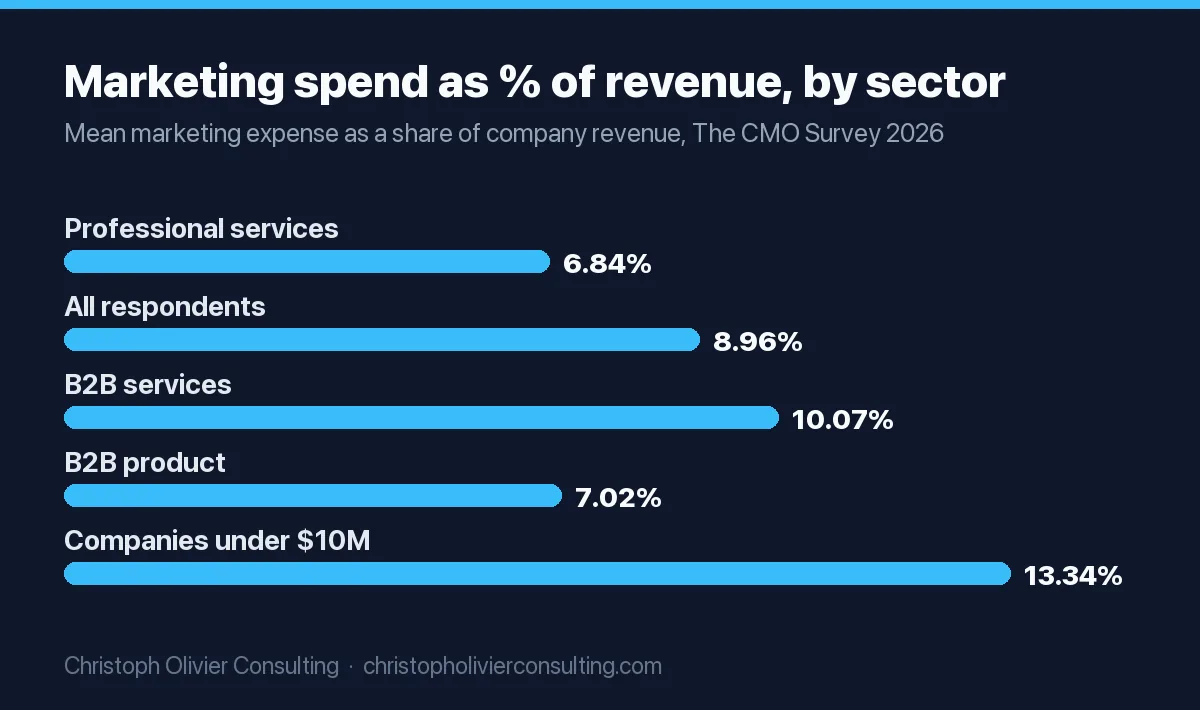
In The CMO Survey 2026 Firm and Industry Breakout Report, professional services companies reported marketing at a mean 6.84% of revenue (12 responses, p. 126), against 8.96% for all 154 respondents and 10.07% for B2B services companies (41 responses, p. 125). The sample is small, so treat 6.84% as a sanity check, not a target. It still matters: a lower budget leaves less room for a leadership fee, which is why revenue band decides fit more than anything else.
What a fractional CMO costs: published rates
None of these rates comes from an independent survey. They are asking prices published by firms that sell fractional or consulting talent. Use them to sanity-check quotes, and always ask how many hours sit behind a monthly fee.
| Engagement | Published rate | Hours | Source, date |
|---|---|---|---|
| Fractional CMO, strategy only | $3,000 to $6,000 a month | 5 to 10 a week | MarketerHire, April 15, 2026 |
| Fractional CMO, strategy plus execution oversight | $7,000 to $12,000 a month | 15 to 20 a week | MarketerHire, April 15, 2026 |
| Fractional CMO, hourly | $150 to $350 an hour | 5 to 15 a week | MarketerHire, April 15, 2026 |
| Fractional CMO, project | $5,000 to $25,000 | Fixed duration | MarketerHire, April 15, 2026 |
| Fractional CMO for professional services firms | $5,000 to $18,000 a month | Not stated | GTM 80/20, undated, fetched November 2026 |
| Executives-as-a-service firm, retainer | $1,500 to over $30,000 a month, about $300 to $500 an hour equivalent | Not stated | Chief Outsiders, updated October 26, 2026 |
| Independent marketing consultant | $100 to $200 an hour, some $450 and up | Not stated | Chief Outsiders, October 26, 2026 |
| Large consultancy | About $400 an hour for an MBA-level staffer, over $1,500 for a partner | Not stated | Chief Outsiders, October 26, 2026 |
MarketerHire adds that a CMO with deep vertical experience prices 20% to 30% higher than one with broad but shallow experience, and that Bay Area and New York CMOs charge 15% to 25% more. A specialist in accounting or law firm marketing will usually sit at the upper end of any range.
To compare two quotes, convert each to an effective hourly rate: monthly fee divided by (weekly hours x 52 / 12). A $6,000 retainer for 10 hours a week is $138 an hour. A $12,000 retainer for 20 hours a week is also $138 an hour. If two quotes differ by 2x at the same effective rate, you are comparing hours, not quality. If you already have a proposal on the table, book a consultation and we can check its hours and scope against these published ranges before you sign.
How much should I pay a marketing consultant instead?
If you need a diagnosis rather than an ongoing leader, buy a fixed block of hours. A 20 to 40 hour audit at Chief Outsiders’ published $100 to $200 an hour for independent consultants is $2,000 to $8,000, one time. A consultant advises and leaves. A fractional CMO owns the plan, the budget and the results report every month. If nobody inside the firm can carry out the advice, the audit will sit in a drawer.
Fractional vs full-time vs doing it yourself: year-one cost
Two public inputs turn a salary into a real cost. BLS puts the May 2025 median wage for marketing managers at $166,790 across all industries and $170,050 in professional, scientific and technical services, with the top 10% above $293,610. The BLS Employer Costs for Employee Compensation for June 2026 shows private-industry management, business and financial jobs costing $59.85 an hour in wages, $8.47 in paid leave and $20.31 in other benefits and supplemental pay. Salary already covers paid leave, so the load is 20.31 / (59.85 + 8.47) = 29.7%. If you hire through a retained search firm, Korn Ferry’s fiscal 2026 annual report says its fee is “generally one-third of the estimated first-year cash compensation of the placed candidate.”
| Option | Math (our calculation) | Year-one cost | Leadership hours a year |
|---|---|---|---|
| Partners do it themselves | Partner hours x billing rate x realization (illustrative: $3,600 a month) | Your number; $43,200 a year in the illustrative case | Whatever partners can spare |
| Independent consultant, one audit | 20 to 40 hours x $100 to $200 | $2,000 to $8,000 | 20 to 40, once |
| Fractional CMO, strategy only | $3,000 to $6,000 x 12 | $36,000 to $72,000 | 260 to 520 |
| Fractional CMO, strategy plus oversight | $7,000 to $12,000 x 12 | $84,000 to $144,000 | 780 to 1,040 |
| Full-time marketing manager, professional services median | $170,050 x 1.297 | $220,602 | 2,080 paid |
| Same hire through retained search | $220,602 + one-third of $170,050 salary | $277,285 | 2,080 paid |
| Full-time leader at top-decile pay, retained search | $293,610 x 1.297 + one-third of $293,610 | $478,764 | 2,080 paid |
Assumptions: the search fee is calculated on salary only, so a bonus would raise it; benefits use the all-industry management load, not a professional-services-only figure. The break-even is $220,602 / 12 = $18,384 a month. A fractional CMO billing more than that for a full year costs more than a median full-time hire you find yourself. A fractional CMO is cheaper because you buy fewer hours, not because each hour costs less. Salary benchmarks by company size are in the CMO salary guide, and tier-by-tier fractional pricing is in the fractional CMO cost guide.
Which firms can afford one: a cost model by revenue band
This is our own model, built from two public sources. Firm counts are employer firms in NAICS 54 (professional, scientific and technical services) by annual receipts, from the Census Bureau’s 2022 Statistics of U.S. Businesses (released April 2025). The marketing budget applies the CMO Survey’s 6.84% professional services mean to each band’s lower and upper revenue. The last column divides the leadership option’s annual cost by that budget. Our working rule, an opinion and not a survey finding: keep leadership under about 30% of the marketing budget so most money still reaches the market.
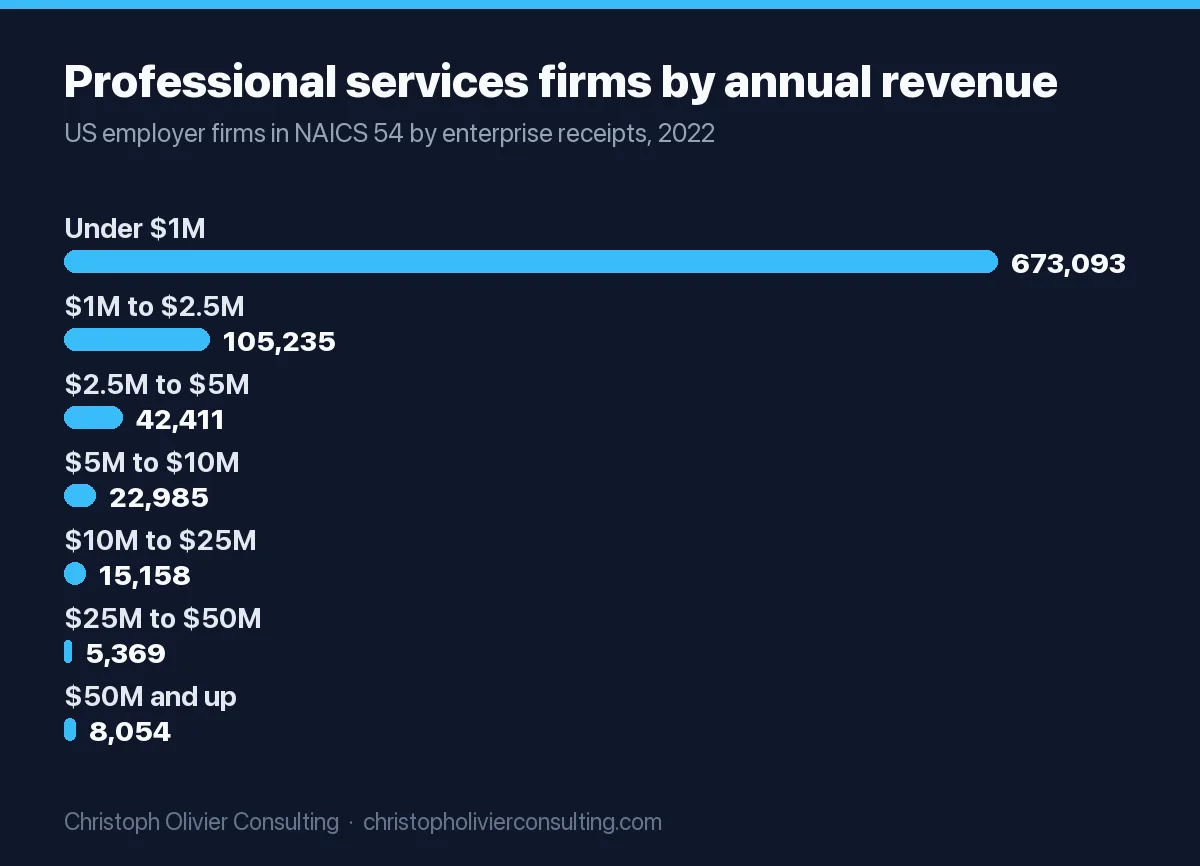
| Annual revenue | US firms (SUSB 2022) | Marketing budget at 6.84% | Leadership that fits | Leadership as share of budget |
|---|---|---|---|---|
| Under $1 million | 673,093 (77.2%) | Under $68,400 | Partners, one freelancer, a one-time audit | Strategy-only fractional above 50%: no fit |
| $1 million to $2.5 million | 105,235 | $68,400 to $171,000 | Audit plus a specialist; strategy-only fractional at the top of the band | Strategy-only $36,000 to $72,000 = 21% to 105% |
| $2.5 million to $5 million | 42,411 | $171,000 to $342,000 | Strategy-only fractional CMO | Strategy-only = 11% to 42%; with oversight = 25% to 84% |
| $5 million to $10 million | 22,985 | $342,000 to $684,000 | Fractional CMO with oversight, plus a coordinator or agency | $84,000 to $144,000 = 12% to 42% |
| $10 million to $25 million | 15,158 | $684,000 to $1,710,000 | Fractional CMO with oversight, or a first full-time marketing leader | Fractional at $144,000 = 8% to 21%; full-time $220,602 = 13% to 32% |
| $25 million to $50 million | 5,369 | $1,710,000 to $3,420,000 | Full-time leader; fractional as a bridge or advisor | Top-decile full-time $380,894 = 11% to 22% |
The same split holds inside the big professions. In the same Census table, 76.2% of legal services firms (NAICS 5411) and 80.1% of CPA offices (NAICS 541211) had receipts under $1 million, and another 21.5% and 18.5% fell between $1 million and $10 million. Most firms in the industry are too small for a CMO of any kind. The fractional model matters for the roughly 191,000 firms between $1 million and $50 million.
When hiring a fractional CMO makes sense, and when it does not
The honest answer for many firms is “not yet” or “not this.” Find your situation in the table.
| Your situation | Better choice | Why |
|---|---|---|
| Under $1 million, one or two partners, referrals fill the calendar | Do it yourself: a clean website, Google Business Profile, a referral-partner list and one talk a quarter | A strategy-only retainer would take more than half the typical budget |
| You know what to do but nobody has time to do it | A part-time marketing coordinator or a specialist freelancer | You are short on execution hours, not on strategy |
| You want an outside view once, then plan to run it yourself | A 20 to 40 hour audit from an independent consultant | $2,000 to $8,000 one time instead of a monthly retainer |
| Your only gap is one channel, such as search | A channel specialist or agency with a tight scope | Buying CMO hours to manage one channel overpays |
| Partners will not give 2 to 4 hours a month to marketing | Fix that first; no hire will work | Professional services marketing runs on partner expertise and relationships |
| $2.5 million to $25 million, referrals are flattening, two or more vendors and no one owns the number | Fractional CMO | Leadership fits inside 30% of budget and someone has to own the plan |
| Multi-office firm planning a merger, new practice area or rebrand | Fractional CMO with oversight, 15 to 20 hours a week | Positioning and partner alignment are strategy problems, not production problems |
| Over $25 million with a marketing team of three or more | Full-time CMO or director; fractional only as interim cover | A full-time salary drops to roughly 11% to 22% of budget at that size |
Not sure which row your firm is in?
Bring your revenue, current marketing spend and any proposals you have. We will tell you which option fits, including when the answer is a freelancer or doing it yourself.
What a professional services CMO owns in the first 90 days
Use this as a scope check for any proposal. Each phase has a deliverable and a pass/fail test you can hold the engagement to.
- Days 1 to 30: find where work actually comes from. Pull the last 24 months of new matters or engagements and tag each by source (named referrer, past client, search, event, other). Interview 5 to 8 recent clients and 3 to 5 referral sources. Deliverable: a one-page source map with revenue per source. Pass if every new client in the period has a source. Fail if the report is built from website analytics alone.
- Days 31 to 60: choose the practice areas and the people to lead with. Pick one or two practice areas or industries to lead with, and set the referral-partner list (bankers, attorneys, CPAs, wealth managers, whoever sends you work). Set a partner time budget, for example 2 to 4 hours a month each. Deliverable: positioning statement, partner activity calendar and a budget by channel. Pass if each partner signs off on their own hours.
- Days 61 to 90: launch and measure. Start the expertise program (talks, articles drafted from interviews, practice-area pages built for search) and a referral-partner touch plan. Set up CRM source tracking so every inquiry gets a source at intake. Deliverable: a monthly report reconciled to new engagements in the books. Pass if the report shows inquiries, consultations and signed work by source, not only website traffic.
Search matters more than it used to: in Hinge’s studies the share of buyers who searched online rose from 11% in 2013 to 18.2% in 2018. The SEO for professional services guide covers the practice-area page structure. If you want the engagement terms written down before you start, the fractional CMO contract template lists the clauses to include.
Professional services marketing by firm type
The constraints above apply everywhere, but the main buyer and the main rule change by profession.
| Firm type | US firms (SUSB 2022) | What the CMO has to get right | Deeper guide |
|---|---|---|---|
| Law firms (NAICS 5411) | 168,306 | State bar advertising and solicitation rules; practice-area search demand | Estate planning attorneys |
| CPA offices (NAICS 541211) | 50,885 | Seasonal capacity; moving clients from compliance work to advisory | CPA and accounting firms |
| Architecture and engineering (NAICS 5413) | 95,284 | Shortlists, RFPs and qualifications packages | Engineering firm marketing |
| Management consulting (NAICS 5416) | 204,867 | Narrow positioning; partner-authored ideas | Use the 90-day plan above |
| Financial advisors (regulated by the SEC or states) | Not in NAICS 54 | SEC marketing rule on testimonials and performance | Financial advisors |
Interview questions for a professional services CMO, with pass/fail answers
| Ask | Pass | Fail |
|---|---|---|
| How will you find out where our new business comes from? | Tags past engagements by source from your own records and interviews clients and referrers | Starts with a new website or an ad campaign |
| How much partner time will you need? | Gives hours per partner per month and designs around billable targets | “As much as you can give” or “none” |
| Which advertising rules apply to us? | Names your regulator or bar rule and says how claims and testimonials get reviewed | Has not heard of them |
| How many hours are behind this fee? | A weekly number and what happens to unused hours | “Whatever it takes” with no number |
| What will you report every month? | Inquiries, consultations and signed engagements by source, reconciled to your books | Traffic, impressions and followers only |
| What results do you guarantee? | None; commits to a plan, activity and honest reporting | Promises a number of leads or rankings |
What working with CO Consulting looks like
CO Consulting works with professional-service firms and 7-figure service businesses, including CPA and accounting firms, tax planning firms, financial advisors, estate planning attorneys and law firms. The fractional CMO service starts with an audit and a prioritized 90-day plan, then moves to weekly leadership, monthly reviews and quarterly planning, with KPI reporting tied to pipeline. The CMO directs the people who produce the work. Hands-on content writing, ad building, design and video are out of scope unless you add another service. There are no guarantees of rankings or lead volume. If you want to know whether your firm is in the “hire” rows or the “not yet” rows of the fit table, book a free consultation and bring your numbers.
Ready to scale your revenue?
Book a free 30-min consultation. We’ll diagnose your growth bottleneck and map out the 3 highest-leverage moves for your business.
Frequently asked questions
How much does a fractional CMO charge per hour?
MarketerHire's April 2026 cost guide lists $150 to $350 an hour for hourly fractional CMO work at 5 to 15 hours a week. Chief Outsiders puts executives-as-a-service retainers at roughly $300 to $500 an hour equivalent. To compare monthly quotes, divide the fee by weekly hours x 52 / 12: a $6,000 retainer for 10 hours a week works out to about $138 an hour.
What are fractional CMO services for a professional services firm?
A part-time senior marketer owns the growth plan, the marketing budget and the referral and reputation pipeline, usually for 5 to 20 hours a week. In a law, accounting, engineering or consulting firm that means mapping where clients come from, choosing practice areas to lead with, building a partner expertise program within billable targets, keeping claims inside professional advertising rules and reporting signed work by source.
What does a professional services marketing consultant do, and how is that different from a fractional CMO?
A consultant diagnoses and advises, usually for a fixed block of hours, then leaves the plan with you. A fractional CMO owns the plan and the results every month and directs the people doing the work. If nobody in the firm can carry out advice, a consultant's audit tends to stall. A 20 to 40 hour audit at $100 to $200 an hour costs $2,000 to $8,000.
How much should a professional services firm spend on marketing?
In The CMO Survey's 2026 Firm and Industry Breakout Report, professional services companies reported marketing at a mean 6.84% of revenue, based on only 12 responses, against 8.96% for all respondents and 10.07% for B2B services companies. Treat it as a sanity check. At 6.84%, a $5 million firm would have about $342,000 a year for marketing, including leadership.
What's a fractional CMO salary compared with a full-time hire?
Fractional CMOs are paid fees, not salaries: about $36,000 to $144,000 a year at MarketerHire's published monthly rates. BLS puts the May 2025 median marketing manager wage in professional, scientific and technical services at $170,050. With benefits at the BLS management load of about 29.7%, that hire costs about $220,600 a year before any search fee.
When is a professional services firm too small for a fractional CMO?
Under about $1 million in revenue, a strategy-only retainer of $36,000 a year would take more than half of a marketing budget set at the 6.84% professional services mean. At that size, partners doing the basics, one freelancer or a one-time consultant audit is usually the better buy. Census data show 77.2% of US professional services employer firms had receipts under $1 million in 2022.
Fractional CMO: cost, fit and industries