

Logistics marketing for a 3PL or freight brokerage works when it is narrow: pick the lanes, modes and shipper types where you can already prove performance, put that proof in front of the specific shipping and transportation managers who own those lanes, and time the message to the freight cycle. Load boards keep your trucks covered. They do not build a book of direct shippers, and that book is what decides whether your business is worth more next year.
This playbook is written for the owner of a growing brokerage or 3PL, somewhere between “a few good accounts and a lot of spot freight” and “we need a real pipeline.” It skips the generic advice (post on social, start a blog) and works through the order I would build things in: lanes first, trust signals second, a target account list third, then outreach, case studies and events.
Need senior marketing leadership without a full-time hire? See CO Consulting’s fractional CMO services.
Load boards cover trucks. They do not win you shippers.
Most brokerages run two businesses at once. On the carrier side, you post and search loads on boards such as DAT and Truckstop to find capacity. On the shipper side, you are trying to get into a shipper’s routing guide, win lanes in their bids and become the person they call when a primary carrier rejects a tender. Marketing only matters on the second side. A strong carrier network is an operations asset; it is not a sales channel.
The freight you are chasing also comes in different shapes, and each one is bought differently. Mixing them in one message is the most common reason small logistics companies sound generic.
| Freight type | Who decides | How they buy | What your marketing must prove |
|---|---|---|---|
| Spot and surge loads | Shipping clerk, logistics coordinator, plant shipping manager | Whoever answers fast with a truck and a fair rate | Speed, coverage in their lanes, a clean authority and insurance file |
| Contract lanes in a routing guide | Transportation manager, logistics director, procurement | Annual or quarterly bids, mini-bids, scorecards | Lane history, tender acceptance, on-time performance, claims handling |
| Dedicated, warehousing and managed transportation | VP or director of supply chain, CFO, operations leadership | RFI and RFP, site visits, references, multi-year contracts | Systems integration, visibility, cost and risk outcomes, account management |
The bigger the commitment, the more the purchase looks like a strategic partnership rather than a load. The 2027 Third-Party Logistics Study, released in October 2026 by Penske Logistics, NTT DATA and the University of Tennessee, found that shippers tie 39% of their outsourced logistics spend to strategic partnerships, while 3PLs say 54% of their revenue comes from such relationships, as reported by AJOT. Read that gap as a warning: you probably think more of your accounts are “strategic” than your shippers do. Marketing that shows how you run their lanes, not how big your network is, is how you close the gap.
Marketing for logistics companies starts with three lanes, not a logo
Before you spend on a website, ads or an agency, write down the three lanes or lane clusters where you are measurably good. A lane is an origin region, a destination region, a mode and an equipment type. “Midwest to Southeast, dry van, retail replenishment” is a lane. “Nationwide coverage” is not.
For each lane, pull the numbers from your own TMS for the last 12 months:
- Loads moved and number of shippers served on that lane
- On-time pickup and on-time delivery percentage
- Tender acceptance (how often you took the load when offered)
- Claims count and average time to resolve a claim
- Your average rate versus a market benchmark you already subscribe to
Those figures become your marketing. They tell you which shippers to target (ones that ship on those lanes), what to say (your performance on their lanes) and what to put on your site and in your proposals. If a lane’s numbers are weak, do not market it yet. Fix the operation first, because a shipper who tries you on a weak lane will remember it at bid time.
This also answers the niche question every broker hears about. Your niche is rarely an industry label. It is the overlap between lanes you run well, equipment you can reliably cover, and shippers whose freight sits on those lanes. A reefer specialist out of the Central Valley and a flatbed broker serving steel and building products need completely different target lists, even if both call themselves “full service.”
What a shipping manager checks before giving you a load
Freight fraud has made shippers more cautious about new brokers, and that caution is a marketing opportunity. Verisk CargoNet recorded 677 theft incidents in the US and Canada in Q2 2026, fewer than a year earlier, but estimated losses more than doubled to $304.6 million, and fictitious pickup incidents barely moved (165 to 158), according to Verisk’s Q2 2026 cargo theft release. The same release notes that business email compromise and shipment misdirection schemes held steady. A shipper’s first question about an unknown broker is often “are you real?”
Answer that before they ask. Put a plain “Shipper trust” page on your site and attach the same facts to every proposal:
| Trust signal | What it is | How to present it |
|---|---|---|
| Operating authority | Your USDOT number and broker MC number, publicly searchable in FMCSA’s SAFER and Licensing and Insurance systems | List both numbers in the footer and on proposals so a shipper can verify you in under a minute |
| Broker financial security | A $75,000 surety bond (Form BMC-84) or trust fund (Form BMC-85) required under 49 CFR 387.307. If the security drops below $75,000 and is not restored, FMCSA can suspend the broker’s authority within 7 business days of notice | State that your bond is in force and fully funded. Shippers who have been burned by a broker failure understand what this means |
| Insurance | Contingent cargo and contingent auto liability for brokers; cargo, auto liability and warehouse legal liability for asset or warehouse 3PLs | Offer a current certificate on request and name the limits plainly |
| Carrier vetting process | How you onboard and monitor carriers: identity checks, authority age, insurance verification, monitoring for changes | Describe the steps in four or five lines. Do not claim to “eliminate” fraud; describe what you check |
| Professional credentials | Membership in the Transportation Intermediaries Association (TIA) and its Certified Transportation Broker (CTB) designation, earned through coursework and an exam | List who on your team holds it. It signals training, not performance, so pair it with lane data |
| Lane references | Shippers on similar lanes willing to take a call | Two or three named references beat any badge |
None of this is glamorous, and that is the point. Most broker websites lead with trucks and sunsets. A page that shows your MC number, bond status and vetting steps does more for a cautious transportation manager than any brand video.
Time your message to the freight cycle
Freight marketing that ignores the market cycle wastes money. When capacity is loose, shippers’ routing guides work, primary carriers accept tenders and shippers mainly want lower rates. When capacity tightens, tenders get rejected, routing guides break down and shippers start calling brokers for backup capacity. The same email lands very differently in each phase.
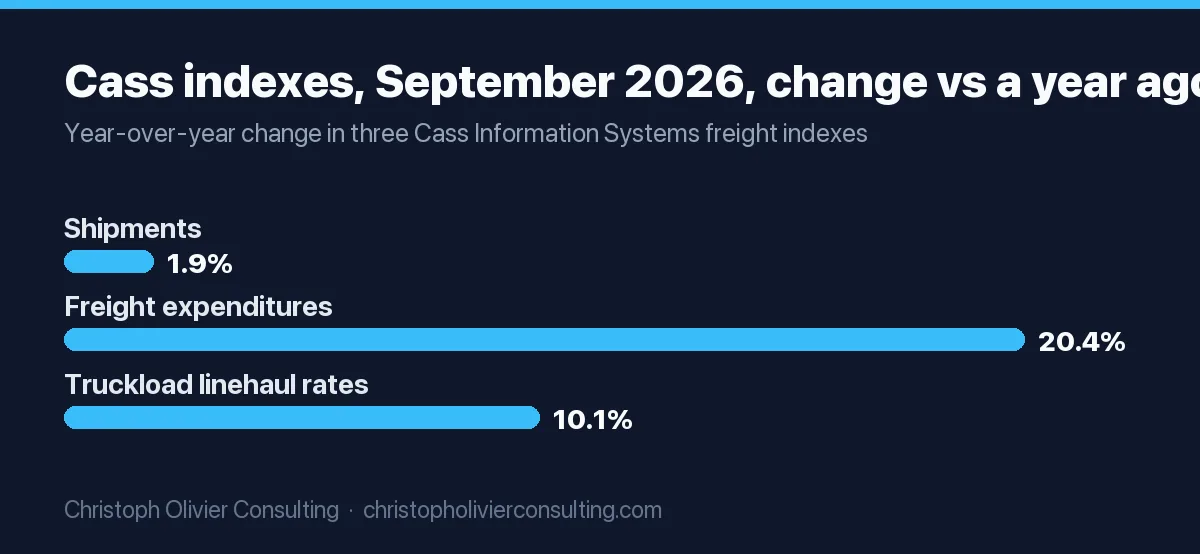
As of the latest data, the cycle is turning. The Cass Freight Index report for September 2026 showed shipments up 1.9% year over year (the second straight positive month), total freight expenditures up 20.4% and the Cass Truckload Linehaul Index up 10.1%. Cass wrote that “freight demand is recovering” and that “the cycle is on a positive track,” while flagging rising oil prices and interest rates as limiting factors. It also said expenditures are on track for a 12% gain in 2026 after declines in 2023, 2024 and 2025.
Here is how I would adjust the message by phase:
| Market phase | What the shipper is worried about | Lead your outreach with | Avoid |
|---|---|---|---|
| Loose (rates falling, carriers hungry) | Cutting freight spend, consolidating providers | Rate competitiveness on specific lanes, mode shifts, mini-bid participation | Capacity scarcity claims nobody believes |
| Turning (volumes and rates starting to rise) | Whether this year’s contract rates will hold, early tender rejections | Backup capacity on their lanes, your tender acceptance record, a request to be added as a secondary carrier in the routing guide | Pushing long-term rate locks you cannot cover |
| Tight (rejections high, spot premiums wide) | Getting freight moved at all, service failures with customers | Coverage speed, surge capacity, dedicated or committed capacity options | Overpromising; a missed load in a tight market costs you the account |
Check Cass, plus whatever spot and contract rate data you already pay for, once a month and rewrite your lead paragraph to match. It takes ten minutes and keeps your outreach relevant.
Account-based marketing to shipping managers: build the list from your lanes
A brokerage or 3PL with a handful of salespeople cannot market to “manufacturers.” It can market to 150 named accounts. That is account-based marketing, and in logistics it fits better than almost any other B2B category, because the buyer universe on any given lane is finite and identifiable.
Start with the shippers that originate or receive freight on your proven lanes: plants, distribution centers, cold storage sites, building material yards. Then find the people who own transportation at each one. Typical titles are transportation manager, logistics manager, director of supply chain, shipping and receiving manager at plant level, and procurement or sourcing for freight at larger companies.
Score each account before anyone writes an email. Here is a scoring model to start from; adjust the weights to your business:
| Factor | Points | Score high when |
|---|---|---|
| Lane fit | 30 | The account ships on one of your three proven lanes, inbound or outbound |
| Mode and equipment fit | 20 | Their freight matches equipment you reliably cover (dry van, reefer, flatbed, LTL, drayage) |
| Trigger event | 20 | New facility, expansion, new transportation leader, a recent bid cycle, a lost carrier, a product launch |
| Volume signal | 15 | Facility size, number of dock doors, shift count or hiring for shipping roles suggests steady weekly loads |
| Access | 15 | You have a named contact, a mutual connection or an existing relationship at a sister site |
Work accounts scoring 70 or more with personal outreach. Put 50 to 69 into lighter email and LinkedIn touches. Below 50, leave them alone for now. The weights are judgment, not research, so revisit them after one quarter of results: if trigger events predict meetings better than volume signals in your data, move the points.
Cold email and LinkedIn outreach that stays legal and gets read
Cold outreach is still how most new shipper accounts start. Two sets of rules shape it.
First, CAN-SPAM applies to business email. The FTC’s CAN-SPAM compliance guide states that “the law makes no exception for business-to-business email.” Every commercial email needs accurate header information, a non-deceptive subject line, identification as an advertisement, a valid physical postal address and a clear way to opt out, and opt-outs must be honored within 10 business days. Each violating email can carry a penalty of up to $53,088. If a lead-gen vendor sends on your behalf, you are still responsible.
Second, mailbox providers enforce their own standards. Google’s sender guidelines require anyone sending 5,000 or more messages a day to Gmail accounts to authenticate with SPF, DKIM and DMARC, support one-click unsubscribe on marketing messages and keep the spam rate reported in Postmaster Tools below 0.30% (Google recommends staying under 0.10%). Send cold outreach from a separate, warmed domain, keep volumes modest and write to small, well-scored lists. More detail on infrastructure and nurture flows is in our guide to B2B email marketing.
Below is a sample four-touch sequence for a brokerage pitching backup reefer capacity to a food shipper. Swap in your own lane and numbers; never send a figure you cannot back up from your TMS.
- Day 1, email. Subject: “Backup reefer capacity, Fresno to Dallas.” Body: “Hi [Name], we move [X] reefer loads a month from the Central Valley into Texas, with [Y]% on-time delivery over the last 12 months. As volumes pick up this fall, a lot of shippers are adding a secondary option in their routing guide before rejections start. Would it be worth a 15 minute call to see if your Fresno to Dallas freight is a fit? [Signature with MC number, postal address, opt-out line]”
- Day 3, LinkedIn. Connect with a one-line note that mentions the lane, not your company. Do not pitch in the connection request.
- Day 8, email. Share one useful fact for their lane: your average transit time, how you handle temperature documentation, or how you vet carriers for food loads. Ask one question: “Who handles carrier selection for the Fresno plant?”
- Day 15, email or call. Offer a low-risk start: “Happy to take one load as a test when your primary carrier rejects. No contract needed.” Then stop if there is no reply, and log the account for the next bid cycle.
LinkedIn carries more of the load than most brokers expect, because transportation managers are visible there and freight is a relationship business. Post your lane observations and market commentary under the owner’s or sales rep’s name rather than only the company page. Our guide to LinkedIn marketing for B2B covers the profile, posting and outreach basics.
The lane case study: your best freight broker marketing asset
A shipper reading a proposal wants evidence that you have done this before, on freight like theirs. A one-page lane case study does that better than a capabilities deck. Build it from real data and get the shipper’s written permission before naming them; if they decline, describe them by industry and region.
Use this structure:
| Section | What to include |
|---|---|
| Shipper and lane | Industry, origin and destination regions, mode, equipment, weekly volume range |
| The problem | What was failing: tender rejections, late deliveries, claims, visibility gaps, too many carriers to manage |
| What you changed | Carrier selection, appointment scheduling, tracking, a dedicated rep, mode shift, consolidation |
| Measured result | Before and after figures from your TMS or the shipper’s scorecard: on-time %, acceptance %, claims, cost per load |
| Time frame | How long the results have held, so nobody mistakes one good month for a trend |
| Contact | A reference willing to take a call, if the shipper agrees |
Write three of these, one per proven lane, and you have the backbone of your website, proposals and outreach. If you do not yet have before and after numbers, start collecting them now on your best accounts. In my experience, the absence of this one document is what most often keeps small brokerages out of bid shortlists.
Trade shows and associations: where shippers walk the floor
Events in logistics split into two kinds: ones where shippers buy, and ones where providers meet each other. Both are useful, but budget them differently.
MODEX is the big shipper-side show for manufacturing and supply chain. MHI’s MODEX 2026 in Atlanta (April 13 to 16, 2026) drew 50,000 registered visitors from 132 countries and 1,057 exhibitors, according to post-show coverage. The same report lists the next MHI shows: ProMat 2027 at McCormick Place in Chicago (April 19 to 21, 2027), MODEX 2028 in Atlanta (April 3 to 5, 2028) and a new MODEX West in Las Vegas (October 18 to 20, 2028). You do not need a booth to get value. Pre-book meetings with scored accounts, attend sessions where your target shippers speak and follow up within a week.
The Transportation Intermediaries Association’s Capital Ideas Conference runs April 5 to 7, 2027, at the Gaylord Palms in the Orlando area and is built for freight brokers, 3PL executives and technology providers. It is a peer event, not a shipper event. Go for partnerships, agent recruiting, carrier relationships and technology, not for leads.
Partnerships deserve their own plan. Freight agents, asset carriers that pass along freight they cannot cover, customs brokers and warehouse operators all sit next to your shippers. Treat them as a channel with clear terms, not as favors. Our pieces on channel sales strategy and on choosing among B2B sales channels cover how to structure that.
Hiring a logistics marketing agency: five questions to ask first
A logistics marketing agency can help, but only if it understands that your buyer is a transportation manager running a routing guide, not a consumer. Ask these before you sign:
- Can you explain the difference between our spot, contract and dedicated business? If they cannot, they will write generic copy about “end-to-end supply chain solutions.”
- How will you use our lane data? A good agency builds targeting and messaging around your lanes and performance numbers. A weak one asks for a brand guide and stock photos.
- How do you handle cold email compliance and deliverability? Listen for CAN-SPAM, authentication, separate sending domains and spam rate monitoring.
- What will you report on? Push for meetings with scored accounts, lanes quoted and lanes won. Traffic and impressions are not the goal.
- What should we stop doing? An agency that only adds activity, and never cuts any, is selling hours.
If you are deciding whether you need an agency, a fractional marketing lead or simply a sharper sales process, it can help to talk it through with someone outside the business before committing budget.
Your first 90 days of logistics marketing
- Weeks 1 to 2: Pull 12 months of lane data. Pick three proven lanes. Retire any marketing that does not match them.
- Weeks 3 to 4: Publish the Shipper trust page with your USDOT and MC numbers, bond status, insurance summary and vetting steps.
- Weeks 5 to 6: Build and score a list of 150 accounts on those lanes. Identify the transportation owner at each.
- Weeks 7 to 8: Set up a separate, authenticated sending domain. Write the four-touch sequence for each lane, adjusted to the current Cass reading.
- Weeks 9 to 10: Draft one lane case study per lane, with permission or anonymized.
- Weeks 11 to 13: Run outreach to accounts scoring 70 or more. Track meetings, lanes quoted and test loads won. Re-weight the scoring model on what actually converted.
None of this guarantees new accounts, and freight markets can turn fast. But a brokerage or 3PL that markets three proven lanes to a scored list of shippers, with trust signals up front, is usually far better placed at the next bid cycle than one that markets “nationwide coverage” to everyone.
Work with CO Consulting
Senior marketing leadership, without the full-time hire
- One senior owner of strategy, budget, vendors and the weekly scorecard
- Audit first, then a prioritized 90-day plan with measurable milestones
- Weekly team leadership, monthly strategic reviews and quarterly planning
- No guarantees we cannot back up; reporting tied to pipeline
Frequently asked questions
What is logistics marketing?
Logistics marketing is how a 3PL, freight broker, carrier or warehouse provider wins and keeps shipper accounts. For most growing firms it means choosing the lanes and modes where they perform well, proving that performance with data and trust signals, and reaching the transportation managers who own those lanes through targeted outreach, case studies, events and referrals rather than broad brand advertising.
How do freight brokers find direct shippers?
Most brokers win direct shippers by targeting companies that ship on lanes they already run well, finding the transportation or logistics manager at each site, and offering a low-risk start such as backup capacity when a primary carrier rejects a tender. Consistent follow-up through bid cycles, lane-specific case studies, LinkedIn activity and referrals from carriers and agents usually matter more than paid ads.
Does CAN-SPAM apply to B2B cold email to shippers?
Yes. The FTC says the CAN-SPAM Act makes no exception for business-to-business email. Commercial emails need accurate headers, honest subject lines, identification as an advertisement, a valid postal address and a working opt-out honored within 10 business days. Penalties can reach $53,088 per violating email, and you stay responsible for email a vendor sends for you.
Are load boards a marketing channel for brokers?
Not really. Load boards such as DAT and Truckstop are mainly tools for finding carrier capacity and spot loads. They help you cover freight, but they rarely build long-term shipper relationships. Contract lanes in a shipper's routing guide are usually won through direct outreach, bids, references and demonstrated performance on specific lanes, which is where marketing effort pays off.
What trust signals do shippers look for in a new freight broker?
Shippers commonly check a broker's USDOT and MC numbers in FMCSA's public systems, confirm the $75,000 surety bond or trust fund required under federal rules is in force, ask for insurance certificates, and want to know how carriers are vetted. Credentials such as TIA's Certified Transportation Broker designation and references from shippers on similar lanes add further reassurance.
Should a 3PL hire a logistics marketing agency?
It can make sense once you know your proven lanes, have case study data and need help with execution such as list building, outreach and content. Before hiring, ask whether the agency understands spot versus contract freight, how it will use your lane data, how it handles email compliance, and whether it reports on meetings and lanes won rather than traffic.
Which trade shows are best for logistics companies?
For reaching shippers, MHI's MODEX and ProMat shows draw manufacturing and supply chain buyers; MODEX 2026 in Atlanta reported 50,000 registered visitors, and ProMat 2027 runs April 19 to 21 in Chicago. TIA's Capital Ideas Conference, April 5 to 7, 2027, is aimed at brokers and 3PL executives, so it suits partnerships and technology rather than shipper leads.
More Growth Consulting guides
- How to Build an Account Based Marketing Strategy
- Marketing Maturity Model: Stages, Dimensions, and a Self-Assessment
- The Best Client Management Apps for Service Businesses (2026)
- Unique Selling Proposition (USP): Definition, Formula, and Examples
- Gym Marketing: Win on Retention Economics, Not Just New Members
- What a Marketing Consultant for Startups Does (and When to Hire One)
- All Growth Consulting guides →