

An accounting firm should advertise first where people already look for an accountant: a complete Google Business Profile, then Google search ads on local, service-specific terms, then a seasonal Meta campaign if you sell tax preparation. Paid ads are not where most clients come from, though. In TaxDome’s 2025 Niche Business Accounting Report, a survey of 353 US businesses that hire accountants, 58% found their current firm through a referral, 17% through online search (Google, Yelp and similar), and only 3% by responding to an advertisement.
So the working order is: make referrals easy, own the search results for your name and your service, then buy ads to fill the gaps. This page is the channel-by-channel decision: for each of 10 channels you get where it works, what it costs (with the source), the main challenge, and a pass/fail fit test. Then a decision tree by firm type and a sample budget you can copy. If you want the full ranking of client sources with a 90-day plan, that lives in our guide to how CPA and accounting firms get clients.
Where should an accounting firm advertise first? The decision tree
Answer these five questions in order. Stop at the first “yes” and start with the channels it names. Come back to the rest once that channel produces a steady flow.
- Do clients visit your office, or do you visit them? Yes: set up your Google Business Profile first, because Google’s Business Profile guidelines are written for a business that “has a physical location that customers can visit, or travels to customers where they are.” No (a fully virtual firm): skip the profile and go to question 3.
- Is most of your new revenue individual or small-business tax preparation? Yes: Google search ads on local tax terms, Local Services Ads under the “Tax specialist” category, and a January Meta Leads campaign.
- Do you sell monthly bookkeeping, payroll or client advisory services (CAS)? Yes: software partner directories (Gusto, BILL), referrals from bookkeepers and bankers, and Google search ads on service terms such as “monthly bookkeeping for contractors.”
- Is your typical first-year fee above about $5,000? Yes: referral partners (attorneys, lenders, wealth managers), partner LinkedIn profiles and two or three speaking slots a year. Use paid search only on high-intent terms. The $5,000 line is my rule of thumb, not a published benchmark.
- Does one industry make up a third or more of your clients? Yes: that industry’s association events, a niche email newsletter and guest spots on podcasts the industry already listens to.
The same logic as a table, by firm type:
| Firm type | Advertise here first | Add second | Skip for now |
|---|---|---|---|
| Tax preparation (1040s, small-business returns) | Google Business Profile, Google search ads | Local Services Ads (“Tax specialist”), January Meta Leads burst | LinkedIn ads, your own podcast |
| CAS, bookkeeping, payroll | Gusto and BILL partner directories, bookkeeper and banker referrals | Google search ads on service terms, email nurture | Local Services Ads (no bookkeeping category), heavy event spend |
| Advisory, CFO, succession planning | Attorney, lender and wealth manager referrals | Partner LinkedIn, speaking at events | Meta ads, Local Services Ads |
| Niche firm (dental, construction, real estate) | Niche association events and referrals | Niche newsletter, podcast guesting, LinkedIn industry targeting | Broad Meta campaigns aimed at everyone in a radius |
The 10 marketing channels for accounting firms at a glance
The share column maps each channel to the TaxDome answer it belongs to. TaxDome’s respondents are businesses (229 executives and senior managers plus 124 small business owners), so individual 1040 clients are not measured, and TaxDome sells practice software.
| Channel | TaxDome 2025 answer it falls under | Cash cost (source below) | Main challenge |
|---|---|---|---|
| 1. Referrals and centers of influence | Referral, 58% | Partner time; no media cost | You cannot buy more of it on demand |
| 2. Google Business Profile and local SEO | Online search, 17% | Free profile | Virtual firms may not qualify; reviews take years |
| 3. Google search ads | Online search, 17% | $93.69 median cost per lead, Business Services | Leads arrive in February when you are full |
| 4. Local Services Ads | Online search, 17% | Pay per lead; price set by location and job type | Only “Tax specialist” fits; no lead credits |
| 5. Meta (Facebook and Instagram) ads | Social media, 10% | $27.39 median cost per lead, all industries | About $1,369.50 a week to exit learning |
| 6. LinkedIn | Social media, 10% | Organic free; ads from $10 a day | Partner time, or a budget most firms lack |
| 7. Email and newsletter | Not a TaxDome answer (nurture, not discovery) | Free to 250 contacts; Mailchimp Standard from $20 a month | Section 7216 limits what the client list can sell |
| 8. Directories (CPA society, software, Yelp) | Online search, 17% | Free, but software tiers need clients first | Listings sit behind client-count thresholds |
| 9. Podcasts and video | Not measured separately | $440 a month for outsourced editing; $2,100 to $6,500 a month full service | Partner hours in January to April |
| 10. Events and seminars | Webinar or event, 6% | High-growth firms put 29.6% of the marketing budget here | Prep time for a 6% share |
Each channel: where it works, what it costs, and the fit test
1. Referrals and centers of influence
Where it works: every firm type, and most of all advisory and niche firms. TaxDome found 92% of business clients rank referrals as important when choosing an accountant, and 58% named a referral as the primary way they found their current one. The referral sources that matter are the people who meet your future client first: estate and business attorneys, commercial lenders, wealth managers, business brokers and bookkeepers.
Cost: partner hours, plus lunches and modest thank-yous. No media spend.
Main challenge: volume is out of your control, and the referral still checks you online. TaxDome’s “primary method” question hides that second step, which is why channels 2 and 8 matter even for a referral-only firm. If money changes hands, AICPA rule 1.520.001 requires you to disclose a referral fee you pay or accept to the client, and Florida goes further: Florida Statutes 473.3205 says a CPA or firm “may not accept or pay a commission or referral fee in connection with the sale or referral of public accounting services.” Keep partner relationships unpaid unless you have checked your board’s rules.
Fit test. Pass: you can name 10 professionals who already serve your ideal client, and you can say who you serve in one sentence (“the accountants for Arizona dental practices”). Fail: your answer to “who do you help?” is “small businesses and individuals.”
2. Google Business Profile and local SEO
Where it works: tax preparation and local small-business firms whose clients search “CPA near me” or “tax preparer in [town].” Google’s own local ranking help page says local results are “mainly based on relevance, distance, and popularity,” and that prominence draws on “how many websites link to your business and how many reviews you have.” You cannot pay for a better position: Google says “there’s no way to request or pay for a better local ranking.”
Cost: the profile is free. The real cost is staff time for photos, posts, review requests and replies.
Main challenge: eligibility and rules. A firm that never meets clients in person does not match the “physical location that customers can visit” test. Google also tells you to “choose the fewest number of categories it takes to describe your overall core business” and to use your real-world name, so stuffing “Best CPA Tax Services” into the business name risks suspension. Reviews are a second trap: AICPA rule 1.600.001 bars advertising that is “false, misleading, or deceptive,” and state boards set their own testimonial rules, so check yours before you build a review campaign.
Fit test. Pass: clients come to your office or you go to theirs, and you can ask 5 happy clients a month for a review. Fail: you are fully remote, or your office is a virtual mailbox. The setup steps and category choices are in our guide to Google Business Profile for accounting firms.
3. Google search ads
Where it works: any firm selling a defined service with a fee range to people who are searching for it right now: tax returns, catch-up bookkeeping, IRS notice response, entity formation. Search catches intent, which is why it sits ahead of social for most firms.
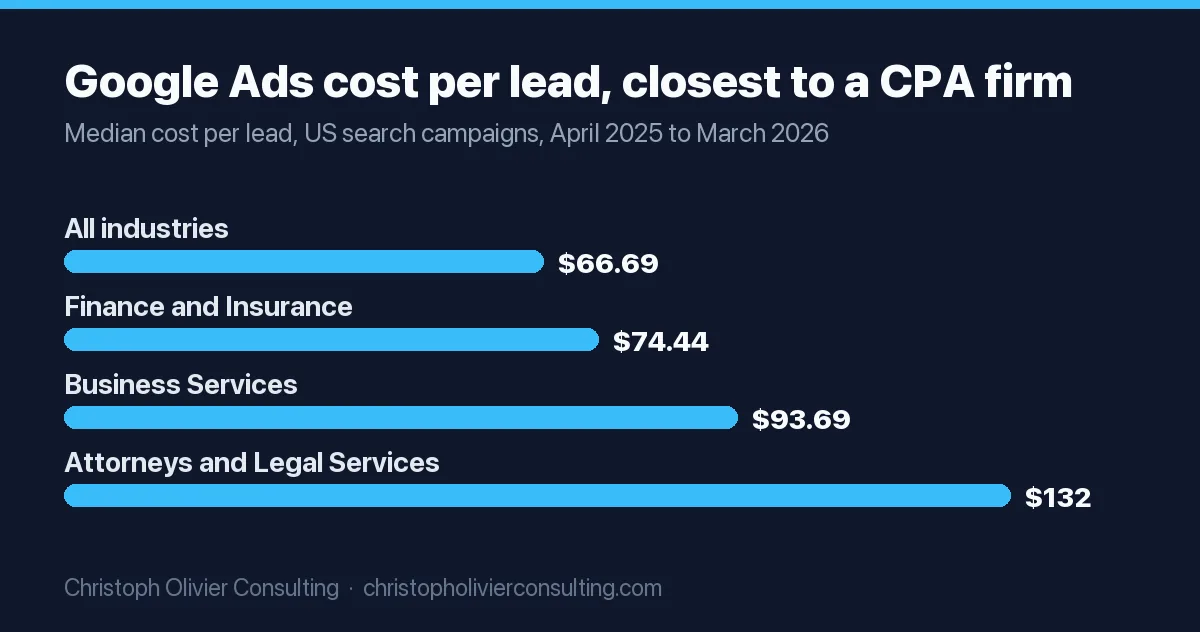
Cost: WordStream’s 2026 Google Ads benchmarks (13,474 US search campaigns, April 2025 to March 2026, medians) report no accounting row. The closest category, Business Services, has a $93.69 cost per lead and a $5.87 cost per click; Finance and Insurance runs $74.44 per lead, and all industries $66.69. For comparison, Attorneys and Legal Services is the most expensive category at $131.63. At $5.87 a click, an $800 monthly budget buys about 136 clicks.
Main challenge: timing and lead quality. Tax-return leads arrive around filing deadlines, the exact weeks your partners cannot take a discovery call. Judge the channel on cost per signed client, not cost per lead: if 1 in 5 search leads signs (an illustrative rate, not a benchmark), a $93.69 lead becomes a $468.45 client. Compare that with the first-year fee.
Fit test. Pass: you can publish a fee or fee range, someone answers new inquiries the same business day, and you will spend at least $500 a month for 90 days before judging. Fail: leads would land in March with nobody free to call them back.
4. Google Local Services Ads
Where it works: tax preparation and tax resolution firms in the US, and almost nobody else in accounting. Google’s Local Services Ads page shows a “Business” tile with “ex. lawyers, accounting, real estate,” but its list of eligible business services names “Tax specialist” and “Financial planner,” with no “Accountant,” “CPA” or “Bookkeeper” category. Google’s developer documentation (updated April 1, 2026) lists Professional Services as “Lawyer, Real Estate Agent, Tax specialist,” marks the list as not exhaustive, and says the categories are enabled only in the US. Check the category picker for your ZIP code before you plan around it.
Cost: you pay per lead, not per click. Google’s How leads work page says you set an average weekly budget, and “lead prices may vary depending on your location, the job type, the type of lead, or your bidding mode.” Google publishes no price per lead for tax specialists.
Main challenge: bad leads cost you. The same page says “lead credits aren’t available for health care verticals, tax specialists, or for advertisers in EMEA,” and that call recordings are not available for tax specialists either. A wrong-number or out-of-scope call is charged like a good one.
Fit test. Pass: you sell individual or small-business tax work in a US market and answer the phone live during business hours. Fail: you sell CAS, audit or advisory, or calls go to voicemail.
5. Meta ads (Facebook and Instagram)
Where it works: seasonal, fixed-fee offers to individuals and small owners within driving distance: January tax returns, extension filers in August and September, year-end planning meetings. Meta’s help article About ads for housing, employment or financial products and services lists “Tax and accounting services” among the offers financial products ads “don’t include,” so a plain tax or bookkeeping campaign keeps normal targeting. A refund advance or an investment arm is a different story.
Cost: WordStream’s 2026 Facebook ads benchmarks put the median cost per lead for Leads campaigns at $27.39 across industries (452 US campaigns). There is no accounting, finance or business services row in the Leads table.
Main challenge: the learning budget. Meta’s learning phase article says ad sets exit learning “after about 50 results in the week after the ad set’s last significant edit.” At $27.39, that is $1,369.50 a week, about $196 a day, for one ad set. Below that the campaign still runs, just as “Learning limited” with less stable costs. In-app form leads are also a lighter commitment than a phone call, so expect more of them not to book.
Fit test. Pass: one offer with a fixed fee, a 6-week season to run it in, and a person who calls every lead within minutes. Fail: you want always-on brand awareness on a few hundred dollars a month. The Instant Form, budget table and six ad templates are in our playbook on Facebook ads for accounting firms.
6. LinkedIn
Where it works: advisory, CFO and niche firms whose buyers have a job title you can name (owner, CFO, controller) and whose referral partners are on the platform. LinkedIn’s ad targeting page lists targeting by “job title, company, industry, seniority and more,” plus Matched Audiences for “website, contact and account targeting.”
Cost: organic posting from partners’ personal profiles costs time only. For ads, LinkedIn’s budget guide says “the minimum daily budget amount required to start on LinkedIn is $10, for any ad format,” and the minimum lifetime budget for a new campaign is $100. LinkedIn itself suggests $25 a day for new advertisers, which is $750 for 30 days.
Main challenge: it is a partner-time channel. A company page with no partner voices behind it rarely produces a conversation, and partners stop posting in February.
Fit test. Pass: a partner will post twice a week outside busy season, and your average first-year fee is high enough that one client a quarter pays for the time. Fail: the plan is a company page and an intern.
7. Email and newsletter
Where it works: every firm with a list, as the channel that turns one-time inquiries into clients between seasons. It is a nurture channel, not a discovery channel: none of TaxDome’s answer options is “email.”
Cost: Mailchimp’s pricing page shows a Free plan limited to 250 contacts and 500 sends a month, and a Standard plan starting at $20 a month. Price rises with contacts.
Main challenge: federal tax privacy rules decide what your client list can sell. Under Treas. Reg. 301.7216-2(n), a preparer may use a list of names, mailing addresses, email addresses, phone numbers and entity classification without consent only to send educational tax information or to solicit more tax return preparation. Selling bookkeeping or advisory to that list needs signed consent first. Paragraph (o) adds that statistical compilations of refund, credit or deduction amounts are not authorized for advertising, so “our clients saved an average of $X” is out.
Fit test. Pass: you have 200 or more contacts in the segment you want to reach and someone owns one send a month. Fail: the list is mostly 1040-only clients you are trying to move away from.
8. Directories: CPA society, software partner, Yelp
Where it works: CAS and bookkeeping firms (software directories) and local firms (society and review directories). TaxDome’s 17% “online search” answer explicitly includes Yelp.
- State CPA society directories. The Arizona Society of CPAs Find a CPA directory is “available to the public free of charge,” lists participating member firms, and filters by industries, services and languages. Ask your own state society whether it runs one.
- Gusto. The Gusto Partner Program puts Bronze partners (3 to 14 reward-eligible clients) and above in Gusto’s Partner Directory, and gives Silver (15 to 49) and Gold (50 or more) a featured profile.
- BILL. The BILL Accountant Partner Program lists Silver firms (5 to 25 points, where one client using one BILL product is one point) and above in its Find-An-Accountant directory. Tiers are re-evaluated in January and July.
- Yelp. A business page is free (“It’s free, easy, and only takes a few minutes,” per Yelp for Business). Yelp does not publish ad prices on that page.
Cost: free listings, but the software directories sit behind client thresholds you have to reach first.
Main challenge: you inherit someone else’s ranking rules, and directories list members only, so a prospect is comparing you with every other participant. Under AICPA interpretation 1.600.010, members “must not do through others what they are prohibited from doing themselves,” so any directory profile copy has to meet the same advertising rule as your own site.
Fit test. Pass: you already run payroll or payables for enough clients to clear the Bronze or Silver line, or you are a society member. Fail: you would be listing a firm with no software clients and no reviews.
9. Podcasts and video
Where it works: niche and advisory firms with a partner who enjoys talking, and as a referral-partner tool: every interview is an hour with an attorney or banker you want referrals from.
Cost: We Edit Podcasts charges $440 a month to edit 2 audio episodes, or $980 with video. Full-service production at Resonate Recordings “generally runs between $2,100 and $6,500 a month.” Twelve months at that range is $25,200 to $78,000.
Main challenge: partner hours, and client consent. Busy season wipes out recording time, and introducing a guest as “our client” is a disclosure under AICPA rule 1.700.001, which bars disclosing “any confidential client information without the specific consent of the client.”
Fit test. Use the five-question go/no-go test in our podcast strategy for accounting firms. If you fail two or more questions, guest on other shows for a year instead of producing your own.
10. Events and seminars
Where it works: niche, advisory and succession-planning firms that can teach a rule their audience cares about: a contractor gross receipts threshold, a real estate professional hours test, a sale-of-business tax checklist.
Cost: sponsorships, room and catering, travel and prep hours. In the 2025-26 AAM Marketing Budget Benchmark Study of 87 firms, high-growth firms put 29.6% of their marketing budget into conferences and events, against 24.5% for low-growth firms, as reported by CPA Practice Advisor.
Main challenge: only 6% of TaxDome’s businesses found their accountant at a webinar or event, so the event has to do double duty: meet referral partners in the room, then follow up with everyone on the list.
Fit test. Pass: a partner commits to two talks a year, both outside February to mid-April, with a follow-up email written before the event. Fail: you would sponsor a table and hope.
The challenges accounting firms face with marketing channels
Most channel failures at accounting firms come from the same six problems, not from picking the “wrong” platform. Here is each one, the channels it hits, and the fix.
| Challenge | Channels it hits hardest | What to do |
|---|---|---|
| Busy season capacity: demand peaks while partners are buried | Google search ads, Local Services Ads, Meta | Pause or cap paid channels from February 1 to April 15; run a waitlist form for new business clients instead |
| Tax return information rules (section 7216) | Email, Meta custom audiences, case studies | Use the no-consent list only for tax education and tax prep offers; get signed consent before anything else |
| Advertising rules (AICPA 1.600 and your state board) | Reviews, directories, ads, podcasts | No promised refunds or savings; disclose when a quoted fee is likely to rise; hold agencies and directories to the same rule |
| Budget below the platform’s floor | Meta ($1,369.50 a week to learn), LinkedIn ($10 a day minimum) | Run one offer at a time in a short season rather than splitting a small budget across platforms |
| Category fit | Local Services Ads (tax specialist only), Google Business Profile (in-person firms) | Check eligibility before you plan; virtual firms lean on directories and search ads |
| Attribution: the referral that Googled you | Every channel | Ask “How did you first hear about us?” on the first call and record the first answer, not the last click |
The AICPA rule worth reading in full is interpretation 1.600.010 in the AICPA Code of Professional Conduct (updated through September 2026). It treats promotion as false, misleading or deceptive if it creates “false or unjustified expectations of favorable results,” implies “the ability to influence any court, tribunal, regulatory agency,” or quotes a fee or fee range when a substantial increase was likely and the prospect was not told. That covers ad copy, directory profiles and podcast intros alike. This is a reading of the rule text, not legal advice.
Sample channel budget for a $1M accounting firm
Start from the best public benchmark: in the AAM study above, high-growth firms spent 2.1% of revenue on marketing (excluding compensation), against 1% for the other firms. For a $1M firm, that is $10,000 to $21,000 a year. The sample below uses $20,000 for a firm that does tax work for individuals and small businesses plus some monthly bookkeeping. Every line is an assumption to show the math, not a recommendation for your market.
| Channel | Annual budget | How it is spent | What the budget buys at published medians |
|---|---|---|---|
| Google search ads | $7,200 | $800 a month for 9 months, off February to April | About 77 leads at $93.69 each |
| Events and seminars | $5,000 | Two local seminars, one association sponsorship | 25% of budget, between AAM’s 24.5% and 29.6% |
| Meta Leads campaign | $3,000 | One January burst on a fixed-fee return offer | About 109 leads at $27.39, running below the learning threshold |
| Referral partners | $2,400 | $200 a month for partner lunches and thank-yous | Not priced per lead |
| Email newsletter | $240 | Mailchimp Standard at its starting price | One send a month to your list |
| Google Business Profile, LinkedIn, directories | $0 cash | Staff and partner time | Not priced per lead |
| Reserve | $2,160 | Released at the mid-year review to the best channel | Not applicable |
| Total | $20,000 | 2.0% of revenue |
How to adjust it. A CAS-heavy firm moves the Meta line into Google search ads on bookkeeping terms and drops the January burst. An advisory firm cuts paid search to high-intent terms only, raises the referral and events lines, and adds LinkedIn ads at $25 a day for a 30-day test ($750). A niche firm puts the events line into its industry’s association. Whatever the mix, review it on cost per signed client by channel after two quarters, using the formulas in our marketing KPIs for accounting firms.
How many channels to run at once
Two or three channels you can feed every week, plus one test. My rule of thumb: a channel earns a place only when it has a named owner, a monthly activity target and a setting for February to April (run, reduce or pause). Cut any channel that misses its activity target two quarters in a row, and do not add a replacement until someone owns it.
The order that works for most firms is the one at the top of this page: referrals first because they win most clients, search second because every referral checks you there, paid channels third to fill a known gap. To turn your chosen channels into a full-year plan with funnel math and a filing-season calendar, use our marketing plan template for accounting firms. If you would rather have someone pressure-test the mix with your own numbers, you can book a consultation.
Frequently asked questions
Where should an accounting firm advertise?
Start where people already search for an accountant. Set up a complete Google Business Profile if clients meet you in person, then run Google search ads on local, service-specific terms. Add a seasonal Meta Leads campaign for fixed-fee tax work. Ads only fill gaps: in TaxDome's 2025 survey, 58% of businesses found their accountant through a referral and 3% through an advertisement.
What are the biggest challenges accounting firms face with marketing channels?
Six come up again and again: leads that arrive in filing season when partners are full, section 7216 limits on using client lists, AICPA and state board advertising rules, budgets below platform minimums such as Meta's learning threshold, channels without an accounting category such as Local Services Ads, and not knowing which channel actually produced the client.
Can accountants use Google Local Services Ads?
Only for tax work. Google's list of eligible business services names Tax specialist and Financial planner, but no Accountant, CPA or Bookkeeper category, and the categories are enabled only in the US. You pay per lead, and Google says lead credits and call recordings are not available for tax specialists, so a poor lead is charged like a good one.
Do accounting firms need Meta's Special Ad Category for Facebook ads?
Usually not. Meta's help article on financial products and services ads lists tax and accounting services among the offers those ads do not include, so a plain tax prep or bookkeeping campaign keeps normal targeting. Offers such as refund advances, investment services, retirement funds or insurance fall inside the financial products category and should run as separate campaigns.
How much does Google Ads cost for an accounting firm?
WordStream's 2026 benchmarks have no accounting row. The closest category, Business Services, shows a median cost per lead of $93.69 and a $5.87 cost per click; Finance and Insurance is $74.44 per lead and all industries $66.69. Judge it on cost per signed client: if one in five leads signs, a $93.69 lead becomes a $468.45 client.
How much should an accounting firm spend on marketing channels?
The 2025-26 AAM Marketing Budget Benchmark Study found high-growth firms spent 2.1% of revenue on marketing, excluding compensation, against 1% for other firms. For a $1M firm that is $10,000 to $21,000 a year. Spread it over two or three channels you can run well rather than every platform at once.
Should my accounting firm be on Yelp and CPA directories?
Usually yes, because listings are free and TaxDome's online search answer includes Yelp. A state CPA society directory such as Arizona's is free to the public and lists participating members. Software directories need clients first: Gusto lists Bronze partners with 3 to 14 reward-eligible clients, and BILL lists Silver firms with 5 to 25 points.
More marketing guides for cpa
- Client Retention for CPA and Accounting Firms: The Quiet Growth Channel
- Client Onboarding for CPA and Accounting Firms: Turning It Into a Referral Asset
- Marketing Calendar for CPA and Accounting Firms
- Marketing Tech Stack for CPA and Accounting Firms
- Strategic Partnerships and Referral Networks for CPA and Accounting Firms
- Sales Consultations and Discovery Calls for Accounting Firms
- Marketing for CPA & Accounting Firms