

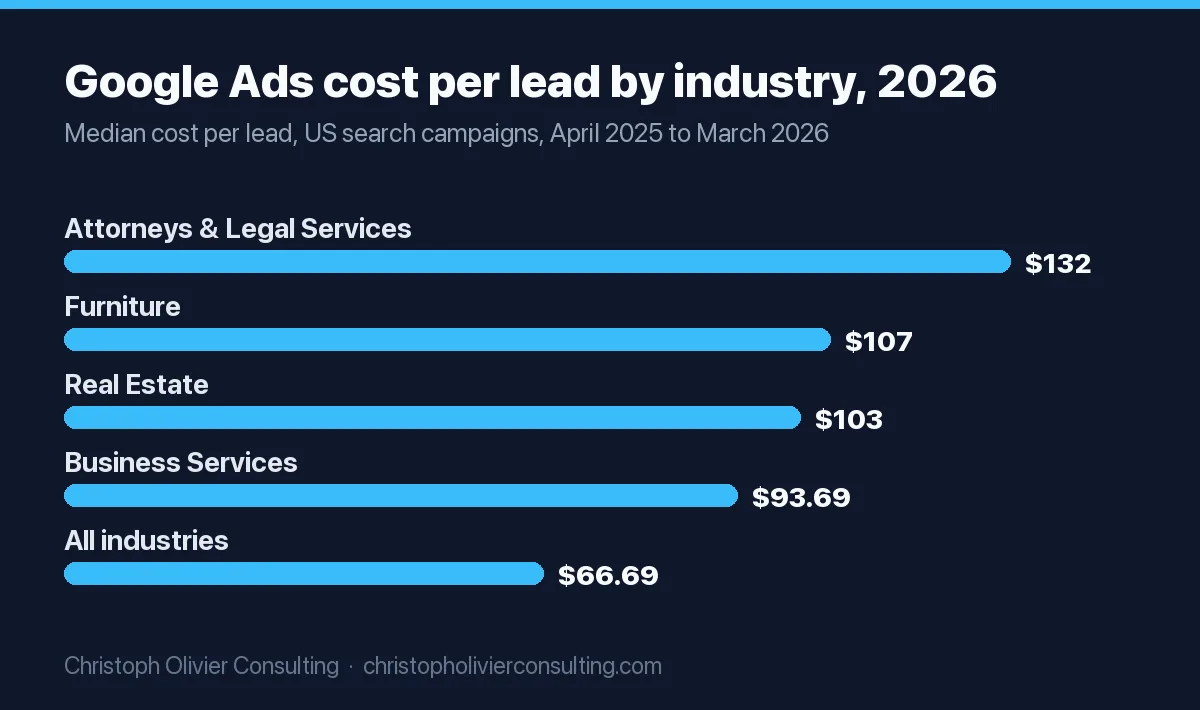
Paid advertising for medical malpractice law runs mainly on two Google products. Search ads cost legal advertisers a median $9.87 per click and $131.63 per lead in the LocaliQ 2026 search advertising benchmarks, the highest cost per lead of any industry tracked. Local Services Ads list a “Malpractice lawyer services” category and charge per lead, not per click. Meta, YouTube and TV come second, as reach during the weeks a family spends researching.
Whether any of it pays back depends less on the click price than on intake. In med-mal, many callers have a bad outcome but no case, and state law (filing deadlines, expert affidavits, damage caps, fee limits) decides which is which. This page gives you the published costs, a campaign build, the rules for six large states, a cost-per-signed-case model with every rate labeled, an intake script, and an agency scorecard.
Want a specialist to build this for your business? See how CO Consulting’s marketing services work, starting with a diagnostic and audit.
Paid advertising for medical malpractice law: what each channel costs
No public benchmark isolates medical malpractice. The closest published figures are for the whole legal category, so treat them as a floor for competitive metros, not a quote. The table uses only figures published by the platform or the benchmark owner.
| Channel | How you pay | Published cost figure | Best job for a med-mal firm | Watch for |
|---|---|---|---|---|
| Google Search ads | Per click | Attorneys and Legal Services: $9.87 CPC, 5.87% CTR, 5.55% conversion rate, $131.63 cost per lead (WordStream 2026: 13,474 US campaigns, April 2025 to March 2026, medians) | Injury-specific searches: “birth injury lawyer”, “surgical error attorney”, “misdiagnosis lawyer” | The figure covers all legal work; med-mal terms in big metros sit above it. No keyword-level CPC is published in a source I could read, so pull yours from Keyword Planner in your own account. |
| Google Local Services Ads | Per lead | No public price. Google: “Lead prices may vary depending on your location, the job type, the type of lead, or your bidding mode” (Google) | Phone leads from “malpractice lawyer near me” searches, with the Google Verified badge | The category name does not say “medical”, so plan for legal-malpractice and other off-topic calls |
| Facebook and Instagram | Per click or impression | Legal traffic campaigns: $0.69 CPC, 1.77% CTR; no legal lead-campaign figures published (LocaliQ 2026 Facebook benchmarks) | Retargeting people who read your injury pages; explainer video | Cheap clicks, early-stage intent |
| YouTube, connected TV, broadcast | Per view, impression or spot | No legal benchmark in the sources above | Name recall in a metro where you already rank or run search | Bar filing and dramatization rules (see the compliance table below) |
| Lead vendors and directories | Per lead, per month or per transfer | Vendor-specific; compared in the law firm lead generation breakdown | Filling gaps in markets you cannot rank in yet | Shared leads and fee-sharing rules |
One trap when you budget from these numbers: the benchmark columns are separate medians, so they do not chain. $9.87 divided by 5.55% gives $177.84, not the published $131.63 cost per lead. Use the cost-per-lead column directly, as the Google Ads CPC by industry tables explain for every category.
Google Ads for medical malpractice lawyers: the campaign build
Campaign structure by injury type
Broad “medical malpractice lawyer” terms pull in insurance shoppers, doctors, students and people with a complaint about a bill. Split campaigns by injury, so each ad group points to a page that answers that family’s questions and your intake team knows what the caller saw.
| Campaign | Keyword themes | Landing page must answer |
|---|---|---|
| Birth injury | birth injury lawyer, cerebral palsy lawyer, erb’s palsy attorney, HIE lawsuit | Deadlines for a child’s claim in your state (minors’ rules differ: Texas gives children under 12 until their 14th birthday; Illinois caps minors at the 22nd birthday) |
| Surgical error | surgical error lawyer, wrong site surgery attorney, retained sponge lawsuit | Foreign-object exceptions (California, New York and Pennsylvania all treat them separately) |
| Missed or delayed cancer diagnosis | misdiagnosis lawyer, failure to diagnose cancer attorney, delayed diagnosis lawsuit | When the clock starts; New York runs it from discovery for missed cancer, with a 7-year outer limit |
| Medication and pharmacy error | medication error lawyer, wrong prescription attorney | What records to request and who the defendant may be |
| Anesthesia and ER negligence | anesthesia error lawyer, emergency room negligence attorney | What an expert review involves and how long it takes |
| Brand | your firm and attorney names | Results page that meets your state’s past-results rule |
Negative keywords to add before launch (copy and paste)
These themes match searches a med-mal account attracts but cannot sign. Remove any line that covers work you actually take, for example legal malpractice or dental claims.
malpractice insurance
insurance quote
tail coverage
for nurses
for physicians
defense attorney
defense firm
jobs
careers
salary
paralegal
law school
definition
statistics
examples
CME
course
pdf
template
veterinary
how to sue without a lawyer
Call conversion setup for medical malpractice law
Many med-mal inquiries arrive by phone, and a phone call that lasts 40 seconds is not a lead. Set up measurement so Google learns from qualified calls only:
- Turn on call reporting under Account settings, so calls route through a Google forwarding number assigned to your call assets, location assets and call ads (Google Ads Help).
- Use AI-qualified call conversions. Google says they “use Google AI to evaluate call recordings”, which requires the call recording setting to be on, and recording is “only available when both the dialing and receiving phone numbers are located in the United States or Canada” (Google Ads Help). Check your state’s call-recording consent law with your own counsel before you enable it.
- When a call cannot be recorded, it counts if it lasts a minimum duration you set under the “Lead qualification” setting. Set that to the length of your shortest real screening call, not the default.
- Import the later stages from your intake system (records requested, expert review ordered, signed) as offline conversions, and bid toward those rather than raw calls.
The injury pages that convert ad traffic are also the ones that rank, so build them once to both standards, as set out in SEO for law firms. Account-level bidding and match-type detail is in Google Ads for lawyers.
Local Services Ads for medical malpractice: the “Malpractice lawyer services” category
Google’s US category list includes “Malpractice lawyer services” alongside “Personal injury lawyer services” and 15 other legal categories, and says Local Services Ads “are available only for certain service categories” (Google: About Local Services Ads). Confirm availability for your ZIP codes in the sign-up flow before you plan around it.
How Google charges, from its lead charges page:
- Charged: answered calls (or a callback where you reach the person), texts and emails, voicemails, booking requests, and missed calls during business hours where the caller stays on the line more than 20 seconds.
- Repeat contact from the same customer is “not charged again, provided there is interaction within 15 days.”
- Google “continuously assesses lead quality over a 30-day period” and credits poor, duplicate or invalid leads automatically. You can also flag a lead in its feedback survey.
Two med-mal consequences. First, the category covers malpractice generally, so a legal-malpractice caller who reaches you may still be billed; flag off-topic calls in the feedback survey every week. Second, the 20-second missed-call rule means your listed hours must match the hours a trained screener actually answers.
Verification: Google now shows a single Google Verified badge; existing verified advertisers got it automatically and new ones must complete Local Services screening (Google). Screening “may include license, insurance, and background checks,” varies by category and region, and Lawyer.com is listed as an affiliate partner that screens through its own process (Google).
The product is moving. Google is migrating Local Services Ads into Google Ads as a Performance Max campaign type built for pay-per-lead goals: select home and storefront services first in August 2026, broader groups in late 2026, and all remaining categories in 2027. Ads still show only on Search and Maps, lead history transfers, but performance reports do not, so export them before your account moves (Google Ads Help). Google does not say which phase legal categories fall into. How Local Services Ads fit next to referrals and the map pack is covered in how law firms get clients.
Meta, YouTube and TV for medical malpractice advertising
Facebook clicks for legal advertisers are cheap ($0.69 in LocaliQ’s 2026 traffic data), but LocaliQ publishes no legal lead-campaign numbers, so there is no honest Facebook cost-per-lead benchmark to quote. Use Meta for two jobs: retargeting people who read a birth-injury or misdiagnosis page and left, and short video where an attorney explains what an expert review is and how long a claim takes. Build those audiences from your own site visitors and video viewers.
YouTube and TV buy recall. They work best in a metro where you already appear in search, so the name a family heard on TV is the name they find when they search. They also carry the most compliance exposure, because actors, dramatizations and results claims are exactly what bar rules police. In Florida, an ad is inherently misleading if it uses a voice or image that makes viewers think the person is your lawyer or employee without a clear disclaimer, or a dramatization a reasonable viewer would not recognize as one (Rule 4-7.13(b)(5) and (6)).
Why medical malpractice intake is different: the state rules that decide which leads are cases
A personal injury screener mostly asks about fault and insurance. A med-mal screener has to know whether the deadline is already gone, whether an expert must sign off before suit, and whether caps or fee limits make the case worth the expert spend. The rules below come from the statute text in each state. They are a marketing and intake triage reference, not legal advice; each statute has tolling rules and exceptions this table does not repeat.
| State | Filing deadline | Outer limit | Before or with filing | Damages rule | Contingency fee limit |
|---|---|---|---|---|---|
| California | 3 years from injury or 1 year from discovery, whichever comes first (CCP 340.5) | 3 years unless fraud, intentional concealment or a foreign body; minors 3 years, or until the 8th birthday if under 6 and that is longer | At least 90 days’ notice of intent to sue (CCP 364) | Noneconomic cap: $350,000 injury and $500,000 death for cases filed from January 1, 2023, rising $40,000 and $50,000 each January 1 to $750,000 and $1,000,000, then 2% a year from 2034; up to three separate limits can apply (Civ. Code 3333.2) | 25% if settled before a complaint is filed; 33% after filing; more only by court motion (B&P 6146) |
| Texas | 2 years from the breach or completion of the treatment (CPRC 74.251) | 10 years; children under 12 have until their 14th birthday | Written notice by certified mail with a medical authorization 60 days before suit (74.051); expert report and CV within 120 days of each defendant’s answer, or dismissal with prejudice plus fees (74.351) | Noneconomic: $250,000 per claimant against physicians and providers; $250,000 per institution and $500,000 for all institutions (74.301). Wrongful death: $500,000 per claimant for all damages, CPI-adjusted from 1977, excluding medical care (74.303) | None set in Chapter 74 |
| Florida | 2 years from the incident or its discovery (s. 95.11(5)(c)) | 4 years; a minor’s claim may be brought on or before the 8th birthday | Presuit investigation with a verified medical expert opinion served with the notice of intent (s. 766.203); no suit for 90 days after notice (s. 766.106(3)) | The s. 766.118 caps were held unconstitutional for wrongful death (2014) and personal injury (2017) (Florida Bar News). Adult children cannot recover lost companionship or pain and suffering for a medical-negligence death (s. 768.21(8)) | Client keeps at least 70% of the first $250,000 and 90% above that, net of costs (Fla. Const. art. I, s. 26), unless waived in writing under oath (Bar Rule 4-1.5(f)(4)(B)(iii)) |
| New York | 2 years 6 months from the act or the last continuous treatment (CPLR 214-a) | Foreign object: 1 year from discovery. Missed cancer: 2 years 6 months from discovery, no later than 7 years | Attorney’s certificate of merit with the complaint after consulting a physician (CPLR 3012-a) | Not addressed in the sections cited here; confirm with New York counsel | 30% of the first $250,000, 25% of the next $250,000, 20% of the next $500,000, 15% of the next $250,000, 10% above $1,250,000, on the net after expert costs (Judiciary Law 474-a) |
| Illinois | 2 years from when the claimant knew or should have known (735 ILCS 5/13-212) | 4 years; minors 8 years but never after the 22nd birthday | Affidavit plus a reviewing health professional’s written report attached to the complaint; 90 extra days if the deadline is about to run (735 ILCS 5/2-622) | The 2005 noneconomic caps were struck down and Public Act 94-677 voided in full (Lebron v. Gottlieb, 2010) | Not set in the sections cited here |
| Pennsylvania | 2 years (42 Pa.C.S. 5524) | 7 years; minors 7 years or age 20, whichever is later; foreign objects exempt; death actions within 2 years of death (MCARE Act s. 513) | Certificate of merit with the complaint or within 60 days (Pa.R.C.P. 1042.3) | Punitive damages against an individual physician capped at 200% of compensatory, except intentional misconduct (MCARE Act s. 505(d)) | Not set in the sections cited here |
California’s cap schedule, worked from the statute: $470,000 (injury) and $650,000 (death) in 2026, $510,000 and $700,000 in 2027. The amount in effect at judgment, award or settlement applies.
What the table changes in your ad account
- Ask the date first. In California, a claim can be dead one year after discovery. Put “when did this happen, and when did you find out” before the story.
- Price the expert in before you market. Texas requires an expert report within 120 days of each answer, and Florida, New York, Illinois and Pennsylvania all require expert sign-off before or soon after filing. Every file you accept costs money before it is worth anything.
- Bid by state economics. The same verdict can produce very different fees. Using a hypothetical $1,000,000 net recovery purely to show the schedules (not a typical case value): California allows $250,000 if settled before filing or $330,000 after; New York’s sliding scale allows $237,500; Florida’s constitutional floor leaves a maximum fee of $150,000 unless the client waives it. Your allowable cost per case should follow the fee you can legally earn.
- Screen death claims for who is calling. In Florida, an adult child calling about a parent’s death may have no claim to the companionship and pain-and-suffering damages the family expects.
The same fee-ceiling-first logic drives every capped practice area. Marketing for Social Security disability lawyers applies it to a federal fee cap.
Cost per signed medical malpractice case: a worked model
Only the cost per lead below is published. Every rate after it is an assumption for illustration, chosen to show the mechanics. Replace each one with your own intake data from the last 12 months.
| Input | Value | Source |
|---|---|---|
| Cost per paid search lead | $131.63 | LocaliQ 2026, all legal (published) |
| A. Leads describing a possible med-mal claim inside your state and deadline | 25% | Assumption |
| B. Of those, files where you order records and an expert review | 40% | Assumption |
| C. Of reviewed files, expert supports merit and damages justify the case | 30% | Assumption |
| D. Of offered representation, client signs | 80% | Assumption |
| Records plus expert review cost per reviewed file | $2,000 | Assumption: use your expert invoices |
The math:
- Lead to signed case: 0.25 x 0.40 x 0.30 x 0.80 = 2.4%, or one signed case per 41.7 leads.
- Ad spend per signed case: $131.63 / 0.024 = $5,484.58.
- Reviews per signed case: 1 / (0.30 x 0.80) = 4.17, so review cost per signed case is 4.17 x $2,000 = $8,333.33.
- Total acquisition cost per signed case: $5,484.58 + $8,333.33 = $13,817.92.
Notice which part is bigger. In this model, expert review costs more than the ads. That is why targeting and screening (rate A) move the result more than a lower CPC:
| Rate A (qualified share of leads) | Lead to signed | Ad spend per signed case | Total with review cost |
|---|---|---|---|
| 15% | 1.44% | $9,140.97 | $17,474.30 |
| 25% | 2.40% | $5,484.58 | $13,817.92 |
| 35% | 3.36% | $3,917.56 | $12,250.89 |
Work it backwards to the most you can pay per lead: maximum CPL = (your allowable spend per signed case minus review cost per signed case) x lead-to-signed rate. With the assumptions above:
| Allowable spend per signed case (your number) | Minus review cost | Maximum cost per lead at 2.4% | Covers the $131.63 legal average? |
|---|---|---|---|
| $10,000 | $1,666.67 | $40.00 | No |
| $20,000 | $11,666.67 | $280.00 | Yes |
| $40,000 | $31,666.67 | $760.00 | Yes |
Set the allowable spend from your own closed-case fees, after the state fee limits above. If your number lands near the first row, fix intake and review costs before you raise bids.
Medical malpractice intake script (copy-ready)
Built around the six-state table. A trained non-attorney can run it; anything that passes goes to an attorney the same day.
- Open: “Thank you for calling [Firm]. I’m [Name]. I’m sorry you’re dealing with this. I’ll ask a few questions so an attorney can tell you quickly whether we can help. Is now a safe time to talk?”
- Dates first: “When did the treatment happen? When did you first learn something may have gone wrong, and how?” (Route to an attorney the same hour if either date is close to a deadline in the state table. In California, one year from discovery can be the limit.)
- Where: “In which state, and at which hospital, clinic or practice?” (Outside your licensed states: note it for a referral and move on.)
- Who was treated: “Was the patient a child at the time? How old?” (Minors’ deadlines differ by state.)
- What happened: “In your own words, what was supposed to happen and what happened instead?” Then: “Has a doctor told you the outcome was caused by an error?”
- The harm now: “What is the patient’s condition today? Any further surgery, lost work, or ongoing care?” If the patient died: “What was your relationship to them?” (Florida: flag adult children.)
- Other lawyers: “Have you spoken with or signed with another attorney about this?” (If represented, stop and do not solicit.)
- Records: “Do you have any records, bills or discharge papers? We can request the full chart with your authorization.”
- Set expectations: “These cases need an independent medical expert to review the records before anyone can say there’s a claim. If the attorney thinks it’s worth reviewing, that is the next step, at no cost to you. The review usually takes [your actual time].”
- Next step with a date: “[Attorney] can call you [day, time] or [day, time]. I’ll text you the authorization form now.”
Pass/fail test: call your own line at 7:30 p.m. and on a Saturday morning. If no trained screener answers, or the caller is not asked the dates in the first two minutes, the intake fails, and every Local Services Ads lead you miss still bills.
Attorney advertising rules for medical malpractice ads
Results drive this practice area’s advertising. A study of 31 plaintiff med-mal firm websites in Suffolk County, Massachusetts found 77% advertised awards (Martindale-Hubbell AV, Avvo, Super Lawyers) and 61% described verdicts and settlements; the authors found the advertised medians “significantly higher” than claims-based studies (Ghobadi et al., Issues in Law and Medicine, 2017). That is exactly what the rules below police.
| Rule | What it says | What it means for a med-mal campaign |
|---|---|---|
| ABA Model Rule 7.1 | No “false or misleading communication”; that includes omitting a fact needed to keep a statement from misleading (ABA). Comment [3]: true results can mislead if they create “an unjustified expectation”; a disclaimer may help (ABA comment) | Every verdict in an ad needs context: injury, year, whether it was reduced or appealed, plus a disclaimer |
| ABA Model Rule 7.3(b) | No live person-to-person solicitation for pecuniary gain, except lawyers, family, close personal or prior professional contacts, and routine business users (ABA) | No calling or visiting families after a reported hospital incident |
| Florida 4-7.13(b)(1) and (2) | Inherently misleading: anything readable as a prediction or guaranty, and past results unless “objectively verifiable” | No “we win” language; keep the docket proof for every result you publish |
| Florida 4-7.18(b)(1)(A) | No written solicitation about personal injury or wrongful death unless the incident occurred more than 30 days before mailing; (b)(2)(B) requires an “advertisement” mark, and email subject lines must begin with “Advertisement” | Applies to letters and email to people you know were hurt |
| Florida 4-7.19 and 4-7.20(g) | File each ad with the Bar at least 20 days before first use; information on your own website is exempt from filing (Rules Regulating The Florida Bar, ch. 4) | Build 20 days into every TV, YouTube and paid social launch |
| Texas 7.03 | No in-person or live electronic solicitation of non-clients; solicitation communications must be marked “ADVERTISEMENT”; no paying non-lawyers for referrals, though paying “reasonable fees for advertising” is allowed (Texas Rule 7.03) | Pay vendors and agencies a flat fee, never per signed case |
| Texas 7.04 | File ads and solicitations with the Advertising Review Committee within 10 days after dissemination; optional pre-approval at least 30 days before (Texas Rule 7.04) | Pre-approve expensive TV spots so a finding of compliance protects you |
If you also mail families, the labeling and filing detail for Florida and Texas is laid out in direct mail marketing for estate planning attorneys. Confirm the current rules with your own state bar before launch; compliance sits with the firm.
Choosing a medical malpractice law Google Ads agency: scorecard and RFP questions
Agency pages in this niche often quote ROAS multiples or conversion rates without a method. Score proposals on what they will show you, not what they claim.
| Criterion | Pass | Fail | Weight |
|---|---|---|---|
| Optimization target | Bids toward records-requested or signed-case conversions imported from your intake system | Reports clicks, calls or “leads” only | 25% |
| Account ownership | Google Ads, LSA and call-tracking accounts in your firm’s name, agency has user access | Agency-owned account you lose on exit | 15% |
| Search-term hygiene | Shows a negative list and a weekly search-terms review process | “We handle that” with no artifact | 15% |
| State-rule fluency | Knows your state’s deadline, expert and fee rules and builds them into pages and screening | Same template for every state | 15% |
| Compliance workflow | Builds bar filing time (Florida 20 days before, Texas 10 days after) into launches; uses objectively verifiable results only | Ad copy goes live without attorney sign-off | 15% |
| Fee structure | Flat or percentage-of-spend management fee | Fee per signed case or share of attorney fees | 10% |
| Claims | Benchmarks cited with source and date | Unsourced ROAS or satisfaction figures | 5% |
RFP questions to send every agency:
- Which conversion action will you bid toward in month one, and which by month four?
- Show a redacted search-terms report from a legal account and the negatives you added from it.
- How will you separate legal-malpractice and billing calls from medical-malpractice calls in reporting and in Local Services Ads disputes?
- Which injury campaigns would you launch first in our state, and why, given the deadline and cap rules?
- Who writes ad copy, and how does it reach our attorney and the bar filing before launch?
- What is your management fee, and is any part tied to signed cases or our fees? (If yes, stop.)
- Will every account be created in our name? What happens to call-tracking numbers if we leave?
- What is your plan when the Local Services Ads migration to Google Ads reaches our category?
- What allowable cost per signed case are you planning against, and how did you get it?
- What would make you recommend we pause paid search?
In my view, the best answer to question 10 tells you more about an agency than any case study. If you want a second set of eyes on proposals before you sign, you can book a consultation.
Work with CO Consulting
Want this done for your business?
- A diagnostic call and an audit of your current marketing and numbers
- A prioritized 90-day plan built for your market
- Execution across SEO and AI search, paid ads, content, funnels and automation
- Weekly check-ins and monthly reporting, led by a fractional CMO
Frequently asked questions
How much does paid advertising for medical malpractice law cost?
No public benchmark isolates medical malpractice. The closest figure is the legal category in the LocaliQ and WordStream 2026 benchmarks: a median $9.87 per click and $131.63 per lead on Google and Microsoft search, the highest cost per lead of any industry tracked. Med-mal terms in large metros usually sit above that, and expert review costs per signed case can exceed the ad spend itself.
Can medical malpractice lawyers use Google Local Services Ads?
Google's US category list includes Malpractice lawyer services, and Local Services Ads charge per lead rather than per click. Charged leads include answered calls, messages, voicemails, booking requests and missed calls over 20 seconds during business hours. Availability varies by category and area, so check your ZIP codes in sign-up, and expect some legal-malpractice calls because the category name does not say medical.
What should I look for in a medical malpractice law Google Ads agency?
Pick an agency that bids toward records-requested or signed-case conversions imported from your intake system, keeps every account in your firm's name, shows its negative keyword list and search-term reviews, and builds bar filing time into launches. Avoid any fee tied to signed cases or your attorney fees, and treat unsourced ROAS or satisfaction claims as a warning sign rather than proof.
Which services drive high-value inquiries for medical malpractice law firms?
Injury-specific search campaigns and pages (birth injury, surgical error, missed cancer diagnosis, medication error) attract families with a defined problem, while attorney referrals and strong organic pages bring pre-researched callers. What turns those into high-value cases is a screen that checks dates, state, harm and representation first, so expert review money goes to files with a real chance of merit.
How do I improve call conversion for medical malpractice law ads?
Turn on Google Ads call reporting so calls route through forwarding numbers, use AI-qualified call conversions where recording is allowed, and set the minimum call length to your shortest real screening call. Then import later stages from your intake system as offline conversions. On the phone side, answer live during listed hours and ask treatment and discovery dates in the first two minutes.
Do medical malpractice law firms need marketing automation?
Automation helps most after the first call: sending the medical records authorization by text, reminding families to return it, logging each stage (records requested, expert review, decision) and pushing those stages back to Google Ads as conversions. It should not replace a trained person answering the phone, because Local Services Ads bill missed calls during business hours that last more than 20 seconds.
Is Facebook advertising worth it for medical malpractice lawyers?
Facebook clicks are cheap for legal advertisers, $0.69 per click in LocaliQ's 2026 traffic benchmarks, but LocaliQ publishes no legal lead-campaign figures. Use Meta to retarget people who read your injury pages and to run short attorney explainer videos, then judge it by records requests and signed cases. In Florida, file the ads with the Bar at least 20 days before they run.
More marketing guides for law firms
- Marketing for Real Estate Law Firms: Referrals, Channels, and Compliance
- Marketing for Social Security Disability Lawyers: Channels, Costs, and Compliance
- Marketing for Workers Compensation Lawyers: Channels, Costs, and Compliance
- Marketing for Bankruptcy Attorneys: Channels, Costs, and Compliance
- Marketing for Construction Law Firms: Channels, Costs, and Compliance
- Marketing for Corporate Law Firms: Channels, Trust, and Compliance
- Marketing for Law Firms