
A product launch marketing budget should be sized from the result you need, not from a percentage someone posted on LinkedIn. Work backward from the customers you need, price each step with current unit costs (in 2026 a Google Ads lead costs a median $66.69 and a Meta lead ad lead $27.39), then check that total against first-year revenue and against what competitors spend. In the worked examples below, a 10-client B2B service launch comes to about $19,900 and a consumer launch with a $500,000 revenue forecast to about $64,000.
Short answer: Multiply the leads you need by your channel’s cost per lead, then add fixed launch costs (a national Business Wire release starts at $940, a Product Hunt launch is free) and a 10% reserve. In the worked B2B example below, 10 new clients for a $24,000 a year service need about $19,900, or 8.3% of first-year contract value. Gartner’s 2026 steady-state average is 7.8% of revenue.
Every unit cost on this page links to the report or vendor page it came from, and each was checked in November 2026. Where a number is a rule of thumb rather than data, it is labeled that way. If you are still deciding positioning and channels, start with how to market your product; this page is only the money side of the launch.
How much to spend on a product launch: three ways to size it
The pages ranking for this question mostly offer line-item ranges ($7,500 to $15,000 a month for PR, “20% of the sales you would like to achieve” for ads) with no source attached. There are only three defensible ways to size a launch budget. Use the first to build the number, and the other two to check it.
| Method | Best for | Inputs you need | Main weakness |
|---|---|---|---|
| 1. Objective and task (work backward from customers) | B2B, services, anything with a sales step | Customer target, your funnel conversion rates, cost per lead by channel | Only as good as your conversion-rate guesses |
| 2. Percentage of first-year revenue | Consumer products with a revenue forecast; board sign-off | First-year revenue forecast, a benchmark ratio | Says nothing about what the money buys |
| 3. Competitive share of voice | Crowded categories with visible ad spend | Estimated category ad spend, your market share | Category spend is an estimate; the rule describes established brands |
Method 1: Objective and task, worked backward from customers
Start from the number of customers the launch must produce, then divide by each conversion step until you reach leads, then multiply by cost per lead. Worked example: a firm launches a new $2,000 a month managed service (annual contract value $24,000) and needs 10 clients in the first six months.
| Step | Formula | Result |
|---|---|---|
| Clients needed | Target | 10 |
| Qualified opportunities | 10 ÷ 25% close rate (your number) | 40 |
| Leads | 40 ÷ 50% lead-to-qualified rate (your number) | 80 |
| Paid search media at the median | 80 × $93.69 Business Services CPL | $7,495 |
| Paid search media, planned | 80 × $93.69 × 1.5 cold-start factor (rule of thumb) | $11,243 |
| Fixed launch costs | $940 wire release + $4,000 landing page and demo video (placeholder quote) + $390 email platform + $1,500 LinkedIn test | $6,830 |
| Reserve | 10% of $18,073 | $1,807 |
| Launch budget | Sum | $19,880 |
| Cost per new client | $19,880 ÷ 10 | $1,988 |
| Share of first-year contract value | $19,880 ÷ $240,000 | 8.3% |
The $93.69 is the WordStream 2026 Google Ads benchmark median cost per lead for Business Services (13,474 US search campaigns, April 2025 to March 2026). It is a median, so half of advertisers paid more. The plan adds a 1.5 multiplier because a brand-new campaign has no conversion history and your first keywords will not all be right; replace it with 1.0 if you already run search ads in the category, and run the 2.0 case ($14,990 media) to see your downside. The 25% and 50% rates are placeholders: pull your own from your CRM. Then compare the $1,988 cost per client with the customer acquisition cost benchmarks for your industry and your LTV to CAC ratio.
Method 2: Percentage of first-year revenue
This is the method finance teams ask for. The only large, current, sourced benchmark is the Gartner 2026 CMO Spend Survey: total marketing budgets average 7.8% of company revenue (401 marketing leaders, January to March 2026, most at companies above $1 billion in revenue). That is a steady-state number for whole companies, not a launch number. No published, sourced benchmark for launch spend as a share of first-year revenue turned up in the research for this page; the “10% to 20% of sales” figures that circulate trace back to agency blogs, not data.
So treat 7.8% as the floor and add a launch-year uplift that you state openly. My rule of thumb is 1.5x to 2x in year one, because a new product has no repeat buyers, no reviews and no branded search yet.
| Step | Formula | Result |
|---|---|---|
| First-year revenue forecast (consumer product, $45 price) | Your forecast | $500,000 |
| Steady-state floor | $500,000 × 7.8% | $39,000 |
| Launch budget range | $39,000 × 1.5 to $39,000 × 2.0 | $58,500 to $78,000 |
| Sanity check: what $40,000 of Meta traffic ads buys | $40,000 ÷ $0.60 CPC | 66,667 clicks |
| Orders at a 2% site conversion rate (your number) | 66,667 × 2% | 1,333 orders |
| Revenue from those orders | 1,333 × $45 | about $60,000, or 12% of the forecast |
The sanity check is the point of this method. If paid media can plausibly deliver only 12% of the forecast, the other 88% has to come from retail placement, repeat purchase, word of mouth or organic search, and you should be able to say which. If you cannot, the forecast is too high or the budget too low. The $0.60 is the all-industry Meta traffic-campaign CPC in LocaliQ’s 2026 Facebook benchmarks. For how the 7.8% compares with other surveys, see marketing budget benchmarks.
Method 3: Competitive share of voice
Share of voice (SOV) is your share of all advertising spend in the category. The rule from the IPA Effectiveness Databank, analyzed by Les Binet and Peter Field: brands whose share of voice exceeds their share of market tend to grow, roughly in proportion to the gap. LinkedIn’s write-up of the share of voice rule puts it at about 0.7 points of market share growth per year for every 10 points of excess share of voice in B2B, and about 0.6 points in B2C. The IPA’s own guidance adds that smaller brands do not need to outspend bigger competitors; they need SOV above their share of market.
The formula for the spend that buys a target SOV, where C is the competitors’ combined annual ad spend:
Your spend = target SOV × C ÷ (1 − target SOV)
| Scenario (C = $1.8 million estimated competitor spend) | Math | Annual spend |
|---|---|---|
| New brand, 0% share, aiming for 5% SOV | 0.05 × $1,800,000 ÷ 0.95 | $94,737 |
| New brand, 0% share, aiming for 10% SOV (10 points of excess SOV) | 0.10 × $1,800,000 ÷ 0.90 | $200,000 |
| Line extension from a parent brand with 4% share, aiming for 10 points of excess SOV (14% SOV) | 0.14 × $1,800,000 ÷ 0.86 | $293,023 |
At 0.7 points of share a year, the $200,000 scenario in a $60 million category implies about $420,000 of incremental annual revenue, if the category behaves like the databank. Two cautions. The databank is built from award-entered campaigns of established brands, so applying it to a launch is an extrapolation. And C is an estimate: tools such as the Google Ads Transparency Center show which ads competitors run, not their budgets, so you are counting active ads and channels and pricing them with the unit costs below. Use this method as a ceiling check: if Method 1 gives you $20,000 and the category spends $1.8 million, expect your ads to be a rounding error outside the narrow audience you target.
Paid media costs to plug into your launch budget
These are the unit costs used throughout this page. All are medians or averages across many advertisers, so your own numbers will differ by keyword, audience and creative. For deeper per-industry tables, see Google Ads CPC by industry.
| Input | 2026 figure | What it measures | Source |
|---|---|---|---|
| Google Ads cost per click | $5.42 | Median CPC, all industries, Google and Microsoft search, April 2025 to March 2026 | WordStream 2026 |
| Google Ads conversion rate | 8.18% | Median share of clicks that complete a tracked conversion (leads, calls, forms) | WordStream 2026 |
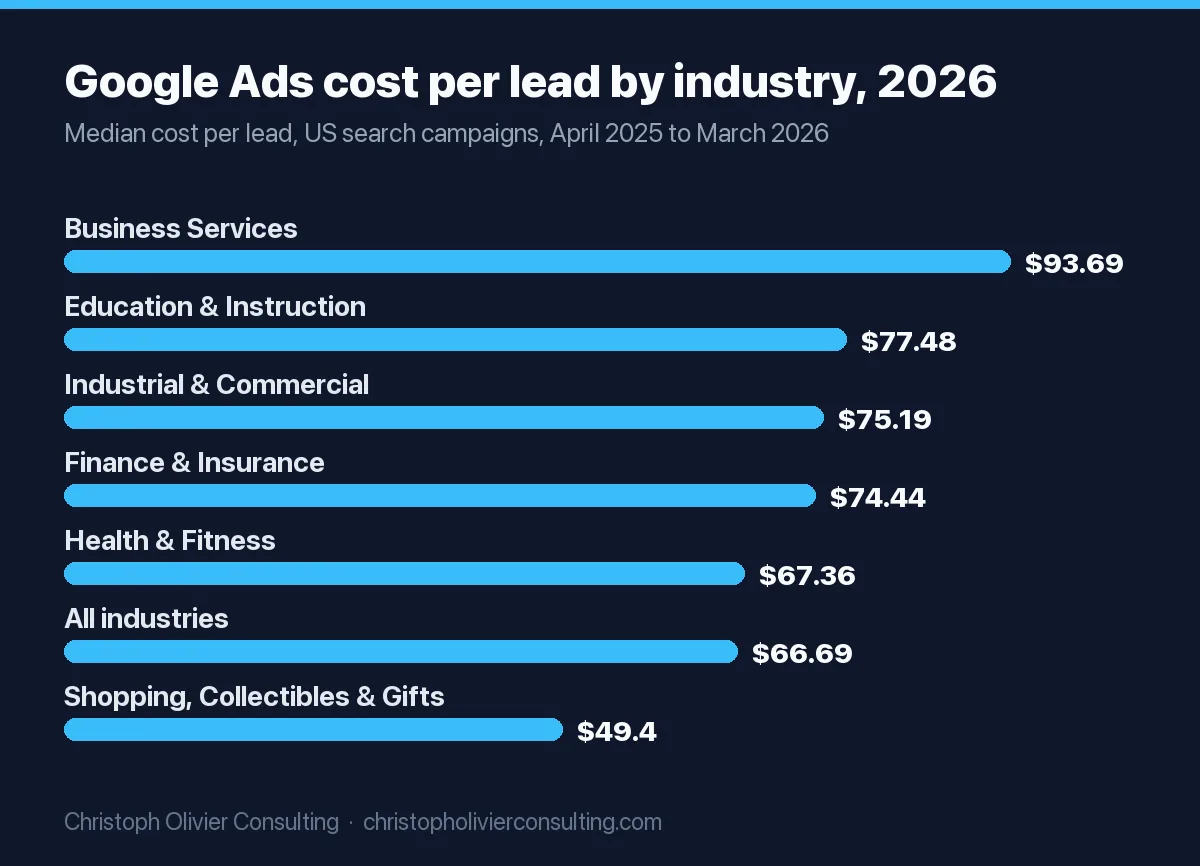
| Google Ads cost per lead | $66.69 | Median, all industries | WordStream 2026 |
| Business Services, Google Ads | CPC $5.87, CVR 4.85%, CPL $93.69 | Industry medians | WordStream 2026 |
| Shopping, Collectibles and Gifts, Google Ads | CPC $4.14, CVR 4.01%, cost per conversion $49.40 | Industry medians | WordStream 2026 |
| Meta traffic campaigns | CPC $0.60, CTR 1.93% | Average, all industries | LocaliQ 2026 |
| Meta lead campaigns | CPC $1.80, conversion rate 8.54%, CPL $27.39 | Average, all industries | LocaliQ 2026 |
| Meta CPM, United States | $23.42 average of monthly medians; $27.47 in November 2025; $20.24 in July 2026 | Cost per 1,000 impressions, all industries, 13 months to July 2026 | Superads ($3 billion ad-spend dataset) |
| LinkedIn Ads minimums | $10 a day minimum; $100 lifetime minimum for a new campaign; LinkedIn suggests $25 a day for new advertisers | Platform rules |
Two things in this table change launch plans. First, timing: US Meta CPMs in November 2025 ran 36% above July 2026 ($27.47 versus $20.24), so a consumer launch in Q4 buys roughly a quarter fewer impressions per dollar than the same launch in summer. Second, the B2B penalty: a Business Services search lead costs 40% more than the all-industry median ($93.69 versus $66.69), and Business Services was one of the industries whose conversion rate fell year over year, so do not budget a B2B launch with all-industry numbers.
Press release, Product Hunt and other launch-day costs
Launch-day costs are mostly fixed and cheap compared with media. Price them from vendor pages, not from roundup articles that mix years. More detail on wires is in press release distribution in 2026.
| Item | Price | What you get | Source |
|---|---|---|---|
| Product Hunt launch | $0 | Launch goes live at 12:01 AM Pacific and runs that full day; schedule from tomorrow up to 30 days ahead; paying for upvotes breaks the rules and can get the launch removed | Product Hunt, FAQ |
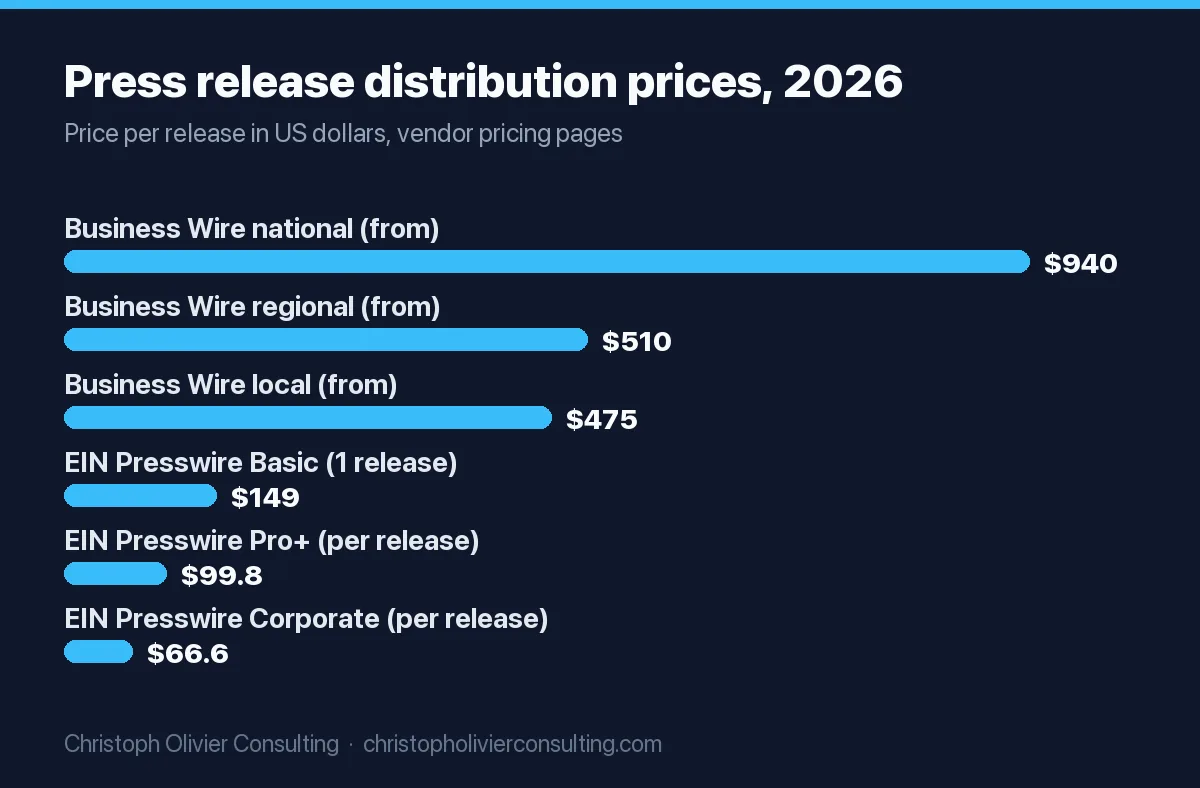
| EIN Presswire Basic | $149 | 1 release, 700 words, 1 country and 1 industry target | EIN Presswire |
| EIN Presswire Pro+ | $499 | 5 releases, 1,000 words each | EIN Presswire |
| EIN Presswire Corporate | $999 | 15 releases ($66.60 each), 2,500 words | EIN Presswire |
| Business Wire, local circuit | From $475 | Starting estimate, 400-word release, most US state, metro or city circuits | Business Wire |
| Business Wire, regional circuit | From $510 | Starting estimate, 400-word release, any US regional circuit | Business Wire |
| Business Wire, national circuit | From $940 | Starting estimate, 400-word release, any US national circuit | Business Wire |
| Email platform (Kit) | Free up to 10,000 subscribers; Creator $390 a year at 1,000 subscribers | Waitlist and launch-day sequence | Kit |
A wire release buys distribution and a dated public record, not coverage. Budget it as one line, then spend the real effort on direct pitches to the five to ten writers who cover your category. If your launch needs only a timestamped announcement for search and partners, the $149 option does that job; a national circuit is worth $940 when trade or financial press actually reads the wire in your industry.
How to split a launch budget: pre-launch, launch window, sustain
There is no study that sets the right phase split for a launch. Ranges on agency blogs often do not even add up (one popular version gives 30% to 40%, 40% to 60% and 20% to 30%, which totals 90% at the low end and 130% at the high end). The split below is my rule of thumb, built from one observation: paid campaigns get cheaper after they collect conversion data, and B2B buyers rarely decide in the launch week, so the sustain phase deserves as much as launch day.
| Phase | Timing | Share (rule of thumb) | What the money buys |
|---|---|---|---|
| Pre-launch | 6 weeks to 1 day before | 20% | Landing page, demo video, tracking and conversion setup, waitlist ads, press list, scheduled wire release, sales one-pager |
| Launch window | Launch day to week 3 | 35% | Wire release, Product Hunt (software), email to waitlist, heaviest paid search and social, retargeting, launch offer |
| Sustain | Weeks 4 to 26 | 35% | Always-on search, retargeting, first customer story, second release at a milestone, scaled winners |
| Reserve | Released at the day 30 review | 10% | Whichever channel is beating its target cost per lead |
For B2B launches there is a sourced guide to the brand versus activation balance: LinkedIn’s B2B Institute, working with Binet and Field on IPA databank cases, recommends roughly a 50/50 split between long-term brand building and short-term sales activation. A launch budget is mostly activation by nature, which is one more reason to fund the sustain phase: that is where brand reach accumulates.
Launch marketing budget template for a B2B or service product
Copy this into a spreadsheet with the header in row 1 and line items in rows 2 to 8. Column E holds the formula; the last column shows what it returns for the Method 1 example above. Add a column F with = E2/$E$11 to see each line’s share of the total.
| A: Line item | B: Phase | C: Unit cost and source | D: Quantity driver | E: Formula | Example |
|---|---|---|---|---|---|
| Paid search (Google, Microsoft) | Launch, sustain | $93.69 CPL, Business Services median (WordStream 2026) | Leads needed from search | = leads × CPL × cold-start factor | 80 × $93.69 × 1.5 = $11,243 |
| LinkedIn sponsored content | Pre-launch, launch | $10 a day minimum, $25 a day suggested start (LinkedIn) | Days live | = daily budget × days | $25 × 60 = $1,500 |
| Wire release | Launch day | From $940, 400 words, national (Business Wire) | Releases | = releases × price | 1 × $940 = $940 |
| Landing page and demo video | Pre-launch | Your quote | 1 | = quote | $4,000 (placeholder) |
| Email platform | Pre-launch onward | $390 a year, Kit Creator at 1,000 subscribers | 1 | = annual price | $390 |
| Sales enablement (one-pager, deck, objection sheet) | Pre-launch | Internal hours or freelance quote | Hours | = hours × rate | Internal, not in total |
| Webinar or launch event | Launch window | Platform or venue quote | Events | = events × cost | $0 in this example |
| Subtotal | = SUM(E2:E8) | $18,073 | |||
| Reserve | Day 30 review | 10% of subtotal | = E9 × 0.10 (cell E10) | $1,807 | |
| Total | = E9 + E10 (cell E11) | $19,880 |
Add two check rows under the total: cost per target customer (= total ÷ customer target) and share of first-year revenue (= total ÷ first-year contract value). If the first is above what a customer is worth over 12 to 24 months, cut the target or the scope before you cut the reserve. For the annual budget this launch sits inside, use how to set a marketing budget.
Launch marketing budget template for a consumer product
Consumer launches carry two costs that B2B templates leave out: product given away and margin given up. Both belong on the budget even when finance books them elsewhere. The example uses the $45 product from Method 2.
| Line item | Phase | Unit cost and source | Formula | Example |
|---|---|---|---|---|
| Meta ads (prospecting and retargeting) | Launch, sustain | $0.60 traffic CPC (LocaliQ 2026) | = target clicks × CPC | 66,667 × $0.60 = $40,000 |
| Google Search and Shopping | Launch, sustain | $49.40 cost per conversion, Shopping, Collectibles and Gifts (WordStream 2026) | = target orders × cost per conversion | 100 × $49.40 = $4,940 |
| Creator seeding | Pre-launch | Your cost of goods plus shipping | = units × (COGS + shipping) | 150 × $12 = $1,800 (placeholder) |
| Launch discount | Launch window | Your price and offer | = discount % × price × discounted units | 20% × $45 × 1,000 = $9,000 |
| Product photography and short video | Pre-launch | Your quote | = quote | $2,500 (placeholder) |
| Wire release | Launch day | $149, EIN Presswire Basic | = releases × price | $149 |
| Email platform | Pre-launch onward | Kit free up to 10,000 subscribers | = plan price | $0 |
| Subtotal | = SUM | $58,389 | ||
| Reserve | Day 30 review | 10% | = subtotal × 0.10 | $5,839 |
| Total | $64,228 |
Notice what happened: Method 2 suggested $58,500 to $78,000, and the line items land at $64,228, but only because the $9,000 discount is counted. Leave it out and the plan looks $9,000 cheaper than it is. That is 12.8% of the $500,000 forecast, which is a launch-year number, not a run rate.
Minimum viable launch budget at $5k, $25k and $100k
These three budgets are illustrative, built only from the verified unit costs above plus clearly marked placeholders for work you must get quoted. Expected volumes use all-industry medians, so they show scale, not a forecast.
| Line | $5,000 launch | $25,000 launch | $100,000 launch |
|---|---|---|---|
| Google Ads search | $3,000 (about 553 clicks at $5.42; about 45 conversions at $66.69) | $9,000 (about 1,660 clicks; about 135 conversions) | $30,000 (about 5,535 clicks; about 450 conversions) |
| Meta ads | $1,200 lead ads (about 43 leads at $27.39) | $6,000 (about 219 leads, or 10,000 traffic clicks at $0.60) | $20,000 (about 730 leads, or 33,333 traffic clicks) |
| LinkedIn Ads | $0 (skip at this size) | $3,000 (60 days at $50 a day) | $15,000 (150 days at $100 a day) |
| Press release | $149 (EIN Presswire Basic) | $940 (Business Wire national, from) | $1,880 (two Business Wire national releases: launch and a 60-day milestone) |
| Product Hunt (software only) | $0 | $0 | $0 |
| Email platform | $0 (Kit free) | $390 (Kit Creator, annual) | $390 (Kit Creator, annual) |
| Creative and production | $0 (founder-made) | $3,200 (placeholder quote) | $15,000 (placeholder quote) |
| PR outreach support | $0 (founder pitches) | $0 (founder pitches) | $7,500 (placeholder quote) |
| Reserve | $651 (13%) | $2,470 (9.9%) | $10,230 (10.2%) |
| Total | $5,000 | $25,000 | $100,000 |
“Conversions” in the Google row means any tracked conversion, usually a lead, not a sale. At $5,000 you are buying a test: enough clicks to learn which message converts, not enough to reach a market. At $100,000 the LinkedIn line runs $100 a day, the top of the $50 to $100 range LinkedIn suggests for advertisers already running campaigns.
Before you lock the number: a pass/fail check
Run the finished budget through these eight checks. Any fail means the number is not ready to defend.
- Unit math. Pass: every paid line shows a unit cost (CPC, CPL or CPM) with a source and a quantity. Fail: a round number with no driver.
- Customers, not clicks. Pass: the funnel math ends in customers, using your own close rates. Fail: the plan stops at leads or traffic.
- B2B numbers for B2B. Pass: industry-specific CPL (for example $93.69 for Business Services). Fail: all-industry $66.69 used for a B2B service.
- Hidden costs counted. Pass: launch discount, free units and creator seeding are line items. Fail: they live only in the P&L.
- Sustain funded. Pass: at least 30% is planned after week 3. Fail: most of the money is gone by launch week.
- Timing priced. Pass: a Q4 consumer launch budgets for higher CPMs (November 2025 ran 36% above July 2026 on Meta in the US). Fail: summer CPMs assumed for a holiday launch.
- Reserve held. Pass: 10% held until a dated day 30 review. Fail: reserve already allocated.
- Kill rule written. Pass: a written rule such as “pause any channel that has spent three times its target CPL with no qualified lead” (a rule of thumb). Fail: channels run until the money is gone.
If you want a second pair of eyes on the numbers before they go to your board or partners, you can book a consultation.
Ready to scale your revenue?
Book a free 30-min consultation. We’ll diagnose your growth bottleneck and map out the 3 highest-leverage moves for your business.
Frequently asked questions
How much should I spend on a product launch?
Work backward from customers: divide the customers you need by your close and qualification rates to get leads, multiply by cost per lead, then add fixed costs and a 10% reserve. In this page's B2B example, 10 clients for a $24,000 a year service need about $19,900, or 8.3% of first-year contract value. Gartner's 2026 steady-state average is 7.8% of revenue.
What percentage of revenue should a product launch marketing budget be?
No sourced benchmark exists for launches specifically. The best current reference is Gartner's 2026 CMO Spend Survey: total marketing budgets average 7.8% of company revenue, mostly at large companies. Treat that as the floor and add a stated launch-year uplift, such as 1.5x to 2x, then check what the money buys with real cost-per-click and cost-per-lead numbers.
What should a launch marketing budget template include?
Each line needs an item, a phase, a unit cost with its source, a quantity driver and a formula. Typical lines: paid search, paid social, LinkedIn for B2B, a wire release, landing page and video, email platform, sales enablement, and for consumer products creator seeding and the launch discount. Finish with a 10% reserve and two checks: cost per customer and share of first-year revenue.
How do you split a launch budget between pre-launch and post-launch?
There is no study that sets the right split. A workable rule of thumb is 20% pre-launch for assets and tracking, 35% for the launch window through week 3, 35% for the sustain phase from week 4 to month 6, and a 10% reserve released at a day 30 review to whichever channel beats its target cost per lead.
Can you launch a product with a $5,000 marketing budget?
Yes, as a test. An illustrative $5,000 plan is $3,000 on Google search (about 553 clicks at the 2026 median $5.42 CPC), $1,200 on Meta lead ads (about 43 leads at $27.39), a $149 EIN Presswire release, a free Product Hunt launch, a free Kit email plan and about $650 in reserve. It buys learning, not market reach.
How much does a press release cost for a product launch?
On vendor pages checked in late 2026, EIN Presswire's Basic plan is $149 for one release, Pro+ is $499 for five and Corporate is $999 for fifteen. Business Wire lists starting estimates for a 400-word release of $475 for a local circuit, $510 regional and $940 national. A wire buys distribution, not coverage, so pitch writers directly too.
Is it free to launch on Product Hunt?
Yes. Product Hunt says launching costs nothing: submitting, commenting and reaching Product of the Day are free. A launch goes live at 12:01 AM Pacific on the scheduled date and runs that full day, and you can schedule it up to 30 days ahead. Paying for upvotes breaks its rules and can get the launch removed.