
Last reviewed: October 2026
A product marketing manager (PMM) is the person who decides how a product is positioned, who it is for, and what the market hears about it, then turns that into launches, sales tools and messaging that help the product sell. In the US, Product Marketing Alliance survey data puts the median PMM salary at $124,900, and senior roles pay well above that.
This guide covers what a product marketing manager actually does day to day, how the role differs from product management and other marketing jobs, the skills that matter, verified salary data, a career path, a first 90 days plan you can copy, and how to tell whether your company needs a PMM yet.
What is a product marketing manager?
A product marketing manager is the bridge between the product and the market. The PMM studies buyers and competitors, defines the product’s positioning and messaging, plans launches, and equips sales to win deals. Product managers decide what gets built. Product marketing managers decide how it is framed, priced in the buyer’s mind, and brought to market.
Pragmatic Institute, one of the longest running training bodies for product teams, puts the split simply: product marketing is responsible for marketing products, while product management is responsible for creating them, and the two must collaborate to develop and successfully market upcoming products.
The role sits at an intersection, and the data shows it. In the Product Marketing Alliance State of Product Marketing Report 2025, 88.8% of PMMs said they work closely with product teams and 81% with marketing. That is why people often call product marketing the glue of a go-to-market team.
What does a product marketing manager do?
A product marketing manager owns positioning and messaging, runs product launches, builds sales enablement, gathers customer and competitive insight, and feeds that insight back into pricing and the roadmap. The exact mix shifts with company size, but positioning, messaging and launches have stayed at the center of the job for years.
Product Marketing Alliance tracked how the role has changed since 2019. Its review of six years of survey data found that positioning, messaging and launches stayed constant, while other duties grew: 78.7% of PMMs now cite sales enablement as a core duty, up from 66.9% in 2023, and customer onboarding more than doubled, from 18.5% to 37.5%. Website and customer-facing content now falls under 65% of PMM teams.
The seven core product marketing manager responsibilities
- Positioning. Decide which market the product competes in, who the best-fit buyer is, and why the product wins for that buyer. A clear positioning statement is usually the first artifact a PMM writes.
- Messaging. Turn positioning into words: the headline, the value pillars, proof points and objection handling that every channel reuses.
- Launches. Plan and run go-to-market for new products and features: tiering launches by importance, coordinating product, sales, support and marketing, and setting the launch date and goals.
- Sales enablement. Build pitch decks, battlecards, one-pagers, demo scripts, case studies and training so sales can explain the product the same way every time.
- Competitive intelligence. Track rivals’ features, pricing and messaging, and turn that into talk tracks and roadmap input.
- Customer and market research. Run win/loss interviews, buyer interviews and surveys to learn why people buy, stall or leave.
- Pricing and packaging input. PMMs rarely own price alone, but they bring buyer willingness-to-pay and competitor packaging data to the pricing decision.
Responsibilities across the product lifecycle
It helps to see the work in three phases. Before launch, the PMM researches buyers, tests positioning and shapes naming and packaging. During launch, the PMM owns the go-to-market plan and the core message. After launch, the PMM tracks adoption, win rates and feedback, refreshes sales tools and plans growth campaigns for the installed base.
Product marketing manager vs product manager vs other marketing roles
A product manager owns what gets built and why. A product marketing manager owns who it is for, how it is positioned and how it reaches the market. A brand marketer owns how the whole company is perceived, and a growth marketer owns acquisition channels and funnel conversion. The roles overlap, so clear ownership prevents duplicated work.
| Role | Core question | Owns | Typical success metrics | Works most with |
|---|---|---|---|---|
| Product marketing manager | Why should this buyer choose this product now? | Positioning, messaging, launches, sales enablement, competitive intel | Win rate, launch adoption, pipeline and revenue influenced, sales ramp time | Product, sales, marketing, customer success |
| Product manager | What should we build next, and why? | Roadmap, requirements, feature prioritization, delivery | Usage, retention, delivery against plan, user satisfaction | Engineering, design, customers |
| Brand marketer | What does the company stand for? | Brand identity, voice, campaigns, awareness | Awareness, share of search, brand preference | Creative, communications, agencies |
| Growth or demand gen marketer | How do we bring in more qualified buyers? | Channels, paid media, funnel experiments, lead flow | Leads, pipeline, cost per acquisition, conversion rate | Sales development, marketing ops |
| Marketing manager (generalist) | How do we run marketing day to day? | Campaign calendar, content, events, vendors | Campaign output, leads, budget pacing | Whole marketing team, leadership |
In small companies one person often covers two or three of these columns. That works for a while, but the PMM column tends to be the one that gets dropped, because launches and sales tools feel urgent only when a deal is lost or a launch falls flat. If you are deciding between a generalist and a specialist hire, compare this table against a standard marketing manager job description to see which work you actually need covered.
Skills a product marketing manager needs
The best product marketing managers combine buyer empathy with commercial judgment. They can interview a customer, spot the real reason a deal was won, compress that into one clear sentence, and then get product, sales and marketing to use the same sentence. Writing, research and influence without authority matter more than any single tool.
- Customer research. Running interviews, win/loss analysis and surveys, and separating what buyers say from what they do.
- Strategic writing. Positioning documents, message frameworks and launch briefs that others can act on.
- Storytelling and presentation. Turning features into a narrative a buyer and a seller can both repeat.
- Market and competitive analysis. Mapping alternatives, including the status quo, and finding the angle where you win. A structured competitive analysis is the usual starting point.
- Project management. Launches touch every team, so a PMM needs to run timelines, owners and checklists.
- Commercial literacy. Reading pipeline data, win rates and pricing, and knowing which numbers leadership cares about.
- Cross-functional influence. PMMs rarely manage the people whose work they shape, so trust and clear reasoning do the work a title cannot.
Tools vary by company, but most PMMs live in a CRM, a slide tool, a docs tool, a survey or interview tool, a call recording tool and, increasingly, AI assistants for first drafts and research synthesis. None of those replaces the judgment above.
Product marketing manager salary in 2026
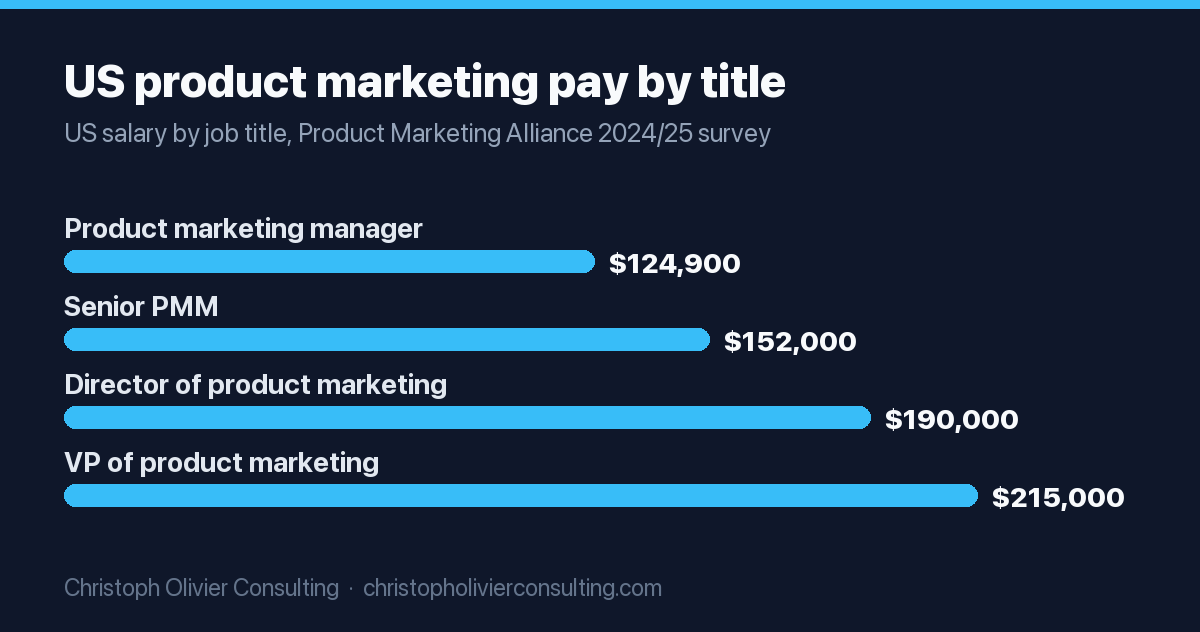
US product marketing managers earn a median of $124,900, according to the Product Marketing Alliance 2024/25 salary survey. Senior PMMs report about $152,000, directors $190,000 and VPs $215,000. The government’s closest occupation, marketing managers, had a median of $166,790 in May 2025, but that category includes many senior and non-product roles.
What the data sources say
The Bureau of Labor Statistics does not publish a separate category for product marketing managers. They fall under marketing managers. For that occupation, BLS reports a median annual wage of $166,790 in May 2025, with the lowest 10 percent earning less than $90,260 and the highest 10 percent more than $293,610. BLS projects 7% employment growth from 2025 to 2035, faster than the average for all occupations, with about 29,100 openings a year across advertising, promotions and marketing manager roles.
For PMM-specific figures, the best public source is the Product Marketing Alliance salary survey, which drew on nearly 700 product marketing professionals in its 2024/25 edition. Its published US figures by title:
| Title | US salary (PMA 2024/25 survey) | Source page |
|---|---|---|
| Product marketing manager | $124,900 (median) | PMA, PMM salary in Boston |
| Senior product marketing manager | $152,000 | PMA, Senior PMM salary |
| Director of product marketing | $190,000 (median) | PMA, Director salary |
| VP of product marketing | $215,000 (median) | PMA, VP salary |
| Marketing managers, all types (BLS) | $166,790 (median, May 2025) | BLS Occupational Outlook Handbook |
What moves PMM pay
- Location. PMA reports Boston PMMs at a median of $127,700, above the US median, and pay in major tech hubs generally runs higher than elsewhere.
- Industry. In the BLS data, marketing managers in the information sector had the highest median wage among the top industries, at $192,600.
- Seniority and scope. The jump from PMM to director is larger than most single promotions, because directors own strategy and a team rather than individual launches.
- Total compensation. Base salary is only part of it. In venture-backed software companies, equity and bonus can be a large share of the package, so compare offers on total value.
Treat any single number with care. Survey medians reflect who answered the survey, and job-board estimates mix titles. If you are setting a salary band, triangulate at least two sources and adjust for your market and the scope you are actually hiring for.
Product marketing manager career path
Most product marketing careers run from associate PMM to PMM, senior PMM, then either a principal track (deep individual expertise) or a management track (director, then VP of product marketing). Many PMMs arrive from sales, product management, consulting or content marketing, and some move on to product management, general marketing leadership or CMO roles.
- Associate PMM (0 to 2 years). Supports launches, builds sales collateral, runs competitive tracking and learns the product deeply.
- Product marketing manager (2 to 5 years). Owns positioning and launches for a product or segment, and partners directly with a product manager and sales leaders.
- Senior PMM (5 to 8 years). Owns larger launches or a whole product line, sets messaging strategy and mentors junior PMMs.
- Principal PMM or group PMM. Senior individual contributor or first-line manager across several products or markets.
- Director of product marketing. Owns the product marketing function, its headcount and its seat in go-to-market planning.
- VP of product marketing or CMO. Sets company positioning and market strategy, often with demand generation or brand reporting in as well.
The year ranges are typical, not rules. People who come from sales or product often skip the associate level because they already understand buyers or the product.
How to become a product marketing manager
Most product marketing managers hold a bachelor’s degree and build several years of experience in a related role first, such as marketing, sales, product or consulting. The fastest route in is to show positioning, research and launch work you have actually done, even on a small scale, rather than relying on certificates alone.
BLS notes that marketing managers typically need a bachelor’s degree, often in marketing or communications, plus work experience in a related advertising, marketing, promotions or sales occupation. In practice, a portfolio that shows the following tends to carry more weight than any single credential:
- A positioning document or messaging framework you wrote, with the research behind it.
- A launch you planned or supported, with what you measured.
- Sales tools you built, such as a battlecard or pitch narrative, and how sales used them.
- Customer interviews or win/loss analysis you ran, and what changed as a result.
A product marketing manager’s first 90 days: a template
A strong first 90 days for a new product marketing manager follows a simple order: listen, then decide, then ship. Spend the first month learning buyers, product and sales, the second month rebuilding positioning and messaging, and the third month putting those into a launch and sales enablement that the team actually uses.
Days 1 to 30: learn
- Meet every product manager, sales leader and customer success lead. Ask what is working, what is lost and why.
- Listen to at least ten recorded sales calls, mixing won and lost deals.
- Interview five to ten recent customers and two or three lost prospects.
- Collect every existing deck, page and one-pager, and note where the story conflicts.
- Map the main alternatives buyers consider, including doing nothing.
Days 31 to 60: decide
- Draft positioning: best-fit customer, category, key alternatives, differentiated value and proof.
- Write a message framework with one headline, three value pillars and proof for each. A sharp value proposition anchors this step.
- Test the message with sales and five customers. Revise.
- Agree a launch tiering model with product so everyone knows what a major, medium and minor release gets.
Days 61 to 90: ship
- Rebuild the core pitch deck, website product page and one battlecard against the most common competitor.
- Run a sales training on the new story and record it.
- Run your first launch with a written brief, owners and goals.
- Set a short scorecard: win rate on target deals, adoption of new assets by sales, and launch goals versus actuals.
- Present a 6 month plan to leadership based on what you learned.
This order matters. New PMMs who rewrite messaging in week one usually rewrite it again in month three, because they had not heard enough buyers yet.
When does a company need a product marketing manager?
A company usually needs a dedicated product marketing manager when it has a product people buy, a sales team that tells the story inconsistently, and launches that land quietly. If win rates are slipping, new features go unused, or every rep pitches differently, a PMM often pays off faster than another channel hire.
Use the signals below to judge timing. A single signal is rarely enough; three or more usually means the gap is costing you deals.
| Signal | What it usually means | Likely first move |
|---|---|---|
| Sales reps describe the product in different ways | No shared positioning or message framework | Positioning and messaging project |
| New features ship but adoption stays low | No launch process or customer communication | Launch tiering and launch briefs |
| Losing deals to the same rival repeatedly | No competitive intel or talk tracks | Win/loss interviews and battlecards |
| Founders still do every sales call well, reps do not | The story lives in founders’ heads | Capture the founder pitch, train it |
| Expanding into a new segment or vertical | Old messaging does not fit the new buyer | Segment research and tailored positioning |
| Sales says most marketing leads are a poor fit | Unclear ideal customer and value story | Ideal customer definition and message reset |
Full-time hire, fractional or contractor?
Many companies do not need a full-time PMM on day one. Product Marketing Alliance found that 44.3% of PMM teams are just one or two people, so even established companies run lean. A practical sequence:
- Project basis. If the main gap is positioning and messaging, a defined project with a consultant can fix the foundation in weeks.
- Fractional. If you need ongoing launches and enablement but not 40 hours a week, a fractional product marketer or fractional CMO can cover it.
- Full-time. Once you ship regularly, run multiple segments, or sales headcount is growing, a dedicated PMM usually earns the seat.
Professional-service firms face the same question in a different form. A law, accounting or consulting firm sells services rather than software, but each practice area still needs a clear position, a message buyers repeat, and a way to launch new offers. The PMM skill set applies directly, even if the title on the org chart is different. For the strategic side, see how a full product marketing strategy ties these pieces together.
How product marketing managers measure success
Product marketing managers are increasingly judged on revenue outcomes, not activity. The most useful metrics connect PMM work to deals: win rates in target segments, pipeline and revenue influenced by launches, adoption of new features, sales ramp time, and how often reps use the assets PMM builds.
Product Marketing Alliance reports that 53.2% of PMMs now track generating revenue as a KPI, up from 50.9% in 2024, as teams shift toward showing business impact through measures such as win rates and upsell. A balanced PMM scorecard often includes:
- Win rate on deals where the target competitor or segment is present.
- Launch goals versus actuals, such as feature adoption or pipeline in the first 90 days.
- Sales asset usage, from your CRM or content tool.
- Message consistency, checked by listening to a sample of recorded calls each quarter.
- Customer insight delivered, such as win/loss findings that changed the roadmap or pricing.
In my experience, the cleanest signal is the sales call. If reps tell the same clear story without reading from a slide, product marketing is working. If you want an outside view on whether your firm needs a product marketer, a fractional lead or just a sharper positioning project, you can book a consultation and we can talk it through.
Frequently asked questions
What does a product marketing manager do?
A product marketing manager defines how a product is positioned and who it is for, writes the core messaging, plans and runs product launches, and builds sales enablement such as pitch decks and battlecards. PMMs also gather customer and competitive insight and feed it back into pricing and the product roadmap, acting as the link between product, marketing and sales.
How much does a product marketing manager make?
The Product Marketing Alliance 2024/25 salary survey reports a US median of $124,900 for product marketing managers, about $152,000 for senior PMMs, $190,000 for directors and $215,000 for VPs. BLS does not track PMMs separately; its broader marketing managers occupation had a median wage of $166,790 in May 2025. Pay varies with location, industry and scope.
What is the difference between a product manager and a product marketing manager?
A product manager decides what gets built and why, owning the roadmap, requirements and delivery. A product marketing manager decides who the product is for, how it is positioned and how it reaches the market, owning messaging, launches and sales enablement. The two work closely, and in most companies the PM owns the product while the PMM owns the story.
Is product marketing manager a good career?
For many people it is. BLS projects 7% growth for marketing managers from 2025 to 2035, faster than average, and product marketing salaries rise steeply with seniority. The role suits people who enjoy customer research, writing and working across teams. It can be demanding, because PMMs often influence work they do not directly control.
What skills does a product marketing manager need?
Core skills include customer research and win/loss analysis, strategic writing for positioning and messaging, storytelling and presentation, competitive analysis, project management for launches, commercial literacy around pipeline and pricing, and the ability to influence product, sales and marketing teams without direct authority. Tools matter less than the judgment to turn research into a clear, repeatable story.
When should a company hire a product marketing manager?
Consider a product marketing manager when sales reps describe the product inconsistently, new features ship with low adoption, you keep losing to the same competitor, or you are entering a new segment. If the main gap is positioning, a project or fractional resource can often fix it first, with a full-time PMM added once launches and sales headcount grow.
More Growth Consulting guides
- Product Marketing Strategy: How to Build One That Drives Pipeline
- How to Write a Positioning Statement (Template + Examples)
- What Is a Value Proposition? Formula, Examples, and a Fill-in Framework
- How to Do a Competitive Analysis (Marketing Guide + Template)
- Marketing Manager Job Description Template
- Self Storage Marketing: A Cost-Per-Move-In Playbook
- All Growth Consulting guides →