
Last reviewed: October 2026
The best content marketing examples are owned media that a buyer would want even if no product were attached: John Deere’s farm magazine The Furrow (since 1895), HubSpot’s free Website Grader, River Pools’ question-answering blog, Edelman’s annual Trust Barometer and Spotify Wrapped. Each one solves a real audience problem, repeats on a schedule, and sits close enough to the product that attention turns into demand.
This page walks through 15 verified examples across B2B and B2C, grouped by format. For each one you get what the company made, the documented result where a credible source exists, and the lesson a professional-service firm can actually use. Then you get a framework and a worked plan for building your own.
What makes a content marketing example worth copying?
A content marketing example is worth copying when three things are true: it serves a specific audience better than the alternatives, it runs as a repeatable program rather than a one-off stunt, and it connects back to what the company sells. Viral reach alone is not the test. Plenty of famous campaigns never moved revenue in any documented way.
Most roundups on this topic list 30 or 50 brands with no proof behind them. This page takes the opposite approach. Every number below links to the primary source or the closest credible report available. Where a widely repeated result could not be verified, the page says so. If you want the underlying definition first, start with this modern content marketing playbook, then come back for the examples.
Read each example through three filters: audience fit (who is it for), repeatability (can it run again next year) and the commercial bridge (how a reader becomes a client).
15 content marketing examples at a glance
The 15 content marketing examples below span print magazines, blogs, free tools, original research, video, live events and social media. They range from a tire company’s 1900 road guide to a 2025 personalization campaign. The table gives you the format, the documented proof and the transferable lesson so you can scan for the model that fits your firm.
| Brand and program | Format | Audience | Documented proof | Lesson for service firms |
|---|---|---|---|---|
| John Deere, The Furrow | Print magazine | B2B (farmers) | Published since 1895; 550,000+ North American readers (2018) | Teach the craft, not the product |
| Michelin Guide | Printed guide | B2C (drivers) | Nearly 35,000 free copies of the 1900 edition | Create demand for the category you serve |
| Morning Brew | Email newsletter | B2C and professionals | Majority stake sold to Insider Inc. in a $75M deal (2020) | A newsletter can become the asset |
| River Pools and Spas | Educational blog and video | B2C (homeowners) | 5,000+ monthly views four months after launch (2009); NYT feature (2013) | Answer every buyer question publicly |
| Ahrefs blog | Product-led blog | B2B (marketers) | Publishes its 0 to 3 “business potential” scoring method | Pick topics where your service is the natural answer |
| HubSpot Website Grader | Free tool | B2B (SMB marketers) | 2 million+ URLs graded by early 2010 | A diagnostic is the best lead magnet |
| Spotify Wrapped | Personalized data story | B2C | 200M engaged users in 24 hours (2025) | Give clients their own data, packaged to share |
| Edelman Trust Barometer | Annual research report | B2B (executives) | 26th year; 33,938 respondents in 28 countries (2026) | Own one annual number in your niche |
| Gong Labs | Research from platform data | B2B (sales leaders) | Research arm built on anonymized platform data | Mine your own files for benchmarks |
| Shutterstock trend report | Annual trend report | B2B (creatives) | Annual format; no public results claimed | A yearly forecast creates a reason to return |
| Red Bull Stratos | Live event and video | B2C | 8 million+ concurrent YouTube live streams (2012) | Big ideas still need a distribution plan |
| Blendtec “Will It Blend?” | Video series | B2C | Long-running official YouTube series; no audited sales data | Demonstrate the claim, do not just state it |
| Mailchimp Presents | Original shows and podcasts | B2B (small business) | 50+ pieces at launch (2019), no ads inside | Own the media instead of renting it |
| Duolingo social | Short-form social video | B2C | Discussed in its own shareholder letters | Brand voice is a strategic decision |
| Patagonia “Don’t Buy This Jacket” | Print ad plus essay | B2C | Black Friday 2011 NYT ad; no verified sales figure | Values content works when it is true |
Owned publications: magazines, guides and newsletters
Owned publications are the oldest content marketing examples and still among the most durable. A magazine, guide or newsletter gives an audience a reason to come back on a schedule, and it lets the brand stay present between purchases. The common thread is editorial discipline: the content is useful first and promotional rarely, if ever.
John Deere: The Furrow
John Deere started The Furrow in 1895 to give farmers practical information on better farming. According to The Drum’s 2018 profile, it reached more than 550,000 readers in North America, and its publications manager said: “We do not talk about ourselves in the editorial space of the magazine.” The lesson for a law, accounting or consulting firm is direct. Write about your clients’ work and decisions, not your firm.
Michelin Guide
The Michelin brothers published their first guide in 1900 to increase demand for cars and, by extension, tires. Michelin distributed nearly 35,000 free copies of that first edition, gave revised editions away until 1920, and started charging in 1922. Stars arrived in 1926. The lesson: some of the best content grows the category you serve, not just your share of it.
Morning Brew
Morning Brew built a daily business newsletter with a casual voice. In October 2020, Insider Inc. bought a majority stake in a deal reported at $75 million, with the brand set to operate independently. The takeaway: a consistent, useful newsletter can become an asset in its own right.
Educational blog content marketing examples
Educational blogs work when they answer the questions buyers already ask, in plain language, before the buyer talks to sales. The two strongest examples here are a pool installer and a software company. Both tie each article to a real buying question, and both treat the blog as a sales asset rather than a news feed.
River Pools and Spas
River Pools is the classic service-business example. During the 2009 downturn, the company shifted from paid advertising toward informational blog posts and videos, a story covered in a February 2013 New York Times small-business feature. The company’s own August 2009 post reported that about four months after launch, the blog had over 5,000 monthly views, over 100 subscribers and more than 25 videos. That method later became the “They Ask, You Answer” approach.
Your buyers have the same kinds of questions about fees, timelines, risks and alternatives. Answering them in public earns trust before the first call.
Ahrefs blog
Ahrefs publishes how it chooses topics. Its SEO content strategy guide scores each topic on “business potential” from 0 to 3, alongside search traffic potential and ranking potential. Its example: a coffee equipment store can pitch its product far more easily on “best coffee machines” than on “why does coffee make me sleepy.”
For a service firm, that means writing about problems where your service is the obvious next step: entity selection beats general money tips for a tax practice.
Free tools and interactive content
Free tools turn content into a personal result. Instead of reading about a problem, the visitor gets a score, a report or a summary of their own data. That creates a natural reason to talk to the company that built it, which is why tools often outperform articles as lead generators for B2B firms.
HubSpot Website Grader
HubSpot launched Website Grader in February 2007. In the company’s own milestone post, it said the tool was “initially created as a way to generate buzz, organic/viral traffic, inbound links and leads,” and that it had graded over 2 million website URLs.
A firm version could be a readiness checklist, a fee estimator or a compliance self-assessment that gives an honest result before offering a conversation.
Spotify Wrapped
Spotify Wrapped packages each listener’s year into a shareable story. Music Business Worldwide reported that Wrapped 2025 reached 200 million engaged users in its first 24 hours, a 19% increase year over year, after taking about 62 hours to reach that mark in 2024. Shares in the first day rose 41% to roughly 500 million.
The service-firm version is smaller but real: an annual client summary of savings, filings, milestones or outcomes that a client is proud to forward.
Original research and data reports
Original research earns links, press mentions and AI citations because it is the only place a specific number exists. For professional-service firms, this is often the format with the best return: you already hold data or expert access that nobody else has. The examples below show how far one annual study can carry a brand.
Edelman Trust Barometer
Edelman, a communications firm, runs its Trust Barometer as an annual online survey, now in its 26th year. The 2026 edition surveyed 33,938 respondents across 28 countries. This is the clearest example on the list of a service firm owning an annual number that executives, journalists and its own clients reference all year.
Gong Labs
Gong describes Gong Labs as its “original research engine,” turning sales conversations, deals and workflows into benchmarks drawn from anonymized platform data. Your operating data is a content source too: an accounting firm can report anonymized client trends; a law firm can track filing timelines.
Shutterstock creative trends
Shutterstock publishes an annual trend report for creatives, one of the formats highlighted in hellodarwin’s roundup. No public results are attached, so treat it as a format model: a yearly forecast gives your audience a reason to return.
Video, live events and entertainment
Video and live content win when they show something that text cannot. The format ranges from a cheap product demo to a global live stream to a full slate of original shows. The common lesson is that production value matters less than a clear idea and a plan for where people will actually watch.
Red Bull Stratos
On October 14, 2012, Felix Baumgartner’s jump from the edge of space drew more than 8 million concurrent live streams on YouTube, according to Tubefilter, beating the previous record for a single live stream.
Blendtec “Will It Blend?”
Blendtec’s long-running YouTube series puts unlikely objects, including smartphones, into its blenders. It proves a product claim through demonstration. No audited sales data is public, so take the lesson: show the result your service produces, using anonymized work.
Mailchimp Presents
Mailchimp launched Mailchimp Presents in June 2019 with over 50 pieces of original video and podcast content for entrepreneurs, made with production partners and containing no Mailchimp advertising, MediaPost reported. Its head of brand put the logic simply: “We can own the media instead of renting space.”
Social media content marketing campaign examples
Social content marketing campaign examples show that voice and values can be a strategy, not decoration. Duolingo built attention with a distinctive, chaotic tone. Patagonia used a single print ad and essay to state a position on consumption. Both carry risks, and both are clearer about intent than most social campaigns.
Duolingo
Duolingo’s mascot-driven short-form videos are among the most discussed brand social accounts. In its Q3 2025 shareholder letter, the company reported 50.5 million daily active users, up 36% year over year, and said it had posted less “unhinged” content on its English-language accounts while it “prioritized building long-term brand sentiment,” then began posting more again. A public company discussing its social voice with investors shows that voice is a business decision.
Patagonia: Don’t Buy This Jacket
On Black Friday 2011, Patagonia ran a full-page New York Times ad headlined “Don’t Buy This Jacket,” tied to its Common Threads Initiative. Patagonia’s own account explains the reasoning but reports no sales figure. Many roundups claim a specific sales lift afterward, but that number could not be traced to a primary source, so it is not repeated here.
For a professional-service firm, values content means publishing what you will not do, such as products you will not sell or fees you will not charge, and meaning it.
What the best content marketing examples have in common
The best content marketing examples share five traits: a narrow audience, a format that repeats, a clear point of view, an asset only that company could make, and a bridge to the offer. Budget is not on the list. River Pools and The Furrow started with small teams; what they had was discipline and time.
- A defined reader. Farmers, pool buyers, sales leaders. Not “everyone.”
- A repeating format. Annual reports, weekly newsletters and question-led articles compound. One-off stunts rarely do.
- Proprietary input. Platform data, field expertise or access no one else has.
- Editorial restraint. The product appears where it genuinely helps, not in every paragraph.
- A commercial bridge. A grade, a consultation or a trial that follows naturally from the content.
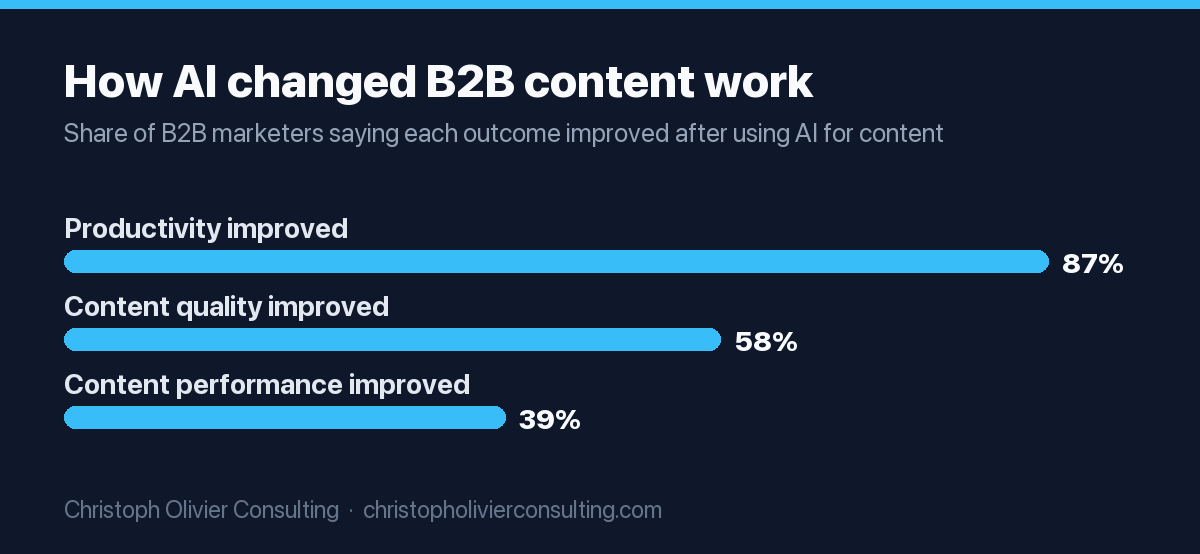
Execution still matters more than tools. In the Content Marketing Institute’s 2026 B2B report, based on a survey of 1,015 B2B marketers, 97% said they have a content strategy. Among marketers reporting on AI in content creation, 87% said productivity improved, but only 58% said quality improved and 39% said performance improved. Faster output is not the same as better results.
B2B content marketing examples: what professional-service firms should copy
Professional-service firms should copy the formats that turn expertise into proof: question-led articles, annual research, diagnostic tools and a steady newsletter. These match how buyers choose an accountant, attorney or consultant. They want evidence of judgment before they book a call, and they compare firms quietly over weeks.
| If your firm has… | Copy this example | First version to ship | Effort |
|---|---|---|---|
| Partners who answer the same client questions weekly | River Pools | 20 articles answering real sales questions, including fees | Low |
| Anonymized data across many clients | Edelman, Gong Labs | One annual benchmark report with a single headline number | Medium |
| A repeatable assessment you do on discovery calls | HubSpot Website Grader | A 10-question online self-assessment with an honest score | Medium |
| A partner who writes well and has opinions | Morning Brew, The Furrow | A twice-monthly email to clients and referral partners | Low |
| A narrow niche with specific workflows | Ahrefs | How-to guides showing your method on real (anonymized) problems | Medium |
| Annual client outcomes worth celebrating | Spotify Wrapped | A one-page year-in-review sent to each client | Low to medium |
If you do not have the people to run this internally, a content strategist can pick the format and set the editorial rules, while writers or partners produce the pieces.
How to build your own content marketing example: a 7-step framework
To build your own content marketing example, pick one audience, one format and one commercial bridge, then commit to a cadence for at least two quarters. The seven steps below turn the patterns above into a working plan. Most firms can complete the first four steps in a single planning session.
- Name the reader. One buyer role in one segment, for example owners of $5M to $20M construction firms.
- List their 30 real questions. Pull them from sales calls, emails and intake forms, as River Pools did.
- Find your proprietary input. Data, a method, or access only your firm has. This becomes your research or tool.
- Choose one anchor format. Blog, newsletter, annual report or tool. Add a second format only after the first runs reliably.
- Score topics for business potential. Use a 0 to 3 scale like Ahrefs. Publish 2s and 3s first.
- Set the cadence and the bridge. Decide how often you publish and what the reader does next: a checklist, a grade or a consultation.
- Measure leads, not just traffic. Track assisted consultations and proposals that mention content, then refine every quarter.
A written content roadmap keeps this from drifting after the first month, which is where most programs stall.
Worked example: a 90-day plan for a mid-size accounting firm
Here is how the framework could look for a hypothetical 25-person accounting firm serving owner-operated businesses. This is an illustrative plan, not a client case study. It combines the River Pools model for search demand with an Edelman-style annual number for authority and links.
- Weeks 1 to 2: Partners list 30 questions prospects ask. Score each 0 to 3 for business potential. Pick the top 12.
- Weeks 3 to 8: Publish two question-led articles per week, each with a direct answer at the top, a fee or timeline range where possible, and a soft link to book a call.
- Weeks 5 to 10: Pull anonymized data from client files, such as average days to close books or the most common filing deadline misses. Draft a short benchmark report.
- Weeks 9 to 12: Launch a twice-monthly client newsletter that recaps new articles and previews the report. Publish the report with one headline number journalists can quote.
At 90 days, success usually looks like early ranking movement on low-competition questions, a growing list and first consultations that cite an article. Revenue impact often takes longer. For a fuller view of formats and channels, see how a structured content marketing program fits together.
Common mistakes when copying famous examples
The most common mistake is copying the surface of a famous example, such as the tone, the budget or the stunt, without the system underneath it. Red Bull Stratos worked because Red Bull already ran a media business. Duolingo’s tone works because it fits a consumer app. Neither transfers directly to a tax practice.
- Copying scale: a 3-person marketing team cannot run a Red Bull calendar. Copy River Pools instead.
- Trusting unverified results: many roundup statistics have no traceable source. Check before you build a budget case on them.
- Skipping the bridge: content without a next step builds an audience you cannot reach.
- Quitting early: The Furrow has run for more than a century. Most firm programs stop within six months.
If you want a second opinion on which model fits your firm, a content marketing consultant can pressure-test the plan before you commit resources. When you are ready to talk it through, you can book a consultation and we can map the first 90 days together.
Frequently asked questions
What are examples of content marketing?
Common examples of content marketing include brand magazines such as John Deere's The Furrow, educational blogs such as River Pools' question-led articles, free tools such as HubSpot's Website Grader, annual research such as the Edelman Trust Barometer, newsletters such as Morning Brew, and personalized data stories such as Spotify Wrapped. Each gives the audience something useful before asking for anything.
What are the best B2B content marketing examples?
Strong B2B content marketing examples include HubSpot Website Grader (a free diagnostic tool), the Ahrefs blog (product-led tutorials scored for business potential), Gong Labs (benchmarks from anonymized platform data), the Edelman Trust Barometer (an annual survey now in its 26th year) and Mailchimp Presents (original shows for small business owners). They share a defined audience and a repeatable format.
What is a good content marketing example for a small service business?
River Pools and Spas is the best documented example. During the 2009 downturn the pool installer shifted from paid advertising to blog posts and videos answering every question buyers asked, including price. Its own 2009 post reported over 5,000 monthly views four months after launch, and the New York Times covered the approach in 2013.
What makes a content marketing campaign successful?
Successful content marketing campaigns usually combine five traits: a narrowly defined reader, a format that repeats on a schedule, proprietary input such as data or expertise, editorial restraint about the product, and a clear next step for the reader. Budget matters less than consistency. Many of the longest-running examples started with small teams.
How long does content marketing take to work?
Content marketing often shows leading indicators, such as rankings on low-competition questions, newsletter sign-ups and consultations that mention an article, within about three months. Revenue impact usually takes longer, which is why the strongest programs run for years. Judge early progress on those leading indicators, and review the topic list and formats every quarter.
Are the results in famous content marketing examples reliable?
Not always. Many roundups repeat results that cannot be traced to a primary source. Patagonia's own account of its 2011 Don't Buy This Jacket ad, for example, reports no sales figure, even though many articles cite one. Before using a result to justify budget, check that it comes from the company, a filing or a credible report.
More Content Marketing guides
- What Is Content Marketing? Modern Playbook
- How to Hire a Content Marketing Consultant
- Content Marketing for Startups: What to Build First With No Team or Budget
- Podcast Marketing: Launch & Grow a Branded Show
- Video Marketing in 2026: Production + Distribution
- Content Marketing for Small Businesses: A Plan You Can Actually Keep
- All Content Marketing guides →