

The proposal follow-up that works for a CPA or tax firm is a short run of personal emails: a recap the next day, one easy question on day 3, something useful on day 7, a decision nudge two business days before the proposal expires, and a “closing the file” email around day 21. Each one gives the prospect a new reason to reply, and the sequence stops the moment they sign or say no. Below are 10 copy-ready templates with subject lines and timing, including a tier-downgrade offer, an engagement-letter reminder, a reply to “your price is too high” and a re-open email for day 60, followed by the proposal strategy, tools, KPIs and Circular 230 rules behind them.
The proposal follow-up cadence at a glance
Day 0 is the day you present the proposal live and send it for signature. The schedule assumes an expiry date 14 calendar days out, which is roughly the “10 business days” signing deadline in our accounting proposal pricing template and the default expiry Ignition applies to new proposals.
| # | When to send | Send only if | Stop when | |
|---|---|---|---|---|
| 1 | Recap | Day 1, morning | Always | Signed |
| 2 | One question | Day 3 | No reply to email 1 | Signed or replied |
| 3 | Summary for the other decision maker | Day 5 | A spouse, partner or board was named on the call | Signed or replied |
| 4 | Value add | Day 7 | No reply yet | Signed or replied |
| 5 | Decision nudge | Day 12, two business days before expiry | Still unsigned | Signed, “no”, or expiry |
| 6 | Tier-downgrade offer | Same day the prospect says budget is the issue, or day 15 after expiry | The recommended tier was Advisory or CFO | Signed or “no” |
| 7 | Reply to “your price is too high” | Same business day as the objection | They raised price | Answered |
| 8 | Engagement-letter reminder | Same day as a verbal yes, again 2 business days later | They said yes but have not signed | Signed |
| 9 | Closing the file | Day 21 | No reply to emails 4 to 6 | Sequence ends |
| 10 | Re-open | Day 60 to 90, or right after a trigger they mentioned | They never asked you to stop contacting them | One send only |
That is four to six emails for most prospects, not ten. Emails 3, 6, 7 and 8 are triggered by what the prospect does, not by the calendar.
10 proposal follow-up email templates for CPA and tax firms
Send each from a partner’s or manager’s own inbox, as plain text, with the proposal link and nothing else attached. Replace everything in [brackets]. The examples use the same three tiers as our pricing guide: Compliance at $675 a month, Advisory at $1,350 and CFO at $3,300.
1. Day 1 recap: “here is what we agreed”
Subject: Your [Advisory] proposal: the 3 things we agreed
When: The morning after the meeting.
Hi [first name],
Thanks for walking me through [the practice] yesterday. The three things you said matter most:
- [Books closed by the 10th so you can see last month before you make decisions.]
- [No repeat of last year’s estimated tax penalty.]
- [A lender-ready financial package before you apply for the line of credit in March.]
The Advisory option covers all three for $1,350 a month, fixed. You can review and sign here: [link]. The proposal stays open until [date, 14 days out].
[Name]
State the price once and the expiry date once. Use their words from the meeting, not your service names.
2. Day 3: one question they can answer in a line
Subject: Quick question on [Company]’s start date
When: Day 3, if email 1 got no reply.
Hi [first name],
One question so I can plan onboarding: would you rather we start with [the December close] or wait until [after you file in April]?
Either works. A one-word reply is fine.
[Name]
A choice between two start dates assumes the decision without asking for it. If they answer, send the engagement letter in reply.
3. Day 5: a summary for the other decision maker
Subject: One-page summary for [spouse or partner’s name]
When: Day 5, only if someone else has to approve.
Hi [first name],
You mentioned [Dana] would want to see this before you decide. Here is the short version you can forward:
What changes: [Books closed by the 10th each month, a written tax projection every quarter, one person who answers within one business day.]
What it costs: [$1,350 a month, fixed, billed on the 1st. Nothing billed hourly.]
What is not included: [Payroll processing, sales tax filings and IRS examination work, which we quote separately before starting.]
Deadline: [Proposal open until (date).]Happy to do a 15-minute call with you both. [Tuesday at 4] or [Thursday at 8]?
[Name]
Most proposals that stall at this stage stall with someone who was not in the meeting. Listing exclusions here stops the “what else will this cost?” question before it is asked.
4. Day 7 value add: one useful fact, tied to their situation
Subject: Before your January 15 estimate
When: Day 7. Give something they can use whether or not they hire you.
Hi [first name],
Since the estimated tax penalty came up, one date and one rule worth knowing. Your fourth 2026 estimated payment is due January 15, 2027. Under the IRS general rule, you avoid the underpayment penalty if your withholding and on-time estimated payments add up to at least 100% of the tax on your 2025 return, or 110% if your 2025 AGI was more than $150,000.
If you want, I can check where your payments stand against that number this week, as part of onboarding. No obligation to sign first.
[Name]
The dates and the 100% and 110% thresholds come from IRS Publication 505 (2026). Swap in the fact that matches their trigger: an IRS notice deadline, a filing date, a lender requirement. Keep it general. Never quote another client’s numbers.
5. Day 12 decision nudge: the proposal expires in two days
Subject: Your proposal expires [Friday]
When: Two business days before the expiry date.
Hi [first name],
The proposal I sent on [date] expires on [Friday]. I am holding a [January] onboarding start for you until then.
Where are you? A yes, a not yet, or a no are all fine answers, and any of them helps me plan.
[Name]
The expiry is real only if you honor it. If you extend every expired proposal without being asked, the date stops meaning anything.
6. Tier-downgrade offer: a smaller starting point
Subject: A smaller starting point: $675 a month
When: The same day budget comes up, or on day 15 if an Advisory or CFO proposal expired unsigned.
Hi [first name],
If [$1,350 a month] is more than you want to commit right now, here is the smaller option from the same proposal:
- Compliance, $675 a month ($8,100 a year): monthly bookkeeping and bank, card and loan reconciliations; your Form 1120-S and Form 1040 (federal and one state); quarterly estimated tax calculations.
- Advisory, $1,350 a month ($16,200 a year): everything in Compliance, plus month-end close by the 10th with a one-page KPI report, a quarterly tax planning meeting with a written projection, and an annual review of your S corp salary.
- CFO, $3,300 a month ($39,600 a year): everything in Advisory, plus a 13-week cash flow forecast updated weekly, an annual budget, and a monthly CFO meeting with a lender-ready package.
Compliance does not include the quarterly planning meeting, so we would not be projecting your tax during the year. You can move up to Advisory at any time, and the fee changes from the next month.
Want me to send Compliance for signature? [link]
[Name]
This is the same tier structure, inclusions and prices used in the price increase letter templates for accountants, so a client who starts on Compliance sees the same three options at renewal. Say plainly what they lose by stepping down. That keeps the offer honest and makes the upgrade path obvious.
7. Reply to “your price is too high”
Subject: Re: [their subject line]
When: The same business day.
Hi [first name],
Thanks for telling me straight. Can I ask: too high compared with what? [Your current preparer’s fee], a quote from another firm, or the budget you had in mind?
The fee is fixed for everything in the Advisory column. I will not cut the price for the same work, but I can cut the work to fit a price. Two ways to do that:
- Start on Compliance at $675 a month and add planning later.
- Keep Advisory but [handle your own payroll entries], which would bring it to [$X].
For context, in Ignition’s 2025 pricing benchmark of 219 US firms, the most common fee for a business tax return alone was $1,000 to $1,499 a year.
Which would you like to see?
[Name]
Move scope, not price. A discount on the same scope tells the prospect, and every client they talk to, that the number was negotiable. More word-for-word replies are in our objection handling scripts for accounting firms.
8. Engagement-letter reminder after a verbal yes
Subject: Your engagement letter is ready to sign (2 minutes)
When: Within an hour of a verbal yes, then once more 2 business days later.
Hi [first name],
Great to have you on board. Your engagement letter for the [Advisory] option is here: [link]. Signing takes about two minutes and sets up the monthly payment on the 1st.
Once it is signed, our portal invite and document checklist go out the same day, so we can [start the December close on schedule].
[Name]
A verbal yes is not an engagement. Until the letter is signed you have no agreed scope, no fee terms and no payment authorization.
9. Day 21: closing the file
Subject: Closing the file on your proposal
When: Day 21, after emails 4 to 6 went unanswered.
Hi [first name],
I have not heard back, so I will assume the timing is not right and close the file on my side. No follow-up after this one.
If anything changes, reply to this email and I will reopen it with a new start date. Good luck with [the second location].
[Name]
Mean it. If the reply is “no” or “please stop,” log it in your CRM and do not send email 10. Circular 230 bars persistent contact with a prospect who has said they do not want to be solicited (rules below).
10. Day 60 to 90: re-open after a trigger
Subject: [Company] after [filing season]: still worth a look?
When: 60 to 90 days after closing the file, or right after the event they mentioned (a lender meeting, a new entity, the end of filing season). Once only.
Hi [first name],
When we spoke in [month], you said [the line of credit decision would come after filing season]. That is about now, so one check-in.
The proposal has expired, but I can send a fresh one with the same options and a [May] start. Want me to?
[Name]
In Ignition, resending an expired proposal resets the expiry using the stored timeframe and moves it from Lost back to Awaiting Acceptance, so you do not have to rebuild it.
Accounting proposal strategies that make follow-up easier
Follow-up rescues proposals. It cannot fix a weak one. Four choices made before you hit send decide how much chasing you will do.
- Present live, then send. Walk the proposal on a call or screen share and ask for the signature in the meeting. A PDF emailed cold puts the whole decision into the follow-up sequence. The order of that meeting, from replaying their situation to saying the price once, is in our guide to sales consultations for accounting firms.
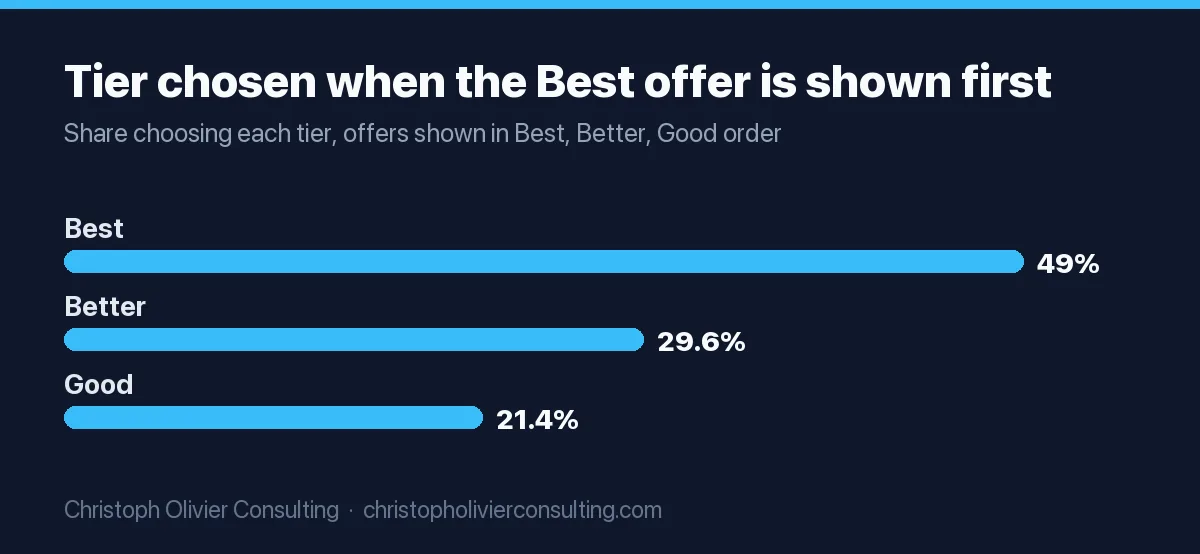
- Offer three tiers, show the top one first. In an experiment reported by Wolfgang Ulaga (INSEAD) and Michael Mansard (Zuora) in INSEAD Knowledge, offers shown in Best, Better, Good order led 49% to choose Best, 29.6% Better and 21.4% Good, with a reported 10.8% revenue increase over the usual Good, Better, Best order. It measured first choice only, not retention. The good, better, best pricing guide covers tier design in more depth. Three tiers also give you email 6: a downgrade offer that keeps the deal alive without a discount.
- Set an expiry date. A deadline gives emails 5 and 9 a real reason to exist. Fourteen days fits most CPA engagements. Tie it to something true, like an onboarding slot or a filing deadline, and do not invent scarcity.
- Collect signature and payment in one step. Every tool below can capture the e-signature and the ACH or card authorization together, which removes the gap where a “yes” goes cold.
Proposal software with automatic reminders and expiry dates: verified USD prices
Most proposal tools can send reminders for you. Check the details before you rely on them, because the default reminder is usually the original proposal email resent, not a new message.
| Tool | US price | Automatic reminders | Expiry dates |
|---|---|---|---|
| Ignition (renamed from Practice Ignition in 2022) | Solo $39/month billed annually or $49 monthly; Core $99 or $149; Pro $229 or $279; Pro+ $399 or $499. Up to 3 options per proposal on every plan | Yes. Set in General Settings under Proposal Reminders: days between reminders and maximum number. Reminders reuse the new-proposal email with “Reminder:” added to the subject and are checked once a day at 5:00 UTC (Ignition help) | Pro and Pro+ only on the US pricing table. New proposals default to 14 days, maximum 91. Unsigned proposals move to Lost at expiry (Ignition help) |
| Anchor | $0 subscription; Anchor deducts $5 from each payment you receive. ACH free; cards 2.9% + $0.30, paid by the client | Yes. Settings, then Notifications: “Proposal not signed” by email and SMS, with number of attempts and interval in calendar days (Anchor help) | 1 to 90 days after sending; the client can no longer view or sign, and status shows Expired (Anchor help) |
| TaxDome | Essentials $800 per seat per year on a 1-year term ($750 on 2 years, $700 on 3), solo users only; Pro $1,000 ($950, $900); Business $1,200 ($1,150, $1,100) | Yes. Reminders work on proposals and stop automatically when the client signs; defaults can be set on a template (TaxDome help) | Not confirmed in the sources we checked |
| Karbon | Team $59 per user/month billed annually or $79 monthly; Business $89 or $99; monthly billing only for teams of 4+ | Not confirmed on the pricing page. Engagements (service templates, branded engagement letters, upfront payment collection) are included from Team, and proposals and engagement letters do not use eSignature credits | Not confirmed on the pricing page |
How to combine automation with the templates above. If you switch on Ignition or Anchor reminders, the prospect gets both your personal emails and the system’s reminders, which reads as nagging. My recommendation: either turn automatic reminders off and send emails 1 to 9 yourself, or keep the system reminders and cut your manual sequence to emails 1, 5 and 9. If expiry dates matter to you and you use Ignition, budget for Pro, because Solo and Core do not include them.
Email marketing examples for accounting firms: proposal follow-ups vs. the CPA email blast
A proposal follow-up and a CPA email blast are different tools, and mixing them is the most common way firms make follow-up feel like spam.
| Proposal follow-up | CPA email blast or newsletter | |
|---|---|---|
| Sent to | One prospect with an open proposal | A segment of clients or subscribers |
| Sent from | The partner or manager who ran the meeting, from their own inbox | The firm, from an email platform or practice management tool |
| Format | Plain text, no images, one link | Designed template, several links, unsubscribe footer |
| Content | Their situation, their deadline, their decision | Deadlines, law changes and firm news that apply to many |
| Timing | Set by the proposal date and expiry | Set by the tax calendar |
| What to measure | Replies and signatures | Clicks, replies, unsubscribes |
Keep prospects with an open proposal out of your blasts for the 21 days the sequence runs. A generic tax-news email landing between email 4 and email 5 undercuts both. The blast side, with a 12-month calendar and five templates, is in our guide to email marketing for CPA firms.
Email marketing template design for CPAs: rules for one-to-one follow-ups
- Plain text beats design. A follow-up should look like a person wrote it, because one did. No banner, no logo block, no buttons.
- One link. The proposal or the engagement letter. Never attach a tax return or prior-year file to a follow-up; send documents through your portal.
- Subject lines name their situation. “Before your January 15 estimate” or “Your proposal expires Friday,” not “Just checking in.”
- Short enough to read on a phone. My rule of thumb is under 120 words, with the question in the last line.
- A compliant signature. Name, credential, firm, phone and the firm’s postal address. Under 31 CFR 10.30(a), an enrolled agent may not use the term “certified” or imply employment by the IRS; “enrolled to represent taxpayers before the Internal Revenue Service” is one of the permitted descriptions.
- Treat it as commercial email. The FTC’s exemption for transactional messages covers email that “facilitates, completes, or confirms a commercial transaction that the recipient already has agreed to” (FTC CAN-SPAM guide). A prospect who has not signed has not agreed yet, so the safe default is to include your postal address and honor any request to stop within the FTC’s 10 business days.
Proposal-to-engagement KPIs: what to track and how to calculate it
I have not found an independent published benchmark for accounting firms’ proposal acceptance rates, so measure your own baseline for one quarter before setting targets. The first two rows use the same definitions as our marketing KPIs for accounting firms and the sales consultations guide, so the numbers line up across your reports.
| KPI | Formula | A low number usually points to |
|---|---|---|
| Proposal turnaround | Median business days from consultation to proposal sent | A partner bottleneck on proposal writing |
| Consult-to-engagement rate | Engagements signed ÷ consultations held | The agenda, the fee range, or proposals that go out late |
| Proposal acceptance rate | Proposals signed ÷ proposals sent (count each prospect once, even if resent) | Pricing, qualification, or proposals emailed instead of presented |
| Median days to sign | Median calendar days from proposal sent to signed | A missing expiry date, or an absent decision maker |
| Expiry rate | Proposals expired unsigned ÷ proposals sent | Follow-up that stops after email 1 |
| Tier mix | Signed proposals by tier ÷ all signed proposals | Tier gaps that are too narrow, or the top tier shown last |
| Average first-year fee | New first-year fees signed ÷ engagements signed | Underpricing, or too many downgrades to Compliance |
Worked example with hypothetical numbers. A firm sends 20 proposals in a quarter and 9 are signed: a 45% acceptance rate. Four sign Compliance ($8,100 a year), four sign Advisory ($16,200) and one signs CFO ($39,600). New first-year fees are 4 x $8,100 + 4 x $16,200 + $39,600 = $136,800, an average of $15,200 per engagement. If the downgrade offer (email 6) turns 2 of the 11 lost proposals into Compliance clients, that adds 2 x $8,100 = $16,200 in first-year fees and lifts the acceptance rate to 55%, while the average fee falls to $13,909 ($153,000 ÷ 11). That is the trade-off to watch: more clients at a lower average, which only pays off if your Compliance price clears its cost floor.
Circular 230 and AICPA rules for proposal follow-up emails
Follow-up emails are solicitation, so the same fee and advertising rules that govern your consultations apply. These rows match the rules table on our sales consultations page. State boards can be stricter. This is general guidance, not legal advice.
| Rule | What it says | What it means for your follow-up |
|---|---|---|
| AICPA 1.510.001, Contingent Fees Rule | A member may not prepare an original or amended tax return or claim for a tax refund for a contingent fee for any client | Never close with “you only pay if we find savings” or a percentage of the refund |
| Circular 230, 31 CFR 10.27 | Contingent fees generally barred for matters before the IRS, with exceptions for examinations, certain interest and penalty claims, and judicial proceedings. A 2014 court ruling, Ridgely v. Lew, barred the IRS from applying it to ordinary refund claims | Quote exam or notice representation separately from the tiers. Treasury proposed replacing 10.27 in December 2024, and the CPA Journal describes it as still a proposal; the AICPA rule above applies to CPA members either way |
| Circular 230, 31 CFR 10.30(b) | Fee ranges and initial consultation fees may be published; published rates hold for at least 30 calendar days | If your website publishes a fee, you cannot charge this prospect more than it for at least 30 days after you last published it, so update the site before the proposal, not after |
| Circular 230, 31 CFR 10.30(c) | No persistent contact after a prospect says they do not want to be solicited; keep copies of direct mail and e-commerce communications for 36 months | A “no” or “stop” ends the sequence, including email 10. Keep your follow-up templates on file |
| AICPA 1.600.010.02 | Promotion is misleading if it creates unjustified expectations of favorable results or quotes a fee that was likely to rise substantially without saying so | No promised savings in the value-add email; if the fee could change, say what would change it |
The AICPA quotes are from the Code of Professional Conduct, updated for releases through July 2026. One more habit worth keeping: never mention another client’s results, numbers or name in a follow-up, even as a “firm like yours” story. If you want help turning these templates into a sequence your team actually runs, you can book a consultation.
Frequently asked questions
How many times should a CPA follow up on a proposal?
Four to six emails over about three weeks covers most engagements: a recap on day 1, one question on day 3, a value add on day 7, a decision nudge two business days before the proposal expires, and a closing-the-file email around day 21. Add trigger-based emails only when the prospect raises budget, price or a verbal yes. Stop immediately if they say no.
What are good email marketing examples for accounting firms?
Split them into two kinds. One-to-one emails, such as proposal follow-ups and engagement-letter reminders, should be plain text from a partner's own inbox with one link. Firm-wide emails, such as deadline reminders and tax law alerts, belong in a designed newsletter or blast sent from your email platform. Keep prospects with an open proposal out of blasts while their follow-up sequence runs.
What are the best accounting proposal strategies?
Present the proposal live and ask for the signature in the meeting, offer three fixed-fee tiers with the top tier shown first, set a real expiry date of about 14 days, and collect the e-signature and payment authorization in one step. Then run a short follow-up sequence. Each of these reduces how much chasing the proposal needs afterwards.
Should an accounting proposal have an expiration date?
Yes, if it is tied to something real such as an onboarding slot or a filing deadline. Ignition sets new proposals to expire after 14 days by default on its Pro and Pro+ plans, with a 91-day maximum, and Anchor allows 1 to 90 days. Only honor the date if you mean it; extending every expired proposal unprompted teaches prospects to ignore it.
Is a CPA email blast the same as a proposal follow-up?
No. A blast goes to a segment of clients or subscribers about deadlines and law changes, from your email platform with an unsubscribe footer. A proposal follow-up goes to one prospect about their own decision, from the person who ran the meeting. Treat both as commercial email under CAN-SPAM: include your postal address and honor stop requests within 10 business days.
Can I offer a discount to close an accounting proposal?
Cutting the price for the same scope signals that your fees are negotiable. Change the scope instead: offer the Compliance tier at a lower monthly fee, or remove a line item from Advisory and quote the new fixed fee. Never offer a fee that depends on finding savings or on the refund, which the AICPA Contingent Fees Rule bars for tax return preparation.
What are the best CPA prospect follow-up strategies after the proposal goes quiet?
Give every email a new reason to reply: a one-line question, a summary for the other decision maker, a useful date such as the January 15, 2027 estimated payment, or a smaller tier. Close the file on day 21, then send one re-open email 60 to 90 days later only if the prospect never asked you to stop contacting them.