

A webinar that sells an agency or consulting offer runs about 60 minutes and sells one thing: a short diagnostic or strategy call. It follows a fixed order: a promise, a diagnosis of the problem, a teaching block that proves your method, the first mention of the call before minute 40, a 10 minute offer segment, then live Q&A with the booking link pinned. Everything around the live hour matters as much as the hour itself: a promotion plan that peaks in the final week, a registration page that pre-qualifies, a reminder schedule that protects show-up, and a seven day follow-up that does most of the booking.
This page is the full playbook, with dates relative to the event, copy you can paste, a minute-by-minute run of show and benchmarks from the platforms that publish them. If you only need the offer itself (what goes in it, how to price it, how to make urgency honest), use our separate guide on how to structure a webinar offer that converts; this page covers everything that gets people into the room and turns them into booked calls.
The blueprint on one screen
Read the whole system left to right before you build any of it. Each stage has one job and one number that tells you whether it did that job.
| Stage | When | Its one job | Number to watch |
|---|---|---|---|
| Topic, title, offer | Day minus 28 | Attract buyers of your service, not learners | Share of registrants who fit your client profile |
| Registration page | Live by day minus 24 | Turn a click into a qualified registrant | Visit to registration rate, by traffic source |
| Promotion | Day minus 21 to the morning of | Fill the list, with the heaviest push in the last 7 days | Registrants per channel |
| Reminders | Registration to start time | Get registrants into the live room | Live attendance rate |
| Live hour | Day 0 | Prove the method, then invite the right people to a call | Share of attendees who click the booking link |
| Follow-up | Day 0 to day 7 | Book the people who did not act live | Calls booked after the event, by segment |
Benchmarks from the webinar platforms, and what each one counts
Webinar benchmarks disagree mostly because they measure different things. ON24 counts on-demand viewers as attendees; Goldcast and Univid report live attendance separately. Use the number that matches the metric you are tracking.
| Source (data period) | Benchmark | What it means for you |
|---|---|---|
| ON24 2026 Webinar Benchmarks (2025 platform data) | 60% of registrants became attendees (live plus on-demand); average 239 attendees; average engagement 49 minutes; 67% of attendees joined live | An enterprise-heavy upper bound. If you count replay viewers, compare to 60%. |
| Goldcast 2026 B2B Webinar Benchmark Report (26,190 webinars, 522 B2B brands, 2025) | 40% average attendance rate; 251 average registrants; live attendees complete about 74% of the webinar; consulting webinars averaged 69.4 minutes | The cleanest live attendance yardstick. The 74% completion figure is why your call to action cannot wait for the last 10 minutes. |
| Univid Webinar Insights 2026 (2,000+ webinars, Jan 2023 to Aug 2026, about 70% European) | 49% median live attendance, 57% including replay; 22% of attendees click a call to action; 25% with two CTAs; 26% for 50 to 100 attendee webinars | The only public benchmark for CTA clicks, which is the number a consultant cares about most. |
| GoTo webinar benchmarks (published 2019) | 59% of registrations arrive in the week before the event and 17% on the day; email drives 57% of registrations; marketing webinars average 44% attendance | Older data, but still the best published view of registration timing. Do not stop promoting early. |
The small-audience CTA figure from Univid matters for service firms: you do not need a 500 person room. A tightly targeted session of 50 to 100 attendees had the highest click rate in their data. For more numbers in one place, see our roundup of webinar statistics and benchmarks.
Pick the day and time from your audience, not from averages
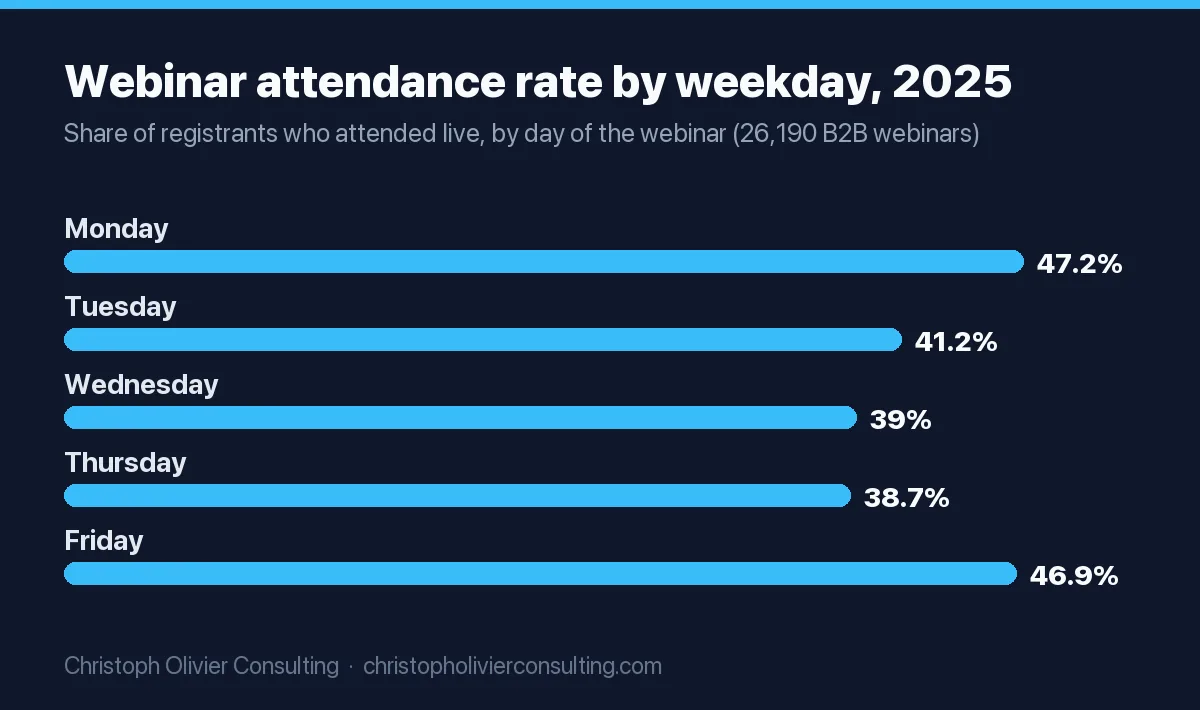
Goldcast’s 2025 data shows a clear tradeoff: Thursday draws the most registrants, but Monday and Friday convert registrants into attendees best (47.2% and 46.9%, against 38.7% on Thursday). For consulting firms specifically, its best slot was Tuesday 8 to 11 AM ET at 46.9% attendance, and Goldcast itself flags per-industry samples as small, so treat that as a slot to test first. Univid, whose data skews European, found 3 PM starts had the highest live attendance. If your buyers are US owners and partners, start with Tuesday at 10 AM ET, inside Goldcast’s best consulting window, then test a Friday late morning slot on your next run.
Promotion plan: what to send, day by day
Day 0 is the live event. This calendar assumes you have an email list, a LinkedIn presence and at least one partner. Because GoTo found most registrations land in the final week and roughly one in six on the day itself, the schedule gets denser as the date approaches.
| Day | Action | Copy angle |
|---|---|---|
| Minus 28 | Lock title, offer and the one qualifying question. Brief partners and send them a promo kit (subject lines, two email drafts, a LinkedIn post, tracked link). | Result plus audience plus timeframe in the title |
| Minus 24 | Registration page and confirmation flow live. Test every link and the calendar file. | |
| Minus 21 | Email 1 to your list. LinkedIn post from the host’s personal profile. Create a LinkedIn Event. | Announcement: the problem and who it is for |
| Minus 14 | Email 2 to non-registrants. Partner email 1. Personal one-to-one invites to your 25 to 50 best-fit prospects. | The costly mistake your audience is making, with a number |
| Minus 10 | Start retargeting ads to site visitors and email openers, pointed at the registration page. | Same promise as the title |
| Minus 7 | Email 3. Partner email 2. Second LinkedIn post with one slide from the deck. | Preview one framework you will teach |
| Minus 3 | Email 4 to non-registrants. | Three questions the session will answer |
| Minus 1 | Email 5. Partner day-before email. LinkedIn “tomorrow” post. | Last chance, plus who should skip it |
| Day 0, 3 hours before | Email 6 to non-registrants: “Today at [time] ET.” | Short, one link |
The one-to-one invites at day minus 14 are where agencies and consultancies win. A personal note to a named partner at a target firm (“I’m walking through how we cut cost per lead for three firms your size, thought of you”) brings the exact buyers who book calls. Our webinar invitation email templates cover the list emails in full.
The registration page: fields and copy to use
Ask for as little as possible, but ask the one question that tells you who is worth a follow-up call. Here is a page you can adapt line by line.
| Element | Copy-ready version |
|---|---|
| Headline | How [firm type] doing [$X to $Y] book [result] in [timeframe] without [thing they hate] |
| Subhead | A 60 minute working session for owners and partners. Live on [Tuesday, date] at [10 AM ET / 7 AM PT]. |
| Three bullets (outcomes, not agenda) | The [number]-step [method name] we use to [result]. / The [metric] that predicts [outcome] before you spend a dollar. / A [template/scorecard] you can use the same afternoon. |
| Who it is for / not for | For: firms with [team size or revenue] that already [prerequisite]. Not for: anyone looking for [thing you do not do]. |
| Proof line | One specific, verifiable credential or client result you have permission to use |
| Form fields | First name. Work email. “Which best describes you?” (dropdown with 3 to 4 options that map to your service tiers, plus “Just researching”) |
| Optional mobile field | Only with a separate, unchecked consent box (wording below) |
| Button | Save my seat |
If you want to text reminders, get consent in writing on the form. Under the FCC’s TCPA rule, 47 CFR 64.1200 defines prior express written consent as a signed (electronic is fine) agreement that clearly authorizes automated marketing messages to that number and discloses that agreeing is not a condition of purchase. A checkbox line that covers both points: “Text me reminders and occasional offers from [Firm] at this number. Automated messages; msg and data rates may apply; consent is not required to buy anything; reply STOP to opt out.” Have your counsel review it.
The thank-you page has three jobs: Add to Google / Outlook / Apple calendar buttons, a one line pre-work ask (“Reply to your confirmation email with the one number you most want to move”), and a quiet link for people who are ready now: “Already know you want help? Book a 20 minute diagnostic.” For page layout patterns, see our guide to lead generation landing pages.
Show-up rate: the reminder schedule
Registrants forget. The fix is a fixed cadence that WebinarJam’s own hosting guide also uses (confirmation, then 24 hours, 1 hour and 15 minutes before, with optional SMS), plus two additions that matter for B2B buyers.
- Immediately: confirmation email with a calendar file attached and the join link in the first line.
- Day minus 3: “Your pre-work” email. One question to think about, and a one-slide preview. People who have invested a thought show up.
- 24 hours before: restate the single outcome they signed up for, and name the live-only element (live audit of two attendee examples, Q&A with the host).
- 1 hour before: email plus SMS (consented numbers only): “Starts at 10 AM ET. Here’s your link.”
- 10 to 15 minutes before: “We’re opening the room.” The join link and nothing else.
- 5 minutes after start: to registrants who have not joined: “We’ve started. You haven’t missed the [framework] yet.”
Benchmark your result against Goldcast’s 40% live attendance average, not the 60% ON24 figure, unless you also count replay viewers. Goldcast’s own diagnosis is a useful rule: strong registrations with weak attendance usually means a pre-event communication problem; healthy attendance with weak registrations means a reach problem.
Run of show: the 60 minutes, minute by minute
This is the structure for a webinar that sells a strategy call. Goldcast found live attendees complete about 74% of a webinar on average and advises landing the call to action in the first two-thirds. So the first invitation to book comes before minute 40, and the booking link stays pinned from then on.
| Minutes | Segment | What you say or do |
|---|---|---|
| 0 to 3 | Cold open | Start on time. State the promise in one sentence and how the hour runs: “Teaching for 35 minutes, then I’ll show you how we can help, then your questions.” |
| 3 to 6 | Poll 1 | “What’s your firm’s biggest bottleneck right now?” with 4 options. The answers become your segments for follow-up. |
| 6 to 10 | Why listen to me | Ninety seconds of credentials, then one short story of a client problem that looks like theirs (with permission, no exaggeration). |
| 10 to 18 | The diagnosis | Show the three reasons the problem persists. Use their numbers: “If your close rate is 20% and you need 4 new clients a quarter, you need 20 qualified calls.” |
| 18 to 32 | The method | Teach your framework in 3 steps. Give one step in full detail with a worked example. Teach the what and why fully; show the how for one step only. |
| 32 to 35 | First soft CTA | “Some of you already know you’d rather have us run this. The link in the chat books a 20 minute diagnostic. Stay for the rest either way.” Post the link. |
| 35 to 38 | Live example | Apply the method to an attendee example from the pre-work replies or the poll. |
| 38 to 48 | Offer segment | Who the call is for, what happens on it, what they leave with, how many slots this week, how to book. Second CTA, link reposted. |
| 48 to 58 | Q&A | Answer the questions that block buying first (time, cost, “can we do this in-house”). Repost the link every 3 to 4 questions. |
| 58 to 60 | Close | Recap the 3 steps, state when booking closes, thank them, end on time. |
Two choices in this structure come straight from the data. Univid found two CTAs outperform one (25% versus 22% click rate), which is why there is a soft invitation at minute 32 and a full offer at minute 38. And because consulting webinars on Goldcast averaged 69.4 minutes, you have room to overrun Q&A by 10 minutes for engaged rooms. Just announce the formal end at minute 60 so people can leave without missing the offer.
The offer segment for a strategy session
For a retainer or project worth several thousand dollars, the webinar should sell the conversation, not the engagement. The cleanest version is a 20 to 30 minute diagnostic with a named deliverable. Use six slides:
- Who this is for: the profile, plus one line on who should not book.
- What happens on the call: three steps, for example “we review your last 90 days of leads, find the biggest leak, and map the fix.”
- What you leave with: a one-page plan, a scorecard, or a written estimate, whether or not you hire us.
- What it is not: “Not a pitch disguised as a call. If we’re not a fit, we’ll tell you who is.”
- Capacity: the real number of calls the team can take this week, and the date booking closes.
- How to book: the link, a QR code, and the one qualifying question the calendar form asks.
Transition line that works because it is true: “Everything I’ve shown you works if you have someone with 10 hours a week to run it. If you don’t, that’s what we do. Here’s how to find out if it makes sense.”
The calendar form should ask two questions at most: company website and the bottleneck from poll 1. Then use a structured call agenda so the diagnostic delivers what the slide promised; our sales call script for consultants has one you can adapt.
Webinar to sell a strategy session: the math, worked through
There is no independent, published case study that tracks a consultancy’s webinar from registrant to closed client. The closest public example is vendor-published: StealthSeminar’s Clients on Demand case study describes a marketing consultancy using automated webinars with a call-booking flow for higher-ticket offers, and reports revenue growth from about $15K to $200K per month in four months. Those figures come from the software vendor and are not independently verified.
So model your own. The top half of this example uses published benchmarks; the bottom half uses placeholder assumptions you must replace with your own numbers.
| Step | Rate | Result | Where the rate comes from |
|---|---|---|---|
| Registrants | 250 | Close to Goldcast’s 251 average | |
| Live attendees | 40% | 100 | Goldcast average attendance |
| Clicked the booking link live | 22% | 22 | Univid median CTA click rate |
| Completed a booking | 50% | 11 | Assumption: replace with your calendar data |
| Booked from follow-up (no-shows and non-clickers) | 5 | Assumption: replace with your own | |
| Calls held | 75% | 12 | Assumption |
| New clients | 25% | 3 | Assumption: use your trailing close rate |
With a $5,000 per month retainer kept for 6 months, 3 clients is $90,000 in contract value from one event. Swap in your numbers and the same table tells you which step to fix first: the step whose rate sits furthest below its benchmark or your own baseline.
Follow-up sequence: 7 days of copy
Most bookings from a consulting webinar happen after it ends, so split registrants into three groups before you send anything. Pull the lists from your webinar platform: clicked the booking link but did not book, attended without clicking, and registered but did not attend.
| When | Who | Subject line | Body (short) |
|---|---|---|---|
| Within 2 hours | Clicked, did not book | Quick one | Plain text from the host: “Saw you looked at the diagnostic link. Want me to just send two times that work this week?” |
| Within 1 hour | Attended, no click | The replay + the [method] slide | Replay link, the one slide people screenshot, and one line: “If you want us to apply this to your numbers, here’s the 20 minute call.” |
| Within 1 hour | No-shows | You missed it, so here are the 3 steps | The three steps in three sentences, then the replay link. Booking link in the P.S. |
| Day 2 | Everyone not booked | “Can we do this in-house?” | Answer the most common Q&A objection honestly, including when in-house is the better choice. |
| Day 4 | Everyone not booked | How [client type] fixed [problem] | One real client example with permission: before, what changed, after. No results you cannot document. |
| Day 6 | Everyone not booked | Diagnostic slots close Friday | Only if true. The real number of remaining slots and the date. |
| Day 7 | Everyone not booked | Should I close your file? | “Reply ‘later’ and I’ll check back next quarter.” Replies become your next nurture list. |
Use the poll 1 answers to swap one paragraph in each email so it speaks to the attendee’s bottleneck. Replay viewing is worth tracking separately: Univid found 57% total attendance including replays against 49% live, so the replay adds real viewers.
Co-marketing webinars with a partner
A co-hosted webinar with a firm that serves the same buyers (a law firm and an accounting firm, an agency and a software vendor) doubles the invite list and borrows trust. BigMarker’s joint venture webinar guide lays out a usable cadence: share a joint promo kit six weeks out, have both partners email one month, one week and one day before, and make sure both partners present rather than one acting as a silent sponsor.
Agree on three things in writing before promotion starts. Lead sharing: state on the registration page that registrant details go to both firms. Offer: one shared next step, or each firm offers its own call to a defined segment. Follow-up: who emails whom, and when. Our partnership marketing guide covers how to structure the relationship beyond one event.
Challenge framework vs webinar marketing
A challenge is a multi-day series (usually 3 to 5 live sessions) that ends in an offer. A webinar is one session. Neither is better in general; they fit different offers.
| Factor | Single webinar | Multi-day challenge |
|---|---|---|
| Buyer time asked | About 1 hour | 3 to 5 hours across several days |
| Best for | Busy owners and partners buying done-for-you services | Buyers who need to do work to see value (programs, coaching, training) |
| Typical next step | Strategy or diagnostic call | Program enrollment or application |
| Production load | One deck, one run of show | A session per day plus daily emails and community moderation |
| Reusability | Easy to run monthly or as a recorded session | Usually run as periodic launches |
For agencies and consultancies selling done-for-you work to time-poor decision makers, the single webinar is usually the better fit. A middle path is a short series: Goldcast found 31.2% of B2B webinars were part of a series in 2025, with a median of 4 episodes.
How financial services firms can use webinars for qualified leads
The structure above works, with one extra step: compliance review before anything goes out. For FINRA member firms, FINRA Rule 2210 treats scripts, slides, handouts and other written materials used in public appearances as communications subject to the rule (2210(f)(4)), and a principal must approve each retail communication before the earlier of its use or filing (2210(b)(1)(A)). In practice, get the deck, registration page, reminder emails and follow-up sequence approved together, and keep live Q&A answers inside what the approved deck covers.
Qualification matters more in financial services because one good client is worth more. Use the registration dropdown to ask about the situation that matches your niche (business sale, equity compensation, approaching retirement), and run topic-specific sessions rather than general market updates. Our webinar marketing playbook for financial advisors covers seminars and client events as well.
Platform cost: watch the session-length cap
The run of show above needs a platform that allows sessions over an hour, polls, a pinned link and attendee-level reports you can export. Check the length cap before you buy. On WebinarJam’s pricing page, Starter ($39 per month billed annually, $49 monthly) caps sessions at 1 hour and 100 attendees with 1 host, so a 60 minute webinar with a Q&A overrun needs Basic ($79 per month billed annually, $99 monthly: 2 hours, 500 attendees, 2 hosts). Whatever you use, confirm the platform can export who clicked the booking link, because the follow-up segments depend on it.
Scorecard: diagnose your last webinar
Run this after every event. Fix the first stage that fails before touching anything downstream.
| Check | Pass | If it fails, fix this |
|---|---|---|
| Registrants who fit your client profile (from the dropdown) | At least half | Title and promotion channels attract learners, not buyers. Rewrite the title around a business result and lean on one-to-one invites. |
| Live attendance rate | At or above 40% (Goldcast average) | Reminder cadence, pre-work email, time slot. |
| Registrations in the final 7 days | A real final-week push happened (GoTo: 59% of registrations arrive then) | You stopped promoting too early. Add day minus 3, minus 1 and day-of emails. |
| Attendees who clicked the booking link | At or above 22% (Univid median) | Offer segment too late or too vague. Move the first CTA before minute 35 and name the deliverable of the call. |
| Bookings after the event | Follow-up produced bookings from no-shows and non-clickers | Segmented follow-up was skipped or sent as one generic replay email. |
| Calls held to clients closed | At or above your trailing close rate from other channels | Calls attract the wrong buyers: tighten the “who this is for” slide and the calendar question. |
If the scorecard keeps pointing at the same stage and you want a second opinion on the whole funnel, you can book a consultation and walk through your numbers.
Frequently asked questions
How do you structure a webinar offer that converts for an agency or consulting firm?
Sell one next step, usually a 20 to 30 minute diagnostic call with a named deliverable. Run about 60 minutes: promise, diagnosis, a 3 step method, a soft invitation to book around minute 32, a 10 minute offer segment by minute 38, then Q&A with the booking link reposted. Goldcast data shows live attendees complete about 74% of a webinar, so the offer must land in the first two-thirds.
Can a webinar sell a strategy session for a consulting business?
Yes, and for retainers or projects worth several thousand dollars it usually should sell the call rather than the engagement. Plan with benchmarks: Goldcast puts average live attendance at 40% and Univid finds a median 22% of attendees click a call to action. Track bookings, show rate and close rate from your own calendar to complete the math, and expect a large share of bookings to come from follow-up emails.
Challenge framework vs webinar marketing: which should a consultant use?
A webinar asks about an hour of the buyer's time and suits busy owners buying done-for-you services, with a strategy call as the next step. A challenge runs 3 to 5 sessions over several days and suits programs where buyers must do work to see value. Most agencies and consultancies selling to time-poor decision makers do better with a single webinar or a short series.
How can financial services firms use webinars to drive qualified leads?
Run narrow, situation-specific sessions (business sale, equity compensation, approaching retirement) and ask one qualifying question at registration. For FINRA member firms, Rule 2210 treats scripts, slides and handouts used in public appearances as communications, and retail communications need principal approval before use. Get the deck, registration page and every email approved together before promotion starts.
What is a co-marketing webinar and how should partners split the leads?
A co-marketing webinar is co-hosted by two firms that serve the same buyers, so each promotes to its own list. BigMarker's joint venture guide suggests a shared promo kit six weeks out and partner emails one month, one week and one day before. Disclose on the registration page that details go to both firms, and agree in writing on the offer and who follows up with whom.
What is a good webinar attendance rate in 2026?
It depends on what is counted. Goldcast's 2026 report, covering 26,190 B2B webinars from 2025, puts average live attendance at 40%. Univid reports a 49% median live rate and 57% including replays. ON24 reports 60% of registrants converting to attendees, but that figure includes on-demand viewers. Compare your live rate to 40% and your total rate to the higher figures.
What does a webinar marketing consultant do?
A webinar marketing consultant designs the system around the live hour: topic and offer, registration page, promotion calendar, reminder cadence, run of show, segmented follow-up and reporting. Ask any candidate how they measure success. The answer should be booked calls and closed clients per event, not registrants, and they should be able to show where each number in your funnel sits against published benchmarks.