

House cleaning PPC management in 2026 means running three separate Google Search campaigns (recurring, deep clean, move-out), a Local Services Ads profile in Google’s “House cleaning services” category, and a negative keyword list that keeps job seekers out. Budget for a median $8.33 per click and $90.92 per lead, the 2026 WordStream figures for Home and Home Improvement, the closest published category to residential cleaning. Published management fees at a $2,000 monthly budget start at $399 (GrowPep) and $750 (WebFX), on top of your ad spend.
This page gives you the campaign build with copy-ready keywords and negatives, the LSA rules as Google documents them today, fee math for cleaning-sized budgets, verified booking software prices, and the break-even math on the question every owner asks: is a $25 first-clean discount worth it?
House cleaning PPC costs in 2026: clicks, leads and booked cleans
No benchmark study publishes a “house cleaning” category, so you have to pick the closest one. I use Home and Home Improvement for residential cleaning and Business Services for commercial cleaning; that matching is my judgment, not WordStream’s. The figures below are from the WordStream 2026 Google Ads benchmarks, which cover 13,474 US search campaigns from April 1, 2025 to March 31, 2026, and the same numbers appear in LocaliQ’s Search Advertising Benchmarks (last updated June 1, 2026). WordStream notes that its “averages” are medians.
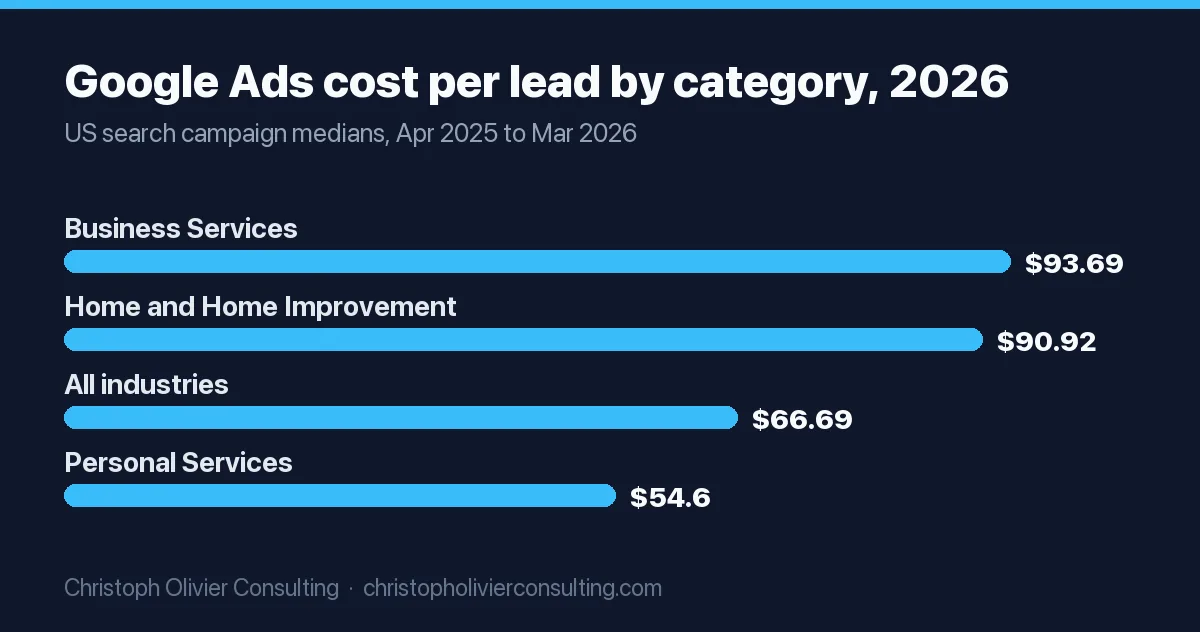
| Category (2026, US medians) | Avg CPC | CTR | Conversion rate | Cost per lead | Use it for |
|---|---|---|---|---|---|
| Home and Home Improvement | $8.33 | 6.47% | 8.05% | $90.92 | Residential cleaning: recurring, deep clean, move-out |
| Business Services | $5.87 | 6.10% | 4.85% | $93.69 | Commercial and office cleaning |
| Personal Services | $7.17 | 7.16% | 12.34% | $54.60 | A lower bound only; it is not a home-services category |
| All industries | $5.42 | 6.64% | 8.18% | $66.69 | Context |
Our Google Ads CPC by industry page has every category and the 2024 and 2025 editions, if you want the trend.
A lead is not a booked clean. Divide cost per lead by the share of leads you actually book to get the number that matters:
| Leads you book | Cost per booked first clean at $90.92 per lead |
|---|---|
| 25% | $363.68 |
| 40% | $227.30 |
| 60% | $151.53 |
The booking rates are assumptions; replace them with yours. At a 40% booking rate you pay $227.30 to book a first clean, which is more than the HomeAdvisor cost guide’s $175 average per-visit price for professional house cleaning. That is why paid search only works for cleaning companies that turn first cleans into recurring plans. One-time jobs rarely pay back the click.
What house cleaning PPC management costs: published agency fees
A cleaning company’s budget sits at the small end of every agency’s price list. These are the providers that publish their prices; the full comparison, including larger budgets, is on our PPC management guide.
| Provider | Fee model | Published price | Setup and terms |
|---|---|---|---|
| GrowPep | Flat tiers capped by spend and campaign count | Essential $399/mo (spend up to $3,000, 2 campaigns); Growth $699/mo (up to $7,500, 4 campaigns); Scale $1,099/mo (up to $15,000, 7 campaigns) | One-time setup $199, $299 or $399 |
| WebFX | Flat fee, then percentage of spend with a floor | Lite $750/mo ($100 to $5,000 spend); Pro $975 or 15% of spend, whichever is higher ($5,000 to $30,000); Enterprise $4,500 or 12%, whichever is greater ($30,001+) | First month “initial optimization” $1,200, $2,250 or $5,800 including a campaign audit |
| Lotiva | Flat tiers, then percentage above $30,000 | Starter $2,000/mo (spend up to $10,000); Growth $3,000 (up to $20,000); Premium $4,000 (up to $30,000); Enterprise $5,000 base plus 15% of spend from $30,000 to $75,000, 12% to $150,000, 10% above | Setup, tracking, audit and a landing page included; one quarter to start |
| Credo PPC pricing survey (last updated 2022) | Survey of PPC firms | 85% of PPC firms charge $50 to $200 an hour; 50.97% have a retainer minimum of $1,000 to $3,000 a month | 30.52% require a 6 to 12-month minimum; 26.3% have none |
Here is what those formulas cost at two typical cleaning budgets:
| Ad spend per month | Provider and tier | Monthly fee | Fee as share of spend | Year one fee (excluding media) |
|---|---|---|---|---|
| $2,000 | GrowPep Essential | $399 | 20% | $4,987 ($199 + 12 x $399) |
| $2,000 | WebFX Lite | $750 | 37.5% | $9,450 ($1,200 + 11 x $750) |
| $2,000 | Lotiva Starter | $2,000 | 100% | $24,000 |
| $5,000 | GrowPep Growth | $699 | 14% | $8,687 ($299 + 12 x $699) |
| $5,000 | WebFX Lite | $750 | 15% | $9,450 |
| $5,000 | Lotiva Starter | $2,000 | 40% | $24,000 |
Run the all-in math before you sign. At $2,000 a month and the $90.92 median, you buy about 22 leads. Add GrowPep’s $399 and each lead costs about $109; add WebFX’s $750 and it costs about $125. A manager earns the fee only if they cut your cost per booked clean by more than the fee adds. Lotiva’s Starter fee includes a landing page and tracking setup, so it is a different product from a capped management tier, not a like-for-like price.
Three questions to ask any manager: Is the Google Ads account in your company’s name with you as Admin? Do they count booked cleans or form fills as conversions? Will they show you the search terms report every month? If you want a second opinion on a proposal, you can book a consultation.
Campaign structure for a cleaning company: recurring vs deep clean vs move-out
Split by job type, not by city. The three jobs have different searchers, different tickets and different odds of becoming a recurring client, so they need their own budgets, ads and landing pages. The HomeAdvisor guide puts biweekly cleaning at $100 to $250 a visit, deep cleaning at $200 to $400 and move-in or move-out cleaning at up to $500.
| Campaign | Starter keywords (phrase or exact match) | Landing page shows | Budget priority |
|---|---|---|---|
| Recurring cleaning | “biweekly house cleaning”, “weekly cleaning service”, “recurring house cleaning”, “maid service near me”, “house cleaning service [city]” | Weekly, biweekly and monthly prices, same-cleaner promise, instant booking | Highest: these clients pay every two weeks |
| Deep clean | “deep cleaning service”, “deep house cleaning near me”, “one time deep clean”, “spring cleaning service” | Deep clean checklist, price by home size, an offer to switch to a plan after the first visit | Medium: a deep clean is often the first visit of a plan |
| Move-out and move-in | “move out cleaning”, “move in cleaning service”, “end of lease cleaning”, “apartment move out cleaning [city]” | Flat prices by bedrooms, deposit-back checklist, weekend availability | Lower: high ticket, rarely recurring; push it to realtors and property managers too |
| Brand | Your company name and misspellings | Home page or booking page | Small, always on |
Two settings that change results:
- Location option. Google’s location targeting help recommends “Presence or interest” for Search, and suggests “Presence” when “you only want to target users in specific locations.” For recurring and deep clean campaigns, use Presence: a route business can only clean homes inside its radius. For move-in cleaning, test Presence or interest, because a person relocating to your city searches from where they live now.
- Commercial cleaning goes in its own campaign with its own benchmark (Business Services above). Facility buyers search differently and buy on contracts; the bid and contract side is covered in our daycare marketing guide, which includes how to win school and daycare cleaning work.
Negative keywords for house cleaning (copy-ready list)
The biggest waste in cleaning accounts is job seekers. “House cleaning jobs” contains your keyword and looks like a lead until you read it. Add these as an account-level negative list before you spend a dollar, and remove anything you actually sell.
| Category | Negatives | Match type |
|---|---|---|
| Jobs | job, jobs, hiring, hire me, career, careers, salary, pay rate, how much do house cleaners make, indeed, craigslist, apply, application, part time, cleaner wanted, start a cleaning business | Broad (single words), phrase for multi-word |
| DIY and how-to | how to, checklist printable, tips, hacks, homemade, recipe, diy, schedule template | Phrase |
| Products | products, supplies, spray, vacuum, mop, wipes, machine, rent, rental, amazon | Broad |
| Services you do not offer | dry cleaning, carpet cleaning, duct cleaning, gutter cleaning, pressure washing, window cleaning, car detailing, pool cleaning, hoarder, biohazard | Phrase |
| Wrong buyer | free, volunteer, school project, janitorial (if residential only), office cleaning (if residential only) | Phrase |
Google’s negative keyword help explains two traps. First, “Negative keywords won’t match to close variants,” so you must add “job” and “jobs,” “cleaner” and “cleaners” separately. Second, broad match is the default for negatives and blocks a search only when it contains all of the negative’s words, in any order. Then open the search terms report every week for the first 90 days and keep adding.
Count calls and bookings, not clicks
If Google learns from clicks, it buys clicks. Set up phone call conversions using the path in Google’s call conversion help:
- Open Goals, then Summary.
- Select + Create conversion action, then Conversions from phone calls, then Save and continue.
- Set the category to Phone call lead.
- Add Calls from ads and Calls from website visits. Google counts calls longer than a minimum duration you set. My suggestion for cleaning is 60 seconds, which filters out wrong numbers and quick hang-ups.
- Add your online booking form’s thank-you page as a separate conversion, and later upload booked jobs from your CRM through Calls via uploads or an offline import so bidding learns which clicks became paying clients.
Local Services Ads for house cleaning: category, badge and charged leads
Google lists “House cleaning services” as an eligible US category on its Local Services Ads eligibility page, alongside “Carpet cleaning services” and “Window cleaning services.” You pay per lead, not per click.
The badge is Google Verified. Search Engine Roundtable reported that from October 20, 2025, Google replaced Google Guaranteed, Google Screened and License Verified by Google with one Google Verified badge, and quoted Google: “The Money Back Guarantee associated with the Google Guarantee badge will also be discontinued.” If your site or vans still say “Google Guaranteed,” change them.
Screening is lighter than for urgent trades. Google’s verification checks table lists, for house cleaning: a business check and owner check, business registration and business representative checks, general liability insurance, and state business and owner licenses “where applicable by local law,” all marked “Select users only.” Unlike the electrician and plumbing categories, it does not list background checks for each cleaner. Our electrician marketing guide shows the heavier version for comparison.
What counts as a charged lead, per Google’s lead charging help:
- A call you answer, or a call back where you speak with the customer.
- A text, email, voicemail or booking request (booking requests in the US and Canada only).
- A missed call during business hours where “the customer stays on the line for more than 20 seconds.” A voicemail greeting counts as a connected call, so the lead is charged after 20 seconds whether or not the caller leaves a message. PPC Land reported this missed-call rule took effect October 1, 2026.
- Repeat contacts from the same number or email are not charged again if “there is interaction within 15 days.” Google credits leads it finds to be “of poor quality, duplicate, or invalid,” assessed over 30 days.
LSA is moving into Google Ads. Google’s migration article names house cleaning in the first phase, for select US home and storefront service advertisers from August 2026. Export your lead history and call recordings before your account moves.
LSA pass/fail check for a cleaning company:
- Hours equal answered hours. Pass if a person or answering service picks up during every hour in your LSA schedule. A cleaner on a job cannot answer, and under the 20-second rule every missed call is billed.
- Service types match what you sell. Pass if job types you do not do (for example move-out, if you only do recurring) are switched off.
- Service area matches your route. Pass if the area is the ZIP codes your crews can reach without breaking the schedule.
- Every lead is logged. Pass if each LSA lead lands in your CRM with source “LSA,” so you can compare cost per booked clean against Search.
Angi and Thumbtack cleaning leads: how they are priced
Neither marketplace publishes a lead price list for cleaning. What they do publish is how you are charged:
| Marketplace | How you pay (as published) | Shared or exclusive |
|---|---|---|
| Angi | Charged “as soon as both you and the homeowner show interest”; “You are charged for leads whether or not you open or respond to them”; fees vary with task, location and demand (Angi help center) | Shared: each request goes to “no more than five pros” |
| Thumbtack | You set “max lead price settings”; a Thumbtack moderator wrote “I can’t speak to how individual leads are priced” (Thumbtack community) | Shared: the example lead in that thread went to three pros |
| Google LSA | Per charged lead, as above; Google does not publish a price list | Not stated in the help pages above |
The marketplace math is simple. If an Angi request goes to five cleaners and you win one in four of the ones you call, your cost per booked clean is four times the lead price. On a shared lead you are racing up to four other cleaners, so only buy them if someone can call back within minutes during working hours.
Is a $25 discount for the first cleaning worth offering for first time customers?
Usually yes, if you convert first-time clients to recurring plans. It is a bad trade if most of your first cleans are one-and-done. The $25 costs you on every first-time booking, including people who would have booked anyway, so the question is how many extra bookings it creates. Here is the break-even math. Every assumption is labeled; replace them with your numbers.
| Input | Value used | Where it comes from |
|---|---|---|
| First clean (deep clean) price | $300 | Midpoint of HomeAdvisor’s $200 to $400 deep cleaning range |
| Cleaner wage | $17.07 an hour | BLS median for maids and housekeeping cleaners, May 2025 |
| Wage burden (payroll taxes, workers’ comp) | x 1.25 | Assumption |
| Deep clean labor | 6 labor hours = $128.03 | Assumption: 2 cleaners x 3 hours |
| Supplies and travel, deep clean | $20 | Assumption |
| First clean margin, full price | $151.97 | Calculated |
| First clean margin, with $25 off | $126.97 | Calculated |
| Recurring biweekly visit price | $175 | HomeAdvisor average per visit |
| Recurring visit labor and supplies | 3.5 labor hours = $74.68, plus $15 | Assumption |
| Margin per recurring visit | $85.32 | Calculated |
| Average recurring client life | 12 months, 26 visits | Assumption |
| Lifetime margin of a recurring client | $2,218.29 | Calculated: 26 x $85.32 |
The value of one discounted first-time customer is the first-clean margin plus the chance they convert times their lifetime margin. The offer breaks even when it lifts bookings by $25 divided by that value. So the answer depends almost entirely on your recurring conversion rate:
| First cleans that become recurring | Value of a discounted first-time customer | Extra bookings the $25 must create to break even |
|---|---|---|
| 0% (one-time only) | $126.97 | 19.7% more bookings |
| 15% | $459.72 | 5.4% more bookings |
| 30% | $792.46 | 3.2% more bookings |
| 50% | $1,236.12 | 2.0% more bookings |
Read it this way. If 30% of your first cleans turn into biweekly plans, the $25 offer pays for itself if it turns 100 bookings into just 104. If almost nobody converts, it needs 20 more bookings per 100, a big ask for an offer worth about 8% of a $300 job. In paid search terms, at $227.30 per booked first clean (the 40% booking rate above), the discount adds 11% to your acquisition cost.
Three ways to make the same $25 work harder:
- Put it on the plan, not the first clean. “$25 off your first recurring clean when you book a plan” only costs you on clients who convert. At a 30% conversion rate that is $7.50 per first-time customer instead of $25.
- Set an expiry and a single use. ConvertLabs’ cleaning coupon guide suggests $20 to $30 off or 15% for a first booking, a 7 to 14 day expiry for ad offers, and warns that going past 20 to 25% “starts attracting people whose primary motivation is price.”
- Measure the cohort. Tag every discounted booking in your CRM and check two numbers at 90 days: the share that became recurring and their revenue. If discounted clients convert at half your normal rate, use the lower row of the table.
Never tie the discount to a review. Google’s rules ban it, as the reviews section below explains.
Booking and CRM software for cleaning companies: verified 2026 prices
PPC only improves if bookings flow back into a system that records source and job value. These are list prices in dollars as shown on each vendor’s pricing page, read November 1, 2026.
| Software | Plans and monthly price | Notes |
|---|---|---|
| ZenMaid | Starter $19; Pro $39; Pro Max $49 (“Coming Soon”) | Built for maid services; Starter capped at 40 appointments a month; Pro adds unlimited appointments, booking forms and QuickBooks; SMS charged separately; month to month |
| BookingKoala | Starter from $27; Growing from $57; Premium from $197; larger Premium $237 to $597 | Online booking and scheduling; priced by providers or storage (Starter 5 providers); no contracts |
| Launch27 | Base $75; Pro $150; Plus $299 | Booking software; Base includes “Unlimited Bookings”; 15% off annual plans |
| Jobber | Core $49 (1 user); Connect from $139; Grow from $199; Plus from $499 (5 users), monthly with no commitment | Lower if billed annually (Core $29, Connect $99, Grow $149); extra users $29 a month |
| Housecall Pro | Basic $79 (1 user); Essentials $189 (5 users); Max $329 (8 users), monthly billing | Annual billing: $59, $149, $299 a month; extra Max users $35 a month |
For a solo or two-crew operation, a cleaning-specific tool (ZenMaid, BookingKoala, Launch27) covers booking and recurring schedules for less. Jobber and Housecall Pro cost more but suit companies that also run other home services.
The market you are bidding in: BLS and Census figures
- Labor. The BLS counts 860,670 maids and housekeeping cleaners (occupation 37-2012) in its May 2025 OEWS estimates, at a median $17.07 an hour and a mean $17.83 ($37,080 a year). The 10th percentile is $13.29 and the 90th is $23.35. Only 92,440 of them work in Services to Buildings and Dwellings, the industry group that includes cleaning companies, against 415,160 in traveler accommodation. You compete with hotels for cleaners as well as with other maid services for clients.
- Competitors. The Census Bureau’s 2023 County Business Patterns counts 67,799 janitorial establishments (NAICS 561720) with 1,088,193 employees and $32.7 billion in annual payroll. Census’s 2022 NAICS index puts “Residential cleaning services” and “Maid services” in that same code, so it mixes residential and commercial. 41,548 of those establishments, 61%, have fewer than 5 employees.
Most businesses in that code are small, so in most metros you are bidding against owner-operators, not national franchises alone. A clean negative list and real call tracking are where a small account can be better run than a bigger one.
Reviews: what Google and the FTC allow a cleaning company to do
Reviews feed both your LSA ranking and your conversion rate, and the rules are stricter than most owners think.
| Practice | Google’s policy | FTC rule |
|---|---|---|
| “$25 off your next clean for a review” | Banned: no “incentives, such as payment, discounts, free goods and/or services, in exchange for posting any review” | Allowed only with no “express or implied requirement” of a particular sentiment |
| Asking only happy clients (review gating) | Banned: no “selectively solicit positive reviews from customers” | The FTC Q&A we read does not address it |
| Cleaners or family reviewing the company | Banned as conflict of interest, which “may include current or former employment” | Allowed only with clear disclosure of the relationship |
| Pressuring a client to remove a bad review | The policy text we read does not address it | Banned: no threats or intimidation to get a review removed or changed |
Sources: Google’s prohibited and restricted content policy and the FTC Consumer Reviews and Testimonials Rule Q&A, which says the rule “went into effect on October 21, 2024” and lets courts impose civil penalties for knowing violations. On Google, the stricter Google rule is the one that applies. A referral credit for a friend who books is not a review incentive.
Copy-ready text to send to every client, the same day, after every clean:
Hi [first name], it’s [company]. [Cleaner name] finished your home today. If you have a minute, we’d value an honest Google review, good or bad, so we can keep improving: [review link]. Thank you!
Our guide on how to get more Google reviews covers review links and replies in more detail.
A 90-day plan for house cleaning marketing and PPC
| Days | Do this | Done when |
|---|---|---|
| 1 to 14 | Pick booking software; build three landing pages (recurring, deep clean, move-out) with prices; set up call and booking conversions; give each channel its own tracking number; start a lead sheet (date, source, cost, job type, booked Y/N, became recurring Y/N) | A test call and a test booking both show as conversions in Google Ads |
| 15 to 30 | Apply for LSA in “House cleaning services”; trim service types and ZIP codes; set hours to answered hours only. Launch Search with the three campaigns, Presence targeting and the full negative list | LSA profile approved; search terms reviewed weekly with new negatives added |
| 31 to 60 | Start the review text after every clean; test the $25 offer on the plan, not the first clean, with a 14-day expiry; call every shared marketplace lead within five minutes or stop buying them | Cost per booked clean known for each channel |
| 61 to 90 | Move budget from the worst channel to the best by cost per recurring client, not cost per lead; upload booked jobs to Google Ads; decide whether to hire a manager using the fee table above | You know your recurring conversion rate and which row of the discount table you are in |
If paid search is only one piece of your plan, our small business lead generation playbook shows how to split a limited budget across referrals, local SEO and paid channels.
Frequently asked questions
How much does house cleaning PPC management cost?
Published fees at a $2,000 monthly ad budget start at $399 a month (GrowPep Essential, plus a $199 setup) and $750 a month (WebFX Lite, with a $1,200 first month). Lotiva's Starter is $2,000 a month and includes a landing page and tracking. All fees are on top of ad spend, so at $2,000 of spend the fee adds 20% to 100% to your cost per lead.
How much do Google Ads cost for a house cleaning business?
No benchmark publishes a house cleaning category. The closest, Home and Home Improvement, had a 2026 median of $8.33 per click, an 8.05% conversion rate and $90.92 per lead in WordStream's study of 13,474 US campaigns. If you book 40% of leads, that is about $227 per booked first clean, so paid search pays only when first cleans become recurring plans.
Is a $25 discount for the first cleaning worth offering for first time customers?
It is if a meaningful share of first cleans become recurring. Using HomeAdvisor prices, the BLS median wage and labeled assumptions, the $25 breaks even with 3.2% more bookings when 30% convert to biweekly plans, but needs 19.7% more when nobody converts. Putting the $25 on the first recurring visit instead limits the cost to clients who sign a plan.
Can house cleaners use Google Local Services Ads?
Yes. Google lists House cleaning services as an eligible US Local Services Ads category. Checks include business and owner checks, business registration, general liability insurance and state licenses where local law requires them. Since October 20, 2025 the badge is Google Verified, and house cleaning is in the first group moving LSA into Google Ads from August 2026.
What negative keywords should a cleaning company use in Google Ads?
Start with job-seeker terms (job, jobs, hiring, salary, careers, indeed, craigslist), DIY terms (how to, tips, checklist printable), product terms (supplies, spray, vacuum, rental) and services you do not offer (dry cleaning, carpet cleaning, pressure washing). Google says negatives do not match close variants, so add singular and plural forms, then check the search terms report weekly.
Can I offer a discount to clients who leave a Google review?
Not on Google. Its content policy bans offering payment, discounts, free goods or services in exchange for posting any review, and bans asking only happy customers. The FTC rule, in effect since October 21, 2024, allows incentives only without a sentiment requirement, but Google's stricter rule applies to Google reviews. Ask every client for an honest review instead.
More Growth, Strategy & Sales guides
- Painting Company Marketing: Cost Per Booked Job by Channel
- Wedding Planner Marketing: How to Book More Weddings in 2026
- Welcome Email Sequence: The 5-Email Series You Can Copy
- Auto Repair Shop Marketing: The Cost-Per-Customer and LTV Math That Sets Your Priorities
- Coffee Shop Marketing: The Frequency Economics That Beat One-Time Discounts
- Daycare Marketing: A Funnel That Fills Your Enrollment
- All Growth, Strategy & Sales guides →