

Foundation repair booked-job generation services sell you scheduled inspections instead of raw inquiries, and they price in four ways: per lead (Google Local Services Ads, Thumbtack, Angi), per qualified call, per booked appointment, or a monthly retainer plus ad spend. The only fair way to compare them is cost per held inspection and cost per sold job, measured against a job that averages $5,175 nationally according to Angi’s 2026 foundation repair cost data (4,219 projects, most between $2,225 and $8,133). Below: what each channel verifiably costs, a worked example you can rerun with your own numbers, and a scorecard for vetting any vendor that promises booked jobs.
Want a specialist to build this for your business? See how CO Consulting’s marketing services work, starting with a diagnostic and audit.
Foundation repair booked-job generation services: the channel menu and what each one costs
Only some of these prices are public. Where a vendor does not publish a price, the table says so instead of guessing. Ask for that number in writing before you sign.
| Channel | You pay for | Published price point | What “booked” means here |
|---|---|---|---|
| Google Local Services Ads | Each valid lead (call, message, voicemail, booking request) | Not published; set by your budget and bid mode, varies by location and job type | Nothing is booked for you. You convert the lead. |
| Google Search ads | Clicks | Home and home improvement average: $8.33 per click, $90.92 per lead (WordStream 2026) | You convert the click into a call, then an inspection. |
| Thumbtack | Each lead or answered Opportunity | Not published; you set your lead price with a slider | Customer has messaged you. You still schedule. |
| Angi | Leads | No public price list on Angi’s pro sign-up page | Customer request routed to you. You still schedule. |
| Pay-per-call networks | Qualified inbound calls | $40 to $110 per qualified foundation repair call (CallScaler marketplace) | A live call that met your duration rule. |
| Pay-per-appointment vendors | Appointments | Usually quoted privately | Ranges from “soft-set” to confirmed. Get the definition in the contract. |
| Retainer agencies | Monthly fee plus ad spend | Most clients invest $5,000 to $8,000 a month (Hook Agency pricing page) | Agency reports on booked jobs; you run the sales process. |
Google Local Services Ads: foundation repair is an eligible category
Yes, you can run Local Services Ads for foundation work. Google’s US eligibility list includes “Foundations services” (and separately “Water damage services” and “General contractor”). There is no separate basement waterproofing or crawl space category on that list.
The pay-per-lead rules from Google’s How leads work page are what you should model:
- A lead is charged when you speak with the caller, when you miss a call during business hours and the caller stays on the line more than 20 seconds, or when you get a message, voicemail or booking request.
- Lead prices vary by location, job type, lead type and bidding mode. Message leads are usually cheaper than phone leads, though not always.
- Bidding has three modes per Google’s bidding help page: Maximize leads (Google recommends a budget of at least 10 leads a week), Target cost per lead, and Max per lead. Allow about 2 weeks for the model to settle.
- Credits are automatic. Google’s lead credit page says credits usually post within 30 days, and Google no longer credits “job type not serviced” or “geo not serviced” leads. If you do not do mudjacking, switch that job type off yourself. Google will not refund those calls.
- To get approved you go through Google’s screening and verification, which can include background checks on the owner and field crew, insurance and license checks, and business registration through a D-U-N-S number that can take up to 30 days to obtain.
LSA is changing management screens. Google is moving it into Google Ads as Performance Max campaigns with pay-per-lead goals. The August 2026 first wave named plumbing, HVAC, roofing and other trades but not foundations. Service-area businesses follow in late 2026, and any remaining categories in 2027. Your weekly budget becomes a daily budget (weekly divided by 7), monthly spend is capped at daily budget times 30.4, manual bidding goes away, and old LSA performance reports do not carry over. Screenshot or download your cost per lead by job type before your migration date. Our plumber marketing cost guide walks through the same migration for a trade that is already in the first wave.
Google Search ads: what clicks and leads cost
No primary source publishes a cost per click for “foundation repair” alone. The closest dated benchmark is WordStream’s 2026 report, built from about 13,000 search campaigns that ran April 2025 to March 2026. Home and Home Improvement averaged $8.33 per click, an 8.05% conversion rate and $90.92 per lead. In the report’s list of highest-CPC industries, it sits second, behind attorneys ($9.87).
For your own market, open Keyword Planner and use Discover new keywords for each service term separately (“foundation piering”, “bowing basement wall repair”, “crawl space encapsulation”). Then build one campaign per service, so a crack-repair click never shares a budget with a $15,000 settlement job.
Thumbtack and Angi: marketplace leads
Thumbtack’s help center says lead prices vary with the type and size of the job, how many pros are available and your market. You set the exact amount per lead in the Pro app under Services, then Manage lead prices. For Opportunities (open leads), you message first and pay the listed price only if the customer replies. Angi does not publish lead prices on its pro sign-up page. Ask the rep for the foundation repair price in your ZIP codes, plus the number of other pros each request goes to, before you add a card.
Pay-per-call and pay-per-appointment vendors
On a pay-per-call marketplace such as CallScaler, you set the payout per call, the minimum call length and the service area, and typical foundation repair payouts run $40 to $110 per qualified call. Pay-per-appointment is the model most often sold as “booked-job generation.” Definitions vary, so read them closely. Contractor Appointments, for example, describes its pay-per-appointment product as soft-set appointments that “are not officially Confirmed/Set until your team has reached out to confirm with the homeowner.” That is a fair model if you price it as a warm lead, not as a held inspection.
Retainer agencies
Retainer agencies run your search, LSA, SEO and website for a monthly fee and leave the selling to you. Hook Agency is one of the few that publishes a figure: most of its clients invest $5,000 to $8,000 a month across search, paid ads and website, with Google Ads and LSA billed on a flat retainer set by ad spend. For more published agency fee schedules in the trades, see what general contractor marketing agencies charge.
Pay per lead vs pay per booked appointment vs retainer: who carries the risk
| Model | Vendor carries | You carry | Fits when | Watch for |
|---|---|---|---|---|
| Pay per lead (LSA, Thumbtack, Angi) | Media cost | Answer rate, scheduling, close rate | You answer the phone within minutes and have a scheduler | Shared leads, uncreditable job types |
| Pay per qualified call | Media cost, call qualification | Booking the call, close rate | Your office books calls well | A very short minimum call length, which bills you for wrong numbers |
| Pay per booked appointment | Media, call handling, scheduling | Show rate, close rate | You lack office staff to book inspections | Soft-set billed as booked, appointments resold to competitors |
| Retainer plus ad spend | Execution only | All performance risk | You want to own the accounts, data and phone numbers | 12-month lock-ins, agency-owned ad accounts |
The break-even test for a pay-per-appointment quote is simple. Multiply your in-house cost per held inspection by the vendor’s confirm rate. In the worked example below, in-house cost per held inspection is $151.53. If 75% of a vendor’s appointments actually happen (an example assumption), the vendor has to charge $113.65 or less per appointment to beat doing it yourself.
Foundation repair job economics: a worked example you can rerun
The job value comes from Angi. The lead cost is WordStream’s 2026 home improvement average. The two conversion rates are example assumptions: swap in your own from your CRM.
| Step | Input | Math | Result |
|---|---|---|---|
| Average job value | Angi 2026 national average | Given | $5,175 |
| Cost per lead | WordStream 2026, home and home improvement | Given | $90.92 |
| Lead to held inspection | Example assumption: 60% | $90.92 / 0.60 | $151.53 per held inspection |
| Inspection to signed job | Example assumption: 30% | $151.53 / 0.30 | $505.11 per sold job |
| Ad cost as share of revenue | $505.11 / $5,175 | 9.8% | |
| Return on ad spend | $5,175 / $505.11 | 10.2x |
Now run it backwards. If you allow 10% of revenue for acquisition, you can pay $517.50 per sold job, $155.25 per held inspection (at a 30% close rate) and $93.15 per lead (at 60% lead to inspection). The generic home improvement lead price of $90.92 barely clears that bar. That is why the job mix matters more than the channel.
The same formula by service. Allowable cost per lead = job value x 10% x 30% x 60%, using Angi’s 2026 ranges (we used the range midpoint where Angi gives a range):
| Service (Angi 2026) | Typical price | Value used | Max cost per lead |
|---|---|---|---|
| Foundation crack repair | $250 to $800 | $525 | $9.45 |
| Mud or slab jacking | $500 to $1,300 | $900 | $16.20 |
| Foundation leaks | $2,000 to $7,000 | $4,500 | $81.00 |
| Crawl space encapsulation | $5,000 to $15,000 (average $5,500) | $5,500 | $99.00 |
| Bowing walls | $4,000 to $12,000 | $8,000 | $144.00 |
| Home settling | $5,000 to $25,000 | $15,000 | $270.00 |
Crawl space figures come from Angi’s crawl space encapsulation cost guide. The takeaway: a booked-job vendor that fills your calendar with crack-repair inspections loses money at any per-appointment price above about $16 under these assumptions ($525 x 10% x 30%), while a settlement appointment can carry up to $450 and a bowing-wall appointment up to $240. Make vendors quote by service type, or filter out the small jobs.
Vendor-vetting scorecard for booked-job services
Score every vendor out of 100 before a trial. Criteria 1, 2 and 4 are knockouts: a fail on any of them ends the conversation no matter the total. Our lead provider comparison scorecard covers the general lead-buying contract terms and the TCPA consent rules. This one is tuned to foundation repair appointments.
| # | Criterion | Weight | Pass (full points) | Fail (0 points) |
|---|---|---|---|---|
| 1 | Lead exclusivity (knockout) | 15 | Contract says each lead or appointment goes to you only, with no resale | “Semi-exclusive,” shared, or not in writing |
| 2 | Definition of “booked” (knockout) | 15 | Homeowner confirmed date, time and address; you are billed only after confirmation | Soft-set appointments billed as booked |
| 3 | Call recordings | 10 | Every call recorded and available to you within 24 hours | Summaries or notes only |
| 4 | Refund policy for bad leads (knockout) | 15 | Written credit reasons (wrong service, outside area, duplicate, renter without authority, no-show) and at least a 30-day dispute window | “Case by case” or credits only as future leads |
| 5 | Contract length | 10 | Month to month, or a 90-day test with 30-day notice | 12 months with auto-renewal or an early termination fee |
| 6 | Ownership | 10 | Ad accounts, tracking numbers, website and Google Business Profile in your name | Vendor owns the phone numbers or the profile |
| 7 | Source transparency | 10 | Names the channels behind each lead (LSA, Search, Meta, call network) | “Proprietary sources” |
| 8 | Service and ZIP filters | 5 | You can exclude crack-only jobs, ZIPs and job sizes | All or nothing |
| 9 | Reporting to sold job | 5 | Reports cost per held inspection and per sold job from your CRM | Reports leads and clicks only |
| 10 | Consent records | 5 | Timestamp, page URL and consent wording for every web lead | No consent record |
How to read the total: 85 or more, run a 90-day paid test. 70 to 84, negotiate the failed lines into the contract first. Under 70, or any knockout fail, walk away. “Guaranteed” appointments deserve the same scrutiny as guaranteed roofing leads: our roofing lead generation breakdown shows what those guarantees usually cover and what they do not.
Send these five questions before the sales call and ask for written answers:
- How many other foundation contractors in my ZIP codes receive the same homeowner’s request or appointment?
- At what moment does an appointment become billable, and who confirms it with the homeowner?
- Can I hear the recording of every call that produced an appointment I paid for?
- What are the exact credit reasons, the dispute window, and do credits come back as cash or as future leads?
- If I cancel, which phone numbers, ad accounts and review profiles stay with my company?
When foundation repair leads spike: soil, drought and rain
Demand follows the soil. The Colorado Geological Survey says expansive clays can swell 10% or more in volume when wet and push on foundations with 20,000 pounds per square foot or more. It also notes that arid and semi-arid regions with seasonal moisture swings see expansion problems much more often than the wetter eastern half of the US. To see where your service area sits, the USGS Swelling Clays Map of the Conterminous United States (Map I-1940, 1989) classes ground as high, slight to moderate, or little to no swelling potential.
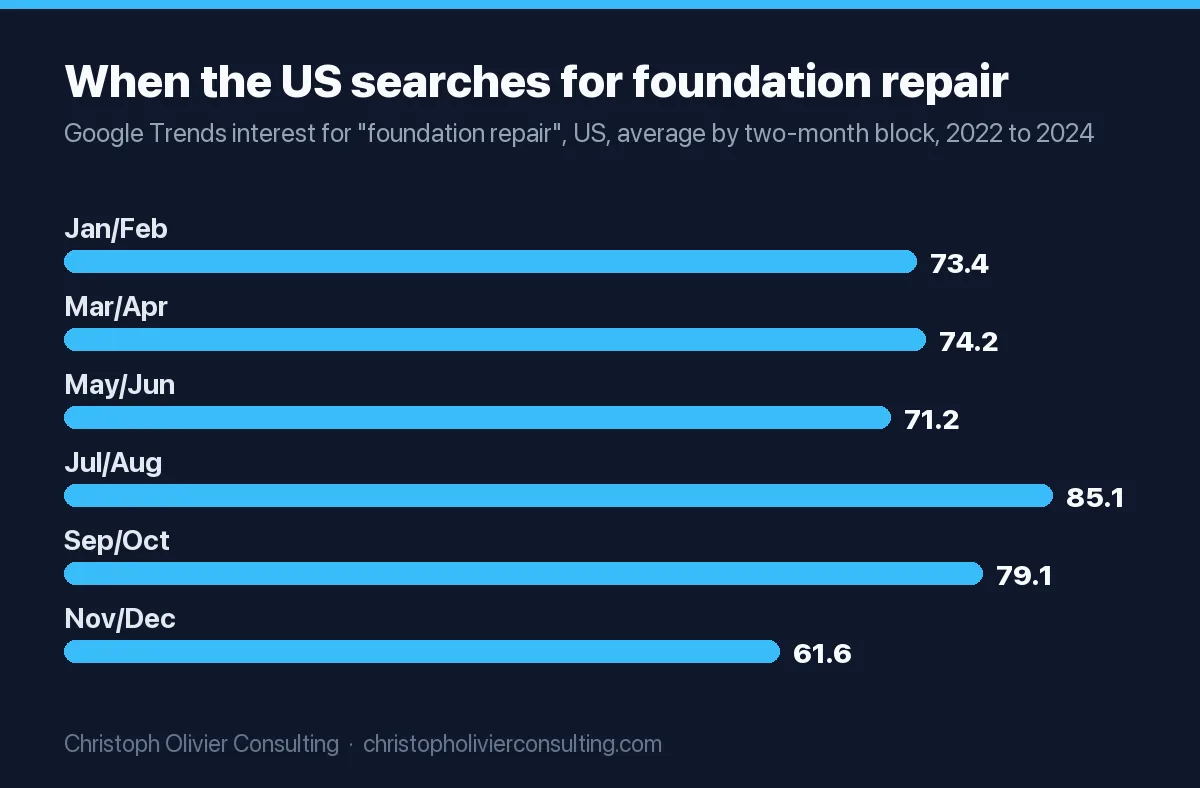
Search interest shows the seasonality. In Google Trends data for “foundation repair” in the US, 2022 to 2024, July and August were the highest two-month block (index 85) and November and December the lowest (62). In Texas the summer peak was sharper in 2022 and 2023. Those are the summers Drought.gov’s August 2023 Southern Plains update describes as record heat (July 2022 holds the Texas July temperature record) with July 2023 rainfall at 1.3 inches against a 2.51-inch normal. The milder 2024 summer had no such spike. That is correlation, not proof, but it is a practical pacing rule:
- Dry heat (expansive clay markets): raise LSA and search budgets as drought monitors worsen. Push “cracks in walls after drought” and “doors sticking” ads and pages.
- Wet season: shift budget to waterproofing, bowing walls and crawl space moisture pages.
- November and December: cut cost-per-lead channels first and keep retainers and SEO running. In the US average, that is the lowest-demand stretch of the year.
Service pages that book inspections: piering, wall anchors, crawl space encapsulation
One “foundation repair” page cannot rank or convert for six different problems. Build one page per service, each answering the homeowner’s symptom, showing a price range and offering the inspection.
| Page | Homeowner’s words | Price range to show (Angi 2026) | Proof to include |
|---|---|---|---|
| Foundation piering | “house sinking,” “floors sloping” | Piering or underpinning $1,000 to $3,000 per pier | Pier count on 3 past jobs, warranty terms, engineer letter if used |
| Wall anchors and bowing walls | “basement wall bowing,” “horizontal crack” | Bowing walls $4,000 to $12,000 | Before and after measurements of wall deflection |
| Crawl space encapsulation | “musty crawl space,” “moisture under house” | $5,000 to $15,000, average $5,500 | Humidity readings before and after |
| Crack repair | “crack in foundation,” “is this crack serious” | $250 to $800 | Photo guide of hairline vs structural cracks |
| Slab lifting | “sunken patio,” “uneven driveway” | Mud or slab jacking $500 to $1,300 | Foam vs mud comparison |
Angi’s own guide tells homeowners to get at least three quotes and to look for free inspections. So put your inspection terms (free or paid, how long it takes, what the written report includes) above the fold on every page.
Google Business Profile and reviews for foundation contractors
Your Business Profile now feeds your paid leads too. After the Performance Max migration, business name, address and hours sync one way from your profile into the ad campaign. Google’s profile guidelines set the rules that matter for foundation companies:
- Pick the fewest categories that describe your core business, as specific as possible.
- A service-area business gets one profile per staffed location. The service area should not reach much farther than about 2 hours of driving from the base.
- A “virtual” office that is not staffed during business hours cannot be listed.
On reviews, Google’s Maps contribution policy bans offering discounts or anything else in exchange for a review, discouraging negative reviews, and selectively asking only happy customers. That last one rules out “review gating” funnels. Ask every customer, the day the crew finishes, with a link and a photo of the completed work. Our guide on how to get more Google reviews has the request scripts.
Financing offers that turn inspections into signed jobs
With most jobs between $2,225 and $8,133, many homeowners compare monthly payments, not totals, and Angi’s cost guide advises them to ask contractors about payment plans. Present the monthly figure in the written estimate. The HVAC playbook for converting estimates into booked jobs covers presenting financing early, in monthly dollars, and it transfers directly to foundation work.
Be careful with the ad copy. Under Regulation Z, 12 CFR 1026.24(d), stating a down payment, a number of payments or repayment period, a payment amount or a finance charge in an ad triggers extra disclosures: the down payment, the full terms of repayment, and the APR (and whether it can rise). Two versions:
- No trigger: “Financing available. Ask your inspector about monthly payment options.”
- Triggers disclosures: “Piering from $149 a month.” This needs the down payment, the term and the APR next to it, supplied by your lender.
Financing platforms differ on contractor cost. Hearth’s pricing page, for example, lists a marketplace of 18+ lenders with $0 dealer fees. Get the lender’s own advertising disclosures before you put a monthly number in any ad.
The seven numbers to track every week
- Leads by source (LSA, Search, marketplace, call network, appointment vendor, organic, referral).
- Answer rate on inbound calls during business hours. LSA charges for missed calls after 20 seconds.
- Lead to held inspection rate, by source.
- Inspection to signed job rate, by source and by service.
- Average signed job value, by service.
- Cost per held inspection, by source.
- Cost per sold job, by source, against the allowable figure from the table above.
If two sources show the same cost per lead but one closes twice as often, the scorecard and these seven numbers will show it within a month. If you want a second set of eyes on a vendor contract or your channel mix, you can book a consultation.
Work with CO Consulting
Want this done for your business?
- A diagnostic call and an audit of your current marketing and numbers
- A prioritized 90-day plan built for your market
- Execution across SEO and AI search, paid ads, content, funnels and automation
- Weekly check-ins and monthly reporting, led by a fractional CMO
Frequently asked questions
What are foundation repair booked-job generation services?
They are vendors that deliver scheduled inspections or appointments instead of raw inquiries. Pricing runs per lead (Google Local Services Ads, Thumbtack, Angi), per qualified call, per booked appointment, or as a monthly retainer plus ad spend. Compare them on cost per held inspection and cost per sold job, not cost per lead, against your average job value.
Can foundation repair companies run Google Local Services Ads?
Yes. Google's US eligibility list for Local Services Ads includes Foundations services. You pay per valid lead, such as an answered call, a missed call over 20 seconds during business hours, a message or a booking request. Google screens advertisers, can require background, insurance and license checks, and is migrating LSA into Google Ads Performance Max campaigns with pay-per-lead goals.
How much does a foundation repair lead cost on Google Ads?
No primary source publishes a foundation-only figure. WordStream's 2026 benchmarks, covering about 13,000 campaigns from April 2025 to March 2026, put Home and Home Improvement at $8.33 per click and $90.92 per lead. Check your own service terms in Google Keyword Planner and run separate campaigns for small and large repair types.
Is pay per booked appointment better than pay per lead for foundation repair?
It is better only if the appointment price is below your in-house cost per held inspection multiplied by the vendor's confirm rate. In our example, in-house cost is $151.53 per held inspection, so at a 75% confirm rate the vendor must charge $113.65 or less. Also check whether appointments are soft-set or homeowner-confirmed before you are billed.
What should I check before signing with a foundation repair lead or appointment vendor?
Get written answers on lead exclusivity, the exact moment an appointment becomes billable, access to call recordings, credit reasons and the dispute window for bad leads, contract length and cancellation terms, and who owns the phone numbers, ad accounts and Business Profile. Treat any fail on exclusivity, the booked definition or the refund policy as a deal breaker.
What is the average foundation repair job value for ROI math?
Angi's 2026 data puts the national average at $5,175 across 4,219 projects, with most homeowners paying $2,225 to $8,133. By service, crack repair runs $250 to $800, bowing walls $4,000 to $12,000 and home settling $5,000 to $25,000, so your allowable cost per lead depends heavily on which jobs a channel brings you.
When do foundation repair leads peak during the year?
In Google Trends data for the US from 2022 to 2024, searches for foundation repair were highest in July and August and lowest in November and December. Texas showed sharper summer peaks in the 2022 and 2023 drought summers. Expansive clay soils shrink in dry heat and swell when wet, so pace budgets to local soil and weather.
More Growth, Strategy & Sales guides
- Garage Door Company Marketing: The 2026 Channel and Cost Guide
- Hair Restoration Marketing: A 2026 Cost Per Consult Playbook
- Kitchen Remodeling Marketing: A Channel Plan That Books High-Ticket Projects
- Locksmith Marketing: A 2026 Playbook for Booked Jobs and Beating Lead-Gen Spam
- Logo Design Cost in 2026: What You Pay by Source
- Water Damage Restoration Marketing: The 2026 Playbook for More Booked Jobs
- All Growth, Strategy & Sales guides →