
Garage door company marketing wins when you show up at the moment a spring snaps or a door will not open, book that call fast, and turn one repair into a review and a future replacement. This guide gives you the channel mix, the cost per booked job by channel, and the repair versus install math that decides where your budget goes in 2026.
Last reviewed: September 2026
What garage door company marketing actually is
Garage door company marketing is the system that puts your business in front of homeowners at the exact second an emergency search happens, then converts that urgent search into a booked job. It combines Google Business Profile, local SEO, Local Services Ads, paid search, a review engine, and referral partners. The number that matters is cost per booked job, not cost per click.
Most demand in this category is repair driven and high urgency. Searches like broken spring or opener not working convert quickly, which keeps book rates high when your intake answers on the first ring. Your job is to be visible, be fast, and be trusted before the homeowner calls the next company on the list.
The channels that book garage door jobs
Five channels drive most garage door bookings: Google Business Profile and local SEO, Local Services Ads, non-branded paid search, a review engine, and referral partners such as builders and realtors. Each has a different cost per booked job and a different speed to first call, so a healthy program runs several at once rather than betting everything on one source.
Owned and earned channels like local SEO and referrals cost the least per booked job once they mature, but they take time to build. Paid channels buy speed. A practical mix pairs a paid channel for immediate calls with a local SEO and review program that lowers your blended cost over the following two quarters. For a wider view of building this pipeline, see our guide to small business lead generation.
Cost per booked job by channel
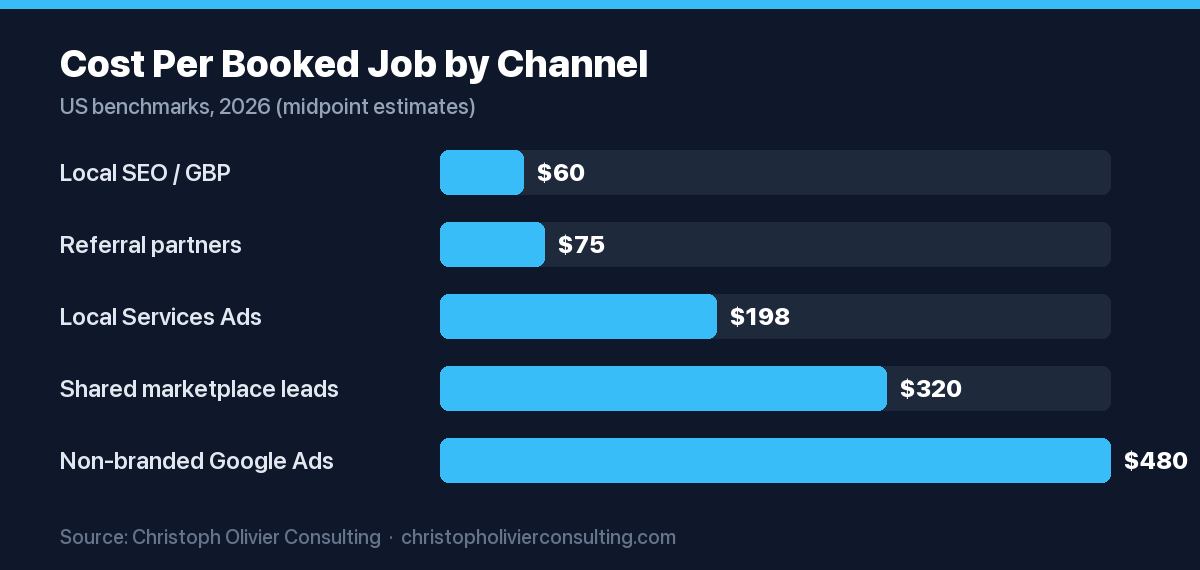
Cost per booked job matters more than cost per lead because channels close at different rates. A Local Services Ads lead near $49 becomes a paying customer for roughly $198 after conversion, while non-branded Google Ads run several times higher because clicks cost more and close at a lower rate. Local SEO and referral partners produce the lowest cost per booked job once established.
| Channel | Typical cost per lead | Approx. cost per booked job | Notes |
|---|---|---|---|
| Local SEO / Google Business Profile | Retainer, low per-lead | ~$60 | 60 to 90 days to move the map pack |
| Referral partners | Low and variable | ~$75 | Builders, realtors, plumbers |
| Local Services Ads | $15 to $59 | ~$198 | Google-screened, pay per lead |
| Shared marketplace leads | $20 to $100 | ~$320 | Shared with rivals, lower close rate |
| Non-branded Google Ads | $145 to $173 | ~$480 | Fast calls, highest cost per booked job |
Read this table as a starting point, not a promise. Your real numbers depend on market size, close rate, and job mix. Track cost per booked job monthly and shift spend toward the channels that book profitable work.
Local SEO and Google Business Profile for garage door companies
Local SEO and a complete Google Business Profile are the highest-return long-term investment for a garage door company. Fill every field: name, address, phone, hours, service area, description, and full service list. Add photos, keep hours current, and turn on Reserve with Google so homeowners can book from the profile. Most companies see map pack movement within 60 to 90 days.
Review volume, recency, and your owner response rate all feed both ranking and conversion. In tests, a profile with 40 reviews and a 90 percent response rate outranked one with 100-plus reviews and under 50 percent response, and replies within 24 hours helped rankings. For the ranking mechanics behind this, read our guide to SEO for professional services.
Local Services Ads and paid search
Local Services Ads are usually the most efficient paid channel for garage door companies. Garage door is one of the cheaper trades on the platform, with leads clustering around $15 to $59 in 2026 and a booked-customer cost near $198. You pay per lead, gain the Google Screened badge, and can dispute leads that are off-target.
Non-branded Google Ads buy speed but cost more, with a blended cost per lead of roughly $145 to $173 and cost per booked job that can reach $480. Use search ads for high-intent replacement and commercial terms where the ticket justifies the spend, and lean on Local Services Ads and organic for repair volume.
Reviews and referral networks
A review engine is the single highest-impact move in this category because reviews feed both map pack ranking and buyer trust at the same time. Ask for a review by text within an hour of every completed job, respond to all of them, and aim for a steady drip rather than one big push. Companies with 100-plus reviews at 4.7 stars tend to hold the map pack.
Referral partners produce some of your cheapest booked jobs. Build standing relationships with builders, realtors, property managers, and plumbers who meet broken doors before you do. Share short before-and-after content on social media lead generation channels so partners and past customers keep you top of mind.
Repair versus install economics
Repair and install jobs need different marketing math. Repairs are frequent, low ticket, and close fast, so they reward cheap high-volume channels. Installs and full replacements carry a much larger ticket and gross profit, which justifies a higher acquisition budget per job. Track average job value monthly so you know which one your marketing is actually attracting.
| Job type | Typical ticket | Est. gross profit at ~40% | Marketing takeaway |
|---|---|---|---|
| Repair (spring, opener, roller) | $150 to $600 | $60 to $240 | Win on volume and speed to answer |
| Full door replacement | $1,200 to $2,500 | $480 to $1,000 | Higher budget per booked job pays off |
If your paid channels attract mostly low-value repairs when you want replacements, your keywords and ad copy are pointed at the wrong intent. Split your campaigns so replacement terms get their own budget and messaging.
A 30-day plan to book more garage door jobs
You can improve bookings inside one month by fixing the highest-impact items first: the profile, the review flow, one paid channel, and your speed to first call. Work the list in order and measure cost per booked job as you go.
- Complete every Google Business Profile field, add fresh photos, and turn on Reserve with Google.
- Set up a text-based review request that fires within one hour of each completed job.
- Launch Local Services Ads for repair terms and confirm your intake answers on the first ring.
- Split paid search so replacement and commercial terms have their own campaign and budget.
- Line up three referral partners and give each a simple way to send you work.
- Build a monthly dashboard that tracks leads, booked jobs, and cost per booked job by channel.
Work with a fractional CMO on garage door marketing
A fractional CMO gives a garage door company senior marketing leadership without a full-time salary. The role sets the channel strategy, holds vendors accountable to cost per booked job, and builds the review and referral systems that lower your blended cost over time. See how this works on the services page.
The goal is simple: more booked jobs at a lower cost per job, with a bigger share of profitable replacements. Start with the channel you can measure fastest, prove the math, then reinvest into the owned assets that keep paying after the ad budget stops.
Frequently asked questions
How much does garage door marketing cost?
Budgets vary by market and goal. Local SEO retainers commonly run $900 to $5,000 per month, Local Services Ads charge per lead at roughly $15 to $59, and non-branded Google Ads cost $145 to $173 per lead. Most companies blend a paid channel for fast calls with a local SEO and review program that lowers cost per booked job over two to three quarters.
What is the best marketing channel for a garage door company?
There is no single best channel. Google Business Profile paired with local SEO produces the lowest cost per booked job over time, while Local Services Ads deliver the fastest calls at a reasonable rate. The strongest programs run both, add a review engine, and build referral partners with builders, realtors, and plumbers to reduce blended acquisition cost.
How much does a garage door lead cost in 2026?
Garage door leads on Google Local Services Ads cluster around $15 to $59, with a national midpoint near $49. Non-branded Google Ads run higher at roughly $145 to $173 per lead. Shared marketplace leads range from $20 to $100 but close at a lower rate. Judge each channel on cost per booked job, not cost per lead alone.
How do garage door companies get more reviews?
Send a text-based review request within one hour of every completed job, while the experience is fresh. Respond to every review, positive or negative, ideally within 24 hours. Aim for a steady stream rather than one large push. Review volume, recency, and your response rate all feed both map pack ranking and buyer trust.
How long does local SEO take for garage door companies?
Most garage door companies see measurable map pack movement within 60 to 90 days of fully optimizing their Google Business Profile and starting a review program. Break-even on an SEO retainer usually lands between months five and nine, depending on your average job value and close rate. A single extra install per month often covers the retainer.
Is Google Local Services Ads worth it for garage door repair?
For most garage door repair companies, yes. It is one of the cheaper trades on the platform, with leads near $15 to $59 and a booked-customer cost around $198, well below non-branded Google Ads. You pay per lead, gain the Google Screened badge, and can dispute leads that fall outside your service area or job types.
More marketing guides for rank on ai: get cited by ai search
- Hair Restoration Marketing: A 2026 Cost Per Consult Playbook
- Kitchen Remodeling Marketing: A Channel Plan That Books High-Ticket Projects
- Locksmith Marketing: A 2026 Playbook for Booked Jobs and Beating Lead-Gen Spam
- Logo Design Cost in 2026: What You Pay by Source
- Water Damage Restoration Marketing: The 2026 Playbook for More Booked Jobs
- Weight Loss Clinic Marketing: A Compliant Playbook for GLP-1 Growth
- Rank on AI: Get Cited by AI Search