

Good better best pricing means selling the same offer at three levels: Good for price-sensitive buyers, Better as the package you want most clients to choose, and Best as a premium level that captures clients who will pay for more and makes Better look sensible. The strategy works when each tier is a real, deliverable offer separated by clear “fences” (seniority, speed, scope, warranty), and when the price gaps are set on purpose rather than improvised on each quote.
Below: where the model came from (with a 1948 Sears price list), what the research actually shows, five real tiered price lists checked on each company’s US page on November 1, 2026, a copy-ready tier worksheet, a worked margin example for a professional-services firm, and a test plan sized for firms that send 10 proposals a month, not 10,000 checkout sessions.
Want an outside expert to find your biggest growth lever? See how CO Consulting’s growth consulting works.
The good better best model, defined (and a 1948 price list)
The good better best model has three parts that do three different jobs:
- Good (entry): wins buyers you would otherwise lose on price, without discounting your main offer.
- Better (target): the package built around what your typical good-fit client needs. Most of your revenue should land here.
- Best (anchor): captures clients with higher willingness to pay, and gives Better a higher reference point.
Pricing consultant Rafi Mohammed set out the modern case in “The Good-Better-Best Approach to Pricing” (Harvard Business Review, September-October 2018): companies lose profit by discounting to win price-sensitive customers and by giving high-end customers no reason to spend more. A three-level offer addresses both at once.
The idea is much older than the article. Wikipedia’s entry on good-better-best notes that Sears often used it in its mail-order catalog, for lines such as Craftsman tools, though no source I found dates the first use. You can see it in a primary source: the white dress shirt page of the 1948 Sears Christmas Wish Book sells Pilgrim white broadcloth dress shirts in three labeled qualities.
| 1948 Sears tier | Fabric (the fence) | Price each | Gap vs Better |
|---|---|---|---|
| GOOD | 112×60 broadcloth, “our lowest priced dress shirts” | $1.97 | 23% below |
| BETTER | 136×60 combed cotton broadcloth | $2.57 | n/a |
| BEST | 144×76 mercerized combed broadcloth, pearl buttons | $3.77 | 47% above |
Two details are worth stealing 78 years later. The fence is one attribute a buyer can see and explain (thread count). And the gaps sit almost exactly on the rules of thumb pricing consultants still quote today: Good about a quarter below Better, Best about half above it.
Why three tiers work: the research, and its limits
Three options change the buyer’s question from “is this price acceptable?” to “which level fits me?” Four pieces of research explain why, and two of them come with warnings that most GBB articles leave out.
The decoy effect (asymmetric dominance), Huber, Payne and Puto, 1982
In “Adding Asymmetrically Dominated Alternatives: Violations of Regularity and the Similarity Hypothesis” (Journal of Consumer Research 9(1), 90-98), Joel Huber, John Payne and Christopher Puto showed that adding an option that is clearly worse than a “target” option, but not clearly worse than its competitor, can raise the share of the target. In their 2014 look back, the authors note that the decoy options in their studies were chosen only about 2% of the time: the decoy works without being bought.
The compromise effect, Simonson, 1989
Itamar Simonson’s “Choice Based on Reasons: The Case of Attraction and Compromise Effects” (Journal of Consumer Research 16(2), 158-174) found that brands tend to gain share when they become the compromise alternative in a choice set, and that attraction and compromise effects were stronger among people who expected to justify their decision to others. That second finding is the one that matters for B2B services: a managing partner who has to explain the spend to colleagues reaches for the defensible middle.
Ariely’s Economist subscription test
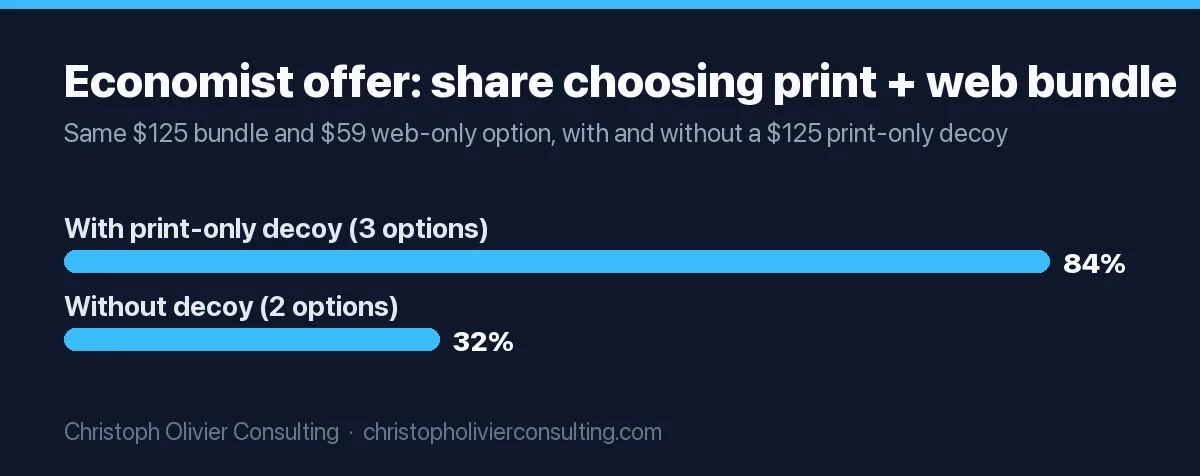
In Predictably Irrational (2008), Dan Ariely described an Economist offer: web-only for $59, print-only for $125, and print plus web for $125. As Mind Hacks summarized it, with all three options 16 of 100 participants chose web-only, none chose print-only and 84 chose print plus web. Remove the print-only option nobody picked, and 68 chose web-only while only 32 chose the bundle. Same two real products, same prices; the useless third option moved the majority.
What the original researchers say about real markets
This is the part to read before you build a “decoy” tier. In “Let’s Be Honest About the Attraction Effect” (Journal of Marketing Research, 2014), Huber, Payne and Puto answer critics (Frederick, Lee and Baskin found the effect when options were shown numerically, but not otherwise). Their own view: pure asymmetric dominance “occurs rarely in the marketplace today,” because real offers have many attributes and dominated products tend to disappear. They add that merchants more often succeed with the compromise effect, surrounding a target product with a higher and a lower option.
The practical rule: design for the compromise effect, not the decoy. Best must be something a real segment of clients buys and you can deliver. A fake Best tier that exists only to make Better look cheap is the weakest version of the strategy.
Presentation order: Best first lifted revenue in one 2025 experiment
Wolfgang Ulaga (INSEAD) and Michael Mansard (Zuora, a subscription billing vendor) reported a controlled experiment with three offers shown in Best, Better, Good order: 49% chose Best, 29.6% Better and 21.4% Good, with a reported 10.8% revenue increase versus the Good-Better-Best order. The authors measured initial choice only, not retention or lifetime value, and the article does not state the number of participants. Treat it as a strong reason to test order, not as a settled answer.
Good better best examples with real prices (checked November 1, 2026)
These are public price lists from each company’s own US page. They are examples of structure, not recommendations, and prices change: recheck before you quote them.
| Company (type) | Good | Better | Best | Step sizes | Main fence |
|---|---|---|---|---|---|
| LYFE Marketing (social media agency) | Good Plan: $750/mo, 12 photo posts | Better Plan: $1,350/mo, 12 short-form videos (marked “Featured”) | Best Plan: $1,550/mo, 20 short-form videos | +80%, then +15% | Format (photo vs video), then volume. $300 setup fee; ad budget separate |
| LegalZoom (LLC formation) | Basic: $0 + state fees | Managed Service: $249 + state fees | Expert Service: $299 + state fees | +20% from Better to Best | Attorney review of the filing and a 30-day advisor, attorney and accountant team in Expert. Advisor subscriptions auto-renew at $49 and $99 a month |
| Sobieski Services (HVAC, DE/NJ/PA/MD) | Silver: $15.49/mo, one heat or one AC visit a year | Gold: as low as $19.90/mo, one heat and one AC visit | Platinum: $33.30/mo or $399/yr, adds plumbing inspection, water heater flush, 2-year service guarantee | +28%, then +67% | Units covered, then a second trade (plumbing) |
| HubSpot Marketing Hub (B2B software) | Starter: $20 per seat/mo list (shown with a limited-time new-customer discount) | Professional: from $800/mo, 3 core seats, $3,000 required onboarding | Enterprise: from $3,600/mo, 5 core seats, $7,000 required onboarding | 4.5x from Professional to Enterprise | Buyer size and required onboarding |
| Sears 1948 (retail catalog) | GOOD shirt: $1.97 | BETTER: $2.57 | BEST: $3.77 | +30%, then +47% | Fabric quality |
Three patterns fall out of this table:
- The “small last step” ladder (LYFE, LegalZoom). Best costs only 15% to 20% more than Better. The job of Best here is to make the upgrade feel almost free, so a share of Better buyers keep going. This only works when Best costs you little extra to deliver (eight more videos, one attorney review).
- The “big jump to a new tier of service” ladder (Sobieski, HubSpot). Best adds something categorically different: a second trade, or seats and onboarding for a larger organization. The gap is wide because Best serves a different buyer, not a more enthusiastic version of the same one.
- The entry tier is either free or deliberately narrow. LegalZoom’s Basic is $0 plus state fees; Sobieski’s Silver covers one unit. Good gets a buyer in the door without cannibalizing Better, because the fence is obvious.
If you want more published agency tiers to compare, the digital marketing packages guide lists over 30 real packages with what each tier includes.
Good better best tier-design worksheet (copy and fill in)
Design from the middle out. Better comes first because it is the offer you want most clients to buy. Then strip it down for Good and build it up for Best. Paste this into a doc and fill in every bracket.
Offer: [service name] | Typical good-fit client: [industry, size, trigger event]
Step 1. BETTER (target tier)
Outcome the client buys: [one sentence, in the client’s words]
Deliverables and cadence: [e.g. monthly close, monthly 60-minute strategy call]
Who does the work: [named lead, seniority]
Response time: [e.g. 1 business day]
Delivery hours per month: [__] junior + [__] senior
Price: [$____] per [month / project]
Step 2. GOOD (entry tier)
Keep (the core outcome must survive): [____]
Remove (2 to 4 items price-sensitive buyers value least): [____], [____], [____]
Fence that stops Better clients trading down: [e.g. no strategy calls, 3-day response]
Never remove: [anything required for competent, compliant work]
Price: [$____] | Gap vs Better: [__]%
Step 3. BEST (anchor tier)
Add (access, speed or risk transfer, not just more volume): [____], [____], [____]
Who realistically buys it: [segment; name 2 current clients who would]
Capacity check: if 3 clients buy Best next quarter, who delivers it? [____]
Price: [$____] | Gap vs Better: [__]%
Step 4. Checks (all must pass)
[ ] Every item in Good is also in Better and Best (upgrading never loses anything)
[ ] No more than 4 attributes differ between adjacent tiers
[ ] Each tier price is above its cost floor: hours x loaded cost per hour / (1 minus target margin)
[ ] You can explain each step up in one sentence: “Better adds ___”
[ ] Tier names describe the level of help, not metals (Foundation / Growth / Partner beats Bronze / Silver / Gold)
What goes in each tier, by job:
| Tier | Job | Put in it | Keep out of it | Price rule of thumb (label: heuristic) |
|---|---|---|---|---|
| Good (entry) | Win price-sensitive buyers without discounting | The core deliverable, standard turnaround, self-serve or junior-led delivery | Strategy time, named senior lead, fast response | Product-style offers: no more than about 25% below Better. Service ladders: often about half of Better |
| Better (target) | Carry most revenue at a healthy margin | Everything in Good plus planning, reporting with commentary, a named lead | Things only a minority values (move those to Best or add-ons) | Set first, from cost floor and value |
| Best (anchor) | Capture high willingness to pay; frame Better | Everything in Better plus senior or partner access, same-day response, wider scope, guarantees you can keep | “More of the same” volume as the only difference | Close-step ladder: 15% to 50% above Better. New-service ladder: roughly double or more |
Where the ratios come from: the 25% and 50% limits and the four-attribute cap are Mohammed’s HBR guidance as summarized by Nick Borsh in The Product Person (HBR’s full text is paywalled). They suit products where tiers share most of their cost. In professional services each tier is usually a different amount of senior time, so prices often roughly double at each step, as in the 3-tier accounting proposal covered below. Pick the ladder that matches your cost structure, then test it.
Tier names and the one-line description under each should repeat the promise in your unique selling proposition. If the buyer cannot tell what makes you different, three columns only give them three ways to compare you on price.
Worked margin example: a 3-tier retainer for a professional-services firm
A hypothetical 6-person consulting firm sells a monthly advisory retainer. All inputs are assumptions for illustration, not benchmarks: junior time costs $70 an hour fully loaded (salary, payroll taxes, benefits, software and overhead divided by billable hours), senior time costs $150 an hour, and the firm’s target margin is 45%. Use the same cost-floor formula as the accounting example below: floor = delivery cost / (1 minus target margin).
| Tier | Hours per month | Delivery cost | Floor at 45% margin | Price | Gross margin |
|---|---|---|---|---|---|
| Foundation (Good) | 10 junior + 2 senior | $700 + $300 = $1,000 | $1,000 / 0.55 = $1,818 | $2,000/mo | 50.0% |
| Growth (Better) | 18 junior + 5 senior | $1,260 + $750 = $2,010 | $3,655 | $4,500/mo | 55.3% |
| Partner (Best) | 24 junior + 12 senior | $1,680 + $1,800 = $3,480 | $6,327 | $8,500/mo | 59.1% |
Notice the design choice: margin rises with each tier because the extra senior time is priced well above its cost. Good sits closest to its floor on purpose, so it is never the most profitable thing to sell.
Now the mix. Here are three scenarios for the same firm:
| Scenario | Client mix | Monthly revenue | Delivery cost | Gross profit | Senior hours needed |
|---|---|---|---|---|---|
| A. One package only | 12 on Growth | $54,000 | $24,120 | $29,880 (55.3%) | 60 |
| B. Tiers work as designed | 4 Foundation (3 of them deals previously lost on price), 8 Growth, 3 Partner | $69,500 | $30,520 | $38,980 (56.1%) | 84 |
| C. Good cannibalizes Better | 6 Foundation, 6 Growth, 0 Partner | $39,000 | $18,060 | $20,940 (53.7%) | 42 |
Scenario B adds $9,100 a month in gross profit, but it also needs 24 more senior hours a month: check that you have them before you publish a Partner tier. Scenario C loses $8,940 a month versus doing nothing, which is why the Good fence matters more than the Good price. If your current Better clients would happily accept everything Good includes, Good is too good.
Professional services pricing with good better best: accounting, consulting, legal
For professional services, three fixed-fee options built from a written scope usually beat a single hourly estimate, because the buyer chooses a level of help instead of debating your rate. The tiers differ by who does the work and how proactive it is, and every tier has to clear its cost floor.
| Firm type | Good | Better | Best | Strongest fence | Never strip from Good |
|---|---|---|---|---|---|
| Accounting / CPA | Compliance: books, reconciliations, returns, estimates | Advisory: adds month-end close by the 10th, quarterly tax planning with written projection | CFO: adds 13-week cash forecast, budget, monthly CFO meeting, lender package | Proactive tax planning | Anything the return or engagement standards require |
| Consulting / coaching | Diagnostic: assessment and written findings | Plan: diagnostic plus a 90-day plan and monthly review calls | Partner: plan plus implementation support and leadership-meeting access | Senior access and cadence | A clear deliverable the client can act on alone |
| Legal (flat-fee matters) | Document-only package | Package plus attorney meeting and review | Package plus review, follow-through tasks and a defined update period | Attorney time and review | Anything competent representation requires; check your state bar’s fee rules |
Accounting. Our accounting proposal pricing guide works one full example: Compliance at $675, Advisory at $1,350 and CFO at $3,300 a month, each built from a cost floor ($60 loaded cost per hour, 45% target margin), checked against 2025 fee benchmarks, and capped by the value the client named on the discovery call. It shows the CFO tier first and recommends Advisory. Note that the ladder roughly doubles at each step, much wider than the 25%/50% product heuristic, because each tier adds a different kind of work. That page also covers the professional fee rules a CPA proposal has to respect.
Consulting and coaching. The fence is almost always access: who you talk to, how often, and how fast they answer. Volume fences (“4 calls vs 8 calls”) invite the client to do arithmetic instead of choosing a level of help. The proposal and pricing presentation guide for coaches and consultants shows how to lay the three options out on the page.
Legal. LegalZoom’s LLC ladder in the examples table shows the cleanest legal fence: the Expert tier adds a licensed attorney’s review. Law firms selling flat-fee packages can use the same logic, as long as no tier removes work the matter requires. Matters where scope cannot be known in advance (litigation, complex transactions) are poor fits for three fixed tiers.
When not to use three tiers at all: truly bespoke work, RFPs where the buyer defines the scope and compares like-for-like bids, firms already turning work away (add Best, not Good), and very small sales where explaining three options costs more than it earns.
Once a client is in a tier, the move from Good to Better becomes your planned expansion conversation. Time it to a trigger (a new location, a hire, a missed deadline), as described in the upselling and cross-selling guide.
How to present the three tiers
- Run discovery first. Tiers shown before you know the client’s goals look like a menu.
- Show Best first, then Better, then Good, and test it against your current order (see the 2025 order experiment above).
- Recommend one tier in one sentence tied to their goal: “Based on the hiring plan you described, I would start with Growth.”
- Explain each step up as a fence, not a feature list: “Partner adds me in your leadership meeting and same-day answers.”
- If price is the objection, move scope, not price. Offer the lower tier. Never discount the same scope in the meeting.
If your tier structure is fine but prospects still compare you with the cheapest option in town, the problem is usually positioning rather than the price list. Our pricing strategy guide covers the upstream choices, and you can book a consultation if you want a second set of eyes on your tiers and delivery costs.
How to test good better best tiers: a plan for low-volume service firms
Start with the sample-size reality. A standard two-proportion power calculation (95% confidence, 80% power) needs about 163 proposals per version to reliably detect a win-rate lift from 30% to 45%, and about 356 per version to detect 30% to 40%. You can rerun those numbers with your own baseline in Evan Miller’s sample size calculator. A firm sending 15 proposals a month would need most of two years for the first test. So for proposals, run disciplined sequential tests and judge them on revenue per proposal and tier mix, not on a significance badge.
- Baseline. Pull your last 20 to 30 proposals: win rate, average monthly fee won, and gross margin on won work.
- Change one variable per block. Order (Best first vs Good first), the Best price, or the Good fence. Never two at once, or you will not know what moved.
- Run each version for a fixed block, for example the next 20 proposals, and alternate by week rather than choosing which prospects get which version.
- Log every proposal with the columns below.
- Decide on revenue per proposal sent (won fees divided by proposals sent), then check margin and capacity.
- Where volume exists, run a true A/B test. A public pricing page with a few thousand visitors a month can be split-tested; proposals usually cannot.
| Proposal log column | Example entry |
|---|---|
| Date sent / test block | 2026-11-04 / Block 2 (Best first) |
| Tiers and prices shown | $2,000 / $4,500 / $8,500 |
| Order shown | Best, Better, Good |
| Tier recommended | Growth |
| Outcome and tier chosen | Won, Growth |
| Lost reason (if lost) | Chose in-house hire |
| Monthly fee won / delivery hours planned | $4,500 / 23 |
How to read the results:
| Signal after 20+ proposals | Likely cause | Change next |
|---|---|---|
| Most wins are Good | Good is too complete, or Better is too far above it | Tighten one Good fence before touching price |
| Nobody picks Best | Best adds volume, not access, speed or risk transfer | Replace a volume item with senior access or a guarantee you can keep |
| Best sells but margin falls | Best priced below what its senior time costs | Reprice Best or remove one delivery-heavy item |
| Win rate drops after launch | Tiers confusing or shown before discovery | Cut the differences to 4 or fewer; present only after discovery |
| Good clients upgrade within 6 to 12 months | Good is working as an entry point | Schedule an upgrade review at month 6 |
Why bother: in an HBR IdeaCast episode (July 7, 2020), Mohammed cited a McKinsey study finding that a 1% price increase, with demand held constant, would on average raise operating profit by 8.7%, and said that over 50% of airline customers who start at the lowest fare end up upgrading. Moving even a few clients from Good to Better changes profit faster than adding clients at the same mix. I would still change one thing at a time: redesign every tier at once and you cannot tell which change paid.
Work with CO Consulting
Find and fix your biggest growth constraint
- Built for service businesses doing $1M to $25M in revenue
- A diagnostic that maps your funnel, unit economics, channels and team
- A 90-day execution plan with clear KPIs, done-for-you or transfer-of-knowledge
- No guaranteed lead or revenue figures; any consultant who promises them is guessing
Frequently asked questions
What is good better best pricing?
Good better best pricing sells one offer at three levels. Good is a narrower entry option for price-sensitive buyers, Better is the package built for most clients, and Best adds access, speed or risk transfer for clients who will pay more. Fences such as seniority, response time or warranty stop Better clients from trading down. Sears used the labels in its 1948 catalog.
What is a good better best pricing strategy?
It is a plan for setting three tiers on purpose: define Better first, strip two to four items out for Good, add access or guarantees for Best, and set the gaps deliberately. Pricing consultant Rafi Mohammed's HBR guidance, as summarized, keeps Good within about 25% of Better, Best within about 50% above it, and no more than four differences between adjacent tiers.
What is an example of the good better best model?
LYFE Marketing literally names its social media plans Good ($750 a month), Better ($1,350) and Best ($1,550). LegalZoom sells LLC formation as Basic ($0 plus state fees), Managed Service ($249) and Expert Service ($299). Sobieski Services sells HVAC plans as Silver ($15.49 a month), Gold (from $19.90) and Platinum ($33.30). Prices were checked on November 1, 2026.
How far apart should good better best prices be?
For product-style offers, a common rule of thumb from Mohammed's HBR article is Good no more than about 25% below Better and Best no more than about 50% above it. Professional-service tiers often roughly double at each step because each level adds senior time. Every tier must stay above its cost floor: delivery cost divided by one minus your target margin.
Does good better best work for professional services pricing?
Usually, for recurring retainers and defined projects. Accounting firms can offer Compliance, Advisory and CFO tiers; consultants can offer Diagnostic, Plan and Partner; law firms can tier flat-fee packages by attorney involvement. It fits poorly for truly bespoke matters, RFPs that fix the scope, or firms that cannot staff the top tier. No tier may remove work that competent service requires.
Why do most buyers pick the middle option?
Itamar Simonson's 1989 study found that options gain share when they become the compromise in a choice set, especially when buyers expect to justify the decision to others. Huber, Payne and Puto showed in 1982 that a clearly inferior option can boost the option that beats it. In their 2014 commentary they say the compromise effect is the one merchants use successfully more often.
Should I show the most expensive tier first?
Test it. In a 2025 experiment reported by INSEAD's Wolfgang Ulaga and Zuora's Michael Mansard, showing Best, Better, Good in that order led 49% to choose Best and produced a reported 10.8% revenue lift over the usual order. The study measured initial choices only, so track renewals too. Whatever the order, recommend one tier and explain why.
More Growth Consulting guides
- Pricing Strategy: A Founder’s Guide to Setting the Right Price
- What Is a Value Proposition? Formula, Examples, and a Fill-in Framework
- Upselling and Cross Selling: The Practical Guide
- What Is Commercial Marketing? Definition, and How It Differs From Social and Corporate Marketing
- Marketing Maturity Model: Stages, Dimensions, and a Self-Assessment
- Ecommerce Marketing Strategy: A Channel-by-Channel Plan Built on LTV:CAC
- All Growth Consulting guides →