

To structure a webinar offer that converts, sell one small, priced next step and present it in a fixed order: the outcome, what is included, who it is for, an honest price anchor, the price, a risk reducer, a real deadline and one action. For agencies and consultants that next step is usually a paid diagnostic or a qualified strategy session, not the full retainer. Put the offer inside the first two-thirds of the hour, because that is where most of the live audience is still watching.
This page is the offer itself: an 11-slide offer framework with minute marks, an agency offer stack with the anchoring math worked through, objection slides with copy, a rule for choosing call booking or direct checkout, and a fill-in template. Promotion, registration pages and the full run of show live in our end-to-end webinar marketing playbook for agencies and consultants, so they are not repeated here.
What is a webinar offer, and why do most webinars skip it?
A webinar offer is the specific, priced next step you invite attendees to take, with a deadline and a single action. It is different from the webinar’s promise, which gets people to register. Many B2B webinars never make one: they teach, take questions and end, and the buying decision is left to chance.
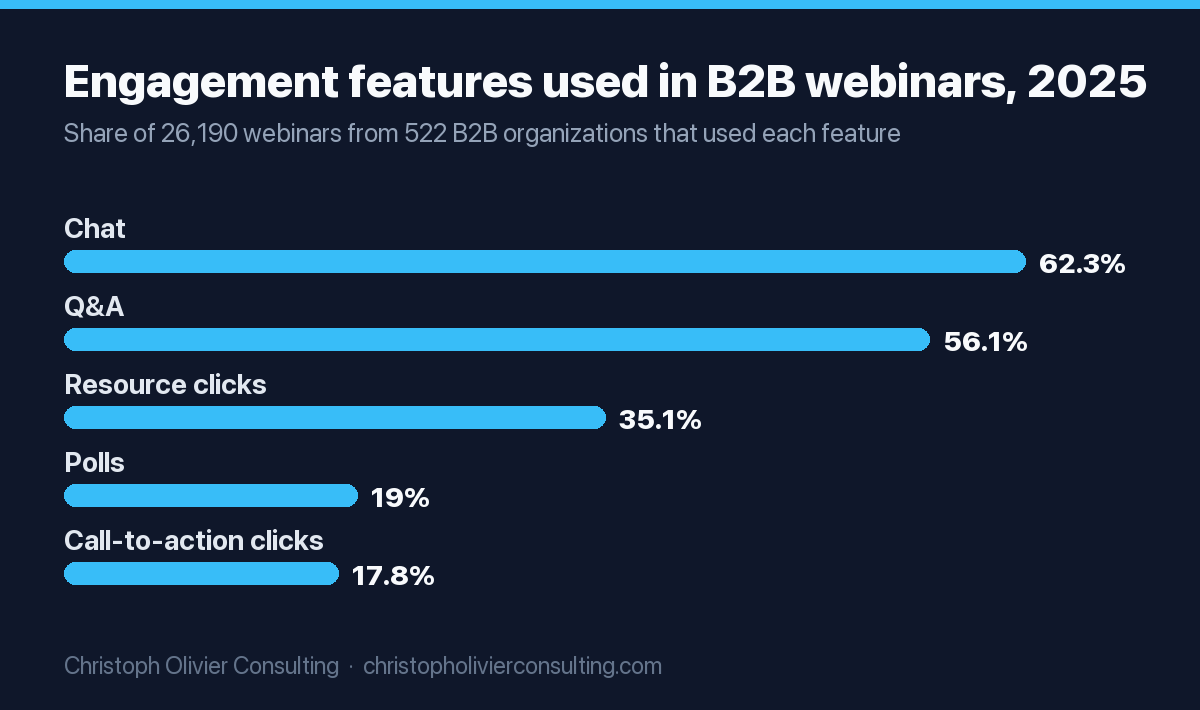
The Goldcast 2026 B2B Webinar Benchmark Report analyzed 26,190 webinars from 522 B2B organizations in 2025. Call-to-action clicks were used in only 17.8% of them, against 62.3% for chat and 56.1% for Q&A. That is the share of webinars using the feature, not a click rate, but it matches what you see in practice: teams invest in the content and under-invest in the ask.
When the ask is there, buyers use it. ON24’s 2026 Webinar Benchmarks summary (published June 19, 2026, covering 2025 platform data) reports a 4X increase in meeting bookings made during webinars, a 73% rise in demo bookings and a 49% rise in CTA engagement per attendee. Those are year-over-year changes on an enterprise-heavy platform, not conversion rates you should expect, but they show attendees will book from inside a session when you give them a way to.
The registration promise qualifies people at the door; the offer converts the qualified ones. If you built the registration side with our guide to a webinar that books sales calls, this page is the second half.
What should you sell at the end of a webinar?
Sell the smallest next step a qualified attendee can say yes to within a week, and that leads naturally to your core engagement. Match it to your price point and to how ready the room is to buy.
| Offer type | Best fit | What the attendee commits | Main strength | Watch out for |
|---|---|---|---|---|
| Free strategy session | High-ticket, custom services with a considered buying process | 30 to 45 minutes and an application | Lowest friction; lets you qualify one to one | No-shows and poor fits unless the application screens them out |
| Paid diagnostic or audit | Agencies and firms whose expertise shows in an assessment (marketing, accounting, legal, IT) | A fixed fee for a fixed scope | Filters for buyers; the fee can be credited toward the larger engagement | Scope creep; define the deliverable in writing |
| Group program or cohort | Consultants who have productized a method | Program fee plus time each week | Can close on the webinar itself | Delivery capacity, refund terms, start-date logistics |
| Done-for-you package | Agencies with a productized service | Project fee or retainer | Highest value per sale | Rarely closes on the webinar alone; usually needs a call |
The rule underneath the table: the higher the price and the more custom the work, the more the webinar should sell a conversation or a diagnostic, not the engagement itself. Few people sign a five-figure retainer from a slide. Many will book a call or pay a modest, credited fee to find out whether it makes sense.
Free strategy session or paid diagnostic?
A free session works when your calendar has room and a short application screens people out. A paid diagnostic works when your calendar is the constraint. The fee screens out browsers, the deliverable shows your thinking, and a fee credit removes the feeling of paying twice. My own bias for agencies and professional-service firms is the paid diagnostic, because it turns a sales call into a piece of delivered work.
How to productize a consulting offer so it can be sold on a webinar
A webinar audience cannot buy “custom work, priced after discovery”. Before the session, turn your entry offer into a product with five fixed elements: a name, a fixed scope (for example “the last 90 days of leads, three channels”), a fixed deliverable (a written report and a 60-minute readout), a fixed timeline (three weeks) and a fixed price that you also charge outside the webinar. If you cannot write all five in one line each, the offer is not ready to pitch live.
What are the parts of a webinar offer?
A complete webinar offer has seven parts. If any part is missing, attendees fill the gap with doubt, and doubt usually turns into “later”.
- A name. “The Intake Leak Audit” is easier to remember, repeat to a partner and find in an inbox than “a call with us”.
- The outcome. One sentence on what changes for the client. If it is fuzzy, work through a value proposition exercise before you build slides.
- What is included. Deliverables, sessions, timeline and access. “A 90-day call-tracking review and a 60-minute readout” beats “full visibility into your funnel”.
- Who it is for, and who it is not for. Naming the poor fit makes the good fit feel seen and saves you bad-fit calls.
- Price and terms. The actual number, payment options and any credit toward future work.
- A risk reducer. A refund condition, a fee credit or a cancellation window. Write terms you will honor every time.
- A reason to act now, and one action. A real deadline or capacity limit, plus a single link. Two calls to action split attention.
How should you price and anchor a webinar offer?
Anchor the price against something real: your standard fee for the same work, the cost of the problem worked out from the attendee’s own numbers, or the cost of the alternative path. Then state the actual price plainly, with payment terms. Do not print a “total value” you have never charged.
The FTC’s Guides Against Deceptive Pricing (16 CFR 233.1) treat a former price as a legitimate comparison only when it is the actual, bona fide price at which the item was offered to the public on a regular basis for a reasonably substantial period. A price inflated so you can announce a large reduction is called fictitious. A stack slide that says “total value $27,000, yours today for $2,000” invites exactly that question: has this ever been offered at $27,000? If not, drop the number.
Offer stack example for an agency, with the anchoring math
Here is a complete stack for a hypothetical agency that runs lead generation for B2B service firms. The agency, prices and inputs are invented for illustration; replace them with yours. The audit is sold on the agency’s services page at $3,500 all year, which is what makes it a usable anchor.
| Stack line | What it is | Price shown on the slide |
|---|---|---|
| Core offer: The Intake Leak Audit | Review of the last 90 days of calls and form fills, a response-time test on every channel, a written report and a 60-minute readout, delivered in 3 weeks | $3,500 (the regular price, charged year-round) |
| Webinar incentive | $600 off for decisions made by Friday at 5 pm ET, then the price returns to $3,500 | $2,900 until the deadline |
| Bonus 1 (answers “I need my partners”) | 30-minute briefing call with the other decision makers before the readout | Included; no invented dollar value |
| Bonus 2 (answers “we won’t implement it”) | 30-day check-in to review which fixes went live | Included |
| Risk reducer | The full audit fee is credited toward the first retainer month if you sign within 30 days of the readout | Credit terms stated in writing |
| Payment options | Pay in full, or 2 payments of $1,500 | $2,900 or $3,000 total (the $100 difference is shown) |
The anchor slide then shows three comparisons, each built from numbers the room can check:
- Against the real regular price. $3,500 regular, $2,900 by Friday: a $600 reduction, about 17%, from a price the agency actually charges. That is the comparison 16 CFR 233.1 allows.
- Against the cost of the problem. Use the attendee’s own inputs, collected in a poll. Example: 120 leads a month, 10% to 20% of them never answered within a business day, a 25% close rate on answered leads and a $4,000 average new-client value. That is 12 to 24 unanswered leads, 3 to 6 lost clients and $12,000 to $24,000 a month in fees at stake. At $2,900, the audit costs about 12% to 24% of one month of that range. Show the assumptions on the slide and present the range, never the single biggest number.
- Against the alternative path. A partner doing the same review in-house: 20 hours at a $350 billable rate is $7,000 of billable time, before any fixes are made.
Close the slide with the effective price for buyers who continue: if the retainer is $6,000 a month, the first month is $6,000 minus the $2,900 credit, or $3,100 in new cash, and the audit has effectively cost nothing. Keep it to one offer with two payment options. A tiered menu works well in a proposal, as our guide to good, better, best pricing shows, but three tiers on a live webinar give the room a reason to postpone. This is general guidance, not legal advice; if your pricing claims are aggressive, have counsel review them.
Which bonuses actually help a webinar offer?
Good bonuses remove a specific objection or speed up the first result, and they are things you would deliver anyway. Weak bonuses pad the stack with recycled PDFs and invented dollar values. Two or three relevant bonuses beat ten, and a bonus tied to a real deadline gives you honest urgency.
- “It costs too much.” A payment plan, or crediting the fee toward the next engagement.
- “I don’t have time.” A done-with-you setup session, or a data handoff your team does for them.
- “I’m not sure it fits my situation.” A short pre-start fit review, with a clear exit if it does not fit.
- “I need to ask my partners.” A one-page summary written for the other decision makers, or a briefing call with them. In partner-led firms this often matters more than any discount.
- “I’ll decide later.” A bonus available only to people who decide by a stated date, and that you actually withdraw afterwards.
How do you add urgency without fake scarcity?
Use only deadlines and limits that are true and that you enforce: a cohort start date, a number of slots your team can actually staff, a bonus that genuinely expires, or a price that changes back on a stated date. Never use a countdown timer that resets or an “ends tonight” claim for an offer that does not end.
The FTC staff report Bringing Dark Patterns to Light (September 2022) lists both common webinar tricks as dark patterns. A “Baseless Countdown Timer” is a fake countdown clock that goes away or resets when it times out. A “False Limited Time Message” says an offer is good only for a limited time but has no deadline, or a meaningless one that resets when reached.
- Capacity. “We run eight audits a month because two analysts deliver them.” True, specific and checkable.
- Calendar. A cohort that starts on a date, or a fee that changes at the start of a quarter.
- Bonus expiry. The partner briefing call is included for decisions made by a named date.
Automated and evergreen webinars need extra care. If each registrant gets a personal deadline, it must actually close for that person. A replay page that says “available for 48 hours” while the same offer stays open indefinitely is the false limited-time message the FTC describes.
How do you use proof and testimonials in the pitch safely?
Use real clients, with permission, describing results that are representative or clearly qualified. Under 16 CFR 255.2, an endorsement about a key attribute is read as representing what buyers will generally achieve. If you cannot substantiate that, the ad should clearly and conspicuously disclose the generally expected performance.
Separately, the FTC’s Consumer Reviews and Testimonials Rule, in effect since October 21, 2024, prohibits testimonials that misrepresent the person’s experience with the service, and it authorizes courts to impose civil penalties for knowing violations. Law, accounting and financial advice carry extra rules on testimonials and past results, so check with your regulator or bar before you put client outcomes on a slide.
Proof that does not depend on outcome claims is also easier to keep compliant:
- Process proof. Show a redacted page of the actual report or scorecard the client receives.
- Live demonstration. Run one step of the method on a volunteer’s numbers during the teaching section, with permission.
How should the last 15 to 20 minutes of the webinar be structured?
Give the offer block a fixed sequence of 11 slides, from the recap to the ask, then take questions with the ask slide pinned. In a 60-minute webinar the block runs from about minute 40 to minute 51, with Q&A to minute 60. Two short slides earlier in the hour set it up, so nobody feels ambushed.
The timing comes from attention data. Goldcast found that live attendees complete about 74% of a webinar on average and advises landing the CTA in the first two-thirds of the event, since a CTA in the last 10 minutes can be missed by a large part of the audience. Its 2025 data put the average B2B webinar at 56.8 minutes, with 50.5% running exactly 60 minutes, while consulting webinars averaged 69.4 minutes. If you run 75 minutes, move the whole block earlier so the ask lands by minute 50, two-thirds of the way through.
The 11-slide webinar offer presentation framework
| Slide | Minute (60-min webinar) | On the slide | Say this |
|---|---|---|---|
| Setup A: How this hour runs | 2 | Teach 35 min / How we help 10 min / Q&A | “I’ll teach for about 35 minutes, take ten to show how we help, then answer questions.” |
| Setup B: Soft mention | 30 | One line and the link | “If you’d rather have us run this for you, I’ll show how at minute 40. The link is in the chat now.” |
| 1. Recap | 40 | Three lessons, one line each | “You now have the three leaks, the test for each, and the fix order.” |
| 2. Two paths | 41 | Do it yourself / Have us do it | “You can do this with today’s checklist, or get help to do it faster. Both are valid.” |
| 3. Offer name and outcome | 42 | Name plus one-sentence outcome | “The Intake Leak Audit: in three weeks you’ll know exactly which leads you’re losing and the fix order.” |
| 4. What is included | 43 | Deliverables, timeline, your part | “Your part is a 30-minute data handoff and the readout. Everything else is ours.” |
| 5. For and not for | 44 | Two columns of fit criteria | “If you get fewer than 50 leads a month, don’t buy this. Use the checklist.” |
| 6. Proof | 45 | Redacted report page or a compliant client example | “This is page 4 of a real report, shared with permission.” |
| 7. Anchor | 46 to 47 | Regular price, cost of the problem, in-house cost | Walk the three comparisons from the pricing section, using the poll numbers. |
| 8. Price and terms | 48 | $2,900 by Friday, then $3,500; 2 x $1,500 option; fee credit | “Here’s the number, and here’s how the credit works if you continue.” |
| 9. Bonuses and risk reducer | 49 | Each bonus next to the objection it answers | “The partner briefing is there because most of you can’t sign alone.” |
| 10. Deadline and capacity | 50 | The date, the slot count, and why | “Eight audits a month, because two analysts deliver them. The price goes back Friday at 5 pm.” |
| 11. The ask | 51 (pinned to the end) | One link or QR code and the next three steps | “Click, answer four questions, pick a readout date. You’ll get a confirmation within the hour.” |
The “two paths” slide does the most work. When doing it yourself is a credible option, the offer reads as a faster route, not a trap.
Objection-handling slides, with copy
Build one slide for each predictable objection and keep them hidden until Q&A, roughly minutes 52 to 58. If nobody raises an objection, answer it anyway: “A question I usually get here is…” After each one, go back to the ask slide.
| Objection | Slide headline | Copy to say |
|---|---|---|
| “It’s too expensive.” | What this costs vs. what waiting costs | “The audit is $2,900 this week. On the numbers you gave in the poll, the leak is $12,000 to $24,000 a month. The fee is credited in full if you continue.” |
| “We don’t have time.” | Your part: 90 minutes in total | “A 30-minute data handoff and a 60-minute readout. We do the rest, and the report tells you who on your team owns each fix.” |
| “Will this work for a firm like ours?” | Who this is not for | “Under 50 leads a month, the sample is too small. If that’s you, the checklist from minute 20 is the better use of your money.” |
| “Our team could do this.” | Yes, here’s how | “You can. The method from the first half is everything we do. Buy the audit if you want it done in three weeks by people who run it every month.” |
| “I need my partners’ sign-off.” | Bring them in | “Book the slot now. The partner briefing is included, and you can cancel at no cost up to 48 hours before it if they say no.” |
| “Let me think about it.” | Three questions to decide | “Is the leak bigger than the fee? Can you give us 90 minutes? Can you decide by Friday? If any answer is no, wait for the next round.” |
Application and call booking or direct checkout?
For a high-ticket service offer, the ask slide either sends people to a checkout or to an application and a calendar. My rule of thumb: use direct checkout when one person can approve the price and the scope is identical for everyone; use an application when the buyer needs sign-off, the scope varies or you must turn people away.
| Signal | Direct checkout on the webinar | Application and call booking |
|---|---|---|
| Who approves the spend | The attendee alone | Partners, a board or a finance lead |
| Scope | Fixed and the same for everyone (a productized audit) | Custom, priced after discovery (a retainer or project) |
| Cost of a bad-fit client | Low; a refund fixes it | High; a bad fit costs months of delivery |
| Capacity | You can deliver to everyone who buys | A fixed number of slots you need to allocate |
| Ask-slide wording | “Buy the Intake Leak Audit: $2,900 until Friday” | “Apply for one of 8 strategy sessions this month” |
| Tool setup | Calendly Standard ($10 per seat per month, billed yearly) connects Stripe and PayPal, so a paid diagnostic can be booked and paid in one flow | Calendly Teams ($16 per seat per month, billed yearly) adds routing forms that screen invitees and route them based on their answers |
The middle path for most agencies is the one in the stack above: direct checkout for the fixed-fee audit, then a call at the readout for the retainer. If you go the application route, keep it to four or five questions so it still feels like booking, not a tax return:
- Company website.
- Your role: owner or partner, marketing lead, other.
- Annual revenue: under $1M, $1M to $3M, $3M to $10M, over $10M.
- What has to change in the next 90 days?
- If we’re a fit, who else signs off, and when could you start?
Route answers below your minimum to a resource page instead of the calendar, and reply to everyone within one business day. Our application form questions page has longer versions and scoring rules if you need a stricter screen.
What follow-up sequence should come after a webinar offer?
Most registrants never see the live pitch, so the replay and the emails have to carry the offer on their own. Goldcast measured live attendance at 40% of registrants in 2025, with 89.1% of webinars offered on demand and on-demand viewers completing 91% of the content versus 74% live. ON24 reports 60% of registrants attending, but it counts on-demand viewers as attendees, and 67% of its attendees joined live. Either way, a large share of your buyers will meet the offer in the replay.
Follow up by behavior until the real deadline, then stop pitching this offer. The offer-specific rules:
- Replay page: put slides 3 to 11 under the video as text, with the same deadline and the same single link.
- Clicked but did not buy: send the objection slides as one email, in writing, the next morning.
- Stayed through the pitch or asked a question: a short personal note from the presenter.
- Deadline day: one morning reminder of what closes and when, then a note confirming it has closed.
The day-by-day copy for the whole sequence is in the playbook linked at the top. Build the branches as funnel automations in your CRM, so webinar-platform tags (attended, clicked, watched replay) trigger the right path without manual list work. Set your replay and attendance targets against the benchmarks in our webinar statistics roundup.
Fill-in webinar offer template
Write your offer with this template before you build a single slide. If you cannot fill a line with something specific and true, the offer is not ready. Each line maps to one slide in the framework above, so the finished template doubles as your pitch outline and your replay-page copy.
- Offer name: ____________________
- Outcome (one sentence): After this, you will have ____________ so that you can ____________.
- What is included: (1) ________ (2) ________ (3) ________, delivered over ____ weeks. Your part: ____ minutes.
- Who it is for: ____________________
- Who it is not for: ____________________
- Regular price you charge outside the webinar: $______
- Cost-of-problem math (inputs from the poll): ____ x ____ x ____ = $______ to $______ a month
- Alternative path cost: ____ hours x $____ rate = $______
- Webinar price and terms: $______ until ______, then $______; or ____ payments of $______; credited toward ______ within ____ days.
- Risk reducer: ____________________ (terms you will honor every time)
- Bonus 1 (objection it answers): ____________________
- Bonus 2 (objection it answers): ____________________
- Real deadline or limit, and why it exists: ____________________
- Checkout or application: ____________ (use the decision table)
- One action: Go to ______ and ______. Next, you will ______.
Worked example for a consulting firm (illustrative)
Here is the template filled in for a hypothetical fractional CFO firm that runs a webinar for owners of multi-location dental groups. The firm, numbers and terms are invented for illustration.
- Offer name: The Cash Flow Diagnostic.
- Outcome: After this, you will have a 13-week cash forecast and a ranked list of margin leaks, so that you can decide on your next location with real numbers.
- What is included: a data request checklist, a 90-minute working session, a written report and a 45-minute readout with you and your partners, delivered over three weeks.
- Who it is for: groups with three or more locations and a bookkeeper already in place.
- Who it is not for: single-location practices, or anyone without twelve months of clean books.
- Regular price: $2,500, the same fee all year; the webinar adds a bonus, not a discount.
- Risk reducer: if you decide after the working session that the diagnostic is not useful, the firm refunds the fee.
- Credit: the $2,500 is credited in full toward a retained engagement started within 30 days.
- Bonus: a partner briefing call for groups that book by the stated date.
- Real limit: eight diagnostics per month, because two analysts deliver them.
- Checkout or application: checkout, because one owner can approve $2,500 and the scope is fixed.
- One action: go to the booking page, pay, and pick a working-session date.
Notice what is missing: no invented “total value”, no resetting timer, no savings promise. It still has a name, a price, a reason to act and one next step. If you would like a second set of eyes on your offer before your next session, you can book a consultation and we can work through the stack and the anchor slide together.
Frequently asked questions
How do you structure a webinar offer that converts for an agency or consulting firm?
Sell one small, priced next step, usually a fixed-fee diagnostic or a qualified strategy session, rather than the retainer. Present it in a fixed order: recap, two paths, offer name and outcome, what is included, who it is for, proof, an honest anchor, price and terms, bonuses and risk reducer, a real deadline, and one link. Land the ask by about minute 40 of a 60-minute webinar.
What is a good webinar offer presentation framework?
Use two setup slides (an agenda that announces the offer at minute 2 and a soft mention around minute 30), then an 11-slide offer block from about minute 40 to 51, then Q&A with the ask slide pinned. Keep one objection slide ready for price, time, fit, doing it in-house, partner sign-off and 'let me think about it', and return to the ask after each answer.
What is the best high ticket webinar offer structure for a service business?
For high-ticket custom work, the webinar should sell the conversation or a paid diagnostic, not the engagement. Productize that entry step with a name, fixed scope, fixed deliverable, fixed timeline and a price you also charge outside the webinar. Credit the fee toward the larger engagement, add two or three bonuses that answer real objections, and state a deadline you actually enforce.
Should a high ticket webinar send people to checkout or to a sales call?
Use direct checkout when one person can approve the price and the scope is the same for everyone, such as a fixed-fee audit. Use an application and call booking when partners or a board must sign off, the scope is custom, or you have limited slots. Many agencies combine them: checkout for the diagnostic, then a call at the readout for the retainer.
How long should the pitch section of a webinar be?
Plan about 10 to 12 minutes for the offer itself and 8 to 10 minutes for Q&A. Goldcast's 2025 data shows live attendees complete about 74% of a webinar on average, and it advises placing the call to action in the first two-thirds. In a 60-minute session that means starting the offer around minute 40, with a short soft mention earlier.
Is it legal to use a countdown timer on a webinar offer?
A countdown is fine when the deadline is real and enforced. The FTC's 2022 staff report Bringing Dark Patterns to Light lists a baseless countdown timer that resets and a false limited-time message without a real deadline as dark patterns. On evergreen webinars with per-registrant deadlines, the offer must actually close for that person. This is general information, not legal advice.
How do you use a webinar to sell a strategy session?
Make the session a named product with a stated deliverable, such as a one-page plan, so it does not feel like a disguised pitch. Show who it is for and not for, the real number of slots, and a short application of four or five questions. Route unqualified applicants to a resource page and reply to everyone within one business day.
More Funnels & Email guides