
Last reviewed: October 2026
The channels to increase B2B sales fall into four groups: direct selling (field reps, inside sales, account-based selling and outbound), digital self-serve (your website, ecommerce and trials), partners (resellers, referral partners and marketplaces) and relationship channels (events, referrals and LinkedIn). Most firms grow fastest by mastering one or two channels that fit their deal size and buyer, then adding a third once the first is predictable.
This guide compares the main B2B sales channels on cost, sales cycle and fit, shows what current buyer research says about how companies actually purchase, and gives you a step-by-step way to pick and sequence channels. It is written for owners, partners and marketing leads at professional-service firms and 7-figure service businesses, but the logic applies to most B2B sellers.
What are B2B sales channels?
A B2B sales channel is the route a business uses to reach, sell to and close another business. Channels are either direct (your own people or your own website sell to the buyer) or indirect (a partner, reseller, marketplace or referrer sits between you and the buyer). Each channel has its own cost, speed and level of control.
People often mix up sales channels and marketing channels. Marketing channels (SEO, paid search, email, content) create demand and generate leads. Sales channels are how that demand turns into a signed contract. LinkedIn, events and outbound sit in both camps, which is why they show up on almost every list of B2B channels.
How B2B buyers buy in 2026, and why it changes your channel mix
B2B buyers now research mostly on their own, involve large buying groups and switch between digital and human contact throughout one purchase. That means no single channel carries a deal from first touch to signature. Your channels have to hand buyers off cleanly, with the same message on your website, in your outreach and in the sales conversation.
Four findings from primary buyer research shape the choices in this guide:
- Buyers prefer to start without a rep. A Gartner survey of 632 B2B buyers, run in August and September 2024, found that 61% prefer an overall rep-free buying experience, and 73% actively avoid suppliers who send irrelevant outreach.
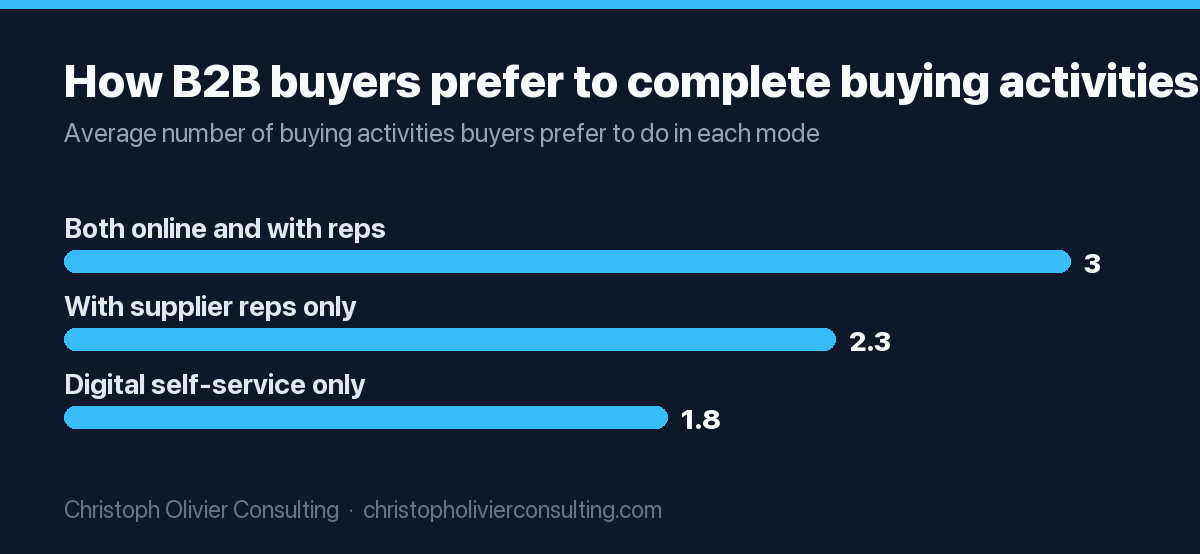
- But they still want a human for fit questions. In the same Gartner study, buyers preferred to complete an average of 3.0 buying activities both online and with reps, 2.3 with reps only and 1.8 through digital self-service. Gartner also reported that 69% of buyers see inconsistencies between a supplier’s website and what its sellers tell them.
- Buying groups are big and deals stall. Forrester’s State of Business Buying 2024 found that 86% of B2B purchases stall during the buying process, 81% of buyers are dissatisfied with the provider they chose, and an average of 13 people inside the organization are involved. Forrester’s 2026 edition, as reported by Digital Commerce 360, puts it at 13 internal stakeholders plus nine external participants, and names generative AI tools as the single most cited meaningful interaction type for researching purchases.
- Big orders are moving online. McKinsey’s ninth annual B2B Pulse Survey of 3,942 decision makers, as covered by Digital Commerce 360, found that 39% of B2B buyers are willing to spend over $500,000 per order through self-service digital commerce or remote connections with a sales rep, up from 28% two years earlier. McKinsey describes a “rule of thirds”: B2B revenue splits roughly evenly between self-service digital, remote rep-led and in-person selling.
The practical takeaway: you need at least one self-serve path (a website that answers real questions, pricing guidance, case material) and at least one human path, and both must tell the same story. For more data points on cycle length, buying groups and quota attainment, see our roundup of B2B sales statistics.
10 channels to increase B2B sales
The ten channels below cover nearly every way a B2B company wins revenue. Four are direct and human-led, one is digital self-serve, three run through other businesses, and two are relationship channels. You do not need all ten. Most growing firms run two or three well rather than eight poorly.
1. Field sales (in-person direct selling)
Account executives meet buyers face to face, run discovery and negotiate. Field sales is the most expensive channel per rep, but it fits large, complex or high-trust deals where the buying group needs to meet the people they will work with. It is common in enterprise software, industrial equipment and high-value professional services.
2. Inside sales
Reps sell by phone, video and email instead of travel. Inside sales costs less per opportunity than field sales and can cover more accounts, which is why it has become the default for mid-market deals. It matches McKinsey’s “remote” third: buyers are comfortable signing significant contracts over video.
3. Account-based selling (ABM)
Sales and marketing pick a defined list of target accounts and coordinate outreach, content and ads to the whole buying group at each one. ABM fits when your total market is small and each account is worth a lot. It is slower to start but suits the 13-person buying groups Forrester describes, because you reach several stakeholders, not one.
4. Outbound prospecting
Cold email, cold calls and LinkedIn messages to people who have not raised their hand. Outbound gives you control over who you talk to and how fast. The risk is relevance: Gartner’s finding that 73% of buyers avoid suppliers who send irrelevant outreach means generic volume can damage your brand. Tight targeting and a specific reason for reaching out matter more than volume.
5. Digital self-serve and B2B ecommerce
Your website, online ordering, pricing pages, configurators, free trials and booking tools. For product companies this can be full ecommerce. For service firms it usually means a site that answers scoping and pricing questions, a self-booking calendar and proof (case studies, sample deliverables). Forrester’s 2026 data shows more than 60% of buyers engage in some form of trial before committing, so a low-risk first step is a channel in its own right.
6. Channel partners and resellers
Resellers, value-added resellers (VARs), distributors and agencies sell your product or service to their customers, usually for a margin or commission. Partners extend reach into segments and regions you cannot cover yourself. In exchange you give up margin and some control over the customer experience. Our guide to channel sales strategy covers how to recruit, enable and pay partners.
7. B2B marketplaces
Platforms where business buyers compare and purchase from many suppliers: general marketplaces for physical goods, cloud marketplaces for software, and directories or freelance platforms for services. Marketplaces bring ready demand but also price comparison, platform fees and limited access to the customer relationship.
8. Events and trade shows
Industry conferences, trade shows, your own roundtables and webinars. Events compress the trust-building that usually takes weeks into a single conversation. They are costly and lumpy, so they work best when you have a clear list of target accounts to meet, not as a hope for random foot traffic. In CMI’s research, 33% of B2B marketers plan to increase investment in events and experiential marketing in 2026.
9. Referrals and referral partners
Introductions from happy clients, and formal referral arrangements with firms that serve the same buyer (an accountant referring to a law firm, an IT provider referring to a cybersecurity consultant). Referred buyers arrive with trust already transferred, so cycles are often shorter. The limit is volume: referrals are hard to scale without a deliberate program.
10. LinkedIn and social selling
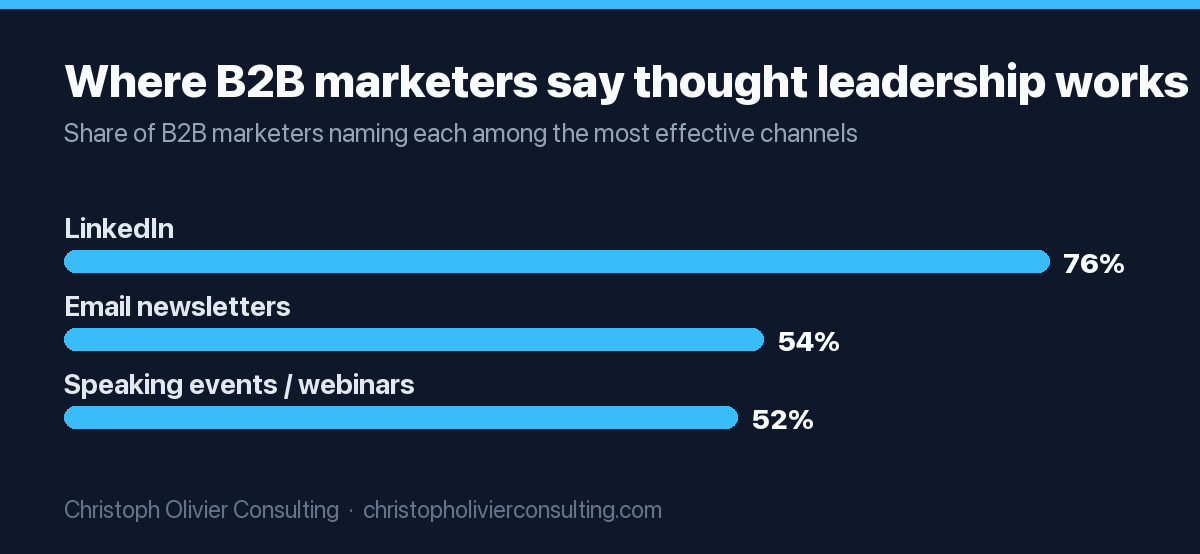
Founders, partners and reps building visibility and conversations on LinkedIn through posts, comments and direct messages. LinkedIn is the main B2B social channel: in the Content Marketing Institute and MarketingProfs B2B trends research for 2026, marketers named LinkedIn (76%) as one of the most effective channels for publishing thought leadership, ahead of email newsletters (54%) and speaking events or webinars (52%). Our LinkedIn marketing for B2B playbook covers the full setup.
B2B sales channels compared: cost, cycle and fit
The right channel depends on three things: how much a deal is worth, how complex the buying decision is, and how much control you need over the customer relationship. The table below compares the ten channels on those dimensions. Ratings are relative, not benchmarks; your own costs and cycle times will vary by market and offer.
| Channel | Relative cost to acquire a customer | Typical sales cycle | Control of customer | Best fit |
|---|---|---|---|---|
| Field sales | Highest | Long | Full | Large, complex, high-trust deals |
| Inside sales | Medium | Short to medium | Full | Mid-market deals, repeatable offers |
| Account-based selling | High | Long | Full | Small list of high-value accounts |
| Outbound prospecting | Medium | Medium | Full | Clear ICP, new market entry |
| Digital self-serve / ecommerce | Lowest at scale | Shortest | Full | Standardized products, entry offers, reorders |
| Channel partners / resellers | Low upfront, paid as margin | Medium (slow to ramp) | Shared | New regions or segments, bundled solutions |
| B2B marketplaces | Low upfront, paid as fees | Short | Limited | Commoditized goods, software listings |
| Events and trade shows | High per event | Medium | Full | Trust-heavy sales, concentrated industries |
| Referrals / referral partners | Low | Short | Full | Professional services, high-trust offers |
| LinkedIn / social selling | Low cash, high time | Medium to long | Full | Founder-led and expertise-led firms |
Two patterns stand out. First, the cheapest channels in cash (referrals, LinkedIn) are often the most expensive in time, usually partner or founder time. Second, partner and marketplace channels shift cost from upfront investment to ongoing margin, which looks cheap early and expensive at scale.
How to choose the right channels to increase B2B sales
Choose channels by working backward from your buyer and your economics, not from what competitors seem to be doing. Start with where your best existing clients came from, check that each candidate channel fits your deal size, then test one new channel at a time with a fixed budget, a fixed window and a clear success metric.
- Map your current revenue by source. Pull the last 12 to 24 months of closed deals and tag each one with its original source (referral, outbound, website, partner, event). Most firms find one or two channels produce most of the revenue. That is your base.
- Define the buyer and the buying group. Who signs, who influences, who blocks? A single owner-buyer suits referrals and LinkedIn. A 13-person group with procurement involved suits account-based selling and strong self-serve content that champions can forward internally.
- Match channel cost to deal value. A field rep cannot pay for itself on small deals, and a marketplace listing rarely closes a six-figure consulting engagement. Estimate what you can afford to spend to win one client (a share of first-year gross profit is a common starting point) and rule out channels that clearly cost more.
- Check your capacity to run the channel. Partners need enablement and someone to manage them. LinkedIn needs a person who will post consistently. Outbound needs list building, copy and follow-up. A channel you cannot staff will underperform no matter how good it looks on paper.
- Run one test at a time. Give a new channel a defined budget, a 90-day window and a leading indicator (meetings booked, qualified opportunities) plus a lagging one (revenue closed). Running four new channels at once makes it hard to tell what worked.
- Scale, fix or cut. At the end of the window, scale what is producing qualified pipeline at acceptable cost, fix what is close, and cut what is not working. Then pick the next channel to test.
How to sequence B2B channels as you grow
Most B2B firms add channels in a predictable order: relationship channels first, then direct outreach, then scalable digital and partner channels. The order follows cash and proof. Early on you have more time than money and few case studies; later you have budget, proof and processes that other people can run.
| Stage | Primary channels | What to build before moving on |
|---|---|---|
| Founder-led (early revenue) | Referrals, personal network, LinkedIn | A clear ideal client profile and 3 to 5 documented case studies |
| First sales hires | Outbound, inside sales, website self-serve path | A written sales process, CRM discipline, consistent messaging across site and reps |
| Scaling | Account-based selling, events, referral partners | Target account list, marketing and sales agreement on qualification |
| Expansion | Channel partners, marketplaces, new regions | Partner terms, enablement materials, channel conflict rules |
Worked example: a channel plan for a 7-figure professional services firm
Here is an illustrative plan for a hypothetical accounting and advisory firm with about $3 million in revenue that wants to add new business without hiring a large sales team. The numbers are planning assumptions to show the method, not results from a real client.
Starting point. A review of closed work shows most new clients came from client referrals and partner introductions, a small share from the website, and almost none from outbound. Average first-year engagement value is around $25,000. The firm has two partners willing to spend a few hours a week on business development.
Plan for the next two quarters:
- Keep and formalize referrals. Ask every satisfied client at a natural milestone (year-end close, completed project) and track introductions in the CRM. Build three referral partnerships with firms serving the same owners, such as a law firm and a wealth manager.
- Add LinkedIn for both partners. Two expertise posts per week each, plus thoughtful comments on target owners’ posts. The goal is recognition when a referral or outreach lands.
- Fix the self-serve path. Add a services page with price ranges, a short scoping questionnaire and a self-booking link, so buyers who prefer a rep-free start can qualify themselves.
- Test small outbound. One 90-day test: 150 hand-picked companies in one industry, each contacted with a specific, relevant reason (a regulatory change, a growth signal). Success metric: 10 qualified first meetings.
What not to do yet. No trade show budget, no reseller program, no paid marketplace listing. Those channels need more case studies and process maturity first. At the 90-day review, the firm scales whichever test produced qualified meetings and holds the rest.
B2B sales strategies to increase sales within each channel
Adding channels is only half the job. You can often increase B2B sales faster by improving conversion inside the channels you already run. The strategies below apply across channels and target the stall points that Forrester and Gartner research highlights: inconsistent messaging, large buying groups and irrelevant outreach.
- Make the website and the sales team say the same thing. With 69% of buyers reporting gaps between website and seller information in Gartner’s study, aligning pricing guidance, scope and proof across both is a direct conversion fix.
- Arm the champion. Give your main contact material they can share internally: a one-page business case, a comparison of options, answers to finance and procurement questions. Large buying groups decide in meetings you are not in.
- Offer a low-risk first step. A paid diagnostic, a pilot or a trial lets buyers test fit before a full commitment, which matches how many buyers already behave.
- Personalize outreach with a reason. Every outbound message should answer “why this company, why now.” Fewer, better messages tend to outperform volume.
- Shorten the time to first response. Inbound leads from your site or referrals should get a reply the same business day. Slow follow-up wastes the cheapest leads you have. A documented B2B sales process keeps the handoff from every channel consistent.
For the demand side of this work, including content, paid and outbound programs, see our guide to B2B lead generation strategies.
Metrics to track for each B2B sales channel
Track every channel on the same small set of numbers so you can compare them fairly: pipeline created, win rate, sales cycle length, average deal size and cost to acquire a customer. Add one leading indicator per channel so you can judge a new channel in weeks rather than waiting months for closed revenue.
| Channel | Leading indicator | Lagging indicators |
|---|---|---|
| Outbound | Positive reply rate, meetings booked | Opportunities created, win rate |
| Inside / field sales | Qualified opportunities per rep | Win rate, cycle length, deal size |
| Account-based selling | Engaged stakeholders per target account | Pipeline and revenue from target list |
| Digital self-serve | Booked calls or orders per visitor | Revenue per visitor, repeat purchase |
| Partners / resellers | Active partners, partner-sourced opportunities | Partner revenue, margin after commissions |
| Marketplaces | Listing views, inquiries | Revenue net of fees |
| Events | Target-account meetings held | Pipeline within 90 days, cost per opportunity |
| Referrals | Introductions received per month | Referral win rate, cycle length |
| Conversations started with ICP buyers | Meetings and opportunities attributed |
Attribution in B2B is messy because buyers touch several channels. A simple fix is to record both the first source and the source that produced the meeting in your CRM, and to ask every new client how they first heard of you.
Common mistakes when adding B2B sales channels
The most common mistake is spreading effort across too many channels before any of them is predictable. Others include picking channels that do not fit the deal size, ignoring channel conflict with partners, and judging new channels on revenue too early, before the sales cycle has had time to run.
- Launching partners without enablement. Partners sell what is easy to sell. Without training, materials and clear terms, they will default to whatever they already know.
- Letting channels compete for the same client. Decide in advance who owns an account when a partner and your direct team both reach it.
- Treating outbound as a volume game. Irrelevant outreach can push buyers away from your brand, not just fail to convert.
- No owner. Every channel needs one named person accountable for its numbers.
In my experience, the firms that grow steadily are rarely the ones with the most channels. They are the ones that know exactly which two channels pay, and why. If you want a second opinion on which channels fit your firm and in what order, you can book a consultation and we can map it out together.
Frequently asked questions
What are the best channels to increase B2B sales?
There is no single best channel. For high-value, complex deals, account-based selling, field or inside sales and referrals usually perform well. For standardized offers, digital self-serve and marketplaces scale better. Most firms do best by mastering the one or two channels their best clients already come from, then testing one new channel at a time.
What is the difference between B2B sales channels and B2B marketing channels?
Marketing channels such as SEO, paid ads, email and content create demand and generate leads. Sales channels are the routes that turn that demand into signed contracts, such as direct reps, your website, partners or marketplaces. Some channels, including LinkedIn, events and outbound, do both jobs, which is why they appear on lists of each.
How many B2B sales channels should a company use?
Most small and mid-sized B2B firms should run two or three channels well rather than many channels poorly. Add a new channel only when your current ones are measurable and someone owns the new one. Buyers still move between digital and human contact, so you need at least one self-serve path and one human path.
What is B2B channel marketing?
B2B channel marketing is the work of selling through partners such as resellers, distributors, agencies and referral partners, rather than only through your own team. It includes recruiting partners, giving them training and co-marketing materials, setting margins or commissions, and managing conflicts between partner and direct sales.
Do B2B buyers still want to talk to salespeople?
Yes, but later and for specific reasons. Gartner found 61% of B2B buyers prefer an overall rep-free buying experience, yet buyers still want seller input on questions about fit for their company. The practical answer is to let buyers self-educate online, then make it easy to reach a knowledgeable person when they are ready.
How do you measure which B2B sales channel works best?
Track each channel on the same core numbers: pipeline created, win rate, sales cycle length, average deal size and cost to acquire a customer. Add one leading indicator per channel, such as meetings booked or introductions received, so you can judge a new channel within weeks. Record both first source and meeting source in your CRM.
More Sales Process & CRM guides
- B2B Sales Process: First Touch to Close
- Challenger Sale Method: Still Relevant in 2026?
- What Is B2B Sales? Modern Definition
- Sales Forecasting Methods & Models
- Sales Approach: The 4 Core Styles and How to Pick Yours
- Sales Forms Every Service Business Needs (And What Goes in Each)
- All Sales Process & CRM guides →