
Last reviewed: October 2026
The Starbucks marketing plan in 2026 rests on four pillars: a premium “third place” coffeehouse experience, a loyalty program and app with 35.8 million 90-day active US members, seasonal rituals like the Pumpkin Spice Latte, and cultural moments that get people talking. Under CEO Brian Niccol’s “Back to Starbucks” strategy, the company moved money out of discounting and into brand building, with advertising expense reaching $869.5 million in fiscal 2025.
This page breaks down the Starbucks marketing strategy as it runs today, using Starbucks’ own filings and earnings calls: positioning, marketing mix, loyalty, campaigns, budget, a plan template, and lessons a service firm can use.
The Starbucks marketing plan at a glance
A Starbucks marketing plan has one job: turn coffee into a daily ritual people will pay a premium for. It does that through brand experience (the coffeehouse), retention (Starbucks Rewards and the app), demand spikes (seasonal launches), and relevance (cultural moments and merch). Each layer feeds the next, which Starbucks itself calls its “brand flywheel.”
Starbucks reported $37.2 billion in net revenue for fiscal 2025 and 40,990 stores at year end, 21,514 company-operated and 19,476 licensed. North America accounted for about 74% of revenue.
| Pillar | What Starbucks does | Reported evidence (2025 to 2026) | Metric that matters |
|---|---|---|---|
| Positioning | The “third place” coffeehouse, premium coffee, handcrafted drinks | More than 1,000 coffeehouse uplifts completed in North America by Q3 fiscal 2026 | Transactions, brand affinity |
| Loyalty and app | Starbucks Rewards with Green, Gold and Reserve tiers, Mobile Order and Pay | 35.8 million 90-day active US members in Q3 fiscal 2026 | Visit frequency, active members |
| Seasonal campaigns | Pumpkin Spice Latte, holiday cups, summer limited-time drinks | S’mores lineup tracking as the strongest summer coffee LTO in several years | Reactivation of lapsed customers |
| Culture and social | Festival tie-ins, merch drops, viral products | Brand affinity, consideration and purchase intent at five-year highs | Earned attention, consideration |
| Service as marketing | Green Apron Service standard in every US company-operated coffeehouse | More than 80% of US company-operated coffeehouses averaging four minutes or less for cafe service | Speed, consistency |
| Paid media | Brand advertising funded as a share of sales | Roughly 2% of sales, per Niccol; $869.5 million in fiscal 2025 | Return on spend, not budget size |
Sources for the table: Starbucks’ fiscal 2025 Form 10-K, the Q4 fiscal 2025 earnings call and the Q3 fiscal 2026 earnings call.
Positioning: the third place and premium pricing
Starbucks positions itself as the “third place”: a warm, welcoming spot between home and work where the coffee is handcrafted and the experience justifies a premium price. It does not try to be the cheapest. It competes on ritual, consistency and connection, which is why store design and service speed are marketing decisions at Starbucks, not just operations.
Niccol put it directly on the July 2026 earnings call: “That’s the magic of the third place. It’s a human need only we can fulfill and a community only Starbucks can create.” The company is spending to make the stores match that line. Its coffeehouse “uplifts” add back “warmth, texture, and great seats at a fraction of the cost of earlier remodels.” Starbucks passed 1,000 uplifts in Q3 fiscal 2026 and now aims for at least 1,500 by the end of fiscal 2026.
Positioning is also enforced by what you remove. The fiscal 2025 10-K says Starbucks closed coffeehouses without “a viable path to offering the physical environment consistent with the brand,” including 627 company-operated stores in the fourth quarter of fiscal 2025.
Why premium pricing still works
Premium pricing only holds if the experience earns it. In Q3 fiscal 2026, US comparable sales rose 7.9%, with comparable transactions up 4.2% and average ticket up 3.6%, according to the quarterly earnings release. On the call, management said pricing contributed less than a point of ticket growth. Growth came mainly from more visits, not higher prices. If you are working out your own position, the same principle sits at the center of brand strategy for a small business: pick the experience you want to be known for and make every touchpoint prove it.
Starbucks marketing mix: the 4Ps in 2026
The Starbucks marketing mix pairs a beverage-led product line with premium pricing, a dense network of company-operated and licensed locations plus mobile ordering, and promotion built on loyalty, seasonal launches and culture rather than heavy discounting. Beverages made up 73% of company-operated store sales in fiscal 2025, so the drink menu carries the brand.
| P | How Starbucks runs it | Data point | What changed under Back to Starbucks |
|---|---|---|---|
| Product | Handcrafted beverages, food, merchandise, packaged coffee; brands include Teavana, Ethos and Starbucks Reserve | Company-operated retail mix in fiscal 2025: 73% beverages, 23% food, 4% other | Innovation tied to daily rituals: protein cold foam and protein lattes, Refreshers, matcha, sparkling beverage tests |
| Price | Premium pricing backed by experience; value delivered through Rewards perks | Pricing added less than a point to ticket growth in Q3 fiscal 2026 | Removed the extra charge for nondairy milk; added a 60-Star, $2-off redemption |
| Place | Coffeehouses, drive-thrus, Mobile Order and Pay, delivery, and grocery through the Global Coffee Alliance with Nestlé | 41,304 stores at the end of Q3 fiscal 2026 | Coffeehouse uplifts, scheduled pickup ordering in the app, China moved to a licensed joint venture |
| Promotion | Starbucks Rewards, seasonal launches, cultural partnerships, merch, paid media | Advertising expense of $869.5 million in fiscal 2025 | Budget shifted from discounting toward brand marketing; loyalty rebuilt around recognition |
Sources: Starbucks fiscal 2025 10-K, Q3 fiscal 2026 earnings release, Q1 fiscal 2025 earnings release.
Product is also how Starbucks recruits its next generation of regulars. On its April 2026 call, the company said protein and new flavors had strengthened the appeal of cold foam, “especially among Gen Z.”
Starbucks Rewards and the app: the loyalty engine
Starbucks Rewards is the core of the Starbucks marketing strategy because it turns visits into a habit and gives the company a direct channel to every member. In the US it had 35.8 million 90-day active members in the third quarter of fiscal 2026, up both quarter over quarter and year over year, according to the company’s earnings call.
The mechanics are simple, which is part of the point. Per the 10-K, customers who register a Starbucks Card are automatically enrolled in what the company calls “primarily a spend-based loyalty program.” Members earn Stars on purchases, including when they pay with cash, cards or mobile wallets, and the Mobile Order and Pay feature lets them order ahead.
| Quarter | 90-day active US Rewards members | Company commentary |
|---|---|---|
| Q1 fiscal 2025 (Dec 2024) | 34.6 million | Up 1% year over year, 2% quarter over quarter |
| Q4 fiscal 2025 (Sep 2025) | 34.2 million | Up 1% quarter over quarter and year over year |
| Q2 fiscal 2026 (Mar 2026) | 35.6 million | Record level, up 4% year over year |
| Q3 fiscal 2026 (Jun 2026) | 35.8 million | Members “leveling up from green to gold and gold to reserve” |
Sources: Q1 fiscal 2025 release, Q4 fiscal 2025 call, Q2 fiscal 2026 call, Q3 fiscal 2026 call.
Notice what the table does not show: explosive growth. The value comes from what Starbucks does with members once they are in: early access, personalized offers and frequency incentives. If you want the wider benchmark data behind loyalty programs, our roundup of customer loyalty statistics collects it in one place.
The 2026 Rewards redesign: personalization over discounts
On March 10, 2026, Starbucks relaunched Rewards with three status tiers, Green, Gold and Reserve, plus a cheaper 60-Star redemption and perks like Free Mod Mondays. The goal was to reward frequency and recognition instead of training members to wait for coupons, a shift Niccol described plainly on the April 2026 earnings call.
According to Nation’s Restaurant News, the tiers work like this:
- Green (under 500 Stars a year): one Star per dollar, a birthday drink, personalized offers, games, and Free Mod Mondays, a monthly free drink modification.
- Gold (500 to 2,500 Stars a year): faster earning, Stars that never expire, a week-long birthday window, and at least four extra Double Star days.
- Reserve (2,500+ Stars a year): more Double Star days, exclusive merchandise, and invitations to experiences such as trips to coffee destinations.
- All tiers: a new 60-Star redemption worth $2 off. Green members’ Stars expire after six months without activity.
The strategic logic came straight from the CEO. On the Q2 fiscal 2026 call, Niccol said “you don’t have to make your Rewards program a coupon book, which is where I felt like we were when I first got here, and we had to stop doing all that discounting. This needed to be about engagement, this needed to be about personalization, and this needed to be about recognition.” Six months earlier, management had said the “intentional shift away from last year’s discounting strategies drove a healthier mix of non-discounted transactions.”
Early signals were positive by the company’s own account. The 60-Star option became the most used reward, at roughly a third of all redemptions. On the July 2026 call, Niccol said one in three members who tried a new modification through Free Mod Mondays reordered it. A free add-on is a cheap way to start a new habit.
Starbucks marketing campaigns: seasonal rituals that return every year
Starbucks’ best-known marketing campaigns are not one-off ads. They are recurring rituals: the Pumpkin Spice Latte each fall, the holiday cups and Peppermint Mocha each winter, and limited-time summer drinks. Because customers expect them, each launch reactivates lapsed buyers and gives fans something to share without Starbucks paying for every impression.
Pumpkin Spice Latte
The PSL started development in 2003, was tested in Vancouver and Washington, D.C. late that year, and rolled out to all US stores in 2004, per its documented history. On the Q4 fiscal 2025 call, management said growth in 90-day active members was “led by higher reengagement and fueled by customers returning for their seasonal favorites.” A seasonal anchor gives you a reason to contact every lapsed customer at the same time each year.
Holiday cups and red cups
Starbucks introduced holiday-themed cups in 1997, and they were predominantly red for the first time in 1999. The cup itself became media: the plain 2015 design set off a national argument and a counter-hashtag, #ItsJustACup. In 2022, Red Cup Day tied the ritual to a waste-reduction goal with free reusable cups. If you are planning a seasonal push of your own, our list of Christmas marketing campaign ideas adapts this playbook to smaller budgets.
Summer and limited-time launches
Summer is now a third tentpole. In Q3 fiscal 2026, Starbucks gave Rewards members early access to its S’mores coffee lineup, which management said was “tracking as our strongest summer coffee LTO launch in the past several years” and resonating with Gen Z. The company also brought back the Unicorn Frappuccino. Early access makes membership feel like an inside track. For more examples of launches built this way, see our breakdown of innovative marketing campaigns.
Culture, social media and merch: earning attention
Starbucks treats social media and culture as a way to earn attention instead of only buying it. In July 2026, Niccol credited the marketing team with “putting us back in front of culture,” citing Coachella, soccer captain cup sleeves, a Miffy merch drop and the viral Pink Bearistas. The test: do people talk about it?
The April 2026 call listed “cultural moments like Coachella, global stages like the Winter Olympics, or tech platforms like ChatGPT” as places the brand showed up. By Q3 fiscal 2026, the company reported brand affinity, consideration and purchase intent “all at five-year highs.” Three patterns stand out:
- Merch as media. Collectible drops create lines and social posts that cost far less than equivalent paid reach.
- Customer-made content. Seasonal cups and colorful limited drinks are designed to be photographed. The product is the post.
- In-store media. Niccol said digital menu boards would be in roughly 80% to 90% of stores by September 2026, and the team is dayparting them to sell afternoon drinks.
In my view, this is the same reason the most famous ads endure: they stop being advertising and become something people reference on their own.
Back to Starbucks: how the marketing plan changed under Brian Niccol
Back to Starbucks is the turnaround strategy announced in late 2024 after Brian Niccol became CEO. The company’s 10-K says it supports baristas, improves the customer experience, reestablishes Starbucks as the community coffeehouse, and strengthens the brand “through product development, marketing, in-store and digital experience.” In practice, money moved from discounts to brand.
The sequence, from Starbucks’ filings and calls:
- Q4 fiscal 2024: the strategy is announced, per the 10-K.
- Q1 fiscal 2025: Starbucks removes the extra charge for nondairy milk and invests in partner wages, benefits and hours, per the Q1 release.
- August 2025: Green Apron Service goes live across the full US company-operated portfolio, per the Q4 fiscal 2025 call. Around the same period, the condiment bar comes back as part of the value push.
- Q4 fiscal 2025: global comparable sales rise 1%, the first increase in seven quarters, per the Q4 results release. Underperforming coffeehouses close.
- March 10, 2026: the redesigned Starbucks Rewards launches.
- Q3 fiscal 2026: global comparable sales rise 7.9%, more than 1,000 uplifts are complete, and full-year guidance is raised.
The budget behind it
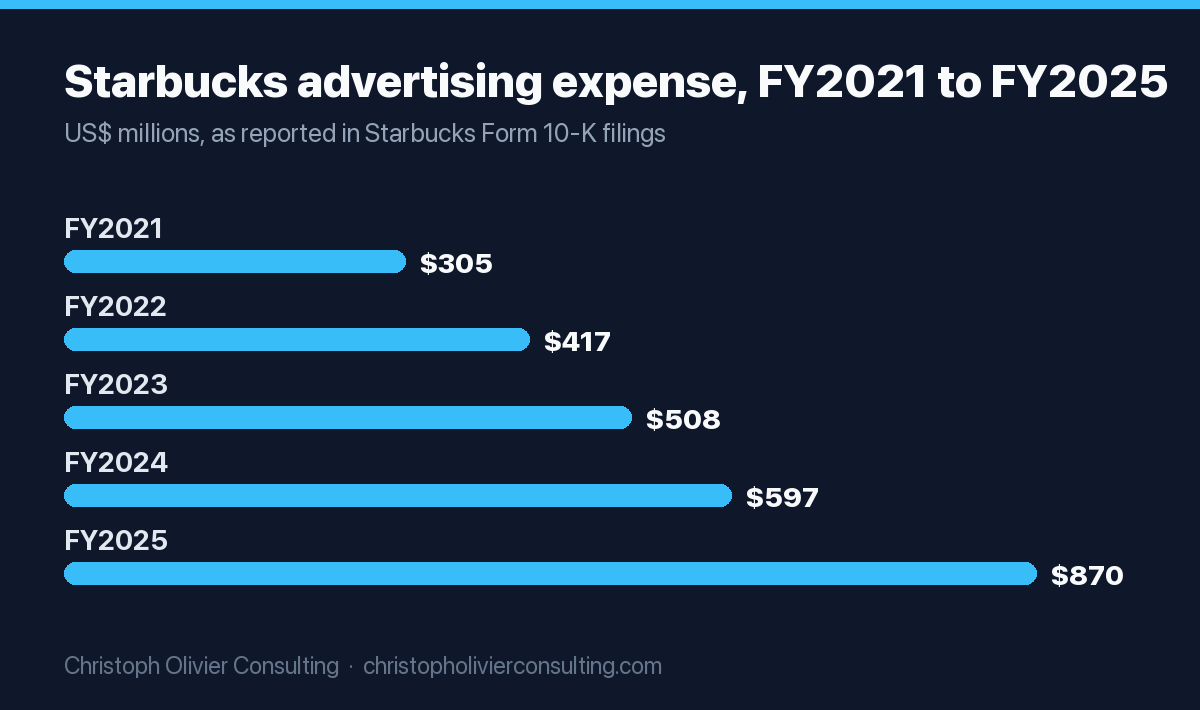
Advertising expense, as disclosed in Starbucks’ 10-K filings, rose from $305.1 million in fiscal 2021 to $869.5 million in fiscal 2025. By my calculation from the same filings, that is about 2.3% of fiscal 2025 revenue, up from 1.7% in fiscal 2024 and 1.4% in fiscal 2023. Niccol’s own framing on the July 2026 call: “we spend a little bit more than 2% of sales on marketing,” adding that “we’re not capping that spending” and are “not seeing diminishing returns.”
One honest caveat: the turnaround is not all marketing. Niccol said about half, or a little less, of the 7.9% Q3 comp came from closures, sales transfer and delivery growth. The rest came from store performance, menu and innovation.
How to write a marketing plan like Starbucks: a template
You can borrow the structure of the Starbucks marketing plan without its budget. Start with one clear position, define the ritual you want customers to repeat, build a retention system that rewards frequency, plan a seasonal calendar, then measure visits and repeat rate before revenue. The template below works for a firm of five people or five hundred.
- Position. One sentence on the experience you will be known for. Starbucks: the third place.
- Ritual. Name the repeat behavior you want: a daily coffee, or for a service firm, a quarterly review.
- Service standard. Turn the promise into a measurable standard, the way Starbucks tracks cafe service time. Pick one number your clients would notice.
- Retention system. Decide how you recognize your best clients without discounting: priority access, a named contact, early invitations.
- Seasonal calendar. Own two or three moments a year your market already cares about, in the same format every year.
- Cultural and content moments. One shareable piece a quarter: original data, an event, or a tool.
- Budget rule. Set marketing as a share of revenue and protect it when it works.
- Scorecard. Track active clients, repeat rate and referral rate alongside new leads.
Worked example: a 12-person accounting firm
This is an illustrative example, not a client case.
| Starbucks element | Accounting firm version | What to measure |
|---|---|---|
| Third place positioning | “Proactive tax planning, not just filing” | Share of clients on a planning engagement |
| Green Apron Service time standard | Every client email answered within one business day | Median response time |
| Rewards tiers | Clients with three or more years get a priority planning slot in October | Retention by client tenure |
| Pumpkin Spice Latte season | An annual year-end planning checklist sent the same week every November | Meetings booked from the send |
| Uplifts and closures | Retire low-margin services that blur the position | Revenue per client |
What a service business can steal from Starbucks
The most useful lessons from the Starbucks marketing strategy are not about coffee. They are about treating service as marketing, rewarding loyalty with recognition instead of discounts, owning a recurring season, and cutting anything that dilutes the position. A professional-service firm can apply all four with a small team and a modest budget.
- Make the experience the ad. Starbucks put service standards at the center of its turnaround. For a firm, onboarding and response time are your most persuasive marketing.
- Stop training clients to wait for a deal. Discounts can bring short-term volume but often teach buyers to wait.
- Own a season. A predictable annual moment can compound in a way scattered campaigns often do not.
- Measure brand health, not only leads. Starbucks tracks affinity and purchase intent. A firm can survey clients on likelihood to refer twice a year.
- Remove what does not fit. Retiring off-brand services can sharpen your position the way store closures sharpened Starbucks’.
What not to copy: honest caveats
Not everything in the Starbucks marketing plan transfers. Its results depend on 40,000-plus locations, a proprietary app, a large data team and an advertising budget approaching $900 million. Copy the principles, not the scale, and be careful with any analysis that skips the recent changes or treats the old discount-heavy approach as the model.
- Scale effects. A small firm needs perks that cost time, not cash, such as priority access.
- Attribution is murky. Starbucks does not publish return on spend by campaign.
- Discount hangovers are real. If you have trained clients to expect deals, plan for a transition period.
- Rituals take years. The PSL has been building since 2004.
I think the real takeaway is discipline: one position, enforced by service, rewarded through loyalty, and refreshed by a predictable calendar. If you want help turning that into a plan for your firm, you can book a consultation and we can map it to your market and budget.
Frequently asked questions
What is Starbucks' marketing strategy?
Starbucks markets a premium coffeehouse experience, the "third place," and turns it into a daily habit through Starbucks Rewards and its app, recurring seasonal launches like the Pumpkin Spice Latte, and cultural moments such as merch drops and festival tie-ins. Since 2024 its Back to Starbucks plan has shifted spending away from discounts and toward service, store upgrades and brand marketing.
What is the Starbucks marketing mix (4Ps)?
Product: handcrafted beverages (73% of company-operated store sales in fiscal 2025), food and merchandise. Price: premium, with value delivered through Rewards perks rather than broad discounts. Place: about 41,000 company-operated and licensed stores, Mobile Order and Pay, delivery and grocery through Nestle. Promotion: loyalty, seasonal campaigns, culture and paid media.
How much does Starbucks spend on advertising?
Starbucks reported advertising expense of $869.5 million in fiscal 2025, up from $597.3 million in fiscal 2024 and $507.8 million in fiscal 2023, according to its Form 10-K. That is roughly 2.3% of fiscal 2025 revenue. CEO Brian Niccol said in July 2026 that the company spends a little more than 2% of sales on marketing.
How many Starbucks Rewards members are there?
Starbucks reported 35.8 million 90-day active Starbucks Rewards members in the US in the third quarter of fiscal 2026, up both quarter over quarter and year over year. The program was redesigned on March 10, 2026 with Green, Gold and Reserve tiers, a 60-Star redemption worth $2 off, and perks such as Free Mod Mondays.
What is the Back to Starbucks strategy?
Back to Starbucks is the turnaround plan announced in late 2024 after Brian Niccol became CEO. It focuses on supporting baristas, faster and more personal service (Green Apron Service), reestablishing Starbucks as the community coffeehouse, and strengthening the brand through product, marketing and digital experience. It also meant less discounting and closing stores that could not meet the brand standard.
Who is Starbucks' target market?
Starbucks targets customers willing to pay a premium for quality coffee and a consistent experience, from morning commuters to afternoon visitors. In 2026 the company said sales growth was broad-based across generations and income groups, and it has used cold foam, protein drinks and seasonal launches like its S'mores lineup to attract Gen Z customers.
What are Starbucks' most famous marketing campaigns?
Its best-known campaigns are recurring rituals rather than single ads: the Pumpkin Spice Latte, which rolled out nationally in 2004; the holiday cups, introduced in 1997 and predominantly red since 1999; and limited-time drinks such as the Unicorn Frappuccino. Starbucks Rewards early access and collectible merch drops now extend these campaigns.
More Growth Consulting guides
- Gym Marketing: Win on Retention Economics, Not Just New Members
- How Digital Marketing Grows a Business: The Engine, the ROI, and What to Expect
- Call to Action Examples That Convert (With Before and After Rewrites)
- Auto Repair Shop Marketing: The Cost-Per-Customer and LTV Math That Sets Your Priorities
- How to Generate More Leads: 12 Tactics That Actually Work
- Med Spa Marketing: How to Attract and Keep Clients in 2026
- All Growth Consulting guides →