
Last reviewed: October 2026
The best SMS marketing platforms for most small and mid-sized businesses in 2026 are SimpleTexting, EZ Texting, SlickText and Textedly for straightforward texting, Klaviyo, Omnisend, Postscript and Attentive for ecommerce, and Twilio or HighLevel when you want texting built into your own systems or CRM. Entry plans run from about $25 to $39 a month for roughly 500 messages, but carrier fees and 10DLC registration add to every bill.
This guide compares 10 platforms using prices taken directly from each vendor’s pricing page in October 2026, then covers what most roundups skip: what a text really costs per segment, the carrier registration step that blocks unregistered senders, the consent rules in federal law, and a worked cost example for a service business.
Need the funnel and follow-up built for you? CO Consulting designs and builds funnels and email automations focused on one thing: conversion.
SMS marketing platforms compared: prices and best fit (October 2026)
SMS marketing platforms fall into three groups: all-in-one texting apps for small businesses, ecommerce suites that bundle SMS with email, and developer or CRM tools billed per message. The table below lists each platform’s verified starting price, what that price includes, and the type of business it suits best.
| Platform | Best for | Starting price (vendor page, Oct 2026) | What the entry price includes | Trial or free tier |
|---|---|---|---|---|
| SimpleTexting | Small service businesses | $29/mo for credits plus $10/mo local number (shown as $39/mo) | 500 credits, unlimited contacts, 3 users | Free trial, no card |
| EZ Texting | Small teams, simple campaigns | $25/mo monthly ($20/mo billed yearly) | 500 credits; $5/mo telecom fee on this tier | 14 days, no card |
| SlickText | List growth, keyword campaigns | $29/mo | 500 credits, rollover credits, free incoming texts | 14 days, no card |
| Textedly | Lowest-friction start | $29/mo (Basic) | 500 messages; all plans share the same features | Free plan: 50 texts, 1 keyword |
| Klaviyo | Shopify and DTC brands | $15/mo SMS plan | Up to 1,250 SMS/MMS credits, carrier fees included | Free: 150 SMS/MMS credits |
| Omnisend | Shopify and WooCommerce stores | Paid plans from $11.20/mo; SMS billed per message | US SMS from $0.009 down to $0.007 each by volume | Free plan (email) |
| Postscript | Shopify SMS revenue | $0/mo Starter with $49 monthly minimum spend | $0.009 per SMS plus carrier fees | $100 credit for first 30 days |
| Attentive | Large ecommerce programs | Custom pricing (quote only) | Priced on list size, volume and channels | Demo |
| Twilio | Developers, custom builds | $0.0083 per SMS segment plus carrier fees | Pay as you go; local number $1.15/mo | No plan fee |
| HighLevel (LeadConnector) | Agencies and CRM-first service firms | $97/mo Starter, plus usage | CRM, funnels, workflows; US SMS $0.00747 per segment | 14 days |
Sources: SimpleTexting pricing, EZ Texting pricing, SlickText pricing, Textedly pricing, Klaviyo on the Shopify App Store, Omnisend pricing, Postscript pricing, Attentive pricing, Twilio US SMS pricing, HighLevel pricing and the LC Phone pricing guide. Vendors change prices often, so confirm on the pricing page before you sign.
The best SMS marketing software, reviewed
The best SMS marketing software is the one that matches your business model. Service businesses usually need two-way texting, reminders and a shared inbox. Online stores need cart and browse triggers tied to their shop. Firms already running a CRM often do better adding texting there than buying a separate tool. Here is how each option fits.
SimpleTexting
SimpleTexting is a polished general-purpose texting app. Every plan includes unlimited contacts, two-way messaging with free incoming texts, drip campaigns, an AI message writer, API access and 3 user seats. The entry tier is $29 a month for 500 credits, and the pricing page adds a $10 monthly local number, so the estimate it shows is $39 a month. Extra credits cost 5.5 cents each and an MMS uses 3 credits.
EZ Texting
EZ Texting’s Launch plan is $25 a month billed monthly or $20 a month billed yearly, with 500 monthly credits and a $5 monthly telecom fee that is waived on higher tiers. Boost ($75 a month) and Scale ($125 a month) lower the overage rate from 4 cents to 3.5 and 3 cents a credit. It suits teams that want a shared inbox and simple campaigns.
SlickText
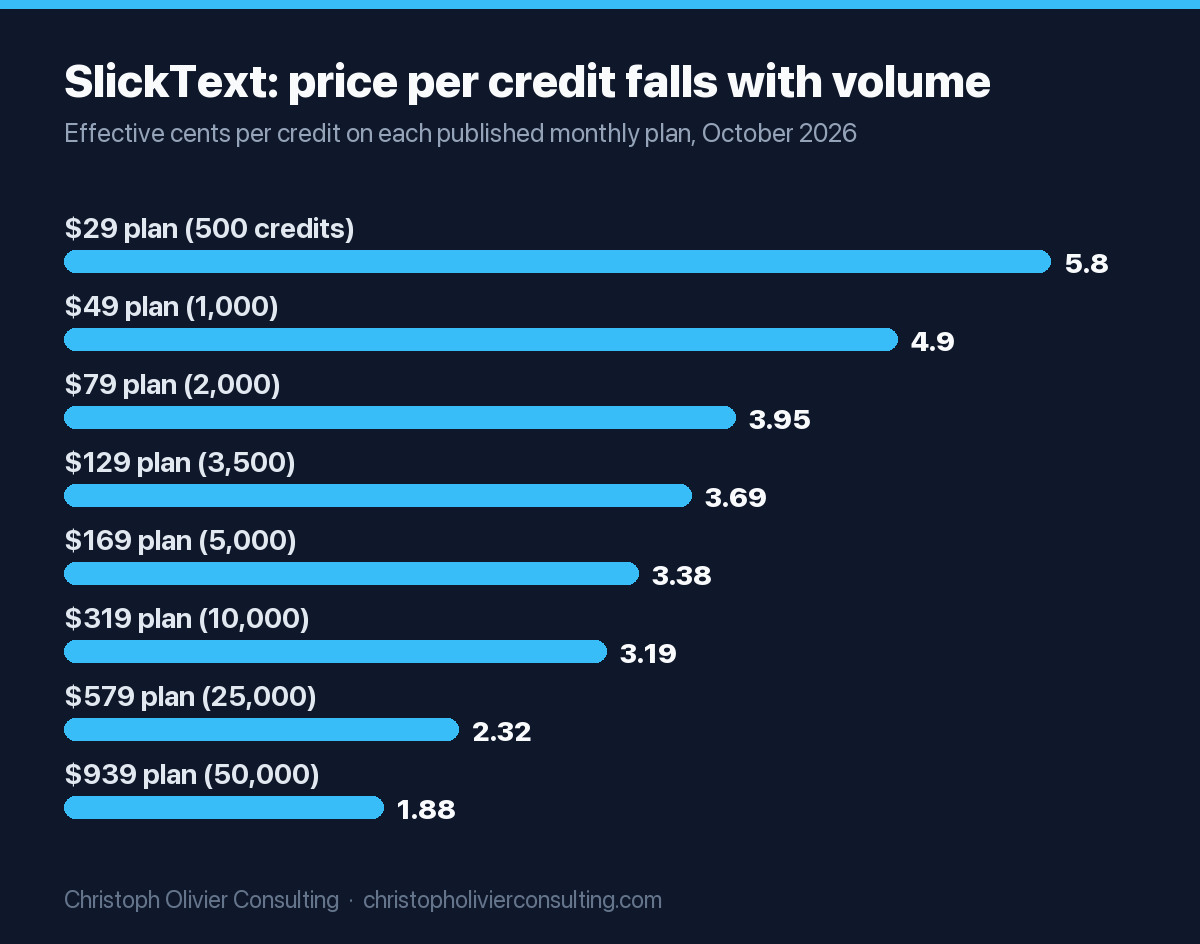
SlickText has nine published tiers, from $29 a month for 500 credits to $939 a month for 50,000. All plans include free incoming texts, unlimited contacts, rollover credits and live support, and yearly billing gives 2 months free. It is strong on keyword and list-growth campaigns, which makes it a good fit for retail, restaurants and events.
Textedly
Textedly prices 14 tiers purely on volume, from Basic at $29 a month for 500 messages up to 300,000 messages a month. Every plan has the same features. A free plan with 50 texts and one keyword lets you test before paying, and the first 10DLC registration is included.
Klaviyo
Klaviyo is the default choice for many Shopify brands because SMS runs on the same customer profiles as email. Its Shopify App Store listing shows a free tier with 150 SMS/MMS credits and an SMS plan at $15 a month for up to 1,250 credits, with carrier fees included. If email is your main channel, compare it against the options in our guide to the best email marketing software.
Omnisend
Omnisend bundles email, SMS and web push for ecommerce stores. Paid plans start at $11.20 a month, and SMS is billed per message: US rates step down from $0.009 to $0.007 a text as monthly spend rises.
Postscript
Postscript is SMS-first for Shopify. The Starter plan has no platform fee but a $49 monthly minimum spend, with SMS at $0.009 and MMS at $0.045 plus carrier fees. Growth ($100 a month) and Professional ($500 a month) lower the per-message rate. New accounts get $100 to use in the first 30 days.
Attentive
Attentive targets larger ecommerce programs and publishes no prices. Its pricing page says cost depends on list size, message volume, channels and AI tools, and you get a quote after a demo.
Twilio
Twilio is infrastructure, not a marketing app. You pay $0.0083 per outbound SMS segment plus carrier pass-through fees, and a local number is $1.15 a month. You, or a developer, build the opt-in, scheduling and reporting.
HighLevel (LeadConnector)
HighLevel is a CRM and automation suite with texting built in through LC Phone. Plans start at $97 a month, and US SMS runs $0.00747 per segment, a 10% discount on the $0.0083 list price. For a service business that also needs pipelines, booking and funnel automations, one system can replace three tools.
What text message marketing platforms really cost
Text message marketing platforms bill in credits or segments, not messages. A standard text is one segment of up to 160 characters, but an emoji switches the message to Unicode and the limit drops to 70 characters. On top of the plan price you pay carrier fees, a phone number and 10DLC registration fees.
HighLevel’s guide to calculating SMS costs shows one message going from 1 segment to 4 after emojis were added. Most texting apps also charge an MMS (picture message) as 3 credits. So a “500 credit” plan can cover far fewer than 500 sends if your copy is long or decorated.
| Cost line | What it is | Example figure (source) |
|---|---|---|
| Platform plan | Monthly subscription that includes a credit bundle | $29/mo for 500 credits (SlickText) |
| Per-segment rate | Price for each 160-character SMS segment | $0.0083 per segment (Twilio) |
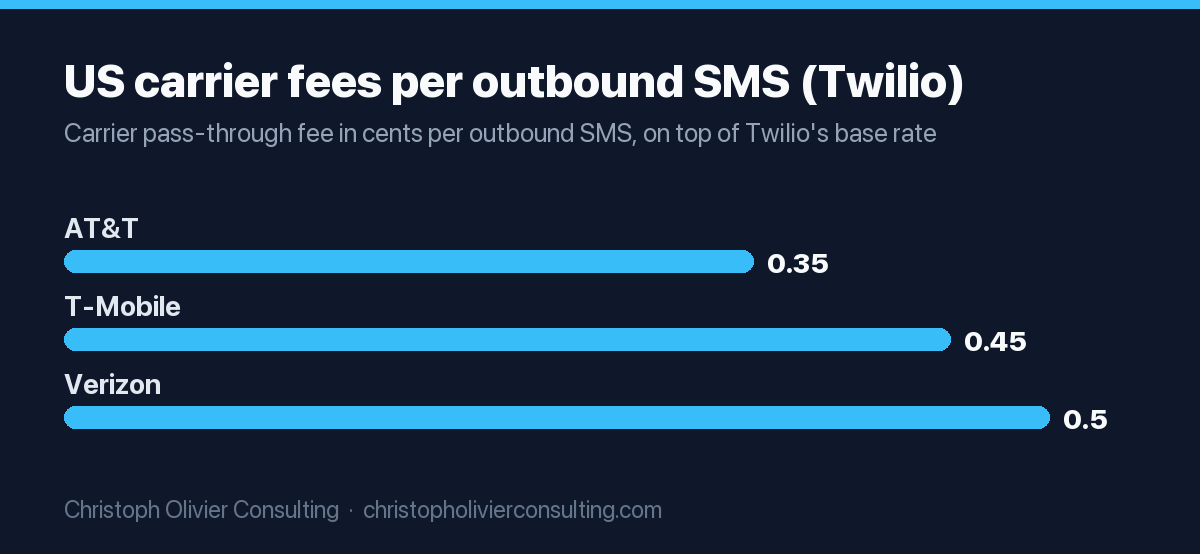
| Carrier pass-through fee | Charged by the recipient’s carrier per message | $0.0035 (AT&T) to $0.005 (Verizon) per outbound SMS (Twilio) |
| Phone number | Local, toll-free or short code rental | $1.15/mo local, $2.15/mo toll-free (Twilio) |
| Short code | 5 or 6 digit number for high volume | $1,000/mo or more (SimpleTexting) |
| 10DLC one-time fees | Brand registration and campaign vetting | $22.50 to $64.00 (HighLevel LC Phone) |
| 10DLC monthly fee | Per registered campaign | $1.50 to $10.50 (HighLevel LC Phone) |
| Overage | Credits beyond your plan | 3 to 5.5 cents per credit (EZ Texting, SimpleTexting) |
On SlickText’s published tiers, the effective price per credit falls from 5.8 cents on the $29 plan to under 2 cents on the 50,000-credit plan. Buy for the volume you will send in the next 3 months, not your hoped-for list size.
Carrier fees are the line most buyers miss. Some vendors fold them into the plan, as Klaviyo’s listing says it does; others add them separately.
10DLC registration: the step most small businesses miss
10DLC (10-digit long code) registration is the US carrier system that verifies businesses texting from ordinary local numbers. Anyone sending application-to-person texts over a 10DLC number must register a brand and a campaign. Unregistered traffic gets blocked, so registration has to be finished before your first campaign, not after.
Twilio’s documentation is direct about scope: “Anyone sending SMS/MMS messages over a 10DLC number from an application to the US must register for A2P 10DLC,” including individuals and hobbyists (Twilio A2P 10DLC docs). Its registration overview states there is a full block of all unregistered US-bound messages sent after August 31, 2023, and lists a $15 one-time campaign vetting fee plus $1.50 to $10 per campaign per month.
Registration has two parts:
- Brand: your legal business name, EIN, address and website, matched against public records.
- Campaign: the use case (marketing, account notifications, customer care), sample messages, and exactly how people opt in and opt out.
- Approval: carriers review the campaign. Vague samples or a missing opt-in description are common reasons for rejection.
Most texting apps handle the paperwork for you, and Textedly includes the first registration. Toll-free numbers go through a separate verification, which SimpleTexting quotes at about a week. Short codes take longest: SimpleTexting quotes 6 to 8 weeks and EZ Texting 4 to 12 weeks on its enterprise tier.
TCPA consent, quiet hours and opt-outs
Under federal rules, marketing texts sent with automated systems need the recipient’s prior express written consent: a signed agreement that clearly authorizes marketing messages and states that agreeing is not a condition of purchase. Opt-outs must be honored within 10 business days, and solicitations are limited to 8 a.m. to 9 p.m. local time.
Those rules come from 47 CFR 64.1200: paragraph (a)(2) for written consent, (f)(9) for its definition, (c)(1) for the 8 a.m. to 9 p.m. window at the called party’s location, and (a)(10), which lets consumers revoke consent “by using any reasonable method” and requires that revocation be honored “within a reasonable time not to exceed ten business days.” Some states add stricter hours or consent rules, so check the states your customers live in.
One change to know: the FCC’s “one-to-one consent” rule, which would have required consent seller by seller, was vacated by the Eleventh Circuit in January 2025 in Insurance Marketing Coalition v. FCC, as summarized by Morrison Foerster. The general written-consent requirement still stands.
Carriers add their own expectations through the CTIA Messaging Principles and Best Practices (May 2023). Key points:
- Send an opt-in confirmation with the program name, a help contact, how to opt out, message frequency, and any fees.
- Use standardized “STOP” wording, but also act on plain-language requests such as “end”, “unsubscribe” or “please opt me out”.
- Do not text rented, purchased or shared lists. Build your own opt-in list.
- Keep consent records: timestamp, method, the language shown, the campaign, and the phone number.
This is general information, not legal advice. If texting is a large channel for you, have counsel review your consent flow.
Template: opt-in language and confirmation message
Form checkbox (unchecked by default): “Yes, text me offers and updates from [Business Name] at the number above. Up to [4] msgs/month. Consent is not a condition of purchase. Msg and data rates may apply. Reply STOP to cancel, HELP for help. See our [Privacy Policy] and [Terms].”
Confirmation text: “[Business Name]: You’re subscribed to offer alerts, up to [4] msgs/mo. Msg and data rates may apply. Reply HELP for help or STOP to cancel.”
Watch: how US A2P 10DLC registration works
If you want a visual walkthrough of brand and campaign registration before you start, Twilio’s developer team explains the process below. It applies whichever platform you choose, because every texting app routes through the same carrier registration system and the same approval rules for local numbers.
SMS marketing for small business: use cases that pay off
SMS marketing for small business works best on messages people actually want quickly: appointment reminders, a text back after a missed call, review requests, quote follow-ups and win-back offers to past customers. Promotional blasts come last. Start with the messages tied to revenue you already have in motion.
- Appointment reminders. A reminder 24 hours before and a second one 2 hours before, with a reply-to-confirm option. These are informational, but keep the opt-in and opt-out language anyway.
- Missed-call text back. When a call goes unanswered, an automatic text (“Sorry we missed you, how can we help?”) keeps the lead warm. Response speed matters, as our roundup of speed-to-lead statistics shows.
- Review requests. One short text after the job, with a direct link to your review profile. Send it the same day while the experience is fresh.
- Quote and estimate follow-up. A text 2 days after an estimate often gets a reply when an email does not. Pair it with the triggered emails you already send so the two channels do not repeat each other.
- Reactivation offers. A seasonal or annual check-in to past customers who opted in to marketing. This is where written consent matters most.
For benchmarks on open, response and click rates, see our collection of SMS marketing statistics.
Ecommerce or service business: which platform type fits
Ecommerce brands should pick an SMS tool that syncs with their store for cart, browse and post-purchase triggers. Service businesses should prioritize two-way conversations, reminders, a shared inbox and CRM integration. Picking a tool built for the other model is the most common and most expensive mismatch.
| Your situation | Platform type | Shortlist | Watch out for |
|---|---|---|---|
| Shopify store, email already on Klaviyo | Ecommerce suite | Klaviyo, Postscript | Per-message costs at high volume |
| Store with uneven seasonal volume | Per-message ecommerce | Omnisend, Postscript | Monthly minimums |
| Large DTC program, dedicated SMS owner | Enterprise ecommerce | Attentive | Quote-only pricing, contract terms |
| Local service firm, reminders and replies | SMB texting app | SimpleTexting, EZ Texting, Textedly | Extra fees for numbers and users |
| Retail or events, keyword sign-ups | SMB texting app | SlickText, Textedly | Short code cost if volume grows |
| Agency or CRM-first service firm | CRM with built-in SMS | HighLevel | Setup time, usage billing |
| In-house developers, custom app | API | Twilio | You build consent and reporting |
How to choose an SMS marketing platform in 6 steps
Choose an SMS marketing platform by working backward from your use cases, not from feature lists. Define the messages you will send, estimate monthly segments, check what integrates with your CRM or store, compare total cost including carrier fees, confirm who handles 10DLC registration, and run a free trial with real messages.
- List your top 3 message types. Reminders, follow-ups and promotions need different features.
- Estimate monthly segments. Contacts times sends per month, times the average segments per message.
- Check integrations. The tool must read and write to your CRM, booking system or store, or you will be exporting CSV files forever.
- Compare total monthly cost. Plan, overage, number rental, carrier fees, extra users and 10DLC fees.
- Confirm compliance support. Who submits 10DLC registration, how opt-outs sync, and whether consent records are stored.
- Trial with live messages. Send real reminders to your team, test STOP handling, and check how replies reach staff.
Worked example: monthly cost for a 1,000-contact service business
A service business with 1,000 opted-in contacts sending two short campaigns a month plus 300 reminders needs about 2,300 segments. On a texting app that lands on a mid-tier plan around $79 to $129 a month. Built on Twilio, the raw messaging cost is closer to $32, before development time.
Here is the math, using published prices:
- Volume: 1,000 contacts x 2 campaigns = 2,000 segments, plus 300 single-segment reminders = 2,300 segments. Add emojis to the campaigns and that can double or more.
- SlickText: the $79 tier covers 2,000 credits, so 2,300 credits means moving up to the $129 tier (3,500 credits). Unused credits roll over to later months.
- Twilio: 2,300 x $0.0083 = $19.09. Carrier fees at the highest listed rate ($0.005) add up to $11.50. A local number adds $1.15. Total about $31.74, plus a 10DLC campaign fee of $1.50 to $10 a month.
- HighLevel: 2,300 x $0.00747 = $17.18 in LC Phone usage plus carrier fees, on top of the $97 plan that also includes the CRM.
The cheapest per-message option is rarely the cheapest overall. In my experience the deciding cost is staff time: who writes the messages, who answers replies, and whether the tool connects to the system where your leads already live.
SMS launch checklist
Before your first campaign, confirm registration, consent capture, opt-out handling, message content and measurement. A short checklist catches the issues that cause carrier filtering or complaints. Assign an owner to each line before anything goes to customers, and recheck it when you add a new campaign.
- [ ] 10DLC brand and campaign approved (or toll-free verified)
- [ ] Opt-in checkbox live on forms, unchecked by default, with consent and STOP/HELP language
- [ ] Consent records stored: timestamp, source, wording, phone number
- [ ] Opt-in confirmation text set up with frequency and fee disclosure
- [ ] STOP, END, UNSUBSCRIBE and plain-language opt-outs tested
- [ ] Send window limited to 8 a.m. to 9 p.m. in the recipient’s time zone
- [ ] Messages checked for segment count (no stray emojis or curly quotes)
- [ ] Replies routed to a named person with a response time target
- [ ] Links tagged with UTM parameters so revenue shows up in analytics
- [ ] Purchased or shared lists excluded
If you want help choosing a platform or wiring texting into your CRM and follow-up flows, you can book a consultation and we can map it out together.
Work with CO Consulting
Get a funnel and follow-up system built for you
- Funnels designed, built and optimized for booked calls, sales or qualified leads
- Email and follow-up automations connected to your CRM
- A working system you own, not a set of page mockups
- No guaranteed lead counts or conversion rates before your offer is tested
Book a free strategy callSee our funnel and email automation services
Frequently asked questions
What is the best SMS marketing platform for a small business?
For most small service businesses, a dedicated texting app such as SimpleTexting, EZ Texting, SlickText or Textedly is the simplest start, with entry plans around $25 to $39 a month for about 500 messages. If you already run a CRM like HighLevel, adding texting there can be simpler. Ecommerce stores usually do better with Klaviyo, Omnisend or Postscript.
How much do SMS marketing platforms cost?
Entry plans on vendor pages in October 2026 ran from $25 a month (EZ Texting) to $29 a month (SlickText, Textedly) for about 500 credits, while SimpleTexting shows $39 including a local number. Per-message platforms charge under a cent per segment. Expect carrier fees, number rental and 10DLC registration fees on top of the plan price.
Do I need 10DLC registration to send marketing texts?
Yes, if you text customers from a standard 10-digit local number through software. Twilio states that anyone sending application-to-person messages over a 10DLC number to the US must register a brand and a campaign, and unregistered US-bound traffic has been blocked since 2023. Most texting apps submit the registration for you.
What consent do I need before sending SMS marketing?
Federal rules at 47 CFR 64.1200 require prior express written consent for marketing texts sent with automated systems. The agreement must clearly authorize marketing messages to that number and state that consent is not a condition of purchase. Keep a record of when, where and how each person opted in. Have counsel review your flow if texting is a major channel.
What hours can I send marketing text messages?
Federal rules limit telephone solicitations to between 8 a.m. and 9 p.m. in the recipient's local time, under 47 CFR 64.1200(c)(1). Some states set stricter windows, so schedule campaigns by the recipient's time zone and check the rules in the states where your customers live. Most platforms let you set quiet hours automatically.
Is SMS marketing better than email marketing?
They do different jobs. SMS suits short, time-sensitive messages such as reminders, missed-call replies and review requests, and it costs per message. Email suits longer content and newsletters at a lower unit cost. Most businesses get the best results running both from connected tools so customers do not receive the same message twice.
Why does my text use more credits than expected?
Platforms bill by segment. A standard SMS segment holds up to 160 characters, but emojis or some special characters switch the message to Unicode, which holds only 70 characters per segment. A long or emoji-heavy message can use several segments, and picture messages (MMS) often cost 3 credits on texting apps.
More Funnels & Email guides
- Welcome Email Sequence: The 5-Email Series You Can Copy
- Microsoft Ads in 2026: Strategic Guide
- The Search Funnel: How Search Fits Every Stage of the Buyer’s Journey
- CRO Process for 2026 — Practical Guide
- Funnel Marketing Agency: What They Do, When to Hire One, and How to Choose
- Sales Funnel Software: A Buyer’s Guide to the Tool Categories
- All Funnels & Email guides →