
Last reviewed: October 2026
Enterprise SEO tools are platforms built to crawl, track and report on sites with tens of thousands to millions of URLs, many markets and many stakeholders. In 2026 the main options are BrightEdge, Conductor, Botify, seoClarity, Lumar, Siteimprove, Semrush Enterprise and Ahrefs Enterprise, plus Screaming Frog for desktop crawling and dedicated AI-visibility trackers such as Profound. Most quote custom prices, so fit beats feature lists.
This guide compares those platforms on what each does best, how it is priced (only figures published on the vendor’s own site), crawl scale, AI search features and stack fit. It then gives you an evaluation process, a weighted scorecard you can copy, and an honest test for when an enterprise tool is more than you need.
Would you rather hand SEO to a specialist? CO Consulting’s SEO services start with a month-one audit that decides the plan, and AI search optimization is included.
What are enterprise SEO tools?
Enterprise SEO tools are SEO platforms designed for large, complex websites and large teams. They differ from standard SEO software in crawl capacity, keyword tracking volume, user and permission controls, API and data warehouse access, single sign-on and security reviews, and reporting that ties search performance to revenue across brands, regions and business units.
A standard tool answers “how is my site doing?” An enterprise platform answers “which of our 400,000 product pages lost visibility in Germany last week, which template caused it, and who owns the fix?” That difference shows up in five places:
- Crawl scale. Crawling millions of URLs, rendering JavaScript and reading server log files to see what search engine and AI bots actually request.
- Tracking volume. Thousands to tens of thousands of keywords across countries, devices and search features, plus AI answer engines.
- Governance. SSO, role-based access, audit logs and procurement-friendly security documentation.
- Data access. APIs, warehouse connectors and, increasingly, MCP servers so analysts and AI agents can query the data directly.
- Workflow. Alerts, ticket routing, content briefs and change monitoring, so fixes move through teams instead of sitting in a spreadsheet.
If you are still choosing between mainstream tools, start with our roundup of the best SEO tools. This page is for teams that have outgrown them.
The best enterprise SEO tools in 2026 at a glance
The best enterprise SEO platforms split into three groups. Suites (BrightEdge, Conductor, seoClarity, Semrush Enterprise) cover research, tracking, content and reporting. Technical platforms (Botify, Lumar, Screaming Frog) go deepest on crawling and indexing. Ahrefs Enterprise and AI trackers such as Profound fill data and AI-visibility gaps. Most large teams run one suite plus one specialist.
| Platform | Best at | Published pricing (checked Oct 2026) | AI search features |
|---|---|---|---|
| BrightEdge | Keyword research (Data Cube), share of voice, forecasting, executive reporting | Not published, demo and quote | AI search visibility across ChatGPT, Perplexity and Google AI Overviews |
| Conductor | Content workflows, writing assistant, 24/7 site monitoring | Usage-based tiers (Essentials, Growth, Enterprise), no prices listed | Visibility in ChatGPT, Perplexity and Gemini; apps for ChatGPT, Claude and Copilot; MCP server |
| Botify | Technical SEO at scale: crawling, log files, rendering, automated fixes | Not published | AI bot and agent analytics, GEO analytics, product feeds for AI |
| seoClarity | Rank tracking at volume, unlimited crawling on higher tiers | From $2,500/mo (Research & Content), $3,200/mo (Technical SEO), $4,500/mo (Enterprise) | Clarity ArcAI, priced separately |
| Lumar | Technical crawling, QA testing before release, accessibility metrics | Not published, custom packaging | GEO/AI search metrics |
| Siteimprove | SEO plus accessibility, content quality and analytics in one governance tool | Not published | Tracks mentions and citations in ChatGPT, Perplexity and AI Overviews |
| Semrush Enterprise | Competitive intelligence on a very large keyword and backlink dataset | Not published, demo and quote | AI Optimization (AIO) module for brand visibility in AI models |
| Ahrefs Enterprise | Backlink and SERP data, uncapped API, SSO | $1,499/mo, annual commitment | Brand Radar across AI Overviews, AI Mode, ChatGPT, Gemini, Perplexity and Copilot |
| Screaming Frog SEO Spider | Desktop crawling, custom extraction, ad hoc audits | $279 per licence per year; free up to 500 URLs | None built in; used alongside the platforms |
| Profound | Dedicated AI answer engine visibility tracking | Free 7-day trial; Enterprise custom | Nine engines on Enterprise, including ChatGPT, Gemini, Claude, Copilot and AI Mode |
Sources: each vendor’s own pricing or product page, linked in the reviews below. Prices are list starting points and change often, so confirm with sales before you budget.
Enterprise SEO platforms reviewed: what each is best at
Each enterprise SEO platform has a home turf. BrightEdge and Conductor lead on content and reporting, Botify and Lumar on technical crawling, seoClarity on tracking volume, Siteimprove on governance, and Semrush and Ahrefs on competitive data. Pick by the bottleneck you need to remove, not by the longest feature list.
BrightEdge: best for research and executive reporting
BrightEdge organizes its product around three jobs: discover demand (Data Cube keyword research, share of voice, opportunity forecasting, Intent Signal), create optimized content (recommendations and ContentIQ technical auditing) and measure results (site, keyword and page reporting plus StoryBuilder dashboards). It also measures AI search visibility across ChatGPT, Perplexity and Google AI Overviews. It suits marketing organizations that need forecasts and dashboards leadership will read. Pricing is by quote.
Conductor: best for content teams and website monitoring
Conductor combines Conductor Intelligence (search and AI answer engine visibility across ChatGPT, Perplexity and Gemini), Conductor Monitoring (24/7 alerts for technical issues and content changes), Conductor Creator for content generation, and AgentStack, which adds apps for ChatGPT, Claude and Copilot plus an MCP server and data API. Its pricing page lists usage-based tiers rather than seats: Essentials covers 500 tracked keywords and 100,000 monitored pages, Growth 5,000 keywords and 500,000 pages, and Enterprise starts at 60,000+ tracked keywords. No dollar figures are published.
Botify: best for technical SEO on very large sites
Botify is built around crawling and indexing. SiteCrawler handles website analytics, LogAnalyzer shows how search and AI bots crawl you, and RealKeywords connects search data. On the activation side, PageWorkers deploys changes, SmartLink manages internal links, and SpeedWorkers serves JavaScript-heavy pages to bots, which Botify says it does in under 300 milliseconds. It is the natural shortlist pick for large ecommerce and publisher sites where crawl waste is the main problem. Pricing is not published.
seoClarity: best for tracking volume with transparent tiers
seoClarity is the rare enterprise vendor that publishes starting prices. A Rankings plan starts at a minimum of 2,000 keyword queries on custom pricing. Research & Content starts at $2,500 a month, Technical SEO at $3,200 a month with unlimited crawl pages and projects plus log file analysis, and Enterprise at $4,500 a month for global teams tracking 5,000+ keyword queries across multiple domains. Final pricing depends on domains and keywords tracked. Clarity ArcAI, its AI search product, is priced separately.
Lumar: best for technical QA and release testing
Lumar (formerly Deepcrawl) packages Analyze for crawling, Monitor for tracking metrics across domains, Protect for automated QA tests before code ships, and Impact for showing results. It also reports GEO/AI search metrics, site speed and accessibility. It fits engineering-heavy organizations that want SEO checks inside the release process. Pricing is custom.
Siteimprove: best when SEO sits inside web governance
Siteimprove bundles SEO and answer engine tracking with accessibility monitoring, content quality and analytics. Its search agents report whether your brand is mentioned in ChatGPT, Perplexity and AI Overviews, and whether your content is cited as a source. Siteimprove says it serves 5,000+ organizations. It fits universities, public bodies and regulated firms where accessibility and content compliance carry as much weight as rankings.
Semrush Enterprise: best for competitive intelligence
Semrush Enterprise is a separate product from the self-serve plans. It covers SEO, AI Optimization (AIO) for brand visibility in AI models, Site Intelligence for crawling and accessibility audits, and data products. Semrush cites a dataset of 28.7 billion keywords, 805 million domains and 43 trillion backlinks. It suits teams whose first question is “what are competitors doing?” Pricing is by demo and quote.
Ahrefs Enterprise: best for link data and API access
Ahrefs publishes its Enterprise price: $1,499 a month with an annual commitment. Enterprise adds uncapped API access, custom API endpoints, SSO, access management with audit logs and unlimited historical data. Its Brand Radar tracks brand visibility in AI Overviews, AI Mode, Copilot, Gemini, Perplexity and ChatGPT. It is the cheapest published entry into enterprise-grade governance, and it pairs well with a technical crawler.
Screaming Frog at scale: best low-cost crawler for specialists
Screaming Frog’s SEO Spider costs $279 per licence per year, falling to $235 per licence at 20+ licences, and the free version crawls 500 URLs. Its user guide says the licensed default limit is 5 million URLs but not a hard cap: a machine with a 500GB SSD and 16GB of RAM should crawl roughly 10 million URLs in database storage mode. Crawl comparison, change detection and segments only work in that mode. It does not replace a platform’s scheduling, sharing and alerting, but almost every enterprise SEO team keeps it.
AI-visibility trackers: best for the new reporting gap
Dedicated trackers exist because suites added AI features unevenly. Profound offers a free trial that tracks 50 prompts daily for 7 days across ChatGPT, Gemini and AI Overviews. Its Enterprise plan, on custom pricing, adds Perplexity, AI Mode, Copilot, DeepSeek, Claude and Exa Search. Buy one only if your suite cannot report the engines your buyers actually use.
What enterprise SEO software costs in 2026
Most enterprise SEO software is sold on custom annual contracts. Among vendors that publish numbers, Ahrefs Enterprise lists $1,499 a month on an annual commitment, and seoClarity starts at $2,500 to $4,500 a month depending on tier. BrightEdge, Conductor, Botify, Lumar, Siteimprove and Semrush Enterprise quote individually, usually priced by keywords, pages, domains or usage.
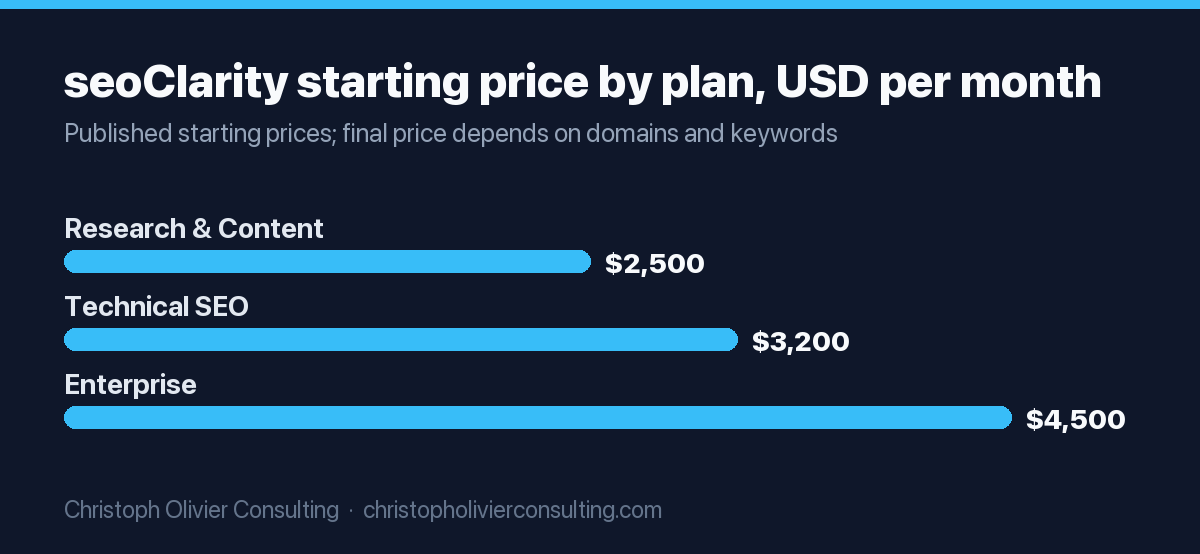
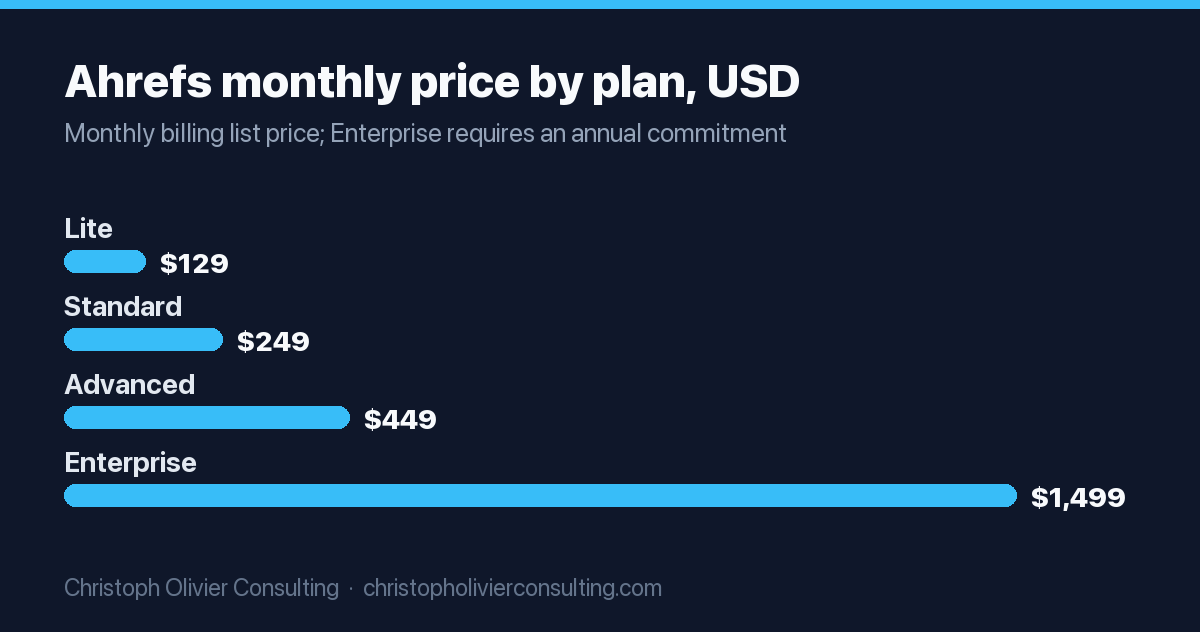
The published numbers show the shape of the market. The jump from a self-serve plan to an enterprise tier is large, and it buys governance (SSO, audit logs, API) more than extra data.
What actually drives a quote:
- Tracked keywords and markets. seoClarity prices on domains and keywords; Conductor on keywords, pages analyzed and pages monitored.
- Crawl volume and frequency. Unlimited crawling is usually a higher tier, not a default.
- AI visibility. Often a separate module or add-on, as with seoClarity’s ArcAI.
- Services. Onboarding, strategists and custom reporting are bundled into many contracts. Ask what you are paying for if you would not use them.
- Term. Annual commitments are standard. Negotiate a pilot or an exit clause tied to implementation milestones.
Budget for people as well as licences. A platform nobody configures or reads is the most expensive line in the SEO budget.
AI search visibility: the feature that changed the shortlist
In 2026 an enterprise SEO tool should report how often AI answer engines mention your brand and how often they cite your pages, separately. BrightEdge, Conductor, Botify, seoClarity, Lumar, Siteimprove, Semrush and Ahrefs all now market AI visibility features, but engine coverage, prompt volume and pricing differ widely.
The mention versus citation split matters. A mention means the model named you. A citation means it linked to your page as a source, which is the part your content team can influence and the part that can send traffic. Siteimprove explicitly reports both. When you demo any platform, ask to see the two numbers apart.
Questions to ask about AI features:
- Which engines are tracked on the plan you are quoted, not the top plan? List them by name.
- How are prompts chosen, how many are included, and how often are they run?
- Is AI tracking included or an add-on with its own price?
- Can you see AI crawler activity in your logs (Botify’s LogAnalyzer is one example), not just answer outputs?
- Can the data be exported or reached by API so it lands next to your web analytics?
For the measurement side, our guide to AI search analytics covers how to connect AI referrals and citations to pipeline.
SEO platforms for large websites: when crawl scale really matters
Crawl scale matters when Google cannot keep up with your site. Google’s own crawl budget guide targets sites with 1 million+ unique pages that change weekly, sites with 10,000+ pages that change daily, and sites with many URLs stuck in “Discovered, currently not indexed.” Below that, sitemaps and Search Console usually suffice.
Google’s crawl budget documentation defines crawl budget as “the set of URLs that Google can and wants to crawl,” made up of a crawl capacity limit and crawl demand. It also says plainly that if your pages are crawled the same day they are published, you do not need the guide. That is a useful test before you buy a technical platform: check the Page Indexing report first.
Signals that you need log file analysis and a scheduled crawler, not a desktop crawl once a quarter:
- Faceted navigation or filters generating millions of parameter URLs.
- Large shares of pages in “Discovered” or “Crawled, currently not indexed.”
- JavaScript rendering that hides content or links from bots.
- Frequent releases that can break templates across thousands of pages at once.
- Several domains, subfolders or country sites managed by different teams.
Google Search Central’s Mythbusting episode on crawl budget is a good primer for anyone in the buying group who is not an SEO.
How to run an enterprise SEO tool evaluation
Run an enterprise SEO tool evaluation like any software RFP: define the problems first, shortlist two or three vendors that specialize in them, test each on your own site with the same tasks, score them on a weighted scorecard, and negotiate the contract around adoption, not just price. It often takes several weeks.
- Write the problem statement. Three to five specific problems, for example “we cannot see which templates lose indexation after releases.” If you have no list, a website content audit will produce one.
- Map your stack. Analytics, BI or warehouse, CMS, ticketing, SSO provider. Integration needs often cut the shortlist in half.
- Size the requirement. URLs to crawl, crawl frequency, keywords, markets, users and AI engines. Vendors price on these, so arrive with numbers.
- Shortlist by category. One suite and one technical specialist, or two of the same type if you are replacing an incumbent.
- Run a scripted demo. Give every vendor the same tasks on your own domain. Do not accept a canned demo account.
- Pilot with real users. Have the people who will use it daily complete the tasks, not only the buyer.
- Check security and procurement early. SSO, data residency, audit logs and a security questionnaire can add weeks if left to the end.
- Score, then negotiate. Use the scorecard below. Negotiate onboarding scope, named support and an exit path.
Our breakdown of SEO competitive analysis tools is a useful companion if competitor research is one of your problem statements.
Enterprise SEO vendor scorecard template
A vendor scorecard turns demos into a defensible decision. Weight six to eight criteria by how much each matters to your problem statement, score every vendor 1 to 5, multiply score by weight and total. The weights below are a starting point for a content-led team; shift weight to crawl depth if technical debt is the bottleneck.
| Criterion | What to test | Example weight | Vendor A (1 to 5) | Vendor B (1 to 5) |
|---|---|---|---|---|
| Crawl and technical depth | Crawl a template set, render JavaScript, read logs | 20% | ||
| Rank and SERP tracking | Your keyword set across markets, devices and SERP features | 15% | ||
| AI search visibility | Named engines, mentions vs citations, prompt control | 15% | ||
| Content workflow | Brief, optimize and monitor one live page | 15% | ||
| Integrations and API | Analytics, warehouse, CMS, ticketing, MCP or API | 10% | ||
| Reporting | Build the executive dashboard you need monthly | 10% | ||
| Governance and security | SSO, roles, audit log, data residency | 5% | ||
| Total cost and terms | Licence, add-ons, services, term, exit | 10% |
Worked example (illustrative numbers). Suppose Vendor A scores 5 on crawl depth, 3 on AI visibility and 4 on everything else, and Vendor B scores 3 on crawl depth, 5 on AI visibility and 4 on everything else. With the weights above, A totals (5 x 0.20) + (3 x 0.15) + (4 x 0.65) = 4.05 and B totals (3 x 0.20) + (5 x 0.15) + (4 x 0.65) = 3.95. A narrow gap like that tells you the decision rests on weights, so revisit your problem statement before you sign.
RFP checklist: ask every vendor for
- A written quote showing what is included on your tier and what is an add-on (especially AI tracking).
- Exact crawl limits, crawl frequency and whether JavaScript rendering costs extra.
- The named AI engines tracked on your plan and the number of prompts.
- API documentation, rate limits and warehouse connectors.
- SSO support, role controls, audit logs and data residency.
- Onboarding scope, named contacts and response times.
- Contract term, renewal uplift and exit terms.
- Two references in your industry and site size.
When enterprise SEO tools are overkill
Enterprise SEO tools are overkill when your site has a few thousand pages, one market and a small team. In that case a self-serve suite, Google Search Console and a desktop crawler cover almost every need for a fraction of the cost. The upgrade earns its place when scale, governance or reporting demands outgrow those tools.
| Your situation | Usually enough | Consider enterprise when |
|---|---|---|
| Under 10,000 pages, one market | Self-serve suite, Search Console, Screaming Frog | Rarely; spend on content and links instead |
| 10,000+ pages changing daily | Scheduled crawler plus log review | Indexation gaps persist or releases break templates |
| 1 million+ pages | Not usually a desktop-only setup | Often worth a technical platform |
| Many markets, brands or teams | Shared dashboards on a self-serve tool | You need SSO, roles, audit logs or per-team reporting |
| Leadership asks for AI search reporting | A self-serve suite’s AI add-on | Buyers use engines your tools do not track |
Most professional-service firms and 7-figure service businesses sit in the first row. In my experience the gap there is rarely the tool; it is a clear strategy and someone with time to act on the data. If that is your situation, it often makes more sense to invest in SEO services or a focused plan than in a five-figure platform contract.
How to choose the right enterprise SEO platform
Choose the platform that removes your biggest bottleneck. Pick Botify or Lumar if crawling and indexation are the problem, Conductor or BrightEdge if content operations and reporting are, seoClarity for tracking volume, Siteimprove for governance, and Semrush or Ahrefs Enterprise for competitive and link data. Then add one specialist only if a gap remains.
A practical sequence: confirm you actually have an enterprise problem using the crawl budget test and the table above, write your problem statement, shortlist two or three vendors, and run the scorecard on your own site. Keep Screaming Frog regardless; it is cheap and every specialist uses it.
If you want a second opinion on whether you need an enterprise platform at all, or help running the evaluation, you can book a consultation and we will work through it with your numbers.
Work with CO Consulting
Want SEO that brings in qualified clients?
- A month-one audit that decides the mix, written into a 90-day plan you can hold us to
- Technical, on-page, local, content and AI search work in one engagement
- Monthly tracking of whether ChatGPT, Perplexity and Google AI Overviews cite your business
- Reporting tied to pipeline, not vanity rankings. No ranking guarantees, ever
Frequently asked questions
What are the best enterprise SEO tools in 2026?
The main enterprise SEO platforms are BrightEdge, Conductor, Botify, seoClarity, Lumar, Siteimprove, Semrush Enterprise and Ahrefs Enterprise. Most large teams pair one suite with a technical specialist and keep Screaming Frog for ad hoc crawls. The best choice depends on your bottleneck: crawling and indexation, content operations, tracking volume, governance or competitive data.
How much do enterprise SEO tools cost?
Most enterprise SEO tools use custom annual quotes. Among vendors that publish prices, Ahrefs Enterprise lists $1,499 a month with an annual commitment, and seoClarity starts at $2,500, $3,200 or $4,500 a month depending on tier. Screaming Frog costs $279 per licence per year. AI visibility tracking is often an extra module.
What is the difference between enterprise SEO software and regular SEO tools?
Enterprise SEO software adds scale and governance: crawling millions of URLs, log file analysis, tracking thousands of keywords across markets, SSO, role permissions, audit logs, APIs and warehouse connectors, and reporting across brands or business units. Regular SEO tools cover research and audits well but are built for smaller sites and teams.
Do enterprise SEO platforms track AI search visibility?
Yes, most now do, but coverage varies. BrightEdge, Conductor, Siteimprove, Semrush, Ahrefs, Botify, Lumar and seoClarity all market AI visibility features, sometimes as paid add-ons. Ask which named engines are tracked on your plan, how many prompts are included, and whether mentions and citations are reported separately.
When is an enterprise SEO platform overkill?
An enterprise platform is usually overkill for a site with a few thousand pages, one market and a small team. Google's crawl budget guidance targets sites with 1 million+ pages changing weekly or 10,000+ pages changing daily. Below that, a self-serve suite, Google Search Console and a desktop crawler often cover what you need.
How do you evaluate enterprise SEO platforms?
Write three to five specific problems, size your requirement in URLs, keywords, markets and users, then shortlist two or three vendors. Give each the same scripted tasks on your own domain, pilot with daily users, check security early and score them on a weighted scorecard before negotiating onboarding, support and exit terms.
More SEO guides
- Best SEO Tools for Small Business: How to Choose the Right Stack
- AI Search Analytics: How to Measure Visibility and Traffic From AI Search
- SEO Requirements for a New Website: The Spec to Hand Your Builder Before They Start
- SEO Recommendations Report: Turn an Audit Into a Prioritized Action Plan
- SEO for Bloggers: The Per-Post Workflow That Ranks (2026)
- Search Experience Optimization (SXO): The SEO + UX + CRO Operating System
- All SEO guides →