
Last reviewed: October 2026
The best email newsletter examples in 2026 include Morning Brew, TLDR, Lenny’s Newsletter, Stratechery, First Round Review, Bloomberg’s Money Stuff, Marketing Examples and HBR’s Management Tip of the Day. They look different, but they share four traits: one clear reader promise, a fixed format, a cadence they never miss, and a voice you would recognize without the logo.
Below are 17 newsletters worth studying, each checked against its own site in October 2026, grouped by format: daily briefings, B2B and operator newsletters, curation and design, and professional-services publications. After the examples you get a format comparison table, honest benchmarks, and a newsletter blueprint and issue template built for a service firm that has expertise to share but no newsroom.
The best email newsletter examples at a glance
The strongest newsletters each do one job for one reader. Daily briefings save time, operator newsletters teach a skill, curated newsletters filter the internet, and professional publications keep clients current. Use the table to find two or three examples that match your audience and capacity, then study those closely instead of trying to copy all 17.
| Newsletter | Format | Cadence (per its site) | Verified audience claim | What to steal |
|---|---|---|---|---|
| Morning Brew | Daily business briefing | Daily | 4 million (2022) | Witty, plain-English summaries of dense news |
| TLDR | Daily link summaries | Daily | 8,000,000+ readers | Read-time label on every item |
| The Hustle | Daily briefing plus Sunday feature | Daily, Sunday originals | Not stated | Two formats under one brand |
| theSkimm | Daily briefing, consumer | Daily plus weekly verticals | 10+ million readers | “What it means for your life” framing |
| Money Stuff | Single-author column | Every weekday | About 300,000 (Jan 2024) | Personality as the product |
| Marketing Brew | Industry trade briefing | Weekdays | 250,000 (2022) | A vertical spin-off of a proven format |
| Stratechery | Analysis, freemium | Free weekly article, 3 paid updates a week | Readers in 85+ countries | Free flagship that sells the paid tier |
| Lenny’s Newsletter | Advice column, freemium | Regular issues | 1,200,000+ subscribers | Paid tier bundled with community and perks |
| The Pragmatic Engineer | Deep dives, freemium | Tuesday deep dive, Thursday paid issue | 1 million+ readers | Named recurring sections |
| First Round Review | Long-form B2B content | Weekly | Not stated | 5,000-word tactical pieces, evergreen archive |
| Marketing Examples | Short teardown | Every Monday | Read by 130k | Fixed 3-2-1 structure |
| Growth.Design | Visual case study | Weekly | Not stated | Comic-style breakdowns, 5-minute read |
| Really Good Emails | Curated inspiration | Weekly | 300,000 email pros (community) | Curation from a library you already own |
| Dense Discovery | Curated links | Weekly | 38,000+ readers | One editor, one voice, 410+ issues |
| HBR Management Tip of the Day | Micro-advice | Daily | Not stated | One idea per email |
| Kitces Weekend Reading | Professional curation | Weekly | Not stated | Industry news with an expert’s take |
| Hinge: Professional Services Marketing Today | Firm blog digest | Weekly or daily (reader picks) | Not stated | Let readers choose the frequency |
Audience figures are each publisher’s own claim or a dated press report, linked below. “Not stated” means we found no verifiable number.
Daily briefing newsletter examples
Daily briefings win by saving the reader time. They summarize a busy news cycle into a five-minute read with a consistent order of sections and a distinct tone. They are the hardest format to sustain, because they need fresh material and an editor every single day, which is why most service firms should study them for style rather than cadence.
Morning Brew
Morning Brew turned business news into something people want to open. Its daily newsletter had topped 4 million subscribers by 2022, and its trade spin-offs Marketing Brew and Retail Brew had 250,000 and 180,000 respectively, according to Talking Biz News. The lesson is tone: short paragraphs, humor that never buries the facts, and a familiar order every morning.
TLDR
TLDR describes itself as a free daily email with summaries of the most interesting stories in startups, tech and programming, and claims more than 8,000,000 readers. Every item shows a read time, such as “2 min read,” so subscribers can triage the issue in seconds. That small label is worth copying in any curated format.
The Hustle
The Hustle, now part of HubSpot, runs a daily newsletter of bite-size business stories plus a Sunday newsletter of original reporting. The split is the idea to steal: a light daily or weekly product that builds the habit, and a deeper feature that builds the reputation.
theSkimm
theSkimm invites readers to “join us and 10+ million readers” and frames the Daily Skimm as what is happening “and what it means for your life.” That second half is the whole strategy. For a firm, every update should end with what it means for the client.
Money Stuff
Matt Levine’s Money Stuff is published every weekday by Bloomberg and had around 300,000 subscribers as of January 2024, per his Wikipedia entry. It is proof that a single expert voice, explaining complex finance with humor and precision, can carry a newsletter on its own.
B2B newsletter examples worth copying
The best B2B newsletter examples teach a skill or explain a market better than anyone else. They rarely pitch. Instead, they earn trust issue by issue, and the business result shows up in paid subscriptions, deal flow or recruiting. Their common move is a fixed, named structure that readers learn and come back for.
Marketing Brew
Marketing Brew covers brand strategy, social media and ad tech for marketing professionals through a weekday newsletter, plus events and guides. It shows a proven format narrowed to one profession, the same move a firm makes when it writes only for, say, dental practice owners.
Stratechery
Ben Thompson’s model is simple: “Weekly Articles are free” while three Daily Updates a week are for subscribers only, and he reports readers in more than 85 countries. The free piece is the marketing for the paid one. A consultancy can run the same split with a free monthly insight and a client-only briefing.
Lenny’s Newsletter
Lenny Rachitsky calls his publication a deeply researched advice column about building product, driving growth and advancing your career, and his subscribe page shows over 1,200,000 subscribers. Paid members get every issue, interviews, the archive, a private Slack community he puts at 30k+ members, and a year of 15+ premium products, per the about page. The lesson: stack value around the email, not only inside it.
The Pragmatic Engineer
Gergely Orosz publishes a Tuesday deep dive for everyone and a Thursday issue called The Pulse for paid subscribers at $15 a month or $150 a year, and he states that the newsletter runs no sponsorships of any kind, according to its about page, which also claims more than 1 million readers. Named, dated sections make a busy schedule feel predictable.
First Round Review
Venture firm First Round Capital publishes First Round Review as a weekly email promising “5K words on not just what to do, but exactly how to do it,” backed by an archive of 600+ pieces. It is the clearest example of a firm newsletter that sells by never selling. The content itself is the proof of expertise.
Marketing Examples
Harry Dry’s Marketing Examples arrives every Monday with three short examples, two copywriting tips and one favorite tweet, and the site says it is read by 130k. A numbered recipe like 3-2-1 is easy to write, easy to read, and ends the blank-page problem.
Design and curation newsletter examples
Curated newsletters do the filtering a busy reader cannot. The editor reads widely, picks a few items and adds a line of judgment on each. Design-led newsletters go further and make the format itself memorable. Both suit firms with a strong point of view but limited time to write long original pieces every week.
Growth.Design
Growth.Design promises fun weekly comics that dig into the psychology behind great products, readable in about 5 minutes. Turning a case study into illustrated panels is labor-intensive, but it makes the brand unforgettable. A lighter version for a firm is one simple diagram per issue.
Really Good Emails
Really Good Emails curates real marketing emails, with a dedicated newsletter category, and says 300,000 email pros learn and hang out on the site. Its own weekly email draws on that library. A firm with an archive of articles or client questions has the same raw material.
Dense Discovery
Dense Discovery promises “one email worth opening, every week,” with hand-picked links across design, tech, culture and art. It reports 38,000+ readers and 410 issues since 2018. Years of consistency from one curator is the real asset.
Professional-services newsletter examples
Professional-services newsletters work when they turn expertise into short, useful guidance clients can act on. The best ones come from publishers and firms that know their readers’ jobs: managers, advisers, marketers. They favor one idea per issue, an expert’s take on industry news, and a predictable schedule over flashy design.
HBR Management Tip of the Day
Harvard Business Review’s newsletter page lists a daily Management Tip of the Day offering “quick, practical management advice to help you do your job better,” alongside a biweekly Leadership newsletter, a weekly HBR Executive Agenda and a Daily Alert of new content. One tip, one email, is a format any partner could write in a single short sitting.
Kitces Weekend Reading for Financial Planners
Michael Kitces publishes Weekend Reading For Financial Planners as a weekly installment. Each edition kicks off with the week’s biggest industry news and then rounds up articles worth an adviser’s time. It positions the author as the person who has read everything so advisers do not have to. That is the right job for an accounting, legal or wealth firm newsletter too.
Hinge: Professional Services Marketing Today
Hinge, a marketing firm for professional services, offers its blog as “Professional Services Marketing Today, FREE and Delivered Weekly,” and lets subscribers choose daily or weekly delivery. Letting readers pick their frequency is a simple way to keep people who would otherwise unsubscribe.
The appetite for this kind of content is clear. In the Content Marketing Institute’s B2B research for 2026, 96% of B2B marketers said their organization creates thought leadership content, yet in many companies fewer than 5% of employees contribute. A newsletter is often the easiest way to get partners’ knowledge out of their heads and into clients’ inboxes. If you run an accounting practice, the newsletter templates for accounting firms give you ready-made issue structures.
Newsletter formats compared: which one fits your firm
Pick the format by matching reader need to the writing time you can protect. Most professional-service firms do best with a weekly or monthly expert briefing or a short practical tip format. Daily briefings and long-form deep dives can work, but only with a dedicated editor or a partner who genuinely loves to write.
| Format | Examples | Best for | Writing load | Realistic cadence for a service firm | Main risk |
|---|---|---|---|---|---|
| Daily briefing | Morning Brew, TLDR, theSkimm | Media brands, large audiences | Very high | Rarely sustainable | Burnout, thin issues |
| Single-expert column | Money Stuff, Stratechery | A partner with a strong voice | High | Weekly or biweekly | Depends on one person |
| Long-form tactical | First Round Review, Pragmatic Engineer | Complex B2B sales, recruiting | High per issue | Monthly | Slow to produce |
| Fixed-recipe short | Marketing Examples, HBR tip | Busy owners, quick wins | Low to medium | Weekly | Can feel repetitive |
| Curated digest | Kitces, Dense Discovery, Really Good Emails | Regulated or fast-moving fields | Medium | Weekly or biweekly | Weak if the commentary is thin |
| Visual case study | Growth.Design | Design, product, process firms | Very high | Monthly | Cost of design time |
| Firm blog digest | Hinge | Firms already publishing articles | Low | Weekly | Feels automated, low replies |
Format is only half the decision. The other half is who the newsletter serves and what you want it to do, which is the planning work covered in this email newsletter strategy guide.
What the best newsletters have in common
Across all 17 examples, the same patterns repeat. Each has a reader promise you can state in one sentence, a structure that barely changes, a cadence it keeps, and a person behind it. None of them reads like a company announcement, and none asks for a sale in every issue.
- A one-line promise. “One email worth opening, every week” (Dense Discovery) tells you exactly what you get.
- A fixed, named structure. The 3-2-1 recipe, The Pulse, the Sunday original: readers learn where to look.
- A visible human. Levine, Thompson, Rachitsky, Orosz, Kitces. People subscribe to people.
- Consistency over years. Dense Discovery’s 410 issues and First Round’s 600-piece archive show compounding beats bursts.
- A business model that fits. Ads (Morning Brew), subscriptions (Stratechery), or reputation and deal flow (First Round Review). Service firms are in the third group.
For more ways to apply these patterns beyond the newsletter itself, see these email marketing ideas, and for how the same principles work across blogs, video and reports, browse these content marketing examples.
Email newsletter benchmarks: what good looks like
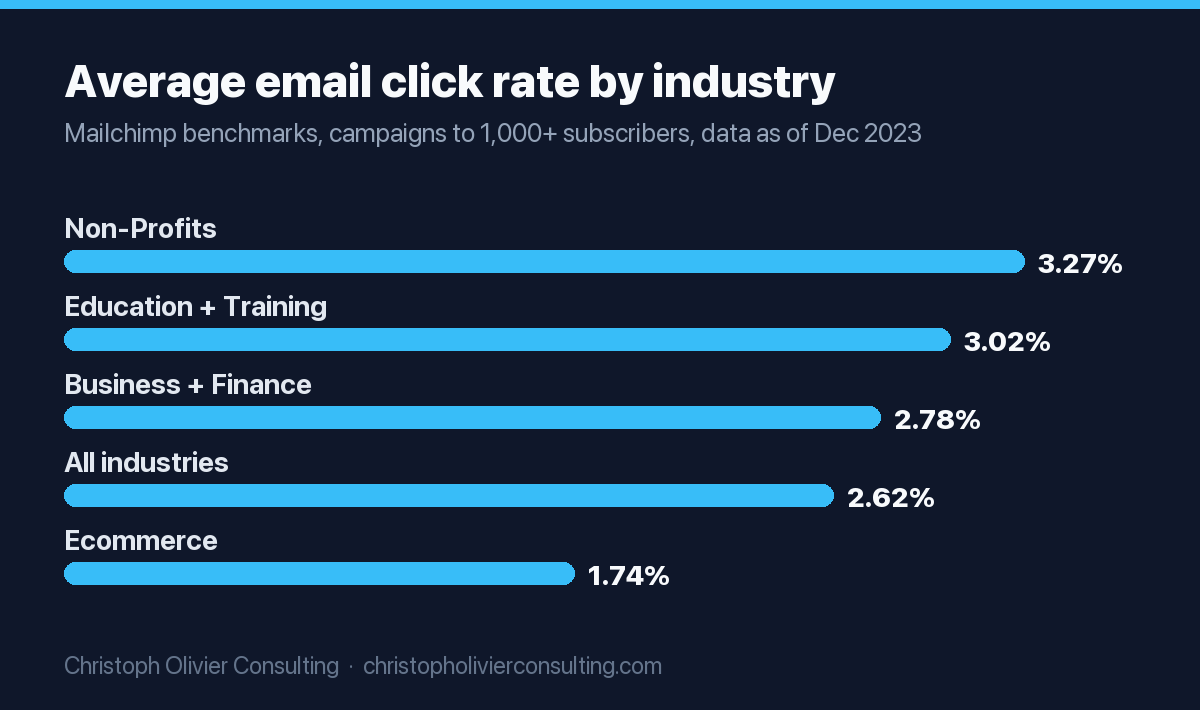
Mailchimp’s published benchmarks put the average open rate across all industries at 35.63% and the average click rate at 2.62%, based on data as of December 2023. Treat open rates as a rough signal only, since Apple’s Mail Privacy Protection can hide whether a message was actually opened.
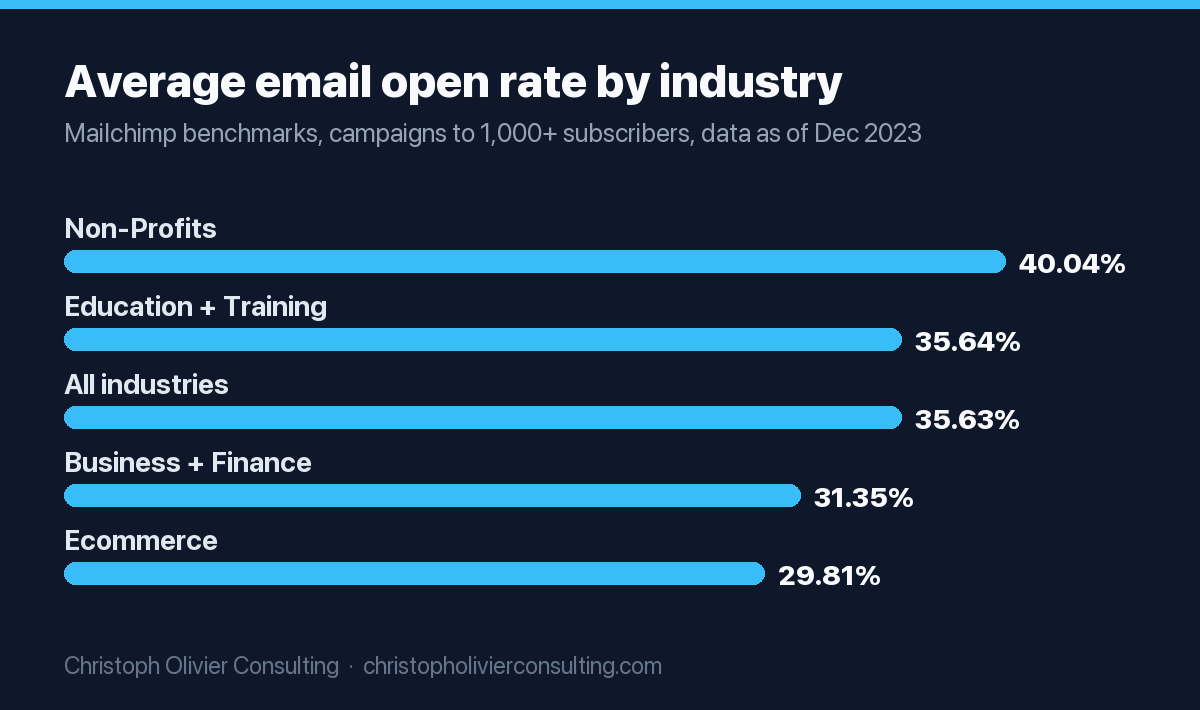
According to Mailchimp’s email marketing benchmarks, the all-industry unsubscribe rate was 0.22%, and the Business and Finance category, the closest match for most professional-service firms, averaged a 31.35% open rate, a 2.78% click rate and a 0.15% unsubscribe rate. The data covers campaigns sent to at least 1,000 subscribers.
The caveat matters. Apple says Mail Privacy Protection “prevents senders from seeing if you’ve opened the email message they sent you,” and that it does not extend to links. That is why clicks and replies are more trustworthy than opens for judging a newsletter.
How to measure whether your newsletter is working
Judge a firm newsletter by what readers do, not what they open. Track clicks per issue, replies, forwards, consultation requests and the number of existing clients who mention it. Opens and list size are context. Pipeline, retention and referrals are the outcomes a professional-service newsletter is there to support.
- Clicks per issue: compare against your own last six issues, not just industry averages.
- Replies: ask one direct question per issue. Replies are the strongest relationship signal in email.
- Consultations or inquiries: tag any lead that cites the newsletter in your CRM.
- Unsubscribes: a spike after a promotional issue tells you the mix tilted too far toward selling.
B2B teams that want to connect these numbers to the wider program can use this guide to B2B email marketing for segmentation and nurture ideas.
A newsletter blueprint for a professional-service firm
A service firm newsletter works best as a monthly or biweekly expert briefing with one main idea, one practical takeaway, a few curated items and a single soft invitation to talk. Build it in seven steps, launch with a small list, and protect the cadence before you try to grow the audience.
- Write the one-line promise. Who it is for and what they get, for example: “The three tax and cash-flow changes that matter to owner-led firms this month.”
- Choose a format from the table above. For most firms that means a fixed-recipe short or an expert-curated digest.
- Name a byline. Put a real partner’s name and photo at the top. People subscribe to people.
- Set a cadence you can keep for a year. Monthly on a fixed day beats weekly for three months and then silence.
- Build a 90-day topic bank. Mine client questions, regulatory deadlines, seasonal decisions and the articles you have already published.
- Set up compliance basics. The FTC’s CAN-SPAM compliance guide requires a valid physical postal address and a clear opt-out, says opt-outs must be honored within 10 business days, and states that the law makes no exception for business-to-business email.
- Review every quarter. Check clicks, replies and inquiries, cut the sections nobody clicks, and expand the ones that start conversations.
Email newsletter template for a service firm
Use this template as a starting skeleton for each issue. It borrows the fixed recipe from Marketing Examples, the “what it means for you” framing from theSkimm and the expert curation of Kitces. Once the topic bank exists, a partner can usually fill it in one sitting.
Subject line: [Specific benefit or change], under about 50 characters. Example: “3 changes to check before year-end”
Preview text: One sentence that finishes the subject line’s thought.
1. Opening (2 to 3 sentences): What happened or what clients keep asking, written in plain English, signed by a named partner.
2. The main idea (200 to 400 words): One topic. What it is, who it affects, and “what this means for you” in three bullet points.
3. One action to take this month: A single, concrete step the reader can do without hiring you.
4. Worth reading (3 links): Curated items, each with one line of your judgment on why it matters.
5. Question of the month: Ask readers to hit reply with their situation. Answer the best one next issue (with permission and no identifying detail).
6. Soft invitation: One line, such as “If this applies to you, reply and we will point you in the right direction.”
Footer checklist: physical postal address, working unsubscribe link, reason they are receiving it, link to the archive.
Before you send, run this quick checklist:
- Could a client act on this issue without calling you?
- Is there exactly one call to action?
- Does every claim or figure link to its original source?
- Does it read well on a phone with images turned off?
Common newsletter mistakes to avoid
Most firm newsletters fail for the same few reasons: they talk about the firm instead of the reader, they cover too many topics, they arrive irregularly, and they sell in every issue. Fixing these rarely needs new tools. It needs a clearer promise, a tighter format and a calendar someone owns.
- The firm-news trap. New hires and awards belong in a footer line, not the lead story.
- Irregular sends. A newsletter that disappears for months has to rebuild trust each time.
- Unverified claims. In advice-led fields, one wrong figure costs more credibility than ten good issues earn.
In my experience, the firms that get the most from a newsletter are the ones that treat it as a standing conversation with clients rather than a broadcast. If you want a second opinion on which format and cadence would suit your firm, you can book a consultation and we can map it out together.
Frequently asked questions
What are the best email newsletter examples?
Strong examples in 2026 include Morning Brew and TLDR for daily briefings, Stratechery, Lenny's Newsletter and The Pragmatic Engineer for paid analysis, First Round Review and Marketing Examples for B2B, and HBR's Management Tip of the Day and Kitces Weekend Reading for professional audiences. Each has one clear promise, a fixed format and a cadence it keeps.
What is a good B2B newsletter example?
First Round Review is one of the clearest B2B newsletter examples. The venture firm sends a weekly email of long, tactical articles, roughly 5,000 words each, and never pitches its own services. The quality of the content is the proof of expertise, which is the same job a professional-service firm newsletter should do for its partners.
How often should a professional-service firm send a newsletter?
Send as often as you can sustain for at least a year. For most service firms that is monthly or every two weeks on a fixed day. Daily and weekly formats work for media brands with editors, but a firm that goes quiet after a few months loses more trust than it gains from a burst of frequent issues.
What is a good open rate for an email newsletter?
Mailchimp's benchmarks, based on data as of December 2023, put the all-industry average open rate at 35.63% and Business and Finance at 31.35%. Treat opens as a rough signal, because Apple's Mail Privacy Protection can stop senders from seeing whether a message was opened. Clicks, replies and inquiries are more reliable measures.
What should a firm newsletter include?
A useful firm newsletter includes a specific subject line, a short opening from a named partner, one main idea with what it means for the reader, one action to take, a few curated links with your commentary, a reply prompt and a single soft invitation. The footer needs a physical postal address and a working unsubscribe link.
Do B2B newsletters have to follow CAN-SPAM?
Yes. The FTC's CAN-SPAM compliance guide says the law makes no exception for business-to-business email. Commercial messages need a valid physical postal address and a clear way to opt out, and opt-out requests must be honored within 10 business days. Each violating email can carry penalties of up to $53,088.
More Funnels & Email guides
- Email Newsletter Strategy: How to Grow an Audience and Pipeline
- What Is a Sales Funnel? Anatomy & Examples
- Product Funnel: How to Sequence Your Offers From Lead Magnet to Premium
- Best Email Marketing Platforms for Small Business: How to Choose
- Funnel Marketing Agency: What They Do, When to Hire One, and How to Choose
- Conversion Funnel Optimization Audit
- All Funnels & Email guides →