
Last reviewed: October 2026

Starting a marketing consulting business takes five moves: pick a niche where you can prove results, package one clear offer with a price, set up the legal and tax basics (structure, EIN, contracts, insurance), win your first two or three clients through your network, and only then add subcontractors or a team. Most solo consultancies can launch in 30 to 60 days with low upfront cost, because the product is your expertise.
This guide covers each step in order, with verified pricing benchmarks, the US legal and tax setup from SBA and IRS sources, a tools stack, a launch checklist and an illustrative first-year financial model. It works whether you want to stay a solo consultant or grow into a small agency.
Consultant, freelancer or agency: what are you actually starting?
A marketing consultant sells judgment: strategy, audits, roadmaps and oversight. A freelancer sells execution in one skill. An agency sells execution at scale with a team. Decide which you are starting before anything else, because the choice sets your pricing model, your hiring needs and how many clients you can carry.
| Model | What the client buys | Typical pricing | Team needed at launch | Main constraint |
|---|---|---|---|---|
| Marketing consultant | Strategy, audits, plans, advisory | Project fee or advisory retainer | Just you | Your calendar |
| Freelance marketer | Hands-on work in one channel (SEO, ads, email, content) | Hourly, per deliverable or small retainer | Just you | Billable hours |
| Fractional CMO | Part-time marketing leadership and ownership of results | Monthly retainer | You, plus vetted specialists | Seniority and track record |
| Small agency | Done-for-you execution across channels | Retainers and projects | 2 or more people, or white-label partners | Margins and delivery quality |
If you are coming from a hands-on channel role, the freelance digital marketer path is often the fastest first step, and many consultants move up to advisory work once they have case studies. If you have led a marketing function, a part-time leadership offer like fractional marketing usually commands a higher monthly fee than channel work.
Starting a marketing consulting business: the 7-step roadmap
The fastest path is sequential: niche, offer, price, legal setup, tools, first clients, then team. Each step depends on the one before it. You cannot price well without a defined offer, and you cannot write a tight contract until you know exactly what you deliver. Expect about 30 to 60 days for the first five steps.
- Choose a niche. Pick one industry or one problem where you already have proof.
- Design one core offer. A fixed-scope entry project plus an ongoing retainer.
- Set your pricing. Anchor to value and market benchmarks, not your old salary.
- Handle legal and tax setup. Structure, EIN, bank account, contract template, insurance, estimated taxes.
- Build a lean tools stack. CRM, proposals, invoicing, scheduling, reporting.
- Win your first clients. Warm network first, then content and referrals.
- Add capacity. Subcontract or white-label delivery before you hire employees.
Step 1: Pick a niche you can prove
Your niche is the intersection of a buyer you understand, a problem they pay to solve, and evidence that you have solved it. A narrow niche makes referrals easier, sharpens your content and lets you charge more because you compare against generalists. Choose by proof and access, not by what sounds trendy.
Score two or three candidate niches. The one with the most “yes” answers usually wins.
- Proof: Do you have one result or metric you can show (with permission)?
- Access: Can you name 20 people in this market you could message this week?
- Budget: Do these businesses already spend on marketing, or would you have to sell the category first?
- Urgency: Is the problem tied to revenue (leads, pipeline, retention) rather than “brand awareness”?
- Repeatability: Could you deliver the same core engagement to 10 clients with small changes?
You can niche by vertical (marketing for law firms) or by function (paid search for B2B software). Vertical niches tend to make referrals easier; functional niches tend to make delivery more repeatable. Either works if you can prove it.
Positioning: how to stand out when starting an online marketing agency
Positioning is the one sentence that tells a buyer who you serve, what result you deliver and why you are the safer choice. Specific beats broad: “paid search for multi-location dental groups” is easier to buy than “full-service digital marketing.” Fill in this template until it sounds like something a client would repeat:
I help [specific buyer] who [specific situation or pain] get [measurable outcome] through [your method], unlike [the default alternative they are considering].
Back it with three proof assets: one detailed case study, one framework or process page, and one piece of content that answers your buyers’ most common question. In my view, one strong case study with real numbers (and client permission) beats a large portfolio of generic samples.
Step 2: Build your offer and choose a pricing model
Package your work as a defined offer before you price it. The simplest structure that works: a paid diagnostic or strategy project (two to six weeks) that leads into a monthly retainer. Then pick a pricing model that matches how value shows up for the client, not how many hours you spend.
Pricing models compared
| Model | How it works | Best for | Risk to you | Risk to client |
|---|---|---|---|---|
| Hourly | Bill time at a set rate | Unclear scope, small ad hoc work | Income capped by hours; penalizes speed | Open-ended cost |
| Project (fixed fee) | One price for a defined deliverable | Audits, strategy, launches, website projects | Scope creep if the contract is loose | Low, cost known upfront |
| Monthly retainer | Fixed monthly fee for ongoing scope or access | Ongoing management, fractional leadership | Overservicing if scope is vague | Paying for a slow month |
| Value-based | Price set against the expected business outcome | Clear, measurable revenue impact | Needs strong discovery and trust | Higher headline price |
| Tiered packages | Two or three scoped levels at set prices | Productized services, faster sales | Packages can be too rigid | Low, easy to compare |
Tiered packages deserve special attention for new consultancies, because they let the buyer choose instead of negotiate. The good, better, best pricing structure is a practical way to set them up.
What marketing consultants and agencies charge
Published rate data is thin and self-reported, so treat these as directional, not a price list. These are the benchmarks I could verify at the source:
| Source | Finding | Caveat |
|---|---|---|
| Credo pricing survey: consultants | Average digital marketing consultant rate of $141.67 per hour. 73.49% have a monthly retainer minimum under $3,000; 34.94% are under $1,000. 69.44% have a single-project minimum under $3,000. | Survey data appears to date from 2019; page last updated 2023. No sample size published. |
| Credo pricing survey: agencies | About 50% of agencies have a retainer minimum of $2,000 per month or less; 13.5% are above $5,000. 49.88% of agencies do not bill by the hour. | 2019 survey, page updated 2022. |
| SE Ranking SEO pricing survey | 260 agencies. 53% prefer monthly retainers over other models. 45% charge $50 to $100 per hour; in the US and Canada, 40% charge over $125 per hour. | SEO agencies only, published December 2024; the authors note the sample may not be statistically significant. |
Two takeaways. Retainers are the dominant model, so build your offer around one. And low minimums are common, so a specialist with proof does not need to compete at the bottom. Price from the client’s outcome, then sanity-check against these ranges. Seeing those ranges from the buyer’s side helps, and our breakdown of marketing consulting services sets out scope, engagement models and pricing.
Step 3: Legal and tax setup for a marketing consulting business (US)
In the US, you can legally start as a sole proprietor with no formation filing, but most consultants form an LLC to separate business and personal liability. Then get a free EIN from the IRS, open a business bank account, sign every client to a written contract, buy professional liability insurance and plan for quarterly estimated taxes.
This is general information, not legal or tax advice. Rules vary by state, so confirm details with an attorney and a CPA.
Sole proprietorship vs LLC
According to the SBA’s business structure guide, you are automatically a sole proprietor once you do business without registering another entity, and you “can be held personally liable for the debts and obligations of the business.” An LLC is formed by filing articles of organization with your state, and the SBA notes that LLCs “protect you from personal liability in most instances.” Either way, the SBA says LLC members “are considered self-employed and must pay self-employment tax.”
The setup sequence
- Choose your structure and, if forming an LLC, file with your state and write an operating agreement (the SBA recommends one even where not required).
- Get an EIN directly from the IRS. The IRS EIN page states “You never have to pay a fee for an EIN” and warns against websites that charge for one.
- Open a business bank account and run every client payment and business expense through it.
- Write a contract template covering scope, deliverables, fees, payment terms, revision limits, IP ownership, confidentiality, termination notice and limitation of liability. Have an attorney review it once.
- Buy insurance. The SBA’s insurance guide describes professional liability coverage as protection “against financial loss as a result of malpractice, errors, and negligence,” which is the main risk for advice-based work. General liability is a separate policy.
- Plan for self-employment and estimated taxes. The IRS self-employment tax page sets the rate at 15.3% (12.4% Social Security and 2.9% Medicare) once net earnings reach $400. The IRS estimated taxes page says individuals, including sole proprietors, generally must pay quarterly if they expect to owe $1,000 or more.
Simple habit: move a fixed share of every client payment into a separate tax account the day it lands, at a percentage your CPA sets.
Step 4: Your tools stack and startup costs
A new marketing consultancy needs surprisingly little software: a professional domain and email, a CRM, a way to send proposals and contracts, invoicing and bookkeeping, scheduling and a reporting tool. Many of these have free or low-cost tiers, so startup costs are usually driven by insurance, legal review and your website rather than software.
| Category | What it does | Start with | Upgrade when |
|---|---|---|---|
| Domain, website, email | Credibility and inbound | A one-page site with your niche, offer, proof and booking link | You publish case studies and content weekly |
| CRM | Track prospects and follow-ups | A free CRM tier or a simple spreadsheet | You have more than 30 active conversations |
| Proposals and e-signature | Send scope and get signed contracts | A proposal template plus an e-sign tool | You send more than a few proposals a month |
| Invoicing and bookkeeping | Get paid, track expenses for taxes | Accounting software connected to your business bank | You add contractors or sales tax obligations |
| Scheduling | Book discovery calls without email ping-pong | A booking link on your site and email signature | You run group sessions or a team calendar |
| Project management | Deliver on time across clients | A shared board per client | You add subcontractors |
| Reporting | Show results to clients | A dashboard built on the client’s analytics and ad accounts | Clients want monthly automated reports |
Check current pricing with each vendor, since tiers change often. Work inside the client’s own ad, analytics and CRM accounts wherever possible, so they keep their data if the engagement ends.
Step 5: How to get your first marketing consulting clients
Your first clients almost always come from people who already know you: former employers, colleagues, vendors and past clients. Message them directly with a specific offer, ask for introductions, and turn every early win into a case study. Content and referrals compound later, but the warm network pays the first invoices.
A first-30-days outreach plan:
- List 50 people who have seen your work or sit near your niche.
- Send short, personal messages: what you now do, who it is for, and one specific problem you solve. No attachments.
- Offer a paid diagnostic with a clear deliverable, not a free “pick my brain” call.
- After every conversation, ask: “Who else do you know dealing with this?”
- Publish one useful post a week on the platform your buyers read, based on questions you heard on calls.
- Get a written testimonial and permission to share results at the end of every project.
For a deeper playbook, including scripts and channel choices, read how consultants get their first clients.
The Ahrefs video in this section, from the company’s official channel, is a case study of an SEO consultant who built an agency on inbound from sharing his work in public, including how he went full time and raised his retainer prices.
How to start a marketing agency from a solo practice: hire, subcontract or white-label
Add capacity when you are consistently turning work down or your delivery quality is slipping, not before. Start with subcontractors or white-label partners for execution, keep strategy and the client relationship yourself, and hire employees only once retainer revenue is stable enough to cover salary through a slow quarter.
The usual order is:
- Specialist subcontractors for overflow (a designer, copywriter, ads specialist).
- White-label partners for whole service lines you sell but do not deliver, such as SEO or paid media. A good white-label digital marketing partner lets you add a service without adding payroll.
- A first employee, usually an account manager or a generalist operator, once the pipeline is predictable.
Be careful with worker classification. The IRS guidance on contractors vs employees looks at the entire relationship across three categories: behavioral control, financial control and the type of relationship. If you control someone’s hours, tools and methods like an employee’s, they may be one, whatever the contract says.
First-year financial model: a worked example
A useful first-year model starts with a few retainers ramping up over twelve months, subtracts tools, insurance, contractor and marketing costs, then sets aside self-employment and income tax. The example below is illustrative only. The numbers are assumptions to show the math, not a forecast or a typical result.
Assumptions: one $2,500 monthly retainer in months 1 to 3, two in months 4 to 6, three in months 7 to 12, plus one $5,000 strategy project in Q4.
| Line item | Q1 | Q2 | Q3 | Q4 | Year |
|---|---|---|---|---|---|
| Retainer revenue | $7,500 | $15,000 | $22,500 | $22,500 | $67,500 |
| Project revenue | $0 | $0 | $0 | $5,000 | $5,000 |
| Total revenue | $7,500 | $15,000 | $22,500 | $27,500 | $72,500 |
| Software and tools | $750 | $750 | $750 | $750 | $3,000 |
| Insurance, legal, formation, accounting (assumed) | $2,000 | $400 | $400 | $500 | $3,300 |
| Subcontractors | $0 | $1,500 | $3,000 | $3,500 | $8,000 |
| Marketing and events | $500 | $500 | $500 | $500 | $2,000 |
| Net profit before tax | $4,250 | $11,850 | $17,850 | $22,250 | $56,200 |
Self-employment tax at 15.3% on $56,200 would be about $8,600, before income tax. (Schedule SE applies the rate to a slightly reduced base, and half of SE tax is deductible for income tax, so your CPA’s number will be a bit lower.) That leaves roughly $47,600 before income tax, with no employer health insurance or retirement match.
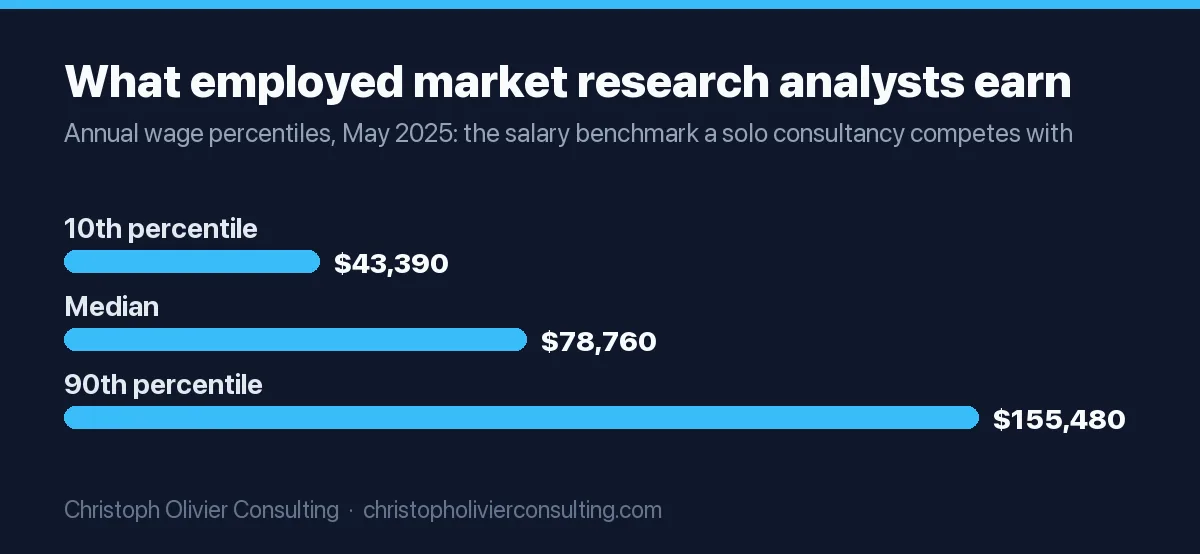
Now compare that to employment. The BLS Occupational Outlook Handbook lists a median wage of $78,760 for market research analysts in May 2025. An employee also has the employer paying half of Social Security and Medicare. The lesson: to beat a salary, you need either more retainers, higher fees or a faster ramp than this example. Three $2,500 retainers is a start, not a destination.
Two levers matter most in year one: price per client and ramp speed. Raising each retainer from $2,500 to $4,000 in the same model would add $40,500 in revenue (27 retainer-months at $1,500 more) with almost no added cost.
Survival odds and the mistakes that sink new consultancies
Most new businesses that fail do so early. Bureau of Labor Statistics data shows about 80% of new US private-sector establishments survive their first year and about half reach year five. For consultants, the usual causes are a vague offer, underpricing, one client providing most revenue and no pipeline activity while delivering.
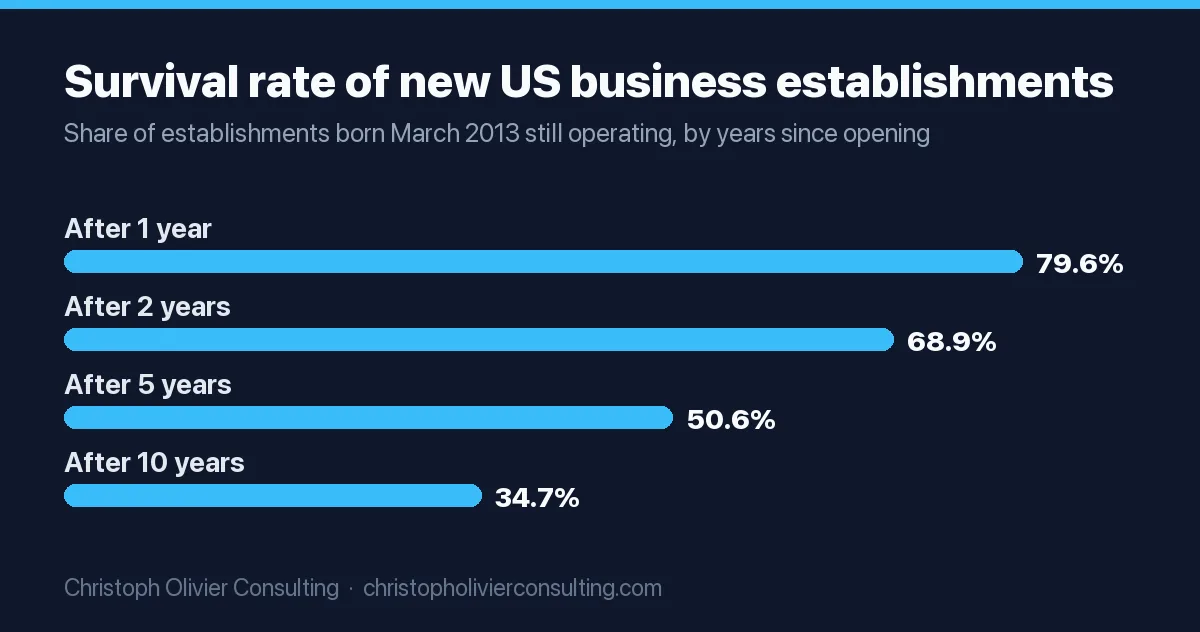
According to BLS Business Employment Dynamics data, of establishments born in March 2013, 79.6% were still operating after one year, 68.9% after two, 50.6% after five and 34.7% after ten. These figures cover all private-sector establishments, not consultancies specifically, but they show where the risk sits.
The avoidable mistakes:
- Selling “marketing” instead of an outcome. Buyers pay for pipeline, leads or launches, not activity.
- Underpricing to win the first deal. Your first rate becomes the client’s reference point.
- Client concentration. If one client is most of your revenue, you have a job without the benefits.
- Stopping outreach once busy. Pipeline dries up exactly when the first retainers end.
- Loose scope. Unlimited revisions and “quick favors” turn a good retainer into a loss.
Launch checklist: your first 60 days
Use this checklist to launch a marketing consulting business in about 60 days. It front-loads the decisions that are hardest to change later (niche, offer, structure) and pushes nice-to-haves like a full website and paid tools until after you have revenue. Tick items off in order.
Days 1 to 14: Decide
- [ ] Niche chosen and scored against proof, access, budget, urgency and repeatability
- [ ] Positioning sentence written and tested on 3 people in the niche
- [ ] Core offer defined: entry project plus retainer, with scope and deliverables
- [ ] Prices set for each tier
Days 15 to 30: Set up
- [ ] Structure chosen (sole proprietor or LLC filed)
- [ ] EIN obtained free from IRS.gov
- [ ] Business bank account and tax savings account open
- [ ] Contract template reviewed by an attorney
- [ ] Professional liability insurance quote compared and bound
- [ ] One-page website, booking link and CRM live
Days 31 to 60: Sell
- [ ] 50 warm outreach messages sent
- [ ] 10 discovery calls held
- [ ] First paid diagnostic or project signed
- [ ] Weekly content habit started
- [ ] Estimated tax schedule set with your CPA
If you would like a second opinion on your niche, offer or pricing before you launch, you can book a consultation and we can pressure-test the plan together.
Frequently asked questions
How do I start a marketing consulting business with no clients?
Start with your warm network. List 50 former colleagues, employers, vendors and contacts in your niche, message each one personally with a specific offer, and propose a paid diagnostic instead of a free call. Ask every contact for introductions. Turn your first project into a case study with the client's permission, then publish weekly content built from the questions you hear on calls.
How much does it cost to start a marketing consulting business?
Startup costs are usually low because you sell expertise, not inventory. The main costs are state LLC filing fees if you form one, an attorney review of your contract template, professional liability insurance, a simple website and a few software subscriptions. An EIN from the IRS is free. Check your state's filing fee and get insurance quotes, since both vary widely.
Do I need an LLC to be a marketing consultant?
No. In the US you are automatically a sole proprietor once you start doing business, with no formation filing. The SBA notes that sole proprietors can be held personally liable for business debts, while an LLC protects you from personal liability in most instances. Many consultants form an LLC for that separation. LLC members still pay self-employment tax.
How much should a new marketing consultant charge?
Price from the client's outcome and your niche, then check against benchmarks. Credo's pricing survey reported an average digital marketing consultant rate of $141.67 per hour, and SE Ranking found 40% of US and Canadian SEO agencies charge over $125 per hour. Most consultants package work as a fixed-fee project leading into a monthly retainer rather than billing hourly.
What is the difference between a marketing consultant and a marketing agency?
A marketing consultant mainly sells strategy, audits and advisory, usually as one person, and is limited by calendar time. An agency sells done-for-you execution across channels with a team, so it is limited by margins and delivery quality. Many people start as a solo consultant and grow into an agency by adding subcontractors or white-label partners.
How long does it take to start a marketing consulting business?
The setup itself can take 30 to 60 days: about two weeks to choose a niche, offer and pricing, two weeks for legal setup, insurance and tools, and the rest for outreach. Landing steady retainer income usually takes longer and depends on your network, niche and pricing. Keep doing outreach even after the first clients sign.
Do marketing consultants need insurance?
Insurance is not always legally required for a solo consultant without employees, but it is strongly advisable. The SBA describes professional liability insurance as protection against financial loss from malpractice, errors and negligence, which is the main risk in advice work. Some clients also require proof of coverage in their contracts. Compare quotes from licensed agents before you sign your first client.
More Growth Consulting guides
- How to Create a Marketing Plan (Step by Step, With Template and Example)
- Logo Design Cost in 2026: What You Pay by Source
- Business Growth Strategies That Compound
- Catering Business Marketing: The Channels That Actually Book Events
- Marketing Intelligence Software: What It Is, How It Differs From Analytics and BI, and How to Choose
- Online Marketing Consultants: 2026 Costs, Comparisons and How to Choose
- All Growth Consulting guides →