

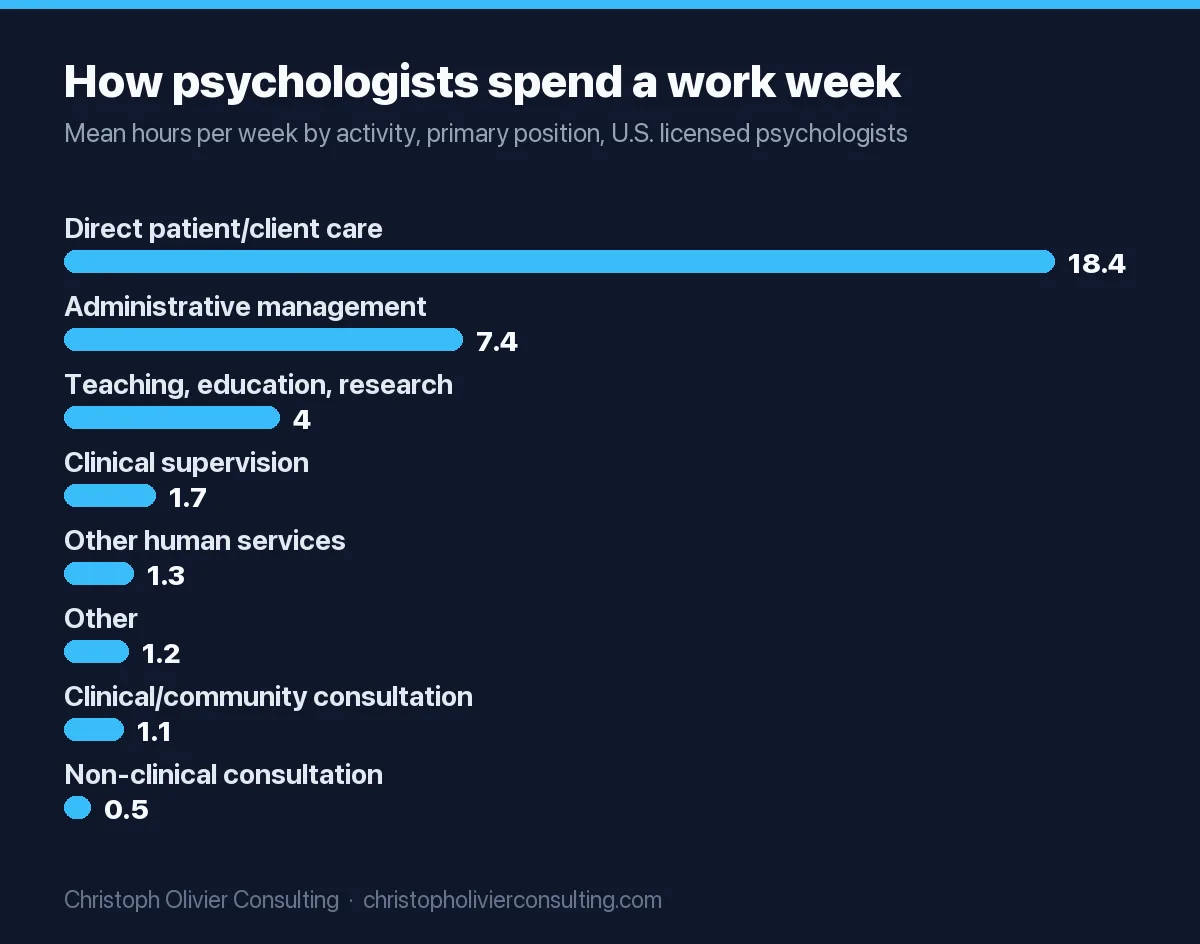
A full-time therapist typically sees about 20 clients a week, and 25 is a common target in private practice. The best national data point comes from the American Psychological Association’s 2015 survey of more than 5,000 licensed psychologists: a median of 20 hours a week of direct patient care (mean 18.4) inside a median 40-hour work week. In community mental health, a study of 733 Los Angeles County agency therapists found an average caseload of 14 clients at 41 hours of total work a week.
Below you will find every published number we could verify, split by setting and license type, the difference between “caseload” and “sessions per week”, a caseload-to-income calculator with each input explained, and the marketing math for how many inquiries it takes to fill a caseload.
Short answer: Most full-time therapists hold 20 to 25 client sessions a week. APA survey data puts licensed psychologists at a median of 20 direct-care hours a week, and APA’s 2024 practitioner survey counts 31 or more client hours a week as full-time. Above 30 sessions a week is the high end, and published research ties larger caseloads to emotional exhaustion.
What the published data says about therapist caseloads
Most pages that answer this question repeat “15 to 30 clients a week” without a source. Here is what the primary sources actually measured. Read the “what it measures” column carefully: hours of direct care, active caseload and sessions per week are three different numbers.
| Figure | What it measures | Who | Period | Source |
|---|---|---|---|---|
| 18.4 hours mean, 20 hours median | Direct patient/client care per week, primary position | U.S. licensed doctoral psychologists (5,000+ respondents) | 2015 | APA Center for Workforce Studies, Table 11 |
| 36.0 hours mean, 40 hours median | Total hours worked per week, primary position | Same survey | 2015 | APA 2015 HSP survey |
| 7.4 hours | Administrative management per week (mean) | Same survey | 2015 | APA, Table 11 |
| 48.3 weeks mean, 52 median | Weeks worked per year | Same survey | 2015 | APA 2015 HSP survey |
| 14.02 clients (SD 8.57, range 0 to 44) | Active caseload: number of clients the therapist serves | 733 community mental health therapists, 65 agencies, Los Angeles County | 2015 survey, published 2018 | Kim et al., Professional Psychology: Research and Practice |
| 41.18 hours (SD 8.13) | Total weekly hours of work | Same 733 therapists | 2015 | Kim et al. |
| 75% of work hours | Minimum time on client-related recorded services (“Sustainability Standard”) | Clinical staff, Monterey County Behavioral Health (psychologists, social workers, psychiatrists, nurses) | Policy revised 2019 | Monterey County Policy 145 |
| 35+ hours, or 31+ client hours | APA’s definition of “working full-time” | APA practitioner survey qualifier | 2024 | APA 2024 Practitioner Pulse topline |
| 20 or 25 appointments | “Standard” weekly schedule for a full-time therapist (expert opinion, not survey data) | Headway clinical engagement lead | 2024 | Headway |
Two things stand out. First, the 20-hour median for psychologists is the closest thing to a national “sessions per week” figure, because direct care for most of them is mainly therapy and assessment hours. Second, the community mental health caseload of 14 looks low until you see the 41-hour week: agency therapists in that study also logged travel for client contact (2.5 hours a week on average), supervision (2.5 hours) and outcome monitoring (1.6 hours), and many serve children and families, where one case can mean several contacts.
Caseload vs sessions per week: why the numbers never match
“Caseload” is how many active clients you carry. “Sessions per week” is how many appointments land on your calendar. They only match if every client comes weekly. Headway’s clinical team makes the same point: a therapist scheduling 20 or 25 appointments a week may carry 40 or 50 people if most clients come every other week or monthly.
Use this conversion to translate one into the other:
| Client frequency | Clients on caseload | Sessions per week each | Weekly sessions |
|---|---|---|---|
| Weekly | 15 | 1.0 | 15.0 |
| Every other week | 10 | 0.5 | 5.0 |
| Monthly | 4 | 0.23 (1 ÷ 4.33 weeks) | 0.9 |
| Total | 29 clients | about 21 sessions |
So when a colleague says “I have 30 clients” and another says “I see 20 a week,” they may be describing the same schedule. When you set your own target, set it in weekly sessions, because that is what drives both your energy and your income.
How many clients a therapist sees by setting: private practice, group practice, community mental health
No national survey publishes weekly sessions by work setting for all license types. What exists is setting-specific evidence, summarized here, with the gaps stated plainly.
| Setting | Who sets the number | Best published evidence | What it implies for a 40-hour week |
|---|---|---|---|
| Solo private practice | You | 45% of licensed psychologists work in private practice (25.5% individual practice); the group as a whole reports a median 20 direct-care hours a week (APA 2015, Tables 5a and 11) | About 20 sessions plus 7 or more hours of admin, notes and marketing |
| Group practice (W-2 or 1099) | Owner, in the contract | 8.5% of psychologists name group psychological practice as their main setting (APA 2015, Table 5a). We found no published survey of group-practice session quotas. | Read your contract: the quota is usually stated as booked or kept sessions per week |
| Community mental health agency | Agency productivity standard | Mean caseload 14 at 41 hours a week (Kim et al. 2018); Monterey County requires at least 75% of work hours on client-related recorded services (Policy 145) | About 28 hours of client-related time in a 37.5-hour week (the policy’s own example uses 7.5 working hours a day), which includes case management and documentation, not only sessions |
| Insurance-billing platforms (Headway, Alma, Grow, Rula) | You | Headway’s clinical lead calls 20 or 25 appointments a week standard (Headway); the article cites no measured average or methodology | Same as solo practice, minus billing admin |
The Monterey County policy is worth reading in full if you work in an agency, because it shows how a “productivity” percentage becomes a workload. Its own worked example: an LCSW working full time had 9,450 available minutes in a month, logged 6,908 minutes of client services plus 480 minutes of peer review, and hit 78%, just above the 75% standard. New hires are not expected to meet the standard in their first two months.
Therapist caseload by license type: psychologist, LPC, LCSW, MFT
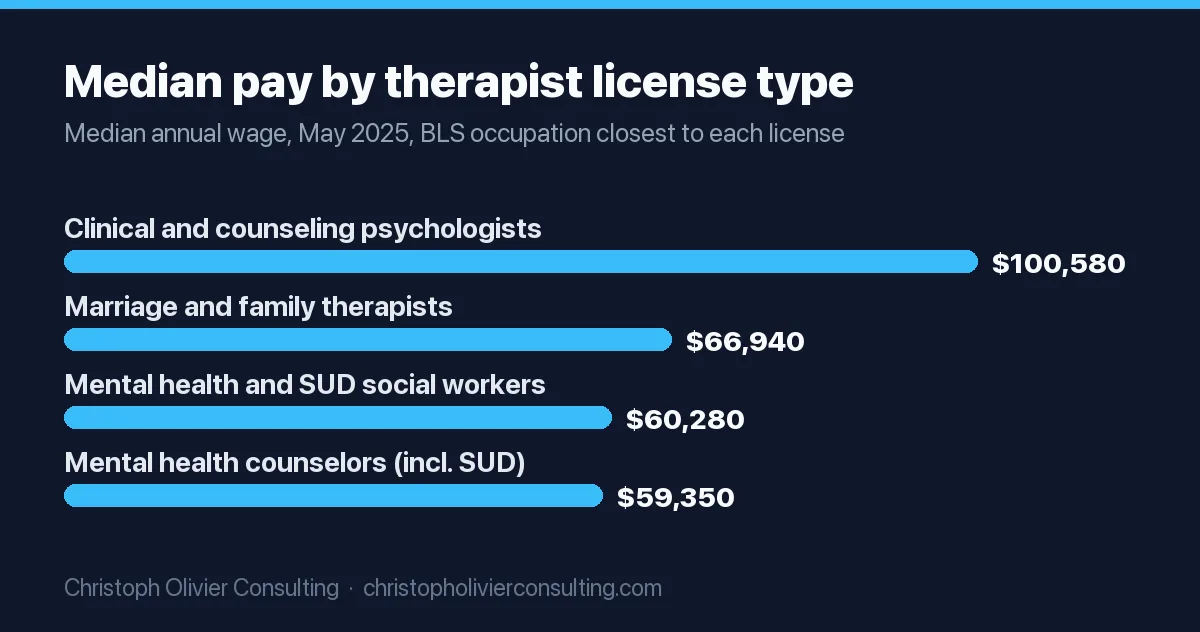
Here is the honest state of the data: only psychologists have a national survey of weekly direct-care hours (the APA one above). For licensed professional counselors (LPC or LMHC), clinical social workers (LCSW) and marriage and family therapists (MFT), the federal data covers headcount and pay, not sessions. That still tells you something useful, because pay per session is the other half of the caseload question.
| License | BLS occupation | Jobs, 2025 | Median annual wage, May 2025 | Medicare 2026 national amount, 90837 (60-min therapy) |
|---|---|---|---|---|
| Psychologist (PhD, PsyD) | Clinical and counseling psychologists | 81,300 | $100,580 | $167.00 |
| MFT / LMFT | Marriage and family therapists | 76,300 | $66,940 | $125.25 (75% of the psychologist amount) |
| LCSW | Mental health and substance abuse social workers | 138,900 | $60,280 | Not covered by the CMS page we used |
| LPC / LMHC | Substance abuse, behavioral disorder and mental health counselors | 533,400 | $59,350 | $125.25 (75% of the psychologist amount) |
The Medicare figures come from the CMS 2026 physician fee schedule relative value file (RVU26D): 90837 carries 5.00 non-facility RVUs, multiplied by the 2026 conversion factor of $33.4009, before geographic adjustment. 90834 (45 minutes) works out to $113.90. CMS states that since January 1, 2024, MFTs and mental health counselors bill Medicare directly at 75% of what a clinical psychologist is paid. BLS wages are for employed workers and its counselor category includes substance use counselors, so treat the table as direction, not a precise pay ladder.
The practical takeaway: at a lower rate per session, a counselor or MFT needs more sessions to hit the same income, which is one reason caseloads in master’s-level private practice often sit at the high end of the 20 to 25 range. Olfson and colleagues’ 2025 analysis of national survey data also found social workers and counselors, not psychologists, took a larger share of U.S. psychotherapy between 2018 and 2021.
How many clients does a therapist see per day?
Divide your weekly target by your clinical days. The math is simple, but it shows why many full-time therapists work four clinical days instead of five.
| Weekly sessions | 4 clinical days | 5 clinical days |
|---|---|---|
| 15 | 3.75 a day | 3 a day |
| 20 | 5 a day | 4 a day |
| 25 | 6.25 a day | 5 a day |
| 30 | 7.5 a day | 6 a day |
Add the non-session work. Psychologists in the APA survey spent a mean 7.4 hours a week on administration alone, on top of supervision and consultation. If your notes take 10 minutes a session, 25 sessions adds about 4 hours a week before billing, email or marketing.
Is 30 clients a week a lot?
Yes, by the available data. Thirty sessions a week is 50% above the APA median of 20 direct-care hours and just under the 31 client hours APA uses as its full-time threshold. Three findings are worth knowing before you book a 30-session week:
- Caseload predicts exhaustion on its own. In the Los Angeles County study, therapists’ caseload was strongly associated with emotional exhaustion even after accounting for hours worked, and positive attitudes toward the treatments they delivered did not buffer that effect.
- Burnout is common even at normal loads. In APA’s 2024 practitioner survey, 31.8% of psychologists agreed or strongly agreed “I feel burned out” (23.6% agree, 8.2% strongly agree), and 20% planned to cut their weekly treatment hours in the next 12 months. In APA’s 2022 survey, 45% said they felt burned out.
- Booked is not attended. In a study of 542 psychotherapy patients at a public safety-net hospital outpatient department, 13% of scheduled appointments were missed or cancelled with under 24 hours’ notice. Booking 30 to keep 26 is a different week than keeping 30.
Thirty can work for a short stretch, for a therapist with a narrow niche and fast notes, or for a schedule heavy on biweekly clients. As a permanent default, the data says it sits at the edge.
Caseload-to-income calculator: a worked example
This is the formula behind every “how many clients do I need” decision. Copy it into a spreadsheet and replace the inputs with your own.
Annual session revenue = sessions booked per week × fee per session × weeks worked per year × (1 minus the missed-session rate)
What each input means and the figure used in the example:
- Sessions booked per week: appointments on the calendar, not caseload. Example: 25.
- Fee per session: what you actually collect per kept session, after insurance write-downs. Example: $167.00, Medicare’s 2026 national amount for a 60-minute session (90837), used as a neutral anchor. Your private-pay fee or contracted insurance rate replaces it.
- Weeks worked per year: 52 minus vacation, holidays, sick days and conferences. Example: 48, rounded from the 48.3-week mean in the APA survey.
- Missed-session rate: no-shows plus late cancellations you do not bill. Example: 13%, from the safety-net hospital study above. If you charge and collect a late-cancel fee, lower this number.
Worked example: 25 × $167.00 × 48 = $200,400 booked. × 0.87 (that is, 1 minus 0.13) = $174,348 in annual session revenue, before rent, software, insurance, taxes and any platform or group-practice split.
| Sessions booked per week | Booked revenue (× $167 × 48) | After 13% missed |
|---|---|---|
| 15 | $120,240 | $104,609 |
| 20 | $160,320 | $139,478 |
| 25 | $200,400 | $174,348 |
| 30 | $240,480 | $209,218 |
| 25 at the MFT/counselor Medicare amount ($125.25) | $150,300 | $130,761 |
Run it backwards to set your caseload target from an income goal: sessions needed per week = income target ÷ (fee × weeks × (1 minus missed rate)). A $120,000 goal at a $150 fee, 48 weeks and 13% missed needs 120,000 ÷ (150 × 48 × 0.87) = 19.2, so book 20 a week. That is the reason I tell practice owners to raise the fee or cut the missed rate before adding a 26th slot: both raise income without adding to the caseload that predicts burnout. For fee-setting logic beyond this, our pricing strategy guide covers the mechanics.
How many clients do you need to fill your caseload? The marketing math
A full calendar is a flow, not a number. Clients finish, pause and drop out, so you need a steady stream of new intakes just to stay level. This is where most caseload articles stop and where the business problem starts.
Step 1: estimate how many different clients a year your schedule serves. In national survey data, adults in psychotherapy averaged 11.8 psychotherapy visits per year in 2021 (Olfson et al., American Journal of Psychiatry, 2025). At 25 booked sessions, 48 weeks and 13% missed, you deliver about 1,044 sessions a year. 1,044 ÷ 11.8 = about 88 different clients a year if your clients look like the national average. A long-term-therapy niche will have far fewer; a brief-therapy or assessment practice far more.
Step 2: subtract the clients who carry over from last year. If half of your 88 are continuing clients (an example input, not a benchmark), you need about 44 new clients a year, or roughly 4 a month.
Step 3: plan for early endings. A meta-analysis of 669 studies covering 83,834 clients found a weighted dropout rate of 19.7%, about 1 in 5 (Swift and Greenberg, 2012). The 11.8-visit average already includes dropouts, but it is why one bad intake month shows up in your calendar six weeks later.
Step 4: work the funnel backwards. We found no published, methodology-stated benchmark for therapy inquiry-to-consult or consult-to-intake rates, so the rates below are example inputs. Track your own for 90 days and replace them.
| Funnel stage | Formula | Example input | Example result per month | Your number |
|---|---|---|---|---|
| New intakes needed | New clients per year ÷ 12 | 44 a year | About 4 | |
| Consult calls needed | Intakes ÷ consult-to-intake rate | 60% book an intake | About 7 | |
| Inquiries needed | Consults ÷ inquiry-to-consult rate | 50% of inquiries book a consult | About 14 | |
| Paid search budget if every inquiry came from Google Ads | Inquiries × cost per lead | $141.17 mental health CPL (LocaliQ) | About $1,976 |
Two reality checks on those numbers. APA’s 2022 survey found psychologists were contacted by more than 15 potential new patients a month on average, so 14 inquiries a month is in range for an established psychologist in a high-demand market. In APA’s 2024 survey, 53% of psychologists had no openings for new patients and 39% kept a waitlist. That demand is not evenly spread: a new counselor in a crowded metro starts at zero inquiries, which is why the cost per lead line matters. LocaliQ’s benchmark, drawn from more than 3,500 healthcare campaigns, also found mental health had the lowest conversion rate of its healthcare subcategories (1.85%), so paid search is rarely the cheapest first channel.
The cheaper channels come first: referral relationships with primary care offices, one or two directory profiles and a Google Business Profile. Our guide on how to advertise as a therapist prices each channel, and the mental health marketing guide covers niche pages, ethics rules and HIPAA-safe tracking. To compare the lead cost with other professional services, see our average cost per lead by industry benchmarks.
How to pick your own number
Use the data above as guardrails, then set the number in this order:
- Set the ceiling first. Pick the maximum weekly sessions you can deliver well for 48 weeks. The APA median of 20 direct-care hours and the 31-client-hour full-time line are reasonable bookends.
- Run the income formula. If the ceiling does not meet your income goal, change the fee, the missed-session rate or the payer mix, not the ceiling.
- Convert sessions to caseload. Use your weekly, biweekly and monthly mix to see how many active clients that ceiling means.
- Size the funnel. Estimate yearly new clients from your average course of treatment, then work back to monthly inquiries.
- Recheck every quarter. Monterey County reviews productivity quarterly because weekly numbers swing; you should too.
If you run a group practice and want help building the intake funnel that keeps every clinician at target, you can book a consultation.
Ready to scale your revenue?
Book a free 30-min consultation. We’ll diagnose your growth bottleneck and map out the 3 highest-leverage moves for your business.
Frequently asked questions
How many clients do most therapists see in a week?
Most full-time therapists see about 20 to 25 clients a week. APA's 2015 survey of more than 5,000 licensed psychologists found a median of 20 hours of direct patient care per week (mean 18.4) within a median 40-hour work week. Caseload, the number of active clients, is often higher because some clients come every other week or monthly.
Is 30 clients a week a lot for a therapist?
Yes. Thirty sessions is 50% above the APA median of 20 direct-care hours a week and close to the 31 client hours APA uses to define full-time. A study of 733 community therapists found larger caseloads were strongly associated with emotional exhaustion even after accounting for hours worked. It can work short term, but it is the high end.
What is the average caseload for a full-time therapist in community mental health?
A study of 733 therapists at 65 Los Angeles County community mental health agencies reported a mean caseload of 14 clients (range 0 to 44) at an average of 41 hours of work a week. Agencies usually manage workload through productivity standards: Monterey County, for example, requires clinical staff to spend at least 75% of work hours on client-related recorded services.
How many clients does a therapist see per day?
Divide weekly sessions by clinical days. A therapist booking 20 sessions sees 4 a day over five days or 5 a day over four days; 25 sessions is 5 a day over five days. Add administrative time: psychologists in APA's survey spent a mean 7.4 hours a week on administration on top of direct care.
How many clients does a therapist need to make a living?
Use: sessions per week × fee × weeks worked × (1 minus missed-session rate). At $167 per session (Medicare's 2026 national 90837 amount), 48 weeks and 13% missed, 20 weekly sessions bring about $139,478 in session revenue and 25 bring about $174,348, before overhead and taxes. A $120,000 goal at a $150 fee needs about 20 booked sessions a week.
Is $200 a session a lot for therapy?
It is above Medicare's benchmark. CMS's 2026 fee schedule sets the national amount for a 60-minute psychotherapy session (CPT 90837) at about $167 before geographic adjustment, and $113.90 for 45 minutes (90834). Marriage and family therapists and mental health counselors are paid 75% of the psychologist amount by Medicare. Private-pay fees vary by market and are not tracked nationally.