

Yes, a financial advisor can pay a referral fee, but which rules apply depends on who pays whom. An SEC-registered investment adviser that pays anyone for a referral is running a paid “endorsement” under the SEC Marketing Rule, 17 CFR 275.206(4)-1(b). That means clear and prominent disclosures, a written agreement once payments to that person pass $1,000 in 12 months, and no payments to disqualified people. Broker-dealer reps answer to FINRA Rule 2040 instead, state-registered advisers answer to their state rule, and CFP professionals have their own disclosure duty.
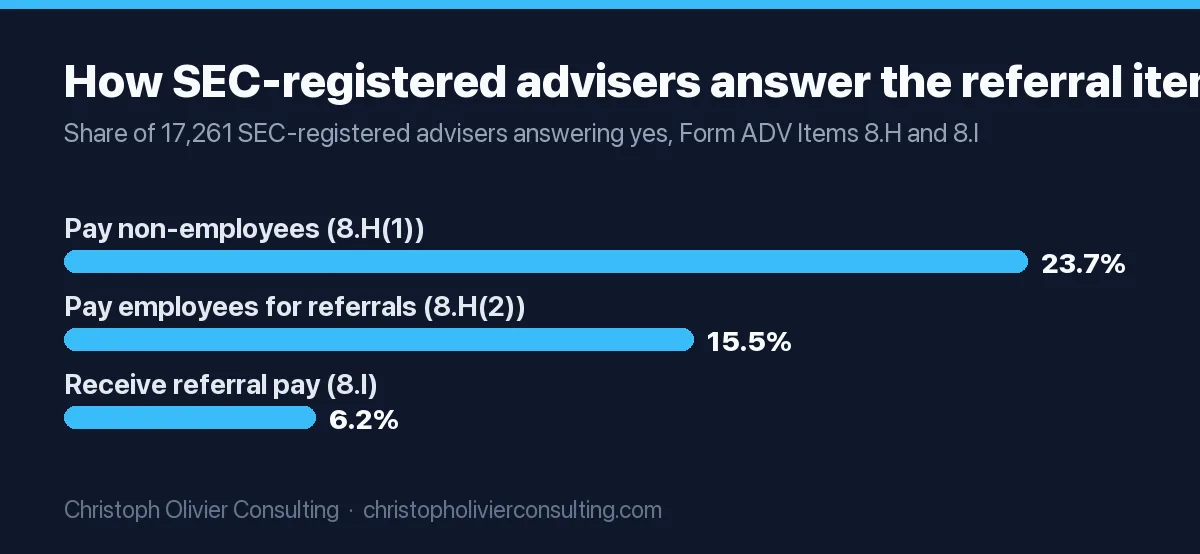
Short answer: Paying for referrals is legal for SEC-registered advisers if they follow Rule 206(4)-1(b): disclose that the referrer is paid, the material terms and the conflicts; sign a written agreement once total pay to that referrer exceeds $1,000 in the preceding 12 months; and never pay an “ineligible person.” The rule took effect May 4, 2021, with mandatory compliance from November 4, 2022, when the old cash solicitation rule, 206(4)-3, stopped applying. In the November 2, 2026 SEC adviser data, 23.7% of SEC-registered advisers said they pay non-employees for client referrals.
This page quotes the rule text itself and links to it, so you can check every line. It summarizes published rules and is not legal advice. Before you sign or pay under a referral arrangement, have your chief compliance officer or securities counsel review it. If you are a CPA wondering whether you can accept the money, the companion page on whether CPA firms can pay or accept referral fees covers the AICPA side.
Who pays whom: the decision table
Most confusion comes from mixing up four separate rulebooks. Find your row first, then read the section it points to.
| Money flow | Allowed? | Controlling rule | What you must do |
|---|---|---|---|
| SEC-registered RIA pays a CPA, attorney, influencer or other non-client for referrals | Yes, with conditions | Rule 206(4)-1(b) (endorsement) | Clear and prominent disclosures; written agreement above $1,000 per 12 months; disqualification check; records under Rule 204-2(a)(15); describe it in Form ADV Part 2A Item 14.B and answer Item 8.H(1) |
| SEC-registered RIA rewards a current client for a referral (gift card, fee credit) | Yes, with conditions | Rule 206(4)-1(b) (testimonial) | Disclosures always apply; at $1,000 or less per 12 months the written agreement and disqualification check are not required |
| SEC-registered RIA pays its own employee a bonus for bringing in clients | Yes | Rule 206(4)-1(b)(4)(ii) | Disclosures and written agreement not required if the affiliation is readily apparent or disclosed and you document the person’s status; answer Form ADV Item 8.H(2) |
| State-registered RIA pays anyone for referrals | Depends on the state | State securities rule (the SEC Marketing Rule applies to SEC registrants) | Often: referrer licensed as an investment adviser representative, written agreement, separate disclosure, signed client acknowledgment (see Iowa and Wisconsin below) |
| Broker-dealer registered rep pays an unregistered person (CPA, friend, realtor) per transaction or account | Only if the recipient would not need broker-dealer registration | FINRA Rule 2040 | No transaction-based pay to anyone who would then need to register as a broker-dealer; payments run through the member firm |
| Advisor receives a fee for sending a client to a CPA, lawyer, bank or product | Yes, with disclosure | Advisers Act Section 206 fiduciary duty; Form ADV Item 8.I; CFP Board Standards | Disclose the conflict before the client acts; a CFP professional who takes it cannot call the firm “fee-only” |
| CPA accepts a fee from the advisor | Yes, with written disclosure (AICPA) | AICPA ET 1.520.001 and 1.520.080 | CPA discloses the fee to the client in writing; state boards can be stricter |
| RIA pays a custodian or matching platform (Schwab Advisor Network, Fidelity Wealth Advisor Solutions, online networks) | Yes, with conditions | Rule 206(4)-1(b), plus Form ADV disclosure | Treat the platform as a paid promoter; disclose the fee, the custody conflict and any transfer fees |
What the SEC Marketing Rule says about paying for referrals
The SEC adopted the Marketing Rule in December 2020 (Release IA-5653, published at 86 FR 13024 on March 5, 2021). The adopting release states that “The Commission is rescinding 17 CFR 275.206(4)-3,” the old cash solicitation rule, and folds referral payments into the new rule. The SEC staff Marketing Compliance FAQ confirms the dates: effective May 4, 2021, compliance required by November 4, 2022, and no mixing (an adviser could not adopt the new advertising provisions while still relying on the old solicitation rule).
Two definitions do the work. An “endorsement” includes any statement by a non-client that “refers any current or prospective client or investor to be a client of” the adviser (Rule 206(4)-1(e)(5)). A “testimonial” is the same thing coming from a current client (e)(17). And under (e)(1)(ii), an “advertisement” includes “any endorsement or testimonial for which an investment adviser provides compensation, directly or indirectly.” So a single paid introduction from a CPA counts, even if it is one email to one person.
“Compensation” is broad. The adopting release lists “fees based on a percentage of assets under management or amounts invested, flat fees, retainers, hourly fees, reduced advisory fees, fee waivers,” directed brokerage, “sales awards or other prizes, gifts and entertainment.” It also says compensated endorsements “may or may not be contingent” on the referral turning into a client.
Rule 206(4)-1(b) then sets three conditions for any paid testimonial or endorsement:
- Disclosures at the time it is disseminated. “Clearly and prominently”: (A) whether the person is a current client or not, (B) “that cash or non-cash compensation was provided,” and (C) “a brief statement of any material conflicts of interest.” Plus, not necessarily in the same prominent spot: “the material terms of any compensation arrangement” and a description of the material conflicts.
- Oversight. The adviser needs “a reasonable basis for believing that the testimonial or endorsement complies,” and “a written agreement with any person giving a testimonial or endorsement that describes the scope of the agreed-upon activities and the terms of compensation for those activities.”
- Disqualification. The adviser “may not compensate a person, directly or indirectly,” if it knows, “or in the exercise of reasonable care should know,” that the person is an ineligible person when the endorsement is disseminated.
The $1,000 de minimis threshold: what it excuses and what it does not
Rule 206(4)-1(e)(2) defines de minimis compensation as “a total of $1,000 or less (or the equivalent value in non-cash compensation) during the preceding 12 months” paid to a person. Under (b)(4)(i), a de minimis payment excuses only two things: the written agreement and the disqualification check. It does not excuse the disclosures or the reasonable-basis oversight. The SEC raised the threshold from the $100 it had proposed, reasoning that $1,000 fits referrals from both professional and non-professional referrers. The adopting release also says it expects “many advisers” running compensated refer-a-friend programs to fall under this exemption.
The threshold is a rolling 12-month total per person, not a per-payment cap. The SEC Division of Examinations’ December 16, 2025 risk alert describes advisers that claimed the exemption “because each time the adviser compensated the promoter, it was for less than $1,000; however, the total compensation exceeded $1,000 during the preceding 12 months.” A $250 gift card every quarter to the same CPA is $1,000. The fifth one needs a written agreement.
Who you cannot pay: the disqualification rule
An “ineligible person” (e)(9) is someone subject to a “disqualifying Commission action” (an SEC order barring, suspending or prohibiting them) or a “disqualifying event” within ten years before the endorsement. Disqualifying events (e)(4) include certain criminal convictions, final orders from state regulators, the CFTC or a self-regulatory organization like FINRA, and SEC cease-and-desist orders for scienter-based fraud or Securities Act Section 5 violations. Matters before May 4, 2021 do not disqualify someone who would have been fine under the old rule.
The staff FAQ added a carve-out on January 15, 2026: if the order is the sole reason the person is ineligible, the self-regulatory organization’s final order did not bar, suspend or expel the person, the person complies with its terms, and every advertisement carrying the endorsement for ten years discloses the order with a link to it, the staff “would not recommend enforcement action.” The December 2025 risk alert shows why the check matters: examiners found promoters “disqualified due to their disciplinary histories with state securities regulators” still receiving pay. Search the referrer in FINRA BrokerCheck and the SEC’s adviser database before the first payment, and again at least yearly.
Records you must keep
Rule 204-2(a)(15) in the Advisers Act books-and-records rule requires: a record of the disclosures given to clients if they were not in the advertisement itself; “documentation substantiating the adviser’s reasonable basis for believing that a testimonial or endorsement” complies; and a list of affiliated people relying on the employee exemption. Under Rule 204-2(a)(11), for compensated oral testimonials and endorsements you may keep a record of the disclosures provided instead of a recording.
Solicitor agreement under the SEC Marketing Rule: what changed and what to put in it
“Solicitor agreement” is old-rule vocabulary, and the requirements changed more than the name. The adopting release describes the old rule as requiring delivery of the adviser’s brochure plus “a separate written solicitor disclosure document at the time of solicitation” and “a signed and dated acknowledgment of receipt.” The new federal rule drops both. At least one large RIA brochure filed in July 2026 still says its solicitor arrangements “comply with the cash solicitation requirements of Rule 206(4)-3.” If your paperwork still says that, update it.
| Requirement | Old cash solicitation rule 206(4)-3 (rescinded) | Marketing Rule 206(4)-1(b) (compliance since Nov. 4, 2022) |
|---|---|---|
| What pay is covered | Cash fees | Cash and non-cash, direct or indirect, including fee waivers, gifts, entertainment and directed brokerage |
| Written agreement | Required for third-party solicitors | Required unless total pay to that person is $1,000 or less in 12 months, or the person is an affiliate |
| Client disclosure | Separate solicitor disclosure document plus Form ADV brochure | Clear and prominent statements at the time of the endorsement, plus material terms and conflicts |
| Signed client acknowledgment | Required | Not required by the federal rule (some states still require one) |
| Small-payment exemption | No de minimis exemption (the 2019 proposal suggested $100) | $1,000 de minimis over the preceding 12 months |
| Bad actors | Paying solicitors with certain disciplinary histories barred | “Ineligible person” with a ten-year lookback and SRO-order carve-out (staff FAQ, Jan. 15, 2026) |
Copy-ready clause list for a promoter (solicitor) agreement. The rule requires only two things in the contract: “the scope of the agreed-upon activities and the terms of compensation.” The other clauses come from the disclosure, disqualification and recordkeeping duties above, and from the risk alert’s findings. Adapt with counsel:
- Parties and status. “[Promoter] is not a client of [Adviser] and is not a supervised person of [Adviser].” (Or state the affiliation.)
- Scope of activities. “Promoter may introduce prospective clients to Adviser by [personal introduction / email introduction / listing on Promoter’s website]. Promoter will not give investment advice about Adviser’s services or any security, will not describe performance, and will not collect client funds.”
- Compensation terms. “Adviser will pay Promoter [X% of advisory fees actually collected from each referred client for [N] years / a one-time fee of $X per referred client who signs an advisory agreement]. Referred clients pay no more than clients who were not referred.”
- Disclosure undertaking. “At the time of each referral, Promoter will give the prospective client the disclosure statement attached as Exhibit A, in the same message or conversation as the referral, in type no smaller than the referral itself. Promoter will not move the disclosure behind a hyperlink.”
- Eligibility representation. “Promoter represents that it is not, and within the past ten years has not been, subject to any disqualifying Commission action or disqualifying event as defined in Rule 206(4)-1(e)(3) and (e)(4), and will notify Adviser within five business days if that changes.”
- State licensing. “Promoter represents that it holds any investment adviser representative registration required by the states where it refers clients, or that an exemption applies.”
- Records and cooperation. “Promoter will provide Adviser copies of referral communications on request, to support Adviser’s records under Rule 204-2(a)(15).”
- Termination. “Either party may end this agreement on written notice. Payments for clients referred before termination continue under Section 3 unless the promoter becomes ineligible.”
Exhibit A, sample promoter disclosure (covers the three “clearly and prominently” items plus material terms): “I am not a client of [Adviser]. [Adviser] pays me [describe pay, e.g., 20% of the advisory fee it collects from you for as long as you remain a client]. Because I am paid when you hire [Adviser], I have a financial incentive to recommend them. [Add any other material conflict, e.g., my firm also receives tax-preparation referrals from Adviser.] Your advisory fee is the same whether or not you were referred.”
State-registered advisers and state licensing of referrers
Rule 206(4)-1 applies to advisers “registered or required to be registered” with the SEC. State-registered advisers follow their state’s rule, and even for SEC registrants the person doing the referring may need a state license. The adopting release says “Most states impose registration, licensing, or qualification requirements on investment adviser representatives who have a place of business in the state,” and “In some states, a third-party solicitor will be subject to state qualification requirements.” A 2009 NASAA model rule notice notes that both the Uniform Securities Act of 1956 and the 2002 Act “include solicitation activity as part of the business that triggers the definition of investment adviser representative.”
Two state examples, quoted from the official texts:
- Wisconsin. The Wisconsin DFI solicitor guide says state rules “require a solicitor to register before contacting potential clients in the state,” and that DFI-Sec 5.066 eliminates “the ability of an investment adviser to pay any solicitor compensation without the written disclosure documents and contractual obligations in place.”
- Iowa. Iowa Admin. Code r. 191-50.37 (version dated Feb. 5, 2025) treats a cash referral fee as fraud unless it is paid under a written agreement that requires the solicitor to hand over the adviser’s brochure plus a separate disclosure with six listed items, and the adviser obtains “a signed and dated acknowledgment of receipt.” It also lists a fee paid “for solicitation activities regarding anything other than impersonal advisory services” among the prohibited cases, so read it with counsel. That is the old federal model, still alive at the state level.
If your referrer is a CPA in another state, check that state’s securities regulator before the first payment. A CPA who refers for pay may also need to register, and their state accountancy board can be stricter than the AICPA code.
Broker-dealer reps: FINRA Rule 2040
If you are a registered representative of a broker-dealer (including dual registrants for brokerage business), the question is different. FINRA Rule 2040(a) says no member or associated person “shall, directly or indirectly, pay any compensation, fees, concessions, discounts, commissions or other allowances to” a person who is not a registered broker-dealer but, “by reason of receipt of any such payments and the activities related thereto,” would be required to register. Regulatory Notice 15-07 set the effective date at August 24, 2015, and describes the rule as governing “the payment of transaction-based compensation” to unregistered persons. FINRA says firms can support that determination with SEC releases, no-action letters or a legal opinion, and that “an annual review for ongoing payments generally would be reasonable.” So a rep should not personally pay a CPA per account or per trade; route any arrangement through your firm’s compliance department and ask what it permits.
CFP professionals: disclosure and the “fee-only” label
The CFP Board Code of Ethics and Standards of Conduct (in force since October 1, 2019) reaches referral fees in two places. When recommending another professional, a CFP professional must “Disclose to the Client, at the time of the recommendation or prior to the Engagement, any arrangement by which someone who is not the Client will compensate or provide some other material economic benefit” for the recommendation. And “Sales-Related Compensation” expressly includes compensation “from the referral of a Client to any person or entity other than the CFP Professional’s Firm,” listing “referral or solicitor fees.” A CFP professional may call the firm “fee-only” only if neither the professional nor the firm receives any Sales-Related Compensation. Paying a promoter does not break fee-only status under that definition; receiving a fee for sending a client to an estate attorney does.
Receiving a referral fee from a CPA, attorney or product provider
Form ADV Part 1A Item 8.I asks every adviser: “Do you or any related person, including any employee, directly or indirectly, receive compensation from any person (other than you or any related person) for client referrals?” Item 8.H asks the paying side. Part 2A Item 14.B requires a narrative: “describe the arrangement and the compensation.”
The SEC’s September 28, 2026 order against Zoe Financial (Release IA-7019) shows the fiduciary risk on the receiving side. Zoe ran a referral network whose member advisers paid it “a portion of investment advisory fees collected” from referred clients. The order found Zoe failed to disclose its incentive to steer clients to advisers using its own platform and misleadingly said it referred people “solely based on that individual’s answer to questions” when, about 46% of the time, clients hired an adviser the algorithm had not initially matched, after a salesperson suggested more names. Penalty: $450,000, censure and a cease-and-desist order under Section 206(2). The lesson for any advisor who takes referral money: disclose every incentive that could change who you recommend, and make sure the description of how you choose is literally true.
What is the standard referral fee for a financial advisor?
No regulator sets a standard rate, and there is no published industry survey of advisor referral fees that I could verify. The best public evidence is what large RIAs disclose in their own Form ADV brochures. These are real 2026 filings, not estimates:
| Program or payer | What the advisor pays (or receives) | Basis | Source |
|---|---|---|---|
| Fidelity Wealth Advisor Solutions (promoter: Strategic Advisers LLC) | 0.25% a year on non-fixed-income assets, 0.10% a year on fixed income, plus a $50,000 annual program fee; one-time 0.75% if a referred account moves away from Fidelity | Disclosed in filed brochures | Mercer Advisors ADV 2A, Mar. 30, 2026; Creative Planning ADV 2A, Mar. 2026 |
| Schwab Advisor Network | Brochures disclose a “Participation Fee” as a percentage of fees or assets with a minimum, paid “for as long as the referred client’s account remains in custody at Schwab,” and a one-time Non-Schwab Custody Fee “higher than the Participation Fees” for a year | Disclosed in filed brochures (no rate stated) | Johnson Investment Counsel ADV 2A, Apr. 2026; Mercer ADV 2A |
| Schwab Advisor Network rate tiers | 0.25% on the first $2 million, 0.20% on the next $3 million, 0.15% on the next $5 million, 0.10% above $10 million, with a 5% increase per tier announced | Reported by the press, Feb. 12, 2025 | InvestmentNews |
| Goldman Sachs Wealth Services referrals | “a portion of the advisory fee earned” from the referred client (rate not disclosed) | Disclosed in filed brochure | Mercer ADV 2A |
| Online matching network (Zoe Financial, per SEC) | “a portion of investment advisory fees collected” from referred clients (rate not stated) | SEC order findings | SEC IA-7019 |
| Lead-generation programs | Per-lead or fixed advertising fees “not contingent upon a prospective client becoming” a client | Disclosed in filed brochure | Savant Wealth Management ADV 2A, July 2026 |
| Advisor receives: deposit program referral (StoneCastle) | 0.05% of the client’s average monthly balance, paid to the advisor | Disclosed in filed brochure | Mercer ADV 2A |
Worked example, using the disclosed Fidelity rates. A referred household has $1.5 million, of which $300,000 is fixed income. Referral fee: 0.10% x $300,000 = $300, plus 0.25% x $1,200,000 = $3,000, so $3,300 a year. If you charge a flat 1%, the household pays you $15,000 a year, and the referral cost is 22% of that revenue, every year the client stays. Using the reported Schwab tiers before the 5% increase, a $3 million household costs 0.25% x $2,000,000 = $5,000 plus 0.20% x $1,000,000 = $2,000, so $7,000 a year, or 23% of a $30,000 fee at 1%. The same arithmetic gives you a benchmark for a private CPA agreement: in these two examples a branded platform costs about a fifth to a quarter of the advisory revenue, every year.
How many advisers actually pay for referrals
I tabulated the SEC’s registered-adviser Form ADV data file dated November 2, 2026 (17,261 SEC-registered advisers that answered Items 8.H and 8.I). Of them, 4,097 (23.7%) said they pay non-employees for client referrals (Item 8.H(1)), 2,675 (15.5%) pay employees referral-based compensation beyond salary (8.H(2)), and 1,073 (6.2%) receive compensation for referring clients elsewhere (8.I). For comparison, the adopting release reported 27% answering yes to Item 8.H(1) as of August 1, 2020. Firms with at least one individual or high-net-worth individual client answered yes to 8.H(1) 26.5% of the time, against 19.2% for firms without them.
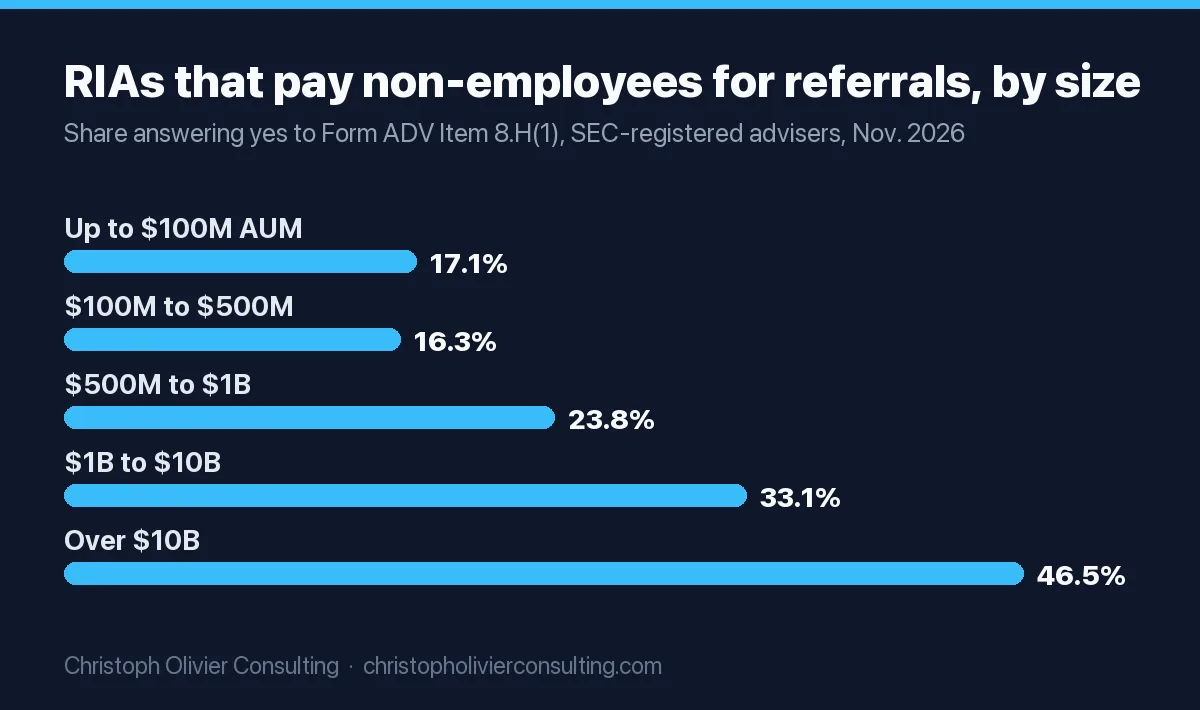
| Regulatory AUM (Form ADV Item 5.F) | Advisers | Pay non-employees for referrals (8.H(1)) | Pay employees for referrals (8.H(2)) | Receive referral pay (8.I) |
|---|---|---|---|---|
| Up to $100 million | 1,818 | 311 (17.1%) | 164 (9.0%) | 124 (6.8%) |
| $100 million to $500 million | 7,616 | 1,238 (16.3%) | 674 (8.8%) | 361 (4.7%) |
| $500 million to $1 billion | 2,441 | 582 (23.8%) | 417 (17.1%) | 117 (4.8%) |
| $1 billion to $10 billion | 4,017 | 1,330 (33.1%) | 940 (23.4%) | 275 (6.8%) |
| Over $10 billion | 1,369 | 636 (46.5%) | 480 (35.1%) | 196 (14.3%) |
| All SEC-registered advisers | 17,261 | 4,097 (23.7%) | 2,675 (15.5%) | 1,073 (6.2%) |
Paying for referrals rises steadily with size. For broader context on the adviser population, see these RIA industry statistics.
Financial advisor referral program: a compliance checklist with pass/fail tests
Most firms run three programs at once: client refer-a-friend, professional partners (CPAs, estate attorneys), and paid platforms. The rules are the same; the risk points differ. The professional-partner channel is where most firms get their best introductions, and the playbook for building it is in this guide to centers of influence marketing for financial advisors. For paid platforms, weigh the cost first with this scorecard for lead generation services. Then run every arrangement through these tests:
| # | Test | Pass | Fail | Rule |
|---|---|---|---|---|
| 1 | Is every paid referrer logged with year-to-date pay? | Ledger by person, rolling 12 months | “Each payment is small” with no running total | 206(4)-1(e)(2) |
| 2 | Written agreement once pay exceeds $1,000 | Signed before the payment that crosses $1,000, with scope and pay terms | Handshake deal with a CPA paid quarterly | (b)(2)(ii) |
| 3 | Disclosure placement | In the referral itself, same size type | Behind a link, in footer type, or only at the first meeting | (b)(1); Dec. 2025 risk alert |
| 4 | Disclosure content | Client or non-client, paid or not, conflicts, material pay terms | “May be compensated” with no terms | (b)(1)(i) to (iii) |
| 5 | Disqualification search | BrokerCheck and SEC adviser search saved to file before first payment and yearly | No search on record | (b)(3), (e)(4), (e)(9) |
| 6 | State licensing of the referrer | Confirmed for each state the referrer works in | Assumed SEC registration covers it | State IAR rules |
| 7 | Fee parity | Referred clients pay the same schedule | Referral cost passed through in a higher fee without disclosure | Material terms and conflicts |
| 8 | Form ADV consistency | Items 8.H, 8.I and Part 2A Item 14 match the actual programs | Brochure cites the rescinded Rule 206(4)-3 or omits a program | Form ADV; 206(4)-1(a) |
| 9 | Client refer-a-friend | Reward disclosed as paid testimonial; under $1,000 per client per 12 months | Undisclosed fee credits | (b)(1), (b)(4)(i) |
| 10 | Referral fees you receive | Disclosed before the client acts; firm not labeled fee-only (CFP) | Undisclosed fee from the estate attorney | Section 206; CFP Board Standards |
Referral programs often overlap with reviews and client stories, which fall under the same section of the rule. The page on using client testimonials and case studies compliantly covers that side.
What enforcement on paid referrals looks like
Enforcement under the testimonial and endorsement section is still thin. The SEC Marketing Rule enforcement tracker logs every case. Two public actions bear directly on paying referrers:
- GeaSphere LLC, April 12, 2024. Among other violations, the SEC found it failed to “enter into written agreements with people it compensated for endorsements.” It paid a $100,000 penalty (SEC press release 2024-46).
- Zoe Financial, September 28, 2026. A referral network that took a share of advisory fees, sanctioned for undisclosed conflicts in how it chose which advisers to refer; $450,000 penalty (IA-7019, above).
The December 2025 risk alert is the better guide to what examiners check: missing disclosures, hyperlinked or small-type disclosures, generic statements that a promoter “received compensation” with no terms, missing written agreements, and paid promoters with state disciplinary histories. If you want a second set of eyes on how your referral program fits your growth plan, you can book a consultation; for the legal sign-off, use your compliance counsel.
Ready to scale your revenue?
Book a free 30-min consultation. We’ll diagnose your growth bottleneck and map out the 3 highest-leverage moves for your business.
Frequently asked questions
Can a financial advisor pay a referral fee?
Yes, in most cases. An SEC-registered adviser can pay anyone for referrals if it follows Rule 206(4)-1(b): clear and prominent disclosure that the referrer is paid and conflicted, a written agreement once pay to that person exceeds $1,000 in 12 months, and no payments to ineligible persons. Broker-dealer reps are limited by FINRA Rule 2040, and state-registered advisers follow their state's solicitor rule.
What is the standard referral fee for a financial advisor?
No regulator sets one. Public 2026 Form ADV brochures show Fidelity Wealth Advisor Solutions charging 0.25% a year on non-fixed-income assets and 0.10% on fixed income, plus a $50,000 annual program fee. Schwab Advisor Network tiers were reported at 0.25% on the first $2 million, stepping down to 0.10% above $10 million. On a 1% advisory fee, that is roughly a fifth to a quarter of revenue.
Is it legal to pay referral fees to a CPA or attorney?
For the advisor, yes, under the SEC Marketing Rule with disclosures and a written agreement above $1,000 a year. The professional receiving the money has separate rules: CPAs must disclose referral fees to the client in writing under AICPA ET 1.520, effective for arrangements from January 31, 2017, and some state boards and bar rules are stricter. The referrer may also need state investment adviser representative registration.
Is a 1% fee a lot for a financial advisor?
It depends on the services and the asset level, and no regulator sets a fair rate. For referrals, what matters is that referred clients should not quietly pay more. Large RIAs in their 2026 brochures state that clients referred through custodian programs pay no more than similar clients who were not referred, and the SEC rule requires disclosure of the material terms of any referral payment.
Is $300,000 enough for a financial advisor?
There is no legal minimum; each firm sets its own. Referral programs can set higher bars: Schwab Advisor Network raised its minimum per referred client from $500,000 to $2 million effective January 2026, according to InvestmentNews. Smaller accounts are usually served directly by firms with lower minimums, flat-fee planners or hourly advisers rather than through custodian referral networks.
Is $500,000 enough to work with a financial advisor?
Yes for many firms, but not for every referral channel. Schwab Advisor Network required $500,000 per referred client until January 2026, when the reported minimum rose to $2 million. If someone refers you to an advisor, ask whether they are paid for the introduction; under the SEC Marketing Rule a paid referrer must tell you that, along with the material terms and conflicts.
What should I ask a financial advisor about referral fees?
Ask whether the person who referred you is paid, how much and for how long, and whether your fee is higher because of it. Ask whether the advisor receives fees for sending you to CPAs, lawyers, banks or products. Check Form ADV Part 2A Item 14 and Part 1A Items 8.H and 8.I on the SEC's adviser search, where these arrangements must be disclosed.
Referral fee rules by profession