

The average US law firm with employees brought in about $2.28 million in 2022: $356.2 billion in receipts spread across 156,583 firms in NAICS 541110, Offices of Lawyers, according to the Census Bureau’s 2022 Statistics of US Businesses (SUSB). That average is pulled up by a few hundred giant firms. The typical employer law firm grosses between $100,000 and $499,999, and 59% of them take in less than $500,000 a year. Solo lawyers with no employees average far less: about $84,500 per business in 2023.
Short answer: Census data put average law firm revenue at $2.28 million per employer firm (2022), but the median firm sits in the $100,000 to $499,999 band. Firms with fewer than 5 employees average $420,000, firms with 5 to 9 employees $1.42 million, and firms with 10 to 19 employees $3.19 million. Legal sole proprietors reported average receipts of $136,644 and average net income of $59,807 on their 2023 tax returns (IRS).
Every figure below comes from a dataset you can download yourself. Where I divided totals to get an average, the dataset, year and NAICS code are named next to the number, and the method is at the bottom of the page.
Average law firm revenue by firm size (Census, 2022)
The table divides total receipts by the number of firms in each employment size class. Census counts employees on the payroll, not owners or partners, so a solo lawyer with one assistant sits in the “fewer than 5 employees” row. All rows are employer firms in NAICS 541110 (Offices of Lawyers), from the SUSB 2022 detailed-size file (us_state_naics_detailedsizes_2022).
| Employees at the firm | Firms | Share of firms | Average revenue per firm | Revenue per employee | Payroll as % of revenue |
|---|---|---|---|---|---|
| Fewer than 5 | 116,668 | 74.5% | $419,995 | $253,766 | 30.4% |
| 5 to 9 | 22,518 | 14.4% | $1,416,234 | $218,832 | 35.1% |
| 10 to 19 | 10,001 | 6.4% | $3,187,546 | $240,839 | 38.4% |
| 20 to 99 | 6,245 | 4.0% | $10,168,102 | $267,828 | 43.3% |
| 100 to 499 | 948 | 0.6% | $58,651,846 | $320,127 | 42.5% |
| 500 or more | 203 | 0.1% | $612,665,074 | $633,961 | 33.1% |
| All employer law firms | 156,583 | 100% | $2,275,101 | $330,420 | 36.7% |
Three things stand out. First, three out of four law firms with employees have fewer than five people on payroll, and they average about $420,000 a year. Second, revenue per employee is fairly flat (roughly $220,000 to $320,000) until you reach the 500+ group, where it nearly doubles to $633,961. That jump is consistent with the higher billing rates of the largest firms. Third, payroll eats a bigger share of revenue as firms grow from 5 to 499 employees, because partners and owners are not on payroll in small firms but associates and staff are in larger ones.
Why the “average” law firm revenue misleads
The $2.28 million mean is real arithmetic, but almost no firm looks like it. The SUSB receipts-size table (us_6digitnaics_rcptsize_2022) shows that just 363 law firms with $100 million or more in receipts, 0.2% of all employer firms, collected $151.1 billion. That is 42.4% of every dollar paid to US law offices with employees. Remove them and the picture changes completely.
The better question is where the middle firm sits. Sort all 156,583 employer law firms by revenue and the firm in the middle lands in the $100,000 to $499,999 band. So if your firm grosses $600,000, you are already ahead of most employer firms in the country, even though you are far below the “average”.
What is the average revenue for a small law firm?
It depends on what you call small. Using the same Census 2022 data for NAICS 541110, here is how many employer law firms fall into each revenue band, what each band averages, and how many employees a typical firm in that band carries.
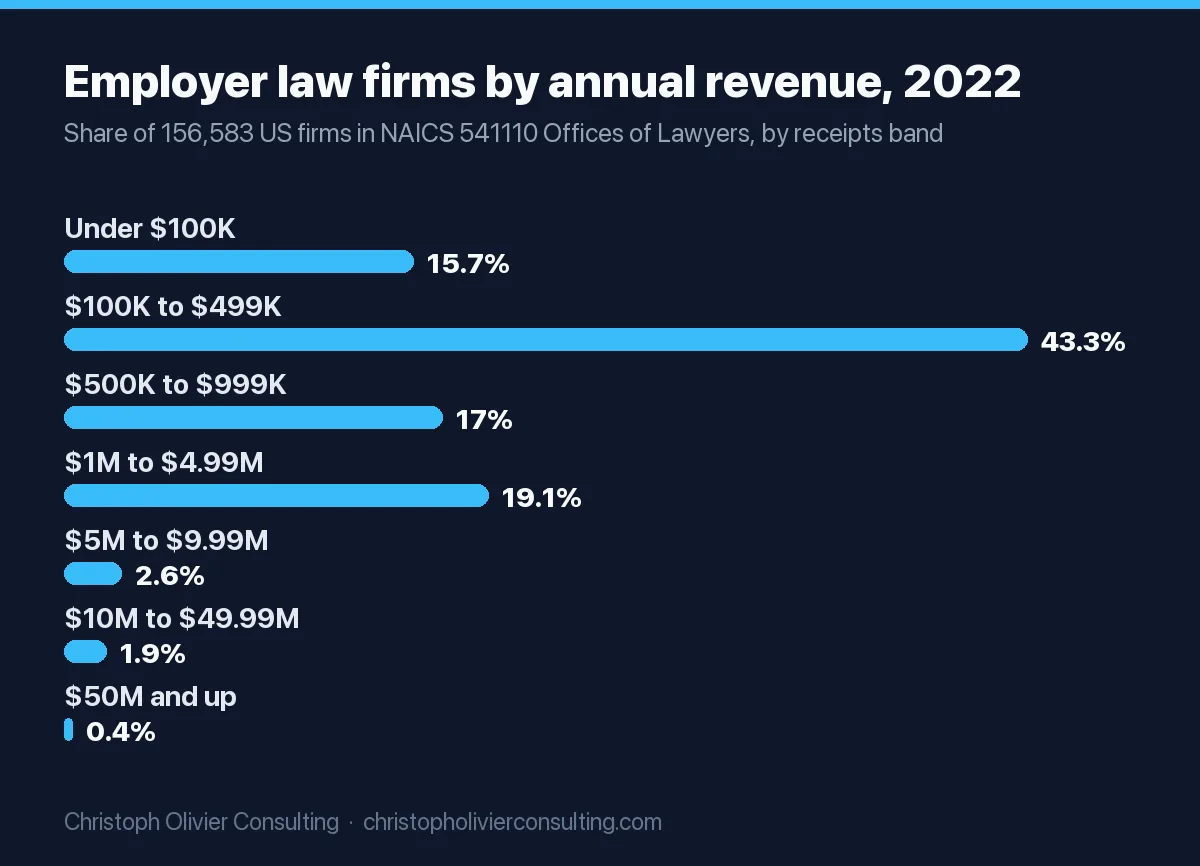
| Annual revenue band | Firms | Share of firms | Cumulative share | Average revenue in band | Average employees | Share of all revenue |
|---|---|---|---|---|---|---|
| Under $100,000 | 24,540 | 15.7% | 15.7% | $51,810 | 1.1 | 0.4% |
| $100,000 to $499,999 | 67,822 | 43.3% | 59.0% | $263,959 | 1.8 | 5.0% |
| $500,000 to $999,999 | 26,635 | 17.0% | 76.0% | $706,734 | 3.6 | 5.3% |
| $1 million to $2.49 million | 21,641 | 13.8% | 89.8% | $1,550,298 | 6.7 | 9.4% |
| $2.5 million to $4.99 million | 8,223 | 5.3% | 95.1% | $3,467,123 | 13.0 | 8.0% |
| $5 million to $9.99 million | 4,129 | 2.6% | 97.7% | $6,900,045 | 24.0 | 8.0% |
| $10 million to $49.99 million | 2,929 | 1.9% | 99.6% | $19,276,017 | 63.8 | 15.8% |
| $50 million to $99.99 million | 301 | 0.2% | 99.8% | $66,972,126 | 179.7 | 5.7% |
| $100 million or more | 363 | 0.2% | 100% | $416,187,634 | 655.2 | 42.4% |
Read it as a ladder. A firm with 3 to 4 employees typically grosses $500,000 to $1 million. A firm with roughly 7 employees typically grosses $1 million to $2.5 million. Only 24% of employer law firms clear $1 million, and fewer than 5% clear $5 million. If you are planning growth or a small law firm marketing budget, the useful benchmark is the next rung up, not the national mean.
Average solo law firm revenue
Most solo lawyers do not show up in the employer data at all. The Census Bureau tracks businesses with no paid employees separately in Nonemployer Statistics, mostly built from tax returns. The national file (nonemp23us) publishes legal services at the 4-digit level, NAICS 5411, which is mainly lawyers but also includes notaries and title abstract offices. Averages below are receipts divided by establishments, 2023.
| Legal form (no employees) | Businesses | Total receipts | Average receipts |
|---|---|---|---|
| Sole proprietorships | 244,454 | $18.07 billion | $73,932 |
| S corporations | 19,385 | $2.61 billion | $134,501 |
| Partnerships | 7,383 | $2.14 billion | $289,212 |
| C corporations and other | 2,778 | $0.35 billion | $125,928 |
| All nonemployer legal services | 274,000 | $23.17 billion | $84,545 |
The same file sorts those 274,000 businesses by receipts. The middle one grosses between $25,000 and $49,999. 46% take in less than $25,000, which tells you many are part-time or side practices. At the other end, 64,976 (23.7%) gross $100,000 or more, 21,773 (7.9%) gross $250,000 or more, and only 6,820 (2.5%) gross $500,000 or more.
To put the two Census programs side by side for the same year: in 2022 there were 283,944 nonemployer legal businesses and 168,306 employer legal firms (NAICS 5411). Nonemployers were 63% of all legal businesses but collected just 5.7% of legal-services receipts.
What IRS tax returns say about solo lawyers
The IRS view is broader, because a Schedule C sole proprietor can also have employees. In IRS Statistics of Income Table 1 for tax year 2023 (23sp01br.xls, released March 2026), the legal services industry had 316,370 sole proprietorship returns reporting $43.23 billion in business receipts and $18.92 billion in net income. That works out to:
- Average business receipts: $136,644 per return
- Average net income (profit less losses): $59,807 per return
- Share of returns with a profit: 77.4% (244,828 returns)
- Among profitable returns only: $166,801 average receipts and $82,522 average net income
A year earlier (tax year 2022, 22sp01br.xls) the averages were $128,016 in receipts and $58,979 in net income across 319,226 returns.
How much do law firm owners make?
No government source publishes “law firm owner income” directly. Owners and partners are not employees, so wage surveys skip them. You can triangulate from four published numbers.
| Benchmark | Figure | What it measures | Source, year |
|---|---|---|---|
| Legal sole proprietor net income | $59,807 average ($82,522 if profitable) | Schedule C profit, which is the owner’s pre-tax pay | IRS SOI, tax year 2023 |
| Salaried lawyer, median | $159,670 | W-2 wages of employed lawyers (SOC 23-1011); excludes owners and partners | BLS OEWS, May 2025 |
| Salaried lawyer, mean | $185,840 | Same population, 754,500 lawyers | BLS OEWS, May 2025 |
| Salaried lawyer, 90th percentile | $351,600 | Wage that only 10% of employed lawyers exceed | BLS OEWS, May 2025 |
| Collected revenue per responsible lawyer, solo firm | $83,219 median, $137,948 mean | Revenue collected on matters a lawyer is responsible for, before expenses | Clio 2025 Legal Trends Report, 2024 data |
| Am Law 100 profits per equity partner | $3.59 million average | Profit divided by equity partners at the 100 highest-grossing US firms | LawFuel summary of the 2026 Am Law 100, fiscal 2025 |
Put together: a typical solo owner nets somewhere around the IRS average of $60,000 to $83,000, which is well below what a salaried lawyer earns (median $159,670 in May 2025). The owners who out-earn salaried peers are the ones who have built a firm in the $1 million+ revenue bands above, where profit from other lawyers’ and staff’s work flows to the owner. Within lawyers employed by law firms specifically (NAICS 5411), BLS reports a mean of $191,320 and a median of $157,870 across 448,040 jobs.
What percentage of lawyers make $500,000 a year?
No official dataset reports this. What the data do show: among the 754,500 lawyers in the BLS wage survey, the 90th percentile is $351,600 (May 2025), so well under 10% of salaried lawyers earn $500,000. For owners, the closest proxy is firm revenue: only 2.5% of nonemployer legal businesses gross $500,000 or more, and only 24% of employer law firms gross $1 million or more (Census). Anyone quoting a precise percentage for “$500,000 lawyers” is quoting a survey of their own audience, not a national count.
Revenue per lawyer by firm size
Clio’s Legal Trends Report is built from anonymized billing data from tens of thousands of firms using its software, so it is a large sample but not a random one. Its 2025 edition tracks collected revenue per responsible lawyer, the lawyer who owns the matter, by firm size.
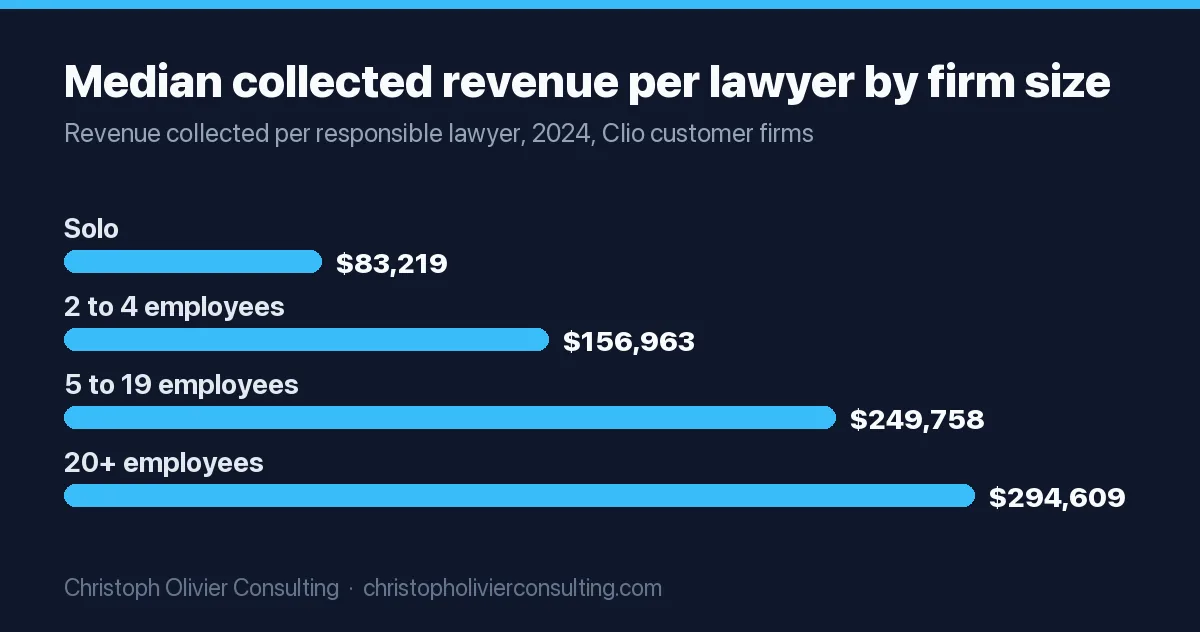
| Firm size | Median, 2016 | Median, 2024 | Mean, 2024 |
|---|---|---|---|
| Solo | $77,630 | $83,219 | $137,948 |
| 2 to 4 employees | $137,648 | $156,963 | $225,236 |
| 5 to 19 employees | $201,089 | $249,758 | $365,309 |
| 20+ employees | $183,063 | $294,609 | $491,946 |
Source: Clio 2025 Legal Trends Report, Appendix A. The gap between median and mean in every row is the same skew you see in the Census data: a minority of high earners pulls the average up.
At the top end, the 2026 Am Law 100 (fiscal 2025) reported aggregate gross revenue of $178.95 billion, up 13.0%, which is an average of $1.79 billion per firm. Kirkland & Ellis led at $10.556 billion, and Wachtell, Lipton, Rosen & Katz led profits per equity partner at $12.152 million, per the LawFuel release. Above the Law adds that revenue per lawyer rose 8.7% across the group, with 92 of 100 firms posting gains.
Law firm average profit margin
“Profit margin” means different things at different firm types, which is why blog figures disagree. Here is what the primary data support.
- Solo and small sole proprietorships: about 44%. Net income divided by business receipts for legal-services sole proprietors was 43.8% in tax year 2023 (49.5% among profitable returns), from the IRS SOI table above. That margin is the owner’s pay, before income and self-employment tax, because sole proprietors do not pay themselves a salary.
- Employer firms: payroll takes about 37% of revenue. Census does not publish law-firm profit, but SUSB 2022 shows annual payroll at 36.7% of receipts for all employer firms in NAICS 541110, ranging from 30.4% at firms under 5 employees to 43.3% at firms with 20 to 99. Rent, technology, insurance, marketing and the owners’ own pay come out of what is left.
- The planning rule of thumb: one third. The “rule of thirds” splits gross revenue into roughly equal parts for lawyer compensation, overhead and profit. LeanLaw’s explanation gives the classic example: a lawyer costing $150,000 in total compensation should bill and collect at least $450,000. It is a management heuristic, not a measured average.
If you want to compare legal services with other sectors, our profit margin by industry table covers 94 industries on a consistent basis.
Solo practice revenue model: rate x hours x realization x collection
Most lawyers who bill hourly can predict revenue with one formula. Clio calls it the lawyer’s funnel: the hours in a day, times the share that is billable (utilization), times the share of billable time that gets invoiced (realization), times the share of invoices that get paid (collection). In the 2025 Legal Trends Report those rates were 38%, 88% and 93%. Clio’s KPI benchmarks page now lists 42%, 90% and 92% for 2026.
Copy this formula into a spreadsheet:
Annual collected revenue = hourly rate x 8 hours x utilization x realization x collection x working days
Worked example, family law solo: $343 x 8 x 0.38 x 0.88 x 0.93 x 240 days = 2.49 collected hours a day x $343 x 240 = $204,807
The $343 is Clio’s average lawyer hourly rate for family law in the 2025 report. The 240 working days (48 weeks of 5 days) is my assumption; change it to your own calendar. Swap in your own rate from the practice-area list: wills and estates $370, civil litigation $351, criminal $217, bankruptcy $456, immigration $361. If you practice estate planning, our breakdown of the estate planning attorney hourly rate goes deeper on that number.
Here is how sensitive the result is. Every cell uses 88% realization, 93% collection and 240 working days.
| Hourly rate | 30% utilization (1.96 hrs collected/day) | 38% utilization (2.49 hrs/day) | 50% utilization (3.27 hrs/day) |
|---|---|---|---|
| $250 | $117,850 | $149,276 | $196,416 |
| $343 | $161,690 | $204,807 | $269,483 |
| $450 | $212,129 | $268,697 | $353,549 |
Two lessons fall out of the grid. At $343 an hour, moving utilization from 38% to 50% adds $64,676 a year, slightly more than raising the rate from $343 to $450 at 38% utilization ($63,890). And to reach the $450,000 in collections that the rule of thirds expects from a $150,000 lawyer, a solo at $343 an hour needs about 5.5 collected hours a day, more than double the national average. That helps explain why firms that grow past the solo bands do it by adding associates and staff whose billed hours the owner does not have to work personally.
To estimate take-home pay, apply your own overhead. As a reference point only, if your expenses matched the IRS average for legal sole proprietors (net income equal to 43.8% of receipts), the $204,807 example would leave about $89,600 before tax.
What is the 80/20 rule for lawyers?
The 80/20 rule is the Pareto principle applied to a practice: roughly 80% of revenue comes from 20% of clients or matter types, and 80% of headaches from a different 20%. It is a heuristic, not a law-firm statistic; no public dataset measures it for US law firms. You can test it on your own books in 15 minutes:
- Export collected revenue by client (or by matter type) for the last 12 months.
- Sort from largest to smallest and add a running cumulative percentage of total collections.
- Find the row where the cumulative share crosses 80%. Divide that row number by the total client count.
- Pass if the answer is under 30%: your revenue is concentrated, so protect and market to that client profile. Fail if it is over 50%: revenue is spread thin, so check whether rates or matter mix, not client volume, are the constraint.
The same concentration shows up nationally. In the Census data, the top 2.3% of employer law firms by revenue (3,593 firms at $10 million or more) collected 63.9% of all receipts in 2022.
How to use these numbers in your own firm
Revenue benchmarks are only useful when they change a decision. Three practical uses:
- Find your rung. Place your trailing 12-month collections in the revenue-band table. The next band up shows what a firm one size larger typically carries in headcount (3.6 employees at $500,000 to $999,999, 6.7 at $1 million to $2.49 million).
- Set marketing spend from revenue, not from a guess. Once you know your collected revenue, you can size a marketing budget as a percentage of it; our guide on how to set a marketing budget walks through the methods.
- Fix the funnel before buying leads. If utilization is near the 38% average, more cases from law firm lead generation will only help if you have capacity and your realization and collection rates hold.
If you want a second set of eyes on how your numbers translate into a growth and marketing plan for your law firm, you can book a consultation.
How these numbers were calculated
- Employer law firms: Census Bureau, Statistics of US Businesses 2022 (released April 2025), NAICS 541110 Offices of Lawyers. Average revenue = receipts / firms, computed from the detailed employment-size file and the receipts-size file. Enterprise size is based on the whole enterprise, so a handful of non-law companies with law offices land in the 500+ rows. Census applies noise to protect confidentiality; nearly all cells used here carry the low-noise flag (under 2%).
- Nonemployer legal businesses: Census Nonemployer Statistics 2023 and 2022, US file, NAICS 5411 Legal Services (the national file does not break out 541110). Average = receipts / establishments. Median band read from the receipts-size distribution.
- Sole proprietors: IRS Statistics of Income, Nonfarm Sole Proprietorships Table 1, tax years 2023 and 2022, “Legal services” row. Averages = column totals / number of returns. IRS figures are sample-based estimates.
- Wages: BLS Occupational Employment and Wage Statistics, May 2025, SOC 23-1011 Lawyers, all industries and NAICS 5411, retrieved through the BLS Public Data API.
- Revenue per lawyer, KPIs and hourly rates: Clio 2025 Legal Trends Report (2024 data, Clio customers only) and Clio’s KPI benchmarks page.
- Largest firms: 2026 Am Law 100 (fiscal 2025) as reported by LawFuel and Above the Law. The American Lawyer’s own tables are paywalled.
Ready to scale your revenue?
Book a free 30-min consultation. We’ll diagnose your growth bottleneck and map out the 3 highest-leverage moves for your business.
Frequently asked questions
What is the average revenue for a law firm?
US law firms with employees averaged $2.28 million in revenue in 2022, based on Census SUSB data for NAICS 541110 ($356.2 billion across 156,583 firms). That mean is skewed by 363 firms grossing $100 million or more. The typical employer law firm grosses $100,000 to $499,999, and 59% of firms take in under $500,000 a year.
What is the average solo law firm revenue?
Legal businesses with no employees averaged $84,545 in receipts in 2023 (Census Nonemployer Statistics, NAICS 5411), and the median one grossed $25,000 to $49,999. Legal sole proprietors filing Schedule C, which can include solos with staff, averaged $136,644 in receipts and $59,807 in net income in tax year 2023, according to IRS Statistics of Income.
What is the average revenue for a small law firm?
Census 2022 data for NAICS 541110 show firms with fewer than 5 employees averaging $419,995 in revenue, firms with 5 to 9 employees averaging $1.42 million, and firms with 10 to 19 employees averaging $3.19 million. Only 24% of employer law firms gross $1 million or more, and fewer than 5% gross $5 million or more.
How much do law firm owners make?
No government source reports owner income directly. Legal sole proprietors averaged $59,807 in net income in tax year 2023 ($82,522 among those with a profit), per the IRS. Salaried lawyers earned a median $159,670 in May 2025 (BLS), and Am Law 100 equity partners averaged $3.59 million in profit in fiscal 2025.
What is the average law firm profit margin?
Legal sole proprietors reported net income equal to 43.8% of receipts in tax year 2023 (IRS), and that margin is the owner's pay. For employer law firms, Census does not publish profit, but payroll alone took 36.7% of receipts in 2022. The common planning rule of thirds targets about one third of revenue as profit.
What percentage of lawyers make $500,000 a year?
No official dataset counts this. Among 754,500 salaried lawyers in the BLS May 2025 survey, the 90th percentile wage was $351,600, so well under 10% of employed lawyers earn $500,000. Owners are not in that survey; only 2.5% of nonemployer legal businesses gross $500,000 or more in receipts (Census 2023).
What is the 80/20 rule for lawyers?
It is the Pareto principle applied to a practice: roughly 80% of revenue comes from about 20% of clients or matter types. It is a heuristic, not a measured statistic for law firms. You can test it by sorting 12 months of collections by client and finding what share of clients produces 80% of revenue.
Practice economics benchmarks