
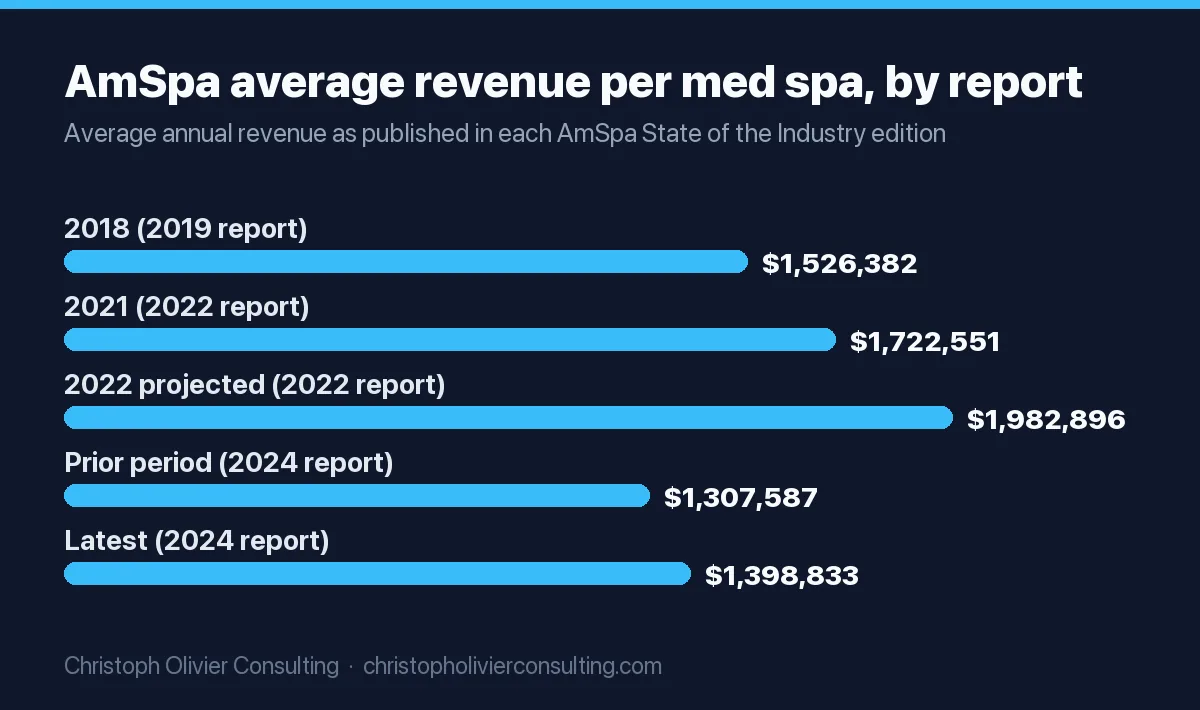
The average US med spa brought in $1,398,833 in annual revenue, according to the American Med Spa Association’s 2024 Medical Spa State of the Industry report, up from $1,307,587 in the prior survey period. That is the latest average AmSpa has published. The same report puts the typical med spa at 245 patient visits a month and $527 spent per visit, and 81% of med spas operate a single location.
Profit and owner pay are harder. AmSpa’s last public profit margin figure is 29%, for 2018. No industry body publishes a current average owner salary, so the owner income numbers you see online are estimates. Below you get every public figure with its source and year, the reason AmSpa’s own averages changed so much between reports, and a worksheet to calculate what your own med spa should make.
Short answer: AmSpa’s 2024 report puts average med spa revenue at $1,398,833 a year per med spa. Its most recent public profit margin is 29% (2018 data, 2019 report), and private equity buyers now screen for adjusted EBITDA above 20%. At the average revenue, a 20% margin works out to roughly $280,000 a year in profit for the owner, before any pay the owner earns as a clinician.
Med spa revenue benchmarks: every public AmSpa figure, by report year
AmSpa runs its survey roughly every two years. The full report costs $995 for non-members, but each edition comes with a free executive summary, and that summary is where the figures below come from. Where AmSpa published the same metric in more than one edition, both are shown so you can see the trend.
| Metric | Latest AmSpa figure | Earlier AmSpa figure | Source |
|---|---|---|---|
| Average annual revenue per med spa | $1,398,833 (2024 report) | $1,307,587 (prior period, 2024 report); $1,982,896 (2022, 2022 report); $1,526,382 (2018, 2019 report) | AmSpa 2024 recap, AmSpa 2022 summary in context |
| Average monthly revenue, single-location med spa | $121,632 (2021 data, 2022 report) | Not published in 2024 summary | AmSpa 2022 |
| Patient visits per month | 245 (2024 report) | 283 non-surgical visits (2022 report); 199 single-location, 449 multi-location primary site (2019 report) | AmSpa 2024 |
| Average spend per visit | $527 (2024 report) | $536 (2022 report); $459 single-location, $465 multi-location (2019 report) | AmSpa 2024 |
| Repeat patients | 73% (2024 report) | 65% (2022 report) | AmSpa 2024 |
| Profit margin | 29% (2018 data, 2019 report) | Not in the 2022 or 2024 free summaries | AmSpa 2019 executive summary (PDF copy hosted by Growth99) |
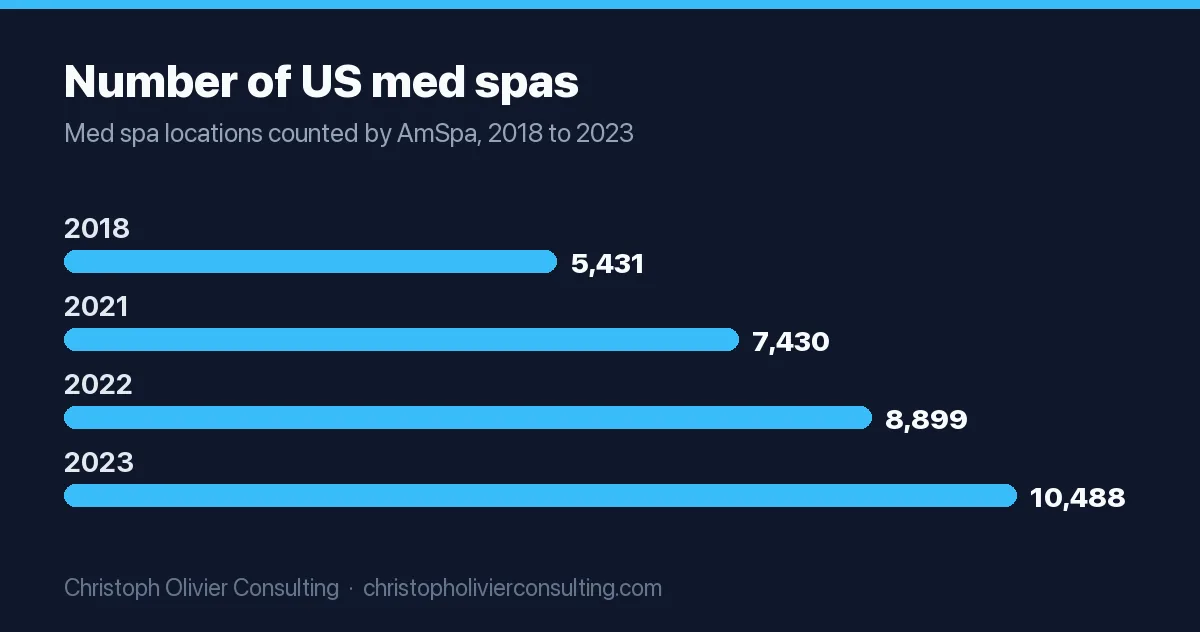
| Number of US med spas | 10,488 (2023) | 8,899 (2022, per 2024 report); 8,841 (2022, per 2022 report); 5,431 (2018) | AmSpa 2024 |
| Single-location share | 81% (2024 report) | 81% (2022 report); 83% (2019 report) | AmSpa 2024 |
| Employees per location | 8 single-location; 12 at a multi-location primary site (2024 report) | 8 and 16 (2022 report) | AmSpa 2024 |
| Owners expecting revenue growth | 84% (2024 report), of whom 54% expect 10% or more | 88% (2022 report) | AmSpa 2024 |
Two labeling notes. AmSpa’s 2024 recap does not attach a calendar year to the $1,307,587 and $1,398,833 figures, while a later AmSpa news post calls them 2023 and 2024. The survey itself ran from September 2023 to March 2024, according to AmSpa’s release announcing the report, so the latest figure mostly reflects 2023 trading. Also, these are averages (means). AmSpa does not publish a median revenue in its free summaries, and a handful of large practices can pull a mean up.
Why AmSpa’s average fell from $1.98 million to $1.4 million
If you read older articles, you will see $1,982,896 quoted as the average. That number is real, but it is a 2022 projection. AmSpa explained in its 2022 write-up that researchers combined survey answers with census, personal care spending and growth-rate data to model 2022 revenue and forecast later years. The 2024 report then measured the prior period at $1,307,587, about $675,000 lower. AmSpa’s 2024 release says revenues “settled down a bit since the artificial highs of the immediate post-pandemic period.” The practical rule: quote $1,398,833 as the current figure and treat $1.98 million as a superseded projection.
How much do med spas make a year? Check the math yourself
You can sanity-check the average with AmSpa’s own volume figures. 245 visits a month times $527 per visit is $129,115 a month, or $1,549,380 a year. That is about 11% above the reported $1,398,833. The gap is normal: an average of visits times an average of spend does not equal the average of revenue, because the busiest med spas are not always the ones with the highest ticket. Working backwards, $1,398,833 at $527 per visit takes about 2,654 visits a year, or 221 a month.
Med spa revenue figures outside AmSpa (and how much to trust them)
Software vendors and data firms also publish revenue numbers. Some come from real transaction data; some are unsourced. This table separates them.
| Figure | What it measures | Source and type |
|---|---|---|
| $2,878,348 per center (2023) | Average revenue of top-earning brands among med spas on Zenoti software | Zenoti, vendor platform data, top earners only |
| Revenue up 10% in 2024; top 10% average ticket fell from $500 (2023) to $454 (2024) | US and Canada med spas on Zenoti | Zenoti 2025 Benchmark Report coverage, vendor platform data |
| Under 1% same-store growth in 2024; Midwest +8%, Northeast and West minus 2%, South 0% | Per-practice revenue at medical aesthetics practices, same-store | Skytale and Guidepoint Qsight, Dec 2025, sales measurement data |
| $20.5 billion US non-surgical spending in 2024, up 5% | Total US non-surgical aesthetics patient spending | Skytale and Guidepoint Qsight, Dec 2025 |
| Median practice revenue up 19.2% year over year; new patients up 1.2% | About 100 brands, roughly 500 locations, H1 2026 | CorralData benchmark, as reported by AmSpa (Aug 2026), self-selected software users |
| $1.8 million to $2 million a year | Stated “average med spa revenue in 2025” | Boulevard blog, vendor claim, no primary source cited |
The honest read: AmSpa’s $1.4 million is the only nationwide survey average with a published method. Vendor numbers describe their own customers, who skew toward practices that buy premium software. The CorralData cohort grew 19.2% while Qsight’s broader sample saw under 1% same-store growth, which tells you sample choice matters more than any single headline.
Are med spas a growing industry?
Yes, by location count. AmSpa counted 5,431 med spas in 2018 and 10,488 in 2023, and 18% of med spas in the 2024 survey had opened in 2023. AmSpa’s CEO said in the 2024 release that med spas employ more than 100,000 people, and AmSpa’s research page describes an industry that has passed $17 billion in revenue and grows by more than $1 billion a year.
Demand is concentrated in injectables. The American Society of Plastic Surgeons counted 9,883,711 neuromodulator injections and 5,331,426 hyaluronic acid filler procedures in 2024, the top two of more than 28.5 million minimally invasive procedures, according to its 2024 statistics release. In its 2025 report, released September 1, 2026, neuromodulators and HA fillers made up 80% of all minimally invasive procedures.
The catch is that more locations split the demand. Qsight found same-store revenue growth under 1% in 2024 even as total spending rose 5%, which means new practices captured most of the growth. A new med spa is entering a busier market than one that opened in 2018.
Med spa profit margin: what the sources actually say
Most articles quote “20% to 25%.” We could not find a primary survey behind that range. Here is what is actually published.
| Margin figure | What it is | Source |
|---|---|---|
| 29% | Average med spa profit margin, 2018, from AmSpa’s member survey | AmSpa 2019 executive summary |
| Adjusted EBITDA above 20%; gross profit above 65% before direct labor; EBITDA above $1 million | What private equity buyers look for in an attractive med spa | Skytale and Qsight, Dec 2025, investment bank view |
| “Potential for consistent profit margins of 20% to 30%” | Investment bank’s description of the sector, not a survey result | Skytale and Qsight, Dec 2025 |
| 20% to 25% (top performers 30% to 40%) | Vendor blog estimate | Boulevard, Zenoti; no survey cited |
| 15% to 25% net once established | Vendor blog estimate | Vagaro; no survey cited |
So the defensible statement is this: the last measured average was 29% (2018), the buyer benchmark today is 20% adjusted EBITDA, and the 20% to 25% range is a reasonable rule of thumb from vendors rather than a measured average. One more reason to be careful: “profit” in a survey depends on whether the owner’s own salary was counted as an expense. An injector-owner who pays herself $130,000 and reports 15% profit may take home more than an absentee owner reporting 25%.
Are med spas profitable? The four numbers that decide it
Most med spas that stay open are profitable, but margin depends on a few controllable inputs. The sources above point to the same four.
- Repeat rate. AmSpa found 73% of patients are repeat patients. Skytale says buyers want retention near 50% for new patients and up to 80% for returning patients. Qsight measured regional retention between 44% and 49% from 2023 to 2024, so most practices sit well below the buyer target.
- Membership share. In the CorralData cohort reported by AmSpa, members spent 2.5 times more than non-members and retained 35 percentage points better. Zenoti reported a 24% rise in med spa membership sales in 2024.
- Service mix. Skytale describes an attractive mature business as about 60% injectables, with the rest in energy devices, skincare, weight loss and other services, and warns that a heavy medical weight loss mix makes investors nervous.
- Lead response speed. In the CorralData data, every practice that answered new leads within 15 minutes and booked more than 30% of appointments online landed in the top half for growth.
Profit also depends on what you spend to win each patient. If you have not calculated it, start with our guide to customer acquisition cost, then compare it to patient lifetime value using the LTV to CAC ratio. A med spa with 73% repeat patients can afford a far higher first-visit acquisition cost than one where most patients come once.
How much do med spa owners make?
No association publishes a current average med spa owner salary. AmSpa’s free summaries report employee salaries, not owner income, and the owner figures in vendor blogs are estimates. The honest way to answer is to model it. Owner income has two parts: the profit the business produces, and any wage you earn if you also treat patients.
| Scenario (AmSpa average revenue of $1,398,833) | Margin used | Annual profit to owner | Where the margin comes from |
|---|---|---|---|
| Thin year, high rent or heavy financing | 15% | $209,825 | Low end of Vagaro’s vendor estimate |
| Buyer benchmark | 20% | $279,767 | Skytale adjusted EBITDA threshold |
| Matches last measured average | 29% | $405,662 | AmSpa 2018 average margin |
This is pre-tax profit, before debt principal repayments and before reinvestment in equipment. Then add clinical pay if the owner works as a provider. For scale, the BLS May 2025 wage estimates put the national mean for nurse practitioners at $137,300 and for physician assistants at $141,280, across all industries. AmSpa reports that 67% of single-owner practices are owned by non-MDs or surgeons, a group that includes NPs, RNs, PAs, entrepreneurs and aestheticians, so many owners earn both a clinical wage and a profit share.
New owners earn less. 18% of med spas in AmSpa’s 2024 survey had opened in 2023, and AmSpa does not publish first-year revenue in its free summaries. Plan your personal budget on the assumption that year one will not look like the averages above.
Do med spa owners make good money compared with working in one?
Compare the owner scenarios with what the same people earn as employees. AmSpa’s 2022 summary lists full-time med spa salaries, and BLS gives the all-industry picture for the same roles.
| Role | Average full-time salary at med spas (AmSpa) | National mean wage, all industries (BLS May 2025) |
|---|---|---|
| Medical director | $120,691 (2022 report) | Not comparable (part-time and contract roles vary) |
| Physician assistant | $112,783 (2022 report) | $141,280 |
| Nurse practitioner | $111,250 (2022 report) | $137,300 |
| Registered nurse | $80,348 (2022 report) | $101,420 |
| Esthetician / skincare specialist | $48,208 (2019 report) | $51,850 |
| Receptionist | $34,876 (2019 report) | $39,460 |
Sources: AmSpa 2022 summary, AmSpa 2019 summary, BLS OEWS May 2025 national estimates. AmSpa salaries are older and do not include commission or bonuses, so they are not a like-for-like comparison with the 2025 BLS figures. Is working at a med spa a good job? On base salary alone, the AmSpa figures sit below the national means for the same licenses; injector pay with commission is not published in the free summaries.
Med spa unit economics worksheet
Use this to estimate what your own med spa should bring in, then compare each line with the AmSpa benchmark. Fill in the “Your number” column from your booking software for the last 12 months.
| Line | Formula | AmSpa benchmark | Your number |
|---|---|---|---|
| A. Active patients (seen in last 12 months) | Count from your software | Not published | |
| B. Visits per patient per year | Total visits ÷ A | Not published | |
| C. Total visits per month | (A × B) ÷ 12 | 245 | |
| D. Average spend per visit | Revenue ÷ total visits | $527 | |
| E. Annual revenue | C × D × 12 | $1,398,833 reported average | |
| F. Repeat patient share | Repeat patients ÷ A | 73% | |
| G. Gross profit before direct labor | (E minus product and supply cost) ÷ E | Buyer target above 65% (Skytale) | |
| H. Adjusted EBITDA margin | EBITDA, adding back one-off costs and excess owner pay, ÷ E | Buyer target above 20% (Skytale); 29% AmSpa 2018 average | |
| I. Owner income | (E × H) plus owner’s clinical wage if any | See scenarios above |
Worked example. A single-location med spa sees 1,000 active patients who visit an average of 2.6 times a year. That is 2,600 visits, or about 217 a month. At $527 per visit, revenue is $1,370,200. At a 20% adjusted EBITDA margin, the business throws off $274,040. If the owner is an NP who also injects, her total income is that profit plus whatever clinical pay the P&L already includes for her. The patient count and visit frequency here are illustrative inputs, not AmSpa data; only the $527 ticket comes from the report.
Two levers move the result fastest. Raising visits per patient from 2.6 to 3.0 on the same 1,000 patients adds 400 visits, or $210,800 a year at $527. Raising the ticket by $50 on 2,600 visits adds $130,000. That is why the CorralData cohort grew 19.2% with only 1.2% more new patients: the growth came from existing patients.
Is owning a med spa worth it? A pass/fail scorecard
Use this before you buy, open or expand. Each threshold comes from a named source. Three or more fails means the business is not yet earning what the market will pay for.
| Test | Pass | Fail | Source of threshold |
|---|---|---|---|
| Annual revenue per location | At or above $1,398,833 | Below it after year two | AmSpa 2024 average |
| Repeat patient share | 73% or higher | Below 65% | AmSpa 2024 (73%) and 2022 (65%) |
| Returning patient retention | 80% or higher | Below 50% | Skytale buyer targets |
| Gross profit before direct labor | Above 65% | 65% or below | Skytale buyer targets |
| Adjusted EBITDA margin | Above 20% | 20% or below | Skytale buyer targets |
| EBITDA in dollars (if you plan to sell) | Above $1 million | Below $1 million | Skytale, “for competitive valuations” |
| New lead response time | Under 15 minutes | Hours or days | CorralData cohort via AmSpa |
| Revenue mix | Injectables near 60%, diversified rest | Heavy reliance on medical weight loss | Skytale |
If the scorecard shows a demand problem rather than an operations problem, the fix is usually marketing. Our med spa marketing playbook covers the channels, and the plastic surgeon marketing budget benchmarks show how adjacent aesthetic practices size spend against revenue. In my view, most med spas under the AmSpa average have a retention and rebooking problem before they have a lead problem, so check line F before you raise ad spend.
How much money do I need to start a med spa?
AmSpa covers start-up costs in the paid full report, but the number is not in the free executive summary, so we cannot quote it. The public figures are vendor estimates: Zenoti says start-up costs “can range from $200,000 to $1 million or more” depending on location, size, equipment and inventory, without citing a survey. Treat that as a wide planning range, not a benchmark. Your biggest variables are whether you buy or lease lasers and energy devices, build-out cost per square foot in your market, and how many months of payroll you fund before patient volume reaches the 221 visits a month that the AmSpa average implies.
If you are building a growth plan around these numbers and want a second opinion on the marketing side, you can book a consultation.
Where these numbers fall short
- AmSpa data is self-reported by survey respondents, and the free summaries give means, not medians.
- The latest AmSpa survey closed in March 2024. The 2024 report is the newest edition with a public summary we could find in November 2026.
- AmSpa reports national data only; its research page notes the report does not break figures out by state or city.
- Vendor benchmarks (Zenoti, CorralData, Boulevard) describe their own customers and are not nationally representative.
- Skytale’s thresholds describe what buyers want, not what the average med spa achieves.
Ready to scale your revenue?
Book a free 30-min consultation. We’ll diagnose your growth bottleneck and map out the 3 highest-leverage moves for your business.
Frequently asked questions
What is the average revenue of a med spa?
The American Med Spa Association's 2024 Medical Spa State of the Industry report puts average annual revenue at $1,398,833 per med spa, up from $1,307,587 in the prior period. The survey ran from September 2023 to March 2024. Older articles quote $1,982,896, but that was a 2022 projection from AmSpa's 2022 report and has been superseded by the 2024 survey.
Are med spas profitable?
Most established med spas are. AmSpa's last published average profit margin was 29%, for 2018. In a December 2025 report, investment bank Skytale said private equity buyers look for adjusted EBITDA above 20% and gross profit above 65% before direct labor. The often quoted 20% to 25% range comes from software vendor blogs, not a published survey.
How much do med spa owners make?
No association publishes a current average owner salary. Modeling AmSpa's $1,398,833 average revenue at margins of 15%, 20% and 29% gives about $209,825, $279,767 and $405,662 in annual pre-tax profit. Owners who also treat patients add clinical pay; BLS puts the May 2025 national mean for nurse practitioners at $137,300.
What is the average med spa profit margin?
AmSpa's 2019 executive summary reported a 29% average profit margin for 2018, the latest margin AmSpa has made public. Current buyer benchmarks from Skytale and Guidepoint Qsight are adjusted EBITDA above 20% and EBITDA above $1 million for competitive valuations. Vendor blogs such as Boulevard and Zenoti cite 20% to 25% without naming a survey.
How many patients does a med spa see per month?
AmSpa's 2024 report found an average of 245 patient visits per month, with patients spending $527 per visit and 73% of patients being repeat patients. The 2022 report showed 283 non-surgical visits per month at $536 per visit. At the 2024 ticket, the average revenue of $1,398,833 implies about 221 visits a month.
Are med spas a growing industry?
Yes. AmSpa counted 5,431 US med spas in 2018 and 10,488 in 2023, and says the industry has passed $17 billion in revenue. Growth per practice is slower: Skytale and Guidepoint Qsight found under 1% same-store revenue growth in 2024, even though total US non-surgical spending rose 5% to $20.5 billion.
Practice economics benchmarks