

No one publishes an average client count for American lawyers, and any single number you see quoted is a guess. What does exist is hard data on how much time a case takes and how many cases a lawyer is allowed to carry. The 2023 National Public Defense Workload Study (RAND, with the ABA) puts a full-time criminal defense lawyer at 7 to 154 cases a year depending on case type. Legal aid lawyers funded by the Legal Services Corporation close roughly 125 cases a year each, by our calculation from LSC’s 2023 data. A private lawyer’s number comes from one division: billable hours available divided by hours per matter.
Short answer: It depends almost entirely on hours per matter. Public defense standards range from 7 cases a year (life-without-parole felonies, 286 hours each) to 150 or more (low-level misdemeanors and probation violations). The average lawyer bills about 3.0 hours of an 8-hour day (Clio, 2025), so a practice averaging 20 billable hours per matter tops out near 36 new matters a year per lawyer, while a 5-hour flat-fee practice can run 140 or more.
How many clients does a lawyer have? The numbers that actually exist
The forum threads that rank for this question trade single numbers (“20 to 30 cases,” “70 to 150 clients”) with no source behind them. Here is every published benchmark we could verify, with what each one actually measures.
| Benchmark | Figure | What it measures | Source |
|---|---|---|---|
| Felony caseload, 1973 national standard | 150 per year | Maximum felonies per public defender per year | NAC 1973, as quoted in RAND 2023 |
| Misdemeanor caseload, 1973 national standard | 400 per year | Maximum non-traffic misdemeanors per public defender per year | NAC 1973, as quoted in RAND 2023 |
| Low-severity felony, 2023 national study | 35 hours per case, 59 cases per year | Annual caseload if an attorney had 2,080 case hours and only this case type | RAND NPDWS 2023, Table S.1 |
| Felony attorney, Washington State (from July 2027) | 47 case credits per year | Maximum weighted felony caseload per full-time public defender | WSBA Standards for Indigent Defense, 2024 |
| Family defense attorney, Washington State | 80 open cases | Open dependency or termination of parental rights cases per attorney per year | WSBA, 2024 |
| Civil legal aid, LSC-funded programs | About 125 cases closed per attorney FTE | 771,006 cases closed in 2023 divided by 6,175 attorney FTEs (our calculation) | LSC 2023 By the Numbers |
| Billable hours, average law firm | 3.0 hours per 8-hour day | 38% utilization rate, 2025 | Clio Legal Trends KPIs |
| Private practice client counts | Not published | No bar, regulator or national survey reports clients per private lawyer | None found |
Two context numbers help with scale. The ABA’s 2025 Profile of the Legal Profession counted 1.37 million active U.S. lawyers. The Bureau of Labor Statistics counts 754,500 lawyers in wage and salary jobs (May 2025 OEWS), a figure that excludes self-employed solos and partners. So a large share of the profession works in exactly the solo and small-firm settings where nobody tracks caseloads.
What is the average caseload for a lawyer?
The only lawyers with official caseload standards are public defenders, and those standards are the best public evidence of how long legal work really takes. The 2023 National Public Defense Workload Study, written by Nicholas Pace, Malia Brink, Cynthia Lee and Stephen Hanlon, pooled 17 state workload studies from 2005 to 2022 and ran a Delphi panel of 33 expert defense attorneys. It produced hours per case for 11 adult criminal case types. RAND’s Table S.1 converts each into an annual caseload, assuming an attorney spends 2,080 hours a year on nothing but that case type.
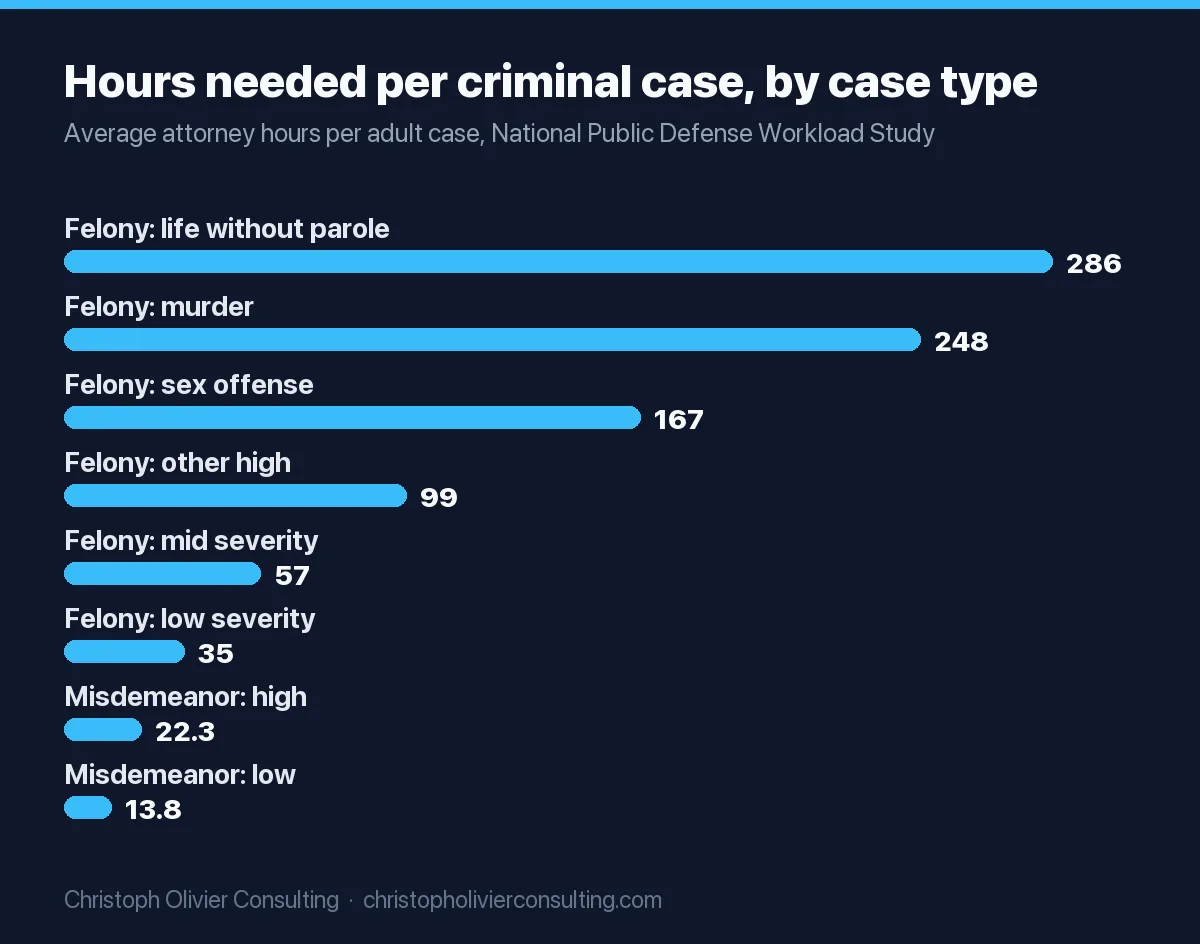
| Case type | Hours per case | Annual caseload standard (2,080 hours) |
|---|---|---|
| Felony, high: life without parole | 286.0 | 7 |
| Felony, high: murder | 248.0 | 8 |
| Felony, high: sex offenses | 167.0 | 12 |
| Felony, high: other | 99.0 | 21 |
| Felony, mid | 57.0 | 36 |
| Felony, low | 35.0 | 59 |
| DUI, high | 33.0 | 63 |
| DUI, low | 19.0 | 109 |
| Misdemeanor, high | 22.3 | 93 |
| Misdemeanor, low | 13.8 | 150 |
| Probation or parole violation | 13.5 | 154 |
Source: RAND, National Public Defense Workload Study, 2023. RAND calls the 2,080 hour assumption “an extremely high estimate” because it ignores training, administration and leave, so real caseloads should be lower than the right-hand column.
The 1973 limits most people still quote
The numbers you see repeated online come from the 1973 National Advisory Commission on Criminal Justice Standards and Goals: no more than 150 felonies, 400 non-traffic misdemeanors, 200 juvenile cases, 200 mental health cases or 25 appeals per attorney per year. RAND points out what those caps imply. At 2,080 hours a year, 150 felonies leaves 13.9 hours per case and 400 misdemeanors leaves 5.2 hours. The 2023 study says a low-level felony needs 35 hours and a low-level misdemeanor 13.8. The report also cites one metropolitan office where misdemeanor lawyers were each appointed to an average of 2,225 cases a year, about 56 minutes per client.
Washington is writing the new numbers into its rules
The Washington State Bar’s 2024 Standards for Indigent Defense phase felony and misdemeanor caps down on this schedule:
- Before July 2, 2025: 150 felonies, 300 misdemeanors (400 where no case weighting exists), 250 juvenile offender cases per attorney per year.
- From July 2, 2025: 110 felony case credits or 280 misdemeanor case credits.
- From July 2, 2026: 90 felony credits or 225 misdemeanor credits.
- From July 2, 2027: 47 felony credits or 120 misdemeanor credits.
The same standards set 36 appeals, 80 open family defense cases and 250 civil commitment cases per attorney per year, and they cite a Massachusetts finding that a defender has about 1,662 hours a year for direct client work. Our own check: 1,662 hours divided by the 35-hour low-felony weight is 47.5, which is almost exactly Washington’s 47-credit cap. That is the logic every lawyer can borrow. Caseload equals usable hours divided by hours per case.
How many cases does a lawyer handle in legal aid?
Civil legal aid gives a second public data set. In 2023, the 131 programs funded by the Legal Services Corporation closed 771,006 cases and employed 4,920 full-time and 1,255 part-time attorney FTEs, per LSC’s 2023 By the Numbers report. Dividing one by the other gives about 125 closed cases per attorney FTE (our calculation). Treat it as a rough ratio: the case total includes matters closed by private and pro bono attorneys, and paralegals do part of the work.
The mix matters more than the total. LSC reports that 74.9% of 2023 cases closed with limited service (counsel and advice or a limited action) and the rest with extended service such as settlements and court decisions. Spread over the same attorney FTEs, that is roughly 93 quick matters and 31 full representations per attorney per year (our calculation). Housing was the largest category, at 39.5% of cases closed.
How many clients can a lawyer have?
There is no legal maximum for private lawyers. The binding limit is ethical. Comment [2] to Rule 1.3 on diligence, as adopted in North Carolina’s Rules of Professional Conduct and following the ABA Model Rule, reads in full: “A lawyer’s work load must be controlled so that each matter can be handled competently.” In practice that turns into arithmetic. The table below is our capacity model. Pick the row that matches your average hours per matter and read across.
| Average hours per matter | Matters per year at 720 billable hours | At 1,662 case hours | At 2,080 case hours |
|---|---|---|---|
| 5 (simple flat-fee work) | 144 | 332 | 416 |
| 10 | 72 | 166 | 208 |
| 20 | 36 | 83 | 104 |
| 40 | 18 | 41 | 52 |
| 80 | 9 | 20 | 26 |
| 150 (complex litigation) | 4.8 | 11 | 13.9 |
How we built it (our calculation): 720 hours is Clio’s 2025 average of 3.0 billable hours a day times 240 working days, an assumption of 48 five-day weeks. 1,662 is the Massachusetts direct-representation figure cited by the WSBA. 2,080 is RAND’s 40 hours times 52 weeks ceiling. The first column is the realistic one for a private lawyer who bills by the hour, because it counts only time that ends up on an invoice. Clio’s KPI page also shows that only 88% of billable time gets invoiced and 93% of invoices get paid, so 3.0 billable hours becomes about 2.4 collected hours a day.
How many clients does a lawyer have at once?
“At once” means open matters, which is a different number from matters per year. The relationship is simple:
Open matters at any time = new matters per year x average months a matter stays open / 12
Worked example (illustrative inputs, our calculation): a lawyer averaging 20 billable hours per matter and billing 720 hours a year can take about 36 new matters. If each one stays open for 8 months, the lawyer carries 36 x 8 / 12 = 24 open files at any moment. Change the duration to 18 months, typical of a contested case, and the same 36 intakes become 54 open files, even though the work per year is identical. This is why litigators describe “caseloads” of 50 or more while billing the same hours as a transactional lawyer with 15 open deals.
Public defense standards count new appointments per year, not open files, so do not compare your open-file count to the 150 felony figure directly. Washington’s family defense cap of 80 is the exception: it counts open cases.
How many clients does a lawyer have per year?
For private practice, the honest answer is the first column of the capacity table: somewhere between a handful and about 150 new matters per lawyer, set by hours per matter. Clio’s 2025 Legal Trends Report adds three findings that shape where you land, though it does not publish absolute matter counts:
- Responsible lawyers in solo firms take on the fewest new matters on average. Lawyers in firms with more than one employee, including firms that add non-lawyer staff, take on more.
- In growing firms, solo lawyers took on 37% more cases than other solos, and lawyers in 2 to 4 employee firms took on 25% more than peers.
- Since 2016 the average timekeeper works 25% more cases and earns over 75% more revenue, adjusted for rate changes.
The same report found 59% of firms billed flat fees in 2024, alone or alongside hourly billing. Flat fees reward the lawyer who cuts hours per matter, which is the only lever that raises matters per year without longer days.
Caseload by practice type
Practice area changes both hours per matter and how long a file stays open. No public source reports private caseloads by practice area, so the table shows what is published for each and what actually limits volume. Rates are Clio’s 2024 average lawyer rates by practice area from the 2025 Legal Trends Report.
| Practice type | Typical billing | Average lawyer rate (Clio) | Published caseload benchmark | What limits the count |
|---|---|---|---|---|
| Criminal defense | Flat fee or appointment | $217/hr | Yes: RAND 2023 hours per case; NAC 1973 and WSBA caps | Court settings and trial weeks |
| Personal injury | Contingency | $335/hr | None published | Months to settlement, so open files pile up |
| Family law | Hourly retainer | $343/hr | Public family defense only: 80 open cases (WSBA) | Contested hearings and client communication |
| Wills and estates | Flat fee is common | $370/hr | None published | Drafting and signing meetings; matters close fast |
| Corporate litigation | Hourly | $460/hr | None published | Discovery and motion practice per matter |
| Civil legal aid | Free to client | Not applicable | About 125 closed cases per attorney FTE (our calculation, LSC 2023) | Intake demand; 74.9% limited service |
If you run an estate practice, our breakdown of estate planning attorney hourly rates shows how flat-fee packages map to hours. For contingency work, the real constraint is how many unsettled files you can finance at once, which is a cash question as much as a time one.
Lawyer capacity worksheet
Copy this into a spreadsheet and fill it from your own time records for the last 12 months. Every number should come from your practice management system, not memory.
- Billable hours per lawyer per year (A). Pull from time entries. If you have none, start with 720, the Clio 2025 average.
- Matters closed in the last 12 months (B) and total hours recorded on them (C). Average hours per matter H = C / B.
- Annual capacity N = A / H. This is how many new matters one lawyer can take at your current pace.
- Average months open (M) from open and close dates. Expected open files = N x M / 12.
- Actual open files today (F). Count them.
- Pass/fail test. Pass if F is at or below the expected open files from step 4. Caution if F is 1 to 20% above. Fail if F is more than 20% above, or if any file has had no recorded work in 30 days. A fail means you are past capacity and the Rule 1.3 workload duty is in play.
- Revenue check. N x H x your rate x 0.88 x 0.93 (Clio’s realization and collection rates) = expected annual collections per lawyer. Compare with what you actually collected.
The 20% band and the 30-day stale-file test are our rules of thumb, not a bar standard. Set tighter ones if your matters are deadline heavy.
What is the 80/20 rule for lawyers?
It is the Pareto principle applied to a practice: a minority of clients tends to produce most of the fees and a different minority produces most of the headaches. It is a heuristic, not a measured law of legal practice, and we found no study that measures the split for law firms. The useful version is a quarterly sort. Rank last year’s matters by collected fees per hour worked. The top fifth tells you which matter types to market for, and the bottom fifth tells you which to refer out or price up. For referral economics, see our guide to law firm referral fees.
What percent of lawyers make $500,000?
No official source publishes that share. The closest primary data is the BLS May 2025 wage survey for salaried lawyers: a median of $159,670, a mean of $185,840, a 75th percentile of $221,370 and a 90th percentile of $351,600. So fewer than 10% of salaried lawyers earn more than $351,600, and the share above $500,000 is smaller than that by definition. Self-employed lawyers and partners are not in the survey.
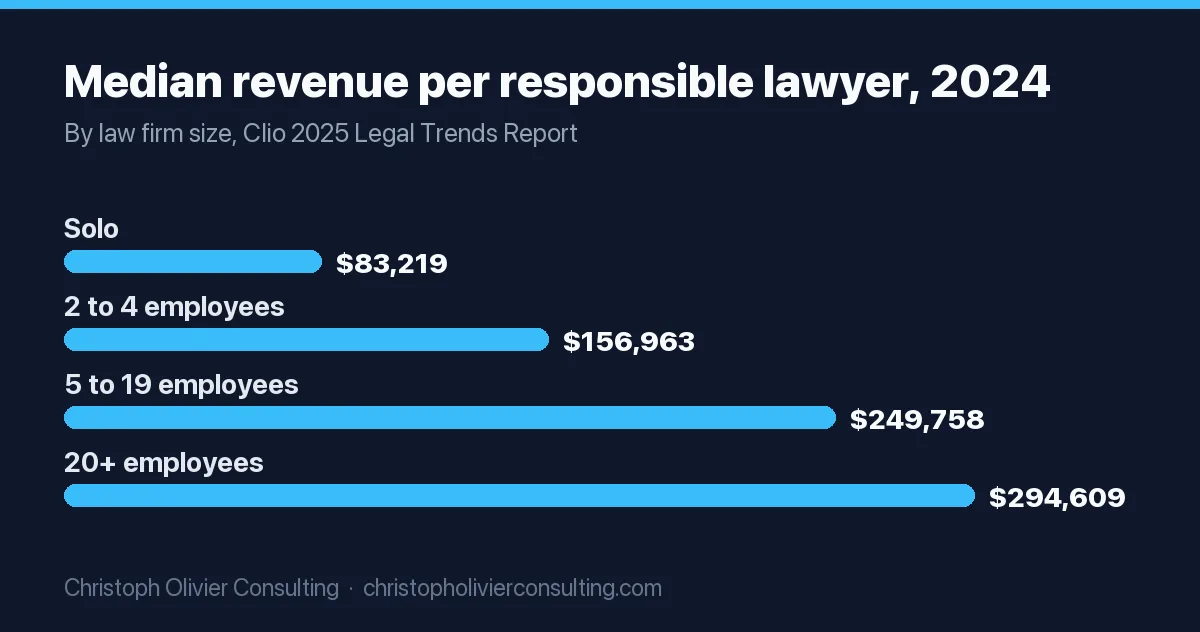
Revenue, which is not the same as pay, tells the same story. Clio’s 2025 report lists median revenue per responsible lawyer in 2024 of $83,219 at solo firms and $294,609 at firms with 20 or more employees, with a mean of $491,946 at those larger firms. Caseload is part of the gap: more staff lets each responsible lawyer run more matters. Our average law firm revenue breakdown goes deeper on firm-level numbers.
What is a lawyer’s client called?
Simply a client. In court papers the client takes the role in the case: plaintiff or defendant, petitioner or respondent, appellant or appellee. Someone who consults a lawyer about hiring them but has not yet signed an engagement is usually called a prospective client. Firms that track caseload should count prospective clients separately, because intake calls consume hours that never show up as matters.
When you are at capacity, change the mix, not the hours
Once the worksheet says you are full, more leads do not help. The levers are fewer, better matters. Raise flat fees on the matter types with the worst fee per hour, refer out the bottom fifth, add a paralegal so the lawyer’s 720 billable hours go to lawyer work, and point marketing only at the matter types in your top fifth. Financial advisers face the same math; our piece on how many clients a financial advisor has uses the same hours-per-client logic. If you want help choosing which matters to chase, our guide on how law firms get clients covers channels by practice area, and you can book a consultation to model your own numbers.
Ready to scale your revenue?
Book a free 30-min consultation. We’ll diagnose your growth bottleneck and map out the 3 highest-leverage moves for your business.
Frequently asked questions
How many clients does a lawyer have on average?
No national average exists for private lawyers. Public benchmarks range widely: the 2023 RAND National Public Defense Workload Study sets 7 to 154 cases a year depending on case type, and LSC-funded legal aid programs closed about 125 cases per attorney FTE in 2023 (our calculation from LSC data). Private practice counts follow from billable hours divided by hours per matter.
How many clients can a lawyer have at once?
There is no legal cap. Ethics rules require a lawyer to control workload so each matter is handled competently. Open files equal new matters per year times average months open divided by 12. A lawyer taking 36 matters a year that stay open 8 months carries about 24 open files; at 18 months the same intake means 54.
How many clients does a lawyer have per year?
Divide annual billable hours by average hours per matter. At Clio's 2025 average of 3.0 billable hours a day, roughly 720 hours a year over 240 days, a practice averaging 20 hours per matter handles about 36 new matters a year, and a 5 hour flat-fee practice about 144. These are our calculations, not survey results.
How many cases does a public defender handle per year?
The 1973 national standard allowed 150 felonies or 400 misdemeanors per year. The 2023 National Public Defense Workload Study says a low-level felony needs 35 hours, which equals 59 cases a year at 2,080 hours. Washington State is phasing its felony cap down to 47 case credits per attorney from July 2027.
What is the average caseload for a lawyer?
Only public defense has official caseload standards. RAND's 2023 study ranges from 7 cases a year for life-without-parole felonies to 154 for probation violations, assuming 2,080 case hours. Civil legal aid lawyers close about 125 cases a year each, mostly brief advice. Private lawyers have no published average.
How many billable hours does a lawyer work per day?
Clio's 2025 Legal Trends data puts the average utilization rate at 38%, or about 3.0 billable hours in an 8-hour day. After 88% realization and 93% collection, about 2.4 hours a day are actually collected. That billable time, divided by hours per matter, sets how many clients a lawyer can serve.
How many clients: caseload research