

A US tax preparer e-files about 100 individual returns a year on average, a CPA or bookkeeping team running monthly outsourced accounting carries roughly 7 to 10 business clients per full-time person, and a typical CAS practice inside a CPA firm serves a median of 69 clients. Those three numbers answer most versions of “how many clients does an accountant have,” and each comes from a different kind of work, so you have to pick the one that matches yours before you compare.
This page pulls the published numbers together from the IRS, the AICPA and CPA.com benchmark surveys, the 2025 NATP Fee Study and the Bureau of Labor Statistics, splits them by service line and firm size, and then gives you a capacity and revenue-per-client calculator you can rebuild in a spreadsheet in ten minutes.
Short answer: It depends on the work. Tax preparers average about 100 e-filed individual returns per PTIN holder (86.8 million professionally e-filed returns in 2025 divided by 870,679 PTIN holders). In IRS e-file data, the median is 160 filings per preparer at firms that could be matched to their preparers. Monthly accounting (CAS) practices report a median of 69 clients and about 7 to 10 clients per full-time employee. Audit counts are far lower and are not published per person.
How many clients does an accountant have? The published numbers by type of work
The reason forum threads give answers from “6 clients” to “800 clients” is that they mix three different jobs. A tax-only preparer counts returns. A bookkeeping or outsourced accounting team counts monthly engagements. An auditor counts a handful of large engagements a year. The table below lines up the best public figure for each, with what it actually measures.
| Type of work | Published figure | What it measures | Source and period |
|---|---|---|---|
| Individual tax preparation (all paid preparers) | About 100 returns per preparer | 86,758,000 returns e-filed by tax professionals divided by 870,679 people holding a 2025 PTIN (derived; not every PTIN holder signs returns) | IRS filing season statistics, as of Oct. 17, 2025; IRS PTIN statistics, as of Dec. 1, 2025 |
| Individual tax preparation (preparers matched to a firm) | Median 160 filings per preparer | E-file submissions per PTIN holder at firms the authors could link to IRS e-file records; submissions include extensions and amended returns | The CPA Journal (Garrett and Donnelly), 2024 filing data |
| Multi-preparer tax firms | 183 to 322 filings per person on average | Firms with two or more matched PTIN holders | The CPA Journal, 2024 data |
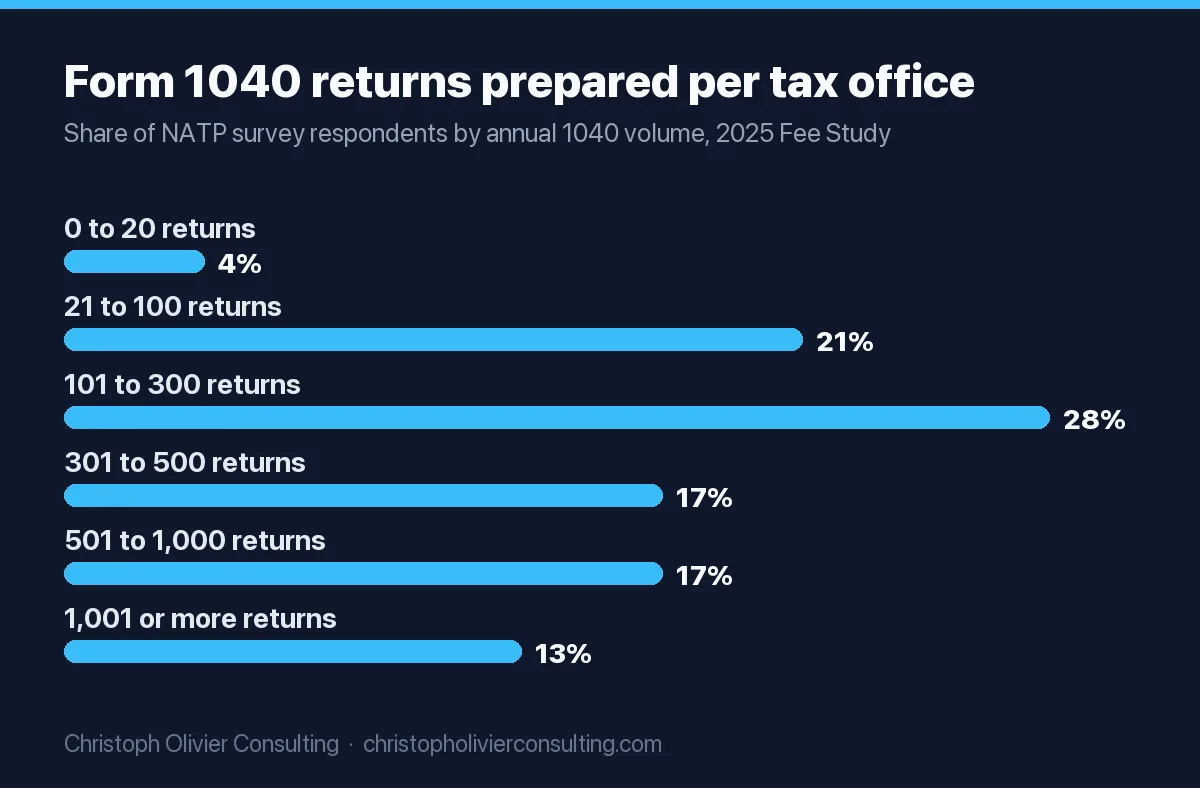
| Tax offices (mostly EAs and CPAs) | 28% prepare 101 to 300 Form 1040s; 30% prepare more than 500 | Form 1040 returns prepared per office, self-reported | 2025 NATP Fee Study, Media Highlights |
| Outsourced accounting / CAS practice | Median 69 clients per practice | Total CAS clients, practices with a median of 10.5 staff | 2024 CPA.com and AICPA PCPS CAS Benchmark Survey, Appendix B |
| Outsourced accounting per staff member | 7.41 to 10 clients per FTE (median) | CAS clients per full-time equivalent; the report shows 7.41 in one appendix table and 10 in its year-over-year table | 2024 CAS Benchmark Survey |
| Public company audit (largest firms) | More than 100 issuer audit clients per firm | The PCAOB threshold for annual inspection; per-partner audit loads are not published | PCAOB inspection data |
How many clients does an average accountant have?
If you mean an accountant who prepares individual tax returns, the fairest single number is about 100 returns a year. That is total professionally e-filed returns divided by everyone with a PTIN, so it is pulled down by part-time and seasonal preparers. The CPA Journal analysis of IRS e-file records shows how lopsided the distribution is: among solo firms with one matched preparer, 9% submit fewer than 10 returns, 31% fewer than 50 and 45% fewer than 100, while firms with two or more preparers average 183 to 322 filings per person.
If you mean an accountant doing monthly bookkeeping, payroll and close work for small businesses, the number is closer to 7 to 10 clients per person, because each client takes hours every month rather than a few hours once a year. And if you mean the roughly 1.6 million accountants and auditors the Bureau of Labor Statistics counts, most do not have external clients at all: only 21% work in accounting, tax preparation, bookkeeping and payroll services firms. The rest work inside companies, government and financial firms, where the “client” is their employer.
How many clients does a typical accountant have per month?
For tax work, “per month” is misleading because the year is lumpy. Respondents to the 2025 NATP Fee Study earn 64% of their gross revenue between February and April, 15% from May to October and 21% from November to January. Roughly two thirds of a tax practice’s year happens in about three months, so a monthly average says little about how busy March feels. For monthly accounting, the count is steady: the CAS survey’s median practice bills a typical monthly fee of $3,000 per client, so the clients you serve in January are the same ones you serve in July.
How many clients does a small accounting firm have?
Most small firms are tiny. In the IRS e-file data analyzed by The CPA Journal, 89% of e-filing firms submit fewer than 1,000 filings a year, and 48% of preparers who could be matched to a firm are the only preparer at that firm. The firm-size split looks like this:
| E-filing firm size (2024 submissions) | Number of firms | Share of all submissions | Median submissions per firm |
|---|---|---|---|
| Tiny (under 100) | 137,079 | 2% | 26 |
| Small (100 to 1,000) | 127,899 | 20% | 294 |
| Medium (1,000 to 10,000) | 33,565 | 32% | 1,620 |
| Large (over 10,000) | 325 | 46% | 15,898 |
Source: The CPA Journal, “How Big Is the ‘Typical’ Tax Firm?” (Exhibit 2), built from the IRS External Customer Data Store. The large group includes software platforms such as Intuit, H&R Block and TaxHawk, where taxpayers self-file, so it is not a count of accountant clients.
So a “small” independent tax practice in the middle of the pack submits around 300 filings a year. Because the IRS file counts extensions and amended returns as separate submissions, the number of distinct clients is lower than the filing count. The NATP survey of mostly experienced practice owners (59% have more than 20 years in the business) shows a similar spread when you ask offices directly how many Form 1040s they prepare.
What revenue tells you about client count
CPA firms rarely publish client counts, but the AICPA’s 2025 National MAP Survey does publish median revenue by firm size, and the NATP and CAS surveys publish average fees. Dividing one by the other gives a ceiling for each firm size. This is my own arithmetic, not a reported client count: real firms mix tax, accounting and advisory work, and most returns carry extra schedules that raise the fee above the base.
| Firm revenue band (MAP 2025) | Median net client fees | If all revenue were CPA base 1040s at $280 | If all revenue were CAS clients at $17,867 a year |
|---|---|---|---|
| Under $200,000 | $106,301 | About 380 returns | About 6 clients |
| $200,000 to $500,000 | $330,000 | About 1,180 returns | About 18 clients |
| $500,000 to $750,000 | $609,852 | About 2,180 returns | About 34 clients |
| $750,000 to $1.5 million | $1.0 million | About 3,570 returns | About 56 clients |
| $1.5 million to $5 million | $2.6 million | About 9,290 returns | About 146 clients |
Inputs: median net client fees by band from the Journal of Accountancy report on the 2025 MAP Survey (fiscal 2024 data, 1,073 firms); the $280 average CPA fee for a base Form 1040 with Schedules 1 to 3 from the 2025 NATP Fee Study at a glance; the $17,867 median average annual CAS revenue per client from the 2024 CAS Benchmark Survey.
Read it this way: a $330,000 firm is either about a thousand individual returns, or under 20 monthly accounting clients, or some blend. One CAS client at the median fee brings in as much as about 64 CPA-prepared base 1040s. That single ratio is why “how many clients” is the wrong headline metric for a firm owner. Revenue per client and hours per client tell you far more.
How many clients does an accounting firm have at mid-size and Big 4 scale?
The CAS Benchmark Survey is the closest public look at a mid-size firm’s client book. Its median respondent firm has $7,050,000 in annual revenue, and its CAS practice alone has $1,606,409 in revenue, 10.5 staff and 69 clients. Top-quartile practices (ranked by revenue per professional) serve a median of 102 clients at $23,129 each with 10.75 staff. The same survey shows a median of 14 new clients a year and a 10% client turnover rate, so a 69-client book replaces roughly 7 clients a year just to stay level.
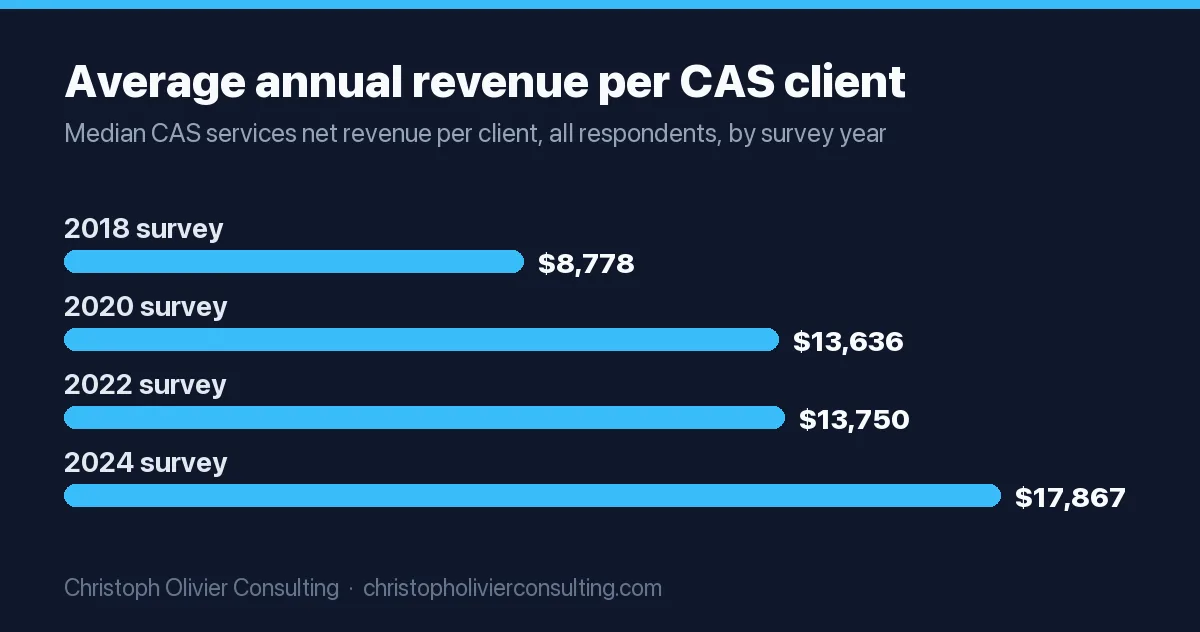
The CAS survey also shows the long-term trend that explains why firms are not simply piling on clients: average annual revenue per CAS client roughly doubled between the 2018 and 2024 surveys while the median number of clients per practice stayed between 67 and 75.
Who are Big 4 clients?
Big 4 clients are mostly the largest listed companies and large private companies. According to the PCAOB, the Big Four US firms (Deloitte, EY, KPMG and PwC) collectively audited approximately 80% of the market capitalization of exchange-listed public companies as of December 31, 2024. Each is inspected every year because each issues audit reports for more than 100 public companies, the PCAOB’s annual inspection threshold. On the advisory side, Deloitte says its network serves nearly 90% of the Fortune Global 500 as well as thousands of private companies. Individual Big 4 audit partners and staff work on a small number of large engagements at a time; the firms do not publish a per-person client count.
Clients per accountant: why one business client is not one tax client
Counting heads hides the real constraint, which is hours. Two published averages from the 2025 NATP Fee Study show how little time the pricing assumes for a simple return: the average fee for a base Form 1040 with Schedules 1 to 3 is $236 (middle half $150 to $328), and preparers who bill hourly charge an average of $182 an hour. At those averages, a base return is priced like about 1.3 hours of work. A monthly accounting client at the CAS median fee of $17,867 a year pays roughly 75 times the fee of a base return.
| Service line | Typical client count signal | Fee per client (published average or median) | What limits capacity |
|---|---|---|---|
| Individual tax only | Hundreds of returns per preparer | $236 base 1040, all preparers; $280 for CPAs; $228 for EAs (NATP 2025) | The February to April window, document chasing, review time |
| Business tax plus advisory | Fewer, larger engagements | Not published as a single national average; NATP reports firms pairing 1040s with advisory price the base 1040 near $250 | Partner review and planning meetings |
| Monthly outsourced accounting (CAS) | About 7 to 10 per FTE; 69 per practice | $17,867 a year all respondents; $23,129 top performers (CAS 2024) | Monthly close deadlines, every month |
| Audit and assurance | A handful of engagements per team | Not published per client in these surveys | Engagement hours, independence rules, inspection risk |
Sources: NATP 2025 Fee Study at a glance; 2024 CAS Benchmark Survey.
Accountant client capacity and revenue-per-client calculator
The useful question for your own firm is “how many clients can each person carry at the fee we charge?” Here is the method, followed by a worked example and a spreadsheet layout you can copy.
- Set chargeable hours per person. Use your own time data. For context, the Thomson Reuters Institute, summarizing the Rosenberg Report, says “many teams are logging less than 1,400 hours annually” of billable time.
- Measure hours per client by service line. Pull last year’s time entries and divide total hours by client count for each line (individual tax, business tax, monthly accounting). Do not guess this; it is the number that drives everything else.
- Capacity per person = chargeable hours ÷ hours per client.
- Revenue per person = capacity × average annual fee per client. Compare it with the CAS survey’s median net client fees per professional of $156,250 and the top-quartile figure of $248,646.
- Required fee = revenue target per person ÷ the number of clients you actually want each person to carry. If that fee is above what you charge now, you have a pricing problem, not a capacity problem.
Worked example using the published medians
Take the CAS survey’s medians at face value. Median revenue per professional of $156,250 divided by median revenue per client of $17,867 is about 8.7 clients per person, which sits inside the 7.41 to 10 range the survey reports directly. If that person logs 1,400 chargeable hours, each client gets about 160 hours a year, or roughly 13 hours a month. To reach the top-quartile $248,646 per professional with the same 8.7 clients, the fee per client would need to be about $28,400 a year. Top performers in the survey get there with a mix of more clients per person and a higher median fee ($23,129).
Now a tax-only example with hypothetical inputs (replace them with yours): a preparer with 1,000 chargeable hours in and around tax season, whose time records show 2.5 hours per individual return, can carry about 400 returns. At the CPA base average of $280 that is $112,000 before schedules and state returns; at 300 returns it is $84,000. The calculator makes the trade-off visible: you either add hours, cut hours per return through better intake, or raise the fee.
| Cell | Label | Formula or input | Example value |
|---|---|---|---|
| B1 | Chargeable hours per person per year | Input from your time system | 1,400 |
| B2 | Hours per client per year (this service line) | Input: total hours ÷ clients, last 12 months | 160 |
| B3 | Average annual fee per client | Input: service line revenue ÷ clients | $17,867 |
| B4 | Capacity: clients per person | =B1/B2 | 8.75 |
| B5 | Revenue per person at capacity | =B4*B3 | $156,336 |
| B6 | Effective rate per hour | =B3/B2 | $111.67 |
| B7 | Revenue target per person | Input | $248,646 |
| B8 | Fee per client needed to hit target at current capacity | =B7/B4 | $28,417 |
Run the sheet once per service line. In my view, the service line with the lowest effective rate in B6 is usually the real source of the “too many clients” feeling, more than the client count itself.
Benchmarks to check your own client load against
Use this scorecard once a year. Each benchmark is a published median or average, not a target, so treat a big gap as a reason to look closer rather than a pass or fail grade.
| Metric | Published benchmark | Source | Look closer if |
|---|---|---|---|
| Returning tax clients | 87% returning, 13% new | NATP 2025 | Your returning share is well below 87% |
| Monthly accounting client turnover | 10% a year | CAS 2024 | You lose more than 1 in 10 clients a year |
| New CAS clients per year | 14 (median practice) | CAS 2024 | You add many more clients than you have staff to absorb |
| Revenue per CAS professional | $156,250 median; $248,646 top quartile | CAS 2024 | You are under the median with a full client list |
| Fee increases | 83% of preparers raise fees every one to two years, typically 6% to 10% | NATP 2025 | You have not raised fees in two years |
| Chargeable hours | Many teams under 1,400 a year | Thomson Reuters Institute | Your plan assumes far more hours per person than your time data shows |
If the fee-increase row is the problem, the price increase letter templates for accountants are a faster fix than hiring. If turnover is the problem, start with client retention for CPA and accounting firms, because replacing a lost monthly client costs more than keeping one.
Can you make $500,000 a year as an accountant?
Yes, but mostly as an equity partner in a larger firm, and it is well above the median. The 2025 Rosenberg MAP Survey, as reported by CPA Trendlines, puts average income per equity partner at $615,000, up 3.2%. The AICPA’s survey, which is weighted toward smaller firms (81% of responses came from firms with $5 million or less in revenue), reports a median compensation per equity partner of $202,521 and a median net remaining per owner of $252,663 for fiscal 2024, according to the AICPA and Journal of Accountancy. For employed accountants and auditors, the BLS reports a May 2025 median of $83,680, with the top 10% earning more than $144,090.
Put that through the client math above. A solo owner who wants $500,000 of profit needs well over $500,000 of revenue. At the CAS median of $17,867 per client that is 28 or more monthly clients before any expenses, which is about three people’s worth of capacity at 7 to 10 clients each. At $280 per base return it is over 1,780 returns. The path to $500,000 runs through fee per client and a team that does the work under you, not through one person carrying more clients.
Is accounting a growing or dying field?
Growing, by every public measure that bears on client work. The BLS projects accountant and auditor employment to grow 5% from 2025 to 2035, faster than the 3% average for all occupations, with about 115,300 openings a year. The number of people holding a current PTIN rose from 870,679 for 2025 (IRS, Dec. 1, 2025) to 902,514 for 2026 (IRS, Nov. 1, 2026), including 210,487 CPAs and 72,945 enrolled agents. Professionally e-filed returns rose from 84,780,000 to 86,758,000 between the 2024 and 2025 seasons in the IRS filing statistics. CPA firms reported a median 6.7% increase in net client fees in the 2025 MAP Survey, and CAS practices reported 17% growth in the 2024 CAS survey.
What is shrinking is tolerance for low-fee, high-touch clients. The AICPA’s Lisa Simpson describes firms “refining their client base and deepening relationships with existing clients,” and the 2025 MAP release notes a slow shift toward value and fixed pricing. In practice, that means fewer clients per person at higher fees.
What to do with your number
Once you know your hours per client and fee per client, the client count becomes an output, not a goal. Firms that run short of capacity usually fix pricing and packaging first; a good, better, best pricing structure is a simple way to move small clients to a fee that matches their hours, and a clear proposal and pricing presentation keeps new clients from coming in at the old rate. Firms with spare capacity have the opposite problem, which is about acquisition rather than caseload; how CPA and accounting firms get clients covers the channels, and marketing KPIs for accounting firms covers what to track so new clients arrive at the right fee. If you want a second pair of eyes on which clients to grow, reprice or let go, you can book a consultation.
Ready to scale your revenue?
Book a free 30-min consultation. We’ll diagnose your growth bottleneck and map out the 3 highest-leverage moves for your business.
Frequently asked questions
How many clients does an accountant have on average?
For individual tax work, about 100 returns per preparer: 86.8 million professionally e-filed returns in 2025 divided by 870,679 PTIN holders. Among preparers matched to a firm in IRS e-file data, the median is 160 filings. For monthly outsourced accounting, the 2024 CAS Benchmark Survey reports about 7 to 10 clients per full-time person and a median of 69 clients per practice.
How many clients does a small accounting firm have?
Most small tax practices are tiny. In IRS e-file data analyzed by The CPA Journal, 89% of e-filing firms submit fewer than 1,000 filings a year and the median small firm (100 to 1,000 filings) submits 294. In the 2025 NATP Fee Study, 28% of offices prepare 101 to 300 Form 1040s and 30% prepare more than 500.
How many clients can one accountant handle?
Divide your chargeable hours by the hours each client takes. The CAS survey's medians imply about 8.7 monthly accounting clients per person at roughly 160 hours each per year, assuming 1,400 chargeable hours. Tax-only preparers carry hundreds of returns because a base Form 1040 is priced like about 1.3 hours of work at NATP's average fee and hourly rate.
How many clients do bookkeepers or CAS accountants have per staff member?
The 2024 CPA.com and AICPA PCPS CAS Benchmark Survey reports a median of 7.41 clients per full-time equivalent in one appendix table and 10 in its year-over-year table. The median CAS practice has 10.5 staff, 69 clients, a typical monthly fee of $3,000 and average annual revenue per client of $17,867.
Who are Big 4 clients?
Mostly the largest listed and private companies. The PCAOB says the Big Four US firms audited about 80% of the market capitalization of exchange-listed public companies as of December 31, 2024, and each issues audit reports for more than 100 public companies. Deloitte says its network serves nearly 90% of the Fortune Global 500.
Can you make $500,000 a year as an accountant?
Yes, mainly as an equity partner. The 2025 Rosenberg MAP Survey puts average income per equity partner at $615,000. The AICPA's 2025 MAP Survey, weighted to smaller firms, reports median equity partner compensation of $202,521. The BLS median for accountants and auditors was $83,680 in May 2025, with the top 10% above $144,090.
Is accounting a growing or dying field?
Growing. The BLS projects 5% employment growth for accountants and auditors from 2025 to 2035, with about 115,300 openings a year. Current PTIN holders rose from 870,679 for 2025 to 902,514 for 2026, professionally e-filed returns rose in 2025, and CPA firms reported a median 6.7% increase in net client fees in the 2025 MAP Survey.
How many clients: caseload research