

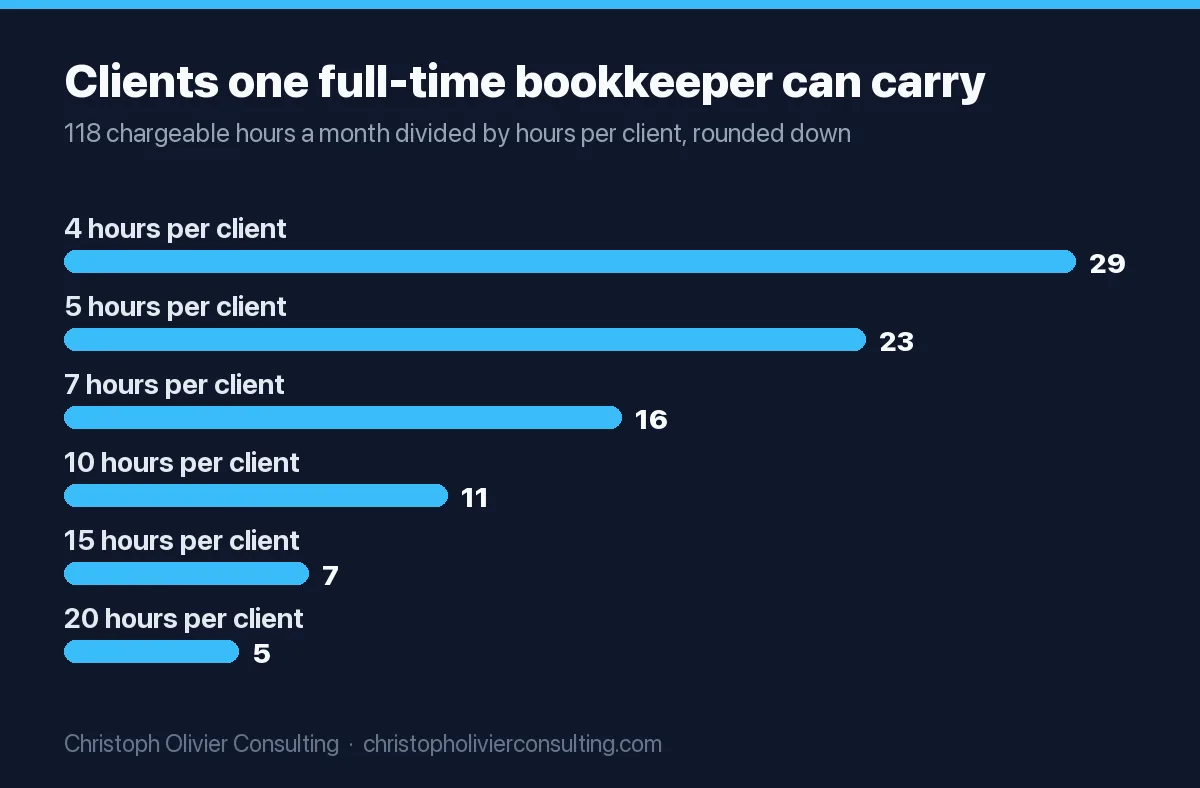
A full-time bookkeeper can usually handle about 11 to 23 monthly clients. The real limit is hours, not a headcount. Divide your chargeable hours per month by the hours each client takes. At about 118 chargeable hours a month, that gives roughly 23 clients at 5 hours each, 11 at 10 hours and 5 at 20 hours. Part-time on 20 hours a week, halve those numbers.
Most pages on this question repeat “10 to 40 clients, 30 on average” with no source. No survey we could find measures an average client count per bookkeeper. Below are the figures that are published: the client-load question in a 2025 bookkeeper survey, chargeable-hour benchmarks from the AICPA’s MAP survey, fee data from two pricing surveys, and BLS wage and job data. Each one is labeled survey data, vendor rule of thumb, or my own arithmetic. Then you get a worksheet to work out your own number.
Short answer: Clients you can handle = chargeable hours per month ÷ average hours per client. With the 1,416 chargeable hours a year the AICPA’s MAP survey reported for professional subcontractors (about 118 a month), that is about 23 clients at 5 hours, 11 at 10 hours and 5 at 20 hours. In a 2025 survey of 644 virtual bookkeepers, 26% were managing 20 or more clients.
How many clients can one bookkeeper handle? The capacity math
Every honest answer comes back to one formula:
Maximum clients = chargeable hours per month ÷ average hours per client per month
Both inputs need a real number, so here is where each one comes from.
Chargeable hours. These are the hours you actually spend on client work. They are not the hours you sit at your desk. Sales calls, admin, invoicing, training and software updates come out of your week first. The Journal of Accountancy’s write-up of the AICPA 2021 MAP survey (more than 1,000 US accounting firms) gives average chargeable hours of 1,416 a year for professional subcontractors across all firms, and 1,584 at the top-performing 25% of firms. That works out to about 118 and 132 chargeable hours a month. These are CPA-firm figures, not a bookkeeper-only survey, but they are the closest published benchmark for a full-time professional’s billable year.
Hours per client. No public survey reports average monthly hours per bookkeeping client. Two widely used vendor rules of thumb give you a starting point:
- Karbon’s bookkeeping pricing guide groups clients as small (under 10 hours a month), medium (10 to 20 hours) and large (over 20 hours).
- Jetpack Workflow’s income model uses about 5, 10 and 20 hours for small, medium and large clients. The article calls these assumptions, not measurements.
Run the formula on those inputs and you get the capacity table below. The arithmetic is mine. The hour benchmarks are linked.
| Hours per client per month | Full-time, 118 chargeable hrs/mo (MAP all-firm average) | Full-time, 132 chargeable hrs/mo (MAP top-performer average) | Part-time, 20 hrs/week (59 chargeable hrs/mo) |
|---|---|---|---|
| 4 hours (very light: bank feeds, categorizing, reconciliations) | 29 | 33 | 14 |
| 5 hours (Jetpack “small”) | 23 | 26 | 11 |
| 7 hours | 16 | 18 | 8 |
| 10 hours (Karbon small/medium line, Jetpack “medium”) | 11 | 13 | 5 |
| 15 hours (Karbon “medium”) | 7 | 8 | 3 |
| 20 hours (Karbon “large” threshold, Jetpack “large”) | 5 | 6 | 2 |
Method: chargeable hours from the AICPA 2021 MAP survey (1,416 and 1,584 hours a year, divided by 12). The part-time column halves 1,416 hours for a 20-hour week. Client counts are rounded down because you cannot serve 0.6 of a client. This table is a calculation, not a survey of actual client loads.
Two things this table makes obvious. First, “how many clients” is the wrong unit. A bookkeeper with 25 clients and one with 6 can be equally full. Second, the jump from 5 to 10 hours per client halves your capacity. That is why a few messy clients sink a practice faster than adding new ones.
How many clients should a bookkeeper have?
Fewer than the table’s maximum. A book filled to 100% of chargeable hours has no slack for month-end crunches, catch-up projects or a client whose payroll breaks. The BLS notes that bookkeeping clerks “may work extra hours to meet deadlines at the end of the fiscal year, during tax time.” So your planning number should leave room for those peaks.
Here is what real bookkeepers report. In The Ambitious Bookkeeper’s 2025 State of Virtual Bookkeeping report (644 responses, published July 8, 2025):
- 26% of respondents were managing 20 or more clients.
- 58% had no team.
- 50% worked full-time.
- 52% said their clients make under $100K a year.
The report does not publish an average client count, so anyone quoting one from this survey is guessing. Read 20 clients alone against the capacity table: it only fits if each client averages about 5.9 hours a month or less (118 ÷ 20). That is light, transaction-level bookkeeping, not monthly close plus payroll plus AP.
My rule of thumb: plan your book to about 80% of your chargeable hours and treat the rest as buffer. That is an opinion, not a benchmark. If your time tracking shows you are over capacity for three straight months, you either raise prices, drop a client, or hire.
How many clients can a bookkeeper handle per month?
“Per month” is the right frame, because bookkeeping is recurring work that resets every close. Your monthly capacity depends far more on the mix of work than on headcount. What drives hours per client:
- Transaction volume. Every bank and card line needs categorizing and later reconciling.
- Number of accounts. Each bank, card, loan and payment-processor account is another reconciliation.
- Payroll. Running it, or only recording it.
- Accounts payable and receivable. Paying bills and sending invoices is a separate job from recording them.
- Inventory, sales tax, multiple entities or classes. Each adds review time every month.
- Client responsiveness. Chasing receipts and answers is unbilled time unless you price for it.
Large outsourced providers price on the same drivers. Intuit says QuickBooks Live Bookkeeping pricing “is based on your company’s average expenses in QuickBooks” and is re-evaluated every three months. Its Full Service tier also excludes sending invoices, paying bills, managing AR, AP and inventory, and running payroll. That is a useful reminder that “bookkeeping” with and without those tasks are different jobs with different hours.
Client complexity scoring rubric (copy and use)
Use this rubric to sort every client into a tier before you count them. The point values and thresholds are a starting framework. They are not industry data. Calibrate them after two months of time tracking.
| Driver | 0 points | 1 point | 2 points |
|---|---|---|---|
| Bank and card transactions per month | Under 100 | 100 to 300 | Over 300 |
| Accounts to reconcile (bank, card, loan, processor) | 1 to 2 | 3 to 5 | 6 or more |
| Payroll | None | Record only | You run it |
| Accounts payable / receivable | Record only | One of AP or AR handled by you | Both handled by you |
| Inventory, sales tax, classes or multiple entities | None | One | Two or more |
| Client sends documents on time | Always | Usually | You chase every month |
Score 0 to 3: Light. Plan 4 to 5 hours a month. Score 4 to 7: Standard. Plan 8 to 10 hours. Score 8 to 12: Complex. Plan 15 to 20 or more hours. These hour bands follow the Karbon and Jetpack tiers above. Replace them with your own tracked averages as soon as you have them.
Client-load worksheet: tier, hours, fee, count
This is the worksheet. Fill one row per tier with your own numbers, then check the totals against your capacity.
- Capacity: chargeable hours per month. Start at 118 for full-time or 59 for 20 hours a week. Lower it if you also do your own sales and admin in those hours.
- For each tier: client count × average hours = hours used. Client count × monthly fee = monthly revenue.
- Effective rate per tier: monthly fee ÷ hours per client.
- Check: total hours used should stay at or under about 80% of capacity (my buffer rule). Total revenue × 12 is your gross annual revenue.
Worked example. The fees here are example inputs, not benchmarks.
| Tier | Clients | Hours per client | Monthly fee | Hours used | Monthly revenue | Effective rate |
|---|---|---|---|---|---|---|
| Light | 10 | 4 | $300 | 40 | $3,000 | $75.00/hr |
| Standard | 6 | 8 | $550 | 48 | $3,300 | $68.75/hr |
| Complex | 2 | 18 | $1,200 | 36 | $2,400 | $66.67/hr |
| Total | 18 | 124 | $8,700 | $70.16/hr |
Read it like this. 124 hours is over the 118-hour full-time benchmark and far above an 80% buffer of about 94 hours. So this book of 18 clients is overloaded, even though 18 sounds modest. Gross revenue is $8,700 × 12 = $104,400 a year. The complex clients earn the lowest effective rate. That is common when fees are set before the hours are known. The fixes, in order: reprice the two complex clients, move light clients to a fixed-scope package, then decide whether to hire. If you change fees for existing clients, our price increase letter templates for accountants give you the wording.
How many bookkeeping clients do I need?
Work backwards from your income target. Clients needed = annual revenue target ÷ (monthly fee × 12), rounded up. The table uses three targets: the BLS median pay for bookkeeping, accounting and auditing clerks ($50,670 a year, May 2025), $100,000 and $150,000. It uses monthly fees at the edges of the bands reported in the pricing surveys in the next section.
| Monthly fee per client | Clients for $50,670 revenue | Clients for $100,000 | Clients for $150,000 | Max hours per client at $100K (118 hrs/mo) |
|---|---|---|---|---|
| $250 | 17 | 34 | 50 | 3.5 |
| $300 | 15 | 28 | 42 | 4.2 |
| $500 | 9 | 17 | 25 | 6.9 |
| $750 | 6 | 12 | 17 | 9.8 |
Revenue, not take-home pay. Software, insurance, self-employment tax and marketing come out of it. The last column divides 118 chargeable hours by the client count needed for $100,000.
The last column is the reality check. At $250 to $300 a month, $100,000 needs 28 to 34 clients. Each one must then take no more than 3.5 to 4.2 hours a month. That only works for very light, well-organized clients.
The simpler way to see it: on 1,416 chargeable hours a year, $100,000 of revenue needs an average of $70.62 per chargeable hour, and $150,000 needs $105.93. If your fees divided by your tracked hours come in below that, adding clients will not get you there. Price will. Our good, better, best pricing guide shows how to package tiers so the heavier clients pay for the heavier scope.
If you are still building the book, not optimizing it, start with how to get clients as a bookkeeper. The Ambitious Bookkeeper survey found 41% of respondents rely on word-of-mouth referrals as their main way to win clients.
How much does a bookkeeper charge per client?
The two US pricing surveys we could check report fee bands, not a median:
- Ignition’s 2025 US pricing benchmark (219 US accounting firms using Ignition, August 21, 2025): the most common monthly fee for bookkeeping and accounting services is $250 to $499 (29% of firms). For most services it benchmarks, 10% or fewer firms charge hourly. 80% expect to raise prices by an average of 5% to 10% in 2026.
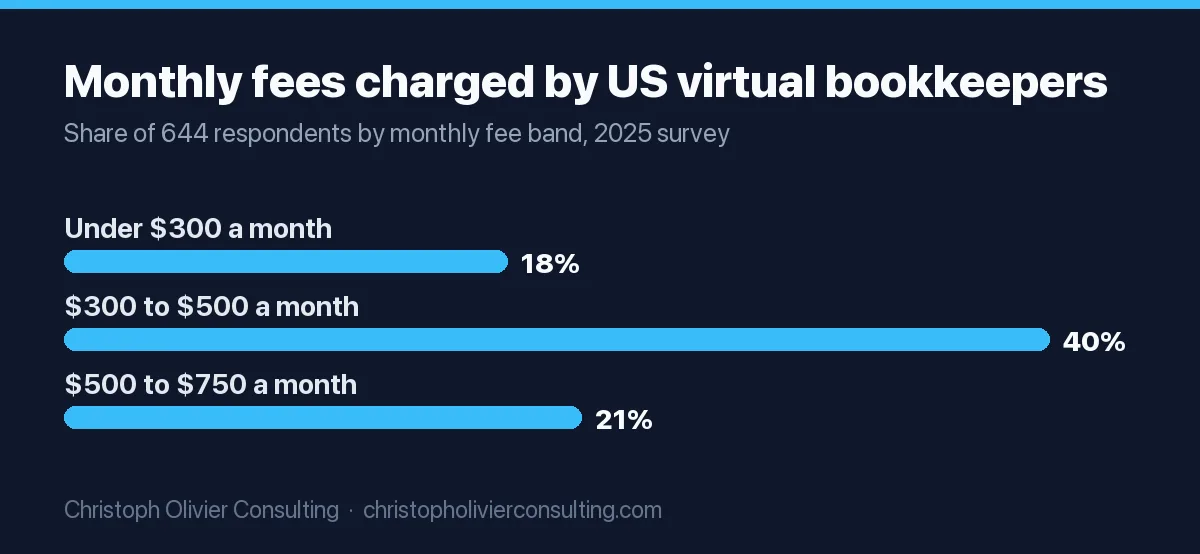
- The Ambitious Bookkeeper 2025 survey (644 virtual bookkeepers): 18% charge under $300 a month, 40% charge $300 to $500, and 21% charge $500 to $750.
Both are samples of software users or community members, not random samples of all bookkeepers. Treat them as market signals, not a price list.
| Measure | Figure | What it measures | Source |
|---|---|---|---|
| Most common US monthly fee band | $250 to $499 (29% of firms) | Monthly bookkeeping and accounting fee, firm survey, reported | Ignition, 2025 |
| US virtual bookkeepers charging $300 to $500 a month | 40% | Monthly fee, practitioner survey, reported | Ambitious Bookkeeper, 2025 |
| US employee bookkeeper median pay | $50,670 a year, $24.36 an hour | Wages of employed clerks, May 2025, not freelance fees | BLS OOH |
| Australia average hourly rate, general bookkeeping | A$79.27 (A$79.91 for ICB members, A$69 non-affiliated) | 2024 ICB survey, 811 respondents, reported | ICB via Associations Forum, 2025 |
| New Zealand bookkeepers charging under NZ$50 an hour | 4.5% | 2024 ICNZB survey, 105 responses, standard bookkeeping | ICNZB rate guide, 2024 |
Note the gap between the employee wage ($24.36 an hour) and the $70 an hour or more that a solo practice needs for $100,000 on 1,416 chargeable hours. That gap is not profit. It pays for unbilled hours, software, insurance, benefits and the time spent finding clients. For the method behind setting a fee, see our pricing strategy guide.
Why are bookkeepers declining?
Employed bookkeeping jobs are shrinking. Demand for the work is not gone. The BLS Occupational Outlook Handbook counts 1,532,400 bookkeeping, accounting and auditing clerk jobs in 2025. It projects a 6% decline to 1,446,800 by 2035, a loss of 85,600 jobs. Its reason: “Software innovations have automated many of the tasks performed by bookkeeping, accounting, and auditing clerks,” so “the same amount of work can be done with fewer employees.” The BLS still projects about 144,100 openings a year, all from replacing workers who retire or change jobs.
Automation also bears on the capacity question. In the AICPA 2025 MAP survey (1,073 firms), 13% of firms said they had already implemented AI and automation successfully. Asked how they would use freed-up capacity, 39% said they would increase client load without adding staff. 45% said they would reduce hours, and 40% would add advisory or consulting services. The practical read: as categorizing and matching get automated, hours per client fall for light clients. The bookkeepers who keep their rates are the ones who move up to review, close and advice.
What are the top 3 to 5 skills that make a great bookkeeper?
The BLS lists five “important qualities” for the occupation:
- Analytical skills: evaluating financial records and identifying issues.
- Computer skills: being comfortable with spreadsheets and bookkeeping software.
- Detail orientation: paying close attention “in order to recognize and avoid making errors.”
- Integrity: keeping an organization’s financial documentation proper and confidential.
- Math skills: comfort with basic arithmetic every day.
For a practice owner trying to carry more clients, I would add one more: systems discipline. That means checklists, a close calendar and time tracking by client. Without time tracking, you cannot fill in the worksheet above with real numbers. Our client onboarding checklist for accountants is a good place to standardize how each new client starts.
What is a bookkeeper not allowed to do?
For federal tax work, the IRS spells out the limits:
- Anyone who prepares a federal return for pay must have a Preparer Tax Identification Number (PTIN).
- Only enrolled agents, CPAs and attorneys have unlimited representation rights before the IRS.
- Annual Filing Season Program participants have limited rights. They can represent only clients whose returns they prepared and signed, and not on appeals or collection issues.
- PTIN holders without a credential or AFSP status cannot represent clients before the IRS at all for returns filed after 2015.
Rules on the CPA title, audits and other attest work are set by each state’s accountancy law, so check your state board before offering anything beyond bookkeeping and preparation.
When to stop adding clients and hire
Run this check every quarter with your time data. Each line is pass or fail.
| Check | Pass | Fail: act |
|---|---|---|
| Hours used vs capacity, 3-month average | At or under 80% | Over 80%: reprice or stop selling |
| Lowest effective rate in your book | Within 20% of your average rate | Lower: reprice or reduce that client’s scope |
| Closes delivered by your promised day | Every client, every month | Any miss two months running: capacity problem |
| Hours on sales and admin | Tracked and inside your plan | Not tracked: your capacity number is too high |
| Revenue at 80% capacity vs your income target | Meets it | Short: raise fees or add a team member |
The pass lines are my thresholds, not industry standards. If the last row fails even at full fees, the answer is help: a part-time bookkeeper on the light tier while you keep the complex clients and the review. If you are making that shift and want help with the positioning and pricing side, you can book a consultation.
Ready to scale your revenue?
Book a free 30-min consultation. We’ll diagnose your growth bottleneck and map out the 3 highest-leverage moves for your business.
Frequently asked questions
How many clients can a bookkeeper handle?
Divide your chargeable hours per month by the average hours each client takes. At about 118 chargeable hours a month, the AICPA MAP survey average for professional subcontractors, that is roughly 23 clients at 5 hours each, 11 at 10 hours and 5 at 20 hours. No published survey reports an average client count, so treat any single number like 30 as a guess.
How many clients can a part-time bookkeeper handle working 20 hours a week?
About half of a full-time load. Halving the 1,416 chargeable hours a year from the AICPA MAP survey gives about 59 client hours a month. That covers roughly 11 light clients at 5 hours each, 5 clients at 10 hours, or 2 complex clients at 20 hours, before you leave any buffer for month-end peaks.
How many bookkeeping clients do I need to make $100,000?
Divide $100,000 by your monthly fee times 12. At $300 a month you need 28 clients, at $500 you need 17, and at $750 you need 12. That is revenue before software, insurance and taxes. On 1,416 chargeable hours a year, $100,000 also requires an average of about $70.62 per chargeable hour.
How many clients should a bookkeeper have?
Fewer than your maximum. Plan to fill about 80% of your chargeable hours and keep the rest for month-end crunches and catch-up work. That is a rule of thumb, not a benchmark. For context, 26% of 644 virtual bookkeepers in a 2025 Ambitious Bookkeeper survey said they manage 20 or more clients.
How much does a bookkeeper charge per client per month?
Ignition's 2025 benchmark of 219 US firms found the most common monthly bookkeeping fee band was $250 to $499, reported by 29% of firms. In a 2025 survey of 644 virtual bookkeepers, 40% charged $300 to $500 a month, 18% under $300 and 21% $500 to $750. Neither survey publishes a median.
Why are bookkeeping jobs declining?
The BLS projects bookkeeping, accounting and auditing clerk jobs will fall 6% from 2025 to 2035, from 1,532,400 to 1,446,800, because software has automated many routine tasks. It still expects about 144,100 openings a year, all from replacing workers who retire or change occupations.
How many clients: caseload research