

Most insurance agents have somewhere between a few hundred and a few thousand clients, and the number depends almost entirely on what they sell. A personal lines service person in an independent agency handles about 600 to 1,500 accounts, a commercial lines account manager handles about 110 to 340, and a State Farm agent office serves roughly 5,000 policies and accounts. Senior market agents who sell Medicare and life insurance mostly stay under 500 clients: in one 2021 survey only about 30% ever passed that mark.
No government agency counts clients per agent, so every figure below comes from a carrier’s own filing, a trade association study or a published survey, linked at the source. Further down you will find how many policies agents actually sell, a book-of-business calculator with the math worked out, and straight answers to the four questions people ask next: failure rate, top 10% pay, average age and the hardest line to sell.
Short answer: There is no official average. Published benchmarks put a personal lines book at roughly 600 to 1,500 accounts per service person and a commercial book at roughly 110 to 340 accounts. State Farm’s own 2025 figures work out to about 5,000 policies and accounts per agent office. To earn the BLS median wage of $62,280 from commission alone, a personal lines agent needs roughly 90 auto and home households or roughly 300 single-car auto clients, using the public premium and commission figures shown below.
How many clients does the average insurance agent have? Benchmarks by type of agent
The question has no single answer because “client” means different things in different lines. A personal lines client is usually a household with one to three policies. A commercial client is a business with several policies and much more service work. A life or Medicare client may buy once and then need a renewal call each year. The table below compiles every public benchmark I could verify, with what each one actually counts.
| Agent type or role | Benchmark | What it counts | Period | Source |
|---|---|---|---|---|
| State Farm captive agent office | About 5,000 policies and accounts per office | 96 million+ policies and accounts divided by 19,200+ agent offices (whole office team, includes bank and investment accounts) | 2025 | State Farm 2025 results |
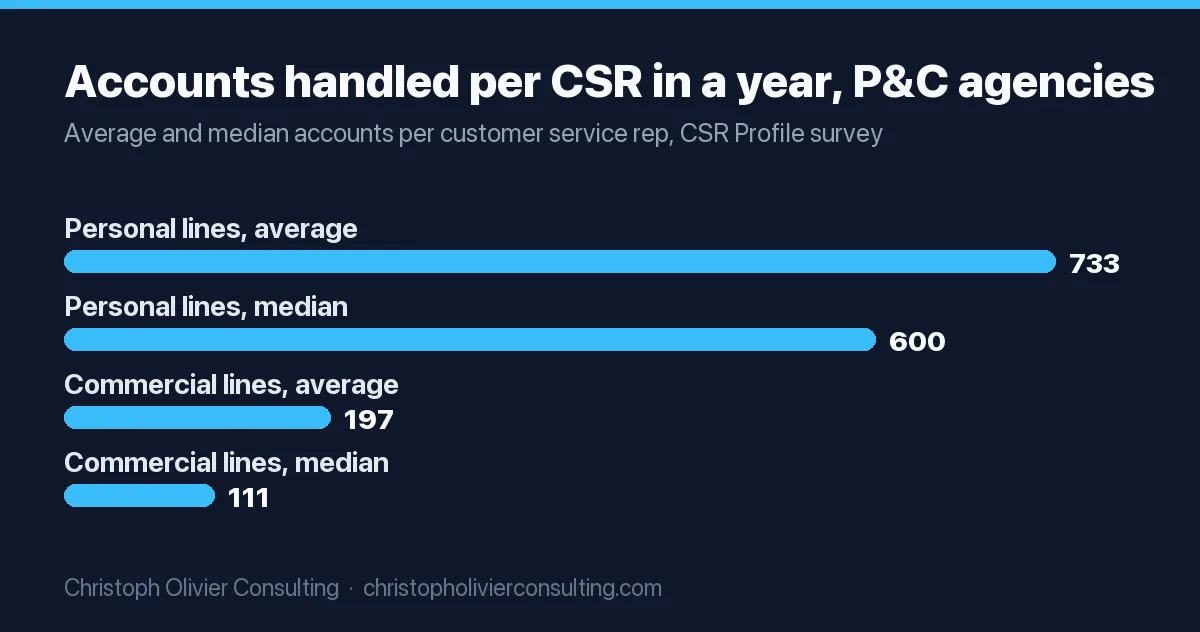
| Personal lines CSR, independent agency | 733 average, 600 median accounts | Accounts serviced per CSR per year | 2008 survey | The CSR Profile, via Rough Notes |
| Personal lines CSR, by agency size | 736 to 962 accounts | Accounts per CSR, Growth and Performance Standards study | 2005 | Rough Notes |
| Personal lines CSR, fully automated vs manual agency | 1,500 customers (1.3 policies each) vs 800 clients | Expert answer from Big “I” Virtual University faculty | 2017 | Independent Agent magazine |
| Commercial lines CSR or account manager | 197 average, 111 median accounts | Accounts serviced per CSR per year | 2008 survey | The CSR Profile, via Rough Notes |
| Commercial lines CSR, by agency size | 340 (small agencies) down to 217 (large) | Accounts per CSR; larger agencies have larger accounts | 2005 | Rough Notes |
| Independent senior market agent (Medicare, life, annuities) | About 30% pass 500 clients; 17% of respondents reported 751+ clients at 10+ years | Self-reported client counts, IMO survey of its agents | 2021 | New Horizons survey (archived) |
| Independent agency, whole firm | 9.9 staff on average | Staff across all positions per agency; about 37,000 agencies in the US | 2026 | Big “I” Agency Universe Study, via Insurance Journal |
Two things stand out. First, the personal lines numbers cluster tightly: every source lands between 600 and 1,500 accounts per service person, which is why “about 1,000” is the rule of thumb one Big “I” expert gives in the Independent Agent answer. Second, the CSR studies are old (2005 and 2008) because, as another expert in that same answer notes, fewer agencies take part in these surveys now. Treat them as the best published floor, not a current census. Automation pushes the number up, which is why the same piece cites 1,500 customers per CSR in a paperless agency.
Personal lines vs commercial lines: why the account gap is 4 to 5 times
In the CSR Profile data, a commercial lines CSR handled about a quarter as many accounts as a personal lines CSR (197 vs 733 on average) but serviced far more commission: $364,800 vs $131,400 a year. Commercial accounts carry more policies, more endorsements and more renewal marketing. So a commercial producer with 150 clients can be busier and better paid than a personal lines producer with 1,000.
How many policies does an insurance agent sell?
Public companies disclose new business by channel, which lets you estimate sales per agent from their own numbers. The results show how different the lines are.
| Sales force | Reported figures | Policies per agent (derived) | Source |
|---|---|---|---|
| Allstate exclusive agency channel (auto and home) | 3,129,000 new auto and 982,000 new homeowners applications issued in 2025; “over 27,400” exclusive agents and licensed sales professionals | About 150 new auto and home items per agent or sales professional per year, about 12 a month | Allstate 2025 Form 10-K |
| Primerica life-licensed representatives (term life) | 331,787 term life policies issued in 2025; average of 152,117 life-licensed reps | 0.18 new policies per rep per month (Primerica’s own figure), about 2 a year | Primerica 2025 Form 10-K |
| State Farm agent offices (all lines) | Nearly 97 million policies and accounts; more than 19,200 agent offices | About 5,000 policies and accounts in force per office (not annual sales) | State Farm 2025 results |
Read the Allstate number carefully. Allstate counts policies “based on items rather than customers,” so a two-car household counts as two auto items, according to the definitions in its 10-K. And the denominator includes licensed staff working inside agencies, not only agency owners. So 150 items a year is per selling head, not per new household.
The Primerica figure looks tiny because many of its 151,524 reps sell part time; the company recruited 358,316 people in 2025 to license 48,722 new reps. It is a fair picture of how slowly a part-time life book grows, not of what a full-time career life agent writes. Forum posts and blogs that quote “30 to 35 policies a year” or “5 to 15 a week” for life agents do not show where the numbers come from, so I left them out.
How many clients does an insurance agent need?
Work backward from income. The number of clients you need is your income target divided by what one client pays you each year. That depends on three things: the client’s annual premium, your commission rate, and the share of commission you keep. Here is the formula, then real numbers.
Book-of-business target formula: Clients needed = Target annual commission ÷ (Average annual premium per client × Commission rate × Share you keep)
The inputs, with public sources
- Premium per client. Allstate’s 2025 brand average was $850 per auto item for a six-month term (about $1,700 a year per car) and $2,263 per homeowners policy for 12 months, per its 2025 10-K.
- P&C commission rate. Erie Indemnity, which sells only through independent agents, paid $1.61 billion in commissions to agents in 2025 against $13.0 billion of premiums written by the Erie Exchange, about 12.4%, or about 13.1% with $94.8 million of incentive pay added, per its 2025 10-K. That blends personal and commercial lines and new and renewal business. Allstate and State Farm do not publish their agent commission percentages.
- Medicare Advantage commission. CMS caps what a plan may pay an independent agent. For 2026 the national maximum is $694 for an initial enrollment and $347 for each renewal year, per the CMS contract year 2026 compensation memo (CMS lists the plan-level data on its agent broker compensation page). These are maximums, not guaranteed payments.
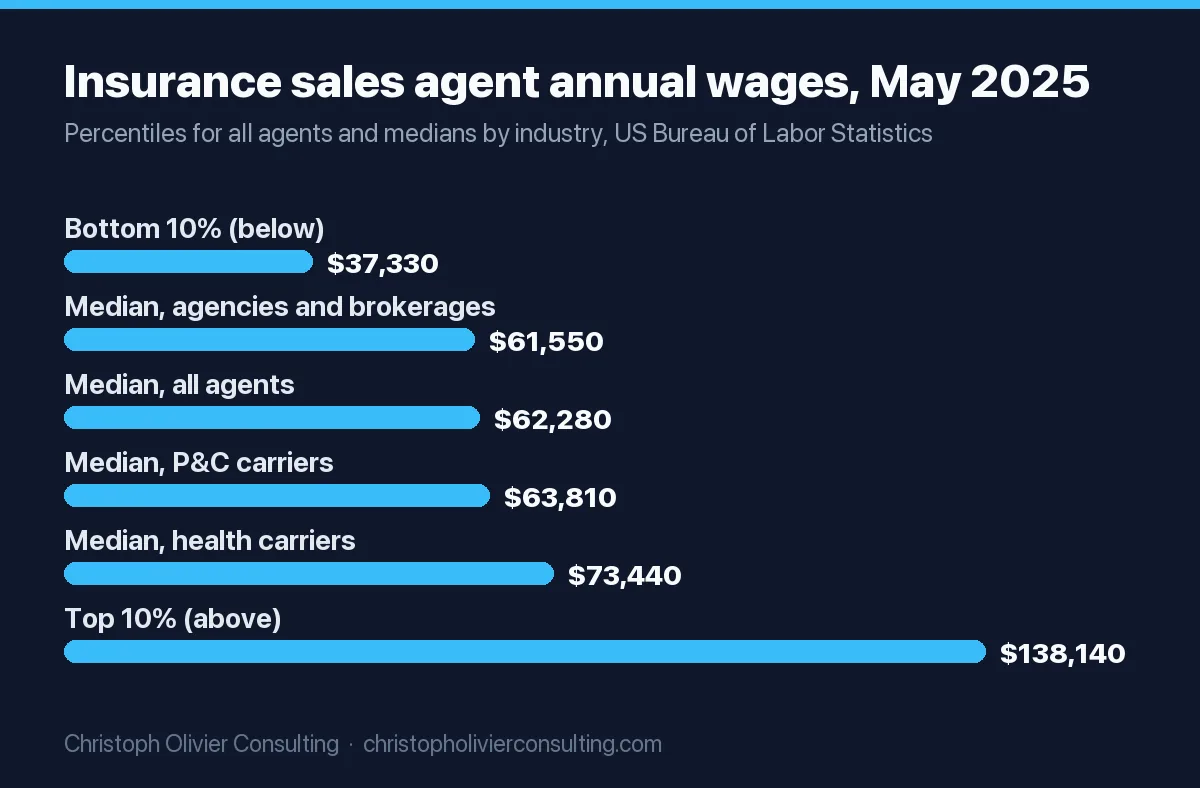
- Income targets. The BLS reports a median wage of $62,280 for insurance sales agents in May 2025, with the top 10% above $138,140, per the Occupational Outlook Handbook.
Worked examples: clients needed to earn the median and top 10% wage
| Client type | Annual premium per client | Commission per client per year | Clients for $62,280 | Clients for $138,140 |
|---|---|---|---|---|
| P&C household: 2 cars + home | $5,663 (2 × $1,700 + $2,263) | $702 at 12.4% | 89 | 197 |
| P&C monoline: 1 car, auto only | $1,700 | $211 at 12.4% | 296 | 656 |
| Medicare Advantage, renewal year | Set by CMS cap | $347 | 180 | 399 |
| Medicare Advantage, first year | Set by CMS cap | $694 | 90 new enrollments | 200 new enrollments |
These are gross commission figures with the “share you keep” set to 100%. Your real number is higher. If you own the agency, staff, rent and software come out of that commission; the average independent agency carries 9.9 staff. If you are a producer inside someone else’s agency, you keep only your split. If you are captive, your carrier sets the schedule. The math also shows why account rounding matters: the bundled household pays about 3.3 times what the single-car client pays, so it takes about a third as many clients to hit the same income.
Copy-ready book-of-business target worksheet
- Target income: write the amount you want to earn: $______.
- Share you keep: your split as a producer, or 1 minus your expense ratio as an owner: ______%. Divide line 1 by this to get the gross commission you need: $______.
- Average annual premium per client: pull it from your agency management system, not from a carrier average: $______.
- Blended commission rate: total commission last 12 months ÷ total written premium last 12 months: ______%.
- Commission per client: line 3 × line 4: $______.
- Clients needed: line 2 ÷ line 5: ______. This is your book-of-business target.
- Service capacity check: line 6 ÷ 1,000 for personal lines (or ÷ 200 for commercial) = service staff you need. The 1,000 and 200 are midpoints of the CSR benchmarks in the first table.
- New clients per year: line 6 × (1 minus your own retention rate), plus your growth goal. This is the number your marketing has to deliver, and it is the input for working out how many leads you need.
Line 8 is where most agents get surprised. A book has to replace lost clients every year before it grows at all, which is why the lifetime value of a client matters more than the first-year commission. If you want to model that properly, the method is in this customer lifetime value guide.
Captive vs independent agents: why client counts differ
The BLS defines captive agents as those who “work exclusively for one company” and independent agents as those who “may sell the policies of several companies.” In practice that changes the client count in three ways.
- Captive offices run large, team-based books. State Farm’s own figures work out to about 5,000 policies and accounts per agent office, spread across the agent and licensed team members. Allstate pays its exclusive agents “a monthly base commission as a percentage of eligible written premium” plus variable pay for new customers and bundling, per its 10-K, which rewards adding policies per household.
- Independent agencies are mostly small firms. The 2026 Agency Universe Study counted about 37,000 independent agencies, down from 39,000 in 2024, with average staff rising from 8.2 to 9.9, per Insurance Business. Allstate alone reports about 58,700 independent agent locations selling its products.
- Where agents work. Of about 572,600 insurance sales agent jobs in 2025, 63% were at agencies and brokerages, 12% were self-employed, 8% were at property and casualty carriers and 5% at health carriers, per the BLS.
What do the top 10% of insurance agents make?
The top 10% of insurance sales agents earned more than $138,140 in May 2025, according to the BLS. The median was $62,280 and the bottom 10% earned less than $37,330. By industry, the median was $73,440 at health and medical insurance carriers, $63,810 at property and casualty carriers and $61,550 at agencies and brokerages. One caveat matters for this topic: these BLS wage figures exclude self-employed agents and agency owners, so the people with the biggest books are not in the numbers.
Client count tracks income closely. In the 2021 New Horizons survey of senior market agents, every respondent earning under $24,999 had fewer than 200 clients, and agents earning over $100,000 were most likely to have over 500, per the archived report. Put that next to the worked examples above and the top 10% threshold lines up with a book of roughly 200 bundled P&C households or about 400 Medicare Advantage renewals, before expenses.
What is the failure rate of insurance agents?
For new life insurance agents in career agency systems, it is high. In LIMRA’s 2024 production and retention data, 68% of new financial professionals left within their first two calendar years, only 16% remained after four years, and the base sales force turned over at 24% a year, per LIMRA’s paper on the hidden costs of chasing volume. Four-year retention ranged from 3% to 40% across companies. LIMRA’s 2025 conference deck adds that historically, four-year retention at agency-building companies “has not exceeded 20 percent,” and its 2022 release put the 2020 figure at 15%.
Two limits on that number. It measures agents still under contract with the company that hired them, so some “failures” moved to another carrier or became independent. And it covers life insurance career systems that mostly recruit inexperienced people. No comparable public figure exists for P&C agents. The link to client count is direct: the agents who leave are mostly the ones who never built enough clients to replace the training allowance, which is what the worksheet above is designed to expose early.
How old is the average insurance agent?
The median age of employed insurance sales agents was 45.1 in 2025, three years older than the 42.1 median for all workers, according to the Current Population Survey table of employed people by occupation and age. Of 618,000 employed agents in that survey, 115,000 were 55 to 64 and 67,000 were 65 or older, so about 29% are 55 or older. The 2021 New Horizons survey found the typical senior market agent was “a male in his 50s.” An older agent base is one reason books change hands: agents nearing retirement sell or transfer their clients, which is how many newer agents acquire a book instead of building every client from zero.
What’s the hardest insurance to sell?
On the public numbers, individual life insurance. Primerica’s reps averaged 0.18 new term policies per month in 2025, per its 10-K, compared with about 12 new auto and home items a month per Allstate exclusive agency seller. Demand exists: LIMRA and Life Happens report that 52% of US adults have some life insurance and 38%, about 92 million adults, say they need it or need more, per the 2026 Insurance Barometer fact sheet. The two main reasons people give for not buying are that they think it costs too much and they have other financial priorities. Unlike auto insurance, no law or lender requires it, so the agent has to create the urgency.
Commercial lines are hard in a different way: fewer clients, longer sales cycles and much more technical knowledge, which is why commercial CSRs earned about 26% more than personal lines CSRs in the CSR Profile data.
How do insurance agents find clients?
Referrals first, then digital. In the 2021 New Horizons survey, 80.95% of agents earning $200,000 or more named referrals or word of mouth as their number one lead source. Independent agencies now spend more on marketing: the average budget rose from $14,300 in 2024 to $20,600 in 2026, and 47% rank social media and digital marketing as their top activity, followed by Google Business, SEO and websites, per the 2026 Agency Universe Study. Growing personal lines business was a top challenge for 41% of agencies.
If referrals are your main channel, build a system for them instead of waiting; this referral marketing guide covers the mechanics. For paid and organic channels specific to agencies, see our insurance agency marketing playbook, and check what a lead should cost against the average cost per lead by industry before you buy any. A good CRM keeps renewal dates, cross-sell gaps and referral sources in one place; the CRM strategy guide shows what to track.
What the data does not tell you
- No official count exists. BLS, the NAIC and state insurance departments publish agent and license counts and pay, not clients per agent. Every client figure here is a carrier disclosure, a trade study or a survey.
- The CSR benchmarks are dated. The most detailed accounts-per-CSR data is from 2005 and 2008. Automation since then pushes capacity up, as the 1,500-customer example shows.
- Survey samples are self-selected. The New Horizons survey covers agents connected to one marketing organization and does not state its sample size.
- Commission rates vary by carrier, state and line. Erie’s 12.4% is one carrier’s blended rate. Use your own commission statement for the worksheet.
In my view, the most useful number is not the industry average but your own commission per client and how many new clients your marketing produces each month. If you want a second pair of eyes on those numbers and the plan to grow them, you can book a consultation.
Ready to scale your revenue?
Book a free 30-min consultation. We’ll diagnose your growth bottleneck and map out the 3 highest-leverage moves for your business.
Frequently asked questions
How many clients does the average insurance agent have?
There is no official average. Published benchmarks put personal lines books at roughly 600 to 1,500 accounts per service person and commercial books at roughly 110 to 340 accounts. State Farm's 2025 figures work out to about 5,000 policies and accounts per agent office, and a 2021 survey found only about 30% of senior market agents pass 500 clients.
How many clients does an insurance agent need to make a living?
Divide your income target by the commission one client pays you each year. Using Allstate's 2025 average premiums and Erie's roughly 12.4% commission rate, a two-car plus home household pays about $702 a year in commission, so about 89 households reach the $62,280 BLS median before expenses. Single-car auto clients take about 296.
How many policies does an insurance agent sell per month?
It depends on the line. Allstate's exclusive agency channel issued about 150 new auto and home items per agent or licensed sales professional in 2025, about 12 a month. Primerica's part-time life reps averaged 0.18 new term policies per month. Life sales are much slower than auto and home sales.
How many accounts should a personal lines CSR handle?
Most published benchmarks fall between 600 and 1,500. The CSR Profile survey found an average of 733 and a median of 600 accounts, the GPS study found 736 to 962, and a Big I expert cites 1,500 customers in fully automated agencies versus 800 in manual ones, with about 1,000 as a rule of thumb.
What percentage of insurance agents fail?
For new life agents in career agency systems, LIMRA's 2024 data shows 68% leave within two years and only 16% remain after four years, with four-year retention ranging from 3% to 40% across companies. That measures agents leaving their hiring company, not the profession. No comparable public figure exists for property and casualty agents.
How much do the top 10% of insurance agents make?
The top 10% of insurance sales agents earned more than $138,140 in May 2025, according to the Bureau of Labor Statistics. The median was $62,280 and the bottom 10% earned under $37,330. These figures exclude self-employed agents and agency owners, who often have the largest books of business.
How many clients: caseload research