

A typical financial advisor at a retail-focused registered investment adviser (RIA) serves about 67 clients. That is the median clients per advisory employee across 8,311 SEC-registered RIAs that mainly serve individuals, computed from the SEC’s November 2, 2026 Form ADV data file. The middle half of those firms run between 40 and 111 clients per advisory employee. The number swings hard with client wealth: firms whose clients average under $500,000 run a median of 123 clients per advisory person, while firms whose clients average $5 million or more run 20.
Short answer: Most independent advisors serve somewhere between 40 and 130 clients. SEC filings put the median at 67 clients per advisory employee at retail RIAs, and Kitces Research found a 25th to 75th percentile range of 38 to 127 clients per lead advisor in 2024. Brokerage models run far higher: Edward Jones reports 6.7 million client households and 20,425 financial advisors, about 328 households each. The right number for you is set by your hours per client and your revenue per client, and both are worked out below.
How many clients does a financial advisor have on average?
There is no single official average, because each source counts a “client” and an “advisor” differently. Here are the four best public numbers side by side, with what each one actually measures.
| Source | What it measures | Clients per advisor |
|---|---|---|
| SEC Form ADV data, Nov 2026 (our analysis of 8,311 retail RIAs) | Individual clients (Item 5.D rows a and b) plus clients without managed assets (Item 5.C(1)), divided by employees who perform advisory functions (Item 5.B(1)). Reported by firms. | Median 67; middle half 40 to 111 |
| Kitces Research, How Financial Planners Actually Do Financial Planning, Vol. 2, 2024 | Clients per lead advisor on a service team; survey of Kitces.com readers fielded Aug 30 to Sep 30, 2024 (73% independent RIA) | 25th to 75th percentile: 38 to 127 |
| Kitces Research 2022 data, reported Sept 2023 | Median clients per advisor by team size | Solo with no staff: 40; 2-person team: 70; 3-person team: 96 |
| Edward Jones (Jones Financial Companies) 10-K for 2025 | Client households at year end (6.7 million) divided by financial advisors at year end (20,425). US and Canada. | About 328 households per advisor (our division) |
Two patterns explain most of the spread. First, fee-only planning firms with high-net-worth clients sit at the low end, and brokerage firms serving the mass affluent sit at the high end. Edward Jones’ client assets work out to about $370,000 per household ($2,481 billion across 6.7 million households), while the median retail RIA in the SEC data manages about $1.13 million per client. Second, support staff roughly doubles a lead advisor’s client count, which the next two sections show in both datasets.
Clients per advisor by firm size: SEC Form ADV data (November 2026)
Every SEC-registered adviser must report its employees and clients in Item 5 of Form ADV Part 1A. We downloaded the SEC’s monthly file of all 17,263 SEC-registered advisers (dated November 2, 2026) and kept the 8,311 firms that look like advisors to individuals: at least 80% of their counted clients are individuals or high-net-worth individuals, they report at least 5 individual clients, they advise no mutual funds or pooled vehicles, they check “portfolio management for individuals and/or small businesses,” and they report at least one employee performing advisory functions. Then we divided each firm’s individual clients (plus clients without managed assets) by its advisory employees.
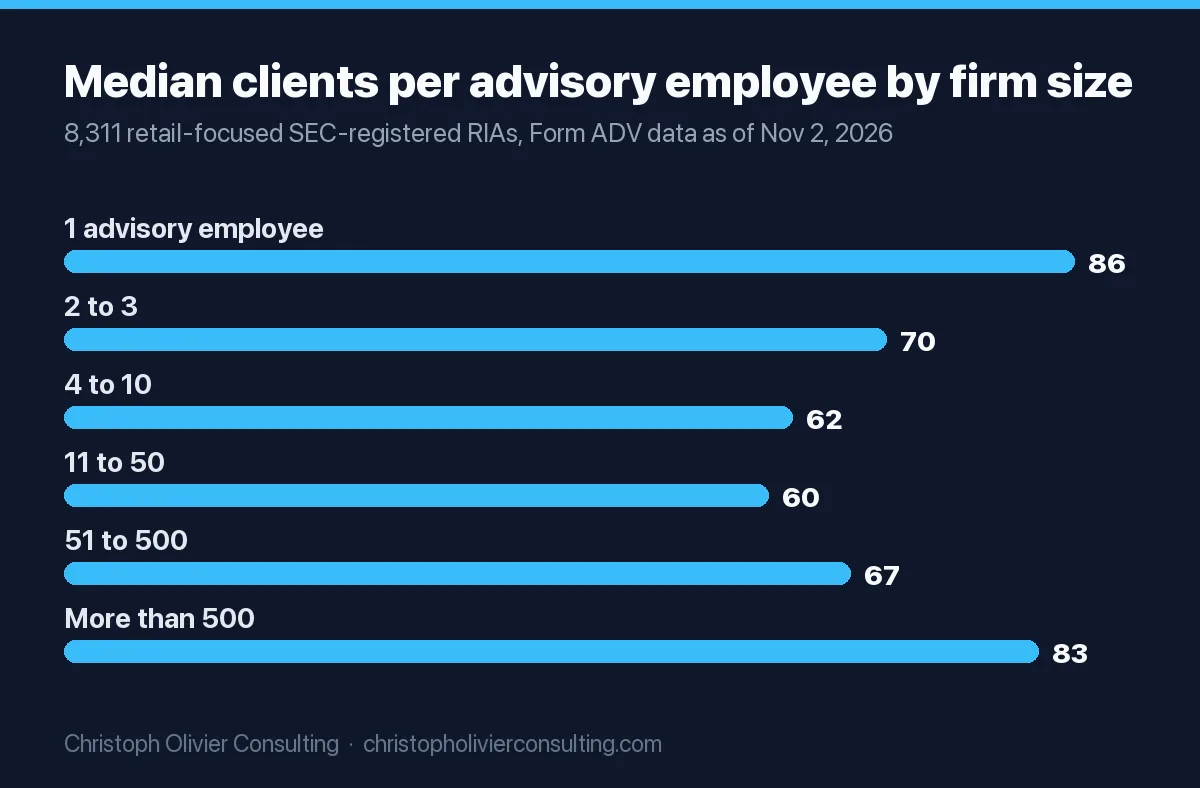
| Advisory employees at the firm (Item 5.B(1)) | Firms | Median clients per firm | Median clients per advisory employee | Middle half (25th to 75th pct) | Median assets per client |
|---|---|---|---|---|---|
| 1 | 1,140 | 86 | 86 | 42 to 172 | $1.45M |
| 2 to 3 | 2,934 | 169 | 70 | 41 to 116 | $1.18M |
| 4 to 10 | 3,000 | 350 | 62 | 39 to 100 | $1.12M |
| 11 to 50 | 935 | 1,062 | 60 | 37 to 92 | $0.93M |
| 51 to 500 | 261 | 6,486 | 67 | 41 to 98 | $0.47M |
| More than 500 | 41 | 139,384 | 83 | 53 to 142 | $0.41M |
| All 8,311 retail RIAs | 8,311 | 256 | 67 | 40 to 111 | $1.13M |
Source: Christoph Olivier Consulting analysis of the SEC registered investment adviser data file of November 2, 2026. Assets per client is individual-client regulatory assets under management divided by individual clients. Categories marked “fewer than 5 clients” were counted as zero.
Three things stand out. Only 29.3% of these firms run more than 100 clients per advisory employee, and only 14.8% run more than 150. The largest firms (over 500 advisory staff) include digital and brokerage-affiliated advisory programs, which is why their client counts per person are higher and their assets per client are lower. And the one-advisor firms split sharply by staffing:
- One advisory person and no other non-clerical employee (605 firms): median 65 clients, median $1.72 million per client.
- One advisory person plus at least one other non-clerical employee (535 firms): median 121 clients, median $1.24 million per client.
That near-doubling matches Kitces Research, which found solo advisors with support staff served about 93 clients versus 36 for solos without staff. If you want the wider industry context behind these firms (headcount, assets, growth), our RIA industry statistics roundup covers it.
The wealthier the client, the fewer clients per advisor
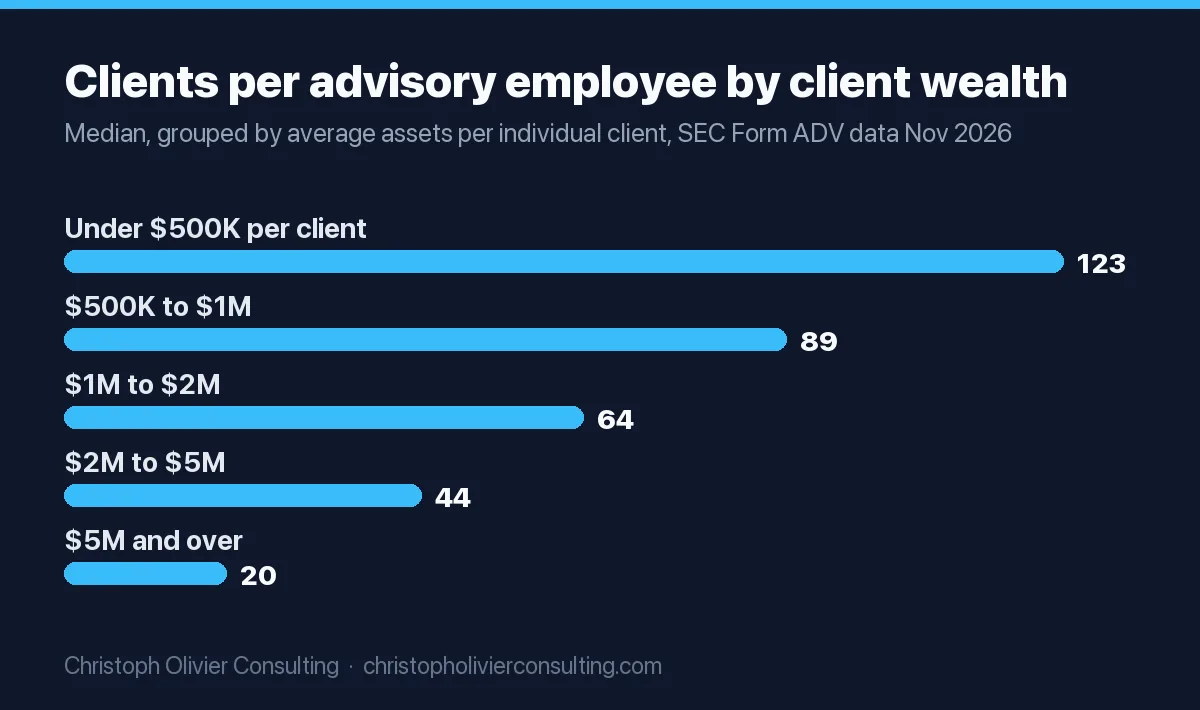
Sorting the same 8,311 firms by average assets per individual client shows the strongest pattern in the data. Client count per advisory person falls by roughly 30% or more with each step up in wealth.
| Average assets per individual client | Firms | Median clients per advisory employee | Middle half | Median share of clients who are high net worth |
|---|---|---|---|---|
| Under $500,000 | 1,584 | 123 | 68 to 218 | 9% |
| $500,000 to $1M | 2,119 | 89 | 61 to 134 | 23% |
| $1M to $2M | 2,416 | 64 | 44 to 91 | 42% |
| $2M to $5M | 1,607 | 44 | 29 to 63 | 62% |
| $5M and over | 585 | 20 | 11 to 33 | 90% |
Kitces Research reached the same conclusion from the survey side: teams serving clients with $3 million or more typically have fewer than 50 client households per lead advisor, about half the 100+ typical for an advisor serving $500,000 clients. Wealthier households bring more complexity (equity comp, entities, estate work) and expect more time, so the book shrinks as it moves upmarket. If moving upmarket is your plan, read how to attract high-net-worth clients alongside this capacity math.
Solo RIA vs ensemble vs wirehouse and broker-dealer advisors
“Financial advisor” covers very different jobs. Use this table to find the benchmark that fits your model instead of comparing yourself to the wrong one.
| Model | Typical clients per advisor | Source | Why it lands there |
|---|---|---|---|
| Solo RIA, no staff | 36 to 65 | Kitces 2022 data (36 and 40); SEC data, one advisory person and no other non-clerical employee (65) | The advisor does planning, service, operations and marketing alone |
| Solo RIA with support staff | 93 to 121 | Kitces 2022 data (93); SEC data (121) | Service and paperwork move to a client service associate |
| Ensemble RIA, 4 to 50 advisory staff | 60 to 62 per advisory employee | SEC data | Associate advisors and paraplanners count as advisory employees, so the per-head figure is diluted; per lead advisor it is higher |
| Hybrid RIA (staff also registered with a broker-dealer) | 83 | SEC data, 1,881 firms reporting broker-dealer reps in Item 5.B(2); median $0.68M per client | Smaller average accounts, some commission business |
| Pure RIA (no broker-dealer reps) | 63 | SEC data, 6,430 firms; median $1.33M per client | Fee-only, more planning-heavy |
| Edward Jones financial advisor | About 328 households | Edward Jones 2025 10-K | Branches “primarily staffed by a single financial advisor” and a support professional, with about $370,000 per household |
| Wirehouses and large independent broker-dealers | Not disclosed | Morgan Stanley and LPL 10-Ks | They report assets and advisor counts, not clients per advisor. LPL reports about 11.6 million client accounts, which counts accounts, not households. |
The 2024 Kitces team data adds one more nuance: the most productive structure is one lead advisor with two support staff (a “1+2” team), which generates $1,237,000 in revenue per advisor, against a median of $182,500 for unsupported solos.
How many clients can a financial advisor handle?
Capacity is a time problem, not a willpower problem. Kitces Research measured the team hours an ongoing client takes each year, and the figure rises steeply with the size of the relationship:
| Client type | Team hours per client per year (ongoing) | Source |
|---|---|---|
| Clients paying under $2,500 a year | 17 | Kitces, Sept 2025 |
| Typical minimum profitable client | 21 (22 in year one) | Kitces, Sept 2025 |
| Clients paying $7,500 or more a year | About 27 | Kitces Report Vol. 2, 2024 |
| Clients paying $40,000 or more a year | 62 | Kitces, Sept 2025 |
Only 16% of that ongoing time is the meeting itself, according to the same 2024 report. Meeting prep and follow-up take 23%, behind-the-scenes planning 19%, service requests 15% and client communication outside meetings 26%. So the client who “only needs two meetings” still eats 20+ hours a year.
Client capacity calculator (copy this)
Run this with your own numbers. Track one month of calendar time if you do not know your hours per client.
- Annual hours per person = weekly hours × working weeks. The typical advisor worked 41.0 hours a week in 2024.
- Client-service hours = annual hours × share of time spent serving existing clients (meetings, prep, follow-up, planning, service, email). Everything else is prospecting, marketing, compliance and running the firm.
- Team client hours = add step 2 across the advisor and every support person on the team.
- Capacity = team client hours ÷ team hours per client per year (from your own tracking, or the Kitces figures above).
- Headroom = capacity minus current active clients. If it is under 10%, you are full.
Worked example (illustrative inputs, swap in yours):
| Input | Solo advisor, no staff | Advisor plus one client service associate |
|---|---|---|
| Advisor hours (41 h × 47 weeks) | 1,927 | 1,927 |
| Advisor share on client service (assumed) | 60% = 1,156 h | 60% = 1,156 h |
| Associate hours (40 h × 47 weeks, 70% on client service, assumed) | 0 | 1,316 h |
| Team client hours | 1,156 | 2,472 |
| Capacity at 27 h per client ($7,500+ clients) | 42 clients | 91 clients |
| Capacity at 21 h per client (minimum profitable client) | 55 clients | 117 clients |
The output lands right where the real-world data sits: 36 to 65 clients for an unsupported solo and roughly 90 to 120 once one support person joins. Kitces’ own 2018 rule of thumb was lighter, 12 hours per client per year, so 100 clients use 1,200 of an advisor’s roughly 2,000 annual hours, but that assumed the initial plan is done separately. Use your measured hours, not anyone’s rule of thumb.
What to do when you hit capacity
When the calculator says you are full, you have three levers: hire (Kitces suggests a client service associate at 30 to 40 clients and an associate advisor at 60 to 70), raise fees and minimums, or transition clients who no longer fit. Keep the clients you want with a deliberate retention plan, and use a CRM and follow-up system so service hours per client stop creeping up. Michael Kitces and Carl Richards discuss the transition conversation in the video below.
How many clients does a financial advisor need?
The number of clients you need is your revenue target divided by revenue per client. Fee levels below come from the 2024 Kitces Report: a typical stated AUM fee of 100 basis points up to $1 million, a blended fee that stays at 100 basis points until $2 million and falls to 85 at $5 million, a median subscription fee of $4,500 a year, and a median revenue per client of $6,857 for teams paid mainly through AUM fees.
| Revenue per client | How it is reached | Clients needed for $182,500 (median unsupported solo revenue) | Clients needed for $400,000 (median revenue per advisor, 2024) |
|---|---|---|---|
| $3,000 | $300,000 portfolio at 1.00% | 61 | 134 |
| $4,500 | Median annual subscription fee | 41 | 89 |
| $5,000 | $500,000 portfolio at 1.00% | 37 | 80 |
| $6,857 | Median revenue per client, AUM-reliant teams | 27 | 59 |
| $10,000 | $1M portfolio at 1.00% | 19 | 40 |
| $20,000 | $2M portfolio at 1.00% blended | 10 | 20 |
| $42,500 | $5M portfolio at 0.85% blended | 5 | 10 |
Revenue targets: $182,500 is the median for unsupported solo advisors; $400,000 is the typical revenue per lead advisor in 2024. Client counts are rounded up.
Now put the two tables together. At $3,000 per client you need 134 clients to reach $400,000, but at 21 hours each that is 2,814 team hours, more than the advisor-plus-associate team in the calculator has. At $10,000 per client you need 40, which one advisor with light support can serve. This is the whole case for the “50 great clients” idea: Kitces showed 50 clients at $5,000 each produce $250,000 of gross revenue. Getting there is a client acquisition problem, which is what how financial advisors get clients covers.
How many clients should a financial advisor have?
My view: decide the number from the top down, not the bottom up. Pick the client you serve best, measure your hours per client, and let the calculator and revenue table set the ceiling. Then use this test to see whether your current book is the right size.
| Check | Pass | Fail | Basis |
|---|---|---|---|
| Clients per lead advisor vs client wealth | Within the SEC middle-half range for your wealth band (e.g. 44 to 91 at $1M to $2M) | Above the 75th percentile for your band | SEC data table above |
| Upmarket book ($3M+ clients) | Under 50 households per lead advisor | 50 or more | Kitces Report 2024 |
| Meetings per client per year | 2 or fewer standard meetings | More than 2 as standard | Kitces flags more than two meetings a year as a sign of overservicing |
| Personalized touchpoints | 10 or fewer a year | More than 10 | Same Kitces overservicing marker |
| Capacity headroom | 10% or more after the calculator | Under 10% | Calculator above (headroom threshold is our rule of thumb) |
| Staffing trigger | Support hired by 30 to 40 households | Solo past 40 with no help | Kitces hiring guidance |
If your firm fails two or more rows, the answer to “how many clients should I have” is probably “fewer, at a higher fee,” and a sharper niche makes that easier to sell.
What is the 80/20 rule for financial advisors?
The 80/20 rule (the Pareto principle) is the idea that roughly 80% of an advisor’s revenue comes from about 20% of clients. It is a rule of thumb, not a measured industry statistic, and we found no primary dataset that confirms the exact split for advisors. What the data does show is a wide revenue gap between clients: Kitces Research found annual revenue of about $1,907 per client for clients under $250,000 and about $20,000 for clients over $10 million, a tenfold difference. Team hours per client rise much less, from about 17 a year for clients paying under $2,500 to 62 for clients paying $40,000 or more. To test the rule on your own book, export revenue by client from your CRM, sort it from highest to lowest, and add up the top 20% of rows. The share you get tells you how concentrated you are and which clients the capacity math says to protect.
Is $300,000 enough for a financial advisor?
Yes, for a large share of advisors. In the 2024 Kitces survey, 35% of teams charging AUM fees had no asset minimum and another 9% had a minimum under $250,000, so at least 44% would take a $300,000 portfolio outright. Another 12% set minimums between $250,000 and $499,000. Of the teams that do have minimums, 78% said they occasionally waive them. For context, Edward Jones’ client assets average about $370,000 per household. At a typical 1.00% fee, $300,000 produces $3,000 a year for the advisor, which is why firms built around larger clients set higher minimums or charge a flat planning or subscription fee instead.
What does Warren Buffett say about financial advisors?
Buffett’s best-known comment is about fees, not about advisors as such. In his 2016 letter to Berkshire Hathaway shareholders he wrote: “When trillions of dollars are managed by Wall Streeters charging high fees, it will usually be the managers who reap outsized profits, not the clients. Both large and small investors should stick with low-cost index funds.” In the same letter he estimated that the search by the wealthy for superior investment advice had wasted “more than $100 billion over the past decade.” For advisors, the practical takeaway is that pure investment selection is hard to charge for, which is one more reason the data above favors planning-led firms with fewer, deeper client relationships.
How we built the numbers, and their limits
- Data: the SEC’s registered adviser file dated November 2, 2026 (17,263 firms). SEC registration generally applies to firms with $100 million or more in regulatory assets under management, so the many small state-registered advisers are not in this data. Their client counts are likely lower.
- “Client”: Form ADV Item 5.D counts trusts, estates, IRAs and 401(k)s of individuals and their family members in the “individuals” category. Firms vary in whether they count a household as one client or several, and all figures are “approximate” by the form’s own wording.
- “Advisor”: Item 5.B(1) counts every employee who performs investment advisory functions, including research, and associate advisors. Clients per lead advisor are therefore higher than our per-advisory-employee figures, which is consistent with the Kitces per-lead-advisor range of 38 to 127.
- Kitces Research is a survey of Kitces.com readers, skewed toward independent, planning-focused RIAs. Edward Jones counts households and includes Canada.
If you want help turning your capacity number into a growth plan that brings in the right clients rather than more clients, you can book a consultation.
Ready to scale your revenue?
Book a free 30-min consultation. We’ll diagnose your growth bottleneck and map out the 3 highest-leverage moves for your business.
Frequently asked questions
How many clients does a financial advisor have on average?
At SEC-registered RIAs that mainly serve individuals, the median is about 67 clients per advisory employee, based on November 2026 Form ADV data for 8,311 firms. The middle half of firms run 40 to 111. Kitces Research puts the typical range at 38 to 127 clients per lead advisor, while Edward Jones advisors average about 328 households each.
How many clients can a financial advisor handle?
It depends on hours per client. Kitces Research measured about 21 team hours a year for a typical minimum profitable client and about 27 for clients paying $7,500 or more. An unsupported solo advisor with roughly 1,150 client-service hours a year can handle about 40 to 55 clients. Adding one support person roughly doubles that.
How many clients should a financial advisor have?
Set the number from your client type and hours. Advisors serving $3 million plus households typically keep fewer than 50 per lead advisor, and those serving $500,000 households often run 100 or more. In SEC data, firms whose clients average $1 million to $2 million run a median of 64 clients per advisory employee.
How many clients does a financial advisor need?
Divide your revenue target by revenue per client. To reach $400,000, the typical revenue per lead advisor in 2024, you need about 134 clients at $3,000 each, 59 at the $6,857 median for AUM-reliant teams, or 40 clients with $1 million portfolios at a 1% fee.
What is the 80/20 rule for financial advisors?
It is the Pareto idea that about 80% of revenue comes from about 20% of clients. It is a rule of thumb, not a measured industry figure. Kitces data shows revenue per client ranges from about $1,907 for clients under $250,000 to about $20,000 for clients over $10 million, so concentration is common. Sort your own revenue by client to test it.
Is $300,000 enough for a financial advisor?
For many advisors, yes. In the 2024 Kitces survey, 35% of AUM-charging teams had no minimum and 9% had a minimum under $250,000, and 78% of teams with minimums sometimes waive them. At a 1% fee, $300,000 earns the advisor $3,000 a year, so firms focused on larger clients may require more or charge a flat fee.
How many clients: caseload research