

The med spa promotion ideas that work bring patients back for a second treatment without training them to wait for a discount: value-adds instead of price cuts, prepaid treatment plans, memberships, manufacturer-run events like BOTOX Cosmetic Day, holiday gift cards, and small education events that end in booked consultations. Each also has to pass rules most idea lists skip: the FTC’s rules on “free” offers and endorsements, FDA limits on injectables and fillers, and state medical board rules on discounts, deal sites and referral rewards. Below: 24 ideas scored by season, margin risk and compliance, a copy-ready 12-month calendar, and the discount math to run first.
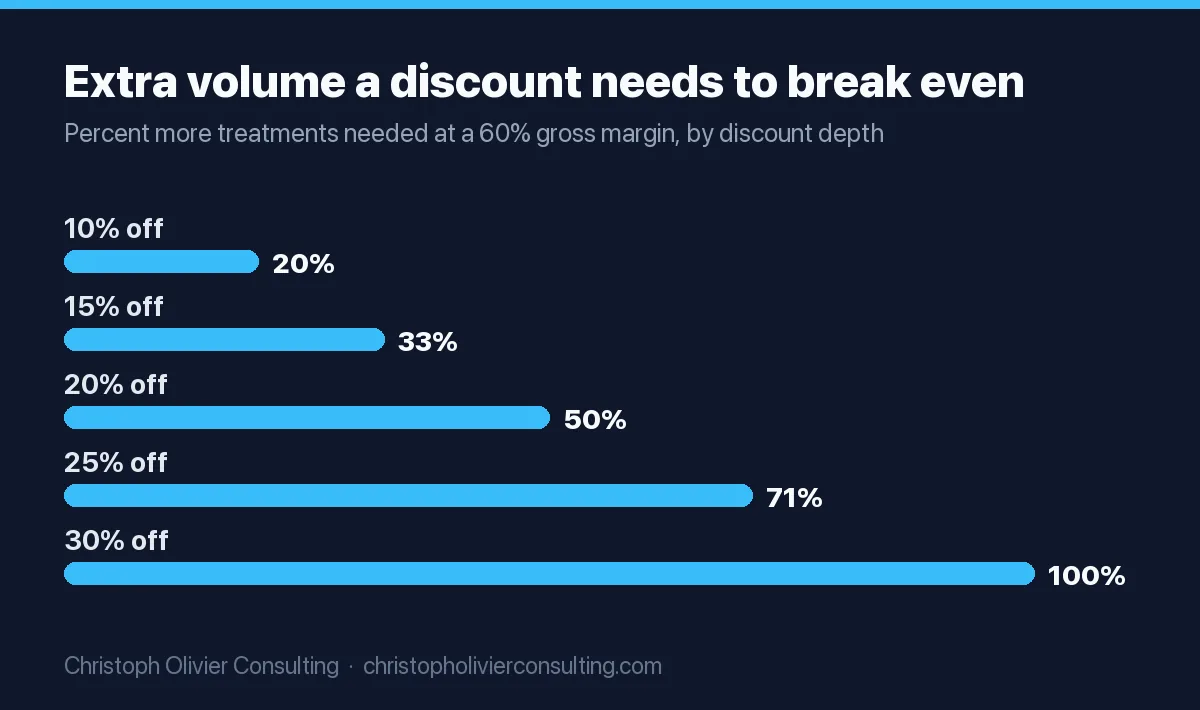
Short answer: Lead with value-adds (a skincare product with a tox appointment), prepaid packages, a membership and seasonal gift cards, and plug into Allē’s BOTOX Cosmetic Day on the third Wednesday of November (November 18 in 2026, November 17 in 2027). Avoid percentage-based deal sites and cash-value referral rewards until your health care attorney clears them, because AmSpa calls deal-site vouchers “a textbook example of fee-splitting” in most states. At a 60% gross margin, a 20% discount needs 50% more volume just to break even.
Three rules every med spa promotion has to pass
A med spa is a medical practice that markets like a retailer, and regulators treat it as the former. The American Med Spa Association (AmSpa) puts it bluntly: “A medical spa may operate like a retail outlet, but it cannot advertise itself like one.” It adds that regulators “often simply browse the websites of medical aesthetic practices” to decide whom to investigate. Run every idea through these three checks.
- The FTC “free” rule. Under the FTC’s Guide Concerning Use of the Word “Free” (16 CFR 251.1), “free” means the patient pays nothing for the free item and “no more than the regular price for the other.” The regular price is the price you “openly and actively sold” at for “a 30-day period.” All conditions must sit “in close conjunction with the offer,” and an asterisk to a footnote “is not regarded as making disclosure at the outset.” It also caps a free offer on one service at “6 months in any 12-month period,” with “at least 30 days” between offers and “no more than three such offers” a year in the same area.
- The FTC endorsement and review rules. Before-and-after posts, testimonials and influencer content fall under the Endorsement Guides (16 CFR 255), and reviews fall under the Consumer Reviews and Testimonials rule (16 CFR 465), which bans incentives “conditioned expressly or by implication on” a review “expressing a particular sentiment, whether positive or negative.”
- FDA and state medical rules. BOTOX Cosmetic is, in Allergan’s own words on its official program page, “a prescription medicine.” The FDA’s dermal filler page says fillers are “medical device implants” approved “for use in adults 22 years of age or older” for specific facial uses. State boards then decide what you can pay for patient acquisition, which is where deal sites and referral rewards get risky.
This is not legal advice. Have a health care attorney in your state review any promotion with a discount on a medical service, a third party paid per sale, or a referral reward.
24 med spa promotion ideas, scored
Each idea with its season, the margin it puts at risk and the rule it has to pass. “Low” margin risk means the cost is mostly product or time you already have; “High” means a straight cut on a service with real product cost, such as neurotoxin or filler.
| # | Promotion idea | Best season | Margin risk | Compliance note |
|---|---|---|---|---|
| 1 | Consultation fee credited toward the first treatment booked within 30 days | Year round | Low | Only call the consult “free” if you have actually charged the consult fee for 30 days (16 CFR 251.1(b)(2)) |
| 2 | Tox appointment plus a full-size skincare product at no charge | Year round, best in Q1 | Low | Do not raise the tox price to fund the gift; state every condition next to the offer, not in a footnote (251.1(b), (c)) |
| 3 | BOTOX Cosmetic Day tie-in for Allē members | November | Low (Allergan’s offer, not your price cut) | Only participating Allē providers can redeem; use Allergan’s terms, do not restate them loosely |
| 4 | Allē double-points or refer-a-friend windows promoted to your list | When Allergan runs them | Low | Promote Allergan’s terms as written; get counsel before adding your own referral reward on top |
| 5 | Prepaid treatment plan (for example, a series of laser or microneedling sessions) | Fall and winter | Medium | Write a refund policy for unused sessions; plans must be set by a qualified provider after an exam |
| 6 | Monthly membership with a banked treatment credit | Launch in January | Medium | Check your state’s automatic renewal law; show renewal terms before sign-up and make cancelling easy |
| 7 | Bonus gift card: buy a set amount, get a smaller promotional card | November, December, May | Low to medium | The bonus card must say “promotional” and show its expiration date on the front (12 CFR 1005.20) |
| 8 | Gift card pre-sale to your email and SMS list before Black Friday | Early November | Low | Purchased cards: funds cannot expire for at least five years (12 CFR 1005.20) |
| 9 | Birthday-month credit for existing patients | Year round | Low | Existing patients only; keep the offer amount fixed so it is not a hidden price change |
| 10 | Off-peak pricing for weekday mornings | Slow months | Medium | Publish the regular price; a “sale” needs a real regular price behind it |
| 11 | Bridal and event countdown plan (consult six or more months out) | January to April | Low | Timeline and treatments set by the provider, not by the package |
| 12 | Injector education night: anatomy, what to expect, Q&A | Spring and fall | Low | No injections in a party setting; book consults for the clinic |
| 13 | VIP night for top patients with event-only pricing on packages | October to December | Medium | Event pricing must be honest against your regular price; limit to existing patients for treatments that need an exam |
| 14 | Open house with live device demos (no prescription treatments on the floor) | Opening, anniversary | Low | Demo energy devices only if your state allows the staff doing it |
| 15 | Co-hosted event with a gym, bridal shop or boutique | Spring | Low | Pay any partner a flat fee for the event, never a fee per patient or a share of revenue |
| 16 | Daily-deal site voucher (Groupon-style) | Avoid, or flat-fee only | High | AmSpa calls percentage-based vouchers “a textbook example of fee-splitting” in most states |
| 17 | Patient referral thank-you that is not cash or a discount on a medical service | Year round | Low to medium | AmSpa warns that value for referrals can breach state anti-kickback or patient solicitation laws |
| 18 | Review request after the follow-up visit | Year round | None | Never tie an incentive to a positive review (16 CFR 465.4) |
| 19 | Local micro-influencer treatment with a disclosed partnership | Launches, slow months | Medium | Disclose the free treatment “clearly and conspicuously” (16 CFR 255.5); approve copy in writing |
| 20 | Before-and-after gallery campaign for one treatment | Year round | None | Show typical results or disclose them (16 CFR 255.2(b)); written patient consent for every photo |
| 21 | Lip filler promotion with an age gate | Year round | High | FDA approval covers adults 22 or older; target ads and offers accordingly |
| 22 | Skincare retail bundle (cleanser, serum, SPF) | Summer, holidays | Low | Retail product, so lighter rules, but claims still need substantiation |
| 23 | Mother’s Day gift package (gift card plus consult) | Late April to May | Low | Same gift card rules as #7 and #8 |
| 24 | New-service launch with an introductory price | When you add a device or product | Medium | For an introductory “free” offer, you must expect in good faith to end it and sell at the promoted price (251.1(f)) |
Two popular ideas are missing on purpose: filler for body contouring and “Botox parties” with injections at someone’s home. The FDA says it “recommends against using dermal fillers or any injectable filler for body contouring and enhancement,” and in its April 2024 counterfeit Botox alert it noted the incidents “occurred when counterfeit Botox is injected by licensed and unlicensed individuals and/or in non-medical or unlicensed settings.” Host the social event; do the injections in the clinic.
Botox promotion ideas that do not train patients to wait for a sale
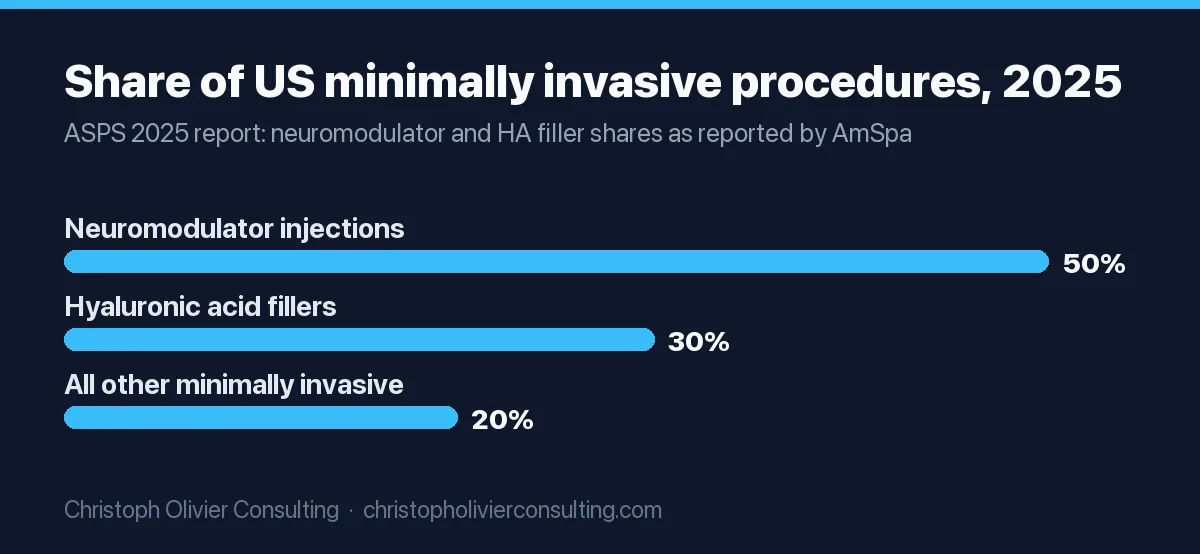
Neurotoxin is the anchor service for most med spas (half of all minimally invasive procedures in 2025, per the ASPS data below), so it gets discounted first. The better Botox promotion ideas move value around the price instead of cutting it.
Plug into BOTOX Cosmetic Day instead of running your own tox sale
Allergan Aesthetics announced on October 28, 2026 that BOTOX Cosmetic Day returns on Wednesday, November 18, 2026, its eighth year. It is “held annually on the third Wednesday of November.” Beginning at 9 a.m. PT, while supplies last, Allē members who buy a $50 gift card “will receive an additional $50 gift card at no cost,” redeemable for BOTOX Cosmetic treatments “with participating Allē providers.” Members who refer a friend during November get $50 off a qualifying Allē product or treatment, and so does the friend. Allē “connects more than 7 million Members with nearly 30,000 practices.” For a participating practice: email and text your list the week before, open extra injector hours on the day, and book a treatment date for every card buyer. You promote Allergan’s offer instead of inventing your own tox discount, so your regular price stays intact.
The 2024 edition ran on Wednesday, November 20, 2024, also the third Wednesday, and Allergan said the prior year’s event set its record for “the highest number of gift cards ever sold.” Put the third Wednesday of November in next year’s calendar now and plan staffing around it.
Use Allē points as the “deal”
Allergan’s Allē program page says members “Earn 200 Allē points for each BOTOX Cosmetic treatment” plus points “on over 50 eligible products and treatments,” and get “exclusive access to annual savings events like BOTOX Cosmetic Day, and seasonal offers like double points.” A reminder that a double-points window is open gives patients a reason to book now without touching your price. For other neurotoxin brands, check that manufacturer’s own program terms first.
Never compare unit prices across brands
Unit-price ads invite comparison shopping between products that are not equivalent. Allergan’s safety information states that “BOTOX Cosmetic dosing units are not the same as, or comparable to, any other botulinum toxin product.” Promote a treatment area or a treatment plan, not a unit price set against a competitor’s different product.
Buy only from authorized sources, especially when margins are squeezed
Deep discounts tempt owners to cut product cost. The FDA’s counterfeit alert is direct: “Federal law requires that all health care providers who dispense or administer prescription drugs purchase those products only from authorized sources.” The counterfeit product it flagged carried lot number C3709C3 and a 150-unit label, “which is not a unit made by AbbVie or Allergan.”
Med spa specials ideas: the math before you publish a discount
Every percentage off comes out of gross margin, not revenue. The formula for how much extra volume a discount needs to break even is simple:
Required volume increase = gross margin ÷ (gross margin minus discount) minus 1
Gross margin here means price minus product cost and provider pay for that treatment, as a share of price. Plug in your own numbers from your last 90 days. The table below uses two illustrative margins (60% and 45%) so you can see the shape of the curve; they are example inputs, not industry benchmarks.
| Discount | Extra volume to break even at 60% gross margin | Extra volume to break even at 45% gross margin |
|---|---|---|
| 10% off | +20% | +29% |
| 15% off | +33% | +50% |
| 20% off | +50% | +80% |
| 25% off | +71% | +125% |
| 30% off | +100% | +200% |
Worked example: a treatment priced at $500 with $200 in product and provider cost has a $300 gross profit, a 60% margin. At 20% off, the price is $400 and gross profit is $200. You need 300 ÷ 200 = 1.5 times the volume, so 50% more patients, just to make the same gross profit. That is before the patients who would have paid full price anyway.
The second cost is retention. AmSpa’s analysis of deal sites cites its 2017 State of the Industry report: “up to 70% of patients are repeat clients” at an average med spa, and adds that “the greater the discount, the less likely it is that the patient will return.” Build specials for existing patients first, and for new patients use the low-margin-risk ideas (#1, #2, #7, #12).
Med spa event ideas that end in booked consultations
Events work when they are small, educational and built around one next step: a booked consult. Here are the formats worth running and how to keep each one clean.
| Event | Who to invite | The one call to action | Watch out for |
|---|---|---|---|
| Injector education night | Prospects from your email list and social followers | Book a consult in the next 14 days | Outcome claims on stage; keep them to what the provider can substantiate |
| VIP patient night | Top patients by visits in the past 12 months | Pre-book next treatment or renew membership | “Event-only” prices that are really your normal price |
| Open house or anniversary | Neighbors, partner businesses, local press | Book a consult or join the list | Live demos of procedures staff are not licensed to perform |
| Co-hosted partner event | A gym, bridal shop or boutique’s customers | Book a consult with an event-only credit | Per-patient or revenue-share payments to the partner (fee-splitting risk) |
| BOTOX Cosmetic Day open hours | Allē members and lapsed tox patients | Book during the event window | Restating Allergan’s offer terms incorrectly |
Plan each one like any campaign, with a budget, a booked-consult target and a follow-up sequence; the steps in our event marketing plan guide apply directly. Capture every attendee in your booking system that night and follow up within 24 hours.
Copy-ready 12-month med spa promotion calendar
Use this as a starting template. Notice that it never runs the same “free” offer on one service in more than three windows a year, which keeps you inside the FTC frequency limits in 16 CFR 251.1(h).
| Month | Main promotion | Event or content | Channel focus |
|---|---|---|---|
| January | Membership launch or re-enrollment; treatment plans for the year | Consult days for planning | Email to full list |
| February | Gift cards for Valentine’s Day; tox value-add (product with treatment) | Bridal countdown consults begin | SMS to existing patients |
| March | Prepaid series for skin texture treatments | Injector education night | Social plus email |
| April | Bridal and event packages | Co-hosted partner event | Partner channels |
| May | Mother’s Day gift package | Before-and-after gallery refresh (with consent) | Email and Google Business Profile posts |
| June | Skincare and SPF retail bundle | Skincare masterclass | In-clinic and email |
| July | Off-peak weekday pricing | Review request push after summer visits | SMS |
| August | Tox value-add (second window) | Patient recall campaign for lapsed patients | Email and SMS |
| September | Fall prepaid series | Injector education night | Social plus email |
| October | VIP pre-sale on holiday packages | VIP patient night or anniversary open house | Email to top patients |
| November | BOTOX Cosmetic Day (third Wednesday; November 18 in 2026) and gift card pre-sale | Extended booking hours on the day | Email, SMS, social |
| December | Bonus gift cards; tox value-add (third and last window) | Membership renewals for January | Email and in-clinic |
Copy-ready offer line you can adapt: “Book any neurotoxin treatment between [date] and [date] and take home a full-size [product] at no charge. Treatment price unchanged at $[regular price]. One per patient. Treatment subject to consultation with our [MD/NP/PA].” It states the regular price, the dates, the limit and the medical condition next to the offer, which is what 16 CFR 251.1(c) asks for.
Deal sites, referral rewards and other state medical board traps
Is Groupon legal for a med spa?
It depends on your state and on how the site is paid. AmSpa explains that in most states medical spas must be owned by physicians or physician-owned corporations, “all payments for medical services must be made in full to the owner,” and a percentage paid to someone else is fee-splitting. It calls deal sites “a textbook example of fee-splitting, since the site gets a percentage of the proceeds,” while noting that “some states, like Illinois, have carved out fee-splitting exceptions for deal sites.”
North Carolina shows what a state-specific answer looks like. The North Carolina Medical Board’s position statement 10.1.1 (amended September 2021) says a licensee “cannot share revenue on a percentage basis with a non-licensee,” but allows voucher advertising if the fee to the voucher company “represents reasonable compensation for the cost of advertising” and every ad clearly states the discounted price against the actual cost, that not all patients may be eligible, and that the purchase price will be “refunded in its entirety” if the patient is not a candidate or never claims the service. If the voucher company does not refund, “it will be the sole obligation of the licensee.”
The business case is weak too. The AmSpa author writes that “five lawsuits involving laser burns have come across my desk, and in every one of those instances the patient had come from Groupon.” If you still want deal-site reach, ask for a flat advertising fee rather than a revenue share, and get a written opinion from a health care attorney first.
Can a med spa pay patients for referrals?
Be careful. AmSpa uses the example of “50% off a Restylane treatment if you refer a friend” and says a medical practice making that offer “is essentially telling the world that it is giving monetary value for referrals, which is potentially a direct violation of local anti-kickback or patient solicitation statutes.” It also says “it’s generally a bad idea to offer gift cards in exchange for referrals.” North Carolina’s board goes further: “It is unethical for licensees to offer financial incentives or other valuable considerations to patients in exchange for recruitment of other patients.” Safer options: a handwritten thank-you, or promoting a manufacturer’s own refer-a-friend window. The structure of a good program is covered in our referral marketing guide; adapt the reward side to your state’s rules.
Influencers, before-and-afters and reviews
- Influencers: a free treatment is a material connection. 16 CFR 255.5 lists “free or discounted products” as material connections that must be disclosed “clearly and conspicuously,” and 255.1(d) says advertisers should “provide guidance to their endorsers” and monitor them.
- Before-and-afters: 16 CFR 255.2(b) says a consumer’s result will be read as typical, so if it is not, the ad “should clearly and conspicuously disclose the generally expected performance.” AmSpa adds that you need proper patient consent before posting, because identifying someone as your patient raises HIPAA issues.
- Reviews: ask every patient, never only the happy ones, and never reward a positive review. The tactics that stay inside the rules are in our guide on how to get more Google reviews.
- Words to avoid: AmSpa warns that ads using “best,” “greatest” or “amazing” are “likely in violation” of state medical advertising statutes.
Gift cards and memberships
Under Regulation E, 12 CFR 1005.20, a purchased gift card’s funds cannot expire for at least five years after issue or last load, and a dormancy fee is allowed only after a year of no activity and with disclosures on the card. A bonus card given in a promotion is treated as a “loyalty, award, or promotional gift card,” which must carry “a statement indicating that the card… is issued for loyalty, award, or promotional purposes” and the expiration date “on the front.” For memberships that renew automatically, check your state’s automatic renewal law before launch, show the renewal price and cancellation method before the patient signs up, and make cancelling as easy as joining.
How to promote a med spa (and keep the patients you win)
Promotions sit on top of the basics: a complete Google Business Profile, a booking system that captures every lead, and email and text lists you own. If those are missing, start with our med spa marketing plan. Then three habits separate promotions that grow a practice from ones that only pull revenue forward:
- Promote to existing patients first. With up to 70% of patients repeat clients in AmSpa’s 2017 data, your list is the cheapest audience you have. A structured loyalty program or membership turns one-off specials into a reason to come back.
- Measure the second visit, not the first. For every promotion, track how many new patients book a second, full-price treatment within six months. If the answer is low, the promotion bought revenue, not patients.
- Know your unit economics. Compare promotion results with the benchmarks in our breakdown of med spa average revenue and margins.
If you want a second set of eyes on a promotion calendar or the math behind a membership, you can book a consultation.
What do most med spas offer, and what are the current trends?
Most med spas are built around injectables, and the latest national data shows why. The American Society of Plastic Surgeons’ 2025 Procedural Statistics release says “neuromodulators and hyaluronic fillers accounted for 80 percent of all minimally invasive plastic surgery procedures last year.” AmSpa’s summary of the report splits that into 50% neuromodulators and 30% HA fillers, and lists laser skin treatments, IPL, hair removal and tattoo removal among the most common minimally invasive procedures. AmSpa’s research page describes a medical aesthetics industry that “has eclipsed $17 billion and is growing by more than $1 billion per year.”
Three trends from the ASPS release should shape your promotion calendar:
- Older patients are growing fastest. Patients 66 and older recorded “a 24 percent rise in procedure volume, the largest gain of any age group,” while volume among patients 18 to 25 fell 9%. Adults 36 to 55 still account for “nearly half of all cosmetic procedures.” Write at least one promotion a quarter for patients over 55.
- Post-weight-loss patients. “82 percent of ASPS Member Surgeons reported receiving consultation requests related to GLP-1 use in 2025.” Skin quality after weight loss is a natural education-night topic.
- Natural-looking results. AmSpa’s summary quotes the ASPS president saying patients want to “look and feel more like themselves.” Before-and-after content that shows typical results fits that demand and the FTC’s 16 CFR 255.2.
Ready to scale your revenue?
Book a free 30-min consultation. We’ll diagnose your growth bottleneck and map out the 3 highest-leverage moves for your business.
Frequently asked questions
What are some effective promotional ideas for a med spa?
The strongest med spa promotion ideas add value instead of cutting price: a skincare product with a neurotoxin appointment, a consultation fee credited to the first treatment, prepaid treatment plans, a monthly membership, bonus gift cards in November and December, and BOTOX Cosmetic Day for Allē providers. Promote to existing patients first, track second visits, and have every discount on a medical service checked against your state's rules.
What are some good Botox promotion ideas?
Good Botox promotion ideas avoid deep unit-price cuts. Join BOTOX Cosmetic Day on the third Wednesday of November if you are an Allē provider, remind patients when Allē runs double points, add a skincare product to the appointment, or price a two-area treatment as a bundle. Do not compare per-unit prices across brands, because Allergan says Botox Cosmetic units are not comparable to other toxins.
What are good med spa event ideas?
Good med spa event ideas are small and educational: an injector education night, a VIP night for your top patients, an anniversary open house with device demos, a co-hosted night with a gym or boutique, a skincare masterclass, or extended hours on BOTOX Cosmetic Day. Give each event one call to action, a booked consultation, and keep injections in the clinic rather than at a party.
Can a med spa advertise a free treatment?
Yes, if it follows the FTC's Guide on the word free, 16 CFR 251.1. The paid item must be at its regular price, meaning the price actually charged for the prior 30 days, all conditions must appear next to the offer rather than in a footnote, and the same free offer should run no more than three times and six months in any 12-month period. State medical advertising rules can add limits.
Is it legal for a med spa to use Groupon?
It depends on your state. AmSpa calls percentage-based deal-site vouchers a textbook example of fee-splitting in states that require medical payments to go in full to the physician-owned practice, while some states, such as Illinois, have carved out exceptions. If you use a deal site, negotiate a flat advertising fee and get a written opinion from a health care attorney in your state first.
Can a med spa give rewards for patient referrals?
Be cautious. AmSpa warns that offering a discount on a medical treatment, or a gift card, in exchange for a referral can be read as giving monetary value for referrals and may breach state anti-kickback or patient solicitation laws. A thank-you note, or promoting a manufacturer's own refer-a-friend offer such as Allē's, carries less risk. Confirm the rules for your state before launching.
Practice marketing ideas