
Yes, therapists can advertise on TikTok in the United States. Paid ads have to pass TikTok’s Healthcare and Pharmaceuticals policy, which means showing them only to users 18 and older. They also have to follow your licensing board, your profession’s ethics code and HIPAA. Organic videos are allowed too. The line you cannot cross is the same in every code: no identifiable client information, and no testimonials solicited from current clients.
Short answer: TikTok has no rule banning therapy ads. In its US section, the closest category, “Medical institutions,” “may be allowed” if you comply with local law, provide certifications if asked, and restrict the ad to users 18 or older. You also cannot target people by mental health condition, and nothing in the ad may touch on suicide or self-harm. The APA, ACA, NASW and AAMFT codes all permit advertising. All four ban soliciting testimonials from current clients, and all four forbid posting identifiable client information without consent.
Are you allowed to advertise on TikTok as a therapy practice?
TikTok’s healthcare policy (page dated September 2026) never mentions psychotherapy, counseling or mental health services anywhere in its country-by-country tables. For each market it lists ad topics as allowed, allowed with conditions, or not allowed. In the United States, a private practice falls most naturally under “Medical institutions.” Those ads “may be allowed” if you meet three conditions: “Comply with local laws and regulations,” “Certifications from appropriate local regional regulating authorities may be required,” and “Restrict the ads to audiences aged 18 years or older.”
In practice, have your license number and a license-verification link ready in case an ad is held for review. Set the ad group’s age range to 18+ before you submit. Canada’s section uses the same three conditions for medical institutions. Outside North America the rules differ a lot. Austria’s section lists “Medical services provided online or through apps that include remote diagnosis and remote treatment” as an example of what is not allowed. TikTok also names 16 markets, including Monaco and Tanzania, where Promote is the only paid ad format and medical institutions cannot advertise at all.
Four other TikTok ad policies apply to almost every therapy ad. The healthcare page is not the one that gets most therapist ads rejected.
| TikTok policy (last updated) | What the policy text says | What it means for a therapy ad |
|---|---|---|
| Healthcare and Pharmaceuticals (Sept 2026) | US medical institutions: comply with local law, certifications may be required, “Restrict the ads to audiences aged 18 years or older” | Set the age to 18+. Keep your license verifiable. Advertise teen therapy to parents, not to teens. |
| Anti-Discrimination Ad Policy (Oct 2024) | Advertisers may not wrongfully target or exclude users by “Individual health statuses or disabilities, including mental, physical, genetic, or emotional health and conditions” | Target by location, age and broad interests. Do not build audiences around a diagnosis, and do not upload a client list as a Custom Audience. |
| Suicide and Self-Harm (Aug 2025) | “Zero-tolerance policy for ads that promote, depict, glorify, endorse, or document suicide, self-harm, or dangerous behaviors”. Educational content is allowed only from “fully vetted organizations, such as government organizations” and NGOs | A private practice cannot run paid ads about suicide or self-harm, even prevention messages. Keep that topic in organic posts and crisis links. |
| Misleading and false content (Nov 2026) | Ad content and landing pages “must not promise or exaggerate results”. Before-and-after comparisons are banned. AI-generated or heavily edited media needs the AIGC label | No “anxiety-free in 6 sessions.” No before-and-after client stories. Label any AI avatar or cloned voice. |
| Commercial Content Disclosure (Jan 2026) | Content that promotes “a brand, product, or service” must have the disclosure setting on, or “your post may be removed or restricted” | Organic posts that promote your practice need “Disclose commercial content” switched on, with “Your brand” selected. |
If you are setting up the account for the first time, our TikTok Ads Manager walkthrough covers campaign structure. Use the table above as the compliance layer on top of it.
Are therapists allowed to advertise? Therapist TikTok ethics in four codes
Yes. No national mental health ethics code bans advertising. They regulate how you do it. TikTok is a medium these codes already cover: the APA Ethics Code (effective January 1, 2017) defines “public statements” to include “paid or unpaid advertising” and “comments for use in media such as print or electronic transmission.” Here is how each code’s advertising and confidentiality standards apply to a TikTok video or ad. Quotes are taken directly from the code text.
| Rule | APA (psychologists) | ACA (counselors) | NASW (social workers) | AAMFT (MFTs) |
|---|---|---|---|---|
| Truthful claims about credentials and results | 5.01(b): no false statements about “their credentials,” “their services” or the “results or degree of success of, their services” | C.3.a: credentials stated “in an accurate manner that is not false, misleading, deceptive, or fraudulent” | 4.06(c): representations of “results to be achieved are accurate” | 9.2: advertisements “in any and all media are true, accurate” |
| Testimonials | 5.05: do not solicit them “from current therapy clients/patients” or others vulnerable to undue influence | C.3.b: do not solicit them “from current clients, former clients,” or others who may be vulnerable | 4.07(b): do not solicit them from current clients, including “consent to use a client’s prior statement” | 9.2: do not solicit “testimonials or endorsements from current clients” |
| Paid ads must look like ads | 5.02(c): “must be identified or clearly recognizable as such” | No equivalent clause | No equivalent clause | No equivalent clause |
| Public advice on video | 5.04: statements must “not indicate that a professional relationship has been established” | C.6.c: recipients are “not encouraged to infer that a professional counseling relationship has been established” | Tech Standard 1.02: post information “from trustworthy sources” | 3.11: adhere to professional standards in “public statements” |
| Client material in public content | 4.07: only if disguised, consented “in writing,” or legally authorized | H.6.d: avoid “disclosing confidential information through public social media” | 1.07(r): avoid “posting any identifying or confidential information about clients” | 2.4: only with written authorization or steps “to protect client identity” |
| Personal vs professional accounts | 3.05: avoid multiple relationships that risk harm | H.6.a: “separate professional and personal web pages and profiles” | Tech Standard 2.09: prevent “client access to social workers’ personal social networking sites” | 1.3: avoid multiple relationships that impair judgment |
Sources: APA Ethical Principles and Code of Conduct (2002, amended 2010 and 2016); 2014 ACA Code of Ethics; NASW Code, Standard 1 and Standard 4; NASW, ASWB, CSWE and CSWA Standards for Technology in Social Work Practice; AAMFT Code of Ethics (revised, effective January 1, 2026).
Two details matter for TikTok. The ACA rule is the strictest on testimonials because it also covers former clients. The NASW technology standards add Standard 2.14, which applies the testimonial ban to “text, audio, or video” and to “current or former clients” vulnerable to undue influence. A stitched or duetted video from a client counts. Your state board’s advertising rule sits on top of all of this. Our guide to ethical marketing for therapists compares state board rules in California, New York and Texas.
Can therapists post on TikTok?
Yes. Educational, organic content is the most common way therapists use the platform, and the codes treat it as media commentary, not treatment. The obligations come from APA 5.04 and ACA C.6.c. Your statements must be “based on their professional knowledge, training, or experience in accord with appropriate psychological literature and practice.” They also must not suggest that a viewer is now your client.
The APA’s own magazine applied this to TikTok directly. In an April 2024 Monitor on Psychology piece, the APA wrote that upholding the code “means recognizing you are always representing the profession, even if you are ‘just’ playing a video game or posting a goofy video on TikTok.” The same piece reports that “APA’s Ethics Committee recommends using a disclaimer on your social pages indicating that interacting with you online does not establish a professional relationship.”
Who you reach matters for both ethics and the ad rules. TikTok skews young. The age-18 floor on ads exists because a large teen audience is on the platform.
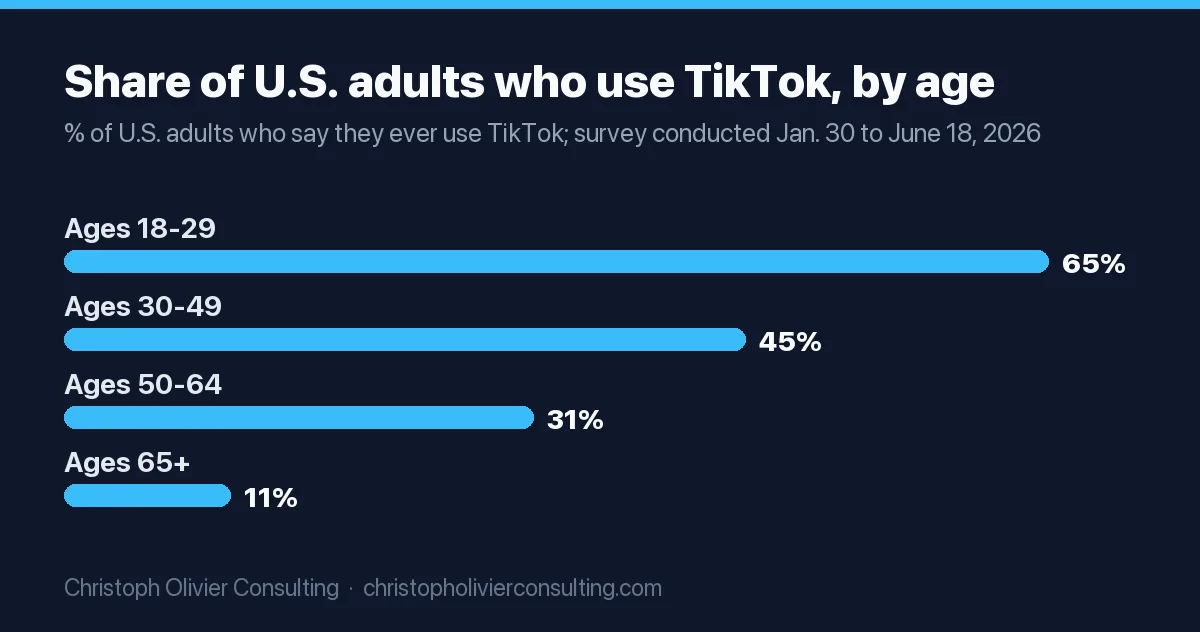
In the Pew Research Center’s 2026 survey of U.S. adults, 65% of 18 to 29 year olds said they use TikTok, compared with 11% of adults 65 and older. Among teens 13 to 17, Pew’s 2025 teen survey found that 61% use TikTok daily and 21% say they are on it “almost constantly.” Organic videos reach minors. Paid healthcare ads cannot. Write organic content so that a 14 year old watching it is not harmed or misled.
Separate accounts and the intake form
ACA H.6.a requires separate personal and professional profiles if you keep both. NASW Technology Standard 2.10 says social workers who use social media “shall develop a social media policy that they share with clients.” ACA H.6.b requires you to explain “the benefits, limitations, and boundaries of the use of social media” during informed consent. ACA A.5.e prohibits “a personal virtual relationship” with current clients. For TikTok, that means you do not follow clients back, you do not reply to their DMs, and your intake paperwork explains what happens if a client comments on a video.
Comments and DMs: where a video turns into treatment
The risk on TikTok is not the video. It is the comment thread. A viewer describes their symptoms and asks if it sounds like a specific diagnosis. If you assess them, you have arguably begun a professional relationship with someone you have not screened, consented or checked for licensure in their state. A 2022 Counseling Today feature quotes a counselor warning that answering such questions means “they could technically be entering into a therapeutic contract without paperwork.” Reply with general education and a link to resources, then stop.
Can therapists make TikToks about clients?
Not about identifiable clients without written consent. In practice, almost never about a real client at all. Every code allows two routes: written consent, or enough disguise that the person cannot be identified. APA 4.07 lists them as “reasonable steps to disguise the person,” consent “in writing,” or legal authorization. ACA G.5.a and AAMFT 2.4 use the same two-route logic. NASW 1.07(r) is shorter: avoid “posting any identifying or confidential information about clients” on social media.
Disguise is harder on TikTok than in a journal article for three reasons:
- The client is likely watching. A client who recognizes their own session in a 30-second clip has had their confidentiality breached from their point of view, even if no stranger could identify them.
- Your audience is local. If you advertise to a radius around your office, your viewers live in the same town as your clients. HIPAA’s de-identification safe harbor at 45 CFR 164.514(b) requires removing “all geographic subdivisions smaller than a State,” plus dates and “any other unique identifying number, characteristic, or code.”
- Video carries identifiers. The same safe-harbor list includes “Full face photographic images and any comparable images” and “Biometric identifiers, including finger and voice prints.” A recorded session, a client’s voice or a reenactment of a distinctive story can all identify someone.
The safer format is a generic composite with no session details: “Many people who start therapy for panic attacks ask…” Never use “A client told me yesterday…” Mental health records also get special protection. Under 45 CFR 164.508(a)(2), a covered entity “must obtain an authorization for any use or disclosure of psychotherapy notes,” apart from narrow exceptions. Reading from notes on camera is never acceptable.
HIPAA and TikTok: pixels, client lists and marketing
If you bill insurance electronically, you are probably a HIPAA covered entity. Three rules then affect your TikTok marketing.
- Marketing needs authorization. HIPAA defines marketing as “a communication about a product or service that encourages recipients of the communication to purchase or use the product or service” (45 CFR 164.501). A covered entity “must obtain an authorization for any use or disclosure of protected health information for marketing,” with exceptions only for face-to-face communication and promotional gifts of nominal value (164.508(a)(3)). HHS’s marketing guidance states it plainly: “the Rule requires an individual’s written authorization.” Uploading client emails or phone numbers to TikTok as a Custom Audience uses PHI for marketing.
- The TikTok Pixel on intake pages. HHS’s tracking-technology bulletin says regulated entities “are not permitted to use tracking technologies in a manner that would result in impermissible disclosures of PHI to tracking technology vendors,” and that “disclosures of PHI to tracking technology vendors for marketing purposes, without individuals’ HIPAA-compliant authorizations, would constitute impermissible disclosures.” On June 20, 2024, a federal court in Texas vacated one part of that bulletin. The vacated part covered connecting an IP address with a visit to an unauthenticated public page about health conditions or providers. Booking forms, client portals and intake flows remain covered.
- Do not reply to a client’s comment by acknowledging they are a client. Even confirming the relationship discloses PHI. Treat a client’s public comment like any other follower’s comment, or hide it.
If you are not a covered entity (cash-pay only, no electronic claims), HIPAA may not apply. Your ethics code and state confidentiality law still do. Our broader mental health marketing guide covers compliant growth channels beyond TikTok.
Allowed, risky and prohibited: TikTok content for therapists
We built this decision table from the code text and TikTok’s policies quoted above. “Risky” means it can be done ethically but often goes wrong.
| Content idea | Verdict | Why (rule) |
|---|---|---|
| Explaining a concept (“what a panic attack does in your body”) with a “not therapy, not advice” disclaimer in your bio | Allowed | APA 5.04, ACA C.6.c: grounded in the literature, no implied relationship |
| “What a first therapy session looks like at my practice,” with fees and insurance stated accurately | Allowed | APA 5.01(b) covers fees and services. Turn on “Disclose commercial content” |
| Paid ad for your practice, 18+, targeting your licensed state, no condition-based audience | Allowed | TikTok US medical institutions rule, Anti-Discrimination Ad Policy, APA 5.02(c) |
| Reacting to a viral video by diagnosing the creator (“this is clearly narcissism”) | Risky | APA 9.01(b) bars opinions about psychological characteristics without an examination. A diagnosis also implies clinical judgment, which goes past education under 5.04 |
| Composite “client story” built from several cases | Risky | APA 4.07, ACA G.5.a: sufficiently disguised only. Clients can still recognize themselves |
| Answering a commenter’s personal clinical question in detail | Risky | APA 5.04, ACA C.6.c: implies a professional relationship. Licensure in the commenter’s state is unknown |
| “Day in the life” filmed in your office | Risky | A client file, calendar or person in the waiting room on screen is a disclosure. HIPAA 164.514 identifiers include full-face images |
| Asking current clients to stitch, duet or post a review video | Prohibited | APA 5.05, ACA C.3.b, NASW 4.07(b) and Tech Standard 2.14, AAMFT 9.2 |
| Any identifiable client detail, session audio or reenactment without written consent | Prohibited | APA 4.07, ACA H.6.d, NASW 1.07(r), AAMFT 2.4. Under HIPAA, an authorization is required |
| Ad promising results (“stop overthinking in 30 days”) or a before-and-after mood story | Prohibited | TikTok misleading-claims policy. APA 5.01(b)(6), NASW 4.06(c) |
| Paid ad about suicide or self-harm, even prevention-focused | Prohibited | TikTok Suicide and Self-Harm policy allows educational ads only from fully vetted organizations |
| Uploading your client list as a Custom Audience or retargeting intake-form visitors | Prohibited | HIPAA 164.508(a)(3) without authorization, HHS tracking bulletin. TikTok Anti-Discrimination policy on health status |
The “Risky” row on diagnosing public figures applies the APA’s assessment standard, 9.01(b). It says psychologists “provide opinions of the psychological characteristics of individuals only after they have conducted an examination of the individuals adequate to support their statements or conclusions,” with limited exceptions.
Pre-post checklist for therapist TikToks and ads
Copy this into your notes app and run every video through it. One “fail” means you edit or do not post.
- Credentials line. Pass: the license type and state in your bio or on screen match your license exactly (APA 5.01, ACA C.4, AAMFT 9.1). Fail: “Dr.” without a doctorate in the field, or a specialty you have no training for.
- Client check. Pass: no client, client story, voice, setting or date appears, and no client could recognize themselves. Fail: anything a specific client could recognize, unless you have written consent on file.
- Testimonial check. Pass: no review, stitch or duet you asked a current client for. Fail: any client endorsement you solicited.
- Claim check. Pass: no promised outcome, timeline or cure. Every factual claim is based on research you can cite. Fail: “fixes,” “cures,” “in X sessions,” or before-and-after framing.
- Relationship check. Pass: a bio disclaimer that viewing or commenting does not create a therapy relationship, plus a crisis resource link. Fail: inviting viewers to describe their symptoms in the comments.
- Disclosure check. Pass: if the post promotes your practice, “Disclose commercial content” is on with “Your brand” selected. Fail: a promotional post with the setting off.
- Ad settings check (paid only). Pass: age 18+, location limited to states where you are licensed, no health-condition or client-list audiences, no AI-generated content without the AIGC label. Fail: any of these missing.
- Landing page check (paid only). Pass: the page matches the ad, and no TikTok Pixel fires on booking or intake pages unless counsel has cleared it. Fail: pixel events on forms that collect client information.
- Suicide and self-harm check. Pass: paid creative never mentions suicide or self-harm, and organic posts on those topics include crisis resources. Fail: any paid creative on those topics.
- Board check. Pass: you have read your state board’s advertising rule this year. Fail: you have not.
Where can I advertise myself as a therapist?
TikTok is one option. The others are directory listings, a Google Business Profile, Google Ads and physician referrals, and each comes with its own rules. TikTok suits therapists who can post on camera consistently. Our guide to how to advertise as a therapist compares each channel’s 2026 prices and rules. If you want the channel mix and compliance review set up for your practice, you can book a consultation.
Are there therapists on TikTok?
Yes, and the APA has used them as examples. The 2024 Monitor piece quotes psychologists who post on TikTok and other platforms. Clinical psychologist Justin Puder tells patients at intake, “If you do like or comment or whatever, I will treat you like any other follower.” Clinical psychologist Kelli Dunlap uses a lengthy intake form that promises never to disclose anything discussed in therapy on her platforms without explicit permission, and even then with no personally identifiable information. Private practitioner Ashley Elliott, PsyD, describes herself as a “TikTok therapist… but I’m not your therapist.” Each one turns a code requirement into a habit you can see: an intake-form boundary, a consent rule and a disclaimer.
Ready to scale your revenue?
Book a free 30-min consultation. We’ll diagnose your growth bottleneck and map out the 3 highest-leverage moves for your business.
Frequently asked questions
Are therapists allowed to advertise?
Yes. The APA, ACA, NASW and AAMFT codes all permit advertising, including paid social ads. They require accurate claims about credentials, services and results, and they ban soliciting testimonials from current clients and others vulnerable to undue influence. The APA code also requires paid ads to be identified or clearly recognizable as ads. Your state licensing board may add its own advertising rules.
Are you allowed to advertise a therapy practice on TikTok?
In the United States, yes, with conditions. TikTok's Healthcare and Pharmaceuticals policy says medical institution ads may be allowed if they comply with local law, provide certifications when required, and are restricted to users 18 or older. Separate TikTok policies ban targeting by mental health status and any ad touching suicide or self-harm from non-vetted advertisers.
Can therapists post on TikTok?
Yes. Educational videos are treated as public statements under the ethics codes. APA 5.04 and ACA C.6.c require content grounded in professional knowledge that does not imply a therapy relationship with viewers. The APA Ethics Committee recommends a disclaimer that interacting online does not create a professional relationship. Keep personal and professional accounts separate and turn on the commercial content disclosure for promotional posts.
Can therapists make TikToks about clients?
Not about identifiable clients without written consent. APA 4.07, ACA G.5.a and H.6.d, NASW 1.07(r) and AAMFT 2.4 allow client material only with consent or sufficient disguise. On TikTok, clients may watch and recognize themselves, and voices, faces and locations count as HIPAA identifiers. Generic, composite education with no session details is the safer format.
Is it a HIPAA violation for a therapist to post on TikTok?
Posting general education is not. It becomes a problem when a covered entity discloses protected health information, for example identifiable client details, confirming someone is a client, uploading client contact lists as a TikTok Custom Audience, or firing a tracking pixel on intake or booking pages. HIPAA requires written authorization before using PHI for marketing under 45 CFR 164.508(a)(3).
Can a therapist answer questions in TikTok comments or DMs?
Only in general terms. Assessing a commenter's symptoms or suggesting a diagnosis can imply a professional relationship, which APA 5.04 and ACA C.6.c tell you to avoid, and you do not know whether you are licensed in the commenter's state. Offer general education and resources, keep exchanges brief, and do not engage with current clients through personal accounts.
Are there therapists on TikTok?
Yes. Licensed psychologists, counselors, social workers and marriage and family therapists post on TikTok, and the APA's Monitor on Psychology profiled several in 2024. The practices it highlighted include social media boundaries in the intake form, a promise never to discuss sessions online without explicit permission, and a bio disclaimer stating the creator is not the viewer's therapist.
Professional advertising rules