
The best law firm advertising examples are the ones you can check: Bates & O’Steen’s 1976 newspaper price ad that the Supreme Court protected, Jacoby & Meyers’ first TV spots in 1977, Alexander & Catalano’s “heavy hitters” commercials with lawyers as giants, Jamie Casino’s 2014 sledgehammer Super Bowl spot, and Morgan & Morgan’s “You Don’t Pay Unless We Win” and 2026 “You Wouldn’t” campaigns. Each one works, or failed, for a reason a small firm can copy: one plain promise, one fact the viewer can verify, and copy that survives a bar review.
Below: 15 real lawyer ad examples, each linked to its court opinion, bar publication, trade report or iSpot.tv page; what lawyers spend by channel; the actual rules (ABA Model Rules 7.1 to 7.3, Florida, Texas, New York); and copy-ready templates with a rule check. This is general information, not legal advice; your state bar’s rules control.
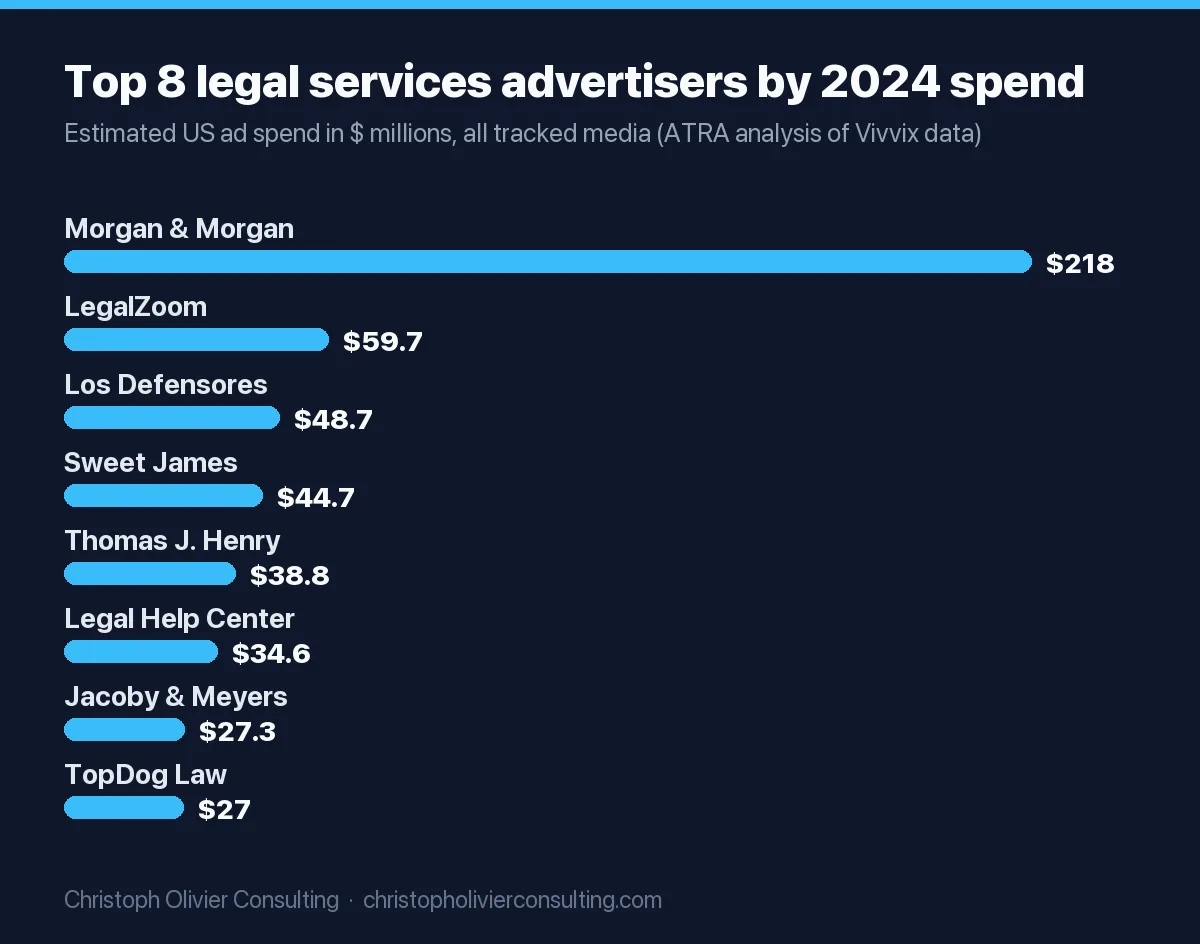
Short answer: Lawyers may advertise in any medium; ABA Model Rule 7.1 only bans communications that are “false or misleading.” The ads that work state a fee model, a location and one checkable fact. TV still takes the most money: an estimated $1.03 billion of the $2.64 billion spent on legal services ads in 2024, per ATRA’s analysis of Vivvix data, with Morgan & Morgan alone at about $218 million.
15 law firm advertising examples at a glance
Read across a row to see what each firm ran and the lesson for your own ads. The first six rows are the court cases that decided what lawyer ads may say; the rest are modern campaigns. Ad Transparency Center records were viewed on November 19, 2026 (region: United States).
| # | Firm | Channel | Year | Core message | Lesson | Source |
|---|---|---|---|---|---|---|
| 1 | Bates & O’Steen (Phoenix) | Newspaper, Arizona Republic | 1976 | “Legal services at very reasonable fees,” with prices for divorce, adoption, bankruptcy, name change | A fee list is the most useful ad a consumer firm can run | Bates v. State Bar of Arizona |
| 2 | Jacoby & Meyers | Television | 1977 | Affordable lawyers for the middle class | Name the client nobody else is talking to | Legal Evolution |
| 3 | Philip Zauderer (Ohio) | Print, 36 Ohio newspapers | 1982 | “DID YOU USE THIS IUD?” with a drawing of the Dalkon Shield | An accurate image is protected; a missing cost disclosure is not | Zauderer v. Office of Disciplinary Counsel |
| 4 | Richard Shapero (Kentucky) | Direct mail letter | 1985 | “It has come to my attention that your home is being foreclosed on” | Targeted letters are allowed if truthful | Shapero v. Kentucky Bar Assn. |
| 5 | Alexander & Catalano (Syracuse, Rochester) | TV | Before 2007 | “Heavy hitters,” partners as giants over buildings, helping space aliens | Obvious humor is not deception | Alexander v. Cahill (2d Cir.) |
| 6 | Pape & Chandler (Florida) | TV, logo, phone number | Disciplined 2005 | Pit bull in a spiked collar, 1-800-PIT-BULL | A mascot can be read as a claim about your conduct | Florida Bar News |
| 7 | Jamie Casino (Savannah) | Local Super Bowl TV, 2 minutes | 2014 | “I don’t represent villains anymore,” flaming sledgehammer | A personal story beats a feature list | ABA Journal |
| 8 | Mike Morse Law Firm (Michigan) | Super Bowl TV, 60 seconds | 2021 | “Masked Mike,” made during the pandemic | Tie the spot to the moment your market is living through | Firm release |
| 9 | Sam Bernstein Law Firm (Detroit) | Super Bowl TV | 2022 | Former Detroit athletes Barry Sanders, Darren McCarty and Kirk Gibson | Local heroes work, but check your state’s celebrity and endorsement rules | Above the Law |
| 10 | Morgan & Morgan | TV | 2020 | “You Don’t Pay Unless We Win,” ticket-window comedy, tagline “For the People” | Explain the contingency fee with an everyday analogy | iSpot.tv |
| 11 | Morgan & Morgan | TV, 30 seconds | 2024 | “All Law Firms Are Not the Same: $3 Billion Last Year” | Aggregate results need proof on file and context | iSpot.tv |
| 12 | Morgan & Morgan | Broadcast, digital, audio, out of home | 2026 | “You Wouldn’t” and “Power Move,” in-house agency | Run a series, not a one-off spot | shots |
| 13 | Morgan & Morgan | Stadium sponsorship, Fenway Park | 2022 | First legal sponsor of the Boston Red Sox, 30-second spot on the center field board | Buy one place your market visits all season | MLB release |
| 14 | Jim S. Adler, P.C. (Texas) | Google keyword ads | 2021 ruling | Trademarks “The Hammer,” “Texas Hammer,” “El Martillo Tejano” | Protect your brand name in search; rivals bid on it | ABA Journal |
| 15 | Cooper Elliott (Columbus, Ohio) | Wall banner, Arena District | 2025 | “Protecting People. Powering Good.” | Sell the change your cases cause, not only the dollars | Law Firm Newswire |
The court-tested ads: what lawyers were allowed to say, and why
Every modern lawyer ad rests on six real ads that ended up in court. Read them as copywriting lessons, not only legal history.
Bates & O’Steen: the price list newspaper ad (1976)
On February 22, 1976, two Phoenix lawyers placed an ad in the Arizona Republic offering “legal services at very reasonable fees.” Justice Powell’s dissent lists the prices: an uncontested divorce for $175 plus a $20 filing fee, an uncontested adoption for $225, a non-business bankruptcy for $250 plus a $55 filing fee, and a change of name for $95 plus $20. The State Bar disciplined them; on June 27, 1977 the Supreme Court held that truthful price advertising for routine services “may not be restrained” (Bates v. State Bar of Arizona, 433 U.S. 350).
Why it still works: the ad answers the first question every consumer has, which is cost, and it separates the fee from the court filing fee. A flat-fee estate planning or uncontested divorce practice can run the same structure today.
Jacoby & Meyers: the first law firm TV ads (1977)
Jacoby & Meyers “became the first law firm to experiment with TV ads” in August 1977, two months after Bates, pitching an affordable option for the middle class between corporate lawyers and legal aid, according to Legal Evolution. The brand still advertises: ATRA’s report estimates Jacoby & Meyers spent $27.3 million on ads in 2024, and the Ads Transparency Center shows about 200 Google ads under the verified advertiser Jacoby & Meyers, P.C.
Lesson: the ad defined a client segment out loud. “Small business owners who can’t afford a general counsel” is the same move in 2026.
Zauderer: the Dalkon Shield ad and the drunk driving refund ad (1982)
In spring 1982 Ohio lawyer Philip Zauderer ran an ad in 36 Ohio newspapers with a line drawing of the Dalkon Shield IUD and the headline “DID YOU USE THIS IUD?” It said “If there is no recovery, no legal fees are owed by our clients,” and drew over 200 inquiries and suits for 106 women. The Supreme Court held the drawing was protected because it was accurate, but upheld discipline for omitting that clients could still owe litigation costs. A second ad promised the “full legal fee refunded if convicted of DRUNK DRIVING,” which Ohio read as a contingent fee in a criminal case; he withdrew it (Zauderer, 471 U.S. 626 (1985)).
Lesson: “no fee unless we win” needs its cost sentence. Florida and Texas both require it today (see the rules table below).
Shapero: the targeted foreclosure letter (1985)
In 1985 Richard Shapero asked Kentucky’s advertising commission to approve a letter to homeowners facing foreclosure: “It has come to my attention that your home is being foreclosed on… Federal law may allow you to keep your home… Call NOW, don’t wait.” On June 13, 1988 the Supreme Court held that states may not categorically ban truthful, nondeceptive letters to people known to face a specific legal problem (Shapero, 486 U.S. 466). Seven years later it upheld Florida’s 30-day ban on direct mail to accident victims, 5 to 4, citing a Bar survey in which 26% of recipients called such mail an invasion of privacy (Florida Bar v. Went For It, 515 U.S. 618).
Lesson: targeted mail works because it is specific, and that is also why bars regulate its timing. Check your state’s waiting period before you mail.
Alexander & Catalano: “heavy hitters,” giants and space aliens
The Second Circuit’s March 12, 2010 opinion describes the Syracuse and Rochester firm’s commercials: jingles, “wisps of smoke and blue electrical currents” around the firm name, the partners “as giants towering above local buildings,” running to a client’s house so fast they blur, and “providing legal assistance to space aliens,” with the slogan “heavy hitters.” New York’s 2007 rules would have banned these techniques. The court struck the bans, writing that Alexander and his partner “do not actually provide legal assistance to space aliens” and that no ordinary viewer would think so (Alexander v. Cahill, 598 F.3d 79).
Lesson: humor that no one would take literally is fair game. A specific, literal claim (“we always win”) is where trouble starts.
Pape & Chandler: the pit bull logo
The Florida firm’s ads replaced the ampersand with “a drawing of a pit bull head in a spike collar” and used the phone number 1-800-PIT-BULL. A referee found no violation, but the Florida Supreme Court, unanimously, ordered a public reprimand, an advertising workshop and a changed ad, reasoning that the public associates pit bulls with viciousness. The U.S. Supreme Court declined review on March 27, 2006 (Florida Bar News).
Lesson: in strict states, a mascot is read as a promise about how you will behave. Pick symbols that describe service, not aggression.
Best lawyer commercials: Super Bowl and TV examples
These are the spots people search for when they type “best lawyer commercials.” All were verified on the firm’s official YouTube channel or in trade coverage.
Jamie Casino, “Casino’s Law” (2014). A two-minute local Super Bowl spot in Georgia. Casino explains he stopped defending criminal suspects after his brother was killed in 2012, then smashes a tombstone with a flaming sledgehammer to heavy metal and says “I don’t represent villains anymore.” Adfreak called it “completely nuts and completely entertaining,” per the ABA Journal. It is still on his official channel.
Mike Morse, “Masked Mike” (2021). A 60-second Super Bowl spot that won the firm’s second straight Golden Gavel Award from the National Trial Lawyers; the first, in 2020, was a 30-second spot called “Ambulance Chaser” (Mike Morse Law Firm). Calling your own ad “Ambulance Chaser” is a smart move: it names the objection before the viewer does.
Detroit, Super Bowl 2022. Above the Law rounded up that year’s local lawyer spots: Sam Bernstein Law Firm with Barry Sanders, Darren McCarty and Kirk Gibson; Brown & Crouppen in St. Louis joking it is “still not over losing the Rams”; William Mattar in New York claiming to have insurers “over a barrel.”
Morgan & Morgan, the national benchmark. Its 2020 spot “You Don’t Pay Unless We Win” shows a couple at a stadium ticket window who only pay if their team wins, then ties that to the firm’s fee policy and the tagline “For the People” (iSpot.tv). Its January 2024 spot is titled “All Law Firms Are Not the Same: $3 Billion Last Year” (iSpot.tv). In 2026 its in-house agency rolled out “You Wouldn’t” (a barbershop quartet sings a layoff to an employee) and “Power Move” (WWE star Liv Morgan babysits), running across broadcast, digital, audio and out of home, per shots. Founder John Morgan’s line in that report: “Humor is a hallmark of our brand, but results are our legacy.”
Morgan & Morgan’s celebrity spots also show why state rules matter to creative. On August 14, 2026 the firm sued The Florida Bar in federal court (N.D. Fla., No. 4:26-cv-00405) over Rule 4-7.15(c), which bars the “voice or image of a celebrity” in lawyer ads. The complaint says the firm runs celebrity campaigns in other states that it cannot run in Florida (complaint as filed). If you plan a spot with a local athlete, check your state first.
Lawyer ad examples in Google search, sponsorships and outdoor
Most firms will never buy a Super Bowl spot. These are the channels a 5 to 50 lawyer firm actually uses.
Google Ads: what the Ads Transparency Center shows
Type any firm’s domain into the Google Ads Transparency Center and you see every Google ad that domain has run, with the verified advertiser name. Counts below are as Google displays them (it rounds), all time, all formats.
| Domain | Ads on file, US | Verified advertiser shown | What to notice |
|---|---|---|---|
| forthepeople.com | ~6,000 | Morgan & Morgan, P.A. (account shows ~7,000) | Video ads by practice area, one titled “Fighting For You For 35+ Years” |
| sweetjames.com | ~1,000 | Sweet James Lawyers LLC; Sweet James LLP | Two advertiser accounts on one domain |
| thebarnesfirm.com | ~600 | Brainlabs Digital, Inc. | Ads can run under the agency’s account |
| jimadler.com | ~300 | Jim S. Adler, P.C. | The “Texas Hammer” firm advertises its own brand terms |
| jacobyandmeyers.com | ~200 | Jacoby & Meyers, P.C. | The 1977 TV pioneer, still buying search |
| 1800askgary.com | ~200 | W.S. Media, Inc. | YouTube spots such as “Roz: 1-800-ASK GARY: That’s The Move” |
The Jim Adler case shows why your own name matters in search. Adler holds the marks “Jim Adler,” “The Hammer,” “Texas Hammer” and “El Martillo Tejano.” A lawyer referral call center bought those terms as Google keywords and ran generic click-to-call ads that, on a phone, dialed the call center. On August 10, 2021 the Fifth Circuit revived Adler’s trademark suit, holding that whether a mark appears in the ad text is “a relevant but not dispositive factor” (ABA Journal; opinion). Run a brand campaign on your firm name, even a small one. Setup details are in our guide to Google Ads for lawyers.
Sponsorships and outdoor
On April 5, 2022 Morgan & Morgan became the Boston Red Sox’s first legal sponsor, with a 30-second commercial on the Fenway Park center field video board before every regular season home game (MLB press release). The small firm version is the local minor league park, high school stadium or community race your clients attend every year.
Cooper Elliott in Columbus went the other way on outdoor. In September 2025 it installed a wall banner in the Arena District, its third in the city, launching “Protecting People. Powering Good.,” a campaign about the safety changes its cases force, not only the money recovered. Co-founder Rex Elliott: “This campaign is about what happens after the outcome” (Law Firm Newswire release).
What kind of advertising do lawyers most commonly use?
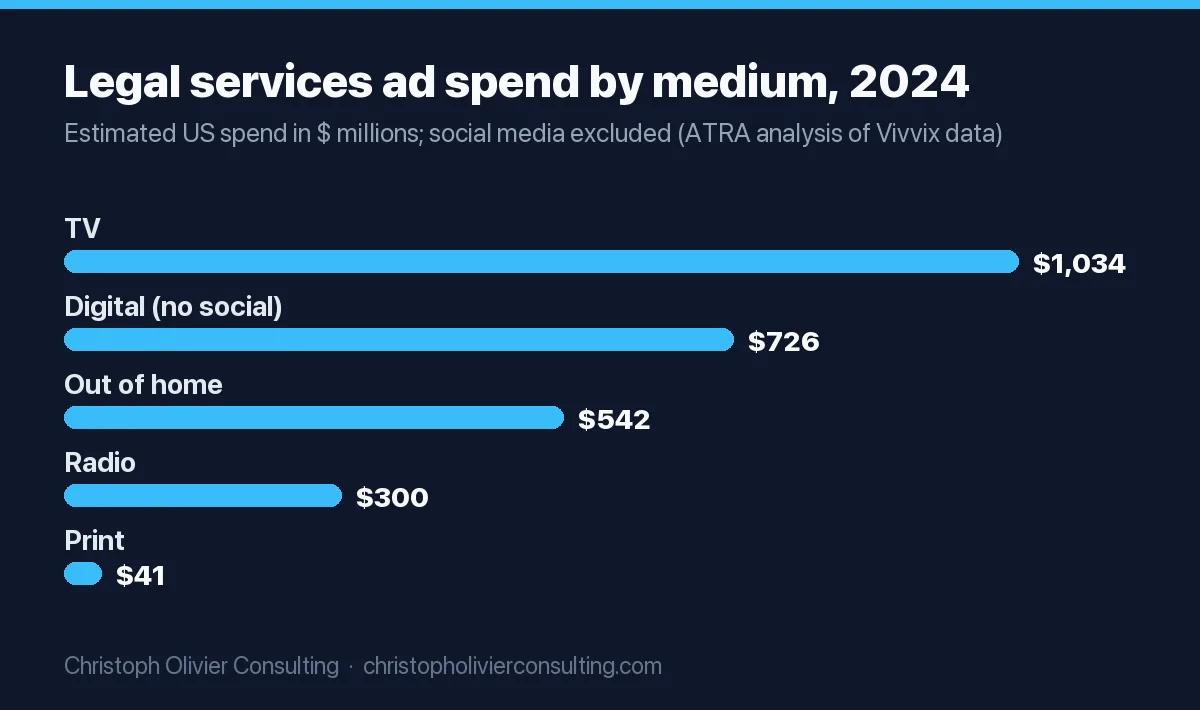
By dollars, television. The American Tort Reform Association, a tort reform advocacy group, analyzed Vivvix ad tracking data and estimated $2.64 billion in legal services ad spending across 26.98 million ads in 2024 (ATRA report, March 2025). Social media is excluded, so real totals are higher. Up from $1.89 billion in 2020, that is a 39.6% rise (my calculation from ATRA’s chart values; ATRA’s text says about 39%).
| Medium | 2024 legal services ad spend (estimate) | Share of total (my calculation) | Trend ATRA reports |
|---|---|---|---|
| TV (network, spot, cable, Spanish language, syndication) | $1,033.7 million | 39% | TV ad count peaked in 2023 at more than 16.4 million |
| Digital (display, search, online video, mobile; no social) | $725.7 million | 27% | Digital ad count down more than 50% since 2020, spend up 84% |
| Out of home (outdoor, cinema) | $541.6 million | 20% | Spend up more than 260% versus 2017 |
| Radio | $300.5 million | 11% | 6.8 million radio ads in 2024, up from 1.8 million in 2017 |
| $41.0 million | 2% | Fewer than 15,000 print ads | |
| Total | $2,642.5 million | 100% | 26,982,382 ads |
The same report ranks the biggest 2024 spenders: Morgan & Morgan at an estimated $218.2 million, then LegalZoom ($59.7 million), Los Defensores ($48.7 million), Sweet James ($44.7 million), Thomas J. Henry ($38.8 million), Legal Help Center ($34.6 million), Jacoby & Meyers ($27.3 million) and TopDog Law ($27.0 million). Los Angeles was the top market at $164.9 million. These are media-monitoring estimates, not firm-reported budgets. For what a firm your size should spend, see our breakdown of the law firm marketing budget.
Lawyer advertising rules every example above had to pass
Can lawyers advertise? Yes. ABA Model Rule 7.2(a): “A lawyer may communicate information regarding the lawyer’s services through any media.” The limit is Rule 7.1: “A lawyer shall not make a false or misleading communication about the lawyer or the lawyer’s services” (ABA Rule 7.1). Comment 3 adds that truthful past results can still mislead if they create “an unjustified expectation that the same results could be obtained for other clients,” and that a disclaimer can cure it (comment on Rule 7.1). Rule 7.2(c) bars implying certification as a specialist unless an approved body certified you and is named, and 7.2(d) requires “the name and contact information of at least one lawyer or law firm responsible for its content” (ABA Rule 7.2). Rule 7.3 bans live person-to-person solicitation for pecuniary gain, with exceptions for lawyers, family and business contacts (ABA Rule 7.3). The full history is in are lawyers allowed to advertise.
States add the detail. This table compiles the provisions that most often decide whether a draft ad runs.
| Issue | Florida | Texas | New York (since June 1, 2026) |
|---|---|---|---|
| Filing | File ads under Rule 4-7.19 (Bar checklist) | File within 10 days after first dissemination, with application and fee; optional pre-approval 30 days ahead (Rule 7.04) | Old filing and recordkeeping requirements for solicitations eliminated (NYSBA summary) |
| Required identity | Lawyer or firm name, plus city, town or county of a bona fide office | Name of the responsible lawyer and primary practice location (Rule 7.02(a)) | Name and contact information of a responsible lawyer or firm; phone or office address |
| “No fee unless we win” | Must disclose whether the client pays costs without a recovery (4-7.14(a)(7)) | Must say whether the client also pays costs such as litigation costs (7.02(c)) | General false or misleading standard |
| Past results | Must be objectively verifiable; no prediction or guaranty (4-7.13(b)) | Not if likely to create unjustified expectations; credit only where you played a substantial role (Rule 7.01) | Mandatory “Prior results do not guarantee a similar outcome” line eliminated, but recommended |
| Actors, dramatizations | Clear disclaimer for actors, non-employees and dramatizations (4-7.13(b)(5) to (7)) | Actor portraying a lawyer can be misleading; disclaimer must be clear (7.01 cmt. 3) | Specific portrayal disclaimers eliminated; false or misleading standard applies |
| Celebrities, judges | No celebrity voice or image; no judge or police spokesperson (4-7.15(b), (c)); challenged in court | Not addressed in the provisions above | Not specifically banned |
| Specialist claims | “Board certified” only for certified lawyers; firms cannot claim certification | “Board Certified, [area] Texas Board of Legal Specialization” format (7.02(b)) | “Specialist” allowed if not misleading; “certified” needs a named certifier |
| “Attorney Advertising” label | Not on this checklist | Not required by 7.02 | Requirement eliminated |
One more New York change matters for the examples above: the 30-day ban on soliciting accident victims that the Second Circuit upheld in Alexander v. Cahill was eliminated on June 1, 2026, per the NYSBA summary. Florida’s version, upheld in Went For It, is a separate rule.
How to advertise as an attorney: copy-ready ad templates
These are templates, not real ads. Replace every [bracket] with your own verified facts. They are written as Google responsive search ad assets, which allow up to 15 headlines of 30 characters and 4 descriptions of 90 characters (Google Ads Help), so recount after filling them in. The rule check cites the provision each line is written to satisfy; it is not a compliance opinion for your state.
| # | Practice | Headlines (30 chars or less) | Description (90 chars or less) | Rule check |
|---|---|---|---|---|
| 1 | Personal injury | [City] Car Accident Lawyer No Fee Unless We Recover Free Case Review Today | [Firm], [City] office. You may owe case costs; see our fee terms before you sign. | Cost disclosure next to the contingency line (FL 4-7.14(a)(7); TX 7.02(c); Zauderer) |
| 2 | Personal injury, proof line | [N] Years in [County] Courts Talk to a Lawyer, Not a Bot | Every case is different. Past results do not guarantee a similar outcome. | Years must be documented; disclaimer per ABA 7.1 cmt. 3 |
| 3 | Uncontested divorce | Uncontested Divorce $[X] Plus Court Filing Fee | Flat fee for uncontested cases in [County]. Price valid through [date]. | Bates-style fee plus filing fee; honor advertised fees (TX 7.02(d)) |
| 4 | Estate planning | Wills and Trusts in [City] Flat-Fee Estate Plans | Fee quoted in writing before we start. Office in [City]. | Name and location (ABA 7.2(d); FL 4-7.12(a)) |
| 5 | Criminal defense | DUI Charge in [County]? Call a Defense Lawyer Now | We explain the process and your options at the first call. No outcome promised. | No result promise; no contingent fee in criminal matters (the Zauderer DUI ad) |
| 6 | Board-certified lawyer | Board Certified [Area] [Name], [City] Attorney | Board Certified, [Area], [Certifying organization]. | Certifier named (ABA 7.2(c); TX 7.02(b) format) |
| 7 | Brand defense | [Firm Name], Official Site [Firm Name] in [City] | The [Firm Name] team at [address]. Call [number] to reach our office directly. | Protects your name in search (Adler v. McNeil) |
For a 30-second TV or radio spot, this script template follows the same rules:
- Open (0 to 5 s): the viewer’s situation in their words. “Hurt in a crash on [highway]?”
- Promise (5 to 15 s): one process promise you control. “We return calls the same day, and a lawyer reviews every case.”
- Proof (15 to 22 s): one checkable fact. “[N] years, [N] lawyers, offices in [City] and [City].”
- Fee line (22 to 27 s): “No fee unless we recover. You may owe costs; ask us how that works.”
- Close (27 to 30 s): firm name, city and number on screen and spoken. If an actor plays a lawyer or client, add the required disclaimer on screen.
Run every draft through this pass/fail check before it goes out. One fail means rewrite:
- Identity: a responsible lawyer or firm name and contact information, plus office location in Florida and Texas. Pass or fail.
- Fee truth: any fee or “no fee unless” line says who pays costs. Pass or fail.
- Results: every number has records behind it, credit only where you had a substantial role, and a past-results disclaimer. Pass or fail.
- Titles: “certified” or “board certified” only with a named certifier. Pass or fail.
- People: actors, dramatizations and celebrities disclosed or cleared for your state. Pass or fail.
- Filing: filed with the bar where required (Texas within 10 days of first use). Pass or fail.
Live firm sites show the disclosure pattern at scale. Cordell & Cordell’s homepage footer, viewed November 2026, reads “THIS IS AN ATTORNEY ADVERTISEMENT,” lists which named partners are licensed in which states, and states “No representation is made that the quality of the legal services to be performed is greater than the quality of legal services performed by other lawyers” (cordellcordell.com). A multi-state firm pays for that length of disclaimer; a one-state firm can usually keep it far shorter.
Funny lawyer ads that worked, and the ones that cost the firm
The record draws a clear line. Alexander & Catalano’s space aliens were protected because no one would read them literally, and Morgan & Morgan’s ticket-window gag explains a fee model. The pit bull lost because Florida read the image as a statement about conduct, and Zauderer’s refund offer failed because it was a fee term. Joke about the situation; keep the fee and the facts literal.
My view after putting these side by side: copy the boring parts first. A fee line, a city and one true number in a search ad is where I would start, then one recurring idea kept for years, as Morgan & Morgan has done with “For the People.” For channel ideas beyond ads, see our law firm marketing ideas and, for injury practices, personal injury law firm marketing. If you want a second read of your ad copy and the rule check before you launch, you can book a consultation.
Ready to scale your revenue?
Book a free 30-min consultation. We’ll diagnose your growth bottleneck and map out the 3 highest-leverage moves for your business.
Frequently asked questions
What are some examples of law firm advertising?
Well documented examples include Bates & O'Steen's 1976 newspaper price ad, Jacoby & Meyers' first law firm TV ads in 1977, Alexander & Catalano's heavy hitters commercials, Jamie Casino's 2014 local Super Bowl spot, Mike Morse's award-winning Masked Mike spot, and Morgan & Morgan's You Don't Pay Unless We Win and 2026 You Wouldn't campaigns. Google's Ads Transparency Center shows the live search and video ads of firms like Morgan & Morgan and Sweet James.
What are some funny examples of lawyer advertisements?
Alexander & Catalano showed its partners as giants towering over buildings and giving legal help to space aliens; a federal appeals court said no viewer would take that literally. Morgan & Morgan explains contingency fees with a stadium that only charges if your team wins, and its 2026 spots include a barbershop quartet delivering a layoff. Mike Morse even named a spot Ambulance Chaser. Humor works best when fees and facts stay literal.
What kind of advertising do lawyers most commonly use?
By spending, television. ATRA's analysis of Vivvix data estimates legal services advertisers spent $2.64 billion in 2024: about $1.03 billion on TV, $726 million on digital excluding social media, $542 million on out of home such as billboards, $301 million on radio and $41 million on print. Small firms typically lean on Google search ads, their website and referrals rather than TV.
How do you advertise as an attorney?
Pick one practice area and one city, then write ads that state your fee model, your location and one fact you can prove, such as years in practice. Include the responsible lawyer's name and contact details, add a cost disclosure to any no fee unless we win line, avoid outcome promises, and file the ad with your bar if your state requires it, as Texas does within 10 days of first use.
Can lawyers say no fee unless we win in ads?
Generally yes, but most states require the cost sentence. Florida requires ads to disclose whether the client pays costs if there is no recovery, and Texas requires ads offering contingent fees to say whether the client also pays costs such as litigation costs. The Supreme Court upheld Ohio's discipline of a lawyer whose 1982 ad omitted that clients could owe costs.
Can lawyers use celebrities or actors in commercials?
It depends on the state. Florida Rule 4-7.15(c) bars the voice or image of a celebrity in lawyer ads, and Morgan & Morgan sued the Florida Bar over that rule in August 2026. Florida and Texas also require clear disclaimers when actors portray lawyers or clients or when events are dramatized. New York dropped its specific portrayal rules in June 2026 in favor of a general misleading standard.
Real advertising examples by industry