

Yes. Hospitals in the United States are allowed to advertise, on TV, radio, billboards, direct mail, search and social, and about half of general acute care hospitals do. The old ban was self-imposed: after federal rulings in the late 1970s and early 1980s struck down organized medicine’s advertising restrictions, the American Hospital Association rescinded its own advertising ban, according to the 2019 JAMA review Medical Marketing in the United States, 1997-2016. What limits a hospital today is a stack of federal rules that mostly govern what you give away, what patient data you use, and what you must disclose, not whether you may buy media.
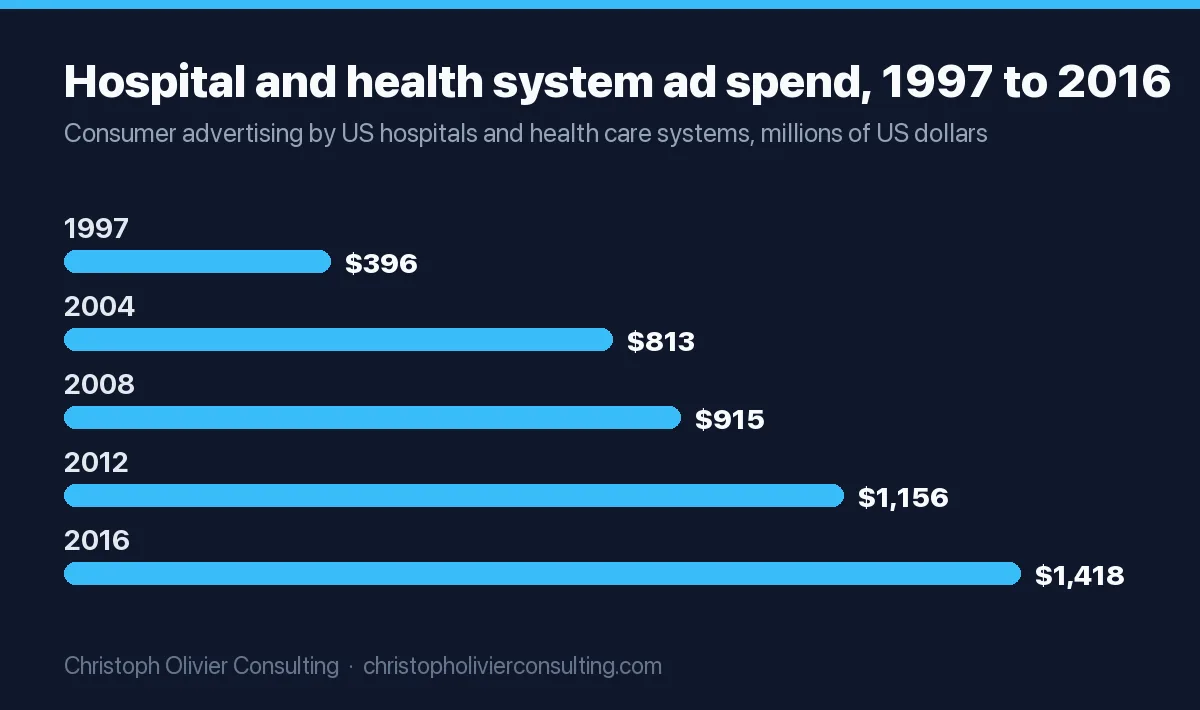
Short answer: Hospitals can advertise in any medium if the claims are true and substantiated. The hospital-specific traps are giveaways to Medicare or Medicaid patients (anything over $15 per item or $75 a year can trigger penalties of up to $20,000 per item or service), using patient lists or stories without HIPAA authorization, physician-owned hospitals that leave the ownership disclosure out of their ads, and price claims that do not match the prices CMS requires you to post. US hospitals and health systems spent $1.42 billion on consumer advertising in 2016, up from $396 million in 1997.
Below: each rule with its section number, an allowed and prohibited content table, spend data from four sources, verified campaign examples and a pass/fail checklist. This is general information for hospital marketers, not legal advice; run anything high stakes past your compliance office or health law counsel.
Why hospitals did not advertise until the 1980s
For most of the 20th century, medical and hospital associations treated advertising as unethical. The FTC sued the American Medical Association in December 1975, and the case ended in 1982 when the Supreme Court split 4 to 4, leaving the lower court rulings in place (FTC case history). The FTC’s position was that the ban kept the public from truthful information about prices, quality and services. Schwartz and Woloshin note that these rulings “also led the American Hospital Association to rescind its advertising ban.” We cover the physician side of that history, with the full court timeline, in are doctors allowed to advertise.
Hospital advertising rules by source
There is no single “hospital advertising law.” Eight federal rulebooks touch hospital marketing, and each one controls a different part of the ad. This table is the map; the sections after it explain each row.
| Rule | What it controls in a hospital ad | Applies to | Consequence |
|---|---|---|---|
| FTC Act Sections 5 and 12 (15 U.S.C. 45, 52) | False or unsubstantiated claims about “services,” including outcomes, rankings and survival rates | For-profit hospitals (FTC jurisdiction); nonprofits mainly face state law | FTC orders; civil penalties up to $53,088 per violation for rule or order violations |
| Beneficiary inducement CMP (42 U.S.C. 1320a-7a(a)(5)) | Free gifts, waived copays and other value offered to Medicare or Medicaid patients to pick your hospital | All hospitals | Up to $20,000 per item or service, plus up to 3 times the amount claimed, plus possible exclusion |
| Anti-Kickback Statute (42 U.S.C. 1320a-7b(b)) | Paying anyone to refer or “arrange for or recommend” federally covered care | All hospitals | Felony: up to $100,000 and 10 years |
| AKS safe harbors (42 CFR 1001.952(bb)) | Free patient transportation and shuttles: protected only if not publicly marketed or advertised | Hospitals offering rides | Loses safe harbor protection |
| HIPAA Privacy Rule (45 CFR 164.501, 164.508(a)(3)) | Using patient lists, stories, photos and tracking data in marketing | All HIPAA covered hospitals | OCR settlements, for example $2.2 million (below) |
| Physician-owned hospital rule (42 CFR 411.362(b)(3)(ii)(C)) | Mandatory “owned by physicians” statement in public advertising and on the website | Hospitals with physician owners or investors | Fails a federal requirement for physician-owned hospitals |
| Hospital price transparency (45 CFR Part 180) | Posted standard charges and at least 300 shoppable services; your advertised prices should match them | All hospitals | Up to $5,500 per day for hospitals over 550 beds |
| Medicare Advantage marketing rules (42 CFR 422.2266) | Where health plans may market inside your hospital, and what your staff may say about plans | MA plans and contracted hospitals | The plan is responsible for compliance in plan-initiated activities |
The FTC Act, and the nonprofit gap
Section 12 of the FTC Act makes it unlawful to disseminate “any false advertisement” likely to induce the purchase of “food, drugs, devices, services, or cosmetics” (15 U.S.C. 52); “services” was added in 1994. The catch for hospitals: the FTC Act defines a “corporation” as an entity “organized to carry on business for its own profit or that of its members” (15 U.S.C. 44). Many hospitals are nonprofits (66% of advertising hospitals in the JAMA Network Open study below), and Schwartz and Woloshin note that nonprofits fall to state attorneys general, who enforce state false advertising laws under state false advertising laws, such as California’s Business and Professions Code 17500, where an untrue or misleading statement is a misdemeanor punishable by up to six months in jail, a $2,500 fine, or both.
Enforcement has been thin. Schwartz and Woloshin found that, over their 1997 to 2016 review window, the FTC’s only health services advertising action was a 1996 case against Cancer Treatment Centers of America over unsubstantiated survival claims, which required unrepresentative patient testimonials to carry the disclaimer “No case is typical. You should not expect these results.” They found no state attorney general action against deceptive consumer advertising for health services. Thin enforcement is not permission; our FTC advertising enforcement statistics show where the agency focuses now.
For patient stories, the FTC’s Endorsement Guides, 16 CFR 255.2(b), say a testimonial about a key attribute will be read as representative of “what consumers will generally achieve.” If your transplant survivor’s story is not typical, the ad “should clearly and conspicuously disclose the generally expected performance.” A survival-rate claim needs your own outcomes data on file before the spot airs.
Free gifts, waived copays and free rides: beneficiary inducement
This is the rule that most separates hospital marketing from ordinary brand advertising. Under 42 U.S.C. 1320a-7a(a)(5), anyone who offers or transfers remuneration to a Medicare or Medicaid beneficiary that they “know or should know is likely to influence” the person to choose a particular provider faces a civil money penalty of up to $20,000 per item or service. “Remuneration” includes waived coinsurance and deductibles and anything given “for free or for other than fair market value.” That covers health fair giveaways, gift cards and “we waive your copay” offers.
Three carve-outs matter for marketing teams:
- Nominal value. The HHS Office of Inspector General’s December 7, 2016 policy statement reads “nominal value” as a retail value of no more than $15 per item or $75 in aggregate per patient per year, and “the items may not be cash or cash equivalents.” A branded water bottle passes. A $25 gift card fails twice.
- Financial-need copay waivers are not remuneration only if, among other conditions, “the waiver is not offered as part of any advertisement or solicitation” (42 CFR 1003.110). You can have a charity care policy; you cannot advertise copay forgiveness.
- Free local transportation is protected by an Anti-Kickback safe harbor only if the hospital “does not publicly market or advertise” it, rides stay within 25 miles (75 miles for rural patients), and drivers do not market services (42 CFR 1001.952(bb)). A shuttle can publish “necessary route and schedule details” and nothing more.
Behind all of this sits the Anti-Kickback Statute, a felony carrying up to $100,000 and 10 years for anyone who pays to induce referrals or to “arrange for or recommend” federally covered care. Paying a lead vendor, influencer or community group per Medicare patient delivered is the arrangement to have counsel review before signing.
HIPAA: patient lists, patient stories and tracking pixels
HIPAA defines marketing as “a communication about a product or service that encourages recipients of the communication to purchase or use the product or service,” and requires written authorization to use patient information for it, except face-to-face communications and promotional gifts of nominal value (45 CFR 164.508(a)(3)). The HHS marketing guidance uses hospitals for most of its examples:
- Not marketing, no authorization needed: a hospital using its patient list “to announce the arrival of a new specialty group (e.g., orthopedic) or the acquisition of new equipment (e.g., x-ray machine or magnetic resonance image machine) through a general mailing or publication.”
- Marketing, authorization needed: a hospital telling former patients about a cardiac facility that is not part of the hospital and offers a baseline EKG for $39.
- Marketing, but exempt as a nominal gift: a hospital giving “a free package of formula and other baby products to new mothers as they leave the maternity ward.”
- Never without each person’s authorization: selling or handing a patient list to another company for its own marketing.
Patient stories and filming are where hospitals pay the most. HHS settled with New York Presbyterian Hospital for $2.2 million after it disclosed two patients’ information to news media during filming of the “NY Med” series, plus a corrective action plan with two years of monitoring.
On tracking pixels, the HHS online tracking bulletin still covers authenticated pages such as patient portals. On June 20, 2024, the Northern District of Texas declared its “Proscribed Combination” unlawful, the part that treated an IP address plus a visit to an unauthenticated public page about specific conditions or providers as protected health information (AHA v. Becerra), and OCR withdrew its appeal on August 29, 2024 (Epstein Becker Green). Keep ad pixels off portals, scheduling flows and symptom forms; state privacy laws still apply to the rest.
Physician-owned hospitals must say so in their ads
This is the one federal rule that dictates ad copy. Under the federal physician self-referral regulations, a physician-owned hospital must “disclose on any public Web site for the hospital and in any public advertising for the hospital that the hospital is owned or invested in by physicians” (42 CFR 411.362(b)(3)(ii)(C)). “Public advertising” means “any public communication paid for by the hospital that is primarily intended to persuade individuals to seek care at the hospital.” The rule accepts “any language that would put a reasonable person on notice that the hospital may be physician-owned.” A short line such as “Physician-owned hospital” in the footer of every paid ad, mailer and landing page does the job.
Price transparency: what you post must match what you advertise
CMS requires every hospital to publish a machine-readable file of all standard charges (45 CFR 180.50) and, since January 1, 2026, to attest in that file that the data is “true, accurate, and complete” and encode the name of the CEO, president or designated senior official responsible. Hospitals must also show at least 300 shoppable services, including as many of the 70 CMS-specified services as they provide, in a consumer-friendly format or a price estimator tool, free and without registration (45 CFR 180.60).
Penalties under 45 CFR 180.90 are capped per day: $300 for hospitals with 30 beds or fewer, $10 per bed for 31 to 550 beds, and $5,500 for hospitals over 550 beds. A full year at the top rate is $2,007,500. CMS issued its first penalties on June 7, 2022: $883,180 against Northside Hospital Atlanta and $214,320 against Northside Hospital Cherokee. The CMS enforcement list now names 28 hospitals, the latest with notices dated 2026. The marketing takeaway is simple: if a mailer says “MRI for $450 cash,” that number should equal the discounted cash price in your posted file, or you have created two public prices and a deception question.
Can I advertise in hospitals? The Medicare Advantage rule
If you are a health plan or vendor asking about advertising inside a hospital, the hospital decides what it allows, but CMS sets limits for Medicare Advantage plans. Under 42 CFR 422.2266, plan marketing is not permitted in exam rooms, hospital patient rooms, treatment areas or pharmacy counter areas. It is permitted in common entryways, vestibules, waiting rooms, hospital cafeterias and community or conference rooms. Hospital staff may announce plan affiliations “through any means of distribution” and answer patients’ questions about plans, but when acting for a plan they may not urge patients to enroll in a specific plan “based on financial or any other interests of the provider.”
What hospitals can and cannot put in an ad
This table compiles the rules above into one decision aid for creative review. “Restricted” means allowed only when the condition is met.
| Ad element | Status | Condition | Rule |
|---|---|---|---|
| New service line, new physician group, new MRI or robot, mailed to your own patients | Allowed | Your own services only; general mailing | HHS marketing guidance; 45 CFR 164.501 |
| Rankings (“No. 1 in the nation,” “Top 100”) | Restricted | Name the ranking body and year; claim must be current | 15 U.S.C. 45, 52; state law |
| Survival, cure or complication rates | Restricted | Your own outcomes data on file before launch; comparable patient group | 15 U.S.C. 52; 16 CFR 255.2 |
| Patient testimonials and filmed stories | Restricted | Signed HIPAA authorization; typical results or disclosure of generally expected results | 45 CFR 164.508; 16 CFR 255.2(b) |
| Cash prices for procedures | Restricted | Must match the discounted cash price in your posted file | 45 CFR 180.50, 180.60 |
| Promotional items to Medicare or Medicaid patients | Restricted | No cash or cash equivalents; at most $15 per item and $75 per year | 42 U.S.C. 1320a-7a(a)(5); OIG 2016 statement |
| Physician-owned hospital ad without ownership statement | Prohibited | Disclosure required in all paid public advertising | 42 CFR 411.362(b)(3)(ii)(C) |
| “We waive your copay” or “no out-of-pocket cost” | Prohibited | Waivers may not be advertised | 42 CFR 1003.110; 42 U.S.C. 1320a-7a(i)(6) |
| Advertising free rides to appointments | Prohibited if you want safe harbor protection | Shuttles may post route and schedule only | 42 CFR 1001.952(bb) |
| Gift cards for choosing your hospital | Prohibited | Cash equivalent; inducement | 42 U.S.C. 1320a-7a(a)(5) |
| Promoting an outside company’s service to your patient list | Prohibited without authorization | Each patient must authorize; disclose any payment | 45 CFR 164.508(a)(3) |
| Paying a vendor per Medicare patient referred | Prohibited unless counsel clears it | Kickback risk | 42 U.S.C. 1320a-7b(b) |
How much do hospitals spend on advertising?
The honest answer is “between roughly $0.45 billion and $4.8 billion a year, depending on what you count.” Four credible sources measure different things, so the numbers do not reconcile. Here they are side by side, with what each one measures.
| Source | What it measures | Period | Figure | Type |
|---|---|---|---|---|
| Schwartz and Woloshin, JAMA 2019 | Consumer advertising by hospitals and health care systems | 1997 and 2016 | $396 million to $1.418 billion | Measured, peer reviewed |
| Same study | All health services advertising (hospitals, clinics, dental, cancer centers and more) | 1997 and 2016 | $542 million to $2.89 billion | Measured, peer reviewed |
| Ndumele et al., JAMA Network Open 2021 | General acute care hospitals only, system spend split across member hospitals | 2008 and 2016 | $335 million to $448 million a year; $3.39 billion over 2008 to 2016 | Measured, peer reviewed |
| Nielsen | Hospital advertising, of which more than $200 million was outdoor | 2024 | $1.27 billion | Industry ad tracking |
| BIA Advisory Services | All local ad spend by hospitals, including direct mail and digital | 2023, 2024 | $4.79 billion (2023 estimate), $4.62 billion (2024 forecast) | Estimate and forecast, industry |
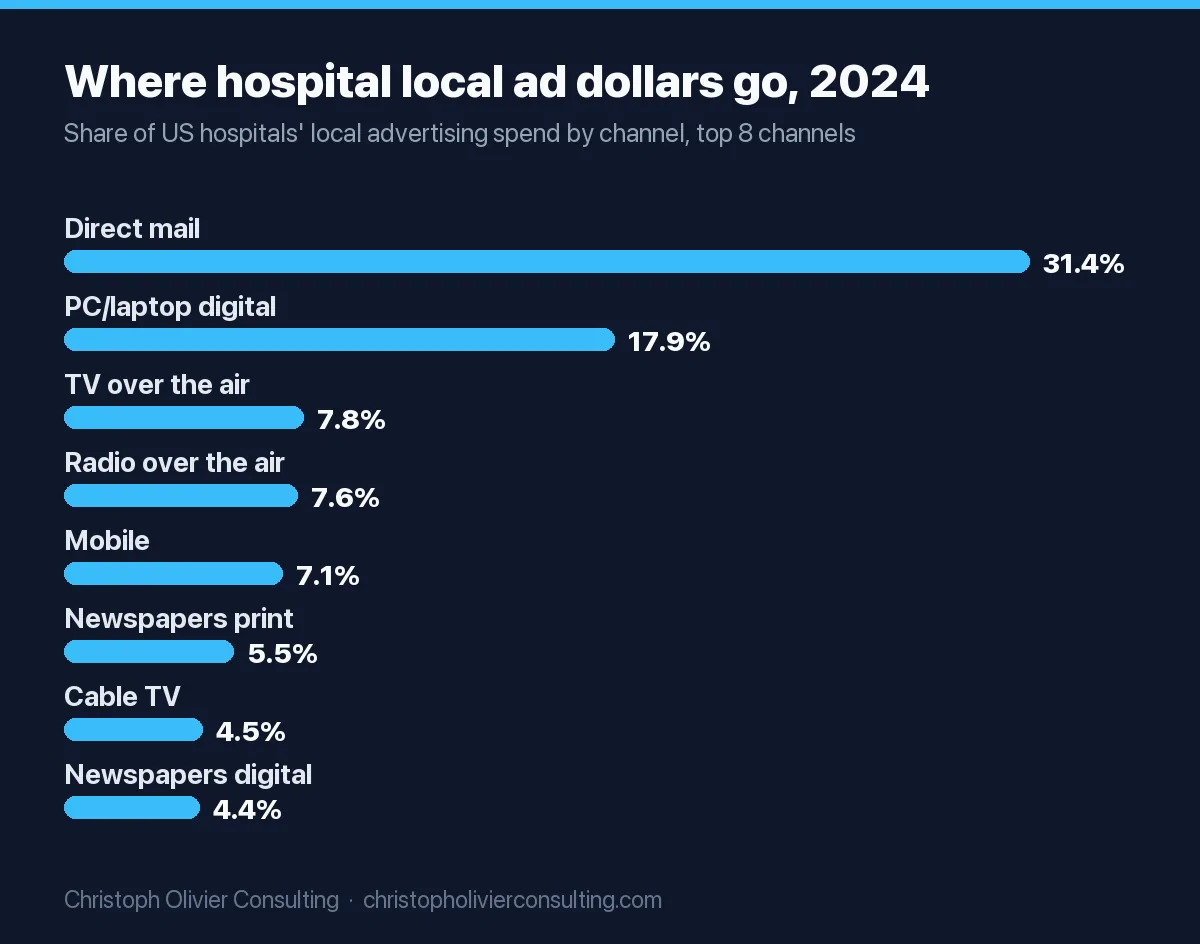
The gap is mostly scope. Ad trackers count the paid placements they can monitor. BIA’s local forecast also counts direct mail and digital (see the channel chart), and the JAMA Network Open study counts only general acute care hospitals.
The peer-reviewed numbers say more than the totals. In the Ndumele study of an average of 4,569 general acute care hospitals a year, 49% (2,239) advertised to consumers at some point in 2008 to 2016, and the share advertising in a given year rose from 38.8% to 43.7%. The mean advertising hospital spent $197,591 a year, television took 32.5% of all spending, and advertisers were bigger (234 beds on average versus 85) and more often nonprofit (66% versus 51%). Patient ratings, readmissions and overall star ratings were essentially the same for advertisers and non-advertisers; the one exception was lower 2016 mortality among the highest spenders (11.2% versus 12.7% for the lowest tercile). In other words, a big ad budget tells patients a hospital has money, not that its care is measurably better.
Do hospital ads bring in patients? A January 2026 National Bureau of Economic Research working paper (not yet peer reviewed) by Alpert, Gupta, Richards, Schutz and Whaley used political ad spikes that crowd hospitals off the air as a natural experiment. It found advertising expands inpatient volume and spending modestly (elasticities of 0.06 and 0.05). Penn’s Leonard Davis Institute summary translates that into nine more admissions per 100,000 Medicare beneficiaries for a 10% increase in a market’s hospital ads, about $3.3 million in extra Medicare spending a year for the average market, with emergency department admissions especially sensitive. For context on how this compares with drug makers, who outspend hospitals by a wide margin, see how much big pharma spends on advertising.
Hospital advertising examples (verified)
Each campaign below is confirmed by the hospital’s own release, its official YouTube channel or a government record, with the compliance lesson in the last column.
| Hospital | Campaign | Date | What it did | Lesson |
|---|---|---|---|---|
| Mayo Clinic | “Transforming Health Care” | April 17, 2023 | Three spots (“Imaginable,” “Predictable,” “Seeable”) in 30 and 60 second versions, national and local TV and OTT, built by Mayo’s internal creative agency; follows the 2020 “The Power of Answers” campaign | The release attributes its ranking claim: “No. 1 hospital in the nation for the past seven years,” according to U.S. News & World Report. Name the source and period every time. |
| NewYork-Presbyterian | “Stay Amazing” | November 8, 2021 | First new brand platform in over a decade, from Havas New York; national and regional TV, print, radio, online and New York out-of-home; evolved from “Amazing Things Are Happening Here” | Brand work about everyday life avoids outcome claims entirely, which keeps substantiation simple. |
| Cleveland Clinic | “Empathy: The Human Connection to Patient Care” (video below) | 2013 | Four-minute film on Cleveland Clinic’s official YouTube channel; nearly 100,000 views in its first two weeks, per e-Patient Dave | A culture film can market a hospital without a single clinical claim or identifiable patient record. |
| Cancer Treatment Centers of America | FTC action | 1996 | Survival claims the FTC found unsubstantiated, per Schwartz and Woloshin | Unrepresentative testimonials had to carry “No case is typical. You should not expect these results.” |
| New York Presbyterian Hospital | “NY Med” filming | 2016 settlement | Disclosed two patients’ information to a media crew | $2.2 million HIPAA settlement. Media access is a disclosure; get authorizations first. |
| Northside Hospital Atlanta | Price transparency | June 7, 2022 | First CMS penalty for failing to post standard charges | $883,180. Prices are now a public, enforced disclosure. |
As in our false advertising examples, the problem is almost never the medium. It is a claim or disclosure the hospital could not back up.
Pre-launch checklist for hospital ads
Paste this into your creative approval workflow. Each item is pass or fail; one fail and the ad does not run.
- Claim file. Every ranking, outcome, survival rate, “first” or “only” claim has its source and date attached. Pass: document in the file before launch. Fail: “the service line says so.”
- Ranking attribution. Ranking body, list name and year appear in the ad. Fail: “nationally ranked” with no source.
- Typical results. Each patient story reflects generally expected results or the ad states them. Fail: “individual results may vary” as the only disclosure.
- HIPAA authorization. Signed, dated authorization for every identifiable patient, including film crews and social posts. Fail: verbal consent or a general admission form.
- Patient list use. Mailings to patients promote only your own services. Fail: any third-party offer without each patient’s authorization.
- Giveaways. No cash or gift cards; promotional items at or under $15 retail and $75 per patient per year. Fail: raffle prizes or gift cards for appointments.
- No advertised waivers. No “copay waived,” “no out-of-pocket” or free-ride offers in paid media.
- Physician ownership line (if applicable) appears on every paid ad, mailer and the website.
- Price match. Any advertised price equals the discounted cash price in your machine-readable file and shoppable services display.
- Tracking. No ad pixels on portals, scheduling flows or symptom forms; vendor contracts reviewed.
- Vendor payments. No agency, lead seller or influencer paid per Medicare or Medicaid patient without counsel sign-off.
My view: items 1, 4 and 9 fail most often, because the claim file, the releases and the price file sit in three different departments. Assign one owner per item in the brief, not after the creative is done.
What this means for your hospital marketing plan
None of these rules stop a hospital from running brand TV, search, social or service-line campaigns. They decide what the ads may say and what you may give away. The channel side is covered in our guide to healthcare marketing. If you want an outside review of a campaign or a budget before it launches, you can book a consultation.
Ready to scale your revenue?
Book a free 30-min consultation. We’ll diagnose your growth bottleneck and map out the 3 highest-leverage moves for your business.
Frequently asked questions
Are hospitals allowed to advertise?
Yes. US hospitals can advertise in any medium, and about half of general acute care hospitals do. The American Hospital Association dropped its own advertising ban after the FTC's case against the AMA. Hospital ads must be truthful and substantiated, and federal rules limit giveaways to Medicare and Medicaid patients, use of patient information under HIPAA, and price claims that conflict with posted prices.
Can hospitals advertise on TV?
Yes. Television is the largest measured medium for hospitals: it took 32.5% of hospital advertising spending in a JAMA Network Open study of 2008 to 2016, and Mayo Clinic and NewYork-Presbyterian both run national TV campaigns. TV spots follow the same rules as any hospital ad: substantiated claims, attributed rankings and signed HIPAA authorizations for any identifiable patient.
How much do hospitals spend on advertising?
It depends on what is counted. A 2019 JAMA study measured $1.42 billion in consumer advertising by US hospitals and health systems in 2016. Nielsen reported $1.27 billion in hospital advertising in 2024. BIA Advisory Services, which also counts direct mail and local digital, estimated $4.79 billion in hospital local ad spend for 2023.
Can a hospital give free gifts to patients as marketing?
Only small ones. HHS OIG reads nominal value as a retail value of no more than $15 per item and $75 per patient per year, and never cash or gift cards. Larger gifts that are likely to steer Medicare or Medicaid patients to the hospital can draw civil money penalties of up to $20,000 per item or service under 42 U.S.C. 1320a-7a(a)(5).
Can I advertise in hospitals?
The hospital decides what outside advertising it allows on its premises. For Medicare Advantage plans, CMS rules at 42 CFR 422.2266 ban marketing in exam rooms, hospital patient rooms, treatment areas and pharmacy counters, but allow it in common entryways, waiting rooms, cafeterias and community or conference rooms.
Can nonprofit hospitals advertise?
Yes. Nonprofits are overrepresented among hospital advertisers: 66% of advertising hospitals in a JAMA Network Open study were nonprofit, versus 51% of non-advertisers. The FTC Act mainly reaches for-profit companies, so nonprofit hospital ads are policed chiefly by state attorneys general under state false advertising laws, while the HIPAA, gift and price transparency rules apply to every hospital.
What is an example of unethical hospital advertising?
In 1996 the FTC acted against Cancer Treatment Centers of America over unsubstantiated survival claims and required unrepresentative patient testimonials to state that no case is typical. Another example is disclosing patients' information for promotional filming: New York Presbyterian Hospital paid a $2.2 million HIPAA settlement over the NY Med series.
Professional advertising rules