

Real estate advertising rules come from four places at once: your state license law, the federal Fair Housing Act, federal lending rules whenever an ad mentions financing, and, if you are a REALTOR®, the NAR Code of Ethics plus your MLS rules. The core of all four is the same. Every ad must be truthful, must show that it comes from a licensee and name the brokerage, must have the owner’s or listing broker’s permission, and must not signal who is or is not welcome to live there.
Below is the actual rule text with section numbers, so you can check an ad against the source instead of a forum thread. This is general information, not legal advice. Your state commission and local MLS have the final word.
Short answer: Put your brokerage’s licensed name in every ad (Texas requires it at least half the size of the largest agent or team contact info), never advertise a property without the owner’s or listing broker’s permission (NAR Standard of Practice 12-4 and MLS Section 2.7), state any interest rate as an “annual percentage rate” (12 CFR 1026.24(c)), and describe the property, not the people you want to buy it (42 U.S.C. 3604(c)).
Real estate advertising rules by source
A state rule can cost you your license. An NAR rule binds only REALTORS®. An MLS rule binds MLS participants and subscribers. Federal rules apply to everyone, licensed or not.
| Source | Who it binds | What it requires in ads | Key section |
|---|---|---|---|
| NAR Code of Ethics, 2026 edition (effective January 1, 2026) | REALTOR® members | Honest, truthful communications; a true picture; professional status readily apparent; firm name shown; no advertising without authority | Article 12, Standards of Practice 12-1 to 12-13; SOP 10-3 |
| NAR Handbook on Multiple Listing Policy | MLS participants and subscribers (local MLS adopts it) | No advertising another participant’s listing without consent; IDX displays must name the listing firm; Clear Cooperation filing within one business day of public marketing | Model rules Sections 1.01, 2.7, 18.2.12 |
| State license law and commission rules | Every licensee in that state | Brokerage name, licensee name or number, team name limits, permission to advertise, no misleading claims | TX 22 TAC 535.155; FL 61J2-10.025; CA B&P 10140.6 and 10 CCR 2773; NY 19 NYCRR 175.25 |
| Fair Housing Act and HUD rule | Anyone who makes, prints or publishes a housing ad | No statement of preference, limitation or discrimination based on race, color, religion, sex, handicap, familial status or national origin | 42 U.S.C. 3604(c); 24 CFR 100.75 |
| Regulation Z (Truth in Lending) | “All persons,” not only lenders | Rates stated as APR; trigger terms require full disclosures; only terms actually available | 12 CFR 1026.24 |
| Regulation N (Mortgage Acts and Practices) | “Any person” in a commercial communication about a mortgage | No material misrepresentation of rates, fees, payments, “fixed” terms or government affiliation; keep ads 24 months | 12 CFR 1014.3, 1014.5 |
What NAR’s Article 12 actually says
Article 12 opens with “REALTORS® shall be honest and truthful in their real estate communications,” then requires a true picture in advertising and marketing and requires that your status as a real estate professional be readily apparent. The 2026 Standards of Practice turn that into specific bans:
- 12-1: You must not represent that your brokerage services are “free or available at no cost” unless you receive no financial compensation from any source for them.
- 12-3: Premiums, prizes, discounts and other inducements are allowed, but their terms must be clearly disclosed in advance.
- 12-4: “REALTORS® shall not offer for sale/lease or advertise property without authority.”
- 12-5: Every ad for real estate services or listed property must disclose the REALTOR®’s firm name in a reasonable and readily apparent manner, either in the ad or through a compliant link.
- 12-6: When you advertise unlisted property you own, disclose your ownership interest and that you are a REALTOR® or licensee.
- 12-7: Only the listing broker or cooperating broker in the transaction may claim to have “sold” the property.
- 12-8 to 12-13: Keep website information current, show the firm’s name and state(s) of licensure on firm websites, avoid deceptive framing, manipulated images, misleading metatags or domain names, and display only credentials you hold.
The Code changes NAR adopted for 2026 touched Article 7 and Standards of Practice 3-4 and 17-4, according to its board meeting report. Article 12 itself was not on that list, so the advertising standards above carry into 2026 unchanged.
State real estate advertising rules compared: Texas, Florida, California, New York
These four states show the range, from Florida’s short rule to New York’s detailed one. Check your own commission before copying another state’s format.
| Requirement | Texas | Florida | California | New York |
|---|---|---|---|---|
| Rule | 22 TAC 535.155 (amended effective Sept. 4, 2018) | Rule 61J2-10.025 (last amended Feb. 5, 2007) | B&P 10140.6; 10 CCR 2773 (amended Mar. 28, 2019) | 19 NYCRR 175.25 (effective Nov. 2, 2020) |
| Brokerage name | Required, in a readily noticeable location, at least half the size of the largest contact info for any agent or team | “All real estate advertisements must include the licensed name of the brokerage firm” | Responsible broker’s identity required on first-contact materials | Broker or brokerage name plus a full address or phone number |
| License number | Not required, per TREC guidance | Not required by the rule | Required: your 8-digit license number on cards, websites, flyers, ads and signs that show your name, in type no smaller than the smallest type used | Not required; license type must be stated accurately (“broker” alone or “sales associate” not allowed) |
| Team names | Must not use “brokerage,” “company” or similar terms that imply an independent brokerage | Not addressed in the rule | Not addressed in these sections | Must include “team”; may not include “associate,” “realty” or “group” |
| Social media and online | Required info may sit on the profile page if directly linked from the post | On websites, firm name next to, above or below the contact info | Covers websites and internet ads you control | Covers websites and email; first email must carry the required info |
| Another broker’s listing | See MLS and NAR rules | See MLS and NAR rules | See MLS and NAR rules | Listing broker’s permission, “Listing by” credit, and the word “advertisement” in paid ads |
California is the only one of the four that requires your license number in almost every ad. New York is the only one that writes other-broker permission into state regulation.
Can real estate agents advertise mortgage rates?
Yes, but once a rate or payment is in your ad, federal lending ad rules cover you even though you are not the lender. The official staff commentary to Regulation Z, comment 2(a)(2)-2, says “all persons must comply with the advertising provisions in §§ 1026.16 and 1026.24,” not only creditors, and names home builders and merchants as examples. Regulation N goes further: under 12 CFR 1014.3 it is a violation “for any person” to make a material misrepresentation about a mortgage term in a commercial communication, and 1014.2 says web pages count.
In November 2012 the FTC sent warning letters to 20 companies, including real estate agents, home builders and lead generators, after reviewing about 800 mortgage ads.
The rules you need, from 12 CFR 1026.24:
- Only real terms (24(a)). State “only those terms that actually are or will be arranged or offered by the creditor.” A rate from last month’s lender flyer is a problem if it is gone.
- Rates as APR (24(c)). A rate must be stated as an “annual percentage rate,” using that term. For a mortgage, a simple interest rate may appear only alongside the APR and not more conspicuously.
- Trigger terms (24(d)(1)). Stating a down payment, the number of payments or repayment period, a payment amount, or a finance charge amount triggers more disclosures.
- Required disclosures (24(d)(2)). Once triggered: the down payment, the terms of repayment, and the APR, plus the fact that the rate may increase if it can.
- Multiple rates (24(f)(2)). If more than one rate applies over the loan, show each rate, how long it applies, and the APR, with equal prominence and close to the advertised rate.
- Banned tactics (24(i)). No misleading use of “fixed,” no calling a product a “government loan program” unless it is FHA, VA or similar, no “counselor” for a for-profit lender.
The North Carolina Real Estate Commission bulletin that ranks for this question dates from March 1970, but its point holds: “Assume 7½% mortgage” was improper without the APR label, while “Small Downpayments Accepted” falls outside the rule.
Copy that triggers disclosures and copy that does not
The examples below are hypothetical ad lines, written to show how the rule sorts them. The numbers are placeholders, not current rates.
| Ad line (hypothetical) | Result | What to add or change | Rule |
|---|---|---|---|
| “Rates as low as 6%!” | Rate stated without APR | State the APR, using that term, at least as prominent as the 6%; confirm with the lender it is actually available | 1026.24(a), (c) |
| “Own it for $2,100 a month” | Trigger term (payment amount) | Down payment, repayment terms and APR; payment amounts and periods for dwelling-secured loans | 1026.24(d), (f)(3) |
| “Just 3% down” | Trigger term (down payment) | Repayment terms and APR | 1026.24(d) |
| “30-year fixed available” | Repayment period is a trigger term | Down payment and APR, and the loan must really be fixed for the full term | 1026.24(d), (i)(1) |
| “Financing available, ask your lender” | General statement, no trigger | Nothing under Reg Z; still must be true | Not a trigger term under 1026.24(d)(1); 1014.3 |
| “Government-backed program, no fees” | High risk | Remove unless it is an FHA, VA or similar program and there truly are no fees | 1026.24(i)(3); 1014.3(c), (n) |
The practical answer: let the lender supply and approve any rate or payment language, and keep every version for 24 months, the retention period in 12 CFR 1014.5. If the lender pays toward the ad, RESPA applies too: 12 CFR 1024.14(b) bans any thing of value for referrals, and a payment that “bears no reasonable relationship to the market value” of what was provided is not protected. The same line runs through our guide to the real estate agent referral fee. For compliant lender-side copy, see these mortgage advertising examples.
Can a real estate agent advertise another agent’s listing?
Only with permission. Three separate rules say so:
- NAR: Standard of Practice 12-4, “REALTORS® shall not offer for sale/lease or advertise property without authority.”
- MLS: NAR model rule Section 2.7, “A listing shall not be advertised by any Participant other than the listing broker without the prior consent of the listing broker.” That is the text in the 2025 MLS Handbook, marked mandatory, and NAR’s current Article 12 code comprehension page still cites it. The 2026 Handbook is sold through NAR’s store, so confirm the number in your local MLS rules.
- State law: some states write it in directly. New York’s 19 NYCRR 175.25(b)(2)(ii) bars advertising another broker’s exclusive listing without permission, and (d)(6) requires a “Listing by” credit and, in paid ads, the word “advertisement” right after your name.
NAR draws a clear line between linking and copying. On its code comprehension page: “Linking to another broker’s website doesn’t require permission,” but “copying and publishing another broker’s listing information is considered advertising.” Florida Realtors (June 2024) adds that attribution does not replace permission.
Can you post other REALTORS’ listings on social media?
Through IDX, yes, if the display follows IDX rules. NAR says IDX displays on social media must update automatically at least every 12 hours and must be presented as the participant’s own display. Each listing shown under IDX must identify the listing firm and its email or phone number “in a reasonably prominent location” and in type no smaller than the median used for listing data, under model rule Section 18.2.12. Your local MLS may ban ads or co-branding on IDX pages.
Outside IDX, such as a screenshot in a Facebook post, a Reel, a paid boost or a flyer, you need the listing broker’s specific consent.
Coming soon, delayed marketing and Clear Cooperation
If you are the listing agent, advertising before the MLS sees the listing has its own trap. Clear Cooperation, model rule Section 1.01, requires you to submit the listing to the MLS within one business day of marketing it to the public. Public marketing “includes, but is not limited to, flyers displayed in windows, yard signs, digital marketing on public facing websites,” IDX and VOW displays, email blasts, multi-brokerage listing networks and public apps.
NAR kept that policy in March 2025 and added “delayed marketing exempt listings.” Its May 2025 FAQ says “CCP itself remains unchanged and in full effect,” that the seller must sign a disclosure, and that during the delay the listing broker can market “in any manner that is consistent with the seller’s needs and interests subject to applicable law,” yard sign included (FAQ 19 and 20). “Multi-brokerage communications about a listing will constitute public marketing.” Local MLSs set the delay period, and NAR’s November 2025 Handbook update left more to local discretion from January 2026.
Can you advertise real estate without a license?
You can advertise property you own. You cannot advertise yourself as a broker or agent, or advertise other people’s property for pay, without a license. The statutes are direct:
- California: B&P 10130 makes it unlawful “to engage in the business of, act in the capacity of, advertise as, or assume to act as” a broker or salesperson without a license. The broker definition in 10131 covers acts done “for another or others” for compensation.
- Texas: Occupations Code 1101.351(a) bars an unlicensed person from acting as, or representing that the person is, a broker or sales agent. The broker definition in 1101.002(1)(A) covers acts performed “for another person,” including offering to sell and procuring prospects.
- Florida: the broker definition in Section 475.01(1)(a), Florida Statutes (2026) includes anyone who “advertises or holds out to the public by any oral or printed solicitation or representation” that they are in the real estate business.
So a for-sale-by-owner ad is fine, and an unlicensed assistant posting “DM me to see this house” for a team is not. In New York, ads naming unlicensed team members must say clearly who is licensed (175.25(e)(2)). One thing does not go away for owners: the Fair Housing Act’s owner exemption in 42 U.S.C. 3603(b) does not cover a discriminatory ad under 3604(c).
Can I advertise listings on Facebook Marketplace or Nextdoor?
Yes, and every license rule above still applies, because a post is an ad. Texas defines an advertisement as “any form of communication by or on behalf of a license holder designed to attract the public,” including social media, and lets the brokerage name sit on your profile if the profile is directly linked from the post (22 TAC 535.155(b)(1), (c)). Florida applies its firm-name rule to all internet advertising (61J2-10.025(3)). The platform layer sits on top:
- Facebook Marketplace: Meta stopped letting business Pages create real estate and rental Marketplace listings from January 30, 2023, according to BAM’s report quoting Meta’s notice. Personal-profile listings remained available, but a listing you post for a client is still your ad and needs your brokerage name.
- Paid Facebook and Instagram ads: Meta’s housing Special Ad Category covers “listings for the sale or rental of a home” and mortgage loans. For US audiences it limits or removes age, gender, ZIP code, exclusion, lookalike and saved-audience targeting, per its Special Ad Categories help page (snapshot of September 16, 2026). HUD’s rule makes choosing media to “deny particular segments of the housing market information” a discriminatory notice (24 CFR 100.75(c)(3)).
- Nextdoor: under a policy posted on August 19, 2026, promoting a business or paid service “must be done from a free Business Page, not a personal neighbor account.” Flagged posts stay up but reach fewer neighbors.
How much to spend on each channel is a separate question, covered in our real estate agent marketing budget guide.
What words can you not use in real estate advertising?
The Fair Housing Act bans any ad that “indicates any preference, limitation, or discrimination” based on race, color, religion, sex, handicap, familial status or national origin (42 U.S.C. 3604(c)). NAR mirrors it in Standard of Practice 10-3. HUD’s 1995 guidance memo from Assistant Secretary Roberta Achtenberg, Guidance Regarding Advertisements Under §804(c) (archived copy; the hud.gov file has moved), is still the clearest word-by-word reference. The test it sets: describe the property, not the people.
| Protected class | Creates liability (HUD examples) | Does not violate the Act (HUD examples) |
|---|---|---|
| Race, color, national origin | “white family home,” “no Irish” | “master bedroom,” “rare find,” “desirable neighborhood” |
| Religion | “no Jews,” “Christian home” | “apartment complex with chapel,” “kosher meals available,” “Merry Christmas” |
| Sex | Explicit preference for one sex in a single-family home or separate unit | “mother-in-law suite,” “bachelor apartment,” “master bedroom” |
| Handicap | “no wheelchairs” | “great view,” “fourth-floor walk-up,” “walk-in closets,” “jogging trails,” “wheelchair ramp,” “non-smoking” |
| Familial status | Limits on the number or ages of children; a preference for adults, couples or singles | “two bedroom,” “cozy,” “family room,” “quiet streets” |
Two notes. The memo lets publishers rely on an ad that says it is housing for older persons, but the owner is liable if the property does not actually meet that exemption. And some associations have moved past the memo on terms like “master bedroom”: the Oregon REALTORS® (May 2024) note that the Houston association encouraged “primary bedroom” in its MLS. State and local laws can also add protected classes, so your local list may be longer.
How old are the rules you are following?
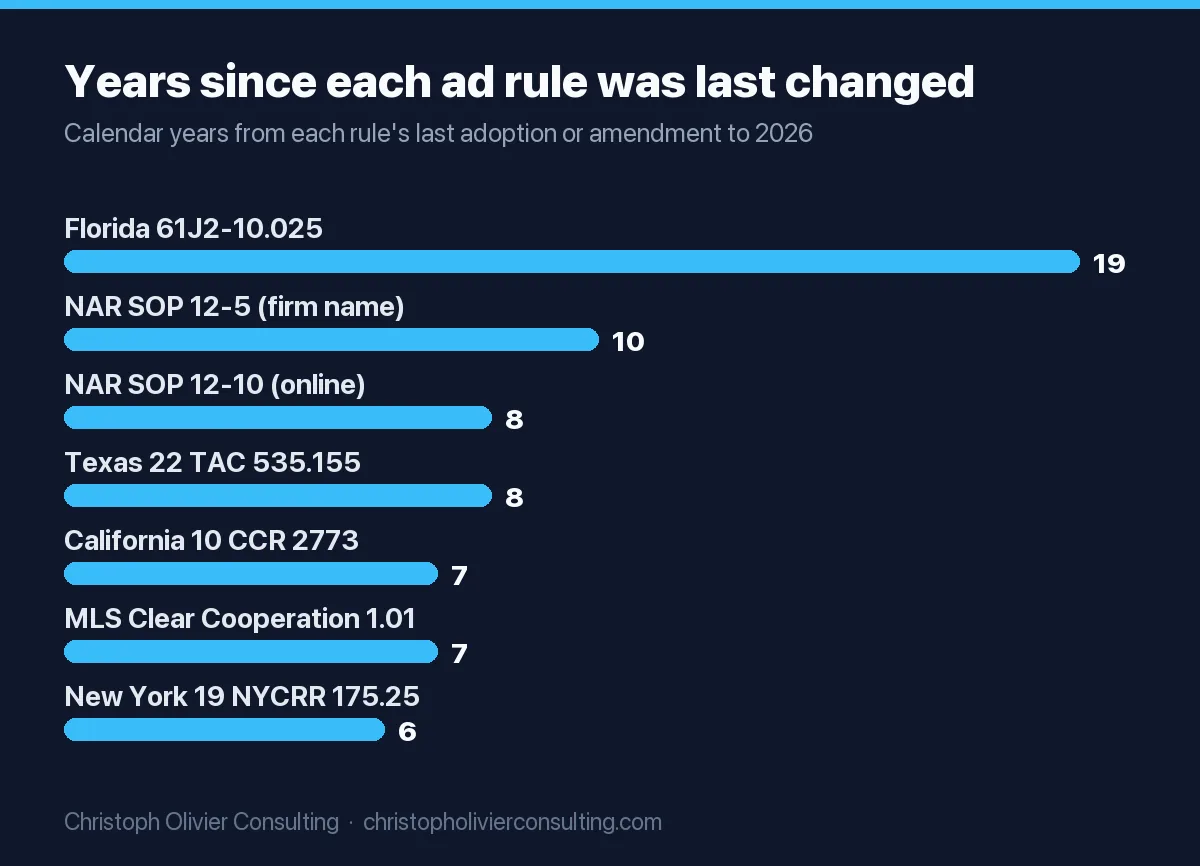
Most of these rules were last rewritten before short-form video and Marketplace listings, which is why online-ad guidance comes mostly from FAQs and interpretations. Dates below are from each rule’s own history note.
| Rule | Last adopted or amended | Years before 2026 | Source |
|---|---|---|---|
| Florida Rule 61J2-10.025 | Feb. 5, 2007 | 19 | Florida Administrative Register |
| NAR Standard of Practice 12-5 (firm name in ads) | Amended 1/16 | 10 | 2026 Code |
| NAR Standard of Practice 12-10 (online true picture) | Amended 1/18 | 8 | 2026 Code |
| Texas 22 TAC 535.155 | Effective Sept. 4, 2018 | 8 | LII, 22 TAC 535.155 |
| California 10 CCR 2773 (license number) | Mar. 28, 2019 | 7 | LII, 10 CCR 2773 |
| MLS Clear Cooperation, Section 1.01 | Adopted 11/19 | 7 | 2025 MLS Handbook |
| New York 19 NYCRR 175.25 | Effective Nov. 2, 2020 | 6 | LII, 19 NYCRR 175.25 |
Until rules catch up, treat the truthfulness and firm-name duties as applying to every new format, which is how Texas and New York already write them.
Pre-publish checklist for real estate ads
Run every ad, post, flyer and listing video through this before it goes live. Each line is pass or fail, and each is tied to a rule above.
| # | Check | Pass if | Source |
|---|---|---|---|
| 1 | Brokerage named | The licensed firm name is in the ad (or on a directly linked profile where your state allows it). In Texas, it is at least half the size of the largest agent or team contact info. | NAR SOP 12-5; TX 535.155; FL 61J2-10.025(1) |
| 2 | Licensee status clear | A reasonable reader knows a licensee placed the ad; license type is accurate (NY) | NAR Art. 12; FL 61J2-10.025(1); NY 175.25(c)(4) |
| 3 | License number | Included if your state requires it (CA: 8-digit number, type no smaller than the smallest used) | 10 CCR 2773 |
| 4 | Authority to advertise | It is your listing, or you hold written consent from the listing broker, or it is a compliant IDX display | NAR SOP 12-4; MLS 2.7; NY 175.25(b)(2) |
| 5 | Listing firm credited | IDX listings name the listing firm and its contact in a reasonably prominent spot | MLS 18.2.12; NY 175.25(d)(6) |
| 6 | Clear Cooperation clock | If this is the first public marketing of your listing, it goes into the MLS within one business day (or the seller signed a delayed marketing disclosure) | MLS 1.01; NAR FAQ 2025 |
| 7 | Claims you can back up | No “free” services if you are paid from any source; incentive terms stated up front; “sold” only if you were a broker in the deal; only credentials you hold | NAR SOP 12-1, 12-3, 12-7, 12-13 |
| 8 | Rates and payments | Any rate is shown as an APR; any trigger term carries the full disclosures; the lender confirmed the terms are available | 12 CFR 1026.24 |
| 9 | Fair housing wording | The ad describes the property and amenities, not the buyers or neighbors | 42 U.S.C. 3604(c); 24 CFR 100.75 |
| 10 | Fair housing targeting | Paid social ads run under the housing Special Ad Category; no audience chosen to exclude a protected group | 24 CFR 100.75(c)(3); Meta policy |
| 11 | Photos and claims current | Status, price and photos match today’s listing; you have rights to every photo | NAR SOP 12-8, 12-10; NY 175.25(b)(2)(iii) |
| 12 | Records kept | A copy of any ad mentioning financing is stored for 24 months | 12 CFR 1014.5 |
If you only fix three things, fix numbers 1, 4 and 9. In my view those cover most of the ad problems agents actually run into: a missing brokerage name, a listing posted without consent, and wording that describes people instead of the house.
What false advertising in real estate looks like
Florida forbids any ad that is “fraudulent, false, deceptive or misleading” (61J2-10.025(1)). Texas lists misleading practices in 535.155(d): material inaccuracies, calling a sales agent a broker, titles like owner or CEO that imply a sales agent runs the brokerage, and value claims without the required disclosures. New York bars naming an area the property is not actually in (175.25(c)(9)). NAR’s Standard of Practice 12-10 covers edited photos, framing and misleading URLs.
Other licensed professions work under the same truthfulness standard: see are lawyers allowed to advertise and are architects allowed to advertise. If you want a second pair of eyes on a brokerage ad program before launch, you can book a consultation, but the final compliance call belongs to your broker and, where needed, a real estate attorney.
Ready to scale your revenue?
Book a free 30-min consultation. We’ll diagnose your growth bottleneck and map out the 3 highest-leverage moves for your business.
Frequently asked questions
What are the rules for real estate advertising?
Four sets of rules apply. Your state license law requires the brokerage name and truthful content. The Fair Housing Act bans ads showing a preference based on race, color, religion, sex, handicap, familial status or national origin. Regulation Z covers any ad that mentions rates or payments. REALTORS also follow NAR Article 12 and their MLS rules, including getting consent before advertising another broker's listing.
Can real estate agents advertise mortgage rates?
Yes, but Regulation Z applies to all persons who advertise credit, not just lenders. A rate must be stated as an annual percentage rate, using that term, and must actually be available. Mentioning a payment amount, down payment or loan term triggers more disclosures: down payment, repayment terms and APR. Regulation N separately bans misleading mortgage claims by any person. Have the lender supply and approve the wording.
Can I advertise another agent's listing on Facebook?
Only with the listing broker's consent. NAR Standard of Practice 12-4 bars advertising property without authority, and the model MLS rule in Section 2.7 bars advertising another participant's listing without the listing broker's prior consent. A compliant IDX display can show other brokers' listings if it names the listing firm and updates at least every 12 hours. Linking to the listing broker's page needs no permission.
Can you advertise real estate without a license?
You can advertise property you own. You cannot advertise yourself as a broker or agent, or market other people's property for pay, without a license. California Business and Professions Code 10130 makes it unlawful to advertise as a broker or salesperson without a license, and Texas Occupations Code 1101.351 bars unlicensed people from representing that they are brokers or sales agents. Fair housing rules still apply to owner ads.
What words can you not use in real estate advertising?
Avoid any words describing who should live there. HUD's 1995 guidance lists examples that create liability, such as white family home, Christian home, no wheelchairs, adults only or limits on children. Describing the property is fine: master bedroom, family room, walk-in closets, jogging trails, wheelchair ramp, quiet streets. Many MLSs and associations now prefer primary bedroom, and state law may add protected classes.
Do real estate agents have to put their license number in ads?
It depends on the state. California requires your eight digit license number on first point of contact materials such as business cards, websites, flyers, online ads and signs that show your name, in type no smaller than the smallest used. Texas does not require a license number but requires the broker's name at least half the size of the largest agent or team contact information. Florida and New York require the brokerage name.
What is false advertising in real estate?
Any ad that gives less than a true picture. Florida bans ads that are fraudulent, false, deceptive or misleading. Texas lists examples such as material inaccuracies, calling a sales agent a broker, or implying a sales agent owns the brokerage. NAR Standards of Practice 12-1, 12-7 and 12-10 ban claiming services are free when you are paid, claiming sold when you were not a broker in the deal, and manipulated images.
Professional advertising rules