

Yes. Dentists in the United States are allowed to advertise, in any medium, including their fees. The American Dental Association’s ethics code opens its advertising section with that exact concession: “Although any dentist may advertise, no dentist shall advertise or solicit patients in any form of communication in a manner that is false or misleading in any material respect” (ADA Code, Section 5.F). The real limits sit in state dental board rules, plus federal rules on reviews and patient privacy.
Short answer: Dentists can run search ads, social ads, TV, mailers and price promotions. What they cannot do is make claims that are false, misleading or unprovable, call themselves a “specialist” without the training in one of the 12 recognized dental specialties, or hide that they are a general dentist when advertising specialty services. States add hard rules on top: Texas requires “General Dentist” next to your name in any ad for a specific service, California bans “as low as” pricing, and Florida bans laudatory statements and requires a 72-hour payment-rights notice on free or discounted offers.
Below: how the bans ended, each rulebook with section numbers, three states side by side, the “specialist” rules, a copy-ready price ad and a pass/fail checklist. This is general information, not legal advice; your state board and a healthcare attorney licensed in your state have the final word.
How dentists went from “unethical to advertise” to “any dentist may advertise”
The modern rules came out of a chain of court and FTC decisions, most of them about competition rather than ethics.
| Year | What happened | Why it matters for dental ads |
|---|---|---|
| 1977 | Bates v. State Bar of Arizona, 433 U.S. 350: the Supreme Court held that lawyers may advertise prices for routine services, calling the belief that lawyers are above “trade” “an anachronism.” | The same First Amendment logic reaches dentistry. |
| 1979 | FTC order against the American Dental Association, reported as American Dental Ass’n, 94 F.T.C. 403 (1979), modified 100 F.T.C. 448 (1982), as listed in the US government’s Supreme Court brief in California Dental Ass’n v. FTC. | The ADA code now says false or misleading is the “sole standard” for judging dental advertising (footnote 3 of the code). |
| 1999 | California Dental Ass’n v. FTC, 526 U.S. 756: the FTC had challenged CDA guidelines that, in practice, blocked ads calling fees “low, reasonable, or affordable,” across-the-board discounts and “all quality claims.” The Court vacated and remanded, saying a fuller analysis was needed. | Associations may police deception, but curbs on truthful price claims draw antitrust scrutiny. |
| 2015 | North Carolina State Board of Dental Examiners v. FTC, 574 U.S. 494: a board controlled by practicing dentists sent “at least 47 official cease-and-desist letters” to non-dentist teeth whiteners. The Court held, 6 to 3, that such a board has no antitrust immunity unless the state actively supervises it. | Boards cannot use enforcement to protect dentists from cheaper competitors. |
| 2017 | American Academy of Implant Dentistry v. Parker, No. 16-50157 (5th Cir.): Texas could not enforce its specialty advertising rule (22 TAC 108.54) against the plaintiffs, who wanted to advertise as specialists in areas the ADA did not then recognize. | Blanket bans on truthful specialty claims are vulnerable. |
| 2024 to 2025 | ADA adds Advisory Opinion 5.F.7 on social media and extends 4.E.1 to influencers (ADA News, February 24, 2025). | Influencer posts now have explicit rules. |
The lawyer side of this story, which started with Bates, is told in our guide on whether lawyers are allowed to advertise. Physicians followed a near-identical path through FTC v. AMA, covered in are doctors allowed to advertise.
The rulebooks that govern dental advertising
Four layers stack, and the strictest one that applies to you wins. In practice, that is usually your state board.
| Source | Who it binds | What it says about ads | Section |
|---|---|---|---|
| ADA Principles of Ethics and Code of Professional Conduct (advisory opinions revised to October 2024) | ADA members; many state rules borrow its wording | Any dentist may advertise; nothing false or misleading in a material respect; specialty claims limited to recognized specialties; general dentists must say so; fee splitting with marketers banned. | 5.F, 5.F.1 to 5.F.7, 5.G, 5.H, 5.I, 4.E.1 |
| State dental practice act and board rules | Every licensee in that state | Price disclosures, “General Dentist” labels, before and after photos, awards, gifts for referrals, record keeping. See the state table below. | e.g., 22 TAC 108.50 to 108.63 (TX); Cal. Bus. & Prof. Code 651; Fla. Admin. Code 64B5-4 |
| FTC Rule on Consumer Reviews and Testimonials | Every business | No fake reviews, no reviews bought for a particular sentiment, insider reviews must disclose the relationship, no suppressing negative reviews. | 16 CFR 465.2, 465.4, 465.5, 465.7 |
| HIPAA Privacy Rule | Every dental practice that is a covered entity | You cannot disclose patient information in ads or in replies to reviews without authorization. Enforced by HHS OCR. | Enforced by HHS OCR (see the review cases below) |
Civil penalties for knowingly violating an FTC trade regulation rule such as Part 465 are listed at $53,088 per violation in 16 CFR 1.98(d). A state board’s tools are different: in California, a violation of Section 651 “is guilty of a misdemeanor” and is “good cause for revocation or suspension” of the license (Cal. Bus. & Prof. Code 651(f) and (g)).
What the ADA Code says about advertising, opinion by opinion
The practical rules live in the advisory opinions under 5.F. Paraphrased from the ADA’s Veracity section and the current full code PDF:
- 5.F.1 Published communications. A health article or newsletter under your byline must truthfully disclose its source and authorship. Ghostwritten “Dr. Smith explains” content without that disclosure is treated as misleading.
- 5.F.2 Examples of “false or misleading.” Avoid statements that misstate a fact, omit a fact needed to avoid misleading, create “an unjustified expectation about results the dentist can achieve,” or claim superior quality without “reasonable substantiation.” The test is the ad “taken as a whole.”
- 5.F.3 Unearned, nonhealth degrees. Use Doctor, Dentist, DDS, DMD or earned health degrees. Honorary degrees, degrees from unaccredited schools and membership fellowships “should be limited to scientific papers and curriculum vitae.”
- 5.F.4 Referral services. Paying for advertising is fine; paying a commercial referral service per patient referred is misleading and fee splitting.
- 5.F.5 Infectious disease test results. Partial truths that create a false impression are misleading, such as advertising negative HIV test results without saying the test “cannot guarantee that I am currently free of HIV.”
- 5.F.6 Websites and SEO. SEO is allowed; your site must be as truthful as any other announcement.
- 5.F.7 Social media. Claims that a product or service is safe and effective need scientific support, whether posted by you or “via a dental influencer.” The code gives three examples of unethical posts: endorsing a product as superior without evidence, unsupported claims about fluoride safety and efficacy, and holistic “remove toxic substances from the body” claims. Anyone endorsing a product “must disclose any paid partnerships with vendors.”
One neighbouring rule matters just as much. 4.E.1 says paying a marketing vendor “a specific amount or percentage of professional fees collected” from patients is fee splitting, and this “includes ‘social media coupons’ and ‘social media influencers.'” A fee set in advance, such as a flat monthly retainer, avoids the problem.
Dental advertising rules by state: Texas, California and Florida compared
These three states show the range. Texas writes the most detailed rules, California focuses on prices and photos, and Florida bans categories of claims that other states allow. Each cell is paraphrased from the official text linked in the header row.
| Topic | Texas (22 TAC 108.50 to 108.63) | California (B&P Code 651) | Florida (64B5-4 and Fla. Stat. 466.0282, 456.062) |
|---|---|---|---|
| Price ads | Must name the service, related services usually needed, that the fee is a minimum, the dates it is available, and the standard fee when discounted (108.53(c)). | Must be “exact,” no “as low as,” “and up,” “lowest prices”; price for each service “clearly identifiable” (651(c)). | Must say the fee is a minimum; state a period or keep the price for 90 days after the last ad; name the procedure by exact ADA CDT wording or code number (64B5-4.003). |
| Free or discounted offers | Cannot call a service “free” when a third-party payor such as Medicaid pays (108.53(d)(5)); cannot imply free when the fee is built into a companion procedure (108.57(c)(13)). | No misleading “bait, discount, premiums, gifts” (651(c)). | Must print in capitals the patient’s right to refuse or be reimbursed for any other service within 72 hours of responding to the ad (456.062). |
| Quality and superiority claims | Banned: implying superiority, unsubstantiated comparisons, “without pain or discomfort” claims (108.57(c)(4) to (6)). | Allowed only if relevant and “substantiated with objective scientific evidence” (651(b)(6)). | Banned: “laudatory statements” and claims about quality compared with other dentists; laser ads cannot say “painless” or “heals faster” (64B5-4.002(3)). |
| Before and after photos | Actual patients of record only, written consent if identifiable, plus “Actual results may vary” (108.57(d)). | Must state the procedures performed, be comparable in pose and lighting, and say results may not occur for all patients; models must be labeled (651(b)(3)). | Covered by the general ban on ads likely to create unjustified expectations (64B5-4.002(3)(d)). |
| Testimonials | Only from patients of record, verifiable, with identity and credential disclosures (108.57(c)(8)). | No testimonial that misleads by omitting material facts (651(b)(8)). | Covered by the general deception rules; laudatory content is banned. |
| General dentists advertising specialty services | “General Dentist” or “General Dentistry” right after the name, in a font no smaller than the largest service term; audible in broadcast ads (108.55(b)). | May state certification by a board or that practice is limited to specific fields (651(h)(5)(A)). | Non-recognized practice emphasis needs a capitalized “IS NOT RECOGNIZED AS A SPECIALTY AREA” disclaimer (466.0282(3)). |
| Awards and “top dentist” claims | Must name the year and awarding organization; paid-for inclusion is deceptive; no crediting one dentist’s award to the whole practice (108.62). | No award-specific rule; any superiority claim needs objective scientific evidence (651(b)(6)). | Likely a banned laudatory statement (64B5-4.002(3)(c)). |
| Solicitation and referral gifts | No paying third parties for patients; non-cash gift to a prospective patient capped at $10; marketing fees must be set in advance at fair market value, not per referral (108.58). | Must disclose any payment to media for “professional publicity” (651(d)). | In-person and telephone solicitation by a dentist or agent is prohibited, except scheduling and follow-up with patients (64B5-4.002(4)). |
| Identification and records | Full licensed name disclosed (108.52); website should show owner, services, addresses, licensure (108.59); keep copies of every ad for 4 years (108.60). | Applies to “mail, television, radio,” directories and the “Internet” (651(a)). | Every ad must identify the responsible Florida licensee by license number, or by name plus address and phone (64B5-4.002(2)). |
Texas text is from the Cornell LII mirror (most sections effective May 1, 2013; 108.54 and 108.55 amended in 2021). Florida’s main rule was last amended in 2006. Check your board’s site for newer changes.
Can dentists call themselves specialists?
Only in one of the recognized specialties, and only with the training. The ADA Code’s Section 5.H lets a dentist “announce as a specialist” in the specialties recognized by the National Commission on Recognition of Dental Specialties and Certifying Boards: dental anesthesiology, dental public health, endodontics, oral and maxillofacial pathology, oral and maxillofacial radiology, oral and maxillofacial surgery, oral medicine, orofacial pain, orthodontics and dentofacial orthopedics, pediatric dentistry, periodontics and prosthodontics. That is 12. The educational bar is a CODA-accredited program “two or more years in length” or diplomate status from a recognized certifying board. Texas lists the same 12 areas in 22 TAC 108.54(b).
Three wording rules follow from 5.H and 5.I:
- Specialists “should use ‘specialist in'” and may say their practice “is limited to” the specialty only if it is devoted exclusively to it.
- General dentists may announce any service they provide, but must avoid anything that expresses or implies specialization and “shall also state that the services are being provided by general dentists.”
- A credential in a non-recognized area (implants, cosmetic, sleep) may be advertised only if the credential required a full-time program of at least 12 months plus oral and written exams, and the ad says “[area] is not recognized as a specialty area by the National Commission on Recognition of Dental Specialties and Certifying Boards” (5.I.1).
Courts have pushed back on stricter versions. In AAID v. Parker, the Fifth Circuit found the plaintiffs’ proposed specialty ads “not inherently misleading” and held Texas had not shown the harms it cited were real, while noting that “Our holding neither forbids nor approves the enactment of a similar regulation supported by better evidence.” The ruling applied to those plaintiffs, not to every dentist, so treat the board’s rules as live until your attorney says otherwise.
Specialist wording: a decision table
| Your situation | OK to say | Do not say | Rule |
|---|---|---|---|
| Completed a 2+ year CODA orthodontic residency, practice is ortho only | “Specialist in orthodontics,” “Practice limited to orthodontics” | “Board certified” unless you hold diplomate status from the recognized board | ADA 5.H; TX 108.54(c) |
| General dentist who places implants | “Jane Doe, DDS, General Dentist. Services: implants, crowns, cleanings.” | “Implant specialist,” “specializing in implants” | ADA 5.I; TX 108.55 |
| General dentist with a qualifying 12-month credential in a non-specialty area | The credential, plus “general dentist” and the “is not recognized as a specialty area” sentence | The credential on the same line as your name, or an acronym without its definition (Texas) | ADA 5.I.1; TX 108.56(b); FL 466.0282(3) |
| General dentist with an honorary or membership fellowship | Keep it to your CV and scientific papers | Fellowship letters after your name in ads | ADA 5.F.3 |
| Multi-doctor practice with one periodontist and three general dentists | Name the periodontist as the specialist | “Our specialists” for the whole team | ADA 5.H (burden on the specialist); TX 108.54(d) |
What dentists are not allowed to advertise
These claims are prohibited, or close to it, under the sources above.
- Guarantees of results. “Perfect smile guaranteed” creates unjustified expectations (ADA 5.F.2(c); TX 108.57(c)(7)). Texas does allow a money-back guarantee if the patient is not satisfied.
- “Pain-free” and “best dentist in town.” TX 108.57(c)(4) and (5); FL 64B5-4.002(3)(e) and (f); ADA 5.F.2(d); Cal. 651(b)(6) unless scientifically substantiated.
- “Sleep dentistry” in Florida unless you hold a general anesthesia permit (64B5-4.002(7)).
- Amalgam removal or detox claims. The ADA treats removing amalgam from non-allergic patients “for the alleged purpose of removing toxic substances from the body” on the dentist’s recommendation alone as unethical (5.A.1), and 5.F.7 extends this to social posts.
- Edited or model photos presented as results. Cal. 651(b)(3) bans altered images and unlabeled models.
- Fake, bought or filtered reviews. 16 CFR 465.2, 465.4 and 465.7.
- Patient details in review replies. HHS OCR settled with Elite Dental Associates in Dallas for $10,000 in 2019 over disclosures in response to social media reviews, and with New Vision Dental in California for $23,000 in 2022 after it disclosed “patient names, treatment, and insurance information” in replies to online reviews. Both also took corrective action plans.
Can dentists advertise prices and discounts?
Yes, and the FTC has fought for the right to do it. The Commission’s case against the California Dental Association targeted rules that, in its findings, “precluded advertising that characterized a dentist’s fees as being low, reasonable, or affordable” and “precluded advertising of across the board discounts” (526 U.S. 756). The state rules control the format. A single promotional line that works in all three states looks like this.
Worked example: one new-patient price ad, three states
The offer: an adult new-patient visit for $99, which normally costs $245, running March 1 to May 31.
| Element | Copy | Required by |
|---|---|---|
| Exact services, by CDT code | “Comprehensive oral evaluation [CDT code], adult prophylaxis [CDT code], bitewing radiographs [CDT code]” using the exact CDT nomenclature or code numbers | FL 64B5-4.003(4); TX 108.53(c)(1) |
| Exact price and standard fee | “$99. Our standard fee for these services is $245.” | Cal. 651(c); TX 108.53(c)(5), (d)(4) |
| Minimum fee notice | “This is a minimum fee. Charges may increase depending on the treatment required.” | TX 108.53(c)(3); FL 64B5-4.003(2) |
| Related services | “Patients with gum disease may need periodontal treatment at an additional fee.” | TX 108.53(c)(2) |
| Dates | “Offer valid March 1 to May 31.” | TX 108.53(c)(4); FL 64B5-4.003(3), (5) |
| Payment limits | “Discount applies to cash payment only.” (only if true) | TX 108.53(c)(5) |
| Florida 72-hour notice, in capitals | “THE PATIENT AND ANY OTHER PERSON RESPONSIBLE FOR PAYMENT HAS A RIGHT TO REFUSE TO PAY, CANCEL PAYMENT, OR BE REIMBURSED FOR PAYMENT FOR ANY OTHER SERVICE, EXAMINATION, OR TREATMENT THAT IS PERFORMED AS A RESULT OF AND WITHIN 72 HOURS OF RESPONDING TO THE ADVERTISEMENT FOR THE FREE, DISCOUNTED FEE, OR REDUCED FEE SERVICE, EXAMINATION, OR TREATMENT.” | Fla. Stat. 456.062 |
| Who is responsible | “Jane Doe, DDS, General Dentist, [address], [phone]” | FL 64B5-4.002(2); TX 108.52, 108.55 |
What fails: “Cleanings from $49,” “Lowest prices in Austin,” or “Free exam” when Medicaid pays. In Florida, without stated dates the price must hold for 90 days after the last ad.
Testimonials, reviews and influencers
All allowed, with conditions (Texas specifics are in 108.57(c)(8) and (d)). Under the FTC rule you may ask every patient for a review, but you may not offer anything “conditioned expressly or by implication” on a positive one (16 CFR 465.4), and a manager or owner who writes a review must clearly disclose the relationship (465.5). Hiding negative reviews while implying you show them all is suppression (465.7).
For influencers, the ADA rule is two lines long: disclose paid partnerships (5.F.7), and do not pay them a percentage of the fees collected from the patients they send (4.E.1). Texas says the same thing in legal terms: marketing pay must be “set in advance,” at “fair market value,” and “not based on the volume or value of any patient referrals” (108.58(c)). If you run a patient referral program, Texas caps a non-cash gift to a prospective patient at $10 and allows rewards to existing patients of record; our dental office referral program guide covers program design.
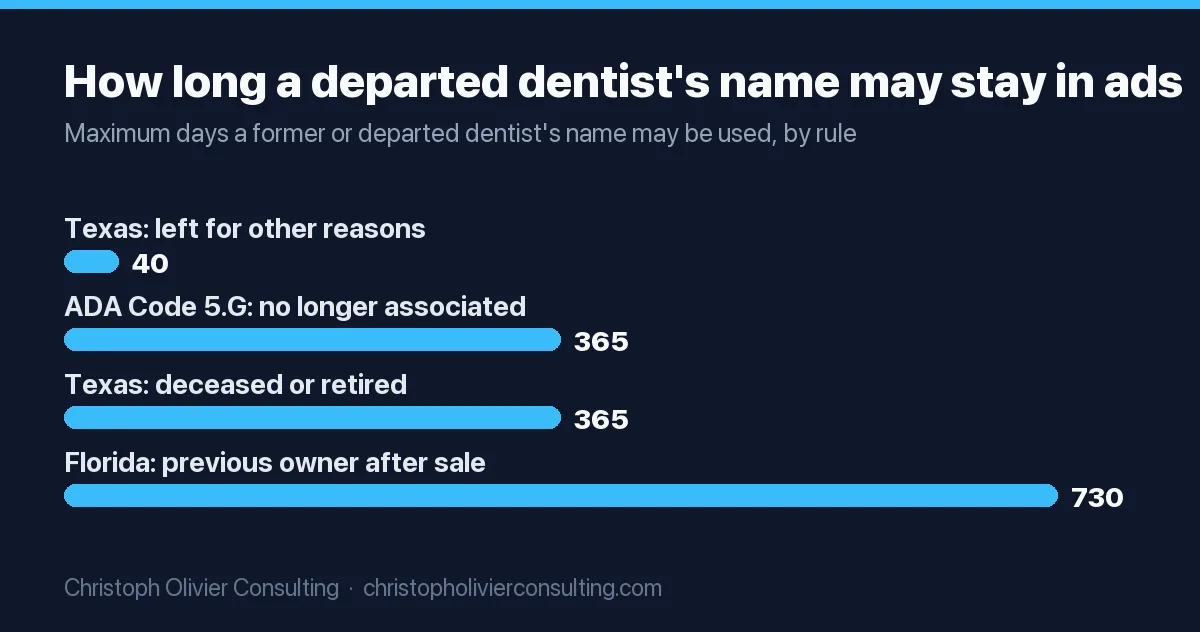
How long can a former dentist’s name stay in your ads?
| Situation | Limit | Source |
|---|---|---|
| Texas: dentist left for any reason other than death or retirement | 40 days | 22 TAC 108.52(b)(3) |
| ADA Code: dentist no longer actively associated | 1 year (longer with permission and prominent retirement notice) | ADA 5.G and 5.G.1 |
| Texas: deceased or retired dentist | 1 year | 22 TAC 108.52(b)(3) |
| Florida: previous owner after a practice sale | Up to 2 years, with written permission | 64B5-4.002(5) |
Can non-dentists advertise teeth whitening?
That was the fight in NC State Board of Dental Examiners v. FTC. After dentists complained that non-dentists “were charging lower prices for such services than dentists did,” the board’s letters and related actions drove non-dentist whiteners out of North Carolina. The Supreme Court held the dentist-controlled board had no antitrust immunity without active state supervision. For practice marketers, expect spas and kiosks to compete for the same whitening searches, and compete on the ad, not through the board.
How dentists advertise within the rules
None of these rules restrict channels: search ads, local SEO, social, mailers and radio are all fine. The rules shape the words. For channel strategy, see our dental marketing guide, and for spend levels, the dental office marketing budget breakdown. To see how real practices put these rules into creative, read dental advertising examples. The same questions for animal health are answered in are vets allowed to advertise.
Dental ad approval checklist (pass/fail)
Paste this into your approval workflow. One fail means the ad does not run.
- Identity. The licensed dentist’s full name appears, plus license number or address and phone in Florida. Fail: practice brand only.
- Status. Every ad for a specific service by a general dentist carries “General Dentist,” in Texas at least as large as the biggest service word. Fail: “IMPLANTS” in 40pt and no status line.
- Specialist wording. “Specialist” appears only for a dentist trained in one of the 12 recognized specialties. Fail: “cosmetic specialist.”
- Credentials. Only earned degrees and qualifying credentials, with definitions and disclaimers. Fail: honorary fellowship letters after the name.
- Prices. Exact price, named services or CDT codes, minimum-fee notice, dates, standard fee for discounts. Fail: “from $49” or “as low as.”
- Free offers. Florida 72-hour notice in capitals; nothing called free when a payor is billed. Fail: “free exam” with the notice in a footnote link.
- Claims. No guarantees, “pain-free,” “best,” or uncited comparisons. Fail: “the gentlest dentist in Tampa.”
- Photos. Real patients of record, written consent, procedures named, same lighting and pose, “Actual results may vary.” Fail: stock smile with no model label.
- Awards. Year and awarding organization named, no paid inclusion, credited to the right dentist. Fail: “Top Dentist” with no year or source.
- Reviews and influencers. Review requests go to everyone, no reward tied to stars, paid partnerships disclosed in the post, flat-fee vendor pay. Fail: “$25 credit for a 5-star review” or a vendor paid 10% of collections.
- Privacy. Review replies contain no patient details. Fail: “As we discussed at your crown appointment…”
- Records. A copy of the ad is filed with its run dates. Texas requires 4 years. Fail: no archive.
My view: items 2, 5 and 10 cause most of the trouble because nobody reads the fine print until a board does. If you want a second pair of eyes on a dental campaign before launch, you can book a consultation.
Ready to scale your revenue?
Book a free 30-min consultation. We’ll diagnose your growth bottleneck and map out the 3 highest-leverage moves for your business.
Frequently asked questions
Are dentists allowed to advertise?
Yes. The ADA Code, Section 5.F, says any dentist may advertise as long as nothing is false or misleading in any material respect, and the code's footnote makes that the sole standard. State dental boards add specific rules on prices, specialist claims, photos and testimonials, and federal FTC and HIPAA rules govern reviews and patient information.
Can dentists call themselves specialists?
Only in one of the 12 specialties recognized by the National Commission on Recognition of Dental Specialties and Certifying Boards, such as orthodontics, endodontics or periodontics, and only after a CODA-accredited program of two or more years or diplomate status. General dentists may list specialty services but must say they are general dentists and avoid implying specialization (ADA 5.H and 5.I).
What does the ADA code say about advertising?
Section 5.F bans advertising that is false or misleading in a material respect. Its advisory opinions cover bylined articles (5.F.1), examples such as unjustified expectations and unsubstantiated superiority claims (5.F.2), unearned degrees (5.F.3), referral services (5.F.4), test results (5.F.5), websites and SEO (5.F.6) and social media and influencers (5.F.7).
Can dentists advertise prices and free exams?
Yes, with state format rules. California requires exact prices and bans phrases like 'as low as' and 'and up.' Texas requires the service, a minimum-fee notice, the dates and the standard fee for discounts. Florida requires a capitalized 72-hour payment-rights statement on any free or discounted offer and CDT wording or codes for priced services.
What are dentists not allowed to advertise?
Common prohibitions include guarantees of results, 'pain-free' claims, unprovable 'best dentist' claims, specialist titles without qualifying training, honorary or membership fellowships presented as qualifications, altered or unlabeled model photos, fake or bought reviews, and any patient information in replies to online reviews. Florida also bans laudatory statements and 'sleep dentistry' without a general anesthesia permit.
Can dentists use patient testimonials and reviews in ads?
Yes. Texas allows testimonials from actual patients of record, with written consent before identifying anyone and 'Actual results may vary' on patient photos. Under the FTC's 16 CFR Part 465 you may ask all patients for reviews but cannot reward positive ones, owners and managers must disclose their relationship, and suppressing negative reviews is banned.
What is the dentist 2 year rule in advertising?
In dental advertising rules, the written two-year limit is Florida's: after a practice sale, the new owner may identify the previous owner in advertising for up to 2 years, and only with that dentist's written permission (Fla. Admin. Code 64B5-4.002(5)). By comparison, the ADA Code allows a departed dentist's name for one year and Texas allows 40 days after most departures.
Professional advertising rules