
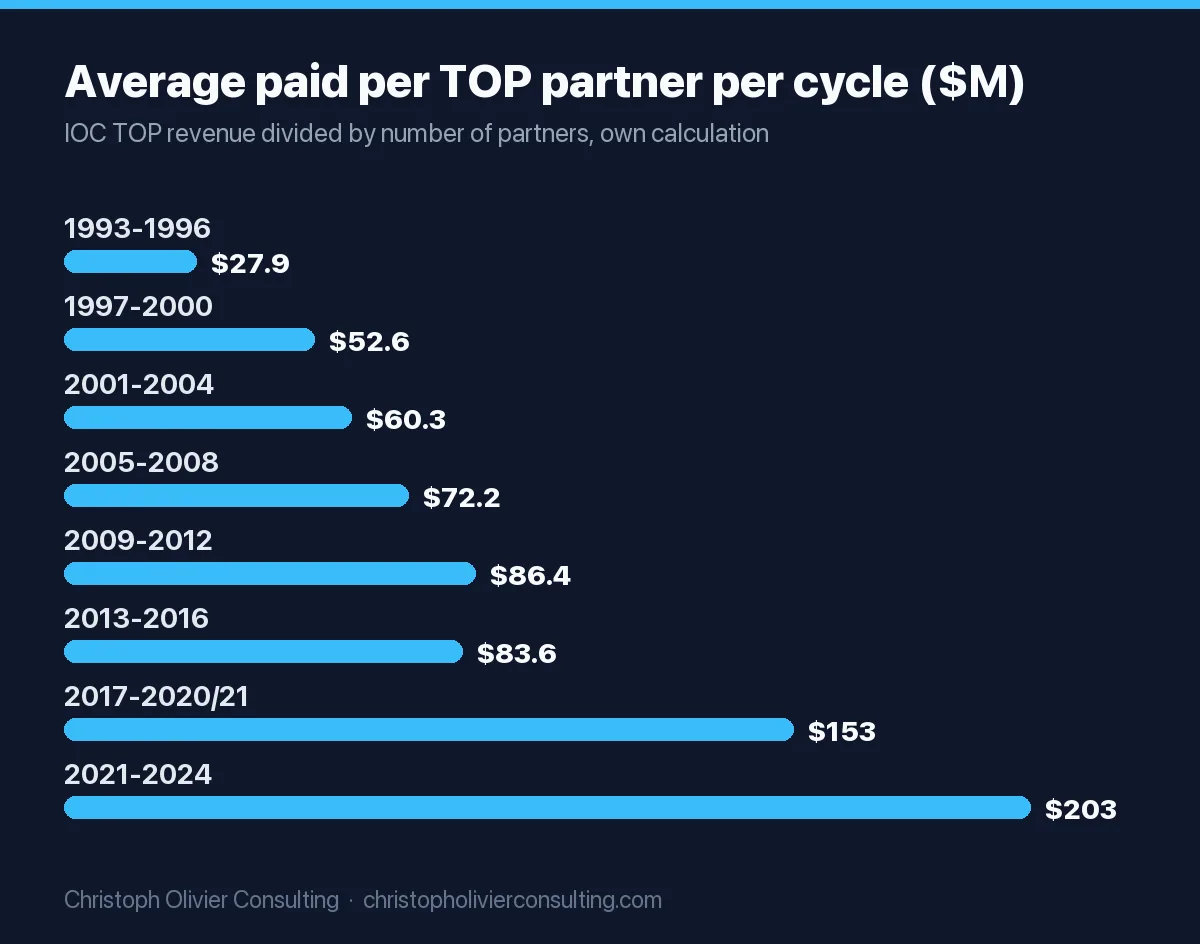
A worldwide Olympic sponsorship (the IOC’s TOP Programme) costs roughly $200 million per partner for each four-year cycle. That is not a rate card: the IOC never publishes prices. It is what the IOC’s own numbers imply. Fifteen TOP partners generated $3.04 billion for 2021 to 2024, which works out to about $203 million each. Single-deal figures you see in the press (Toyota $835 million, Coca-Cola and Mengniu up to $3 billion) are reported, not disclosed, and usually cover two or three cycles. Below: the TOP revenue history with a per-partner average, every reported deal value with its source, what LA28 charges domestic sponsors, and the Rule 40 rules that decide what a non-sponsor can do.
Short answer: A global TOP partnership averaged about $203 million per partner for the 2021 to 2024 Olympiad (own calculation from the IOC’s $3.04 billion TOP revenue across 15 partners), paid in cash plus goods and services. Reported long-term deals run from about $500 million (Airbnb, through 2028) to $835 million (Toyota, 2017 to 2024) and $815 million (Alibaba, through 2028, disclosed in an SEC filing). Domestic LA28 sponsorships are sold separately; LA28 passed $2 billion in sponsorship revenue in December 2025.
Olympic sponsorship cost by tier: who sells what
There is no single “Olympic sponsorship.” Four different organizations sell four different products, and the price gap between them is enormous. Use this table to find the one you are actually asking about.
| Tier | Who sells it | What you get | Cost | Source |
|---|---|---|---|---|
| Worldwide Olympic Partner (TOP) | IOC | Exclusive global rights in one product category: IOC, all active NOCs and their teams, every Games in the term | About $203 million per partner per 4-year cycle, 2021 to 2024 (own calculation, average) | IOC Olympic Marketing Fact File, July 2025 |
| Host-country domestic partner (LA28 Founding Partner, Official Partner, Official Supporter) | Organizing committee (LA28, with USOPC through U.S. Olympic & Paralympic Properties) | Rights in the host country only, plus Team USA | Not disclosed per deal. 2019 list price for an LA28 Founding Partner reported at $400 million, split 50/50 with NBC airtime | Sports Business Journal, 2019 |
| Licensee | Organizing committee | Right to put Games marks on approved products, category-specific and time-bound | Royalty terms not published | LA28, 2026 |
| Athlete personal sponsor | The athlete (with USOPC Rule 40 permission) | Use of one athlete’s name and image, no Olympic marks | Negotiated privately, no public benchmark | USOPC Rule 40 guidance |
How much does it cost to be an Olympic sponsor? The TOP numbers since 1985
The IOC publishes total TOP revenue and the number of partners for every Olympiad in its Olympic Marketing Fact File (2025 edition). Divide one by the other and you get the closest thing to a public price: the average a TOP partner paid per cycle. The IOC notes these figures include goods and services counted at contract value, so a partner like Omega or Alibaba pays partly in timing systems or cloud services, not only cash.
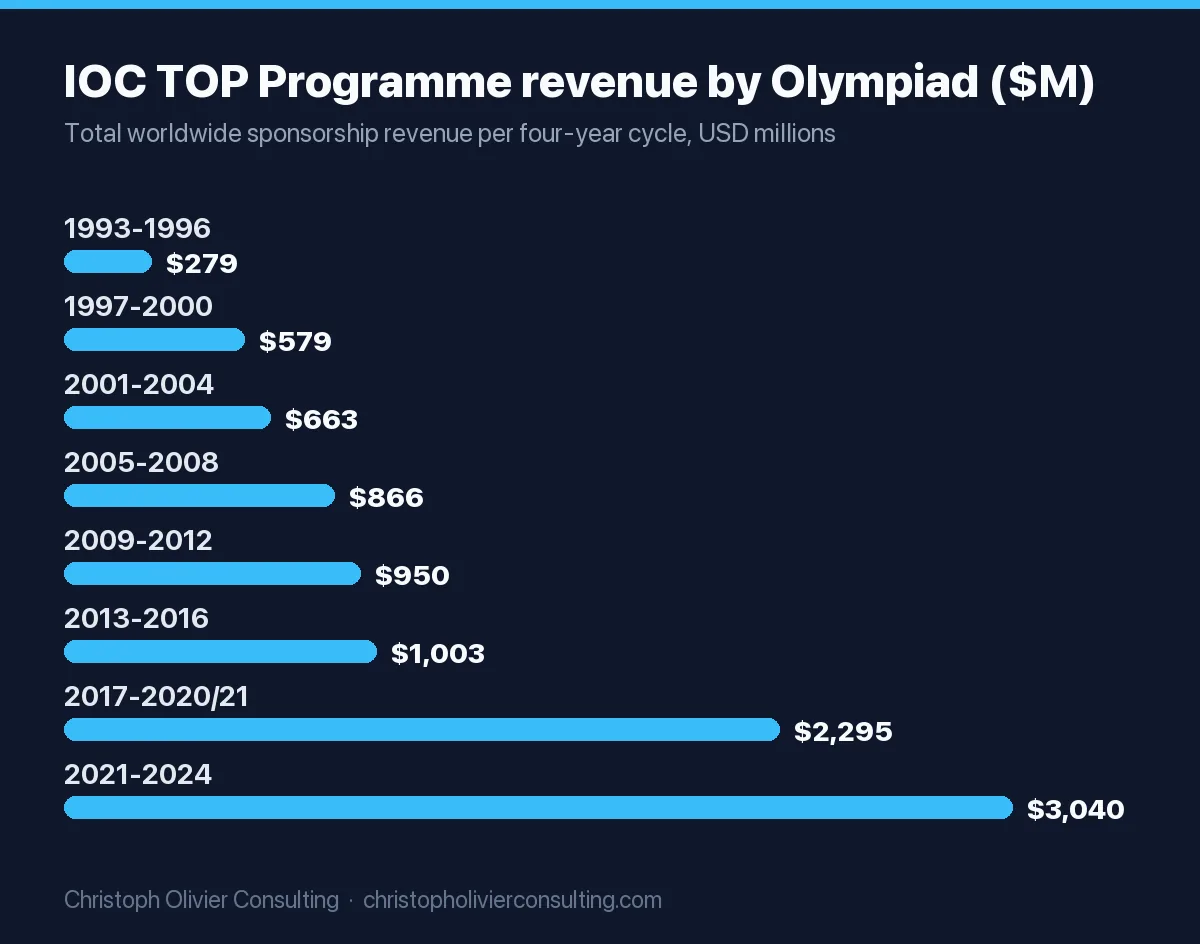
| Olympiad | Games | TOP partners | TOP revenue (USD millions) | Average per partner per cycle (own calc.) | Average per partner per year (own calc.) |
|---|---|---|---|---|---|
| 1985 to 1988 | Calgary / Seoul | 9 | 96 | $10.7M | $2.7M |
| 1989 to 1992 | Albertville / Barcelona | 12 | 172 | $14.3M | $3.6M |
| 1993 to 1996 | Lillehammer / Atlanta | 10 | 279 | $27.9M | $7.0M |
| 1997 to 2000 | Nagano / Sydney | 11 | 579 | $52.6M | $13.2M |
| 2001 to 2004 | Salt Lake City / Athens | 11 | 663 | $60.3M | $15.1M |
| 2005 to 2008 | Torino / Beijing | 12 | 866 | $72.2M | $18.0M |
| 2009 to 2012 | Vancouver / London | 11 | 950 | $86.4M | $21.6M |
| 2013 to 2016 | Sochi / Rio | 12 | 1,003 | $83.6M | $20.9M |
| 2017 to 2020/21 | PyeongChang / Tokyo | 14 to 15 | 2,295 | $153.0M to $163.9M | $38.2M to $41.0M |
| 2021 to 2024 | Beijing / Paris | 15 | 3,040 | $202.7M | $50.7M |
Source: IOC Olympic Marketing Fact File, July 2025 (TOP Programme Evolution table). Averages are our own calculation: revenue divided by partners, then by four years. They assume every partner paid the same, which is not true; real deals vary by category and term. Tokyo 2020 was held in 2021, so that Olympiad ran about five years.
Three things stand out. The average more than doubled from $83.6 million to at least $153 million between the Rio and Tokyo cycles, the cycle in which Toyota’s and Alibaba’s long-term deals began. It then rose another 32.5% for 2021 to 2024, which the IOC itself highlights. And the per-year figure, about $51 million, is the useful one if you are comparing against an annual budget line such as a Super Bowl commercial or a Formula 1 team deal.
The rights fee is also only the entry ticket. A TOP partner still pays separately for advertising on Olympic broadcasts, hospitality, athlete deals and activation. The IOC’s figures do not include any of that.
TOP Olympic partners for 2025 to 2028
The IOC’s 2025 Fact File lists 11 TOP partners for 2025 to 2028. In April 2026 JPMorganChase became the twelfth, the first banking partner in Olympic history. LA28’s partner page lists the same 12 as Worldwide Partners (AB InBev appears under its Michelob Ultra brand).
| Partner | Exclusive category | In TOP since | Deal value |
|---|---|---|---|
| Coca-Cola and Mengniu (joint) | Non-alcoholic beverages and dairy | Coca-Cola 1986 (charter partner); joint deal 2019, runs to 2032 | Not disclosed; reported up to $3 billion combined incl. media |
| Visa | Payment services, transaction security, pre-paid cards | 1986 (charter partner) | Not disclosed |
| Samsung | Wireless communications and computing equipment | 1997 | Not disclosed |
| Procter & Gamble | Personal care, healthcare and household care | 2010 | Not disclosed |
| Alibaba | Cloud infrastructure, cloud services, e-commerce platform | 2017 | At least $815 million through 2028 (SEC filing) |
| Omega | Timepieces, timing, scoring and venue results | 2003 | Not disclosed |
| Airbnb | Unique accommodation and experiences | 2019 | Reported about $500 million through 2028 |
| Allianz | Insurance | 2021; extended to 2032 in 2025 | Not disclosed |
| Deloitte | Management and business consulting | 2022 | Not disclosed |
| AB InBev | Non-alcoholic and alcoholic beers | 2024; extended to 2032 in 2025 | Not disclosed |
| TCL | Home audiovisual equipment and home appliances | 2025 | Not disclosed |
| JPMorganChase | Asset and wealth management, private, commercial and investment banking | 2026, covers LA28 and French Alps 2030 | Not disclosed |
Sources: categories and start years from the IOC Fact File (2025); extensions and TCL from the IOC Annual Report 2025; JPMorganChase from its April 2026 release. Deal values: see the next section.
Who left matters as much as who joined. Toyota, Bridgestone and Panasonic all ended their TOP contracts after Paris 2024, AP reported; Panasonic had been in since 1987. Atos and Intel, both on the 15-partner Paris roster, are not on the 2025 to 2028 list. The effect shows in the IOC’s books: TOP revenue recognized in 2025 was $560.0 million, against $871.5 million in Games year 2024 (IOC Annual Report 2025, note 17). Part of that drop is timing, since revenue tied to a Games is recognized around that Games, but fewer partners means a smaller pool.
Reported TOP deal values, converted to cost per year and per Games
Headline numbers mislead because they cover different terms. A 12-year deal and an 8-year deal cannot be compared until you divide by years and by Games. This is our own worked comparison, using only figures from the cited sources.
| Deal | Reported or disclosed value | Term and Games covered | Per year (own calc.) | Per Games (own calc.) | Source |
|---|---|---|---|---|---|
| Alibaba | At least $815 million in cash, cloud services and marketing support (disclosed) | 2017 to 2028, 12 years, 6 Games | $67.9M | $135.8M | Alibaba financial statements filed with the SEC, FY2017 |
| Toyota | $835 million (reported by Japanese media, via AP) | 2017 to 2024, 8 years, 4 Games | $104.4M | $208.8M | AP via Spokesman-Review, 2015 |
| Coca-Cola and Mengniu | About $1.5 billion sponsorship, up to $3 billion with media spend (reported by the Financial Times) | 2021 to 2032, 12 years, 6 Games | $125M fee; $250M all-in | $250M fee; $500M all-in | Financial Times via Irish Times, 2019 |
| Airbnb | About $500 million incl. value of services such as athlete housing (reported by the Financial Times) | 2019 to 2028, 5 Games | About $55.6M over 9 years | $100M | Financial Times via Irish Times, 2019 |
| Bridgestone, Panasonic | $200 million to $250 million per four-year cycle (reported by the Financial Times) | One Olympiad | $50M to $62.5M | $100M to $125M | Financial Times via Irish Times, 2019 |
| JPMorganChase (TOP plus LA28 Founding Partner) | Not disclosed. Comparable single-quadrennium global plus founding deals have sold for around $200 million, per Sports Business Journal | LA28 and French Alps 2030, 2 Games | Not disclosed | Not disclosed | Deseret News, 2026 |
| Pre-2015 benchmark | About $100 million for a four-year TOP deal, $200 million for eight years (AP) | One or two Olympiads | About $25M | About $50M | AP via Spokesman-Review, 2015 |
Own calculation: value divided by contract years and by number of Games in the term. Assumes even payments, which real contracts rarely use. Airbnb’s 9 years count from its November 2019 signing to 2028. All figures nominal, not inflation-adjusted.
The pattern lines up with the IOC average. Once you normalize, most recent TOP deals land between roughly $50 million and $105 million a year. Alibaba is the only one in the table backed by a regulatory filing rather than a press leak, which makes its $815 million the most reliable single number in the public record.
How much did Coca-Cola pay to sponsor the Olympics?
Coca-Cola has never disclosed it. “We do not discuss the financial aspects of our sponsorship,” a company spokesperson told Fox Business in 2019. What is on the record:
- The current deal: a joint TOP agreement with China Mengniu Dairy signed in 2019, running 2021 to 2032 across six Games. The Financial Times reported the sponsorship itself was worth up to $1.5 billion and the overall commitment closer to $3 billion once media spending with Olympic broadcasters is included.
- The split with Mengniu has not been reported. The $3 billion is a combined figure for both companies.
- The history: Coca-Cola has been at every Games since Amsterdam 1928 and in the TOP Programme since its start in 1986, per the IOC Fact File. LA28 says the company will mark 100 years of partnership in 2028.
Own calculation on the reported numbers: $1.5 billion over 12 years is $125 million a year in rights fees for the two companies together, about 2.5 times the 2021 to 2024 TOP average of $50.7 million a year. That premium buys two categories (beverages and dairy) instead of one. For how the Olympics fit into Coca-Cola’s total advertising budget, see our breakdown of big brand marketing budgets.
LA28 sponsorship cost: the domestic tiers
Host organizing committees sell their own sponsorships in categories the TOP partners do not own, valid in the host country only. For LA28 these are sold jointly with Team USA. On December 4, 2025 LA28 said it had passed $2 billion in domestic sponsorship revenue (Reuters). The Los Angeles Times reported the goal is $2.52 billion, the largest line in an estimated $7.15 billion budget (Reuters puts the budget at about $6.9 billion). The IOC adds a contribution of $1.8 billion to LA28.
| LA28 tier | Examples listed by LA28 (November 2026) | Price |
|---|---|---|
| Founding Partner (top domestic tier) | Comcast, Delta, Honda, Google, Starbucks, Intuit (the six named by Reuters, December 2025), plus Chase (April 2026) | Not disclosed. 2019 list price reported at $400 million including NBC airtime (SBJ) |
| Official Partner | LA28 lists 18 Founding and Official Partners in total, including Cisco, Uber and Phillips 66 | Not disclosed |
| Official Supporter / Provider | 21 listed, from Hershey and Dick’s Sporting Goods to law firms and medical providers | Not disclosed |
| Licensee | Large licensees plus the Made for Two Eight program for small LA County makers | Royalty terms published only when applications open |
Source: LA28 partners page, checked November 20, 2026.
Past host programs give a sense of what the average domestic deal is worth. The IOC publishes total domestic sponsorship revenue and partner count for each Games. Dividing gives an average across all tiers, which hides a wide spread: one Founding Partner likely pays many times what a Provider pays.
| Summer Games | Domestic partners (all tiers) | Domestic sponsorship revenue (USD millions) | Average per partner (own calc.) |
|---|---|---|---|
| Atlanta 1996 | 111 | 426 | $3.8M |
| Sydney 2000 | 93 | 492 | $5.3M |
| Athens 2004 | 38 | 302 | $7.9M |
| Beijing 2008 | 51 | 1,218 | $23.9M |
| London 2012 | 42 | 1,150 | $27.4M |
| Rio 2016 | 53 | 848 | $16.0M |
| Tokyo 2020 | 69 | 3,240 | $47.0M |
| Paris 2024 | 70 | 1,339 | $19.1M |
| Los Angeles 2028 | 39 Founding, Official Partners and Supporters listed (November 2026) | More than 2,000 (December 2025, in progress) | Not comparable yet |
Source: IOC Fact File, 2025 (revenue includes cash and consumed value in kind); LA28 from Reuters and the LA28 partners page. Averages are our own calculation.
LA28 was already above Paris 2024’s full domestic total by December 2025, well before the Games, and it is selling categories that TOP partners vacated, such as automotive (Honda) after Toyota left. If you are weighing a U.S. mega-event slot, the same domestic-tier logic applies to the FIFA World Cup 2026 sponsorship tiers.
Where Olympic sponsorship money goes
The IOC says it redistributes 90% of its revenue and keeps 10% for its own operations, equal to about $4.7 million a day going out to athletes and sports bodies (Fact File, 2025). TOP marketing rights made up 36% of the IOC’s $7.7 billion commercial revenue for 2021 to 2024; broadcast rights made up 55%.
For U.S. readers, the most concrete line is the USOPC’s cut. Note 23 of the IOC Annual Report 2025 shows TOP Programme distributions of $124.5 million to the USOPC in 2024 and $81.6 million in 2025. In 2025 the IOC also distributed $99.3 million of TOP money to the LA28 organizing committee and $95.0 million to Milano Cortina 2026.
Who is paying Olympic athletes $200,000 each?
That money is philanthropy, not sponsorship. In March 2025 the USOPC announced a $100 million anchor gift to the U.S. Olympic & Paralympic Foundation, the largest gift in USOPC history. It funds the Stevens Awards: starting with Milano Cortina 2026 and running at least through 2032, every U.S. Olympian and Paralympian receives $200,000 in benefits for each Games they compete in.
- $100,000 accessible 20 years after the qualifying Games or at age 45, whichever is later, paid over four years.
- $100,000 as a guaranteed benefit to the athlete’s family or beneficiaries at death, backed by life insurance.
- Three Games means $600,000 in benefits. Fortune reported a USOPC spokesman said athletes earning above $1 million a year are not eligible.
Separately, the IOC’s new Fit for the Future Olympian Grant gives every athlete at the Games $10,000, from a $140 million fund, starting with Milano Cortina 2026 (IOC funding page).
Can a small business sponsor the Olympics? Rule 40 and the law
Not as an Olympic sponsor in any affordable sense. But there are three legal routes, and one legal trap. The trap first: under 36 U.S.C. 220506, the USOPC has the exclusive U.S. right to the five rings and the words “Olympic,” “Olympiad” and “Citius Altius Fortius,” and can sue anyone who uses them to sell goods or services without consent. The USOPC’s guidance also treats “Team USA,” host city plus year (for example “LA28” or “Los Angeles 2028”) and Games imagery as protected.
The three routes:
- Sponsor an athlete under Rule 40. During the Games period, a brand may use a Team USA athlete only after completing the USOPC’s online Personal Sponsor Commitment (USOPC Rule 40 guidance). For Milano Cortina 2026 the Olympic Rule 40 period ran January 30 to February 24, 2026; LA28 dates had not been published as of this writing.
- Become a licensee. LA28’s Made for Two Eight program licenses the LA28 brand to LA County makers that qualify as small businesses under SBA size standards and make products locally. Per LA28, applications open October 30 on RAMPLA.org and close in February 2027, with awardees announced in July 2027 (LA28).
- Sell to the Games. Becoming a supplier does not give marketing rights, but LA28 routes procurement through the same RAMPLA.org marketplace.
Rule 40 pass/fail checklist for a non-sponsor campaign
Built from the USOPC’s 2026 guidance. Every line must pass during the Rule 40 period, or the athlete’s eligibility is at risk and your permission can be revoked.
| Check | Pass | Fail |
|---|---|---|
| Permission | Personal Sponsor Commitment completed before any Games-period marketing; athlete’s written consent on file | No PSC, or relying on an old contract |
| Words | No “Olympic,” “Games,” “Summer Games,” “Team USA,” “LA28” | Any of them, including in hashtags |
| Imagery | Athlete in your own setting | Games venues, team apparel, medals, torch, flame, laurel wreath, podium (emojis count) |
| Generic ad | Promotes your product with the athlete, no Games reference | Combines product promotion with the athlete’s Games participation |
| Congratulations | One message on your own social or website, no product, no paid boost | Paid promotion, a discount offer, or “Congratulations on your Olympic gold” |
| Claims | No comparison and no performance claim | “Our product helped her win” or “faster than [competitor]” |
| Volume | Same campaign frequency as the same period in a non-Games year | Ramping spend up during the Games |
| Outside the U.S. | IOC and affected NOCs notified by the IOC deadline (December 19, 2025 for Milano Cortina) | Running the same ad abroad without notice |
Athletes may post up to seven thank-you messages to personal sponsors during the Games period, and may not thank official and personal sponsors in the same post. Nonprofits are covered by the same rules as companies.
For most growing service firms, the realistic play is local: an athlete from your market under Rule 40, or community events around the Games built with a proper event marketing plan. The broader benchmarks in our sports sponsorship statistics show where smaller budgets go further.
Is an Olympic sponsorship worth it? What the exits tell you
No public study proves a TOP partnership pays back, and the companies do not publish returns. What is observable is behavior. Toyota’s statement on leaving cited its evolving brand strategy and a recommitment to motorsports, and its chairman said the IOC’s goals did not match the automaker’s vision (AP). Meanwhile AB InBev and Allianz both extended to 2032 in 2025, TCL joined in February 2025, and JPMorganChase bought in for LA28. The renewals cluster in categories where a global, family-safe audience matters and the brand can serve the Games directly (insurance, banking, accommodation, timing).
If you are building a similar case for a much smaller sponsorship, run the same three questions the TOP renewals imply: does the category exclusivity keep a direct competitor out, can you activate it with your own product, and does the audience match the customers you sell to? If the answer to any is no, the money usually works harder elsewhere. I am happy to pressure-test a specific deal on a consultation call.
Ready to scale your revenue?
Book a free 30-min consultation. We’ll diagnose your growth bottleneck and map out the 3 highest-leverage moves for your business.
Frequently asked questions
How much does it cost to be an Olympic sponsor?
The IOC does not publish prices. Its own figures imply about $203 million per worldwide (TOP) partner for the 2021 to 2024 cycle: $3.04 billion from 15 partners, or roughly $51 million a year, partly paid in goods and services. That is the rights fee only. Advertising on Olympic broadcasts, hospitality and activation cost extra. Domestic LA28 tiers are sold separately and their prices are not disclosed.
How much did Coca-Cola pay to sponsor the Olympics?
Coca-Cola does not disclose it. The Financial Times reported in 2019 that its joint deal with China Mengniu Dairy for 2021 to 2032 is worth up to $1.5 billion in sponsorship and close to $3 billion including media spending, for both companies combined. Spread over 12 years, the reported sponsorship fee is about $125 million a year, our own calculation.
Who are the TOP Olympic partners?
As of November 2026 there are 12: AB InBev, Airbnb, Alibaba, Allianz, Coca-Cola and Mengniu (joint), Deloitte, JPMorganChase, Omega, Procter and Gamble, Samsung, TCL and Visa. JPMorganChase joined in April 2026 as the first banking partner. Toyota, Bridgestone, Panasonic, Atos and Intel were on the Paris 2024 roster but are not on the 2025 to 2028 list.
How much does an LA28 Olympic sponsorship cost?
LA28 has not published prices. Sports Business Journal reported in 2019 that the list price for a Founding Partner package was $400 million, split evenly between LA28 rights and NBC airtime. LA28 passed $2 billion in domestic sponsorship revenue in December 2025 against a goal of about $2.52 billion, with Comcast, Delta, Honda, Google, Starbucks and Intuit named as Founding Partners.
Who is paying Olympic athletes $200,000 each?
The Stevens Awards, funded by a $100 million gift to the U.S. Olympic and Paralympic Foundation announced in March 2025. From Milano Cortina 2026 through at least 2032, each U.S. Olympian and Paralympian gets $200,000 in benefits per Games: $100,000 available at age 45 or 20 years after the Games, whichever is later, and $100,000 paid to family at death.
Can a small business advertise with Olympic athletes or use the word Olympic?
Using the rings or the words Olympic, Olympiad or Citius Altius Fortius to sell goods without USOPC consent can be challenged under 36 U.S.C. 220506. A business can sponsor a Team USA athlete if it completes the USOPC Personal Sponsor Commitment and follows Rule 40: no Games words or imagery, no product promotion tied to the Games, and one unpaid congratulations post.
Where does Olympic sponsorship money go?
The IOC says it redistributes 90% of its revenue to organizing committees, national Olympic committees, international federations and athletes, and keeps 10% for operations. TOP rights were 36% of its $7.7 billion commercial revenue for 2021 to 2024. The USOPC received $124.5 million in TOP distributions in 2024 and $81.6 million in 2025, per the IOC Annual Report 2025.
What sponsorships cost