
Most full-time tattoo artists tattoo somewhere between 1 and 5 clients a day and roughly 5 to 20 a week, and session length decides where in that range they land. No government agency or industry body counts clients per tattoo artist, so every figure quoted online, including the “15 customers a week” line that circulates on booking-software blogs, has no published method behind it. What can be measured is time. Booking platform GlossGenius reports that its users’ small tattoos take an average of 1.35 hours and large tattoos 3.92 hours. Divide your booked hours by those session lengths and you get your real client count.
Short answer: At 25 booked tattooing hours a week, an artist doing mostly small pieces (1.35 hours each) sees about 18 clients a week, or 3 to 4 a day over five days. An artist doing mostly large sessions (3.92 hours each) sees about 6 a week, or 1 to 2 a day. A 50/50 mix lands near 9 or 10 a week. These are our calculations from GlossGenius session-length data, not a survey of artists.
Below: every public number that exists on this question and what each one actually measures, licensing counts from two states that show how many artists compete for the same customers, our capacity table (hours to clients to income), and a worksheet to check whether your own book is full.
How many clients do tattoo artists have? What the data actually shows
The pages that rank for this question trade single numbers (“2 to 5 tattoos a day,” “15 customers a week,” “8 to 16 clients a shop”) without a dataset behind them. Here is every figure we could trace to a named source, with a plain note on what it does and does not tell you.
| Figure | Value | What it measures | Source |
|---|---|---|---|
| Small tattoo session length | 1.35 hours average | Reported by users of one booking platform; sample size not disclosed | GlossGenius |
| Large tattoo session length | 3.92 hours average | Same platform, same caveat | GlossGenius |
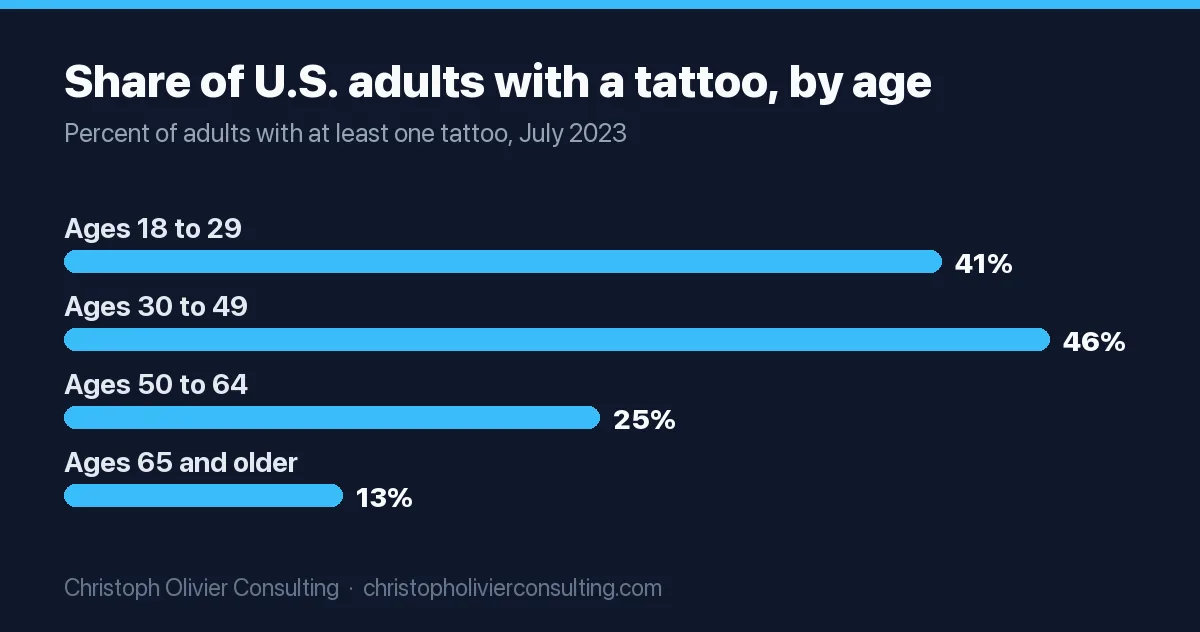
| U.S. adults with a tattoo | 32% (22% have more than one) | Survey of 8,480 adults, July 10 to 16, 2023 | Pew Research Center, 2023 |
| Washington tattoo artist licenses | 2,872 issued in 2024 | One-year individual licenses issued by the state in calendar 2024 | Washington DOL, Aug 2025 |
| Washington shop licenses | 839 issued in 2024 | Body art, piercing and tattoo shop location licenses | Washington DOL, Aug 2025 |
| Minnesota tattooists | 1,400 full licenses, plus 311 temporary and 442 guest | License counts as of March 18, 2025; 380 licensed establishments | Minnesota Department of Health, 2025 |
| Artists employed by personal care businesses (W-2) | 1,460 jobs nationwide, median $38,790 | BLS code 27-1019 in NAICS 812100, May 2025; employees only | BLS OEWS, May 2025 |
| People working in U.S. tattoo studios | 45,268 (2026 estimate) | Market research estimate; includes non-artist staff; method not public | IBISWorld |
| Clients per tattoo artist | Not published | No regulator, survey or trade group reports this | None found |
One comparison in that table is worth a second look. Washington alone issued 2,872 tattoo artist licenses in 2024, yet BLS counts only 1,460 W-2 artist jobs in personal care businesses across the entire country. The gap tells you how the trade is paid: most artists are commission contractors or booth renters, so they never show up in federal wage data. Any “average tattoo artist salary” built from BLS numbers describes a small minority of the trade.
How many clients do tattoo artists have a day?
Per day, the answer is mostly 1 to 4, because a day holds only so many hours of needle time. Our table divides booked tattooing hours by the GlossGenius session lengths. “Mixed” assumes half small and half large sessions, which averages 2.64 hours per client.
| Booked tattooing hours per week | Mostly small pieces (1.35 h) | Mixed (2.64 h) | Mostly large sessions (3.92 h) | Clients per day, mixed, 5-day week | Clients per day, mixed, 4-day week |
|---|---|---|---|---|---|
| 15 hours | 11.1 per week | 5.7 per week | 3.8 per week | 1.1 | 1.4 |
| 20 hours | 14.8 per week | 7.6 per week | 5.1 per week | 1.5 | 1.9 |
| 25 hours | 18.5 per week | 9.5 per week | 6.4 per week | 1.9 | 2.4 |
| 30 hours | 22.2 per week | 11.4 per week | 7.7 per week | 2.3 | 2.8 |
Our calculation. Session lengths from GlossGenius user data. Booked hours are needle time only. Drawing, consultations, setup, cleanup and messaging are extra and unpaid in this model.
Three things change the daily count more than talent or popularity:
- Piece size. An artist who books one full-day back session sees one client. An artist running small flash pieces can see four or more in the same hours.
- Turnover time. Every client adds setup, stencil placement and teardown. If that takes 30 minutes per client, an artist running small pieces loses far more of the day to changeover than one doing a single large session.
- Drawing time. Custom work needs design hours before the appointment. Those hours fill the week but not the chair, which is why custom-heavy artists book fewer clients than their hours suggest.
How many tattoos does a tattoo artist do a week?
Using the same math, an artist booking 20 to 30 hours of needle time does about 5 to 22 sessions a week, depending on piece size. Over a 48-week year, that is roughly 270 to 550 sessions in the mixed scenario (our calculation: 5.7 to 11.4 sessions a week times 48 weeks).
Sessions are not the same as clients. A large piece often spans several appointments. A $5,000 piece at $150 an hour is about 33 hours of work, which is roughly 8 or 9 sessions at the 3.92-hour average large session (our calculation). That one client can fill a slot every other week for four months. So an artist doing large-scale work might see 6 sessions a week but only 60 to 100 different people in a year, while a walk-in flash artist sees hundreds.
How many tattoo artists compete for the same customers?
Washington and Minnesota both publish license counts, which lets you estimate how many adults there are per licensed artist. We divided each state’s adult population (Census 2024 civilian estimates, ages 18 and over) by its tattoo artist license count.
| State | Licensed tattoo artists | Adults, 2024 | Adults per artist | Tattooed adults per artist (at 32%) | Artists per licensed shop |
|---|---|---|---|---|---|
| Washington | 2,872 (issued 2024) | 6,255,004 | About 2,180 | About 700 | About 3.4 (839 shops) |
| Minnesota | 1,400 full licenses (March 2025) | 4,493,489 | About 3,210 | About 1,030 | About 3.7 (380 establishments) |
Our calculation. License counts: Washington DOL, Minnesota Department of Health. Adults: Census Bureau 2024 population estimates (civilian population). The 32% is Pew’s national rate applied to each state, which is an assumption. Minnesota’s count excludes its 311 temporary and 442 guest licenses.
Read this as a ceiling on your local market, not a client list. If a Washington artist works through 400 sessions a year and roughly 700 tattooed adults exist per licensed artist, the whole trade depends on repeat clients and on people getting their first tattoo. That is why rebooking and referrals matter more in this trade than reach.
Is there a high demand for tattoo artists?
The demand signals point in different directions depending on whose data you read:
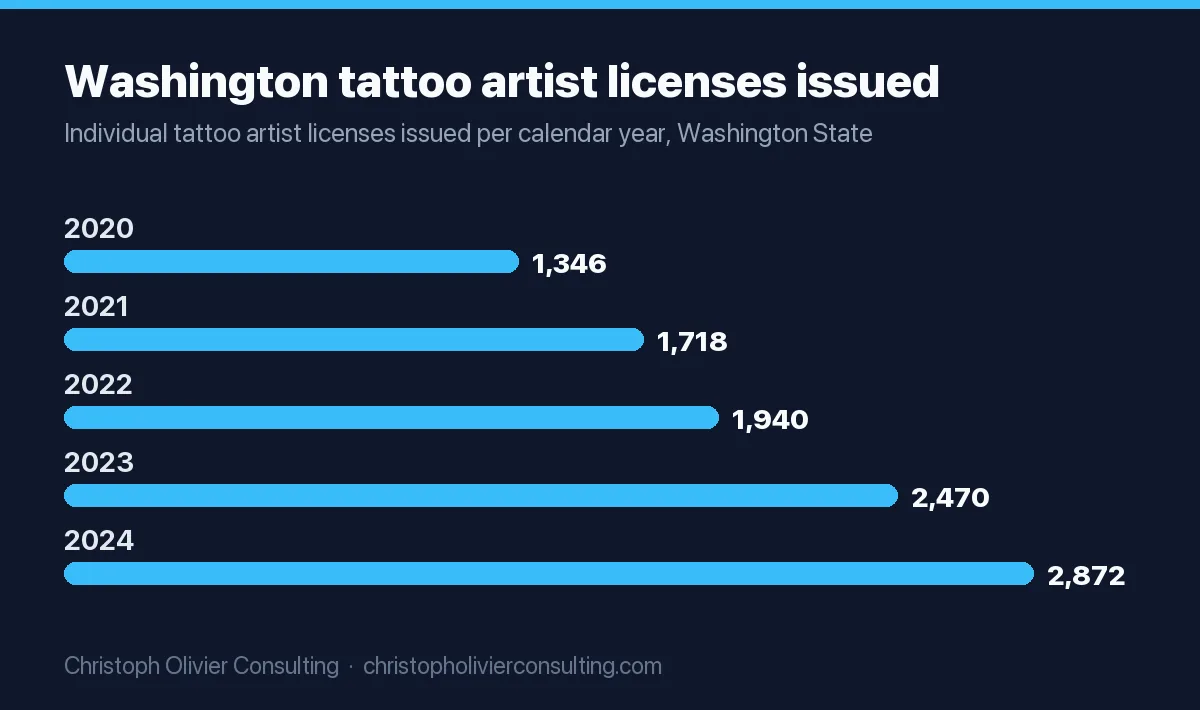
- Licensing is growing fast. Washington’s tattoo artist licenses rose from 1,346 in 2020 to 2,872 in 2024, a 113% increase, while shop licenses grew 31% to 839 (Washington DOL, 2025). More artists per shop means more competition for each chair’s bookings.
- Young adults are the pipeline. Among U.S. adults without a tattoo, 19% of those under 30 say they are extremely or very likely to get one, versus 7% of those 30 to 49 and 2% of those 50 to 64 (Pew, 2023).
- Federal projections are flat. BLS projects craft and fine artists, the broader group that includes tattoo artists, to decline 1% from 2025 to 2035, with about 4,300 openings a year from replacement (BLS Occupational Outlook Handbook). That projection covers painters, illustrators and craft artists too, so it says little about tattooing specifically.
My read: customer demand is steady, but artist supply has grown faster than customers in at least one state that measures it. That makes a full book harder to fill by default than it was five years ago.
How much does a tattoo artist make?
Income follows directly from booked hours, hourly rate and pay structure. Public data offers only rough anchors. PayScale lists average self-reported hourly pay of $91.51 for tattoo artists, from just 85 profiles, with a 10th to 90th percentile range of $14.71 to $203.90 (updated October 2026). BLS puts the median for all craft and fine artists at $55,290 in May 2025, with the top 10% above $131,810, but that excludes the 58% of craft and fine artists who are self-employed.
The model below turns hours into income. Gross billings assume 48 working weeks. The commission columns show the artist’s share before tax. The booth-rent column subtracts $250 a week rent, 8% of billings for supplies and card fees at Square’s in-person rate of 2.6% plus 15 cents per payment, assuming the mixed session count from the capacity table.
| Booked hours per week | Hourly rate | Annual billings | Artist take at 50/50 commission | Artist take at 60/40 commission | Booth renter, after rent, supplies, card fees |
|---|---|---|---|---|---|
| 15 | $100 | $72,000 | $36,000 | $43,200 | $52,327 |
| 15 | $150 | $108,000 | $54,000 | $64,800 | $84,511 |
| 20 | $150 | $144,000 | $72,000 | $86,400 | $116,681 |
| 25 | $100 | $120,000 | $60,000 | $72,000 | $95,212 |
| 25 | $150 | $180,000 | $90,000 | $108,000 | $148,852 |
| 25 | $200 | $240,000 | $120,000 | $144,000 | $202,492 |
| 30 | $150 | $216,000 | $108,000 | $129,600 | $181,022 |
| 30 | $200 | $288,000 | $144,000 | $172,800 | $245,390 |
Our calculation. Assumptions, not market data: 48 weeks, $250 weekly booth rent, 8% supplies, every session paid by card in person. Commission splits of 50/50 and 60/40 are the structures GlossGenius describes; actual splits vary by shop. Commission artists may also pay some supplies. All figures are before income tax and before the 15.3% self-employment tax that 1099 artists and booth renters owe.
The booth renter’s higher number is not free money. The renter also books, markets, handles no-shows and absorbs slow weeks. At 15 hours and $100, the gap between commission and rent shrinks, and in a slow month the fixed rent can push a renter below what a commission artist earns. The tattoo shop owner salary breakdown runs the same math from the shop’s side of the split.
Is $200 an hour expensive for a tattoo artist?
It sits near the top of the published range. PayScale’s 90th percentile for tattoo artist hourly pay is $203.90, and GlossGenius says some popular tattooists charge up to $300 an hour. So $200 is a premium rate, not an outlier. What the client pays and what the artist keeps are different numbers: at a 50/50 split, a $200 hour pays the artist $100 before tax.
How big is a $5000 tattoo?
Price buys hours, not square inches. At $100 an hour, $5,000 is 50 hours of tattooing; at $150, about 33 hours; at $200, 25 hours (our calculation). At the 3.92-hour large-session average, that is roughly 6 to 13 sessions. In practice, that is large-scale work such as a full sleeve or back piece, with the exact size depending on detail, color and the artist’s speed.
How much should I tip on a $900 tattoo?
No survey or regulator sets a tattoo tipping norm, so this is simple math: 15% is $135, 20% is $180 and 25% is $225. Tips are not included in the income model above.
How many clients should a tattoo artist have? Work backward from income
Start with the income you need and solve for hours, then sessions, then the inquiries it takes to fill them. Here is the formula with a worked example.
- Target take-home before tax: $80,000.
- Divide by your share of each billed hour. At $150 an hour and a 50/50 split you keep $75 an hour, so you need 1,067 billed hours a year.
- Divide by working weeks. 1,067 hours over 48 weeks is 22.2 booked hours a week.
- Divide by your average session length. At the mixed 2.64-hour average, that is 8.4 sessions a week, or about 405 a year.
- Estimate unique clients. If an average client books 2 sessions a year, you need about 200 different clients. If you mostly do one-session pieces, you need about 400.
- Estimate inquiries. If 1 in 3 inquiries books (your number, not an industry figure), 200 new clients a year means about 600 inquiries, or 12 a week.
Worked example: our calculation with illustrative inputs. Replace each input with your own numbers.
The useful output is step 6. Most artists track bookings but not inquiries. If you need 12 serious inquiries a week and are getting 5, your problem is lead flow, not talent or pricing. If inquiries are plentiful but few book, look at deposit policy, response time and how your portfolio matches what people ask for.
Is your book full? A pass/fail worksheet
Run this monthly. Each line is a yes or no.
| Check | Pass if | If it fails |
|---|---|---|
| Booked needle hours | At or above the weekly hours from your income formula for 3 of the last 4 weeks | Fix demand first: inquiries, rebooking, referral asks |
| Lead time | Your next open slot is at least 2 weeks out | You have spare capacity; promote open slots or flash days |
| Lead time, upper bound | Next open slot is under 3 months out | Demand exceeds supply; raise your rate before adding hours |
| No-shows and late cancels | Under 1 in 20 appointments, with deposits taken | Tighten deposits and reminder messages |
| Rebooking | Multi-session clients leave with their next date booked | Book the next session at checkout, not by message later |
| Inquiry to booking rate | You know the number (count both for 30 days) | Start counting; you cannot fix what you do not measure |
| Unpaid hours | Drawing and admin take less than half your booked hours | Use flash, templates or a minimum charge for small custom work |
Thresholds are our rules of thumb for a working checklist, not industry standards.
The two lead-time lines are the fastest signal. Under two weeks out, you are not full. Over three months out, you are underpriced. In my view, an artist with a long wait list who raises the rate 10% to 15% usually earns more for the same hours than one who adds a sixth day. That is a judgment, not a measured result.
Getting more clients without working more hours
If the worksheet shows a demand gap, the fixes are mostly marketing basics applied to a trade that sells on visuals and trust:
- Portfolio search beats follower counts. People search “fine line tattoo near me” or a style plus a city. A Google Business Profile with recent healed-work photos and steady reviews catches that intent. Our guide on how to get more Google reviews covers the asking process without breaking Google’s rules.
- Instagram is a portfolio, not a funnel by itself. Post the work you want more of, and put a booking link or form in the profile. The Instagram marketing playbook covers Reels and conversion setup.
- Rebooking is the cheapest client. A client with a half-finished sleeve is already sold. Booking the next session at checkout keeps the slot filled at zero acquisition cost.
Chair-based trades share the same capacity math. If you want to compare, the client-count breakdowns for hair stylists and massage therapists use the same hours-to-clients method. If you run a shop and want help turning the inquiry numbers above into a booking system, you can book a consultation.
Outside the U.S., licensing rules and data sources differ by country, but the capacity math above works anywhere because it depends only on booked hours and session length.
Ready to scale your revenue?
Book a free 30-min consultation. We’ll diagnose your growth bottleneck and map out the 3 highest-leverage moves for your business.
Frequently asked questions
How many clients do tattoo artists have a day?
Usually 1 to 4. Booking platform GlossGenius reports small tattoos average 1.35 hours and large ones 3.92 hours. At 25 booked hours over a five-day week, that works out to about 3.7 small-piece clients a day, 1.9 in a mixed book or 1.3 doing large sessions. These are our calculations, since no agency or survey counts clients per artist.
How many tattoos does a tattoo artist do a week?
About 5 to 22 sessions a week for an artist booking 20 to 30 hours of needle time, depending on piece size (our calculation from GlossGenius session lengths). Large pieces take several sessions, so the number of different clients is lower than the number of sessions, sometimes only 60 to 100 people a year for large-scale specialists.
How much does a tattoo artist make?
It depends on booked hours, rate and split. PayScale reports average self-reported pay of $91.51 an hour from 85 profiles. In our model, 25 booked hours a week at $150 an hour over 48 weeks bills $180,000, which pays the artist $90,000 at a 50/50 commission or about $148,900 as a booth renter after rent, supplies and card fees, before tax.
How many tattoo artists are there in the US?
No government count exists. BLS counts only 1,460 W-2 artist jobs in personal care businesses (May 2025), because most artists are contractors or booth renters. IBISWorld estimates 45,268 people work in U.S. tattoo studios in 2026, including non-artist staff. Washington alone issued 2,872 tattoo artist licenses in 2024 and Minnesota had 1,400 full tattooist licenses in March 2025.
Is there a high demand for tattoo artists?
Customer demand is steady and artist supply is rising fast. Pew found 32% of U.S. adults had a tattoo in 2023, and 19% of untattooed adults under 30 said they were extremely or very likely to get one. Washington's tattoo artist licenses grew 113% from 2020 to 2024, while shop licenses grew 31%, so competition per chair has increased.
Is $200 an hour expensive for a tattoo artist?
It is a premium rate but not an outlier. PayScale's 90th percentile for tattoo artist hourly pay is $203.90, and GlossGenius notes some popular artists charge up to $300 an hour. At a 50/50 shop split, a $200 hour pays the artist $100 before tax, so what the client pays and what the artist keeps differ.
How many clients: caseload research