
A laundromat owner who runs a typical single store makes somewhere between about $15,000 and $150,000 a year before income tax, and a large, busy store can clear more than $250,000. The spread comes down to one number: how many times a day each washer gets used. The industry’s own trade group puts annual cash flow at $15,000 to $300,000 per store (Coin Laundry Association). The average laundromat location with employees took in $508,270 in 2022, and the median company sits in the $100,000 to $499,999 revenue band (Census SUSB 2022, my calculation).
Short answer: In my worked model built from Census, EIA, EPA and BLS data, an owner who manages the store unpaid keeps about $35,000 a year from a 24-washer store doing $254,000 in sales, about $147,000 from a 40-washer store doing $635,000 and about $270,000 from a 60-washer store doing $1.1 million, after equipment loan payments and before income tax. At three turns per washer per day, the 40-washer store loses money. No government survey publishes laundromat owner income directly.
Below: what each public source actually measures, laundromat revenue by size and state, how owner pay splits into a wage and a profit, a utility cost per load built from federal data, a three-size P&L with every assumption labeled, break-even turns per day, startup costs from the equipment maker’s own pages, and a pass/fail worksheet for a store you are thinking of buying.
How much does a laundromat owner make a year? What each source measures
BLS wage surveys exclude owners, and the IRS does not break laundromats out of its “personal and laundry services” line, which also holds hair salons, nail salons and funeral homes. So every owner income figure you see online is either a model, a broker’s listing average or a trade group range. Check what each number measures before comparing two of them.
| Source and year | What it measures | Figure | How it was calculated |
|---|---|---|---|
| Census SUSB 2022, NAICS 812310 | Revenue per coin-operated laundry location with paid employees | $508,270 | $5.55 billion receipts ÷ 10,911 locations (my calculation) |
| Census SUSB 2022, NAICS 812310 | Payroll as a share of revenue, employer laundromats | 18.8% | $1.04 billion payroll ÷ $5.55 billion receipts (my calculation) |
| Census Nonemployer Statistics 2022, NAICS 81231 | Revenue per laundromat business with no paid employees | $95,612 | $899.0 million ÷ 9,403 businesses (my calculation); sole proprietors alone averaged $70,775 |
| Coin Laundry Association, current page | Annual cash flow range for a single store | $15,000 to $300,000 | Published range; no method given |
| BizBuySell benchmarks, 2021 | Average revenue and net profit of laundromat businesses | $632,181 revenue, $75,862 net profit (12%) | Published averages; 2022 to 2024 values are behind a paywall |
| Alliance Laundry Systems Distribution | Average laundromat profit margin quoted by the largest machine maker | 22.2% | Footnoted to a November 2023 industry report on NAICS 81231; definition of profit not stated |
| BLS OEWS, May 2025, NAICS 812300 | Median pay of laundry and dry-cleaning workers in the laundry industry | $34,870 | Published; 96,620 employed |
How to read these together:
- About half of all laundromat businesses have no employees. Census counted 9,650 employer firms and 9,403 nonemployer businesses in the laundromat code for 2022, 19,053 in all. The nonemployer stores averaged under $96,000 in sales. If you own one of those, your “salary” is whatever is left after utilities, rent and repairs.
- The 12% and 22.2% margins are not the same measure. BizBuySell reports net profit; the 22.2% figure on the Alliance page does not say whether it is before or after owner pay, depreciation and debt. My model below lands between them because it subtracts loan payments but not depreciation.
- The Census code includes route operators. NAICS 812310 covers self-service laundries and also companies that supply and service coin laundry machines in apartments and dormitories (NAICS definition). The handful of very large firms in the code are mostly that business, which is why the averages per size band below are more useful than the overall average.
Laundromat owner pay is a wage plus a profit
An owner gets paid in two layers. The first is the job: attendant, manager, repair tech and bookkeeper. The second is the profit left after every bill and loan payment. Sellers often quote “owner benefit” or “cash flow” that rolls both together, which makes a store look better than it is if you would have to hire someone to replace your labor.
BLS publishes what the laundry industry pays the people an owner would otherwise hire (OEWS, drycleaning and laundry services, May 2025):
| Role you might fill yourself | Employed in NAICS 812300 | 10th percentile | Median | 90th percentile |
|---|---|---|---|---|
| Laundry and dry-cleaning worker (51-6011) | 96,620 | $28,070 | $34,870 | $42,010 |
| First-line supervisor of retail sales workers (41-1011) | 1,800 | $35,260 | $48,240 | $75,560 |
| Maintenance and repair worker, general (49-9071) | 4,100 | $34,250 | $48,320 | $73,180 |
| General and operations manager (11-1021) | 7,430 | $40,670 | $79,370 | $169,620 |
Source: BLS Occupational Employment and Wage Statistics, May 2025, industry NAICS 812300, retrieved through the BLS public data API. Annual wages. NAICS 812300 also includes dry cleaners, linen supply and industrial laundries, which pull the manager figures up. Owners and the self-employed are not counted.
The practical floor for an owner-operator is the store manager wage, about $48,240. If a store clears $60,000 after a paid manager, and you are the manager, you earn about $108,000. If it clears nothing after a paid manager, your $48,000 is a wage you could have earned without risking your savings. Census payroll averages back up how lean these stores run: employer laundromats paid $25,368 per employee in 2022 (my calculation), which points to mostly part-time attendants.
How much revenue does a laundromat make? Census data by size
Census counts laundromat companies with employees by annual revenue band. I added shares, averages and payroll ratios.
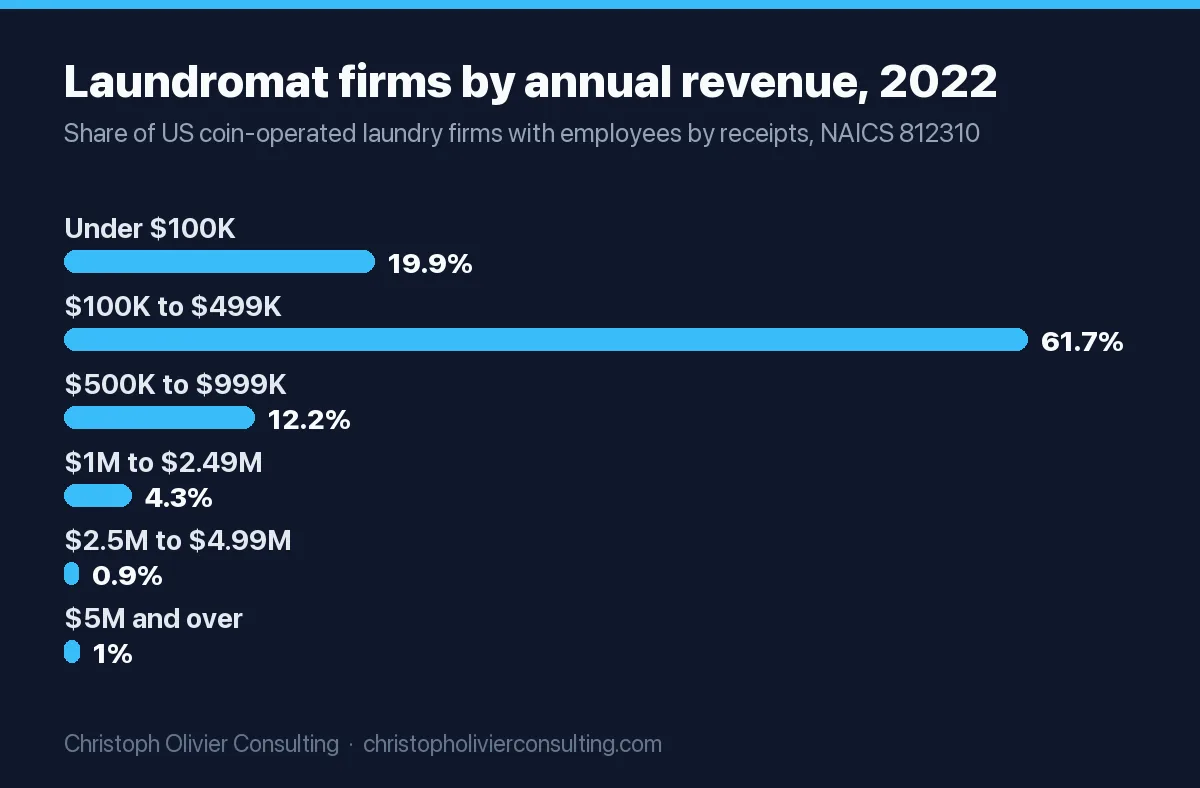
| Annual receipts of the firm | Firms | Share | Cumulative | Avg receipts per firm | Employees per firm | Payroll as % of receipts |
|---|---|---|---|---|---|---|
| Under $100,000 | 1,922 | 19.9% | 19.9% | $55,875 | 1.3 | 25.6% |
| $100,000 to $499,999 | 5,957 | 61.7% | 81.6% | $243,896 | 2.9 | 22.4% |
| $500,000 to $999,999 | 1,175 | 12.2% | 93.8% | $670,965 | 6.5 | 22.6% |
| $1 million to $2.49 million | 411 | 4.3% | 98.1% | $1,366,973 | 11.7 | 21.7% |
| $2.5 million to $4.99 million | 86 | 0.9% | 99.0% | $2,821,081 | 22.7 | 22.6% |
| $5 million and over | 99 | 1.0% | 100% | 43.1% of all receipts in the code; mostly multi-site and route operators | ||
Source: U.S. Census Bureau, SUSB 2022, U.S. 6-digit NAICS by enterprise receipts size, NAICS 812310, released April 10, 2025. Employer firms only. Shares, averages and ratios are my calculations. Payroll is wages only, before payroll taxes.
What the table tells you:
- The typical laundromat company takes in $100,000 to $499,999 a year. 81.6% of employer firms are under $500,000, and the average in the middle band is about $244,000 with fewer than three employees.
- Payroll stays near 22% of sales at every size from $100,000 to $5 million. Unlike restaurants, labor does not climb as stores get bigger. That is why profit margins widen with volume: utilities and repairs scale with loads, but rent and staff do not grow as fast as revenue.
- The money is concentrated at the top. The 11 firms with $100 million or more in receipts ran 176 locations and took 27.3% of revenue in the code (my calculation; Census flags these figures as having higher noise). Alliance Laundry describes the shift in its 2025 10-K: in developed markets there is “a secular shift away from traditional sole proprietor models to professionalized operators managing multi-site operations.”
Laundromat revenue by state
Average receipts per laundromat location ranged from about $217,000 in Mississippi to $960,500 in Hawaii in 2022. The eight highest and eight lowest states from the SUSB 2022 state file (NAICS 812310, receipts ÷ locations, my calculation):
| Highest | Locations | Avg receipts per location | Lowest | Locations | Avg receipts per location |
|---|---|---|---|---|---|
| Hawaii | 30 | $960,500 | Mississippi | 44 | $216,909 |
| Maryland | 208 | $867,423 | Vermont | 26 | $243,577 |
| California | 1,242 | $834,494 | New Hampshire | 58 | $263,724 |
| Minnesota | 99 | $786,545 | Arkansas | 48 | $285,667 |
| Virginia | 271 | $730,114 | Kentucky | 88 | $304,580 |
| Oregon | 82 | $724,329 | Wyoming | 15 | $306,067 |
| Washington | 132 | $679,212 | Idaho | 31 | $322,290 |
| Massachusetts | 298 | $656,765 | Rhode Island | 78 | $331,397 |
New York is the outlier worth knowing. It has 2,252 employer laundromat locations, more than any other state and nearly twice California’s count, but the average New York location took in only $354,624. Lots of small stores sharing dense neighborhoods means fewer turns per machine. California’s 1,242 locations averaged $834,494 with payroll at just 14.9% of receipts.
What utilities cost per load: water, sewer and gas from federal data
Utilities are the cost line that separates laundromats from most retail. You pay for every gallon twice (water in, sewer out), then pay to heat part of it and to dry the clothes. Here is the per-load cost built from published rates and equipment data. Use your own utility bills where you have them.
| Input | Value used | Source |
|---|---|---|
| Water per pound of laundry, front-load washer-extractor | 2 to 4 gallons; model uses 2.5 | EPA WaterSense at Work, Section 3.5, May 2023 |
| Federal water limit, small coin-op front-loader made since Jan. 1, 2018 | 4.1 gallons per cycle per cubic foot (top-loaders 8.8) | EPA WaterSense at Work, citing DOE standards |
| Combined water and sewer rate (example: New York City) | $13.50 per 100 cubic feet (748 gallons), about $18.05 per 1,000 gallons | NYC DEP, fiscal year that began July 1, 2026 |
| Commercial natural gas price | $10.98 per thousand cubic feet, 2025 average | EIA |
| Gas to heat a gallon of water by 75°F | 0.0006 thousand cubic feet, before heater losses | EPA WaterSense at Work, Equation 4 |
| Dryer burner rating, 30 lb stack dryer | 73,000 Btu per hour per pocket | Speed Queen STT30 spec sheet |
| Energy in a cubic foot of natural gas | 1,036 Btu | EIA conversion calculator, 2026 estimate |
| Commercial electricity price | 14.07 cents per kWh, Jan. to Sept. 2026 | EIA Electric Power Monthly, Table 5.6.B |
Worked per-load cost for a 25 lb washer load (my calculation; assumptions: 2.5 gallons per pound, 40% of the water heated, 80% water heater efficiency, 35 minutes of drying with the burner firing half the time):
- Water and sewer: 25 lb × 2.5 gallons = 62.5 gallons × $0.01805 = $1.13
- Water heating: 62.5 × 40% × 0.0006 ÷ 0.80 = 0.019 thousand cubic feet × $10.98 = $0.21
- Drying: 73,000 Btu × 35/60 hour × 50% = 21,292 Btu ÷ 1,036 = 20.6 cubic feet × $0.01098 = $0.23
- Total variable utility cost: about $1.56 per wash-and-dry cycle, before electricity for motors, lights and HVAC
Water and sewer are about 70% of that. In a city with half New York’s combined rate, the same load costs about $1.00. That is why the first thing to check in any store you look at is its water bill, and why owners replace old top-loaders: the federal limit for top-loaders is more than twice the front-loader limit per cubic foot.
Worked P&L: what a laundromat owner keeps at three sizes
This is my own model, not survey data. Revenue is built from machines, turns per day and price. Each store’s revenue falls inside a Census band so I can use that band’s actual payroll ratio. The owner manages the store and takes no wage; whatever is left is the owner’s pay before income tax.
| Line (own calculation) | Small: 24 washers | Mid: 40 washers | Large: 60 washers | Basis |
|---|---|---|---|---|
| Turns per washer per day | 4 | 5 | 5 | CLA range is 3 to 8 or more |
| Average washer price per turn | $5.00 | $6.00 | $7.00 | Assumption; larger stores carry more big machines |
| Washer revenue | $175,200 | $438,000 | $766,500 | Washers × turns × price × 365 |
| Dryer revenue | $78,840 | $197,100 | $344,925 | 45% of washer income; CLA range 40% to 60% |
| Total revenue | $254,040 | $635,100 | $1,111,425 | Inside the Census $100K to $499K, $500K to $999K and $1M to $2.49M bands |
| Water and sewer | $31,620 | $82,345 | $148,220 | 20, 25 and 30 lb average loads at 2.5 gal/lb, NYC rate |
| Gas: water heating and dryers | $13,678 | $31,502 | $51,762 | Per-load method above |
| Electricity | $6,332 | $10,552 | $16,180 | Assumption: 45,000, 75,000 and 115,000 kWh at 14.07 cents |
| Staff wages | $56,905 (22.4%) | $143,533 (22.6%) | $241,179 (21.7%) | Census SUSB 2022 payroll share for the matching band |
| Payroll taxes and workers’ comp | $5,690 | $14,353 | $24,118 | Assumption: 10% of wages; employer Social Security and Medicare alone are 7.65% (IRS Topic 751) |
| Rent | $48,000 | $78,000 | $121,500 | Assumption: 2,000, 3,000 and 4,500 sq ft at $24 to $27 per sq ft; CLA’s 2014 average store was 2,170 sq ft |
| Repairs and parts | $10,162 | $25,404 | $44,457 | Assumption: 4% of revenue |
| Card fees, insurance, supplies, software, marketing, accounting | $17,783 | $44,457 | $77,800 | Assumption: 7% of revenue |
| Equipment loan payments | $28,960 | $57,921 | $115,841 | Assumption: $150K, $300K and $600K over 7 years at 9%; Alliance’s financing terms run 2 to 12 years |
| Owner pay before income tax | $34,910 (13.7%) | $147,033 (23.2%) | $270,367 (24.3%) | Revenue minus all lines |
| Versus hiring a manager at $48,240 | $13,330 short | $98,793 ahead | $222,127 ahead | BLS OEWS May 2025, NAICS 812300 |
Utilities come to about 19% to 20% of revenue in all three cases at New York water rates. The small store is the trap. Its rent, insurance and loan payment are a much bigger share of a $254,000 store than of a $635,000 one, and the owner ends up earning less than a store manager for a job that starts with 6 a.m. machine jams. The mid and large stores pay well because payroll stays near 22% of sales while revenue scales with turns.
Two things the model leaves out. Depreciation is not subtracted, but CLA puts frontload washer and dryer life at 10 to 15 years and small topload washers at 5 to 8 years (CLA), so a full machine replacement is a future cost you must save for once the loan is paid. Wash-and-fold, pickup and delivery and vending income are also left out; they add revenue but also labor.
Laundromat profit margin by turns per day
Turns per day (TPD) is how many times each washer runs in a day, on average. It is the single number that decides whether a store pays its owner. Same 40-washer model, everything held constant except turns. Wages, rent, electricity and the loan stay fixed; water, gas, repairs and the 7% overhead move with loads.
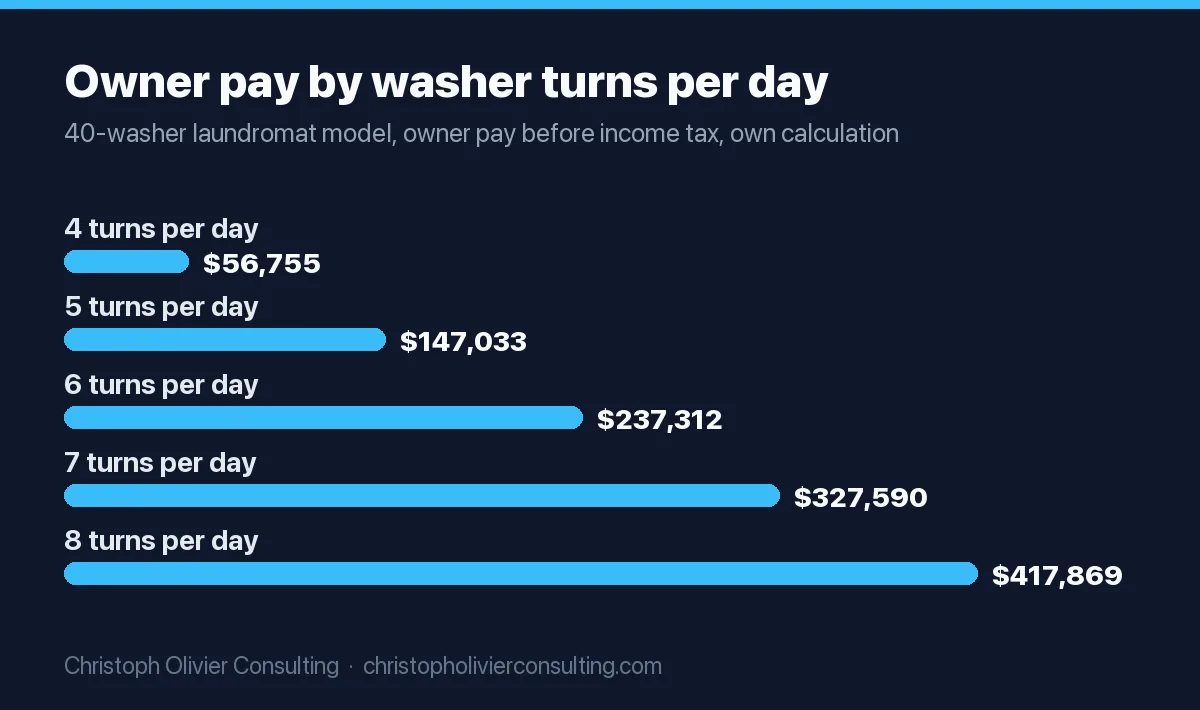
| Turns per washer per day (own calculation) | Annual revenue | Owner pay before income tax | Margin |
|---|---|---|---|
| 3 | $381,060 | loss of $33,524 | negative |
| 4 | $508,080 | $56,755 | 11.2% |
| 5 | $635,100 | $147,033 | 23.2% |
| 6 | $762,120 | $237,312 | 31.1% |
| 7 | $889,140 | $327,590 | 36.8% |
| 8 | $1,016,160 | $417,869 | 41.1% |
Each extra turn adds about $90,000 of owner pay to this store, because each load contributes $6.18 after its own water, gas, repairs and overhead ($8.70 of wash and dry revenue minus $2.52). That also explains the 12% versus 22.2% margin gap in the published sources: they are describing stores at different turn counts.
Break-even turns per day by price
Fixed costs in the 40-washer model are $304,359 a year: wages and payroll taxes ($157,886), rent ($78,000), electricity ($10,552) and loan payments ($57,921). Break-even turns = fixed costs ÷ contribution per load ÷ 40 washers ÷ 365 days.
| Average washer price per turn | Contribution per wash-and-dry cycle | Turns per day to break even (owner unpaid) | Turns per day to also pay the owner $48,240 |
|---|---|---|---|
| $4.00 | $3.60 | 5.8 | 6.7 |
| $5.00 | $4.89 | 4.3 | 4.9 |
| $6.00 | $6.18 | 3.4 | 3.9 |
| $7.00 | $7.47 | 2.8 | 3.2 |
| $8.00 | $8.76 | 2.4 | 2.8 |
Own calculation from the 40-washer model, assuming dryer income stays at 45% of washer income and water and sewer at the NYC rate. Plug in your own fixed costs and contribution per load.
Price is a lever, and the federal data says owners have been pulling it. The consumer price index for laundry and dry cleaning services rose 36.0% from 2019 to 2025, against 25.9% for all items (BLS CPI, series CUUR0000SEGD03 and CUUR0000SA0, annual averages, my calculation). Moving from $5 to $6 a turn cuts break-even from 4.3 to 3.4 turns, but only if customers do not leave for the store down the street.
Laundromat startup costs: new store, franchise or existing store
There is no government survey of laundromat build costs. The best public figures come from the equipment maker and its franchise arm, and they cover very different projects.
| Route | Published figure | What it covers | Source |
|---|---|---|---|
| Speed Queen franchise, new store | $1,199,663 to $1,983,000 total initial investment, including a $49,500 franchise fee | Full build-out of a branded franchise store; the same page cites “average annual revenue that ranges from $525K to $1M+” | Speed Queen Laundry franchise page |
| Independent new store, cash at close | $100,000 to $300,000 | Down payment at an average 30% of total store development cost, so the implied total project is about $333,000 to $1 million (my calculation) | Alliance Laundry Systems Distribution |
| Equipment financing | Terms of 2 to 12 years; average principal balance about $0.1 million | Loans to laundromat owners for new machines, as of Dec. 31, 2025 | Alliance Laundry Holdings 10-K, 2025 |
| Buying an existing store | $50,000 to more than $1 million market value | Price typically 3 to 5 times net cash flow; broker commission 8% to 10% | Coin Laundry Association |
Using the CLA multiple on my model (my calculation): the mid store’s cash flow before loan payments is $204,954, which at 3 to 5 times prices it at about $615,000 to $1.02 million. The small store’s $63,870 prices it at about $192,000 to $319,000. If a seller asks five times a cash flow figure that includes the owner’s own unpaid labor, you are paying for a job, not a business.
Can I open a laundromat with $50k?
Not a new one, by the published numbers. Alliance’s own estimate of cash needed at close starts at $100,000, and that is a 30% down payment. $50,000 is enough for a down payment on a project of roughly $167,000 at the same 30% (my calculation), which in practice means buying a small existing store and financing the rest. At the CLA’s 3 to 5 times multiple, a $167,000 store should produce roughly $33,000 to $56,000 a year in cash flow before debt. Check the water bills and machine ages before you trust the seller’s figure.
Can I buy a laundromat for $15,000?
At 3 to 5 times cash flow, a $15,000 price implies $3,000 to $5,000 a year of cash flow (my calculation). A store priced that low usually has worn-out top-loaders near the end of their 5 to 8 year life, a lease close to expiry or volume too low to cover its own utilities. CLA notes stores sit on long leases of 10 to 25 years; ask how many years remain before anything else.
Is owning a laundromat actually profitable in 2026?
For stores with enough turns, yes, and the costs have moved less than prices. Commercial electricity averaged 14.07 cents per kWh in the first nine months of 2026, up 5.3% from 13.36 cents a year earlier (EIA). Commercial natural gas averaged $10.98 per thousand cubic feet in 2025 against $10.07 in 2024 (EIA), and the monthly price ran $12.87 in August 2026. Laundry prices rose faster than inflation over 2019 to 2025. The squeeze falls on low-volume stores, where every utility increase comes straight out of a thin margin.
The other 2026 fact is competition. Alliance’s 10-K describes “sophisticated, commercially-focused investors” building larger stores with larger machines. A neighborhood store with 1990s top-loaders now competes with those, which shows up as fewer turns per day.
What is the failure rate of laundromats?
No government source tracks laundromat closures. The figure you will see most is Alliance’s “96.85% success rate,” which its own footnote defines as charged-off loans divided by loans originated from 2007 through 2022 (Alliance). That is a loan repayment rate, not a survival rate: a store can repay its machine loan and still pay its owner less than a manager’s wage. Treat it as evidence that owners usually keep up with equipment debt, nothing more.
Outside the U.S., none of the data on this page applies; utility tariffs and labor rules differ by country.
Laundromat buyer’s worksheet: pass/fail benchmarks
Run a store’s last 12 months through these lines before you make an offer. Two or more fails usually means owner pay below the manager median.
| Check | Pass | Fail | Where the line comes from |
|---|---|---|---|
| Washer turns per day (washer revenue ÷ price per turn ÷ washers ÷ 365) | 5 or more | Under 3.5 | CLA range 3 to 8; own break-even table at $6 a turn is 3.4 |
| Dryer income as % of washer income | 40% to 60% | Under 35% or over 70% | CLA range; outside it, check for broken dryers or missing washers in the count |
| Water and sewer as % of revenue | 13% or less | Over 16% | Own model at NYC rates runs 12.4% to 13.3% |
| Staff wages as % of revenue (excluding owner) | 22% or less | Over 26% | Census SUSB 2022 bands run 21.7% to 22.6% |
| Age of frontload washers and dryers | Under 7 years | Over 12 years | CLA useful life 10 to 15 years |
| Years left on the lease, with options | 10 or more | Under 5 | CLA: stores typically sit on 10 to 25 year leases |
| Asking price vs cash flow after a paid manager | 3 to 4 times | Over 5 times | CLA 3 to 5 times multiple; manager at $48,240 (BLS) |
| Owner pay vs hiring a manager | Above $48,240 | Below $35,260 | BLS OEWS May 2025 median and 10th percentile, retail supervisors in NAICS 812300 |
If the store passes on numbers but fails on turns, the gap is customers, not machines. Laundromats win mostly on the map pack, since people search “laundromat near me” from a phone, so the local SEO playbook for service businesses is the place to start, and the ways to promote a small business ranked by ROI covers the rest. To compare laundromat margins with other sectors, see profit margins across 94 industries. The car wash owner salary and vending machine business income pages use the same method for two other utility-heavy, self-service businesses. If you want a second opinion on a store’s growth plan, you can book a consultation.
How the numbers on this page were built
- Census. NAICS 812310 from SUSB 2022 (employer firms, national and state files) and NAICS 81231 from Nonemployer Statistics 2022. All averages, shares and ratios are my calculations. The code includes coin-op dry cleaners and laundry route operators that service machines in apartments.
- BLS. OEWS May 2025 for NAICS 812300 (drycleaning and laundry services, which also includes linen supply and industrial launderers), and CPI annual averages, pulled from the BLS public API.
- Utilities. EIA commercial electricity (Table 5.6.B, year to date through September 2026) and commercial natural gas (2025 annual), NYC DEP combined water and sewer rate as an example of a high-cost city, EPA WaterSense water-use ranges and the hot water energy factor, and a Speed Queen dryer spec sheet.
- Industry figures. Coin Laundry Association ranges, Alliance Laundry Holdings’ 2025 10-K and its distribution and franchise pages, and BizBuySell’s 2021 benchmark averages. The 22.2% margin on the Alliance page cites a third-party industry report I did not open.
- Model assumptions. Washer counts, turns, prices, 45% dryer share, 2.5 gallons per pound, 40% hot water, 80% heater efficiency, 35-minute dry at 50% burner duty, electricity kWh, rent, the 10% payroll load, 4% repairs, 7% overhead, and loans at 9% over 7 years are my assumptions, labeled in each table. Change them to your store’s numbers.
Ready to scale your revenue?
Book a free 30-min consultation. We’ll diagnose your growth bottleneck and map out the 3 highest-leverage moves for your business.
Frequently asked questions
How much does a laundromat owner make a year?
No government survey reports laundromat owner income. The Coin Laundry Association puts annual cash flow at $15,000 to $300,000 per store. In a worked model from Census, EIA and BLS data, an owner who manages the store unpaid keeps about $35,000 from a 24-washer store doing $254,000 in sales, about $147,000 from a 40-washer store doing $635,000 and about $270,000 from a 60-washer store doing $1.1 million, before income tax.
What is the average laundromat profit margin?
Published figures range from 12% to 22.2%. BizBuySell's benchmark shows average net profit of 12% on $632,181 in revenue for 2021, and Alliance Laundry quotes a 22.2% average margin from a 2023 industry report. In a 40-washer model, margin before income tax runs 11% at four turns per washer per day, 23% at five and 37% at seven, so turns explain most of the gap.
How much does it cost to start a laundromat?
Speed Queen's franchise page lists a total initial investment of $1,199,663 to $1,983,000 per store, including a $49,500 fee. For independent new stores, Alliance Laundry estimates cash at close of $100,000 to $300,000, based on an average 30% down payment, which implies a total project of roughly $333,000 to $1 million. Existing stores sell for $50,000 to over $1 million, typically 3 to 5 times cash flow.
How many turns per day does a laundromat need to break even?
In a 40-washer model with $304,359 of fixed costs, break-even is about 3.4 turns per washer per day at a $6.00 average washer price, and 3.9 turns to also pay the owner a $48,240 manager wage. At $5.00 a turn, break-even rises to 4.3. The Coin Laundry Association says stores range from three to eight or more turns per day.
Can I open a laundromat with $50k?
Not a new store by published figures: Alliance Laundry's estimate of cash needed at close starts at $100,000. At a 30% down payment, $50,000 supports a purchase of roughly $167,000, which usually means buying a small existing store and financing the rest. At the Coin Laundry Association's 3 to 5 times multiple, that store should produce about $33,000 to $56,000 a year in cash flow before debt.
Are laundromats still profitable in 2026?
Stores with enough volume are. Laundry and dry cleaning prices rose 36.0% from 2019 to 2025 in the BLS consumer price index, faster than overall inflation of 25.9%. Commercial electricity averaged 14.07 cents per kWh in the first nine months of 2026, up 5.3% from a year earlier. The squeeze falls on low-turn stores, where utility increases come straight out of a thin margin.
What is the failure rate of laundromats?
No government source tracks laundromat closures. Alliance Laundry advertises a 96.85% success rate, but its footnote defines that as charged-off machine loans divided by loans originated from 2007 through 2022. It measures loan repayment, not store survival or owner income, so a store can repay its equipment loan and still pay its owner less than a store manager's wage.
Small business owner income