
A dog grooming business owner typically makes somewhere between what an employed groomer earns and about $100,000 a year before income tax. Where you land depends on how many dogs go over the table each day and whether you groom yourself or manage other groomers. Employed animal caretakers in the industry that includes grooming salons earned a median of $35,190 in May 2025 (BLS OEWS). The 82 Scenthound franchise locations that reported full-year 2025 costs kept an average of 11.5% of revenue as net operating income, with a top quartile at 26.2% and a bottom quartile losing 10.8% (Scenthound 2026 FDD, Item 19).
Short answer: In my worked model built from federal data and franchise disclosure documents, a solo groomer renting a small studio keeps about $47,000 a year, a one-van mobile groomer about $59,000, an owner who grooms alongside staff in a $400,000 salon about $99,000, and an owner who manages a $700,000 salon without grooming about $87,000. All figures are before income tax. No government survey publishes grooming owner income directly, and most pet care businesses are far smaller than these models: the average one with no employees took in $25,176 in 2022.
Below: what each public source actually measures, how much grooming businesses take in by size, the cost lines disclosed in three grooming franchise filings, a four-format P&L with every assumption labeled, how many dogs a day it takes, startup costs, and a pass/fail worksheet for your own numbers.
Dog grooming business owner salary: what each source measures
No federal survey asks grooming business owners what they pay themselves. BLS wage data excludes the self-employed, and the “owner salary” figures on salary sites come from job ads and self-reports. What you can measure is revenue (Census), employee pay (BLS), and the audited-style cost lines that grooming franchisors must disclose when they make earnings claims. One catch: Census and BLS file grooming under NAICS 812910, pet care (except veterinary) services, which also includes boarding, daycare, pet sitting, walking and training.
| Source and year | What it measures | Figure | How it was calculated |
|---|---|---|---|
| Census SUSB 2022, NAICS 812910 | Revenue per pet care firm with employees | $415,944 | $9.85 billion receipts ÷ 23,686 firms (my calculation) |
| Census Nonemployer Statistics 2022, NAICS 81291 | Revenue per pet care business with no paid employees | $25,176 | $3.31 billion ÷ 131,327 businesses (my calculation) |
| BLS OEWS, May 2025 | Median pay of employed animal caretakers (includes groomers, bathers, kennel staff) in other personal services, NAICS 8129 | $35,190 | Published. 90th percentile: $47,990 |
| BLS OEWS, May 2025 | Median pay of first-line supervisors of personal service workers in NAICS 8129, the closest match to a salon manager | $45,720 | Published. 90th percentile: $68,200 |
| Scenthound FDD 2026, Item 19 | Net operating income of 82 franchised locations in 2025, before depreciation and interest, after a $45,000 to $60,000 manager salary | $58,264 avg (11.5%) | Published. Median $44,105 |
| Woof Gang Bakery FDD 2026, Item 19 | Pro forma EBITDA for one grooming and retail store at the 49-month average revenue | $102,830 (13.9%) | Pro forma, not actual results; margin is my calculation |
| IRS SOI, tax year 2023 | Schedule C net profit for pet care | Not broken out | Pet care is folded into “personal and laundry services” with hair, nail and laundry businesses |
How to read these together:
- Most pet care businesses are tiny. The 131,327 nonemployer pet care businesses outnumber the 23,686 employer firms more than five to one, and only 4.3% of them took in $100,000 or more in 2022 (my calculation from the same Census file). Many are part-time walkers and sitters, so the $25,176 average understates a full-time groomer.
- BLS counts the employee, not the owner. BLS says 25% of animal caretaker jobs in 2025 were held by self-employed workers, who are outside the OEWS wage figures (Occupational Outlook Handbook).
- The franchise filings are the only line-by-line cost data. Scenthound is a membership model built on baths, nails, ears and teeth, with haircuts as add-ons. Woof Gang is a full-groom salon with a retail shop. Aussie Pet Mobile runs vans. Read them as benchmarks, not promises.
Owner pay is groomer pay plus profit
A grooming owner gets paid in two layers. The first is the value of the work you do: grooming dogs, managing the salon, or both. The second is what is left after every groomer, bather, landlord and loan is paid. Mixing the two layers is why online “owner salary” figures range from $40,000 to $120,000 without explanation.
For the first layer, BLS shows what the market pays the people you would otherwise hire (BLS public data API, OEWS May 2025):
| Role you might fill yourself | Where | Employed | 10th percentile | Median | 90th percentile |
|---|---|---|---|---|---|
| Animal caretaker (39-2021) | All industries | 266,910 | $27,250 | $35,360 | $50,060 |
| Animal caretaker (39-2021) | Other personal services, NAICS 8129 | 146,190 | $27,210 | $35,190 | $47,990 |
| Supervisor of personal service workers (39-1022) | Other personal services, NAICS 8129 | 13,460 | $32,960 | $45,720 | $68,200 |
Source: BLS Occupational Employment and Wage Statistics, May 2025, national and industry NAICS 812900. Annual wages; the median hourly rate for animal caretakers in NAICS 8129 was $16.92. Self-employed owners are not included.
Commission changes the first layer. Woof Gang’s 2026 FDD says the cost for groomers “is generally at 50.0% of service Gross Revenue,” with bathers paid hourly. So if you groom $100,000 of services yourself, your labor is worth about $50,000 at market rates, and any owner income above that is the return on your money and risk.
How much does a dog grooming business make? Census revenue by size
The $415,944 average for employer firms is pulled up by a few large chains. Census also counts firms by revenue band, so you can see where the typical one sits.
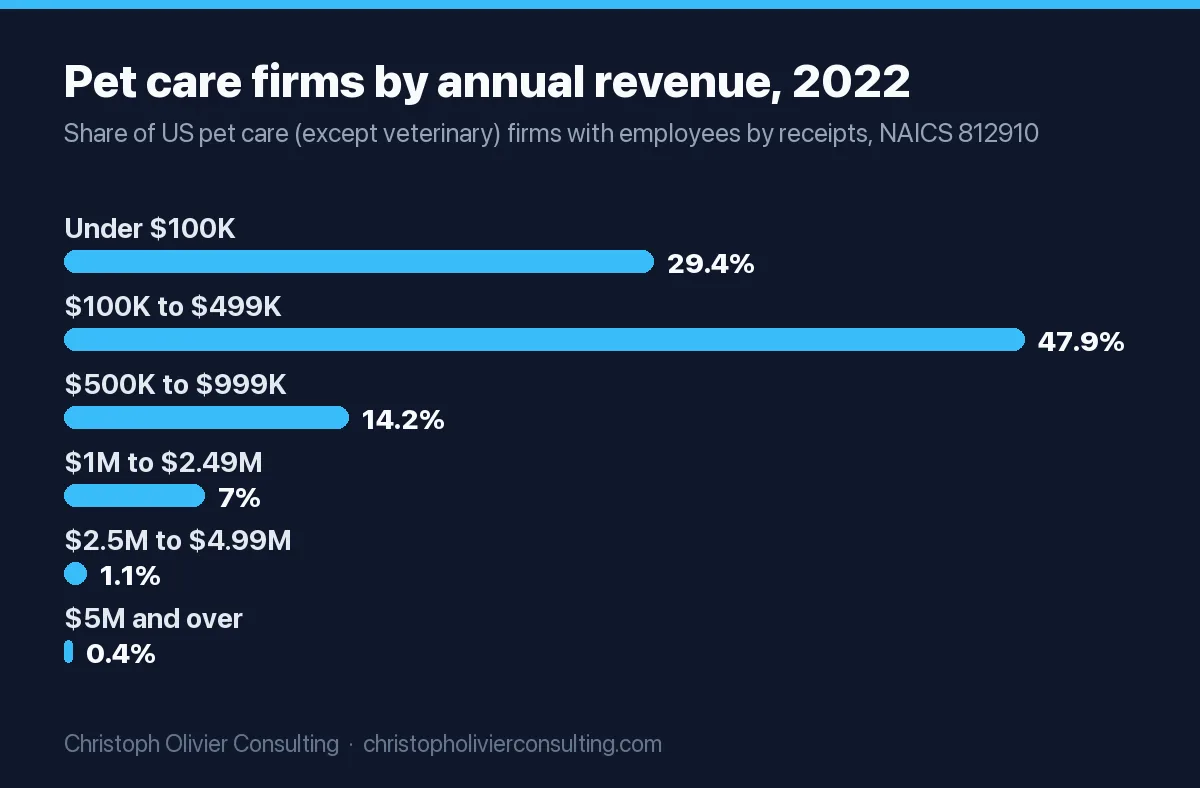
| Annual receipts of the firm | Pet care firms | Share | Cumulative | Avg receipts per firm | Employees per firm | Payroll as % of receipts |
|---|---|---|---|---|---|---|
| Under $100,000 | 6,965 | 29.4% | 29.4% | $45,995 | 1.4 | 44.2% |
| $100,000 to $499,999 | 11,357 | 47.9% | 77.4% | $246,321 | 4.4 | 43.9% |
| $500,000 to $999,999 | 3,358 | 14.2% | 91.5% | $697,184 | 11.8 | 45.6% |
| $1 million to $2.49 million | 1,653 | 7.0% | 98.5% | $1,441,533 | 21.9 | 44.1% |
| $2.5 million to $4.99 million | 249 | 1.1% | 99.6% | $3,161,663 | 41.5 | 42.7% |
| $5 million and over | 104 | 0.4% | 100% | $11,759,365 | 121.6 | 38.7% |
Source: U.S. Census Bureau, SUSB 2022, U.S. 6-digit NAICS by enterprise receipts size, NAICS 812910. Employer firms only; includes boarding, daycare and training as well as grooming. The $5 million and over row is the total minus the published bands, and shares, averages and ratios are my calculations. Payroll is wages only, before payroll taxes and benefits, and can include officers’ pay.
What the table tells you:
- The typical employer pet care firm takes in $100,000 to $499,999 a year and averages 4.4 employees. 77.4% of firms are under $500,000.
- Payroll eats about 44 cents of every dollar at every size. That is the defining fact of the business: it is labor, not product. Scenthound’s 82 reporting locations ran payroll, taxes and benefits at 48.8% of revenue in 2025.
- Without employees, revenue is small. 71.4% of nonemployer pet care businesses took in less than $25,000 in 2022 and 95.7% less than $100,000 (my calculation from Census Nonemployer Statistics).
By state, average receipts per employer pet care location ranged from $184,667 in Wyoming to $612,930 in the District of Columbia in 2022. Among large states, California averaged $526,775 across 2,531 locations and Texas $465,265 across 1,857 (SUSB 2022 state file, receipts ÷ establishments, my calculation).
On the demand side, the American Pet Products Association puts 2025 US spending on “other services,” which covers boarding, grooming, insurance, training, pet sitting and walking, at $14.3 billion, projected to reach $14.9 billion in 2026 (APPA). Its July 2026 dog owner report adds a warning: spending on salon and mobile grooming declined in 2025, and 51% of owners groom their dogs at home (APPA, July 22, 2026).
Dog grooming profit margin: what the franchise filings disclose
The “10% to 20%” and “25% to 40%” margin ranges repeated on software vendor blogs come without a named data source. The most detailed public numbers are in Item 19 of franchise disclosure documents filed with state regulators. Scenthound published actual 2025 costs for 82 locations by quartile. The definition matters: its net operating income excludes depreciation, amortization and interest, and payroll was adjusted to include a manager paid $45,000 to $60,000, so an owner who manages the location keeps the manager wage plus the NOI.
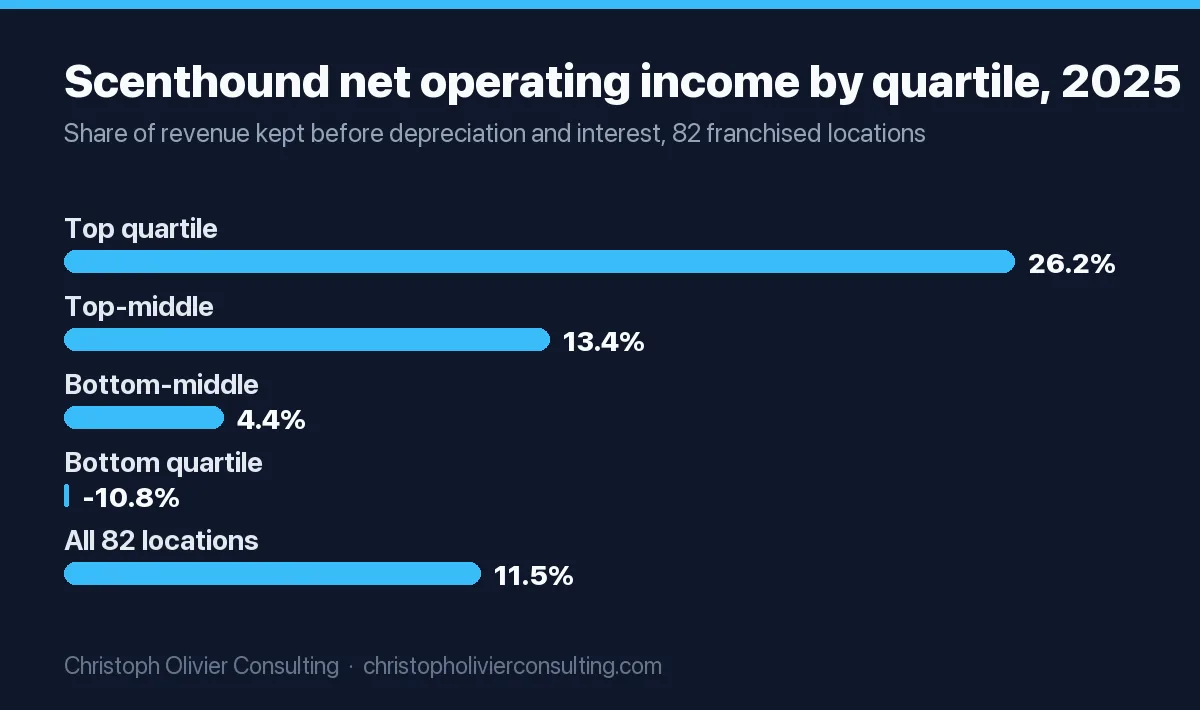
| Scenthound 2025, % of revenue | Top quartile | Top-middle | Bottom-middle | Bottom quartile | All 82 |
|---|---|---|---|---|---|
| Average gross revenue | $667,372 | $554,267 | $459,232 | $334,354 | $505,363 |
| Payroll, taxes and benefits | 40.6% | 48.0% | 53.7% | 60.4% | 48.8% |
| Rent | 7.5% | 10.0% | 12.0% | 14.3% | 10.3% |
| Other occupancy (utilities, repairs, insurance) | 2.2% | 2.5% | 3.0% | 3.4% | 2.7% |
| Royalty, technology and brand fund fees | 8.3% | 8.6% | 9.0% | 9.8% | 8.8% |
| Local advertising | 4.8% | 5.5% | 6.8% | 9.1% | 6.1% |
| Other operating (card fees, supplies, recruiting) | 10.4% | 11.8% | 12.3% | 13.8% | 11.8% |
| Net operating income | 26.2% ($175,259) | 13.4% ($74,769) | 4.4% ($20,307) | −10.8% (−$36,207) | 11.5% ($58,264) |
Source: Scenthound Franchising LLC, Franchise Disclosure Document issued April 18, 2026 as amended July 31, 2026, Item 19 Tables 6 and 7, filed with the Minnesota Department of Commerce. The three franchisor fee lines are combined here. 82 of 114 qualifying locations reported. Individual results vary, and there is no assurance any location earns these amounts.
Three things stand out:
- Volume decides the margin, because labor and rent are mostly fixed. Payroll falls from 60.4% of revenue in the bottom quartile to 40.6% in the top, and rent from 14.3% to 7.5%, even though the dollar amounts are similar across quartiles. The top quartile had 654 members and 759 dog visits a month; the bottom had 383 and 438.
- Older locations earn more. The 27 reporting locations that opened in 2022 or earlier averaged $606,138 in revenue and 17.8% NOI ($108,298). Even their bottom quartile stayed positive at 3.6%.
- Losses are common in the first years. The weakest reporting location lost $66,677 in 2025, and 47 of 82 earned below the $58,264 average.
Two other filings fill in the cost lines Scenthound does not separate. Woof Gang’s 2026 FDD reports that grooming and other services were 78% of revenue at stores open more than 13 months, retail was 22%, and retail cost of goods averaged 45.8%. Its pro forma puts groomers at 50% of service revenue, card fees at 2.0% and grooming supplies at 1.5% of service sales. Scenthound puts card fees at 2.7% to 3.1% and grooming supplies at 2.1% to 2.9%. Shampoo and supplies are cheap; people and space are the business. For how these margins compare with other sectors, see profit margins across 94 industries.
What a big chain discloses
Petco, with about 1,400 US and Puerto Rico pet care centers, reported $1.03 billion in “services and other” revenue for the fiscal year ended January 31, 2026, against $627.5 million in cost of services, a 38.8% gross margin on services (Petco 10-K, my calculation). Grooming is not broken out from veterinary care, and the cost line includes groomer and veterinarian payroll. PetSmart is privately held and does not file public financials.
Worked P&L: what an owner keeps in four grooming formats
This is my own model, not survey data. Each cost line is tied to a public benchmark where one exists, and every assumption is labeled so you can swap in your own numbers. Owner pay is before income tax and before self-employment tax, and it includes the value of any grooming the owner does.
| Line (own calculation) | Solo studio | Mobile, 1 van | Salon, owner grooms | Salon, owner manages | Basis |
|---|---|---|---|---|---|
| Annual revenue | $85,000 | $126,500 | $400,000 | $700,000 | Assumption. Solo: 1,000 grooms at $85. Van: 1,150 grooms at $110; Aussie Pet Mobile averaged about $128,547 per van in 2024 (my calc.). Salons sit in Census bands; $700K is near Woof Gang’s $738,802 average for mature stores |
| Retail share of revenue | none | none | $60,000 (15%) | $140,000 (20%) | Assumption; Woof Gang averaged 22% |
| Hired groomers on commission | none | none | $100,000 | $230,000 | 50% of groomer-produced services ($200K and $460K), per Woof Gang FDD |
| Bathers and front desk, hourly | none | none | $51,000 | $91,800 | 2 and 3 staff at $17/hour, near the $16.92 BLS median; 1,500 and 1,800 hours each |
| Payroll taxes and workers’ comp | none | none | $15,100 | $32,180 | Assumption: 10% of wages. Employer Social Security and Medicare alone are 7.65% (IRS Topic 751) |
| Retail cost of goods | none | none | $28,440 | $66,360 | 47.4% of retail, Woof Gang pro forma |
| Rent or van payment | $14,400 | $28,200 | $42,000 | $70,000 | Assumptions. Van: $2,350/month, inside Aussie Pet Mobile’s $2,100 to $2,600 range. $70,000 matches Woof Gang’s pro forma rent |
| Insurance, utilities, repairs | $7,500 | $9,600 insurance + $9,000 fuel and upkeep | $10,800 | $18,900 | Salons: 2.7% (Scenthound average). Van insurance: about $9,600/year per Aussie Pet Mobile FDD. Fuel and upkeep is my assumption |
| Card fees and grooming supplies | $4,590 | $6,830 | $20,100 | $34,300 | 2.9% card fees plus 2.5% of service revenue for supplies, inside Scenthound’s ranges |
| Marketing | $4,250 | $9,600 | $20,000 | $35,000 | 5% of revenue for shops (Scenthound average 6.1%). Van: $550/month package from Aussie Pet Mobile’s FDD plus $250/month ads |
| Software, phone, accounting | $4,260 | $3,900 | $7,500 | $10,000 | Assumption |
| Equipment and build-out loan payments | $3,000 | included in van | $6,000 | $24,000 | Assumption |
| Owner pay before income tax | $47,000 (55.3%) | $59,369 (46.9%) | $99,060 (24.8%) | $87,460 (12.5%) | Revenue minus all lines |
| Of which: value of the owner’s own labor | $42,500 (grooms $85K) | $63,250 (grooms $126.5K) | $50,000 (grooms $100K) | $45,720 (manages) | 50% commission on own grooming, or the BLS supervisor median |
| Profit above your own labor | $4,500 | −$3,881 | $49,060 | $41,740 | Owner pay minus the line above |
What the model shows:
- Solo and mobile owners are mostly paying themselves a groomer’s wage. At $85,000 in sales, a solo owner earns $47,000, about $12,000 above the BLS median for employed caretakers, but only $4,500 more than a commissioned groomer producing the same $85,000. The van owner earns more in total but slightly less than commission rates for the same work, because the van payment and insurance take 30% of sales.
- The real business return starts when other groomers produce revenue. The $400,000 salon earns about $49,000 above the owner’s own grooming value, because hired groomers’ 50% commission still leaves the other half to cover bathers, rent and profit.
- Stepping off the table costs money until volume catches up. The $700,000 salon earns less than the $400,000 one in total because the owner’s $100,000 of grooming is replaced by commissioned staff. Its 12.5% margin sits near Scenthound’s 11.5% average and Woof Gang’s 13.9% pro forma.
How sensitive owner pay is to commission and price
Same model, $700,000 salon where the owner manages. Price changes move service revenue and commissions together; retail stays fixed.
| Groomer commission (own calculation) | Prices 10% lower | Base prices | Prices 10% higher |
|---|---|---|---|
| 45% of service revenue | $86,866 | $112,760 | $138,654 |
| 50% (Woof Gang benchmark) | $64,096 | $87,460 | $110,824 |
| 55% of service revenue | $41,326 | $62,160 | $82,994 |
Five points of commission are worth about $25,000 a year at this size, and a 10% price change is worth about $23,000. In my view, price is the easier lever: raising commission is how you keep good groomers, and cutting it is how you lose them.
How many dogs can a groomer groom a day?
No government survey measures grooms per groomer per day, and none of the three franchise filings disclose it directly. Scenthound’s 114 reporting locations averaged 560 dog visits a month in 2025, which works out to about $68.61 of revenue per visit (my calculation from $461,041 average revenue). Those visits are mostly baths, nails and teeth, not full haircuts.
Because the daily count is your assumption, here is what each one is worth over a year of 240 working days (own calculation):
| Average ticket | 4 dogs a day | 6 dogs a day | 8 dogs a day |
|---|---|---|---|
| $70 | $67,200 revenue / $33,600 at 50% | $100,800 / $50,400 | $134,400 / $67,200 |
| $90 | $86,400 / $43,200 | $129,600 / $64,800 | $172,800 / $86,400 |
| $110 | $105,600 / $52,800 | $158,400 / $79,200 | $211,200 / $105,600 |
Own calculation: dogs per day × 240 days × average ticket. The second figure is what a groomer on 50% commission would earn from that production. Tips are excluded. Formula for your shop: annual grooming revenue = dogs per day × days worked × average ticket.
Compare the commission column with BLS: the 90th percentile for employed animal caretakers in NAICS 8129 was $47,990. Most employed groomers and bathers are not producing $130,000 a year, which is a reminder that a fully booked 6-dog day at $90 is a good year, not a typical one.
Can a dog groomer make $100,000 a year?
As an employee, rarely: $100,000 sits far above the BLS 90th percentile of $50,060 for animal caretakers across all industries. As an owner, yes, but the math usually needs other groomers. With the solo studio’s costs from the P&L above, a solo owner needs about $144,000 in sales to keep $100,000 (my calculation: $29,160 of fixed costs plus 10.4% of sales in card fees, supplies and marketing). That is 6 dogs a day at $100 for 240 days, a full book with no gaps. The more common route is a salon where hired groomers generate the profit layer, like the $400,000 model.
Dog grooming startup costs: what three franchise filings show
Franchise Item 7 tables are the most detailed public startup budgets for grooming. They include fees an independent would not pay, so I also show the total without franchisor fees.
| Format and filing | Total initial investment | Biggest lines | Without franchisor fees (my calc.) |
|---|---|---|---|
| Scenthound 2026, 1,100 to 1,300 sq ft storefront | $322,999 to $553,269 | Leasehold improvements $140,500 to $266,000; fixtures and equipment $33,000 to $45,800; grand opening marketing $20,000 to $35,000; 3 months of working capital $45,000 to $50,000 | $267,950 to $490,100 |
| Woof Gang Bakery 2026, 1,000 to 1,800 sq ft grooming and retail store | $191,350 to $560,300 | Leasehold improvements $28,000 to $293,700; freezer and grooming equipment $36,000 to $51,450; opening inventory $18,000 to $30,000 | $141,450 to $510,400 |
| Aussie Pet Mobile 2025, mobile vans | $167,325 to $208,650 | Van with required upfit $132,000 to $150,000, financed with $25,000 to $30,000 down; territory fees $100,000 for three territories | $47,375 to $88,700 cash before opening (my calc., van financed) |
“Without franchisor fees” removes the initial franchise fee and territory fees, plus Scenthound’s technology, architect review, opening support, recruiting software and extension fees. It keeps build-out, equipment, marketing (including Woof Gang’s $15,000 start-up media fee, which buys local ads) and working capital. Aussie Pet Mobile’s cash figure includes three months of van payments.
The lesson for an independent: build-out is the swing cost in a storefront, and a lease with a landlord improvement allowance can cut it by six figures. A home-based or rented-room solo groomer avoids most of it, which is why so many grooming businesses start there. For a van, the vehicle is the business: a $132,000 to $150,000 upfit financed at about 8% over 60 months is a $2,100 to $2,600 monthly payment whether you groom 3 dogs that day or 6.
Is owning a dog grooming business profitable?
Usually, once it has volume. In Scenthound’s 2025 data, three of four quartiles were profitable and locations open since 2022 or earlier averaged 17.8%. The risk is the first two years and the low-volume shop: the bottom quartile lost 10.8% of revenue, mostly because payroll and rent did not shrink with sales. Demand is not growing in a straight line either. APPA reported that salon and mobile grooming spending fell in 2025, while half of dog owners now groom at home. Growth has to come from rebooking existing clients on a schedule, which is the core of Scenthound’s membership model, and from local search, where most new grooming clients start. The salon marketing playbook for bookings and rebooks and the local SEO playbook for service businesses cover both.
Is it hard to become a pet groomer?
The barrier is skill, not paperwork. BLS says groomers typically learn by working under an experienced groomer or by attending a grooming school, certification is not required, and many states require self-employed animal care workers to hold a business license (BLS Occupational Outlook Handbook). BLS projects animal care and service worker employment to grow 11% from 2025 to 2035.
Grooming business owner pay worksheet: pass/fail benchmarks
Run last year’s P&L through these lines. Each threshold comes from the filings and federal data above. Two or more fails usually means owner pay below what you would earn grooming for someone else.
| Check | Pass | Fail | Where the line comes from |
|---|---|---|---|
| All payroll, taxes and benefits as % of revenue (excluding owner) | 48% or less | Above 54% | Scenthound 2025: top-middle quartile 48.0%, bottom-middle 53.7% |
| Groomer commission on service revenue | 50% or less | Above 55% | Woof Gang FDD 50% benchmark; see sensitivity table |
| Rent as % of revenue | 10% or less | Above 12% | Scenthound top-middle 10.0%, bottom-middle 12.0% |
| Marketing as % of revenue | 6% or less | Above 9% | Scenthound average 6.1%, bottom quartile 9.1% |
| Card fees plus grooming supplies | 6% or less | Above 7% | Scenthound ranges: card 2.7% to 3.1%, supplies 2.1% to 2.9% |
| Retail cost of goods | 47% or less | Above 55% | Woof Gang 2025 averages 45.8% to 47.7% |
| Net operating income before owner pay above a manager wage | 13% or more | Under 4% | Scenthound top-middle 13.4%, bottom-middle 4.4% |
| Owner pay vs grooming the same volume on commission | At least $20,000 more | Less than commission | Own model: solo and van owners land within about $5,000 of commission pay |
If the fails cluster in payroll and rent, the fix is volume: more booked dogs per groomer day, not more staff. If they cluster in marketing, look at where new clients come from before spending more; the Google Ads budget guide for small business shows how to size a test. For a pet business that sells time by the day instead of by the groom, compare these numbers with the dog daycare owner salary model, and for another commission-based salon, the hair salon owner salary model. If you want a second pair of eyes on a grooming business’s growth plan, you can book a consultation.
How the numbers on this page were built
- Census. NAICS 812910 from SUSB 2022 (employer firms, national and state files) and Nonemployer Statistics 2022 (NAICS 81291). The industry includes boarding, daycare, sitting, walking and training as well as grooming. Averages, shares and payroll ratios are my calculations. Alabama’s state figure carries a moderate noise flag.
- BLS. OEWS May 2025 for occupations 39-2021 and 39-1022, national and NAICS 812900, pulled from the BLS public API. Owners and the self-employed are excluded.
- Franchise disclosure documents. Scenthound (2026, Item 7 and Item 19), Woof Gang Bakery (2026, Item 7 and Item 19) and Aussie Pet Mobile (2025, Items 6, 7 and 19), downloaded from the Minnesota Department of Commerce CARDS database. Item 19 figures are reported by franchisees; Woof Gang’s EBITDA is a pro forma. Per-van revenue for Aussie Pet Mobile is total reported sales of 59 franchisees divided by their 378 vans (my calculation).
- IRS. Sole Proprietorship Returns Table 1, tax year 2023, checked for a pet care line; none is published.
- Petco 10-K for the fiscal year ended January 31, 2026. Services include veterinary care.
- Model assumptions. Grooms per year, average tickets, retail share, staff hours and wage, 10% payroll load, rent, insurance, fuel, software and loan payments are my assumptions, labeled in each table. Change them to your numbers.
Ready to scale your revenue?
Book a free 30-min consultation. We’ll diagnose your growth bottleneck and map out the 3 highest-leverage moves for your business.
Frequently asked questions
How much does a dog grooming business owner make a year?
No government survey publishes grooming owner income. In a worked model built from Census, BLS and franchise disclosure data, a solo groomer renting a studio keeps about $47,000 before income tax, a one-van mobile groomer about $59,000, and an owner who grooms alongside staff in a $400,000 salon about $99,000. Employed animal caretakers in the industry earned a median of $35,190 in May 2025.
How much does a dog grooming business make?
Pet care firms with employees, a Census category that includes grooming, boarding and daycare, averaged $415,944 in revenue in 2022, and 77.4% took in under $500,000. Businesses with no employees averaged $25,176. Among franchises, Woof Gang stores open more than 49 months averaged $738,802 in 2025 and Scenthound locations $461,041.
What is the profit margin for a dog grooming business?
The most detailed public data is Scenthound's 2026 franchise disclosure. Its 82 reporting locations averaged 11.5% net operating income in 2025, before depreciation and interest and after a manager salary. The top quartile kept 26.2%, the bottom quartile lost 10.8%, and locations open since 2022 or earlier averaged 17.8%.
How much does it cost to start a dog grooming business?
Franchise filings give the most detailed budgets. Scenthound's 2026 FDD estimates $322,999 to $553,269 for a storefront, Woof Gang's $191,350 to $560,300 for a grooming and retail store, and Aussie Pet Mobile's 2025 FDD $167,325 to $208,650 for a mobile start, with each upfitted van priced at $132,000 to $150,000. Build-out is the biggest swing cost for a storefront.
How many dogs can a groomer groom a day?
No government source measures it, and the franchise filings do not disclose it. The number is an assumption you should test against your own bookings. At 240 working days, 4 dogs a day at a $90 ticket is $86,400 a year in grooming revenue, 6 dogs is $129,600 and 8 dogs is $172,800. Scenthound locations averaged 560 dog visits a month in 2025, mostly baths.
Can a dog groomer make $100,000 a year?
As an employee it is rare: the 90th percentile for animal caretakers was $50,060 in May 2025, per BLS. As an owner it is possible. Under a modeled solo studio's costs, keeping $100,000 takes about $144,000 in sales, roughly 6 dogs a day at $100 for 240 days. Most owners who pass $100,000 have hired groomers producing revenue.
Small business owner income