
A single vending machine usually grosses a few hundred to about $1,700 a month, and after product, commissions, card fees, fuel and the cost of the machine itself, it keeps roughly $400 to $3,700 a year for its owner. Most vending businesses are small: of the 19,677 vending operators with no employees that filed in 2022, the average took in $35,344 in receipts for the whole year, and 69.9% took in less than $25,000 (Census Nonemployer Statistics 2022, NAICS 445132, my calculation). Revenue is not income. The gap between the two is the whole story of this business.
Short answer: In my sourced model, one machine selling 4 items a day at $2.75 nets about $394 a year after paying for itself over 7 years; 9 a day nets about $1,461; 20 a day nets about $3,732, all before valuing your own restocking time. A 25-machine route at 9 vends a day leaves about $31,700 pre-tax for roughly 1,100 hours of work. Clearing $100,000 takes about 27 strong machines or 68 average ones.
Below: what each public data source actually measures, how much vending businesses take in by size, what the only public vending payments company discloses about real machine volume, a per-machine P&L at three traffic levels, owner income at three route sizes, a setup cost table with current list prices, and a pass/fail worksheet for any location you are offered.
How much does a vending machine make? What each source measures
No government survey asks vending owners what they pay themselves, and no public dataset reports sales per machine. What you can measure is receipts per business (Census), wages for the people you would hire (BLS), and the cashless volume flowing through a large payments network (a 10-K). Read the “what it measures” column before you compare any two numbers.
| Source and year | What it measures | Figure | How it was calculated |
|---|---|---|---|
| Census Nonemployer Statistics 2022, NAICS 445132 | Receipts per vending business with no paid employees | $35,344 | $695.5 million ÷ 19,677 businesses (my calculation) |
| Census SUSB 2022, NAICS 454210 | Receipts per vending firm with employees, all sizes | $3.49 million | $8.98 billion ÷ 2,573 firms; 18 firms with $100 million+ hold 56.4% of receipts (my calculation) |
| Census SUSB 2022, firms under $100K | Receipts per small employer vending firm | $45,013 | $25.1 million ÷ 557 firms (my calculation) |
| Cantaloupe 10-K, fiscal year to June 30, 2025 | Card and mobile payment volume per connected device | $2,691 a year | $3,444 million volume ÷ 1.28 million active devices (my calculation); cash sales not included |
| Cantaloupe 10-K, FY2025 | Average cashless transaction | $2.87 | $3,444 million ÷ 1,199 million transactions (my calculation) |
| BLS OEWS, May 2025, 49-9091 | Median pay of employed coin, vending and amusement machine servicers and repairers | $47,450 ($22.81 an hour) | Published. 26,410 employed; 90th percentile $66,370 |
| NAMA Foundation census, 2026 | Revenue of the whole convenience services industry (vending, micro markets, office coffee) | $31.1 billion (2025, preliminary) | Published estimate, up from $26.6 billion in 2023 |
How to read these together:
- The typical operator is a side business. 88.4% of the 22,250 vending businesses in the two Census files had no employees (my calculation; the two files use different NAICS editions, 445132 and 454210, which cover the same activity).
- The Cantaloupe figure is the closest public proxy for sales per machine. $2,691 a year is $224 a month in card and phone payments only. Its devices also sit on micro markets, laundry and amusement machines, so it is a blended average, not a vending-only number.
- The BLS wage is the value of your time. If you restock and fix machines yourself, $22.81 an hour is what that work costs when you pay someone else to do it.
Vending machine business revenue by size: Census data
Most vending businesses never get big. The receipts distribution for operators without employees is steep:
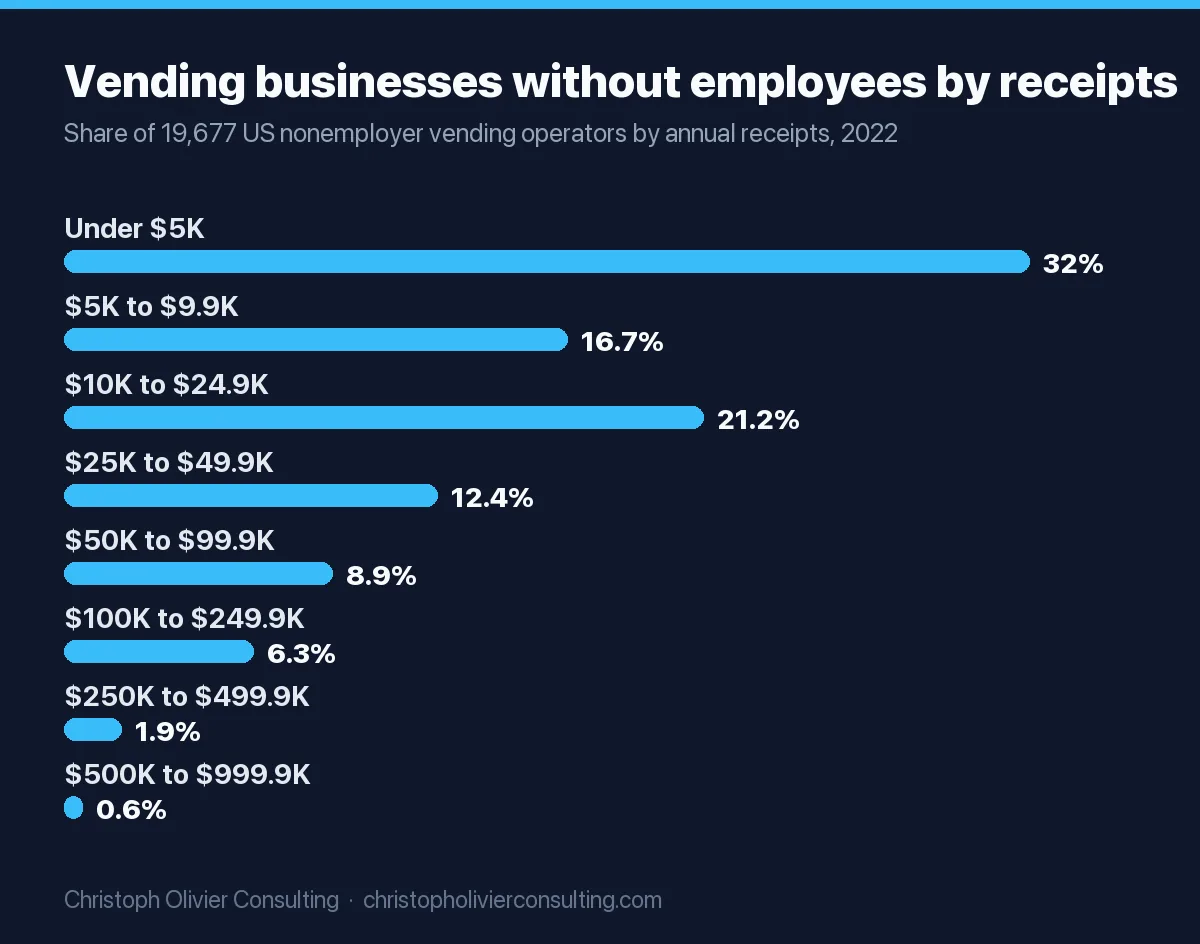
| Annual receipts (no employees, 2022) | Businesses | Share | Cumulative share |
|---|---|---|---|
| Under $5,000 | 6,303 | 32.0% | 32.0% |
| $5,000 to $9,999 | 3,292 | 16.7% | 48.8% |
| $10,000 to $24,999 | 4,169 | 21.2% | 69.9% |
| $25,000 to $49,999 | 2,443 | 12.4% | 82.4% |
| $50,000 to $99,999 | 1,754 | 8.9% | 91.3% |
| $100,000 to $249,999 | 1,240 | 6.3% | 97.6% |
| $250,000 to $499,999 | 367 | 1.9% | 99.4% |
| $500,000 to $999,999 | 109 | 0.6% | 100.0% |
Source: Census Nonemployer Statistics 2022, NAICS 445132; shares are my calculation.
The median nonemployer vending business sits in the $10,000 to $24,999 band. At the $753 a month a decent machine grosses in the model below, that is one to three machines. Only 8.7% of nonemployer operators reached $100,000 in receipts.
Employer firms tell the next part of the story (SUSB 2022, my calculations):
| Employer firm receipts band | Firms | Average receipts | Employees per firm | Payroll as % of receipts |
|---|---|---|---|---|
| Under $100K | 557 | $45,013 | 1.0 | 29.0% |
| $100K to $499K | 1,024 | $249,579 | 1.8 | 18.7% |
| $500K to $999K | 347 | $698,654 | 3.3 | 17.3% |
| $1M to $2.49M | 288 | $1,574,743 | 7.8 | 19.5% |
| $2.5M to $4.99M | 151 | $3,486,629 | 13.5 | 17.2% |
| All employer firms | 2,573 | $3,489,260 | 15.1 | 17.7% |
Two facts stand out. Payroll settles at about 17% to 20% of receipts once a firm passes $100,000, and in firms above $500,000 each employee supports roughly $200,000 to $260,000 in sales. That is the hurdle any owner faces before hiring a route driver: the route has to bring in about $200,000 per person you put on payroll.
Vending machine profit margin: what one machine keeps
Online margin claims of “20% to 30% net” rarely say what is subtracted. Here is every line, with the source or the assumption behind it. This is my own calculation for one combo machine, not reported data.
| Per machine, per year (own calculation) | Weak site: 4 vends/day | Good site: 9 vends/day | Strong site: 20 vends/day |
|---|---|---|---|
| Gross receipts at $2.75 average vend, tax included | $4,015 ($335/mo) | $9,034 ($753/mo) | $20,075 ($1,673/mo) |
| Sales tax inside the price (5%, assumption) | −$201 | −$452 | −$1,004 |
| Product cost (45% of receipts, assumption) | −$1,807 | −$4,065 | −$9,034 |
| Shrink and spoilage (3%, assumption) | −$120 | −$271 | −$602 |
| Location commission (0%, 10%, 15%) | $0 | −$903 | −$3,011 |
| Card fees: 5.2% on 65% cashless, plus $9.99/mo | −$256 | −$425 | −$799 |
| Repairs and parts ($240/yr, assumption) | −$240 | −$240 | −$240 |
| Vehicle: 2, 4 or 8 stops a month, 12 miles each, $0.76/mile | −$219 | −$438 | −$876 |
| Cash profit before your time | $1,172 | $2,239 | $4,510 |
| Machine and reader ($5,448) spread over 7 years | −$778 | −$778 | −$778 |
| Profit after the machine pays for itself | $394 (9.8%) | $1,461 (16.2%) | $3,732 (18.6%) |
| Your restocking time (45 min a stop) at $22.81/hr | 18 hrs, worth $411 | 36 hrs, worth $821 | 72 hrs, worth $1,642 |
| Payback of the $5,448 from cash profit | 56 months | 29 months | 14 months |
Where the inputs come from:
- $2.75 average vend: my assumption, set just below the $2.87 average cashless ticket Cantaloupe reported for fiscal 2025, because card tickets tend to include multi-item and micro market purchases.
- 5.2% card cost: Cantaloupe’s transaction fee revenue of $179.5 million on $3,444 million of volume in fiscal 2025 (my calculation from the 10-K). The $9.99 a month is Nayax’s US list price for its cashless, operations and inventory package (Nayax shop, checked November 2026). The 65% cashless share is my assumption.
- $0.76 a mile: the IRS business standard mileage rate from July 1, 2026 (72.5 cents before that).
- $22.81 an hour: BLS median hourly wage for vending machine servicers, May 2025.
- Product cost, shrink, repairs and tax rate: my assumptions. No public source reports a vending product cost ratio, so test your own invoices against the 45% line. Every 5 points of product cost moves the good-site profit by about $450 a year: $1,913 at 40%, $1,009 at 50%, $558 at 55%.
The weak column is not a worst case. If cash is 35% of sales, Cantaloupe’s $224 a month of cashless volume per device works out to about $345 a month in total, close to the 4-vends-a-day column (my calculation, and a rough one, since Cantaloupe’s devices include non-vending equipment). An average connected machine may keep only a few hundred dollars a year once you pay for it.
What location commissions do to profit
Commissions are the line most beginner guides skip, and they decide whether a busy site is worth taking. Public contracts show what large captive locations demand. The Missouri Department of Corrections awarded vending contracts at 15% of gross sales (contract Y15708470, renewed for 2019), 21.2% (Y18708029, renewed through February 2020) and 33% (Y18708436, renewed for June 2020 to May 2021). Small offices and shops often ask for nothing or a small share; I found no public survey of typical rates, so treat any “industry standard” number you read as an opinion.
Here is my calculation for a 25-machine route at different traffic levels and commission rates, before valuing your time and after spreading machine cost over 7 years:
| Vends per machine per day (gross/mo) | 0% commission | 10% | 20% | 30% |
|---|---|---|---|---|
| 4 ($335) | −$418 | −$10,455 | −$20,493 | −$30,530 |
| 6 ($502) | $21,474 | $6,418 | −$8,638 | −$23,695 |
| 9 ($753) | $54,312 | $31,728 | $9,143 | −$13,441 |
| 13 ($1,087) | $98,095 | $65,474 | $32,852 | $230 |
| 20 ($1,673) | $174,717 | $124,529 | $74,342 | $24,154 |
Same assumptions as the per-machine table, 4 stops per machine a month, plus $4,800 a year for storage, insurance and software.
The rule the grid shows: with product near 45% of receipts, a 30% commission leaves almost nothing unless a machine sells 13 or more items a day. The high-commission contracts go to sites with captive, all-day traffic, which is why they exist at all.
Vending machine owner salary: what a route pays at three sizes
A vending owner is paid in two layers: the restocking and repair work you do (worth the $22.81 BLS median hourly wage if you hired it out), plus whatever profit is left after every bill and the machines themselves. Salary sites that quote a single “vending machine owner salary” are built from job ads and self-reports, not tax returns, so they mix both layers. My worked P&L for three route sizes, using the same inputs:
| Own calculation, per year | Side route: 3 machines | Solo route: 25 machines | Employer route: 80 machines |
|---|---|---|---|
| Vends per machine per day | 9 | 9 | 9 |
| Gross receipts | $27,101 | $225,844 | $722,700 |
| Sales tax inside price (5%) | −$1,355 | −$11,292 | −$36,135 |
| Product cost (45%; 40% with bulk buying at 80 machines) | −$12,196 | −$101,630 | −$289,080 |
| Shrink and spoilage (3%) | −$813 | −$6,775 | −$21,681 |
| Location commissions (10%) | −$2,710 | −$22,584 | −$72,270 |
| Card fees and telemetry | −$1,276 | −$10,634 | −$34,027 |
| Repairs and parts | −$720 | −$6,000 | −$19,200 |
| Vehicle at $0.76 a mile (2 stops/mo per machine at 80) | −$1,313 | −$10,944 | −$17,510 |
| Storage, insurance, software | −$600 | −$4,800 | −$30,000 |
| Employee payroll at the Census 17.3% ratio, plus 10% taxes | $0 | $0 | −$137,530 |
| Machine cost spread over 7 years (10 years at 80) | −$2,335 | −$19,457 | −$43,584 |
| Owner income before income tax | $3,783 | $31,728 | $21,683 |
| Owner hours a year | 160 | 1,108 | 2,080 (managing) |
| Owner income per hour | $23.64 | $28.64 | $10.42 |
| Cash tied up in machines (new, $5,448 each) | $16,344 | $136,200 | $435,840 |
What the model says:
- The side route pays about a servicer’s wage. $3,783 for 160 hours is close to the $22.81 BLS median. It is a part-time job with inventory risk, not passive income.
- The 25-machine solo route is a modest full-time living. $31,728 after machine cost, or $51,185 of cash flow before you set money aside to replace machines. The second number is what most “I make $50K” claims describe.
- Hiring at average volume makes the owner poorer. At 9 vends a day, the Census-typical 17.3% payroll ratio eats the margin. The same $722,700 in receipts produces $48,791 from 55 machines at 13 vends a day and $66,630 from 40 machines at 18 vends a day (my calculation). Employer routes win on volume per stop, not machine count.
If you are weighing vending against another unattended, machine-based business, compare these numbers with the laundromat owner income breakdown, and check the profit margin by industry table to see where retail margins sit overall.
Vending machine setup cost: list prices in 2026
A new, full-size machine is the largest cost by far, and the listed price usually excludes payment hardware.
| Item | Price | Source and note |
|---|---|---|
| Selectivend 29-selection ambient and refrigerated snack and drink combo machine | $5,029 | WebstaurantStore listing, November 2026; “no payment system installed” |
| Nayax VPOS Touch card reader, 1 to 4 units | $399 each | Nayax US shop; $314 at 5 to 9, $299 at 10 to 19, $289 at 20 to 49 units |
| Nayax account activation | $20 one time | Nayax FAQ |
| Cashless, operations and inventory package | $9.99 a month | Nayax shop; processing fee quoted separately based on your price range |
| First fill of product | About $339 | Own calculation: one month of product cost at the good-site volume (45% of $753) |
| Sales tax permit, business registration, insurance | Varies by state | Not modeled; see the LLC question below |
| Total to place one new machine | About $5,787 | Own calculation, before any permit or entity fees |
Where can you buy a vending machine under $1,000? Not new, in any full-size combo listing I checked: the card reader alone is $399. Sub-$1,000 machines are typically used units or small mechanical candy and gumball dispensers. The cheaper the machine, the more the payback math leans on location; a used machine that grosses $335 a month still keeps only about $1,172 a year in cash before your time.
Are vending machines still profitable in 2026?
The industry is growing, but the average machine is not a gold mine. The NAMA Foundation estimates convenience services revenue reached $31.1 billion in 2025, up from $26.6 billion in 2023, about 8.1% a year (NAMA, 2026). A separate operator survey by Automatic Merchandiser puts 2025 revenue at $40.04 billion, so the two estimates measure different things and should not be compared (Vending Market Watch, July 16, 2026).
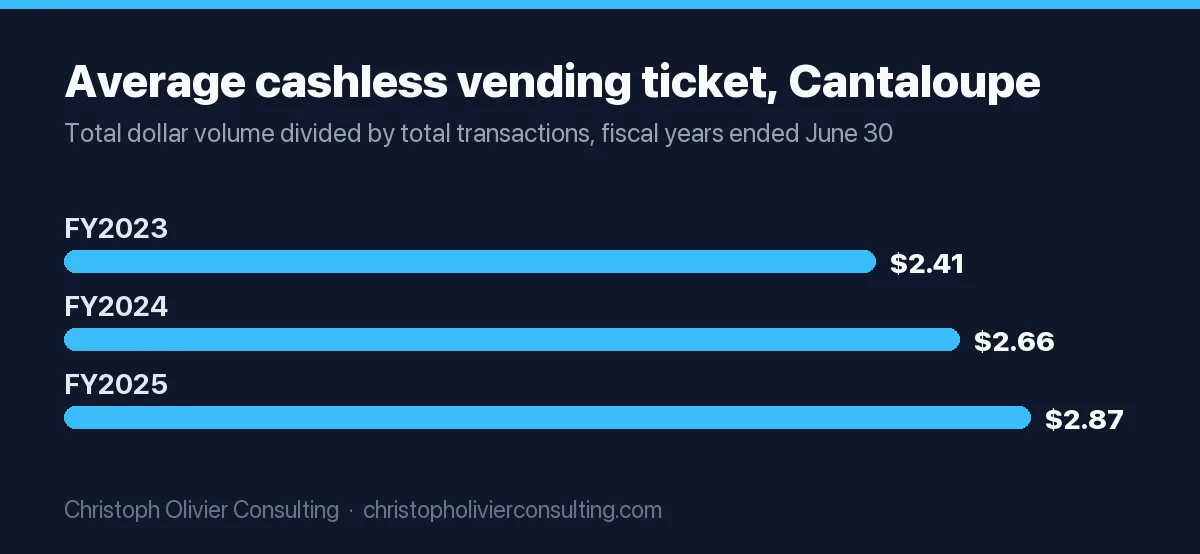
Prices help: the average Cantaloupe cashless ticket rose from $2.41 in fiscal 2023 to $2.66 in fiscal 2024 and $2.87 in fiscal 2025 (my calculation from the 10-K). Consumer prices for food from vending machines and mobile vendors rose 2.0% from September 2025 to September 2026 (BLS CPI series CUUR0000SEFV04, my calculation). Rising tickets lift receipts, but product cost rises with them, so the margin per item does not automatically grow.
In my view, vending is profitable for owners who treat locations like a sales pipeline: they test traffic before placing a machine, pull machines that miss the threshold, and keep adding sites. The marketing work is the business. The same pipeline thinking runs through these nine revenue levers for a small business, and most of them apply to a route.
How many vending machines do you need to make $100k?
In my model, about 27 machines at 20 vends a day with a 15% commission, about 68 at 9 vends a day with a 10% commission, and about 254 at 4 vends a day. That is $100,000 of pre-tax profit after machine cost, before valuing your time. At 68 machines you cannot restock alone (2,448 hours a year at 4 stops a machine), so the realistic path to $100,000 is fewer, busier sites, not more machines.
How much do 10 vending machines make a month?
Ten good-site machines gross about $7,528 a month and keep about $1,218 a month after every cost and machine depreciation (my calculation). Ten strong-site machines gross about $16,729 and keep about $3,110. Ten machines at the weak level keep about $328 a month.
How long does it take a vending machine to pay itself off?
From cash profit before your time, a new $5,448 machine and reader pays back in about 14 months at 20 vends a day, 29 months at 9 a day and 56 months at 4 a day (my calculation). If you count your restocking time at $22.81 an hour, the good-site payback stretches past 3 years.
What is the most sold item in a vending machine?
Sweet items still lead. Snacks, candy and sweet baked goods account for more than a third of vending and smart cooler sales, and cold beverage vending remains the largest equipment category, according to Automatic Merchandiser’s 2026 operator survey (Vending Market Watch). The same survey found nearly two thirds of operators reporting shrink below 5%.
Do I need an LLC for a vending machine business?
No. If you do business without registering another structure, you are automatically a sole proprietor, but you are personally liable for the business’s debts; an LLC protects you from personal liability in most cases and must register with its state (SBA). What you usually do need is a sales tax permit. In California, for example, you generally need a seller’s permit to sell through vending machines, one permit covers all your machines, and food sold for 15 cents or less per item is the exception (CDTFA Publication 118). California treats cold food sold through machines as 33% taxable (CDTFA sales tax factors), which is why my model uses a blended 5% tax line rather than the full local rate. Outside the U.S., none of these rules or figures apply.
Vending location worksheet: pass/fail before you place a machine
Run every location offer through these checks. The thresholds come from the per-machine table and the commission grid above. Two or more fails means the site will probably keep less than $1,000 a year.
| Check | Pass | Fail | Where the line comes from |
|---|---|---|---|
| Expected vends per day | 9 or more | Under 5 | Own model: 9/day keeps $1,461, 4/day keeps $394 |
| Gross receipts per month | $750 or more | Under $400 | Own model; Cantaloupe’s blended device average implies about $345 |
| Commission requested | 10% or less at 9 vends/day | Above 20% at under 13 vends/day | Commission grid; Missouri public contracts ran 15% to 33% |
| Product cost as % of receipts | 45% or less | Above 50% | Sensitivity: 50% cuts good-site profit to $1,009 |
| Card acceptance | Reader installed, fee under 6% of card sales | Cash only | Cantaloupe effective take rate 5.2%; average cashless ticket $2.87 |
| Restock trips per month | Fit with another stop on the same route | Standalone trip over 12 miles | $0.76/mile IRS rate plus 45 minutes at $22.81/hr |
| Payback from cash profit | 30 months or less | Over 48 months | Own model: 14, 29 and 56 months by traffic level |
To use it, count foot traffic for a full week before you sign, multiply people per day by a conversion rate you can defend from a test placement, and plug the result into the vends row. If you cannot get traffic data, ask for a 60-day trial with the right to pull the machine. The same discipline applies to any small cash business with thin margins; the food truck owner income model is a useful comparison for another business where the spot decides the sales.
How the numbers on this page were built
- Census: Nonemployer Statistics 2022 (NAICS 445132, 2022 NAICS edition) and Statistics of U.S. Businesses 2022 (NAICS 454210, 2017 edition, released April 10, 2025). Averages, shares and ratios are my calculations. SUSB payroll excludes the owner of an unincorporated firm.
- IRS: The IRS Statistics of Income sole proprietorship tables for tax year 2023 do not break out vending; it sits inside “food and beverage stores,” so no IRS figure is used.
- Cantaloupe: fiscal year ended June 30, 2025 key metrics from the 10-K filed September 8, 2025. Per-device and per-transaction figures are my calculations and cover card and mobile payments only.
- BLS: OEWS May 2025 national estimates for occupation 49-9091, pulled from the BLS public data API.
- Model assumptions: $2.75 average vend, 5% sales tax inside price, 45% product cost (40% at 80 machines), 3% shrink, 65% cashless, $240 repairs per machine, 12 miles and 45 minutes per stop, new machine cost spread over 7 years (10 at 80 machines). Each is labeled where used. Your invoices replace them.
If you run a route and want a second set of eyes on which locations to pitch next and how to pitch them, you can book a consultation.
Ready to scale your revenue?
Book a free 30-min consultation. We’ll diagnose your growth bottleneck and map out the 3 highest-leverage moves for your business.
Frequently asked questions
How much does a vending machine make?
One machine usually grosses a few hundred to about $1,700 a month. In a sourced model with a $2.75 average vend, a machine selling 4 items a day keeps about $394 a year after product, commissions, card fees, fuel and spreading its $5,448 cost over 7 years; 9 a day keeps about $1,461 and 20 a day about $3,732, before valuing your restocking time.
What is the average vending machine owner salary?
No government survey reports it. Census data shows the 19,677 vending operators without employees averaged $35,344 in receipts in 2022, and 69.9% took in under $25,000. Owner pay is your restocking labor, worth the $22.81 BLS median hourly wage for vending servicers, plus profit. A modeled 25-machine route leaves about $31,700 pre-tax for about 1,100 hours.
What is a typical vending machine profit margin?
In my model, net margin after every cost and machine depreciation runs about 9.8% at a weak site, 16.2% at a good site and 18.6% at a strong one, before the owner's time. Product cost (assumed 45% of receipts) and location commission are the two lines that decide it. A 30% commission wipes out profit below roughly 13 vends a day.
How many vending machines do you need to make $100k?
About 27 machines selling 20 items a day with a 15% commission, about 68 selling 9 a day with a 10% commission, or about 254 selling 4 a day, in my model. That is $100,000 pre-tax profit after machine cost but before valuing your time. At 68 machines the restocking alone is about 2,450 hours a year, so busier sites beat more machines.
How much does it cost to set up a vending machine?
About $5,787 to place one new combo machine: a Selectivend 29-selection combo listed at $5,029 without payment hardware, a Nayax VPOS Touch reader at $399, a $20 activation fee and roughly $339 of opening product. Add $9.99 a month for the cashless package, plus state sales tax permit, entity and insurance costs, which vary by state.
How long does it take a vending machine to pay itself off?
From cash profit before your own time, a new $5,448 machine and card reader pays back in about 14 months at 20 vends a day, 29 months at 9 a day and 56 months at 4 a day in my model. If you also pay yourself $22.81 an hour for restocking, the payback at a good site stretches to almost 4 years.
Do I need an LLC to run a vending machine?
No. Without registering another structure you are a sole proprietor, but the SBA notes you are then personally liable for business debts, while an LLC protects you in most cases. You usually do need a sales tax permit: California, for example, generally requires a seller's permit for vending sales, with one permit covering all your machines.
Small business owner income