
Most bed and breakfast owners earn somewhere between a loss and about $120,000 a year before income tax, and the size of the mortgage decides more of that than the room rate does. The only federal profit data comes from the IRS: the 53,829 sole proprietors filing under travel accommodation (hotels, motels and B&Bs) reported a combined net loss for tax year 2023, an average of minus $12,666 per return. The 43.7% who made a profit averaged $25,085 (IRS Statistics of Income, 2023, my calculation). A hired lodging manager earns a median $67,890 (BLS OEWS, May 2025).
Short answer: In my worked model built from Census, BLS, IRS and CoStar data, an owner-innkeeper at 50% occupancy keeps about $7,000 a year from a 4-room inn, $21,000 from an 8-room inn and $39,000 from a 12-room inn after a 75% mortgage. Owned outright, the same inns leave about $46,000, $80,000 and $117,000. Occupancy is the swing factor: below about 45%, all three lose money after debt payments.
Below: what each data source actually measures, how much B&Bs take in by size and state, where the revenue comes from, a three-size P&L with every assumption labeled, the occupancy you need to break even, and a pass/fail worksheet for an inn you run or want to buy.
Bed and breakfast owner salary: what each source measures
No government survey asks innkeepers what they pay themselves. BLS wage data leaves out the self-employed, and salary sites that quote $40,000 to $90,000 for “B&B owners” are built from job ads for managers, not from owner tax returns. What you can measure is revenue, payroll, reported profit and what buyers pay for inns. Read the second column before you compare any two numbers.
| Source and year | What it measures | Figure | How it was calculated |
|---|---|---|---|
| IRS SOI, sole proprietorships, tax year 2023 | Net profit per Schedule C travel accommodation business, all returns (profits less losses) | minus $12,666 | Net income less deficit of minus $681.8 million ÷ 53,829 returns (my calculation) |
| IRS SOI, tax year 2023 | Net profit per travel accommodation sole proprietor that made money | $25,085 | $589.8 million ÷ 23,510 profitable returns; average receipts $140,572, so a 17.8% net margin (my calculation) |
| Census SUSB 2022, NAICS 721191 | Revenue per bed-and-breakfast inn location with paid employees | $516,987 | $1.274 billion receipts ÷ 2,464 locations (my calculation) |
| Economic Census 2022, NAICS 721191 | Revenue per B&B establishment with payroll | $492,392 | $1.177 billion ÷ 2,390 establishments; 5.0 employees each (my calculation) |
| BizBuySell, B&Bs sold 2021 to 2025 | Seller’s discretionary earnings (cash flow before owner pay, debt, depreciation) of inns that sold | $167,609 median | Published. Median revenue $439,716, so about 38% of revenue |
| BLS OEWS, May 2025, NAICS 721100 | Median pay of salaried lodging managers in traveler accommodation | $67,890 | Published. 10th percentile $39,750, 90th $126,590 |
How to read these together:
- The IRS line is the closest thing to owner income, but it is broad. It covers hotels, motels and B&Bs filed on Schedule C. Those businesses averaged $109,532 in receipts in 2023, so they are mostly small inns and motels, not chains. The IRS says rentals where you provide “regular cleaning, changing linen, or maid service” belong on Schedule C, and may owe self-employment tax (IRS Publication 527), which is why B&Bs land here and plain vacation rentals usually do not.
- A tax loss is not always a cash loss. The average travel accommodation sole proprietor deducted $16,941 of depreciation in 2023, and the 30,319 returns without a profit deducted $22,136 each (my calculation). Depreciation is a non-cash expense, so many “losing” inns still cover their bills. They just do not pay their owners much.
- BizBuySell’s $167,609 is not take-home pay. Seller’s discretionary earnings is cash flow before the owner’s own salary, before loan payments and before depreciation. It also comes from inns good enough to sell. A buyer who finances the purchase pays the mortgage out of that number.
Owner pay is salary plus profit, not a salary
An innkeeper gets paid in two layers. The first is pay for the jobs you do: manager, housekeeper, breakfast cook and reservations desk, usually all before 10 a.m. The second is whatever profit is left after every bill, staff member and loan payment. Online “B&B owner salary” figures mash the two together, which is why they disagree.
For the first layer, BLS publishes what traveler accommodation businesses pay the people you would otherwise hire (OEWS national industry estimates, NAICS 721100, May 2025):
| Role you fill yourself | Employed in traveler accommodation | Mean hourly wage | Median annual | 90th percentile |
|---|---|---|---|---|
| Lodging manager (11-9081) | 36,070 | $37.39 | $67,890 | $126,590 |
| General and operations manager (11-1021) | 23,050 | $49.91 | $81,020 | $192,280 |
| Restaurant cook (35-2014) | 76,340 | $21.55 | $44,290 | $58,950 |
| Maintenance and repair worker (49-9071) | 87,660 | $21.92 | $42,220 | $64,130 |
| Front desk clerk (43-4081) | 242,020 | $17.04 | $35,020 | $45,220 |
| Maid and housekeeping cleaner (37-2012) | 415,160 | $17.63 | $34,920 | $49,510 |
Source: BLS Occupational Employment and Wage Statistics, May 2025, national industry file for NAICS 721100 (oesm25in4), read from a November 2026 archive copy of the BLS download. Wages only, before benefits. Owners and the self-employed are not included.
The second layer depends on the P&L. If your inn clears $30,000 after paying a manager, and you are the manager, you made $97,890. If it clears nothing after paying a manager, your pay is a manager’s wage for a job with no days off. If a couple runs the inn together, divide by two: two people doing the work of a manager, a cook and a housekeeper for $40,000 combined are each earning well below the housekeeper median.
One benefit the tax data does not show: most innkeepers live in the building. The Indiana health rule, for example, defines a B&B as an “operator occupied residence” (410 IAC 7-15.5-2). Part of the mortgage you pay is your own housing, which is real value that never shows up as owner pay.
How much does a bed and breakfast make? Census revenue by size
Census counted 2,429 bed-and-breakfast companies with paid employees in 2022, running 2,464 locations with 12,141 employees. The average firm took in $524,437, but that average is pulled up by a small number of large inns. The median firm sits in the $100,000 to $499,999 band.
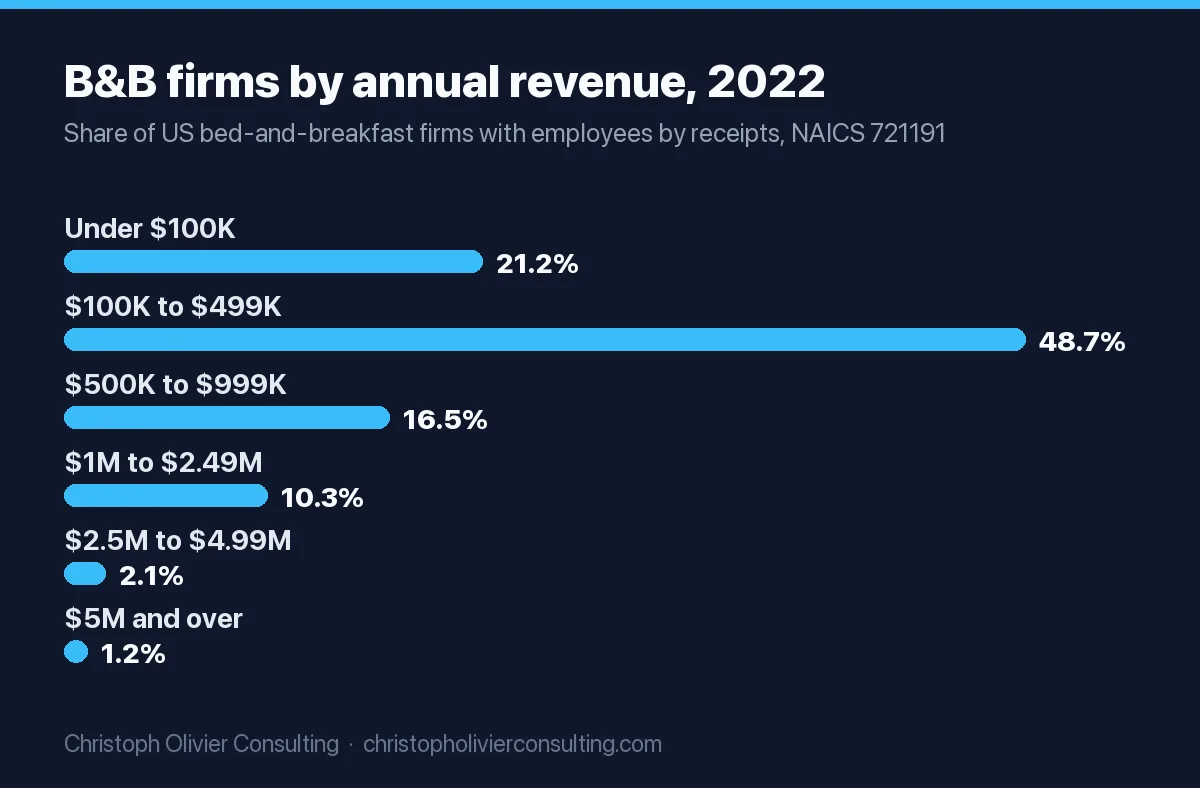
| Annual receipts of the firm | B&B firms | Share | Cumulative | Avg receipts per firm | Employees per firm | Payroll as % of receipts |
|---|---|---|---|---|---|---|
| Under $100,000 | 516 | 21.2% | 21.2% | $48,601 | 1.3 | 33.4% |
| $100,000 to $499,999 | 1,182 | 48.7% | 69.9% | $257,025 | 2.7 | 23.4% |
| $500,000 to $999,999 | 401 | 16.5% | 86.4% | $697,845 | 6.1 | 25.8% |
| $1 million to $2.49 million | 251 | 10.3% | 96.7% | $1,429,653 | 13.7 | 29.9% |
| $2.5 million to $4.99 million | 50 | 2.1% | 98.8% | $3,231,140 | 28.2 | 33.1% |
| $5 million and over | 29 | 1.2% | 100% | not shown | not shown | not shown |
| All B&B firms | 2,429 | 100% | $524,437 | 5.0 | 27.7% |
Source: U.S. Census Bureau, SUSB 2022, U.S. 6-digit NAICS by enterprise receipts size, NAICS 721191, released April 10, 2025. Employer firms only. Shares, averages and payroll ratios are my calculations. The $5 million and over row combines bands Census partly suppressed. Payroll is wages only.
What the table tells you:
- Seven in ten employer B&Bs take in less than $500,000 a year. The typical one in that band collected $257,025 with 2.7 employees, which matches an inn of roughly 8 rooms in the model below.
- Payroll share dips, then rises. It runs 23.4% in the $100,000 to $499,999 band because owners do the work themselves, then climbs to 29.9% at $1 million and up when inns hire cooks and managers.
- Thousands more inns have no employees at all. Census Nonemployer Statistics does not break out B&Bs. Its broader traveler accommodation line counted 67,811 businesses with no paid staff in 2022, averaging $57,046 in receipts, and 58.5% took in under $25,000 (Nonemployer Statistics 2022, NAICS 7211, my calculation). That line also includes many short-term rental hosts, so treat it as context only.
Where B&B revenue comes from
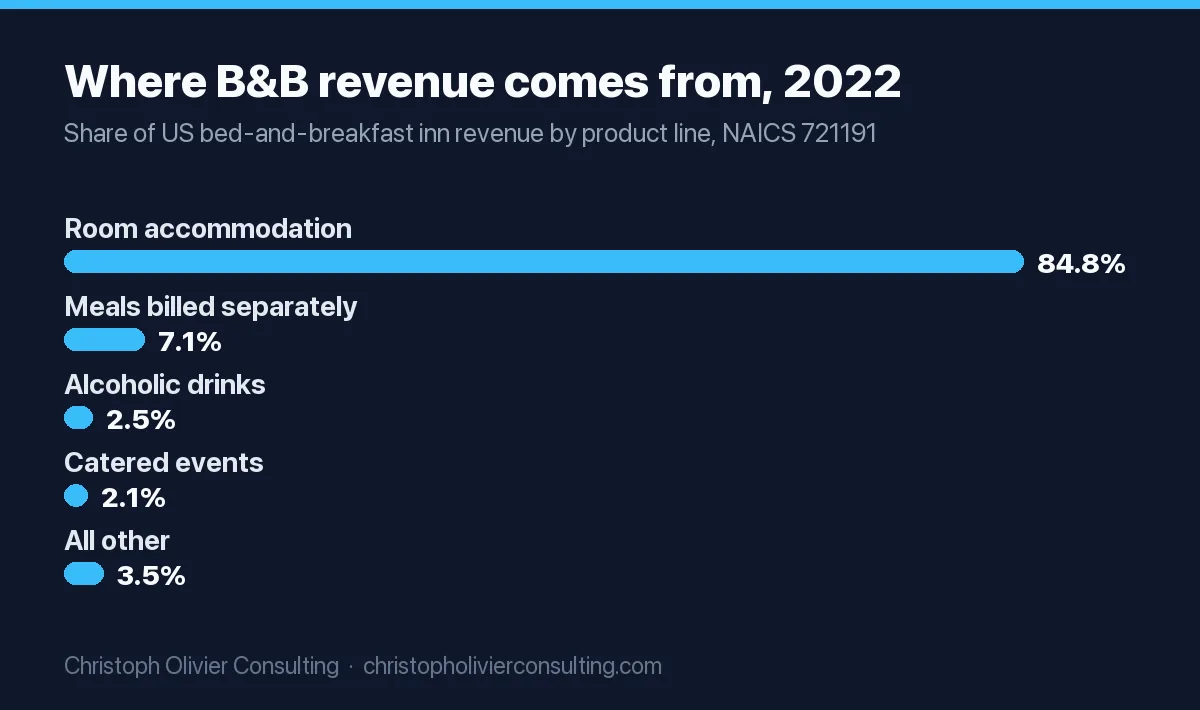
The 2022 Economic Census breaks revenue out by product. Rooms are 84.8% of B&B revenue. Meals billed separately from the room add 7.1%, drinks 2.5% and catered events 2.1% (Economic Census 2022, products by industry, NAICS 721191). Only 536 of 2,390 establishments reported separately billed meals at all, and 56 rented space for weddings and parties. If an inn’s revenue is 95% rooms, events and dinners are the obvious lever. The event venue owner salary model shows what that side of the business earns on its own.
Bed and breakfast revenue by state
Among the 23 states with at least 25 reporting B&Bs, average receipts per establishment ranged from $248,061 in Missouri to $694,694 in California in 2022 (Economic Census 2022, receipts ÷ establishments, my calculation):
| Highest | B&Bs | Avg receipts | Lowest | B&Bs | Avg receipts |
|---|---|---|---|---|---|
| California | 209 | $694,694 | Missouri | 33 | $248,061 |
| Georgia | 58 | $673,448 | Alaska | 55 | $261,764 |
| Virginia | 87 | $657,954 | New Mexico | 39 | $292,308 |
| New York | 120 | $556,133 | Wisconsin | 41 | $334,049 |
| Colorado | 59 | $532,424 | Utah | 32 | $335,344 |
| Vermont | 103 | $513,728 | Louisiana | 37 | $342,757 |
| Arizona | 33 | $494,697 | Tennessee | 25 | $378,320 |
| Maine | 134 | $484,142 | Washington | 71 | $379,268 |
Revenue is not owner income. Payroll ran 30.9% of receipts in Vermont and 22.5% in Michigan, and the file has no data on property prices, which matter more than anything else for owners who borrowed to buy.
Bed and breakfast profit margin: a worked P&L at 4, 8 and 12 rooms
No public company reports B&B margins, and the industry’s member surveys are not public. So here is a model you can check line by line. Room revenue is rooms × 365 nights × occupancy × average daily rate (ADR). Every assumption is labeled; replace them with your own numbers.
Benchmarks used: U.S. hotels averaged 62.3% occupancy, a $160.54 ADR and $100.02 revenue per available room in 2025 (CoStar, Jan. 20, 2026). B&Bs are smaller and more seasonal, so the base case uses 50% occupancy. Non-room revenue follows the Census 84.8% room share. Airbnb’s host-only fee is 15.5% for most hosts and is mandatory for traditional hospitality listings (Airbnb Help Center). The loan rate sits near Freddie Mac’s 7.21% 30-year average for Nov. 25, 2026 (Freddie Mac PMMS); commercial inn loans are priced differently, so treat it as a placeholder.
| Line (own calculation) | 4 rooms | 8 rooms | 12 rooms | Assumption or source |
|---|---|---|---|---|
| ADR × occupancy | $165 × 50% | $175 × 50% | $185 × 50% | Assumption, near the CoStar $160.54 hotel ADR |
| Room revenue | $120,450 | $255,500 | $405,150 | Rooms × 365 × occupancy × ADR |
| Meals, events, retail | $21,590 | $45,797 | $72,621 | Rooms = 84.8% of revenue (Economic Census 2022) |
| Total revenue | $142,040 | $301,297 | $477,771 | 12-room case lands near the $492,392 Census average |
| OTA commissions | $7,468 | $15,841 | $25,119 | Assumption: 40% of room revenue via OTAs at 15.5% |
| Card and booking software fees | $4,261 | $9,039 | $14,333 | Assumption: 3% of revenue |
| Breakfast food and event cost of goods | $16,317 | $33,549 | $51,697 | Assumption: $12 per occupied room night + 35% of non-room revenue |
| Guest supplies, linens, amenities | $4,380 | $8,760 | $13,140 | Assumption: $6 per occupied room night |
| Staff wages + 12% payroll taxes and workers’ comp | $15,796 | $71,874 | $138,194 | BLS mean hourly wages; hours below |
| Utilities | $15,600 | $25,200 | $34,800 | Assumption: $6,000 + $2,400 per room |
| Insurance | $7,000 | $11,000 | $15,000 | Assumption: $3,000 + $1,000 per room |
| Property tax | $6,600 | $9,900 | $13,200 | Assumption: 1.1% of purchase price |
| Repairs and maintenance | $7,102 | $15,065 | $23,889 | Assumption: 5% of revenue |
| Marketing and website | $5,682 | $12,052 | $19,111 | Assumption: 4% of revenue |
| Accounting, licenses, other | $6,000 | $9,000 | $12,000 | Assumption |
| Cash flow before debt and owner pay | $45,834 (32.3%) | $80,018 (26.6%) | $117,288 (24.5%) | Comparable to BizBuySell’s SDE (median 38%) |
| Purchase price, 75% loan | $600,000 | $900,000 | $1,200,000 | Assumption; BizBuySell median sale price $1.2 million |
| Loan payments (7.25%, 25 years) | $39,032 | $58,547 | $78,063 | Own calculation; year-one principal $6,407 / $9,610 / $12,813 |
| Owner pay before income tax | $6,803 (4.8%) | $21,470 (7.1%) | $39,225 (8.2%) | Cash flow minus loan payments |
| Versus hiring a lodging manager at $67,890 | $61,087 short | $46,420 short | $28,665 short | BLS OEWS May 2025 |
Staff hours (assumptions): 4 rooms, owners do everything except 800 hours of relief housekeeping at $17.63. 8 rooms, 2,600 housekeeping hours plus 1,040 breakfast and relief hours at $17.63. 12 rooms, 4,160 housekeeping hours at $17.63, 1,500 cook hours at $21.55 and 1,040 desk hours at $17.04. Resulting payroll is 11.1%, 23.9% and 28.9% of revenue. The 8- and 12-room cases fall inside the 23.4% to 29.9% Census bands; the 4-room case is lower because the owners do the work.
Three things stand out. First, debt eats most of the profit: the 8-room inn produces $80,018 of cash, and the bank takes $58,547 of it. Second, the owner’s pay in these cases sits right where the IRS data does: the profitable minority of small lodging owners averaged $25,085. Third, the principal you repay ($6,000 to $13,000 a year here) is building equity, so total return is better than the cash number, provided the property holds its value.
How occupancy and room rate move owner pay
Same model, only occupancy changed. 62.3% is the 2025 U.S. hotel average from CoStar.
| Owner pay after loan payments (own calculation) | 35% occupancy | 45% | 50% (base) | 62.3% |
|---|---|---|---|---|
| 4 rooms, $165 ADR | loss of $22,246 | loss of $2,880 | $6,803 | $30,623 |
| 8 rooms, $175 ADR | loss of $40,627 | $771 | $21,470 | $72,390 |
| 12 rooms, $185 ADR | loss of $59,920 | $6,177 | $39,225 | $120,523 |
Rate matters almost as much. At 50% occupancy, $25 more per night lifts owner pay to $23,465, $54,795 and $89,212 for the three sizes; $25 less pushes all three into losses of about $10,000 to $12,000.
How profitable is a bed and breakfast? Break-even occupancy
Solving the model for the occupancy where owner pay hits zero, and where it reaches the $67,890 lodging manager median:
| Inn size (own calculation) | Break-even occupancy, owner unpaid | Occupancy to pay the owner $67,890 | Owner pay if owned with no debt, 50% occupancy |
|---|---|---|---|
| 4 rooms, $165 ADR, $600K price | 46.5% | 81.5% | $45,834 |
| 8 rooms, $175 ADR, $900K price | 44.8% | 61.2% | $80,018 |
| 12 rooms, $185 ADR, $1.2M price | 44.1% | 54.3% | $117,288 |
The practical reading: a 4-room inn cannot pay a manager-level wage at any realistic occupancy if it carries a normal mortgage. It works as a home that pays for itself, or as a business for an owner with the house already paid off. From 8 rooms up, an inn that runs near hotel-average occupancy can pay one owner a real salary. Since every point of occupancy comes from bookings, the cheapest place to find money is usually the commission line: shifting bookings from OTAs to your own site is the math in hotel marketing for direct bookings, and tourism SEO covers how small lodging operators rank for their town’s searches.
Is a B&B a good investment? What buyers pay
BizBuySell’s records of B&Bs sold from 2021 to 2025 show a median sale price of $1.2 million, half selling between $615,000 and $1.525 million, and a median earnings multiple of 6.34 times seller’s discretionary earnings (average 4.74, bottom quartile 3.53) (BizBuySell). Those prices usually include the building.
Run the model through that lens. The 8-room inn above produces $80,018 of cash flow; at the 6.34 median multiple, the business would be worth about $507,000. If the asking price is $900,000, about $393,000 of it is paying for real estate and lifestyle, not income. That can still be a good decision, but it is a property investment with a demanding job attached, and the job is paid at housekeeper rates. In my view, the honest way to evaluate an inn purchase is to price the house as a house first, then ask whether the business income justifies the premium.
Compared with other hospitality businesses on the same BizBuySell page, motels sold at a median revenue of $260,000 and median earnings of $100,000, and campgrounds and RV parks at $192,613 and $53,116. If you are weighing an inn against a lighter-service rental, the Airbnb host income model uses the same method without breakfast or daily housekeeping.
Bed and breakfast owner pay worksheet: pass/fail benchmarks
Run last year’s numbers, or the seller’s numbers, through these lines. Each threshold comes from the sources and model above. Two or more fails usually means owner pay below the lodging manager median.
| Check | Pass | Fail | Where the line comes from |
|---|---|---|---|
| Annual occupancy | 55% or more | Below 45% | Model break-even 44% to 47%; CoStar 2025 hotel average 62.3% |
| Revenue per available room (room revenue ÷ rooms ÷ 365) | $100 or more | Below $75 | CoStar 2025 U.S. hotel RevPAR $100.02; model base cases $83 to $93 |
| Cash flow before debt and owner pay, % of revenue | 30% or more | Below 22% | BizBuySell median SDE 38% of revenue; model 24.5% to 32.3% |
| Loan payments as % of that cash flow | 50% or less | Above 70% | Model: 67% (12 rooms) to 85% (4 rooms) at 75% financing |
| Staff payroll, % of revenue (excluding owners) | At or below your Census band (23.4% under $500K) | 3+ points above your band | Census SUSB 2022, NAICS 721191 |
| Share of room revenue booked through OTAs | Under 30% | Over 50% | At 15.5% commission, each 10 points of OTA share costs 1.55% of room revenue |
| Asking price ÷ seller’s discretionary earnings | 6.3 or less | Above 9 | BizBuySell median 6.34, top quartile 6.75 |
| Owner pay vs hiring a lodging manager | Above $67,890 | Below $39,750 | BLS OEWS May 2025 median and 10th percentile, NAICS 721100 |
What does it take to own a bed and breakfast?
- Capital. Half of the B&Bs sold on BizBuySell from 2021 to 2025 went for $615,000 to $1.525 million. With 25% down, that is roughly $150,000 to $380,000 in cash before furniture and working capital (my calculation).
- A license and a fit with local rules. See the licensing section below. Zoning, fire code and occupancy permits come from your city or county.
- Your own labor. In the 8-room model, owners still cover reservations, guest service, most breakfasts and every gap in the staff schedule. At 1,460 occupied room nights a year, even 45 minutes of cleaning per stay is about 1,100 hours (my assumption), the equivalent of a half-time job before breakfast is cooked.
- A booking engine. Every booking that arrives through an OTA rather than your own site costs about 15.5% on platforms like Airbnb. A realistic marketing budget for a small lodging business, built bottom-up, is laid out in hotel marketing budget benchmarks.
Do you need a license to run a bed and breakfast?
Almost always, but the rules are set by states and counties, not federally. Two examples: Indiana defines a B&B as an operator occupied residence with no more than 14 guest rooms that serves breakfast as part of the fee and hosts each guest for no more than 30 consecutive days (410 IAC 7-15.5-2). Virginia requires B&Bs to be permitted as lodging under its hotel sanitary regulations, and exempts them from a food establishment permit only if the inn is owner or owner-agent occupied, serves food only to guests, serves 18 or fewer guests a day and tells guests the kitchen is not a permitted food establishment (Virginia Department of Health). Room caps like these also cap your revenue, so check them before you model a 12-room inn.
How hard is it to run a B&B, and what are the disadvantages?
The numbers show the main disadvantages directly. Fixed costs are high: in the 8-room model, utilities, insurance, property tax and loan payments total $104,647 a year whether or not anyone books. The work is daily: breakfast and housekeeping happen every occupied night, and in the smallest inns the owner does almost all of it. And the income is thin: the IRS data shows most small lodging sole proprietors report no profit in a given year. The upside is that you live in an appreciating property that others help pay for.
What is the monthly income of a B&B or small hotel owner?
For the profitable minority of travel accommodation sole proprietors in 2023, $25,085 a year works out to about $2,090 a month (my calculation from IRS SOI). In the model, the 12-room inn at 50% occupancy pays its owner about $3,270 a month after the mortgage, and about $9,770 a month at 50% occupancy if the property is owned outright. Income is seasonal, so the summer and fall months carry the winter. Outside the U.S., these figures do not apply; tax, labor and licensing rules differ by country.
If you run an inn and want a second opinion on the booking and pricing side, compare your margins against profit margins by industry, or book a consultation.
How the numbers on this page were built
- Census. NAICS 721191 (bed-and-breakfast inns) from SUSB 2022 (employer firms by receipts size), the 2022 Economic Census basic file (states) and products-by-industry file (revenue mix). Nonemployer Statistics 2022 does not publish 721191, so the NAICS 7211 traveler accommodation line is used as context only. All averages, shares and ratios are my calculations.
- IRS. Table 1 of Sole Proprietorship Returns, tax year 2023, line “Travel accommodation (including hotels, motels, and bed and breakfast inns).” It covers Schedule C filers only and includes motels and small hotels.
- BLS. OEWS May 2025 national industry estimates for NAICS 721100, from the official oesm25in4 download (read through a web.archive.org copy because bls.gov blocked automated requests).
- Market benchmarks. CoStar’s full-year 2025 U.S. hotel results, BizBuySell’s 2021 to 2025 B&B sales, Airbnb’s published host fee, Freddie Mac’s weekly mortgage survey.
- Model assumptions. ADR, occupancy, OTA share, food cost per room night, supplies, staff hours, utilities, insurance, property tax rate, maintenance, marketing, purchase prices, 75% loan, 7.25% rate and 25-year term are my assumptions, labeled in each table. Change them to your numbers.
Ready to scale your revenue?
Book a free 30-min consultation. We’ll diagnose your growth bottleneck and map out the 3 highest-leverage moves for your business.
Frequently asked questions
How much does a bed and breakfast owner make?
No government survey reports innkeeper pay. IRS data for tax year 2023 shows travel accommodation sole proprietors, which include B&Bs, averaged a net loss of $12,666, and the 43.7% who made money averaged $25,085. In a worked model at 50% occupancy, owners keep about $7,000, $21,000 and $39,000 from 4, 8 and 12 room inns after a 75% mortgage.
What is the typical bed and breakfast profit margin?
No public company reports B&B margins. BizBuySell's 2021 to 2025 sales show median seller's discretionary earnings of $167,609 on $439,716 of revenue, about 38% before owner pay and loan payments. In a sourced model, cash flow before debt runs 24.5% to 32.3% of revenue, and owner pay after a 75% mortgage falls to 4.8% to 8.2%.
How much does a bed and breakfast make a year in revenue?
Census counted 2,429 B&B firms with employees in 2022. They averaged $524,437 in receipts, but 69.9% took in under $500,000, and the typical firm in the $100,000 to $499,999 band collected $257,025. Rooms were 84.8% of revenue; separately billed meals 7.1%, drinks 2.5% and catered events 2.1%, per the 2022 Economic Census.
How profitable is a bed and breakfast?
It depends on occupancy and debt. In a model with a 75% mortgage, a 4, 8 or 12 room inn breaks even at about 44% to 47% occupancy with the owner unpaid. Paying the owner the $67,890 median lodging manager wage takes about 54% occupancy at 12 rooms, 61% at 8 rooms and 82% at 4 rooms. U.S. hotels averaged 62.3% in 2025.
Is owning a B&B a good investment?
It is mostly a property investment with a job attached. BizBuySell's B&B sales from 2021 to 2025 had a median price of $1.2 million and a median multiple of 6.34 times seller's discretionary earnings. An 8 room inn earning $80,000 of cash flow is worth about $507,000 as a business at that multiple, so a $900,000 price is largely paying for the real estate.
Do you need a license to run a bed and breakfast?
Usually yes, under state and county rules rather than federal ones. Indiana limits a B&B to an operator occupied residence with no more than 14 guest rooms. Virginia permits B&Bs under its hotel sanitary rules and waives the food permit only if the inn is owner occupied, feeds only guests and serves 18 or fewer a day. Zoning and fire permits come from your locality.
Small business owner income