
A fractional CMO for real estate is a part-time chief marketing officer who owns the marketing plan, budget, vendors and reporting for a brokerage, team, homebuilder or property manager, usually for 5 to 20 hours a week on a monthly retainer. Real-estate-specific providers publish rates from $2,500 to $50,000 a month, with most engagements quoted at $8,000 to $15,000. Whether that is a good buy depends less on the rate than on how much of your revenue you actually keep after agent commissions, which is where most real estate cost advice goes wrong.
Short answer: Published 2026 rates for a real estate fractional CMO run from about $5,000 to $15,000 a month, or $150 to $350 an hour. A full-time marketing manager in the real estate industry earns a median $138,630 (BLS, May 2025), roughly $205,000 a year once benefits are added. For a brokerage or team, judge the fee against company dollar (what you keep after agent splits), not gross commission income. Our rule of thumb: under about 10% of company dollar is workable; over 25% means a coordinator or a specialist is the better buy.
What a real estate fractional CMO owns, by type of business
“Real estate” covers four businesses that buy marketing leadership for different reasons. A brokerage markets to two audiences at once, consumers and the agents it wants to recruit. A homebuilder sells a product with a long build cycle from a sales center. A property manager runs two funnels, owners who hand over doors and renters who fill them. An investor or syndicator markets deals to sellers and capital to investors. The CMO’s job changes with the model.
| Business | The fractional CMO owns | Your team or vendors do | The number to judge them on |
|---|---|---|---|
| Brokerage or large team | Brand position in the market, agent recruiting message, lead routing rules, the split between paid portals and owned channels | Listing marketing, social posts, agent websites, ad builds | Closed sides from company-generated leads and cost per recruited productive agent |
| Homebuilder or developer | Community launch plans, interest list strategy, budget per community, sales center follow-up standards | Renderings, signage, paid media, website updates | Cost per sales contract by community, appointment to contract rate |
| Property manager | Owner acquisition offer, the owner funnel versus the renter funnel, review and referral programs | Listing syndication, leasing ads, SEO pages | New doors signed per month and cost per signed management agreement |
| Investor, wholesaler or syndicator | Seller lead channel mix, investor education program, compliance review routing | Mail, calls, content production, webinar logistics | Cost per contract on the seller side, qualified investor calls on the capital side |
Gairy Consulting describes the usual pattern for teams of roughly 5 to 25 agents: they spend on portals, paid social and CRM tools, but nobody senior decides whether that spend is in the right place. That is the gap the role fills. If you already have a strong marketing director, you need execution help, not a CMO.
What makes real estate marketing different (and harder to hire for)
A generalist can learn your positioning in a month. These five constraints take longer.
- Fair housing applies to targeting, not just copy. Under 24 CFR 100.75, it is unlawful to publish housing ads that indicate a preference based on race, color, religion, sex, handicap, familial status or national origin, and paragraph (c)(3) extends that to “selecting media or locations for advertising” in a way that denies segments of the market information. The statute is 42 U.S.C. 3604(c). A CMO who picks channels and audiences is making fair housing decisions.
- Meta locks down housing ads. Ads for sale or rental listings, mortgages and other housing opportunities must run in the Housing special ad category. Jon Loomer’s guide (last updated March 1, 2025) lists the restrictions: age fixed at 18 to 65+, all genders, no ZIP code targeting, a minimum 15-mile radius, no lookalike or saved audiences, and no detailed targeting exclusions. Playbooks built for other industries do not transfer.
- The commission rules changed. Since August 17, 2024, per NAR’s settlement FAQs, MLS participants working with a buyer need a written agreement before touring a home, and offers of compensation can no longer be published on the MLS. Buyer-side marketing now has to sell the agreement, not just the showing.
- Most business already comes from relationships. NAR’s 2026 Member Profile feature sheet (August 19, 2026) reports that the typical REALTOR earned 28% of 2025 business from repeat clients and another 22% from past-client referrals. A plan that pours money into cold leads and ignores the database is usually the wrong plan.
- The cycle is long and the market is thin. Sellers in NAR’s 2025 Profile of Home Buyers and Sellers (November 4, 2025) had owned their homes a median 11 years, an all-time high, and first-time buyers fell to a record low 21% of purchases. Existing-home sales have hovered just above 4 million a year for three and a half years, the lowest level since 1995, per NAR’s feature sheet. Marketing has to stay in front of people for years, not weeks.
State license-disclosure rules and Reg Z triggers are in our real estate advertising rules guide.
What a fractional CMO for real estate costs: published 2026 rates
Every rate below was published by a firm that sells fractional or consulting talent. None cites an independent survey, so treat them as asking prices, and always ask how many hours sit behind a monthly number.
| Option | Published rate | Hours or scope | Source and date |
|---|---|---|---|
| Fractional CMO, real estate teams | From $6,500 a month | Teams of about 5 to 25 agents | Gairy Consulting, 2026 |
| Fractional CMO, real estate companies | $2,500 to $50,000 a month, most $8,000 to $15,000 | Month to month | MarkCMO, 2026 |
| Fractional CMO, PropTech and real estate directory | $5,000 to $15,000 a month or $150 to $350 an hour | Varies by profile | RankedCMO, 2026 |
| Fractional CMO, all industries | $3,000 to $15,000 a month; $150 to $350 an hour | 10 to 20 hours a week | MarketerHire, April 15, 2026 |
| Fractional CMO, strategy only | $3,000 to $6,000 a month | 5 to 10 hours a week | MarketerHire, April 15, 2026 |
| Fractional CMO, strategy plus execution oversight | $7,000 to $12,000 a month | 15 to 20 hours a week | MarketerHire, April 15, 2026 |
| Executives-as-a-service firm | $1,500 to over $30,000 a month retainer, about $300 to $500 an hour equivalent | Retainer | Chief Outsiders, updated October 26, 2026 |
| Marketing consultant, advisory only | $2,000 to $5,000 a month | Recommendations, no execution | MarketerHire, April 15, 2026 |
| Independent marketing consultant | $100 to $200 an hour, some $450 and up | Hourly | Chief Outsiders, updated October 26, 2026 |
| Freelance marketer | $2,000 to $8,000 a month | One channel | MarketerHire, April 15, 2026 |
| Marketing agency | $5,000 to $25,000+ a month | Multi-channel execution | MarketerHire, April 15, 2026 |
If you searched for a real estate marketing consultant, the rows above show the difference in price and in job. MarketerHire’s definition: a consultant advises and leaves implementation to you, at $2,000 to $5,000 a month, while a fractional CMO owns the strategy, manages your team and vendors, sets KPIs and is accountable for execution. If you have a capable marketing coordinator and only need a plan checked twice a year, a consultant is the cheaper and correct buy.
MarketerHire says Bay Area and New York CMOs charge 15 to 25% more, and fees rise with the team and budget managed. To compare quotes, convert each to an hourly rate: monthly fee divided by (weekly hours x 52 / 12). A $6,500 retainer for 10 hours a week is about 43 hours a month, or $150 an hour.
If you have one or two quotes in hand, book a consultation and we will put each against this table: hours, what is leadership versus execution, and whether the scope fits a business your size.
Fractional vs full-time real estate CMO: the year-one math
The full-time baseline uses the real estate industry figure, not the all-industry one, because real estate pays marketing managers less. The BLS Occupational Employment and Wage Statistics series for marketing managers (11-2021), May 2025, shows a median annual wage of $138,630 in the real estate industry, where 4,960 marketing managers work, against $166,790 across all industries (BLS). In the BLS Employer Costs for Employee Compensation release for June 2026, wages were 67.5% of total compensation for private-industry management, business and financial occupations, so we gross the salary up by dividing by 0.675.
| Option | Year-one cost | How we got it |
|---|---|---|
| Fractional CMO at $6,500 a month | $78,000 | Gairy Consulting’s published starting rate x 12 |
| Fractional CMO at $10,000 a month | $120,000 | Inside MarkCMO’s “most engagements” range and MarketerHire’s oversight tier |
| Fractional CMO at $15,000 a month | $180,000 | Top of MarkCMO’s typical range and MarketerHire’s retainer range |
| Full-time marketing manager, real estate industry | About $240,000 | $138,630 median / 0.675 = $205,378 loaded, plus a 25% recruiter fee ($34,658) |
| Full-time marketing manager, all industries | About $288,800 | $166,790 / 0.675 = $247,096, plus 25% recruiter fee ($41,698) |
| Full-time CMO | $260,000 to $520,000+ | MarketerHire’s published year-one range, including benefits, equity and recruiting |
Our calculation. Assumptions: the 25% recruiter fee is the low end of the 25 to 30% that MarketerHire cites; fractional fees exclude ad spend and tools, as do the salaries; ramp time is ignored, which flatters the full-time hire, because MarketerHire puts full-time ramp at 3 to 6 months versus 2 to 4 weeks for fractional. MarketerHire’s break-even signal is a fractional fee above $12,000 to $15,000 a month for six or more months. The baseline is a marketing manager, a level below a CMO.
What real estate companies actually spend on advertising
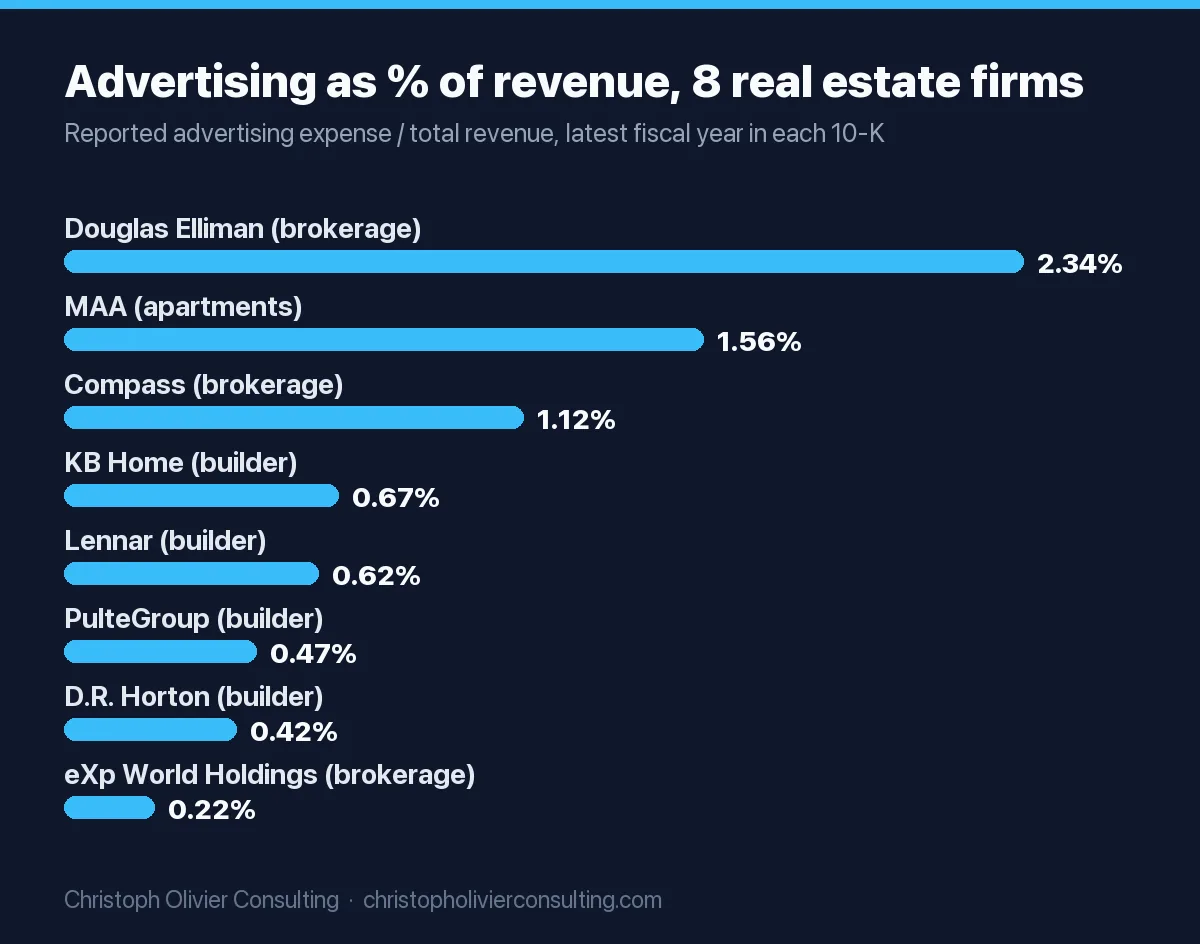
The fee comes out of the same pool as the marketing budget. Every figure below is reported advertising expense from each company’s latest 10-K on SEC EDGAR, divided by total revenue.
| Company (type) | Fiscal year | Advertising expense | Total revenue | Advertising as % of revenue |
|---|---|---|---|---|
| Douglas Elliman (brokerage) | 2025 | $24.2M | $1,033.1M | 2.34% |
| Mid-America Apartment Communities (apartment owner-operator) | 2025 | $34.5M | $2,209.1M | 1.56% |
| Compass (brokerage) | 2025 | $77.7M | $6,961.6M | 1.12% |
| KB Home (homebuilder) | FY to Nov 2025 | $42.0M | $6,236.2M | 0.67% |
| Lennar (homebuilder) | FY to Nov 2025 | $210.8M | $34,186.9M | 0.62% |
| PulteGroup (homebuilder) | 2025 | $81.6M | $17,312.0M | 0.47% |
| D.R. Horton (homebuilder) | FY to Sep 2026 | $137.5M | $33,043.4M | 0.42% |
| eXp World Holdings (brokerage) | 2025 | $10.6M | $4,772.3M | 0.22% |
Advertising expense is only paid media and promotion. It excludes marketing salaries, agent-paid marketing and sales commissions, so total marketing cost is higher at every company.
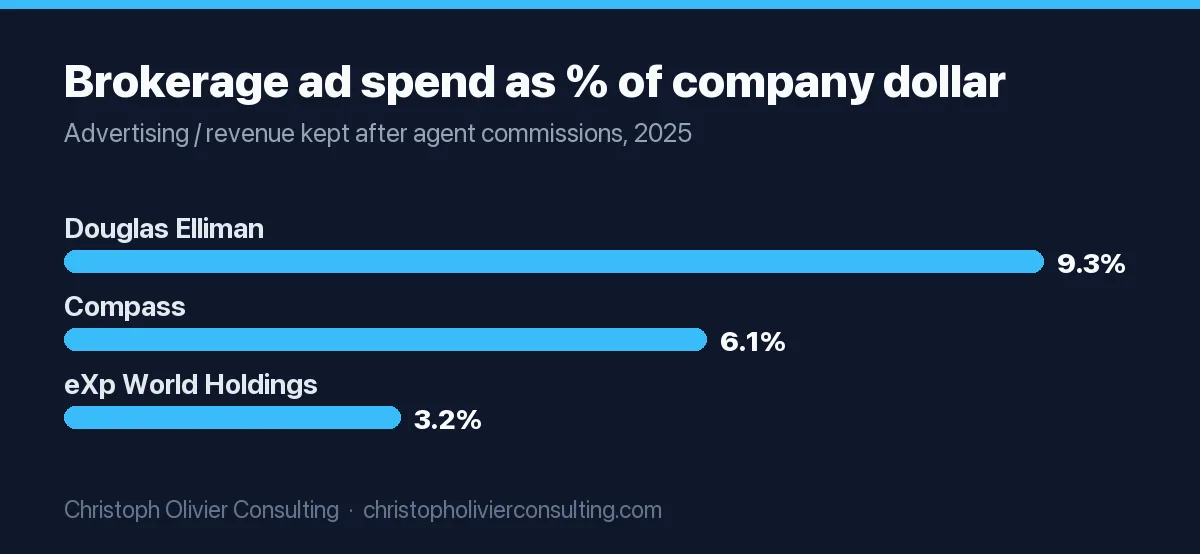
The bigger lesson is in the brokerage rows. Brokerage revenue is gross commission, and most of it goes straight to agents. Douglas Elliman paid $772.0 million of its $1,033.1 million in revenue to agents in 2025, keeping 25.3%. Compass kept 18.4% after $5,679.7 million in commissions and related expense, and eXp kept 7.0% after $4,438.7 million in agent-related costs. Measured against what each firm keeps (company dollar), advertising is a much larger share.
| Brokerage, 2025 | Revenue kept after agent commissions | Share of revenue kept | Advertising as % of revenue kept |
|---|---|---|---|
| Douglas Elliman | $261.1M | 25.3% | 9.3% |
| Compass | $1,281.9M | 18.4% | 6.1% |
| eXp World Holdings | $333.6M | 7.0% | 3.2% |
Our calculation from the 10-K income statements: revenue minus commissions and agent-related costs. For a fuller breakdown of brokerage P&Ls and margins, see our analysis of real estate brokerage average revenue.
Can your brokerage or team afford a fractional CMO? A budget-fit model
This model applies the company-dollar lens to brokerages and teams of different sizes. It is an estimate built for this page, not survey data. Assumptions: an average commission of 2.42% per side, the national average buyer’s agent commission in Q3 2025 per Redfin (December 8, 2025), applied to every side; 25.3% of gross commission kept after agent splits, Douglas Elliman’s 2025 ratio. A team on a 50/50 split keeps more; a 100% or capped model keeps less, which pushes every percentage up.
| Annual sales volume | Gross commission income (2.42%) | Company dollar (25.3%) | $78,000 fee as % of company dollar | $120,000 fee as % of company dollar | Verdict |
|---|---|---|---|---|---|
| $17.5M (median REALTOR team, NAR 2026) | $423,500 | $107,146 | 72.8% | 112.0% | No. Use a coordinator, coaching or a one-off plan |
| $50M | $1,210,000 | $306,130 | 25.5% | 39.2% | Only a short project or advisory hours |
| $150M | $3,630,000 | $918,390 | 8.5% | 13.1% | Fits, at the lower fee |
| $500M | $12,100,000 | $3,061,300 | 2.5% | 3.9% | Fits; compare against a full-time hire |
The median team row uses NAR’s 2025 team figure of $17.5 million in sales volume from the 2026 Member Profile release (June 25, 2026). My rule of thumb, and it is an opinion, not an industry standard: keep the leadership fee under about 10% of company dollar, so that it stays in the same range as the 3.2% to 9.3% that the three public brokerages spend on advertising alone. For homebuilders, compare the fee with revenue instead: a $50 million builder paying $120,000 a year spends 0.24% of revenue on leadership, about half of what the public builders above spend on advertising.
Individual agents are a separate case. NAR puts median gross income at $59,200 for 2025, with total median business expenses of $9,530. No fractional CMO rate in the table makes sense at that level. Our guide to how much a real estate agent should spend on marketing sets out budgets by experience instead.
When a fractional CMO makes sense for a real estate company, and when it does not
In several of these rows, the right answer is not a fractional CMO.
| Your situation | Better option | Why |
|---|---|---|
| Solo agent or small team under about $25 million in volume | Do it yourself with a coach or a written plan, plus a part-time coordinator | The fee would exceed most of your company dollar. Database and referral work, where half of agent business comes from, does not need a CMO |
| You know the plan and need posts, listing videos and ads produced | A freelancer or an agency on a tight scope | You need production, not direction. MarketerHire lists freelancers at $2,000 to $8,000 a month |
| One channel is broken (for example, Meta leads stopped after the switch to the Housing category) | A channel specialist for a 60 to 90 day fix | A narrow technical problem does not need a leadership retainer |
| Leads come in but agents do not follow up | Fix routing, speed to lead and accountability first, with your ops lead or a CRM consultant | More leads into a leaking process cost more per closing |
| Brokerage or team at roughly $100 million to $500 million in volume, several vendors, nobody senior owning the budget | Fractional CMO | The fee lands near or under 10% of company dollar in the model above, and there is a team to direct |
| Regional builder launching new communities, or a property manager pushing for owner growth | Fractional CMO for two to four quarters | Launch plans, budget per community and an owner funnel are leadership work that pays back over a long cycle |
| Over about $1 billion in volume, or a marketing team of 10 or more | Full-time CMO or VP, with fractional as a bridge during the search | MarketerHire’s tipping points: team past 10 people, or fees above $12,000 to $15,000 a month for six months |
Not sure which row your firm is in?
Bring your sales volume, split structure, current marketing spend and any proposals to a free consultation. We will run your numbers through the budget-fit model and tell you if a cheaper option is the better call.
A 90-day plan for a real estate fractional CMO, with pass/fail tests
MarketerHire calls the first 30 days of any engagement diagnostic. In real estate, they must include a compliance review of every audience setup.
| Days | Deliverable | Pass | Fail |
|---|---|---|---|
| 1 to 30 | Audit: lead sources by closed side or contract, cost per closing by channel, past-client database size and last touch date, every live ad account checked against the Housing category and 24 CFR 100.75 | A one-page table of closings by source for the last 12 months, reconciled to your transaction records | Lead counts only, no link to closings or contracts |
| 31 to 60 | Plan: positioning for buyers, sellers and (for brokerages) recruits; budget by channel with a maximum cost per closing; written buyer agreement conversion step in the funnel | Every dollar has a channel, an owner and a stop rule | A strategy deck with no budget split |
| 61 to 90 | Programs live: database touch plan, one paid channel rebuilt inside the Housing rules, one owned channel (SEO or email) started | Weekly scorecard running, first monthly review held | Campaigns launched without a baseline to compare against |
| Day 90 | Decision memo: keep, cut or scale each channel; hire or vendor recommendations | A clear call on the next quarter’s budget, including what to stop | “It is too early to tell” on every channel |
For a template you can fill in yourself, our real estate marketing plan template follows the same structure. Property managers should also read our two-funnel property management marketing plan.
Questions to ask a real estate fractional CMO before you sign
- “How would you set up a listing campaign on Meta under the Housing special ad category?” Strong answer: names the 15-mile radius, no ZIP or age targeting, no lookalikes, and explains how creative and first-party lists do the work targeting used to. Weak answer: talks about interest targeting.
- “How do you measure marketing in a brokerage?” Strong: by closed sides and company dollar, with a source field that agents cannot skip. Weak: leads and cost per lead.
- “What changed in our buyer funnel after August 17, 2024?” Strong: the written buyer agreement before touring, and how marketing explains value before that conversation. Weak: no answer.
- “How many hours a week, and what is leadership versus execution in your quote?” Strong: a number of hours and a list of who does the production. Weak: “whatever it takes.”
- “Who reviews ads for fair housing and state license disclosures?” Strong: a named step before launch, with your broker of record signing off. Weak: “the platform will flag it.”
Where CO Consulting fits for a real estate company
To be clear about fit: real estate is not one of the industries named on our services page, which focuses on professional-service firms such as CPA firms, financial advisors, law firms and capital raisers, plus HVAC contractors. The closest match is an investor or syndicator raising capital, which our fractional CMO guide for capital raisers covers. Our case studies page includes one real estate client who needed investor calls rather than consumer leads. If you need someone who has run a 500-agent brokerage’s marketing, ask every provider, us included, for references in exactly that model.
Where we do fit is a brokerage, team, builder or investor business with real marketing spend, several vendors and no senior owner of the plan. As our services page describes, every engagement starts with a consultation call and an audit of your website, tracking, CRM and ad accounts, then a prioritized 90-day plan with weekly check-ins and monthly reporting. Our fractional CMO services page lists the usual shapes: a retainer of 20 to 40 hours a month with a 3 to 6 month minimum, a fixed project, or a few hours a week of advisory. The fractional CMO owns direction, budget and the weekly scorecard. Listing photography, video production, website builds and daily posting are done by your team or vendors we direct, not by us, and we do not guarantee leads or closings. If the budget-fit table puts you in the “fits” rows, book a consultation and bring your sales volume, split structure and last year’s marketing spend by channel.
Ready to scale your revenue?
Book a free 30-min consultation. We’ll diagnose your growth bottleneck and map out the 3 highest-leverage moves for your business.
Frequently asked questions
How much does a fractional CMO for real estate cost?
Real-estate-focused providers publish rates from $2,500 to $50,000 a month, with most engagements at $8,000 to $15,000 (MarkCMO). Gairy Consulting starts its team partnership at $6,500 a month, and RankedCMO's PropTech and real estate category shows $5,000 to $15,000 a month or $150 to $350 an hour. Ad spend, software and production are extra.
How much does a fractional CMO charge per hour?
MarketerHire's April 2026 guide puts hourly fractional CMO work at $150 to $350 an hour for 5 to 15 hours a week. Chief Outsiders equates its retainers to about $300 to $500 an hour. To compare a monthly quote, divide it by monthly hours (weekly hours x 52 / 12): $6,500 for 10 hours a week is about $150 an hour.
How much does a fractional CMO make?
There is no salary survey for fractional CMOs, only published rates. MarketerHire says most charge $3,000 to $15,000 a month per client and work with two to four clients at a time, so gross billings depend on how many retainers one person carries. For comparison, BLS puts the May 2025 median wage for salaried marketing managers at $166,790, or $138,630 in the real estate industry.
How much should I pay a real estate marketing consultant?
MarketerHire lists advisory-only marketing consultants at $2,000 to $5,000 a month, and Chief Outsiders puts independent consultants at $100 to $200 an hour, some $450 and up. A consultant gives recommendations and leaves execution to you. Pay CMO rates only if the person will own the budget, manage your vendors and be accountable for results.
What does a real estate marketing specialist do?
A specialist executes one area: listing marketing, social media, paid ads, email or the website. A fractional CMO decides which of those you need, sets the budget and measures results by closed sides or contracts. Many brokerages need one of each: a part-time senior owner of the plan and a coordinator or freelancer doing the daily production.
Is a fractional CMO worth it for a real estate team?
Usually not for a typical team. NAR's median team closed $17.5 million in 2025. At a 2.42% average commission and 25.3% kept after splits, that is about $107,000 of company dollar, so a $78,000 retainer would take 73% of it. A coordinator, a coach or a one-off marketing plan is the better buy until volume is several times higher.
Do Fair Housing rules change how real estate ads can be targeted?
Yes. 24 CFR 100.75 makes it unlawful to publish housing ads that indicate a preference based on a protected class, and it covers choosing media or locations in a way that denies groups information. On Meta, housing ads must use the Housing special ad category: no age, gender or ZIP code targeting, a minimum 15-mile radius and no lookalike audiences.
Fractional CMO: cost, fit and industries